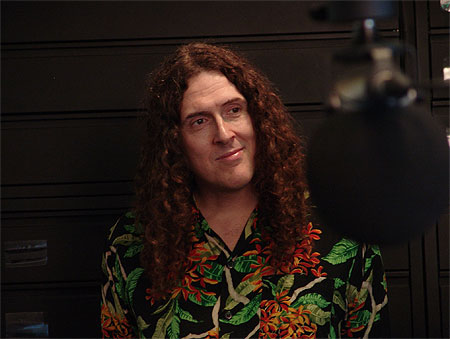
The Bat Segundo Show: Weird Al Yankovic

Weird Al Yankovic appeared on The Bat Segundo Show #418. His most recent album is Alpocalypse. Many thanks to Jay Levey for helping to make this unlikely conversation happen.

Condition of Mr. Segundo: Got skills, he’s a champion of D&D.

Guest: Weird Al Yankovic

Subjects Discussed: Whether most people in the world are doing okay, Weird Al’s longevity, a fastidious concern for the English language, Weird Al as a storyteller, epic songs, writing about human behavior vs. writing about food, thinking of new ways to be funny, narrative songwriting, parodies in which words are transposed, Freytag’s triangle, recording dates, why original songs and style parodies are recorded for explicit parodies, trying to finish an album while responding to present a musical trend, how Al studies an artist’s oeuvre, earlier songs as prototypes for later songs, “One More Minute” to “You Don’t Love Me Anymore,” “It’s All About the Pentiums” to “White and Nerdy,” confronting the defects of earlier material, the number of lists that Al keeps, when your laptop is more organized than your life, Amy Winehouse, keeping up with the increased cycle of emerging artists, the Arcade Fire and Muse, Weird Al’s criteria for selecting hits to parody, finding number one hits despite the rise of Internet culture, rap and polka medleys, attempts to break into long-form film and television, UHF, parts in movies that Al turned down, clearing up several suggestions made by the critic Sam Anderson, whether a gang of barbarians will delete the Internet to the ground, efforts to clarify Weird Al’s vegetarianism status amidst recent self-allegations of cheating, spouses who salivate in response to billboards depicting prime rib, not forcing children into a specific dietary direction, Matt Stone’s tendency to eat junk food, references to bowling in Weird Al’s work, Robert Putnam’s Bowling Alone, watching 100 episodes of The Flintstones for “Bedrock Anthem,” whether intense research gets in the way of spontaneity, fake educational films, the Prelinger Archive, responding to charges that Al is “a parasite of ubiquity,” “Dare to Be Stupid” and The Transformers, Michael Bay, digital distribution, maintaining a long-term legacy, the accidental iconic nature of songs, Nirvana’s “Smells Like Teen Spirit,” Mick Jagger, Weird Al’s confidantes, how Weird Al listens to music, including burps and other delightful gastrointestinal sounds in songs, avoiding profanity in work, Shel Silverstein’s “Get My Rocks Off,” the pros and cons of being family-friendly, Radio Disney asking Al to change lyrics in “The Saga Begins,” Nickelodeon asking Al to remove “gay,” why doesn’t Weird Al always call the shots, art vs. commerce, lines that Weird Al won’t cross, multiple versions of “The Night Santa Went Crazy,” choosing edgy animators for music videos, John Kricfalusi and the “Close But No Cigar” video, why there isn’t an Al TV installment for Alpocalypse and why these haven’t been released in video, taking advantage of blanket waivers, why Al took so long to sit in the producer’s chair after Rick Derringer, “Don’t Download This Song,” applying mainstream cultural values to hip-hop, whether “I’ll Sue Ya” props up reactionary values, unanticipated advocacy of the status quo, tort reform, Hot Coffee, attempts to keep songs non-political, fans who defaced the Atlantic Records Wikipedia page, the consequence of words, political groups who made Weird Al as a poster boy for tort reform, donating proceeds of songs to charity foundations, morality and the gray areas of parody, the breakdown of revenue, contemplating the end of albums, digital distribution, whether Weird Al will reinvent himself on schedule on January 24, 2018, William Shatner’s “Bohemian Rhapsody,” Has Been, playing the camp card, how Weird Al has stayed sincere over the years, and “Since You’ve Been Gone.”

EXCERPT FROM SHOW:

Correspondent: Weird Al, how are you doing?

Yankovic: I’m doing well. Thank you for asking. Yourself?

Correspondent: Oh. I think I’m doing okay.

Yankovic: Good. I’m glad to hear that.

Correspondent: I’m glad we’re on the same page.

Yankovic: I’m glad we’re all doing very well.

Correspondent: Do you think everyone’s doing okay in general?

Yankovic: In the world? Probably not.

Correspondent: Okay.

Yankovic: If you go with the percentages, there are certainly some people in the world who are not doing well currently.

Correspondent: Yeah. I hope you don’t mind. But I may have to — well, actually I will. I will start this off on a tenebrous tone. We’re talking about a year of heavy losses. We have seen the end of REM. The end of the White Stripes. The dissolution of the marriage of Kim Gordon and Thurston Moore. And I look to you, Weird Al, and I say to myself, “Wow, this guy’s been in business for 28 years. He’s had the same manager. The same band.” How do you do it, Al?

Yankovic: Yeah. Everybody’s wondering. When is Weird Al going to break up?

Correspondent: Yes.

Yankovic: And I don’t know. I keep waiting for my limbs to fall off. It just hasn’t happened.

Correspondent: Really? Really? Your mind perhaps?

Yankovic: You know, I have actually had the same band from the very beginning. Which in rock and roll terms is pretty unheard of. But I just still enjoy doing what I’m doing. And apparently the world at large hasn’t gotten completely sick of me yet. And the people that I work with still enjoy working with me. So it just seems to have all worked out. It’s pretty ironic. Because a career like mine, historically speaking, should not have lasted more than a few months. And here I am still.

Correspondent: Well, how do you avoid the fights and the fractiousness? Or is it all very carefully concealed so that the public doesn’t know about how dangerous things are backstage?

Yankovic: Well, I’ve got incriminating Polaroids of everybody in the band and crew.

Correspondent: Oh, I see.

Yankovic: If they don’t want them in public, I’ll play nice.

Correspondent: I’ve detected a fastidious concern for the English language in the course of my research. There was, of course, the infamous 2003 interview with Eminem that you did in which you corrected his triple negative.

Yankovic: Yes indeed.

Correspondent: But also, in an interview with Nardwuar, who I like quite a bit, you actually repeated “Otis Wedding’s Riffs.”* Where he said that to you. And you were very

Yankovic: Don’t remember that. Otis Wedding…what?

Correspondent: He said to you, “Otis Wedding’s Riffs.” And you corrected and repeated that back to him.

Yankovic: Oh.

Correspondent: But the point I’m trying to make here, Al, is why, in an age of increasing illiteracy, would you be concerned with such quaint things as English grammar?

Yankovic: I don’t know. You pick your battles, I guess. I mean, I’m one of those kind of guys — you know, I will not ever text the letter U instead of writing out “Y-O-U.”

Correspondent: Oh yeah?

Yankovic: I am not Prince and I’m not a 13-year-old girl.

Correspondent: You’re not Prince? I’m getting out of here.

Yankovic: Oh, sorry. Sorry. Waste of time. No, I don’t know what it is. It’s kind of a knee-jerk reaction. I mean, I just enjoy the English language and several other national languages as well. So I prefer not to bastardize it.

Correspondent: Does it relate to your increasing need for precision in your audio, in your shows, in your songs…

Yankovic: It’s probably an extension of my whole OCD, anal retentive, compulsive control freak personality.

Correspondent: You’re a control freak. Well, how so? How do you keep it at bay? Because you have to work with people.

Yankovic: No. I mean, it’s not obnoxious. Or at least, if it is, people aren’t telling me about.

Correspondent: Oh, I see. You have handlers to prevent people from getting the truth.

Yankovic: No. But I mean, I work with people who understand that what I do is very precise. When we do parodies these days, we’re trying to emulate a sound exactly. And I don’t have to crack a whip. Everybody in the band knows. They know what we’re looking for. And they’re as OCD as I am. They’re very fastidious about getting it exactly the right sounds.

Correspondent: I want to ask you. Two recent songs, as well as your children’s book, suggest that what you’re really working toward more as an artist is storytelling. I’m thinking of “Skipper Dan” on this latest album, which transcends the Weezer style parody to become this really harrowing tale about this poor man. This guide. As does “Trapped in the Drive-Thru,” where it isn’t really about the R. Kelly parody after a while. You listen to it and you say to yourself, “Wow, this thing’s going on for eleven minutes. And I’m not conscious of it.”

Yankovic: (laughs)

Correspondent: Which is kind of a carryover from “Albuquerque” from the album before. These songs seem to me more about human behavior than your typical obsessions with TV and food and the like. And I’m wondering if these are efforts to get away from the fact of “I’m stuck in parody and I’m stuck of having to replicate things.” And also, in contrast to things like “The Saga Begins” and “Ode to a Superhero,” which are really just cultural retellings of what we already know. I’m more interested in this new Al that’s talking about human behavior. Are we moving towards that? Are you consciously trying to move?

Yankovic: Well, it’s not conscious or calculated. But I’m always trying to think of new ways to be funny. Because I get stuck in ruts sometimes. Like in the ’80s, I wrote a lot of songs about food. And that was pointed out to me by a number of people for a few years. And then I wrote a lot of songs about TV. And currently I think I’m stuck in an Internet/nerd culture era where I’m writing a lot of songs about that. Because I surf on the Internet for a disproportionate amount of time per day. And you write what you know about. But I’m always trying to figure out different ways to be funny. And the nerdom style is a classic way of being funny, of telling a joke, doing a song. I’m a big fan of all those narrative songs from the ’70s. Like, you know, Gordon Lightfoot and Harry Chapin and things like that. And every now and then, I’ll throw a song of that ilk. “The Biggest Ball of Twine in Minnesota” is something along those lines as well. Again, I try to mix it up and be eclectic. And I wouldn’t want to do all narrative songs. But every now and then, it’s nice to throw one in there. Because people like a good story.

Correspondent: Well, why not? What’s so wrong about these really quirky behavioral narratives that we’re talking about here? I mean, why not more of those? The problem here is that, when you think of something like “I Want a New Duck,” well, that whole humor thing comes from transposing “drug” and “duck.” And it doesn’t always work. Although in the case of “Trapped in the Drive-Thru,” which I think is epic and wonderful, that just transcends the parody. What of this conundrum?

Yankovic: It really depends from song to song. “Trapped in the Drive-Thru” — I mean, the reason I wrote that particular narrative was because I figured I needed to do something with the R. Kelly song. It was such an iconic song. It was such a big part of the zeitgeist at the time that, you know, what can I do with this? Because it’s already pretty much about as ridiculous as it can possibly be. Kind of the same problem I had recently with Lady Gaga. How do you go a step above? So instead of even attempting that, I decided to go the other direction and make the song as banal as possible and do a very dramatic, a melodramatic eleven minute song where basically nothing happens. So that was my challenge there. To try and keep a compelling narrative and still have the story be pretty much about nothing.

Correspondent: But I would argue that actually is about something. Because it subscribes to Freytag’s triangle. You have escalating conflict from absolute banality.

Yankovic: Yes.

Correspondent: So as a result, I would say, “Well, despite the fact that he tried to bore the tears out of the audience, you’re absolutely hooked on every consequential step forward!”

Yankovic: Very much like Waiting for Godot or Seinfeld.

* — Yankovic scholars may wish to consult the source to determine if indeed Our Correspondent has his facts correct. Additionally, one word has been uttered throughout this program exactly 27 times.

The Bat Segundo Show #418: Weird Al Yankovic (Download MP3)
This text will be replaced

Ragtime (Modern Library #86)

(This is the fifteenth entry in the The Modern Library Reading Challenge, an ambitious project to read the entire Modern Library from #100 to #1. Previous entry: The Old Wives’ Tale)

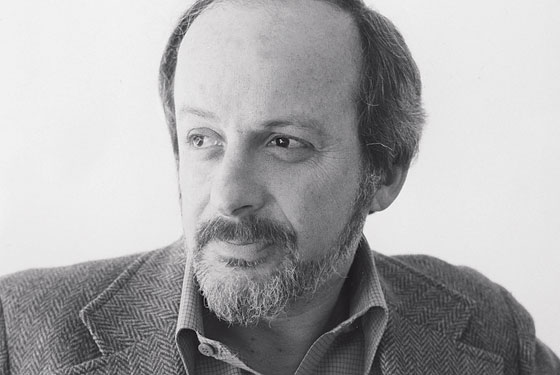
In 1975, the New York Times‘s Christopher Lehmann-Haupt initiated his review with this typically hyperbolic sentence: “E. L. Doctorow’s ‘Ragtime’ is a highly original experiment in historical fiction.” Unfortunately, because Lehmann-Haupt possessed middling erudition, he could not ken that Doctorow had, in fact, ripped off Heinrich von Kleist for his novel’s most memorable character.

In a 1978 interview with Jared Lubarsky, Doctorow declared, “I realized as I went along that the model for this book, in terms of its narrative distance, was the chronicle fiction of the German master Heinrich von Kleist. His novella ‘Michael Kohlhaas’ was very much in my mind when I found the black man Coalhouse Walker, driving up the hill in his Ford.” In 1983, Doctorow was somewhat more honest about his carjacking with the notably sharper Larry McCaffery:

Several years ago my wife related a true story she’d heard about a housemaid in our neighborhood who bore a child and then buried it in a garden. I knew when I heard this I’d use it someday. I found myself using it in Ragtime, where I never knew in advance what was going to happen. Suddenly there was Mother discovering the little brown newborn in the flower bed. There was Sarah coming to live in the house with this baby. Obviously, she would have tried to kill the child only from overwhelming despair or sense of betrayal. So there had to be a father. I had introduced Houdini driving up Broadview Avenue. He came along in his shining Ford, an older man, and he said, “I’m looking for a young woman of color.” Where had he been? I decided he was a musician, a man who lived on the road, going where he found work. Now he was back to make amends. He starts to court Sarah and when she refuses to see him, he plays the piano for the family in their parlor. And that’s how I found the central image of the book. Then I began to think about the implications of a black man owning his own car in the early 1900’s. I knew Sarah would forgive him and they would be reconciled. But that car: What would happen to that lovely car of his is what happened to Michael Kohlhaas’s horses. I had always wanted to rework the circumstances of Kleist’s story. I felt the premise was obviously relevant, appropriate — the idea of a man who cannot find justice from a society that claims to be just. So there it was — I’d finally found the use for that legend I’d hoped to find — but not until the moment I needed it.

Yet four years later, in a Yale Vernacular interview with Liesl Schillinger, Doctorow downplayed “reworking the circumstances” to being “very much inspired by Kleist.” And in a 1988 interview with Herwig Friedl and Dieter Schulz, Doctorow would identify his theft as “a quite deliberate hommage. You know, writers lift things from other writers all the time.” That same year, Doctorow would offer an altogether different defense to Winifred Farrant Bevilacqua: “somewhere along the line as I was writing Ragtime I realized I was writing chronicle-fiction with a certain mocking or ironic tone but nevertheless with the same distance with the characters that you find in chronicle-fiction, that is to say, a distance not as great as a historian, not as close as the post-Flaubertian novelist, but somewhere in the middle and maybe that’s why I remembered that I’d always wanted to use ‘Michael Kohlhass’ in some way, it was a story for me.” But by 1997, Doctorow (sounding more like Cory than Edgar) said to Michael Silverblatt, “The source of what you use finally doesn’t matter….The sources don’t matter as much as the act of composing.”

As The New York Observer noted on March 23, 1998, there was clearly more going on than composing. Doctorow had ripped off many key elements of “Kohlhaas.” Both Kohlhaas and Coalhouse are stopped by men who demand toll. Both figures seek a vigilante form of justice, enlisting men to their eventual deaths when denied proper recourse. Both feature the horse and the car returned in perfect condition. Doctorow’s Booker Washington fills in for Kleist’s Martin Luther. Both feature very specific imagery of significant others receiving a blow to the chest from a weapon (and, as the Observer points out with its citations, the passages from both narratives are quite similar).

But let us inform our good thief Edgar why the sources do matter. According to Broadway World, the 1998 Broadway adaptation of Ragtime grossed close to $80 million during its two year run. The 2009 Broadway revival of Ragtime, which featured a working Model T automobile (the very story element that Doctorow ripped off and altered for his use) as a dominant part of the set, grossed more than $5 million. Not bad for a musical that was budgeted at $11 million and faced declining revenue due to the recession. That’s an $85 million gross over a little more than a decade on a musical based on a novel that ripped off another narrative. If Doctorow can be compared to a robber baron (in Ragtime, he does seem strangely at home writing about JP Morgan and Henry Ford), it’s a remarkably barren robbery.

Doctorow would prove quite defensive and more than a bit smug when called on the carpet more directly. “I find it surprising that this is being brought up 22 years after the event,” he would tell the Observer, seemingly not seeing why a highly successful Broadway adaptation might shine a brighter Klieg on the Kleist pillaging. “I have a sense of a readership that is sophisticated and understands how literature works. There are others who may be naïve about that. And that naïveté is taught by example.”

* * *

But was the 1975 novel really all that sophisticated? I read Ragtime twice for this essay. While I enjoyed it slightly more on the second read, I had severe doubts about Doctorow respecting a readership who “understands how literature works.” Ragtime‘s parody of a junior high school textbook grew tedious. I do everything in my power to accept a book for what it is (Updike’s Rules for Reviewing and all), but I wanted to feel these figures rather than look upon them as one-dimensional. Even Harold Bloom, writing in an introduction for a 2004 study guide, confessed that Ragtime “is far from being Doctorow’s most eminent work.” Was Ragtime a second-rate Doctorow?

Nearly four decades after its publication, one of the book’s biggest surprises is how patronizing Doctorow is. Above all, Doctorow is driven by the need to repeat and explain, as if his readership is a simpering mass of small children, perhaps plagued by amnesia or an uncanny inability to look up a vaguely arcane word, that he must speak down to. We are introduced to “the famous architect Stanford White” in the first chapter. A mere two chapters later, Jacob Riis decides to “interview the eminent architect.” Two chapters after that, we encounter Mrs. Stuyvesant Fish, who is “throwing a commemorative ball in honor of her friend the late Stanford White, the architect of her home. He had designed her home in the style of a doge palace. A doge was the chief magistrate in the republic of Genoa or Venice.”

It’s regrettable that this generic repetition extends to generic and sometimes cartoonish character description. Of the great Booker T. Washington, we are offered this redundancy: “He was an orator and his voice was strong.” Of Houdini, Doctorow writes, “Pound for pound he was as strong as any man he had ever run up against.” That’s pulpish, but somewhat fair. So why then do we need to be explicitly reminded about this already established strength only two sentences later? “He was immensely muscular and agile and professionally courageous.”

Of a strike, Doctorow offers this homely description: “The bosses want you weak, therefore you have to be strong. The people who will help us today will need our help tomorrow.” The reader who flips the next page will read the page that comes after this one. E.L. Doctorow has written a masterpiece. He has written a masterpiece because the book is on the Modern Library list. The Modern Library list, which is still regarded highly by certain literary geeks, is one method of locating masterpieces. Autistic readers are most welcome. Insert your logical fallacy or your X=Y observation of choice here.

Doctorow’s doggerel is hardly confined to phrases or sentences. Here is the man attempting to mythologize American heft as Taft ascends to the White House:

All over the country men began to look at themselves. They were used to drinking great quantities of beer. They customarily devoured loaves of bread and ate prodigiously of the sausage meats of poured offal that lay on the lunch counters of the saloons. The august Pierpont Morgan would routinely consume seven- and eight-course dinners. He ate breakfasts of steak and chops, eggs, pancakes, broiled fish, rolls and butter, fresh fruit and cream. The consumption of food was a sacrament of success. A man who carried a great stomach before him was thought to be in his prime.

If this is deliberate comedy, then it becomes tedious by the third sentence and spoiled by the fifth sentence’s desperate laundry list retreat. If this is intended as literature, then the third sentence’s passive voice and eyesore adverb infringes upon lexical decency. If this is intended as wisdom, then the concluding homily is no different from a barfly’s botched wisdom.

There’s also something of a creepy misogyny running ragged through Ragtime. It’s there early on in the lurid manner with which Harry Thaw demands proof of his wife’s “devotion and it turned out nothing else would do but a fellatio.” But not long after we first meet Emma Goldman, Doctorow depicts Goldman giving Evelyn Nesbit a sensual massage with dimebag imagery: “Goldman rubbed the oil into her skin until her body found its own natural rosy white being and began to stir with self-perception.” Mother’s Younger Brother, who has been stalking Nesbit, bursts out of the closet mid-jerk, firing off “great filamented spurts of jism that traced the air like bullets and then settled slowly over Evelyn in her bed like fallng ticker tape.” As if this silly masturbatory fantasy isn’t enough, Evelyn is next seen taking Mother’s Younger Brother as her new lover. The reason? “It was characteristic of Evelyn that she could not resist someone who was strongly attracted to her.”

And it is characteristic of Doctorow that, with the possible exception of Mother (and even this is dubious, as I shall soon demonstrate), he cannot write about women without objectifying them. Mameh, wife to Tateh, is forced to let her landlord “have his way on a cutting table” and is never seen again. When Evelyn eventually leaves Mother’s Younger Brother, she is never heard from again. Why can’t these women be interesting or useful to the narrative outside of the boudoir? Sarah, lover to Coalhouse Walker, spends most of her time mute and sequestered from the family when Coalhouse arrives. We do see Sarah laughing not long after a fortuitous development, but her happiness flows “in the milk of her breasts.” When Sarah finally does speak, she is bludgeoned by thugs. (And, again, keep in mind that this one-dimensional character is Doctorow’s appropriation from Kleist.)

Doctorow would likely defend such slips as a wry reflection of history’s male-centric sweep (“something I was always planning to do”), from which the narrative “we” (which undoubtedly includes the mysterious boy digging through trash at the family hotel) likely originates from. But when I remembered how William Kennedy’s Ironweed (a much superior novel) worked a time period and a setting somewhat close to Ragtime without this fatal flaw, I became even more bothered by Doctorow’s dickering. Even after her apparent transformation into someone slightly more autonomous, Mother is viewed with her underclothes sticking to her limbs, “recognized in her wet form the ample woman in the Winslow Homer painting who is being rescued from the sea by towline.” Why couldn’t Doctorow, a novelist who clearly loved writing about Houdini’s escape or Theodore Dreiser adjusting his seating position, find his own precise way out of this patriarchal predicament? If history is merely an alluring flipbook of silhouettes to find one’s fortunes and invent a baronetcy (the true underlying pull in this novel), then surely the decent thing for a novelist to do — even one claiming to specialize in mock chronicle-fiction — is to avoid having one’s German chocolate cake and eating it too.

Next Up: Joseph Conrad’s Lord Jim!

The Bat Segundo Show: Anne Enright

Anne Enright appeared on The Bat Segundo Show #417. She is most recently the author of The Forgotten Waltz.

Condition of Mr. Segundo: Troublesomely willing to sign on the dotted line.

Author: Anne Enright

Subjects Discussed: Writing a novel as a minute allegory of the Celtic Tiger, Gresham’s law, books with shifting moral alignment, marriage as a financial relationship, punctuation and subordinate clauses in prose, David Mamet, Caryl Churchill, people who interrupt each other, male and female dialogue, Enright being one of the great penis chroniclers in contemporary literature, the hydraulics of hard-ons, Yeats’s “Sailing to Byzantium,” The Gathering vs. The Forgotten Waltz, flesh and fat in fiction, how women think about anatomy, stigmas against women writers, how character names can be used to describe fraught relationships, unsuccessful attempts to find a sexy Irish name for a man, Australian men, material that Enright would not write about, Catholicism and blasphemy, the specific conditions it takes to earn an injury, the relationship between spirituality and sensuality, Leonard Cohen, reflections and looks within Enright’s fiction, interior and exterior description, whether the world would be better if it were run by 12-year-old girls, characters who cling to what remains of youth, candid moments, the repression of consciousness, being blatant through the spirit of omission, faux partitive noun phrases, “the luxury of the kiss,” the origins of the character name Fiarcha, bountiful character populations in a novel, and old-fashioned knowledge.

EXCERPT FROM SHOW:

Correspondent: I wanted to first of all ask you about the notion of this book possibly serving as a mini-allegory or a minute allegory. I noted that there was the Gresham Hotel, which nicely mimics Gresham’s law in this book. And there were a number of lines about the acquisition of things. Flirting with someone just to flirt with someone. So I have to ask how you honed the right amount of allegory for this. Or was that even important? Was it kind of a bonus that came to your interesting series of squabbles here?

Enright: Yeah. I think the thing about allegories is that they stay still. And what I wanted to do was to write a book that shifted morally. So it was more morally poised than an allegory might be. So it’s a book that can be read by the likes of the readers themselves. So whatever the reader thinks of Gina Moynihan, who is the central character and who is either a woman in love, wonderfully in love, or a homewrecker — depending on your point of view. So I wanted the readers to maybe even shift their points of view about what Gina’s up to. So it does parallel the boom in Ireland. So there is a kind of allegorical content there for adultery, that feeling of just getting what you want, of getting away with it, was very suitable to Ireland in the last ten years before the boom. When there was so much glee and a kind of fantasy and a kind of denial that was going on. Also a huge amount of belief. You had to believe. If you didn’t believe in the economic miracle, you were kind of heretic, you know? Because if you take belief out of the system, there’s nothing left. There’s only debt and not money anymore. It’s a confidence trick. So I thought all of that was brilliant for an adulterous affair. Because you’re living at two levels at the same time, which was pretty much what people were doing.

Correspondent: What’s interesting though is that it is money that has Gina and Conor marrying. Which I found to be an interesting choice. Gina’s view in terms of her relationships — whether it is Conor or Sean — is very much predicated upon, well, it happens to be there. And so this leads me to ask if this kind of moral concern predated the alignment with the Celtic Tiger and the like.

Enright: Money is both important and interesting. It’s also quite highly taboo. People don’t talk about their money. They think about money all the time. And they never or rarely articulate their relationship with money. Yeah. Gina and Conor get a mortgage almost before they get the wedding reception. But that was the reality. That is the reality in Ireland as it was. And I think in many places in the Western world, it was hard to find a place. And it was better to find a place if you were with somebody else. And I think marriage is also a financial relationship.

Correspondent: Yes.

Enright: Whether it’s primarily a financial relationship is — well, that varies from couple to couple. But I don’t think it was primarily here. I mean, Gina, she’s quite materialistic. But she’s not a greedy girl. I mean, she does think about money. But she’s not relentlessly acquisitive. It’s just that wanting is problematic when money is involved.

Correspondent: I also wanted to ask about the use of commas and dashes throughout the prose.

Enright: Oh! Nightmare!

Correspondent: A nightmare?

Enright: My nightmare! (laughs)

Correspondent: Well, it’s interesting because it does lend itself to a very conversational voice. But on the other hand, thinking of like The New York Times Book Review where you can always spot where they’ve edited it, where they have the dash and some sort of subordinate clause and then the dash, I’m curious as to how this worked for you. Whether some of these dashes and commas and various thoughts entered into the editing or were they there from the get go?

Enright: It was always a painful decision about punctuation. Gina is addicted to qualifications, subordinate clauses. A little bit more, a little on the side. The sentences don’t run really simply. It mirrors the way people think. I have a real problem, and I’m going to confess it to you now, with the run-on sentence and the semicolon. But I do like putting a clause in the middle of a sentence to disturb it a little.

Correspondent: The dashes, I suppose, are a more pure unit than say the colon.

Enright: Yes, they are. And they give a bit of space on the page. I like typing. Because I like the rhythm of typing. To me, it’s like dancing on a sprung floor. I like a bit of trip and a bit of rhythm in the prose. Because my narrators are often not omniscient. They don’t know exactly what the end of the sentence is. I like to surprise. I like to see their surprise as their thoughts leap along.

Correspondent: It would seem to me that this more free-form approach to prose will probably lend you to discover more about the characters.

Enright: For sure. But all the time, the content for me is a kind of given. And all the time, I’m trying to make the cadences and the rhythms somehow beautiful. And somehow to get the emotion and the poignancy into that rhythm. I mean, that to me is what it’s all about. And so I love the spoken voice on the page. I love the challenge of it. I mean, if you put a tape recorder on someone, they don’t speak in sentences.

Correspondent: Sure.

Enright: And the prose. Of course, even if you write in realistic type, first-person, it’s a mannered thing. David Mamet. There’s a guy who I love to read as well as…

Correspondent: The earlier Mamet. Not the more recent one. (laughs)

Enright: The earlier Mamet. And, you know, I worked in the theater very early on. And Caryl Churchill as well. Do you know Churchill puts a forward slash before interruptions?

Correspondent: Yes.

Enright: People interrupting each other on stage. Which is actually the way women talk. They rap off each other. It’s more improvisational. A kind of jazz thing that they do. So they’re always interrupting each other. Men are slightly more territorial about their speech. I’d love to be able to do that on the page. But, you know, it would wreck people’s head.

The Bat Segundo Show #417: Anne Enright (Download MP3)

This text will be replaced

The Bat Segundo Show: Roger Corman

Roger Corman appeared on The Bat Segundo Show #416. In addition to directing some of the most memorable and entertaining drive-in movies of the 20th century (among many other accomplishments), he is most recently the subject of a new documentary called Corman’s World, which is now playing film festivals and is set for release on December 16.

Condition of Mr. Segundo: Not of this earth.

Guest: Roger Corman

Subjects Discussed: Corman’s infamous cost-cutting measures, unusual marriage proposals, bloated corporations, Occupy Wall Street, comparisons between Zuccotti Park and 1960s protests, keeping tabs on pop culture, not giving stars and directors a few bucks to stay around, Easy Rider, the philosophy behind the Corman university, picking people on instinct and the qualities that Corman looks for in a potential talent, Francis Ford Coppola, James Cameron, directors who move up the ladder, The Intruder, why Corman didn’t make explicit socially conscious films after 1962, financing pictures with your own money, the financial risks of being ahead of the curve, looking for subtext in the nurses movies, the sanctimony of Stanley Kramer, Peter Biskind’s “one for me, one for them” idea, simultaneous exploitation and empowerment, the minimum amount of intelligence that an exploitation film has to contain, throwing calculated failures into a production slate, distributing Bergman and Fellini through New World, why Corman believes it was impossible to produce and distribute independent art house movies in the United States in the 1960s and the 1970s, the importance of film subsidies, why Corman gave up directing, Von Richthofen and Brown, the allure of Galway Bay, getting bored while attempting to take time off, the beginnings of New World, the many breasts in Corman’s films, Annabelle Gurwitch’s “Getting in Touch with Your Inner Bimbo,” targeted incidental nudity opportunities, enforcing nudity clauses in contracts, questioning why actresses can’t be sexy without taking their tops off, Rosario Dawson, the undervalued nature of contemporary films, and Corman’s thoughts on how future filmmakers can be successful.

EXCERPT FROM SHOW:

Correspondent: I have to get into your eccentric temperament right from the get-go. There is a moment in this documentary where your wife Julie confesses that you proposed to her. And she said yes. Then you disappeared for a week into the Philippines. And she tried to get in touch with you and finally did get in touch with you and asked, “Well, is the marriage still on?” And you said, “Oh yes, of course.” Your justification was, well, you didn’t want to pay the expense of long-distance telephone. I told this story to my partner and I thought it was amusing. But she was absolutely horrified by this. And this leads me to ask if the notorious reputation you have for aggressive cost-cutting, perhaps one of the finest cost-cutters in the history of cinema — well, how much does this lead into your personal life? And your private life? I mean, surely, when you’re talking about sweethearts and fiancées, you can afford to spend at least a buck or something. I mean, come on!

Corman: Well, that story is possibly true. But the fact of the matter is I’d been in the jungle. At that time, there were no phones. So that was the real reason for the call.

Correspondent: That was the real reason. But this does raise an interesting question. I mean, under what circumstances will you, in fact, pay the regrettable cost of maintaining a relationship like this? Whether it be professional or private.

Corman: Well, I would have to divide that into two answers. Privately, and particularly with my wife and children, I’m much more liberal in spending than I’d ever been on films. On films, I really watch every penny.

Correspondent: Yes. But are there any circumstances you’ve regretted? Either spending extra money or not spending the dollar? Or not spending the dime so to speak?

Corman: I don’t think I regret any overspending. I think, once or twice, I should have let pictures go a little longer and spent a little bit more. These were pictures that were coming in on budget and on schedule. I might have added a couple of extra days to the shooting schedule. But I felt this was a fifteen day schedule. This is the thirteenth day. I have to make a decision. We’re going to shoot it in fifteen days. In retrospect, had I gone to sixteen or seventeen, the additional quality — for lack of a better word — might have been greater than the expenditure.

Correspondent: Well, what’s the cost-benefit analysis for this quality to spending ratio that you’ve devised over the years? Is it largely instinctual? Is it largely looking aggressively at the books? What of this?

Corman: It’s a combination of all of the above, plus just the calculation. I’m always looking for the greatest quality. I’ve done pictures — The Little Shop of Horrors — in two and a half days. I did that with very little money. But I did the best possible job I could do with the amount of money. So I’m looking for the highest possible quality. But since I back my pictures with my own money, which is something you’re never supposed to do, I have to be certain — well, I shouldn’t say certain. I have to have a reasonable guess that I’m going to come out of this one okay.

Correspondent: Do you think that such brutal, Spartan-like tendencies might be applied to, oh say, balancing the federal budget? Or perhaps creating a more efficient Department of Defense? Do you have any ideas on this?

Corman: Well, I believe that it isn’t just the federal government. I believe large corporations or the Department of Defense, which of course is part of the federal budget — I think there’s a certain inherent waste in any large organization, whether it’s public or private. I think they all could be streamlined or — let me put it this way, I think they all should be streamlined. But I question whether it can be done. Because the bureaucracies are in place. And it’s very, very difficult to move.

Correspondent: It’s difficult, I suppose, not just in motion pictures, but for everybody right now. Do you have any thoughts on the present Occupy Wall Street movement that’s been going on in this city while you’ve been here?

Corman: Weirdly enough, I was at the Occupy Wall Street meeting — or sit-in. Whatever you want to call it.

Correspondent: You went to Zuccotti Park?

Corman: Yeah. Just about an hour ago.

Correspondent: Really?

Corman: I donated a little money and they had a couple of pictures taken of me there. Which they said they wanted to use in some way. And I told them I was totally in support of what they’re doing.

Correspondent: I’m surprised you weren’t down there with a movie camera getting master shots for a later production based on Zuccotti Park or something like this. There should be an Occupy Wall Street movie. Is there some possible narrative? Some bucks in this?

Corman: Well, it’s the kind of thing I did before in the 1960s, with the various protest meetings and anti-Vietnam demonstrations. I was there with cameras. And we did use the footage. And this one at the moment isn’t quite that big. If it grows, however, that will be a different thing.

Correspondent: Well, did you see it at Times Square on Saturday? It was actually 15,000 people. And it was pretty aggressive with the cops arresting people. 88 people that day too.

Corman: We came in on Saturday.

Correspondent: Oh, I see.

Corman: And actually I saw opposite ends of New York. I came in, went straight to the opera, went straight from the opera to Comic Con to sign autographs. So I figured if I went from New York to the opera to Comic Con, I saw various aspects of New York.

Correspondent: Well, this leads me to ask you about how you collect your ideas or how you maintain your attentions as to what’s going on in contemporary society. It seems to me that going down to Zuccotti Park, you’re still very much interested in finding out what the present concerns are. I mean, how often do you do this now in your daily life? Just to keep tabs. How do you know, for example, that Hell’s Angels or LSD or Zuccotti Park might be a salable idea?

Corman: These are just aspects of pop culture that come to the surface. And I’ve been involved in all the previous ones. Or most of them, one way or another. And the Occupy Wall Street movement is new. And I went just to see what it was like. And it was strange. There’s a real similarity to the 1960s here. And I don’t know if the young people of today know that what they’re doing, the signs they have, the music they had playing, the discussions — it brought me right back to 1968.

Correspondent: Do you see any differences by chance?

Corman: I saw very little differences. I did notice this. The police were not antagonistic. They were standing there. But I didn’t see any of them make any harmful moves. Where in the ’60s, I did see police make harmful moves. Maybe they’ve learned something over the years.

The Bat Segundo Show #416: Roger Corman (Download MP3)

This text will be replaced

Laura Miller’s Black Helicopters

Last Wednesday, Laura Miller offered another typically incoherent tirade, perhaps demonstrating some closet desire to become the Maureen Dowd of the literary world. Her column attempted to stir up controversy over the apparent problem that this year’s fiction finalists for the National Book Award were, with the exception of Tea Obreht’s The Tiger’s Wife, composed of “low-profile and/or small press offerings.” Failing to comprehend that awards often represent opportunities for readers of all stripes to discover new titles, and lacking anything even approximating facts, Miller resorted instead to the conspiracy theories that one expects from undergraduates passing a pipe in a dorm room to stave off boredom. She put on her tin foil hat, detecting “the sense that the fiction jury is locked in a frustrating impasse with the press and the public” and not understanding that the National Book Award judges are too busy reading hundreds of books to worry about what their decisions will mean with “the press and the public.”

Miller writes that the press “expresses bafflement” when some obscure writer wins, but fails to cite any examples. Sure, there was some minor controversy one year over the five fiction finalists all being women from New York. But that was seven years ago. Last year, Jaimy Gordon certainly surprised the audience by winning the National Book Award over such literary bigwigs as Peter Carey and Nicole Krauss. But what specifically is Miller referring to? The New York Times merely reported it as “a surprise pick,” which was accurate reporting. Much as Maureen Dowd once got a ridiculous column out of some mythical meeting between two senators, Miller seems to be implying some similar clink of glasses between NBA judges and the press. But as someone who has covered the National Book Awards multiple times, and who hasn’t been able to get anything from the judges (despite a combination of charm and silly questions), I can confidently report that Miller doesn’t know what she’s talking about.

Miller’s column is little more than irresponsible speculation. It belongs in a neighborhood circular, preferably distributed by lunatics off a moving truck in the middle of nowhere, not a distinguished online magazine. Even though she’s clearly unfamiliar with “whatever policy each panel of judges embraces,” Miller’s ignorance certainly doesn’t prevent her from engaging in relentlessly uninformed speculation. Miller claims that “the impression has arisen that already-successful titles are automatically sidelined in favor of books that the judges feel deserve an extra boost of attention.” But when we refer to two recent judges who were kind enough to share their National Book Award experiences, Miller’s deranged theories don’t add up. In 2006, judge Marianne Wiggins wrote an essay for the Los Angeles Times outlining the process:

In our first conference call, we began to try to define what we were looking for. A “national” book? A work of fiction that spoke to the “American” character? Judge No. 1 wanted “readability,” and No. 5 wanted “a sense of discovery.” I just wanted writing that would set my hair on fire.

We see with Wiggins a variety of motivations. But neither “readability” nor “a sense of discovery” fits into the hypothetical sidelining of successful titles.

More recently, Victor LaValle wrote a piece for Publishers Weekly responding to Miller’s claims: “If such a thing ever happened then the NBA are really nefarious because they wiped my memory banks clean.”

If Miller had taken the time to consult Wiggins’s essay or contacted any of the judges, then she would not have written such an intellectually bankrupt column. She certainly would not have leaped to the paralogic contained in the unintentionally hilarious paragraphs that follow, whereby “the larger reading public has also proven recalcitrant” (really?) and even has the effrontery to dictate the qualities that “don’t matter much to nonprofessional readers or even put them off.”

I’d like to inform Ms. Miller that this outsider was so intrigued by Jaimy Gordon and Paul Harding’s respective award-winning books that he invited both authors to discuss their books at length on The Bat Segundo Show. (Both graciously accepted. You can listen to my conversation with Gordon or Paul Harding, if you like.) I would like to think that Ms. Gordon and Mr. Harding would have found their way onto the program eventually. But it was the awards that allowed resources, permitting these two writers to make their way to New York and talk with me. I don’t especially care how obscure or popular any writer is. And I also don’t especially care whether a book is “so obscure as to be virtually invisible.” I only care if the book is interesting. What Miller doesn’t seem to get is that if people like a book, then they are not going to stay silent about it. To the extent that awards can encourage such enthusiasm, I don’t really see what the problem is. Unless you are someone who hates books or, like Miller, you hate any independent mind or mechanism offering an alternative to your unadventurous, huckster-friendly sensibility. As Dan Green has noted, “by now it’s clear that Laura Miller has staked her claim to critical influence on a defense of ‘ordinary’ readers against fancy writers who write too much and that she’ll stick to that story, however misguided, lest her standing as a critic to be heeded is threatened.”