Occupy Wall Street: After the Brooklyn Bridge

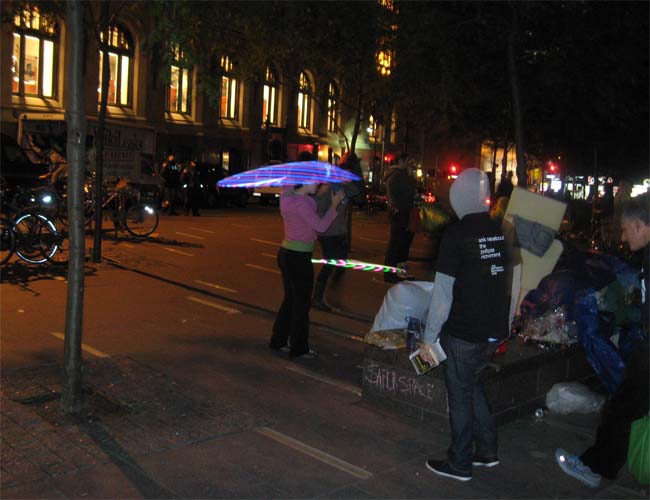
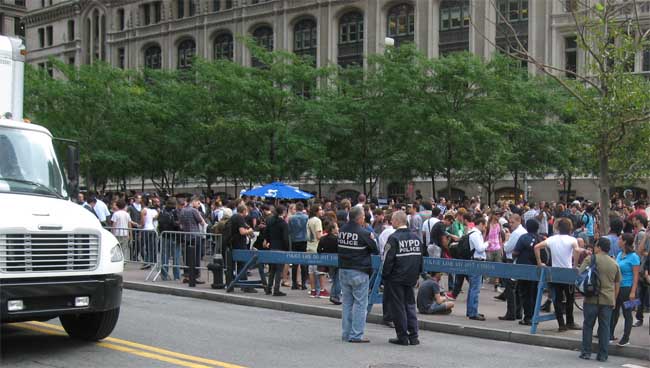
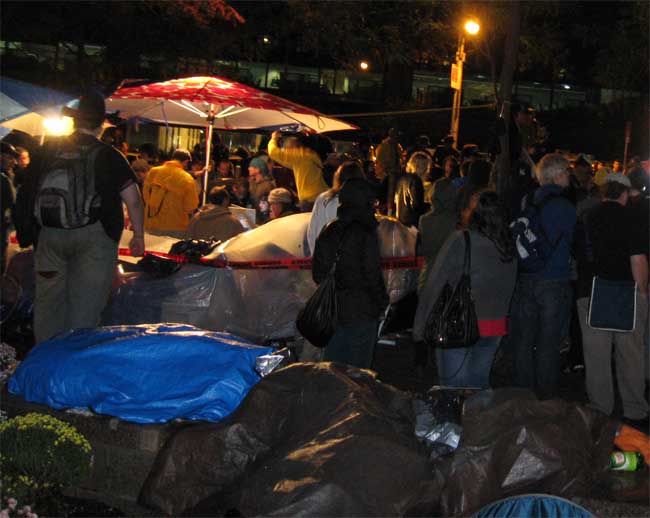
On Saturday night, I returned to Zuccotti Park. It was 55 degrees. Winds lashed at tarp and tents, flapping up flaps and whipping at sleeping bags. But the protesters remained calm and good-natured. Some spun hula hoops around their bodies as the calls and responses carried on.

“The rain is really the only obstacle,” said a protester who had been at Occupy Wall Street from the beginning. “Tonight’s the only night that it’s been actually cold.”

He informed me that there were plenty of Mylar blankets and sleeping bags at the comfort station — the results of ample donations.

A man who had once worked on Wall Street and who lived five blocks away was leading the crowd:

“I think you people aren’t crazy.”

“I THINK YOU PEOPLE AREN’T CRAZY.”

“I love the way you communicate.”

“I LOVE THE WAY YOU COMMUNICATE.”

“The world has noticed your voice.”

“THE WORLD HAS NOTICED YOUR VOICE.”

This text will be replaced

A rumor had circulated that Marines were coming all the way from Florida on behalf of the protesters, to protect them from the NYPD. “I didn’t fight for Wall Street,” posted serviceman Ward Reilly on his Facebook wall. “I fought for America.” Reilly had pledged that a Marine formation would be held that night. But the Marines hadn’t yet turned up in Zucotti Park. They must have been tied up in traffic.

I talked with a young man, who identified himself to me as “Big Ben” and who was busy blowing bubbles.

“I just picked this thing up a second ago,” said Ben. “I saw it on the ground. I figured that I could just dip it like I am and the wind would take care of everything else.”

I had arrived shortly before 10:00 PM: only a few hours after 700 people had been arrested at the Brooklyn Bridge. On Saturday afternoon, protesters had decided to walk across the Brooklyn Bridge. Police blocked the bike path, leading them down the main road, where orange nets and arrests awaited. Natasha Lennard, a freelance reporter for The New York Times, was one of those arrested. An NYPD spokesman had informed me earlier in the evening that most of these protesters would be charged with disorderly conduct at minimum and that some would be singled out for additional offenses.

(Image via Brenda Norrell.)

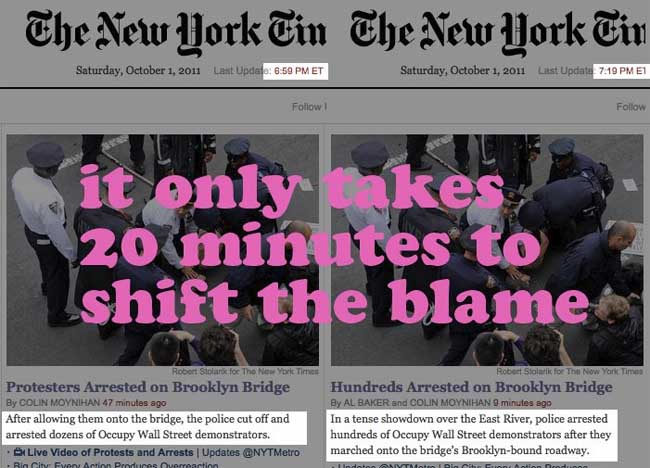
I was uncertain who was at fault. As it turned out, The New York Times didn’t know either. Within twenty minutes, the New York Times had shifted the blame on its website (adding Al Baker to the byline) from the police to the protesters.

[10/2/11 PM UPDATE: The Voice‘s Nick Greene talked with the New York Times City Room about the changes, which include disappearing paragraphs and the videos that the Times relied on for its version of the events. As Bucky Turco has tweeted, there’s a mysterious edit in the second video.]

I talked with Jesse, a friendly and excitable young man with a $100,000 education in industrial design and no job prospects. He had arrived at Zuccotti Park that very day from Philly. He had been at the Brooklyn Bridge and spoke of “awesome photos.” His story cast some aspersions on the revised New York Times angle.

“I’ll tell you exactly what happened!” said Jesse. “They pushed people. They blocked. I think the goal was to go on the bike path. And every one of the cops were in front of the bike path. So everybody walked down on the road. ‘Hey guys! This way!’ That’s what they did. And so everybody went down that way.”

But Jesse got the sense that something was up.

“I was standing there for a couple of minutes,” continued Jesse. “But after like ten minutes of me going like, ‘Guys, if you don’t go, I’m going to go without you.’ I just fucking left. I was not getting arrested. I was too close! I was walking forward. I leave them. And I see all these hands go blazing down underneath the bridge. And they come up behind the protesters.”

Jesse hopped the fence to escape arrest.

“So as I’m going the other direction, there’s fucking four New York buses backing out and backing all the way onto the bridge with the cops. And they’re getting ready to fucking arrest everybody.”

I asked Jesse if he knew why people started walking on the road when the bike lane had been blocked. Whose idea was it?

“It wasn’t an idea,” he said. “It was ‘Well, the cops wanted us to go this way. So we’ll go this way.’ Do you know what I mean? It was like nonpassive. You have people, police there. And you have no police there. So nonpassive. You don’t go through the cops. You go around the cops. You know what I mean? We’re not trying to hurt anybody. We just want to yell and scream.”

Jesse also confirmed reports that police had singled out men for arrests more than women, telling me of a woman with a dog who was able to get around the tape at the other end by dint of possessing a pet.

You can listen to my interview with Jesse here:

This text will be replaced

Occupy Wall Street: SlutWalk NYC

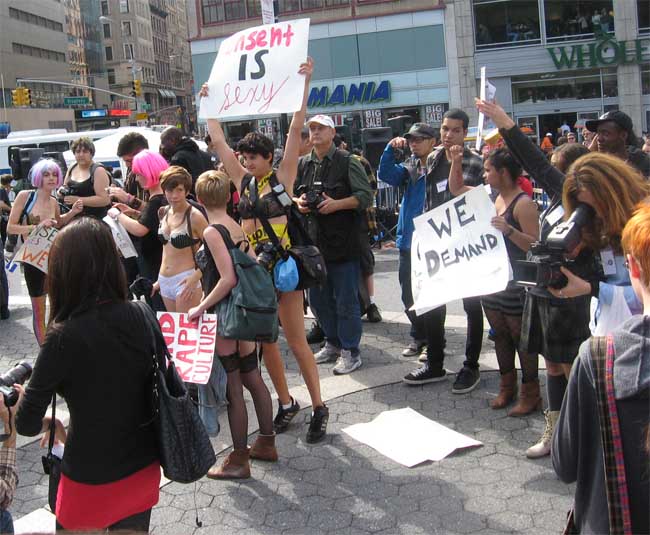
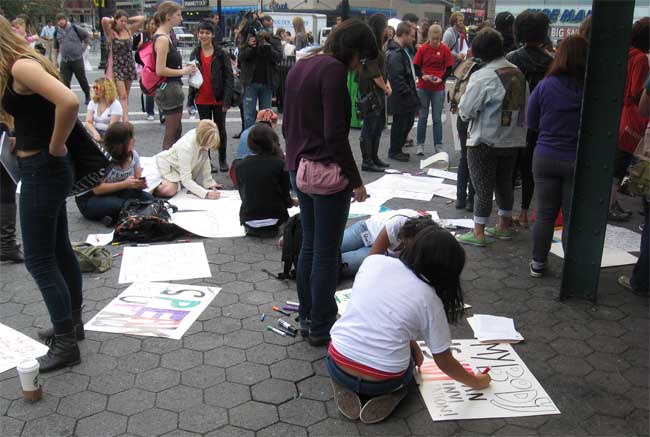
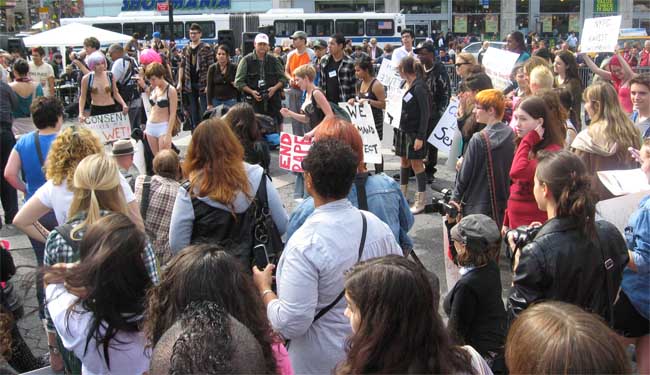
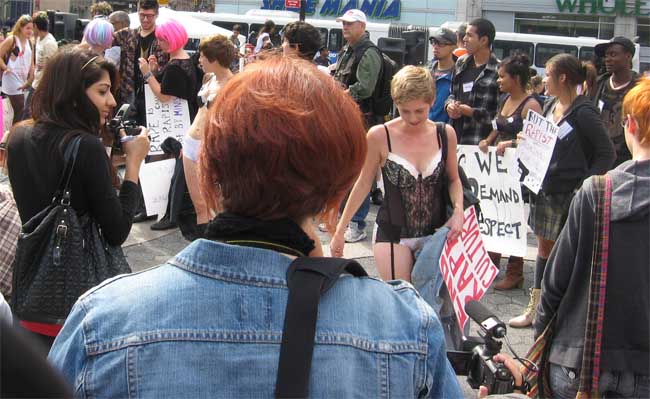
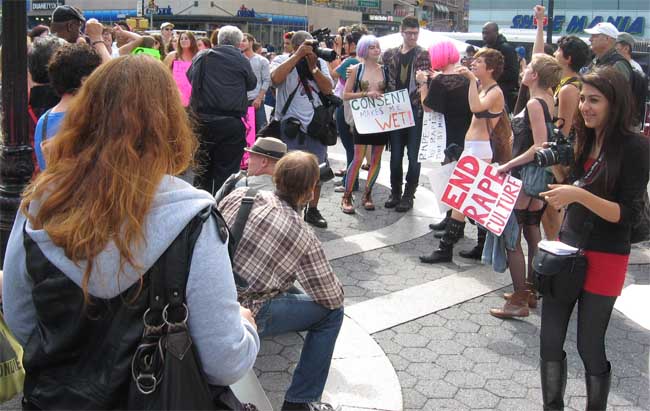
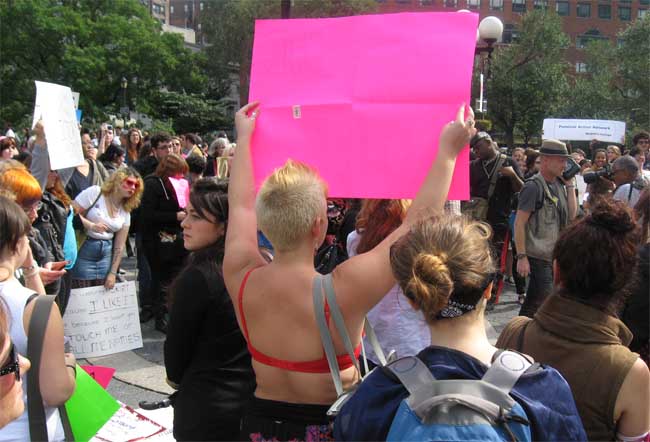
They came from as far away as San Diego and Delaware to participate in SlutWalk, holding signs that read CONSENT IS SEXY and WE DEMAND RESPECT. This was part of a wave of protests initiated in April in Toronto and continuing with additional walks in Australia, Chicago, and London. SlutWalk’s ostensible purpose is to protest associations between rape and appearance. Women (and some men) dress slutty in an attempt to take back the word.

“I think it’s going to have a definite impact on the people who we can talk to and who we can reach out to,” said Andrea, part of a group of fifty women who identified themselves as the Delaware Sluts. “Because so many people think that women are raped because of the way they dress or the way they present themselves. Or they’re too drunk. But, you know, that’s not always the case.”

This text will be replaced

On Saturday morning, many hundreds gathered in Union Square to bring this movement to New York City. I decided to attend because I was curious about the philosophical overlap between SlutWalk and Occupy Wall Street.

I was to discover some startling differences. When I began talking with people last week at Occupy Wall Street, a guy there slipped me his business card (containing a phone number right after “Press Inquiries”) without comment. I very much appreciated the swift nonchalance and unintrusive nature of this gesture. But when I wandered around with my microphone seeking to understand the SlutWalkers, I was informed by three separate people (one identifying herself as a “media coordinator”) that there was a media scrum on at 11:45. I observed another journalist get into a five minute discussion about the interview availability of one of the main organizers. The journalist was informed that the organizer’s schedule was quite busy.

It was as if the SlutWalk organizers were top-level politicians or entertainment figures who had to approve every interview request. Quite frankly, I didn’t have time for this. And I certainly didn’t experience anything like this at Occupy Wall Street. So I just walked around and talked with people.

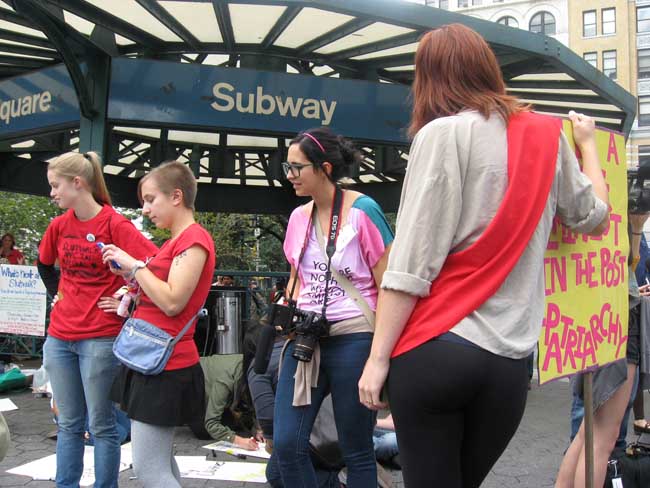
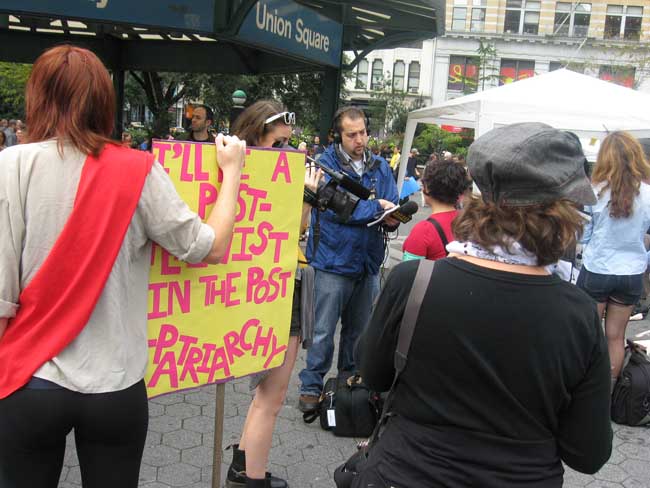
This top brass tendency to drown out the very people who wanted to listen or have a conversation reached a comical crescendo when I talked with a very thoughtful participant named Jen, who was holding an endearingly geeky sign reading </patriarchy>. She had helped to organize SlutWalk San Diego.

As we were discussing protesting issues, another SlutWalk lieutenant — standing only a few feet away from us — boomed “Attention all media! We’re going to be having a media scrum in five minutes on the steps!” into her amplification device without warning. Second later, there was another “Attention all media!” from another lieutenant. This left Jen and I desperately seeking intermittent thirty second pockets to talk, hoping that the lieutenants weren’t going to bark over our conversation, which involved whether a political protest with a narrow message could attract the same 99 percent involved against Wall Street.

This text will be replaced

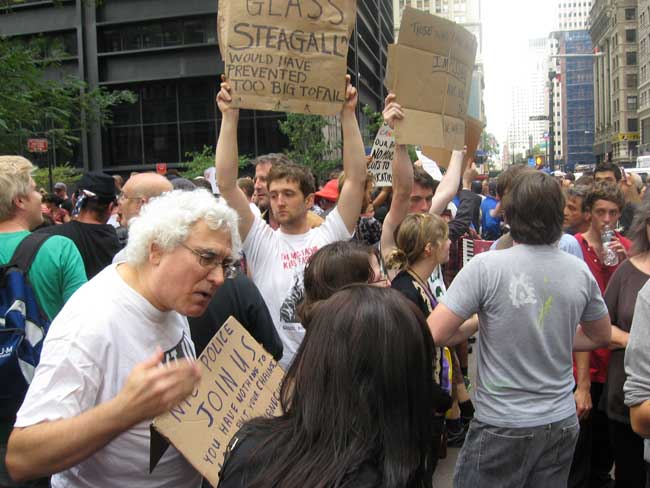
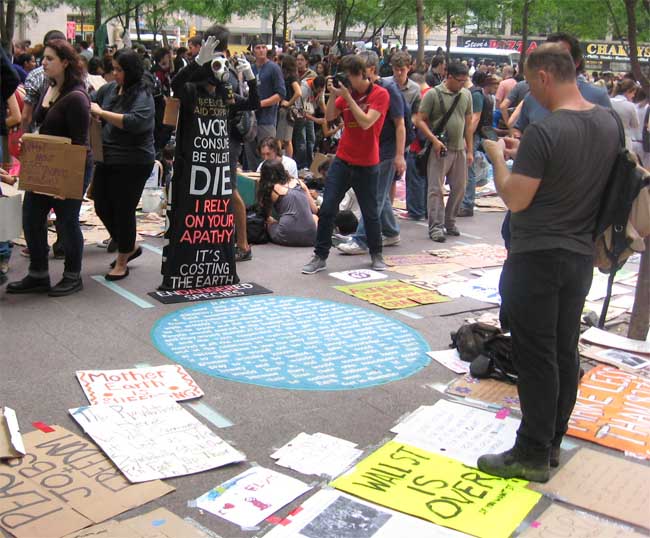
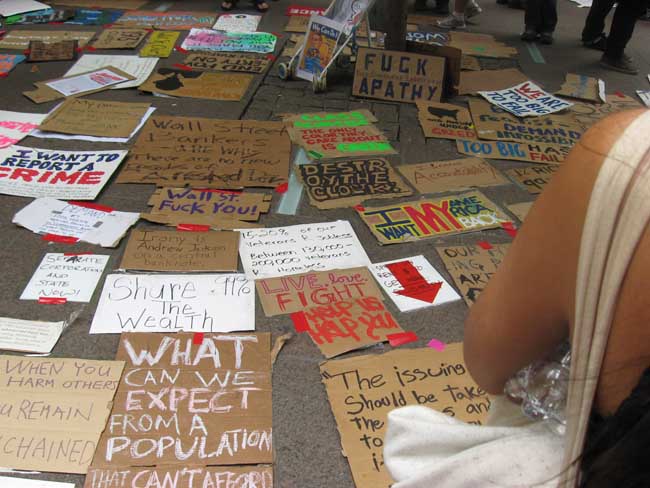
Despite the martinet-minded organizers, most of the SlutWalkers didn’t prepare their signs in advance. The majority affixed marker to board shortly before their participation. It was almost as if they wanted to write out the first thing that came to their minds. I couldn’t help but compare this against some of the cardboard placards that had been placed in Zuccotti Park with more permanent messages in mind.

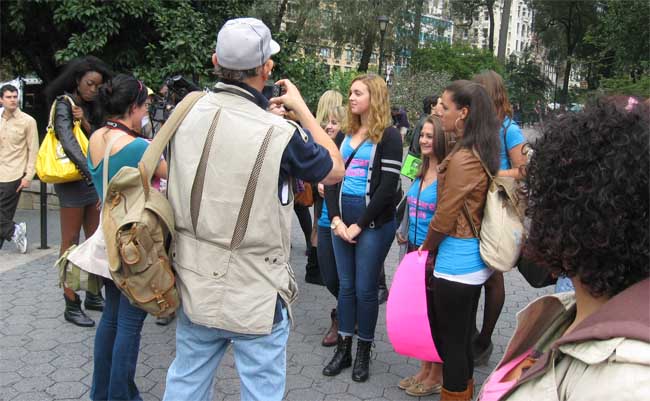
There was a fair amount of media at SlutWalk NYC. I liked the 1010 WINS reporter, who asked many thoughtful questions. I wasn’t impressed with the CNN crew, who proved so lazy that, when the WINS reporter was interviewing a SlutWalker at length, the CNN crew propped his camera up and hoped to siphon off the WINS reporter’s labor. Suddenly there were two mikes recording the woman’s words. I felt compelled to insert my own mike into the shot to make the woman look more important on screen. You can listen to what I recorded of the WINS exchange here:

This text will be replaced

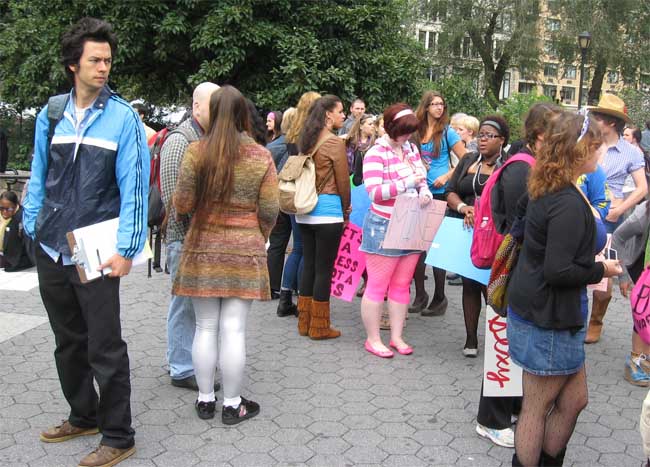
As seen by the way that the young man in the blue jacket checks out women in the above photograph, one little discussed aspect of the SlutWalk is the male gaze. I tried chasing this guy down after I had taken this photo. I wondered if his clipboard meant that he was an organizer or possibly a member of the media. It’s possible that his gaze was innocuous or that he was lost in thought.

Why is this important? Because I overheard a separate conversation between three young men on the perimeter of the protesting area. They didn’t know what the walk was all about. One of them, wearing an orange hoodie, shouted, “They say that women get raped because of what they wear. No, it’s because they crazy loons! If I’m in the jungle at two in the morning, there shouldn’t be crazy loons out there.” The man in the orange hoodie kept enunciating “crazy loons.” I tried to approach this man for a radio interview, curious if he could elaborate on his point and his curious redundancy, but he swiftly disappeared.

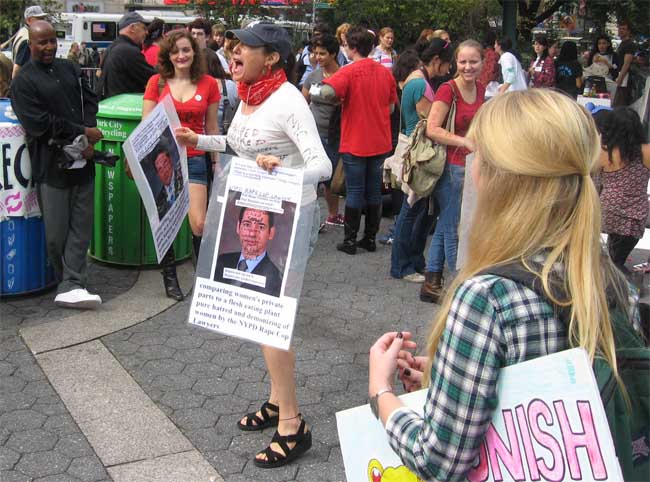
“Stop the rapes! It’s a global epidemic around the world! From babies — yes, babies are raped — to grannies! And that’s around the world! And in New York City, we have a rape epidemic! Rapes are up. The stats on rapes are up. And yet rapes are under reported. Because women don’t want to be cross-examined by Joe Tacopina and Chad Siegel. Women don’t want their vaginas compared to a Venus flytrap!”

This protester was especially vociferous in her tone. You can listen to some of her speech here:

This text will be replaced

I was fortunate to meet Becky, another of the Delaware Sluts. She helped me clarify the origin of the group. I was grateful to learn that the Delaware Sluts was part of an on-campus feminist group called The V-Day Club. The group performs The Vagina Monologues every year to raise money for women’s charities. Hearing of the SlutWalk, they brought the whole group up via bus. Becky also told me that online mobilization was one of the reasons she and her friends were here.

“I read feminist blogs and stuff on the Internet,” said Becky. “And I know that a lot of other people in the organization do too. So I think a lot of people just found it by themselves and then came together through that.”

It sounded to me that, for many who were at Union Square, SlutWalk had come together in a manner not unlike Occupy Wall Street.

Becky confessed to me that she didn’t know a lot of details about Occupy Wall Street. She was still playing catchup.

“I’ve been reading a little bit about it just over the past week,” she said. “But it’s very basic information on my part. I don’t think that anybody feels that we can’t co-exist. I mean, issues are issues. But everybody needs to go out there and be heart. I don’t think it’s really diverting attention from either one.”

This text will be replaced

But while Becky expressed a desire for peaceful unity between SlutWalk and Occupy Wall Street, I began to discover some unanticipated fissures. In search of SlutWalkers who didn’t fit into the demographic of mostly young women, I discovered a middle-aged couple named Murray and Sandy. Both were dressed up for the SlutWalk.

I asked them about Occupy Wall Street.

“I’m very aware of it,” said Murray. “I have a number of friends there. I think the message here is perhaps a little more clear and direct. Over there, it’s a little muddied. But, you know, we definitely wish them luck.”

“I’m not sure why they’re there,” interjected Sandy. “I mean, I know the economy sucks. But I’m not sure what picketing Wall Street is going to, you know, do to help the economy.”

I asked them why they thought the Slutwalk message was clearer than the Occupy Wall Street message.

“Cause this kind of stuff has been going on for as long as I’ve been alive, I think,” answered Sandy, who told me later that she used to work in Wall Street. (She also said later that she approved of Mayor Bloomberg’s parochial statement about bankers struggling to make ends meet.) “That women get accused of inviting rape or whatever by the way that they’re dressed.”

“This is an event that started from an idea with a message,” said Murray, “whereas Occupy Wall Street, I think, just came from…”

Sandy: “General dissatisfaction.”

Murray: “Let’s just go make noise and see what happens.”

When I pressed both of them further on their characterization of Occupy Wall Street as “just noise,” Murray defended SlutWalk as a permanent event and a planned event.

“It’s reasonable to work with authorities on something like this,” he said. “You want to find a compromise. We do have free speech in this society. And for the most part, it is granted. You just have to make compromises to make it work. And I think this is what happens when you make compromises. When you just kind of start showing up, you’re going to get a mass like you have down at Wall Street.”

You can listen to the fascinating five minute exchange I had with Murray and Sandy here:

This text will be replaced

There seemed to me a very conservative thrust to the type of protesting Murray and Sandy were talking about. Occupy Wall Street’s message, while very general, had nevertheless managed to be more inclusive to the public. By contrast, SlutWalk’s more narrowly defined message caused about 500 people to show up on Saturday afternoon.

Yet SlutWalk’s “more clear and direct” message had also attracted participants like Veronica — another member of the Delaware Sluts. Veronica wore very little. When I asked Veronica if I could take her picture, she said, “No thank you.” (During our conversation, she told another person not to photograph her.) When I asked her why she was dressed the way that she had, she told me, “Well, I like how my body is. I love my body and I think I deserve the right to display it the way I want and not be judged because of it.” She told me that SlutWalk hadn’t pushed her over the edge on the issue of judgment and appearance, but that “guys at my college pushed me over the edge on that issue. I’m glad that we have this organization where we can display this dislike of people’s judgments.”

This text will be replaced

Occupy Wall Street: Friday Afternoon

On Friday afternoon, the crowd density at Occupy Wall Street had thickened quite a bit from earlier in the week. Many of the new attendees were journalists. I counted close to thirty media types as I canvassed Zuccotti Park, watching TV vans and cameramen and reporters taking notes on their notebooks and BlackBerries. I saw NY1, CNN, Slate, a concatenation of outlets I had not seen when I hit the park on Tuesday.

“Cough drops!” barked a man with several lozenges in his hand. “Get your cough drops! So when CNN talks with you, you’ll have a clear head for your ideas.”

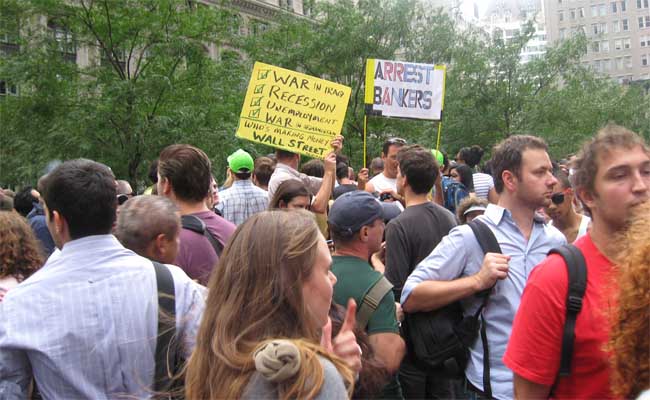
I hit Zuccotti Park in the late afternoon: just before a march upon NYPD headquarters. I estimated the crowd at a few thousand. More poured into the park, some lured by the prospect of a rumored Radiohead appearance at 4PM.

While the park’s perimeter remained open to pedestrian traffic and the cops remained fairly calm (perhaps due to the heightened media), I wondered it the increased media attention would cause more people to come, testing the limits of occupation. I also wondered what plans the NYPD had in store. Cops clad in riot gear? By now, a hackneyed effort to intimidate. Yet across the street from the park, I noticed a badly dressed undercover cop, wearing sunglasses and very much on his own, feebly pretending to be an activist with brand new crutches and a limp that didn’t match the way he was clutching his aluminum.

When attending a large-scale event, it is often my practice to stand in one spot and listen to the surrounding people. The protesters were fully aware that they were putting on a show. Many greenhorns — some considering themselves journalists — had come to gawk. Their intent was to document. They wondered why these people were still sticking after two weeks. Some of the bona-fide journalists appeared to be mystified about why they had been assigned this story.

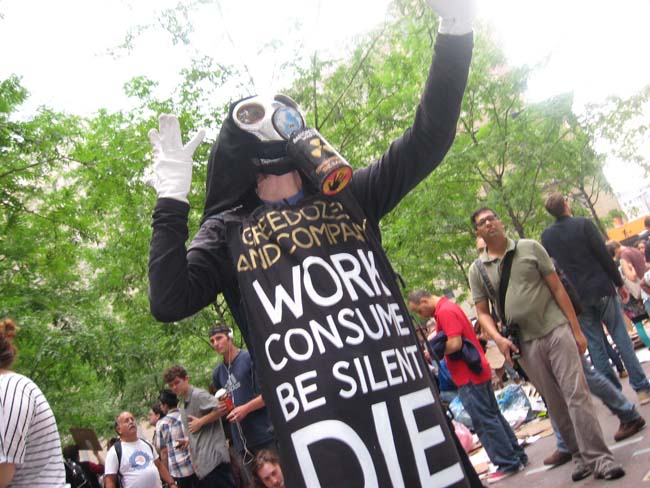
If these slogans and sentiments on cardboard and posterboard appear flip and cliched, what then is the best method to get a message across? In recent days, there has been a modest debate about whether the protesters should dress up and improve their aesthetic.

But from what I have seen in my visits to the park, it isn’t just scruffy kids wearing tie-dye tees. There are many lingering into the park from their day jobs, wearing dress shirts and backpacks. I suppose your sartorial flair depends on the degree to which you’re participating and how long you stick around. (For my own part, I was wearing a red George Orwell shirt.)

The Bat Segundo Show: Nick Broomfield

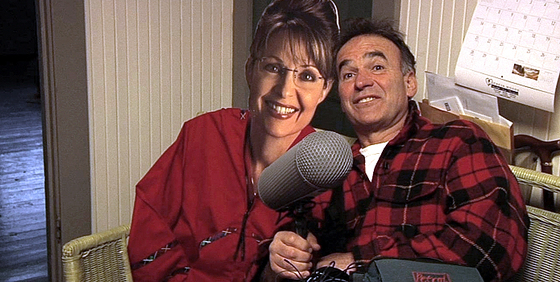
Nick Broomfield appeared on The Bat Segundo Show #413. He is most recently the co-director of Sarah Palin: You Betcha.

Condition of Mr. Segundo: Wondering if he has gone rogue or rouge.

Guest: Nick Broomfield

Subjects Discussed: Being attracted to conservative politicians with big hair, Christopher Hitchens’s sexual fantasies about Margaret Thatcher, Frederick Wiseman and Errol Morris, contending with publicists and press agents, Joe McGinniss’s The Rogue, Levi Johnston and Tank Jones, filming Daryl Gates accepting an interview fee on camera, the ethics of paying interview subjects, Broomfield’s amateurist aesthetic, the faux professionalism of film crews, Broomfield filming himself on the phone, Broomfield’s tendency to gravitate towards ad hominem, whether the possibility of Sarah Palin becoming President is a serious question, John Bitney, Steve Schmidt, campaign management of Palin, Broomfield doing less documentaries, the Kickstarter campaign for Sarah Palin: You Betcha, flipping between documentaries and narratives, wearing red flannel in Wasilla, JC McCavitt, the influence of Palin and the evangelical right in Wasilla, whether or not Wasilla reflects America, whether Broomfield is motivated by vengeance or retaliation, the chewing gum photo montage, balancing the visual details and the facts, collaborating with Joan Churchill, why Broomfield put himself in front of the camera after Lily Tomlin, claims of Lily Tomlin’s insecurity, the difficulty of filming Tomlin, why the construction of a documentary creates a more inclusive one, the dangers of moral labels, why people should trust Nick Broomfield, moral paralysis, subjective truth borne from a personal quest, embarrassing public questioning, Broomfield’s view of restraint as a weakness, hedge funds, getting investors to sign on for a Broomfield movie, working with non-actors, and the ever-shifting Broomfield paradigm.

EXCERPT FROM SHOW:

Correspondent: Going back to Margaret Thatcher [Tracking Down Maggie], it seems to me that you have an especial interest in conservative politicians with very interesting hair-dos. What’s up with this particular commonality? I sense also a formalistic commonality as well with the chase for Maggie and the chase for Sarah here. What of this?

Broomfield: Well, in fact, I never thought of the similarity of the hair-dos. But now that you’ve pointed it out, it’s quite extraordinary.

Correspondent: Are you a man who likes big hair? You’re a Clintonian man?

Broomfield: I’m actually not a particularly big hair man. But when I was doing the Margaret Thatcher film, one of the people I interviewed was Christopher Hitchens.

Correspondent: Yes.

Broomfield: Who had a lot of almost sexual fantasies about Margaret Thatcher, which I hasten to add I never shared. But I noticed that a lot of people also have the same feelings about Sarah Palin.

Correspondent: Yes.

Broomfield: And, again, I’ve never succumbed to those kinds of thoughts with her. But I think that both women captured the imagination of a large part of the population. Probably also because they were women and they had a determination and a charm that was unexpected and was refreshing in its own way.

Correspondent: Yeah. Not attracted to Sarah sexually. But I also think to Fetishes and also to Heidi Fleiss; Hollywood Madam.

Broomfield: Right.

Correspondent: It seems that there is also some sexual quality sometimes to some of your subjects. Especially women. Why do you think this is?

Broomfield: Well, I mean, I think as any full-blooded male once interested — I would apply it more to films like, yeah, Fetishes, Heidi Fleiss. I did a film, Chicken Ranch, in a legalized brothel in Nevada. Even someone like Aileen Wuornos was very interesting along those lines. Sexual lines. It’s funny. Just last week, I saw Fred Wiseman in Toronto. He’s just made a film. The Crazy Horse. A strip club. And before that, he did the ballet film. And I said, “Fred, do I get the sense of some kind of Fräulein in your work.” And he said, “I’d like to see what you’re doing when you’re 81 years old.”

Correspondent: Errol Morris’s Tabloid as well. While we’re on the subject.

Broomfield: Oh really?

Correspondent: Yeah, there you go.

Broomfield: What’s he just done?

Correspondent: He did Tabloid on the sex scandal. 1970s. So there we go.

Broomfield: There we go.

Correspondent: All you documentary filmmakers are turning into dirty old men.

Broomfield: Exactly. Exactly. Just give me a few more years and I’ll be completely there.

Correspondent: To get on a serious subject, since you had experienced difficulties in both Tracking Down Maggie and Heidi Fleiss: Hollywood Madam when dealing with press agents and publicists, you had to know going into this one that you were probably not going to get a sitdown interview with Sarah Palin.

Broomfield: Well, I think that I always had the belief that I would get one probably. And it was only after we’d been there for about ten weeks — just before Christmas — that I really realized with that final phone call with Chuck Heath, the father, that I wasn’t going to get one. I don’t know that one would necessarily learn something devastatingly original with a sitdown interview with her. Because she’s done many interviews and nothing very revealing has come out. Generally, she’s revealing by omission. Which is: she doesn’t know something or she mispronounces a word or she is factually inaccurate or she gets things all confused. So she’s very revealing. Generally about lack of knowledge. She’s very unrevealing generally about herself and her upbringing and even her beliefs. I think she’s very guarded. For somebody who studied media at university, she is completely distrusting of the media and has more control probably over what she says and does than anybody. I mean, the only interview she does is with FOX Television, who she’s employed by. And obviously Facebook and Twitter. But I did think that as we were resident in Wasilla that maybe we would get a down moment with her that would at least be revealing of her — thank you (to barista) — of her family and her friends and the way she saw life around her or as part of the evangelical community. Which is really what Wasilla is.

Correspondent: Well, this is interesting because Joe McGinniss also has a book called The Rogue. And he managed to get more childhood friends to talk — anonymously in that book — and you had to go all the way to way to Alexandria to find someone who would talk with you. I’m curious…

Broomfield: Well, my sources were not talking anonymously. They were talking on camera. And I can back up all my various claims in the film. Whereas I think one of the problems in quoting undisclosed sources is that you cannot back up your claims. And you obviously can’t do that in a film.

Correspondent: I was curious. While we’re on the subject of interviews, Heidi Fleiss: Hollywood Madam has the famous moment where you’re showing Daryl Gates accept the cash.

Broomfield: Right.

Correspondent: In this, you have one moment where you’re talking to Levi Johnston’s manager, Tank Jones, and you’re negotiating trying to interview him for $500. And I’m curious about this. Is this kind of thing ethical? I mean, why would it be ethical? And I’m wondering, when you do in fact pay someone for an interview, do you feel an obligation to feature that on screen? Has this always been the case for you? Have you paid other people?

Broomfield: What I think was interesting is that people like Levi Johnston basically live off — I introduce that segment in the film, saying that there’s an industry that’s grown up around Sarah Palin and people live from that industry. So that was an illustration of Levi Johnston basically — I mean, I think they were asking $20,000. So I think my derisory offer of $500 was more of a joke than anything else. But I think it’s very relevant to point out that there is a great deal of money in tabloid journalism and that people are paid to make contributions. I mean, I didn’t pay anyone in this film. But there have been other films, which you quite rightly pointed out. Like, for example, the Heidi Fleiss film, everybody expected to be paid.

Correspondent: Everybody in Heidi Fleiss pretty much got paid? Ms. Sellers and the like?

Broomfield: They all expected to be paid. I don’t know if they all got paid. But yes. And I think I make a big point of that in the film. I comment on how much money various people wanted. Like DarylGates. I think he wanted $2,000. $1,500 to take part.

Correspondent: But when you introduce money into the equation, doesn’t this affect what you’re going to be getting from your documentary subjects?

Broomfield: Well, I’m making a film about what is. And we live in a world that’s very commercial and a world that has to do with money. And as a documentary filmmaker, you’re reporting on that world. So if everyone wants money in that world, you report on that fact. And of course, that makes a difference. Yes.

Correspondent: What about this amateurist aesthetic that is often in your films? I think of the tape running out in Biggie and Tupac.

Broomfield: Right.

Correspondent: And in this [Sarah Palin: You Betcha], your efforts to try and cross an iced lake or to try and negotiate ice in numerous ways. Or the hat trick in, of course, The Leader[, His Driver and the Driver’s Wife]. And all that.

Broomfield: Right.

Correspondent: There’s a certain…

Broomfield: You’ve certainly done your homework here.

Correspondent: Well, I’m curious about why this exists. Are these deliberate moves on your part to either win over your subjects or win over the audience with a more amateurist approach that’s calculated? Or are these just mess ups on your part?

Broomfield: Well, I would argue that there’s sort of a faux professional approach with a lot of film crews. You know, when they climb back in the car and drive on to the next location, I’m sure they’re a whole lot of fun. And they crack a whole lot of jokes that are not in the film. But when they get the cameras out, they get the clipboards out, and they became these serious professionals. Which I think is a load of bullshit. I think it’s much better to reveal what it’s really like to be doing that film or what you really think or what the humor is, you know? Rather than having this — you know. I remember when I was working for television. I was working with a presenter. And the presenter was actually a very funny guy. And I remember we were making a film in a monastery. And he would get into all these arguments with the monks about whether God existed or how many angels he could get on a pin and all those classic debates. And he would always lose the arguments. Because the monks and the abbot and so on, that’s all they did. And they studied all the books. And they were really up on their theology and logic. And when I showed the film to the TV company, they were horrified. Because they said a professional reporter does not lose his way. Does not stumble over words. Doesn’t turn to the camera and say, “I’m stuck.” But of course, they do. And I think by including those kinds of things, you make a much more accurate portrait than if you leave them out. I think there’s a sort of faux professionalism that we’re surrounded by that is completely inaccurate.

Correspondent: But doesn’t your persona, your schtick, sometimes get in the way of the very subjects that you’re photographing. I mean, every time you make a telephone call in your movies, you’re always in a car.

Broomfield: Right.

Correspondent: And I’m wondering why you feel the need to film that as well. It’s almost as if you’re counting on the subject to say no.

Broomfield: Well, what…wha…I mean, I don’t really understand the point. I don’t know whether you’re saying that the phone calls are irrelevant or the fact that I’m in a car is irrelevant.

Correspondent: I’m trying to point out that you’re really trying to show yourself more than anything else.

The Bat Segundo Show #413: Nick Broomfield (Download MP3)

This text will be replaced
The Bat Segundo Show: Sheila McClear

Sheila McClear appeared on The Bat Segundo Show #412. She is most recently the author of The Last of the Live Nude Girls.

Condition of Mr. Segundo: Embracing the diminishing returns of Old New York.

Author: Sheila McClear

Subjects Discussed: Peter Pan Donuts as a point of meaning in one’s life, Hunter S. Thompson and breakfast, Old New York, staying in New York by any means necessary, having unique issues with your parents, having problems with authority, the swift manner in which money disappears in New York, contending with siblings who tap parents for money, personal responsibility vs. economic victimhood, shyness and job interviews, latent rebellion, zoning out during a peep show strip, whether those who work in the nude can be turned on sexually, the many levels of compartmentalization as a stripper, zoning out in relation to performance and being uncomfortable, transactional relationships and comparisons between stripping and psychiatry, writing as a partition between shyness and performance, being charmed by wolves, how long it takes to a Midwesterner to become a true-blue New Yorker, worldliness, not talking with anybody for two weeks, writing about co-workers and allaying concerns, scribbling on the job and maintaining a notebook, memory as a great liar, expanding anecdotes into stories, how patterns inform the narrative, rebelling and dropping out, freedom and reality, being a reg, healthy addictions and obsessions, the advantages of having a focus, McClear’s reluctance to use the words “object” and “objectify,” difficulties with didacticism, the power dynamic between a stripper and a client, dealing with the inevitability of being objectified, losing one’s virginity later in life, working the same peep show stint as a top draw, Fashion Week, the importance of clothes and theatricality in the peep show, the advantages of wearing a schoolgirl skirt, how piercings trick people, guys who read your energy, not being able to hide behind your clothes, dressing like your archetype, subconscious authenticity, making more money when ovulating, the uselessness of wigs, split-second decisions, racism in the peep show industry, racial profiling and men’s sexual preferences, troubling generalizations, race and hiring practices in strip clubs, hygiene at strip clubs, the dangers of mops, sterilizing dollar bills, the necessity of internships to get a foothold in the New York media industry, Ivy League pedigrees, unemployment claims towards Gawker, improving labor conditions for sex workers, exploitation, stage fees, the difficulties of worker organization, what might have happened to McClear without the peep show industry, and the just safe enough nature of peep shows.

EXCERPT FROM SHOW:

McClear: I have problems with all authorities in general. It makes sense.

Correspondent: It makes sense. Your parents were both lawyers. When you were out here trying to survive, did you ever tap them for money? Because that was a question that was never answered in the book.

McClear: My mom gave me two grand when I moved. And every once in a while, she’d send like a hundred dollars in the mail. I never asked them for money. Occasionally, they would send it. No, I would say, other than the two grand — which, God, that disappeared so quickly.

Correspondent: It does in New York. Yeah.

McClear: I already had money too and…well, not a lot. But no. No. I didn’t. It was that and occasional things in the mail. Also my sister was tapping them for a decent amount of money.

Correspondent: Oh, I see. You wanted to be the more respectable sister? (laughs)

McClear: I felt it was unfair to pile on.

Correspondent: Yeah.

McClear: Then there was also the point of, well, at least then I…you know?

Correspondent: Yeah. Yeah. Of other attempts at employment, you write, “It wasn’t as if I didn’t try and do something else.” And I’m curious. To what extent could you be said to be personally responsible for finding work in a peep show? I mean, you were determined to stay in New York by any means necessary. You wanted to prove something to yourself. So obviously you made the decision. So how responsible are you for something like this? Or do you view yourself as a bit of an economic victim?

McClear: Oh, not at all. No one forced me to work there. And it wasn’t my first choice at all. But as I got more and more and more — I mean, everyone has a hard time finding work.

Correspondent: Sure.

McClear; And I probably — I don’t know. I was probably doing something wrong in my job search.

Correspondent: You really think that? I mean, how many resumes did you send? How many job interviews did you go on?

McClear: I don’t know. I think I was so shy back then that I probably came off as bad in an interview. You know, a little awkward. But I was totally — I had this sort of latent thing where I never had rebelled. And I had never been a slacker. I never did drugs really. I never had acted out or been promiscuous. And like there was sort of that going on. And that sort of felt like the first excuse. Especially now that I was by myself and didn’t know anyone to reprimand me or find out what I was doing. It was sort of the first excuse that I found to act out in what was sort of a safe and controlled environment. I took it. And there are other things leading to that decision. Like needing a job and stuff. But I was looking for a way to act out obviously. It had to happen sometime.

Correspondent: Sure.

McClear: Like when people go through their drug phase or their sleeping around phase or their slacker phase. I never did any of it. And I was 25.

Correspondent: You were feeling left out?

McClear: I was feeling left out! And totally uncool. (laughs)

Correspondent: Uncool? I mean, why? I mean, by what metric, if you are so anti-authority, did you feel uncool or not hep or not with it? I mean, who gives a fuck about that?

McClear: I guess I did give a fuck. (laughs)

Correspondent: Many times in the book, you describe zoning out and shutting your brain off during a peep show strip. Of a photography modeling job that steered into an entirely unusual direction…

McClear: (laughs)

Correspondent: …you write, “I had already floated away inside my head, detaching my mind from my body. Nearly three hours had passed before we were done.” But I have to point out even before you arrived in New York, when you performed with the Terranauts in Michigan, you write, “The rush of performing canceled out the noise in my head.” So it seems to me you’re describing here this need to act out. But I should point out that there has been, at least in my reading, this tendency to want to check your brain in or zone out or just not focus. To what degree was it there before you worked in the peep show? And do you think that working at the peep show exacerbated this tendency?

McClear: Yeah. I think it was there. Because my personality type is more of an observer. A little bit of a depressive. And sort of an introverted person. And a tendency to overthink things. Which is probably like…

Correspondent: (laughs) This is going the other way!

McClear: Well, it’s probably describing most writers. So it’s always a vacation if you can find a way — whether it’s meditation or exercise or playing in a band or whatever — to put your mind at ease. But then, of course, being in the peep show was just so — doing the show was much too personal. It was uncomfortable to be present. So I would always check out. And then it did exacerbate that tendency. Just like I described. Of turning a light switch on and off until the breaks. Because you’re like unsure of like “Am I on or off?” Or you can’t toggle between them as much anymore. Which is why I flipped out that one time and went to Bellevue.

Correspondent: Yeah.

McClear: And then I think it just ends up in you withdrawing more. Or just being less present. I actually had a friend who was a nude massage therapist at the time. And she was like, “Um, are you able to be turned on sexually anymore? Because I’m not.”

Correspondent: (laughs)

McClear: And I was like, “Oh. Me neither.” And she was like, “Yeah, I think it’s my job.” “Yeah, probably mine too.”

Correspondent: You couldn’t compartmentalize in any way? That Chelsea [Sheila’s peep show identity] was one type of sex and Sheila was another?

McClear: I could have. But I felt, and I did to an extent, that compartmentalizing too much would almost be like losing some core part of your personality. And I worked with a lot of girls who compartmentalized to the point where they were not the person they used to be before they worked in the business. So I didn’t want to be like that.

The Bat Segundo Show #412: Sheila McClear(Download MP3)

This text will be replaced