March 31, 2004
Chip's Asleep at the Wheel
More journalistic endeavors later. For now, the NYT book coverage has me very concerned. Eurotrash is the NYT takedown queen, but I knows bad grammar whens I sees it.
From this Michael Kazin review:
"Susan Jacoby regrets in her new book" -- Is that the only way Jacoby regrets? Through tomes?
"zealous Protestants secured laws to ban the sale of alcohol, erotic literature and diaphragms" -- As opposed to executing them? I secure my pants and the Xmas tree on top of the car, thank you very much.
"the teaching of Darwinian theory in public schools" -- Christ, why not just "teaching Darwinism in public schools?"
"Ms. Jacoby concludes her book with a shudder" -- Too bad she didn't conclude with a docey doe or a pirouette. That would have been something.
"Her title was shrewdly chosen." Thank you, Tom Swifty.
"But parochial schools were originally established to provide an alternative to public ones where students routinely learned only the virtues of the Reformation and recited from the King James Version of the Bible, commissioned by a Protestant monarch." Two icky adverb-verb combos in one sentence? WTF, Chip?
"religion is just a stew of unprovable myths." Well, start cutting up those potatoes.
Kazin, incidentally, is writing a biography of William Jennings Bryan. A match made in heaven if you ask me.
Katie Zezima fares better, but not by much.
"A bar by the railroad tracks is named Casey's" -- Active voice?
"The 289 residents of Mudville" -- Again, a voice that is more active?
"What is true is that Thayer" -- What is true is that you don't need anything before "Thayer."
"Thayer went but soon returned to Worcester and wrote" -- Well, make up your mind, Thayer. Three past tense verbs in nine words?
"A stadium is planned for the site where Casey is said to have played."
-- A copy editor is planned for the essay that Katie is said to have written.
Where the hell's Tanenhaus?
March 30, 2004
The Time Has Come
At long last, I have figured this gambit out. The Life, only occasionally referred to here in Reluctant-Land, has become one of those things where one wonders how to maintain a blog under the circumstances. Over the past two weeks, I have been trying to figure out how to balance reading, writing, and living -- all three of which are far more important than anything I could possibly post here. Like most bloggers, posts are offered to stave off afternoon boredom (hence the one-third nudity clause referenced not long ago -- 66% of everything else is illicitly penned with frequent Alt-Tabbing, often with sizable mistakes, quietly corrected after being pointed out by nice people). This Walter Mitty existence is all fine and dandy. It allows me to keep up with literary-related news, you to read it (and/or poach it -- I don't care), and everyone remains more or less happy. But I thought it might be a good idea to point out what this blog is and isn't.
1. This is not a 24 hour literary news powerhouse. That would be nice, but quite frankly I have other things to do with my life. If I do not read, I do not improve my writing. If I do not write, I do not improve my writing. If I do not live, I do not improve my writing. There is an ostensible goal here. It will take years. As a result, early morning and evening updates have been abolished, so that necessary existential duties and functions can be carried out. Maud, the Saloon and Mr. Sarvas (among many other swell places) pull this off better than I can. But frankly, I just don't have the time anymore. In an effort to kill the needless distractions in my life, the plan is to blog (for the most part) daily, but only during hours in which I am renting myself out to unidentified overlords.
2. No more posts while nude. A few weekends ago, a priest buzzed my apartment. He wasn't a Jevovah's witness, but he did identify himself as "a man of the cloth." The priest offered to observe me for a week and determine if there were specific activities I was particularly adept at with clothes on and (he preferred) with clothes off. I didn't ask about the scientific principles involved. But it was either this or a three-hour effort to convert me to Catholicism. So I caved. The priest determined that I was more successful reading in the nude than writing in the nude. Since I have this tendency to take my clothes off, in part or in full, close to bedtime, and since I feel more comfortable doing this, now that a priest is no longer hanging around the flat, the choice has become obvious.
3. A greater emphasis on journalism. I don't have Laila's drive to do a book review every week. But I admire her ambition. And I also admire Mark for his Dan Rhodes interview. And, yes, despite my differences with Dan Green, the man is trying to come to terms with the role of criticism. So props to him too. This is the kind of stuff that we, as literary blogs, should be doing. If we are to have any real credibility or purpose here, then the time has come for us to put ourselves out there, rather than compiling collections of links. Imagine the kind of coverage that can be found at Bookslut or January or Book Ninja transposed to any of your favorite places. Elaborate comparisons, attempts to gain insight that the major newspapers can't (or won't) cover. You know what I'm talking about.
This whole "link plus commentary" business is about as difficult as microwaving a burrito. I think blogs can do better. I know I can do better. There's something extant in the form that has made us all lazy.
Fuck Google News. How about making some phone calls and confirming facts? How about looking at your local literary calendars, calling up a publisher's publicist, and arranging for an author interview? How about showing some actual initiative?
In fact, I double dare everyone involved in the lit blog world to pound the pavement.

Leave of Absence
Herr Pollack is back. My services are no longer required.
March 29, 2004
How to Spice Up Your Relationship
All it takes is a broom.
Updike Wins PEN/Faulkner
The Hollywood Reporter (of all places) is reporting that John Updike has won the PEN/Faulkner.
[UPDATE: Here's the Reuters article. Damn, I was rooting for ZZ. I dig the Rabbit Angstrom books, but does Updike need another award?]
Times X2
The Times chronicles the success story of Andrew Sean Greer, now covered in every newspaper from here to Madrid. Read Max Tivoli before you get sickened by the chronic coverage.
Beyond that, there's stunning news of Anne Fadiman departing The American Scholar. Fadiman was reportedly asked to leave because of PBK's perilous finances. Under Fadiman's tenure, the Scholar was one of the foremost places to find nonfiction.
Dale Peck: PR Poster Boy?
Rake points to this press release for "Peck's Last Negative Review Ever." There's a phone number there for some guy named Peter McFarlane, if anyone's curious. McFarlane notes that he "scored" the Peck review. Well, certainly, if anyone wishes to compare acquiring an essay called "The Man Who Would Be Sven" to a midnight run for a dime bag, then the metaphor is apt. We here at Return of the Reluctant, however, prefer publicity in a more abrasive form:

Those Nanny Diaries Gals Ain't Got Nothin' On Plum Sykes
Sykes, a 34-year-old contributing editor at Vogue and the more dramatic sister of a nineties “It”-girl twin set—“Lucy and I were Paris and Nicky without the sex tape”—received a $625,000 advance for her novel from Miramax Books in 2002. Bergdorf Blondes turns out to be a Devil Wears Prada where everyone is an angel. “I say, if you are lucky enough to go on gorgeous trips abroad, take your girlfriends something fashionable back,” reads one line. Early reviews are lukewarm (“Tacky? Absolutely,” said Publishers Weekly).
(via Emma)
Hey, We May Be More Paranoid Than We Think
You've sold more than 40 million books. Number 12's about to come out. What do you do to keep your readers hooked? You throw in the Messiah himself.
Yes, Glorious Appearing, the latest entry in the Left Behind series is almost due. And this time, it's personal. Jesus himself shows up. And for those who can't wait for the Literary Event of the Millennium, there's an excerpt up for die-hards:
Mac's magnified vision fell upon colorful, metallic pieces glinting in the sun, perhaps a mile from his position. Oh no.
A red fuel tank and a tire looked very much like parts from Rayford's all-terrain vehicle. Mac tried to steady his hands as he panned in a wide arc, looking for signs of his friend. It appeared the ATV could have been hit by a heat-seeking missile or smashed to bits by tumbling. Perhaps, he thought, no sign of Rayford nearby was good news.
Quite possibly, the prose could have been wrought by a devout illiterate or ignored to bits by sleeping.
Dr. LaHaye also notes, "The Bible clearly teaches there's going to be a one-world government in the last days. And after the Rapture of the church, then that one-world government will coalesce, bringing together all the governments of the world and also bringing together all the religions of the world. The fact that we're seeing some of those things happen right now must be a wake-up call to some people to say, `Hey, we may be closer than we think.' "
I don't know, Doc. I'd go with the unnecessary revival of Kirk Cameron's career as augury.
Dublin Shortlist
The Impac Dublin prize has been whittled down to a shortlist of ten. The final nominations are:
The Book of Illusions by Paul Auster
Any Human Heart by William Boyd
Middlesex by Jeffrey Eugenides
Caramelo by Sandra Cisneros
Family Matters by Rohinton Mistry
The White Family by Maggie Gee
The Blinding Absence of Light by Tahar Ben Jelloun
Balthasar's Odyssey by Amin Maalouf
Earth and Ashes by Atiq Rahimi
House of Day, House of Night by Olga Takarczuk
The prize, set at €100,000, is one of the richest literary bonanzas to nab. Or, as previous winners have put it, "You'll never have to work again."
About the Redundant Writer Who Couldn't Stop Repeating Himself
When he met her he met her and he liked her as much as she liked him yes, he heard things better, meaning better than before and quite possibly better before he met her, and in his eyes those powerful bright blue orbs that had taken in her presence when he met her the lines of the physical world meeting up at that point where they had met each other and he had liked her, she liking him as much as he did, both standing on these lines signifying the point of the world where the two met, and they both liked each other. He was smarter, smarter than you, smarter than her yes, and quite possibly smarter than the rest of the world because he was a writer of redundant details, and he always had something to ramble about, whether political satire or short shorts or sentences for the kids. They would publish him because he was rich and because he liked you and liked her and he wrote about cute digressive things, nothing about the real world, the world he knew before he met her and they liked each other, just as they were standing on the lines of demarcation. But as to these physical lines of geography demarcating one detail from another, it should also be said that in addition to liking each other, they also liked these lines of geography, and it is safe to say that the lines of geography also liked them. And since everybody liked each other, they would soon spread this terminology across the planet, getting assorted people to stand upon these lines of geography, these lines of demarcation, and making them like each other without force. Everyone's eyes would turn into bright blue orbs and, yes, he would like her, she would like him, the twain would like the lines of geography, and whoever else happened to be in the room (other than he and she and the lines) would also like everybody else. It would be a fine plan for a fine afternoon involving fine people.
Ustinov Gone
Peter Ustinov has passed on. He was one of the few actors who could write. He made a grand Poirot, and he was so incredible that I foolishly believed he would be around forever. Ustinov's Billy Budd was a personal fave of mine. He'll be missed.
Fourth Amendment Decimated in Three States
The Associated Press: "Acting on a Baton Rouge case, the 5th U.S. Circuit Court of Appeals ruled that police do not need an arrest or search warrant to conduct a swift sweep of private property to ensure their own safety. Any evidence discovered during that search now is admissible in court as long as the search is a 'cursory inspection,' and if police entered the site for a legitimate law enforcement purpose and believed it may be dangerous."
Scaleback
A hard April 1 deadline stares back at me on the play, which is doubly interesting given that a character's gender switched over the weekend (thanks to a very simple and obvious observation from my producer, which explains all the homoeroticism that found its way in). So while I contend with this madness, you won't be hearing much from me this week, except via the usual afternoon subterfuge.
But I will have more on the Academy of Arts contretemps very soon.
March 28, 2004
Laura Miller Pushed for the "One Imagines," I'm Sure
The Hag hits the NYTBR again. That's two tangos with Chip before the handover. It's a good review. However, I suspect that the copy desk mangled clarity into a genteel timebomb: "One imagines it's difficult to capture eloquently the horrors of a baby being thrown out with the bath water, but that's probably why most first-time authors don't attempt it."
And, as Ron observes, that's not even the half of it.
Come on, Tanenhaus. Play ball.
A DAY IN THE GODDAM LIFE OF ...Horace Krum
A Day in the Goddam Life (with apologies to Lenin and all other despicable leftists who object to modifiers like "goddam"), a new feature that will run periodically on Return of the Reluctant, follows local residents through their daily routines. But rather than dwell upon the obvious success stories, it is this publication's hope to profile those who do not have the security blanket of an expendable income. The first installment is about Horace Krum, an aspiring writer living in poverty. Mr. Krum doesn't enjoy being used as a yardstick, and we suspect that this is one of many reasons why he's been denied his fame and fortune. That's exactly why this profile is "about Horace Krum," the same way that the average penis pump owner's John Thomas is "about two inches" or a typical shitstorm from the Weinstein brothers is "about 7.4 on the Richter scale."
For eight years, Krum hasn't received a single notice from the public. He spent much of that time ingratiating himself with the affluent. He courted rich heiresses. He gardened several homes, often pruning the shears with his shirt off. Krum, however, didn't quite have the upper body development that bored rich ladies are bound to notice. So he tried his hand at love letters. Alas, poor Krum was terrible here too.
Eight years of toiling for the attentions of some noble benefactress and eight years of writing stories. For eight years, Krum tried to be noticed. He received boiler plate letter after boiler plate letter: "Dear Ms. Krum: Thank you for submitting your story. Unfortunately, it does not suit our magazine's needs at the present time. Please don't send anything more to us. Ever. Frankly, you suck. Cordially, Tiny Tim Tender, Production Intern."
Which is why our intrepid reporter followed Horace Krum for a day. What's it like to live the life of a failed writer?
8:30 a.m. We meet in Horace Krum's studio apartment, which he shares with his roommate Biff. The apartment's located in a tenement. Krum sleeps in a closet, which allows him to save about $100 a month on rent. Biff, who introduces himself as a gentleman fond of "personal space," tells us "to get the hell out." Krum collects two suitcases: one containing his typewriter, the other containing things to work on.
Krum tells me that he's trying to whip himself into shape. He tells me that it's important for all writers to have a physique honed by Nautilus, because the book world has become increasingly reliant upon "sexy, fuckable authors" that they can send out on book tours. Unfortunately, Krum can't afford a gym membership. So we end up jogging together in Krum's neighborhood. Our tennis shoes crunch down on crack vials. We nearly run into a vagrant's shopping cart taking up the whole of the sidewalk. And, about five minutes into the exercise, we are both mugged.
This is particularly unfortunate for Krum, because he had $200 in his wallet. This was much needed cash. Krum had sold his beloved collection of first edition O. Henrys, so that he could make this month's rent. A hard decision, but he needed to keep a roof over his head. But Krum remains optimistic. He tells me he's sent four stories out this week. One of his stories, "They Had Brunch at Denny's," is 6,000 words. Krum has high hopes for this one. He's submitted it to Waverley Wonders, a small literary magazine that pays 4 cents a word. That's $240 before quarterly taxes.
10:30 a.m. We return to Krum's apartment. Biff is gone. He's headed off to his job as a butcher. I notice that the wallpaper is peeling. Krum quickly flattens down the wallpaper. He shows me a thick file filled with rejection notices, all of them from this year. Most of them are bad photocopies. Some include marked up copies of Krum's stories. I find one which reads, "Unbelievable! Have you ever slept with a woman?" "And that was really odd," Krum tells me, "because that was a coming-of-age tale involving two boys."
I point out to Krum that Waverley Wonders hasn't published a story longer than 2,000 words in its entire run. "Oh, they will," winks Krum. "Just you wait."
11:00 a.m. Krum usually writes between 11:00 a.m. and 5:00 p.m. Except today, because he knows that I plan on buying him lunch. He needs to be done before Biff comes home. Aside from short stories and essays, Krum's also "messing with a romance novel, partly historical, set in Larry Ellison's home." He writes his stories on a typewriter because he cannot afford a computer. He steals paper from a local Kinko's. This is because he has a friend who works there, who hates the job, and wants to "stick it to the man."
"How often do you eat?" I ask. Krum opens two doors of a cupboard. One of the doors falls off its hinges. Inside the cupboard are endless packages of Top Ramen. He gets these at Costco.
Krum has been lucky enough to be invited to a few poetry readings. And he attends these because he can count on free hors d'oeurves, which provide additional sustenance. This diet hasn't boded well for Krum's digestive tract. But Krum tells me he's kept up his energy, thanks to the additional additives in the tap water.
12:00 p.m. I take Krum to Chevy's, largely because Krum's keen on the calories he can get from the endless chips. He orders three margaritas and eats four enchiladas. He begins to slur his words and bemoans "that muddafugga Biff." He then declares himself a genius and tells me that New York will never understand. I point out that he's still writing and sending his stories out regularly. He then apologizes to me for being an ass. He hasn't been able to afford the luxury of liquor for a long time.
1:00 p.m. Back at Krum's apartment, I ask Krum if he has a girlfriend. He dodges the question, pointing out that he used to enjoy cooking, back in the days that he had a day job. "I haven't cooked anything in years," he laughs. "Haven't been able to afford even the basic staples. Man, can you imagine the kind of food that Larry Ellison could afford?"
2:15 p.m. Krum kicks me out of his apartment. It must be the margaritas, but I think it also has something to do with cutting into Krum's writing time. I walk away with growing respect for Krum, a man with almost no resources trying to crack a cruel industry. Perhaps someday, the world will appreciate a man like Horace Krum. That is, if he doesn't die of starvation first.
March 27, 2004
Brass Balls
The Glengarry Mix: the Ultimate Abuse Mix makes life worth living.
I'm All for Donating One's Body to Science, But...
When in doubt, go fuck yourself. (via MeFi)
March 26, 2004
Story Causes Student Expulsion and Teacher Dismissal
On the local front, here at the Academy of Arts College, a student was expelled and an instructor was fired. Jan Richman taught a Narrative Storytelling class. An unnamed student wrote a story which contained violent details. The story was passed onto Tom Molanphy, head of the writing division, for notes. The student's parents called, alleging that their son was being "encouraged to write about violence." To put the story into some context, Richman assigned David Foster Walllace's "Girl with Curious Hair" as an example of an unsympathetic character. But this apparently caused some problems with the top brass. Wallace's story wasn't part of the assigned textbook.
From here, the details grow murky. Richman was led up the administrative ladder, and was dismissed at the beginning of the year, after a series of meetings. No reason was offered for the dismissal.
The Chronicle does (as can be expected) a solid job of collecting the details. However, important questions of policy and procedure remain unanswered. Was there a policy in place to determine what teachers were allowed to teach at the Academy of Arts? And how much freedom do instructors have there?
Eileen Everett, chairman of the liberal arts department, told me that she couldn't comment on any policy matters at this time. She directed me to Sallie Huntting, Senior Vice President of Public Relations. I left a message with Huntting.
I also have calls into Richman and Molanphy.
As information comes in, I'll keep you posted.
March 25, 2004
Book Babes Watch
It has now been eight days since we've heard anything from the Book Babes, with the last column featuring Margo alone (with an almost Stalinist exclusion of Ellen). Have the Book Babes been canned? Did someone actually pay attention to Mark's petition? Inquiring minds want to know.
To be clear to the Poynter Institute (if they are indeed watching), the collected hope was to raise the level of discourse, not eviscerate it completely.
I certainly hope that Poynter isn't foregoing book coverage altogether. But if they're looking for replacements, there are more than a few possibilites.
Storming the Gates
The event is free and open to the public. It happens every year at the San Francisco Main Library. The Northern California Book Awards. Timed early enough to keep the happy hour crowd away. The library shuts its doors at eight. Get out and go home to your books. And buy some on the way.
This is an awards ceremony, but you won't find spouses, friends or family. This is a tableau vivant. Support your local indie bookstore. Support your local gunfighters.
Walk in, away from the dying sun. You don't even have to stroll past security. Just hang a right and gambol down the steps into a murky contemporary world of yellows and browns. Is that why they built the Koret Auditorium? The great irony about this basement hall, which seats 235 people, is that it has no windows.
There is a table of hors d'oeurves in the center of an adjacent room. A civilized din escapes the reception. Eat eat. This is legitimate gatecrashing. Drink drink. Refine your mind with some free wine. But don't you dare take any of it with you into the Koret. It's not allowed. This is, after all, a library.
Stand on the side as the crowd spills on. The authors smile and nod their heads. The readers gush, hoping an aw shucks will secure an acquaintance. But it's not to be. Distance is valued. A good way to fend off the potential nutjobs and filter the unimportant and the unpublished. Telegenic cadences have been perfected on book tours, as has the well-timed bon mot. Nothing too daring, nothing alienating or iconoclastic at all.
There they are, the scribes forming circles, socializing with the occasional stragglers. If you can't recognize them from their author photos, then there's always the name tags. Not much that a stranger can say except, "I loved your book," which is exactly what I tell Ms. Packer. That's enough for most people, but, from what I can see, not enough for a few middle-aged couples looking for a diversion. The old ladies effusing enthusiasm for regional royalty aren't noticing the rote nods, the feigned interest, the Dale Carnegie technique. It looks like winning and influencing, this listening seen from afar as a half-assed gesture. And why not? The obvious goal is to sell books.
One writer recalls my name (before I introduce myself) and pictures of presidents posted in a recent blog entry. This little place? I don't know the ritual. Is this some indication that literary blogs have influence or is this just a way to ensure additional leverage? It reminds me of Bill Clinton noting several personal details just before talking with someone, and winning fans. But I think it's an unintentional way of telling me that this is exactly the impression we dilettantes are conveying to the authors. After all, what can any of us possibly infer beyond the text? What is there to say? I tell her that I've ordered her book ("Your order has shipped" read an email that morning). I ask if she's nervous. She says she's had some wine. Presumably to make the trundling across the room more bearable. Understandable.
These writers hope to retreat to their ateliers. Rebecca Solnit, who wins the nonfiction award for River of Shadows, addresses this solitude and thanks "the book people." Again, understandable. Who wants to do PR? But it's all part of the biz. Beneath a library prioritizing technological glitz over books, there isn't a soul under thirty, save me just barely. The room is populated by authors and their followers. Fervent readers, silent hustlers selling books. Even the catering crew's kept behind a swinging door, save for carefully timed replenishment of viands. I joke to my friend about the guy with the Minor Threat T-shirt and torn jeans who's not there. Fortunately, I spot a few folks in leather jackets. My people? Hell if I know.
They come. All sorts. Whoever spilled in from the street. Whoever will play the game. Whoever remains naive enough to believe that this is a genuine celebration of literature, a call and response for local awareness, the bridge between the masses and the glitterati.
See one prominent novelist's cute lime green skirt flutter as she hits the stage. Marvel over their Miss America smiles, their poise, their diction, even the austere ceremonial rituals. Is this what literature's about? All the nominees saunter in front of a crowd as the titles are riffled out, then disappear into a room, white fluorescent light dappling the tops of their heads. When the winner is announced, she emerges to read something within three minutes. Since there are only seven awards, the timing's just right.
They read. And the words stand alone. But while Tobias Wolff offers a nice Southern drawl, even he has to point out where he's quoting within his text. Solnit has to specify when she's quoting Edison and when "that's me." I have to wonder if the art of reading has been lost.
There is one very sweet moment. Peggy Rathmann wins the Children's Literature Award for The Day the Babies Crawled Away. She's genuinely surprised and honored. Her mouth forms into an adorable O. She shows the audience two pages that she's illustrated and then reads the accompanying text, which isn't much. She's off the stage in less than a minute and a half.
The other grand moment is hearing Phillip Levine, honored for lifetime achievement. He is self-deprecating when he gets his award. He thanks the NCIBA for considering Fresno as part of Northern California, "which suggests that they've never been there." But it's Levine's poem, about spending his days in a library while on the clock, that gets me picking up one of his books after the awards are over.
There's no way to know how nervous these folks are, or how vexed they must be to have their work judged by their deportment. I wonder if there's a better way to generate interest or to get people reading. I wonder if there's a better way to celebrate authors. I'd like to think so. This business of readings and awards ceremonies boils down to the same image-laden, personality-driven nonsense. So why pretend?
But I'm more than willing to concede that it's probably me.
March 24, 2004
Northern California Book Award Winners
Novel: Old School
Short Story Collection: How to Breathe Underwater
Poetry: Notes from the Divided Country
Non-Fiction: River of Shadows
Children's Literature: The Day the Babies Crawled Away
Translation: Head Above Water
Detailed report to follow tomorrow morning.
The biggest surprise was Orringer beating out Packer. Also, it was probably a mistake to introduce myself to Waldman and say, "Hey. How's it going?" There were reasons for this -- among them, a bad memory. More tales of inept literary adventures tomorrow.
Let's See Teachout Pull a Pirouette
I'd be damn remiss if I didn't point out that Terry has a Balanchine excerpt up. (Thanks, Laila, for reminding me.)
Bill Gates Tries Frightened Defense Against EU Antitrust Charges

Always Look on the Bright Side of Mel
The Passion of the Christ? Screw that. The real theatrical gem is The Life of Brian, coming again to a theater near you.
Raines Speaks His Mind
Shocking allegations from Howell Raines will soon appear in the Atlantic -- part of a planned memoir called I Was Master of the House, But Jayson Kept Playing With the Zippo. Among some of the highlights:
1. Raines secretly coveted the drugs and alcohol, and kept Jayson Blair on the payroll so that he could "relive his twenties again."
2. Not once did Raines call Jayson Blair "boy."
3. Raines once asked Blair to sit on his lap. Blair declined. Raines claims there was nothing sexual involved. The lap-sitting incident was all part of a great Raines family tradition dating back to 1872.
4. When fishing with John McPhee on the Delaware River, Raines promised McPhee that he would only name-drop upon publication of a memoir. McPhee gave Raines his blessing, but only after delivering a six-hour lecture on geography.
5. The one thing Raines would have done differently: casual Fridays.
(via Maud)
Who's the Real Bitch?
Rake points to this Birkets column and the potential conflict of interest. Birkets, as we all know, was the last man pummeled by Dale Peck.
No one's entirely sure how the fight went. Because frankly the house wasn't full.
But given Birkets' new offering, we hereby revise our initial assessment of Birkets and demote him.

March 23, 2004
Hasty Snippets
Cathleen Schine's new novel is (no surprise) about a woman leaving her husband for a woman. But that's not all. Schine will also be appearing at the Tennessee Williams/New Orleans Literary Festival on a panel with the man she left, David Denby. The festival organizers have tried to get Denby and Schine to sing "I Got You, Babe," but Denby can't carry a tune. Complicating things further is the fact that Schine doesn't own a leather jacket. She also reports that she saves her provocative undergarments for the bedroom.
A new Rudyard Kipling story has been found. It will be unveiled in front of Kipling fans on April 7. The story is another part in the Stalky & Co. series. The hope was that the stalkers would touch Stalky first.
Print on demand: Comes served with vanity mirror.
Northeastern University closes shop.
The Post-Gazette catches up with Daniel Keyes.
Polanski's doing Oliver Twist. No doubt the role of Nancy will be notably broadened.
And Jennifer Haigh has won the PEN/Faulkner for a distinguished first work of fiction. Her book, Mrs. Kimble, is about a man who marries three different women at different times in his life.
Only One of the Holy Trinity Can Be Counted On
When in doubt, rely upon Dan Rather to defy common sense. Whether it's the 1968 Democratic Convention or Gunga Dan, the very likely possibility that Dan Rather will go nuts is why I will be glued to CBS on Election Night. Only eight more months.
Bob Edwards Fired by NPR
At the risk of coming out of the radio junkie closet, "natural evolution," my ass! Canning Bob Edwards is like pissing on the pontiff's robe. You just don't do it.
[UPDATE: If you'd like to write a letter, NPR's address is 635 Massachusetts Avenue N.W., Washington, D.C. 20001. Letters, by way of being physical objects, are more likely to be read than email. So get at it, folks.]
The Liz Penn/Dana Stevens Reader
Because, beyond the usual spot, well, someone had to do it. If there are any more, please advise.
Surface Beauty (Slate, Oct. 31, 2003)
These Are a Few of My Favorite Things (Slate, Nov. 20, 2003)
Antiques Gone Wild (Slate, Dec. 10, 2003)
The $3.77 Million Wedding (Slate, Dec. 11, 2003)
Laughter in the Workplace (Slate, Dec. 19, 2003)
Global Domination (Slate, Dec. 30, 2003)
Idol Pleasures (Slate, Jan. 2, 2004)
Dysfunctional Family Values (Slate, Jan. 7, 2004)
Terminal Boredom (Slate, Jan. 13, 2004)
Going Postal (Slate, Jan. 19, 2004)
Creature Feature (Slate, Jan. 29, 2004)
Primary Colors (Slate, Feb. 4, 2004)
Mr. Nice Guy (Slate, Feb. 5, 2004)
I'm With the Bland (Slate, Feb. 9, 2004)
Little Women in the City (Slate, Feb. 23, 2004)
Fallen Star (Slate, March 2, 2004)
Insignificant Others (Slate, March 10, 2004)
Sister Act (Washington Post, March 14, 2004)
Hit the Road, Jack
Valenti Resigns: "This is the time for me to depart as CEO. I feel that in my gut."
Maybe it's because he doesn't understand the digital age. This was, after all, a man who once compared the VCR to the Boston Strangler.
Status Report
Uninstalled all useless programs and needless diversions. Ruthless rigor maintains through various threads of life. Urban detritus cleared and disposed of almost but just how the hell did I get that National Review? Was I drunk? Ah, roommate's. Returned.
Dawning conclusion: there are too many uncompleted textual snippets on my computer. Something close to four hundred generated in the last six months. This is wrong. The mark of a failure. Oh stop. Now with gigabytes to spare, this will change. A lot of these, much like these blog entries, could use editing, as the kind people here have commented. Or even completion. Further: there was a frightening number of bottlecaps collected and placed into one spot over several months. Enough to stop any man from drinking.
The book system has become managable. I have disposed of endless magazines. No fear. One can move forward without reading everything. It doesn't have to hurt.
And now the ultimate steering of the vessel. Sure repeats won't get me down. Sudden rise in evening socials! The play! Impetus baby thank you folks who kicked at opportune moments.
(Bueno/mal)practice works both ways.
A daring thought: should I get rid of my television? It's never on.
March 22, 2004
Generalizations Work Several Ways
That, Ladies and Gentlemen, is a traitor. He may be an idiot, a maroon, a 33rd degree moonbat, but he’s still a traitor. That is a man who celebrates the death of Americans (and others) and supports the people who killed them. Oh, sure, he’s nuts. But he fits right in. So what were all these people against, exactly?
500 soldiers dead?
9,000 total dead in Iraq?
That, Ladies and Gentlemen, is a traitor. He may be an idiot, a maroon, a 33rd degree moonbat, but he’s still a traitor. That is a man who celebrates the death of Americans (and others) and supports the people who killed them. Oh, sure, he’s nuts. But he fits right in. So what were all these people against, exactly?
Ron Brown? Vince Foster? Waco? Oklahoma City? 2,000 bombed in Yugoslavia?

That, Ladies and Gentlemen, is a traitor. He may be an idiot, a maroon, a 33rd degree moonbat, but he’s still a traitor. That is a man who celebrates the death of Americans (and others) and supports the people who killed them. Oh, sure, he’s nuts. But he fits right in. So what were all these people against, exactly?
Lebanon? El Salvador? Nicaragua?
CONCLUSION: It is impossible to write about politics without sounding Manichean. That won't stop the angry.
Snail Mail Update
There are participants and still more slots in the Snail Mail Experiment. Please send address and three sentences to ed@edrants.com, and rediscover the magic of postal revival.
Feminism and Motherhood
I'm just as mystified (and as unfortunately gendered) as Tim Kevin, but I also have to ask: What's so wrong about taking a look at women who want to be stay-at-home moms or to have kids before the biological clock? I've read the Daphne de Marneffe interview twice and, from what I can see, it looks like de Marneffe's simply trying to get inside basic child care issues, at least as they apply to the stay-at-home mom or the aspiring mom: how much time is enough, how do you balance various attentions, and the like.
What's particularly interesting is that de Marneffe's assessing how societal norms influence stay-at-home mothers, and whether these norms are compatible with the realities. In addition, de Marneffe's taken an interesting position: feminism and psychoanalysis have looked upon the childrearing role as somehow regressive or limiting, and have sometimes failed to account for it or integrate it with the empowered woman.
By no means does this condemn or dismiss feminism. But it does point out one of its potential limitations. (And this is, interestingly enough, where Betty Friedan was roasted.) In fact, back in 1997, Anne Roiphe wrote Fruitful: A Real Mother in the Modern World, a book dealing with this very issue: how do you balance feminism and motherhood? Are they so antipodal? (Jim Lehrer interview here.)
I'd have a real problem if de Marneffe was suggesting that being a mother was the only option for a woman. But she's not. She's not categorizing men as hunter-gatherers or women as nurturers. She's looking into women who want to exercise responsibility, albeit in a maternal role. That's certainly a wider swath than the Caitlin who shall remain unnamed.
Honestly, I don't get the anger here. If the Third Wave is to advance, then these things do need to be addressed. Outside of a classist argument (which would preclude the desire and certainly limits de Marneffe's scope), would Jessa or some other person explain to my addled Y-chromosome ass why looking into this issue is bad?
[3/23/04 UPDATE: Jessa clarifies her position, which arises from books she's currently reading. I understand. Right now, I'm reading Eric Kraft's Peter Leroy books. While they've proven to be fun, the constant references to clams really annoy me. To the point where I've avoided clam chowder, clam salad, and anything relating to clams. Plus, I inadvertently referred to Kevin as Tim, demonstrating that I'm irrevocably addled. I promise to befriend more Kevins in the next six months.]
[3/23/04 PM UPDATE: And another interview with de Marneffe is up at the NYT. Patricia Cohen does a better job clarifying the conundrum than Salon did. Ayelet Waldman also weighs in, whereby she quibbles over the universal application of motherhood. And more from Liz Kolbert.]
Anthropology 101
The Nonverbal Dictionary. (via Storytelling)
Proposal Script .98b
If Candle(Unlit)
RUN Test.Environmental.Factors
If Test.Environmental.Factors (X) = Test.Environmental.Factors (Planned), Then
Test.Environmental.Factors (true)
Pocket = Pocket(Ring)?
If Pocket Does Not = Pocket(Ring), Then
Either
RUN Sub (Panic) [sep]
Or
END Program
REM // Don't worry, man. App can be run again. But firmware's sensitive to multiple proposals, kid. So be careful //
If Pocket = Pocket (Ring), Then
Position=Position(Knees)
Prompt Computer Input "Mariachi Band?"
If Input "Y" = RUN Sub (Mariachi.Play) [sep]
Else Null
Prompt Computer Input "Hands?"
If Input "Y" Then
SO = SO(Hand)(Kiss)
And
SO(Hand)(Hold)
If SO=Shocked, Then
Pause = 200s
REM // Sorry, man. Like I said, I don't KNOW Mary. You'll have to write this part of the code. But if you need help, I'll give you URL to conversational script. //
Mouth(Closed) = Mouth(Open) Only If SO Does Not = SO(Ran For Her Life)
Speech(True)
SPEAK Will you marry me?
If SO(Answer) = SO(Answer)(Yes), Then
Kiss SO
Hug SO
PROGRAM END
Reference App(WeddingPlan)
Else
If SO(Answer) = SO(Answer)(No), Then
SPEAK Why not?
Or
If SO(Answer)(No), Then Computer(Slap from SO)
Or
If SO(Answer)(No), Then Silence(Sad)
Or
If SO(Answer)(No) And
If SO(Runaway), Then
Computer(Drink)
RUN Sub (Recuperation) [sep]
RUN App (Relationship)
If App(Relationship)(Results)=Lifemate (Potential), Then
GOTO Line 1
Literary Smut
This is London: "Publisher Vintage calls its new Blue edition of 12 modern titillating novels 'sexed-up classics' - they are effectively using sexual content to sell literature." (via Sarah)
Return of the Reluctant has obtained an exclusive Vintage Blue book cover for a forthcoming edition of Portnoy's Complaint:

Confessions of a Useless Complainer -- A Special Guest Column by Jane Austen Powers Doe
[EDITOR'S NOTE: Jane Austen Powers Doe, now in therapy, had several additional things she hoped to say after her Salon article. Since I was still on hiatus, and since Ms. Doe threatened to send me a new email every hour, complaining about some new inanity, until I published her followup article, and since I've had absolutely no luck with any spamblock software, the only solution was to get her to shut up by posting her followup. Also, at Ms. Doe's request, I have added a second middle name. Apparently, the Salon staff wanted to narrow it down to one bad cultural joke. Unfortunately, here at RotR, we have to live with two. I hereby post the followup article and continue my hiatus.]
"Midlist authors are, quite frankly, people who should shut their traps. Most of them realize this and maintain a quiet indignity. Many of them are understandably annoyed by their failure to break through into commercial markets, but they are so far involved with the writing racket that they realize it's ineluctable, and a lot better than working at Starbucks to boot. Which is not to suggest that they're not working part-time jobs. The worst cases, however, not only fail to appreciate their privilege (notwithstanding lack of lucre), but feel the need to write about it in a whiny anonymous essay." -- David Armstrong, "How Not to Quote Me Out of Context," 2004, unpublished.
Reader Advisory: Perhaps I did not warn you enough in the other article, but it is my hope to caution you sufficiently this time around. Be forewarned. This essay is worthless to almost anyone outside of reading and writing circles. I've broken every unspoken law of decency. I'm complaining about a life just outside every failed or unpublished writer's reach. I'm also going through a midlife crisis right now and I'm on the brink of a divorce. And Salon didn't quite understand that publishing a Dave Eggers political satire isn't the way to revive interest. So they were looking for any sign of misery they could muster.
Unfortunately, they rejected my followup article. They figured that two articles by me were enough. Fortunately, my blackmail scheme has worked and you will hear my complaints, sans sotto voce.
Still with me? Great. I can see you enjoy reading the memoirs of self-absorbed dormice.
I won't dare reveal who I am. But let's just say that trying to proposition Michael Chabon was a bad idea. How was I supposed to know that he was happily married? And to a nice attorney-turned-writer to boot! He was actually quite nice about it, and gave me the names of a few authors who would be interested in a quid pro quo that would help my career. At least I think it was Michael. It might have been that scruffy guy who asked me for a smoke just after Michael kicked me out of his house. Of course, Michael was nice about that too. But I'm getting ahead of myself.
Think you can figure me out? I'm pretty confident you won't. Of course, this raises a conundrum. If I'm trying to be candid about the publishing industry and my history as a writer, how can you separate the truth from the fabricated details? We all know the old axiom that writers are, by their very nature, liars. On what imprimatur can a case be made that I'm even a novelist?
Interlude: Edward Champion Emails Me Back
"Will you stop emailing me Word files of your unpublished manuscript and naked JPEGs of yourself? Especially those shots of you at the Colma cemetery. Really! I'm flattered, but I'm not interested. Sorry. I have very specific ways to take care of this part of my life. Besides, don't you have a marriage to save? Would it help matters if I published your addendum? THEN will you leave me alone?"
The Story
Well, as you all know, Mr. Champion published me. The closest thing to oral sex that I could get from the guy.
Beyond that, there's the history of the article. I tried to pitch Talbot on an article for their sex section. How does a midlist writer kill time when her husband's away? What are the many thing she does to not write? And how does her relentless kvetching alienate her from the other people in her life?
Talbot thought it would be better if I narrowed in on more "writerly" things, and suggested the "confessions" approach, seeing as how the Who is Belle de Jour? thing was really big right now. And so here we are.
First off, there's the David Armstrong quote to address. When I quoted Armstrong initially, it was with the idea that more people would purchase copies of Less than Kind. But even Armstrong had to confess that his book-length confession was more of a deft publishing scam than anything else. In one single stroke, he could draw attention to his previous books and sell a publisher on a niche book.
I decided to approach Armstrong for the article. But Chabon had contacted him and told him a number of deceptions and vicious lies. Furthermore, Armstrong's name was not on the list that Michael the guy outside of Michael's house had given me. So he was dead set against seeing me.
What more could I do then but quote his book?
Another thing: Salon hoped that the other anonymous writers would get you to buy into my mostly fictitious story. Well, I made them up too. Never mind the recent news of Jack Kelley, whose fabrications make Jayson Blair look like a harmless cub reporter.
There is, of course, no way to corroborate all this. Lies in a mainstream publication are okay when you're anonymous.
When they say: "Stephen Glass and Jayson Blair's books haven't sold."
What that means: "They haven't heard from a novelist."
When they say: "Aren't these longass articles detracting from your writing?"
What that means: "Come on, the media environment is self-referential ad nauseam."
There Was a Time
There was a time, just a decade ago, when articles dealing with the publishing industry would be devoted to more substantial topics. There was a time when the self-entitlement and the collective narcissism of a nation didn't spill over into the world of writers, when most writers understood that they weren't in this for the cash and they wouldn't become rich doing what they loved.
Those times are over.
I'm happy to have done my job and burned a few more bridges in the process.
March 18, 2004
Maybe Mortem
[Long rambling rant omitted.]
Taking a break. Will return later. Don't know when.
[Also: March 20 is National Clitoris Day. If in San Francisco, why not check out Sia Amma's show at the Yerba Buena Center for the Arts? Proceeds go to women in Sierra Leone who are victims of gential mutilation.]
March 17, 2004
I Prefer Another, Subtler Scotsman
Those crazed tartan-wearing journalists are at it again. The link between terrorism and fiction certainly deserves to be addressed, but there are better ways to go about it than this:
The one fictional insight into terrorism everyone knows or at least everyone claims as authority is Joseph Conrad’s The Secret Agent. It’s not Conrad’s subtlest book but sadly just one line has been lifted from it and waved about as if it were a profound truth: "The terrorist and the policeman both come from the same basket". Taken out of context, it’s one of the most dangerous ideas ever to travel from a novelist’s mind and into the collective (semi) consciousness. Even allowing for the oddity of "basket", which might be Conrad’s Polish-English idiom faltering when he meant "nest" or "cradle", or might be his shrewd economist’s mind recognising that ideologies can be shopped for, even allowing for all of that, it’s a dangerous idea to take as your text.
Yo, Bagpipes! Conrad learned his English when he was 21 by reading the London Times and Shakespare. And he was 50 when he wrote those words. I'm pretty sure he knew what he was writing when he wrote down "basket."
(via Moorish Girl)
mercredi 17 mars
The people who have been "outed" as me aren't me, nor are they you, BdJ, Free to Be, You and Me, Edward Champion, or Dr. Mabuse. Furthermore, these people have attracted attention that is neither wanted by you nor unwanted by me, or anywhere within the twain. For those who wanted the attention, or who mistakenly believed they were loved, or for those who believed that they were "outed," or for those who are convinced that they have a book deal, are you mad? There are only a few people who should really care and who can be loved, or who believe that this is a big deal, or who hope to stroke BdJ's leg on the mantle.
To the critics "working" in anonymity, who have not yet been "outed" or who secretly hope to be "outed." You have too much time on your hands, and it is quite possible you want to believe that you have "outed" yourselves. Failing that, there's the red lipstick, the graveside bukkake, the book deal, and of course the fact that your "outing" isn't necessarily wanted or unwanted by those who have "outed" or who are "working" to be wanted.
I quote a cynical stalker: Please. Give me strength. My life is empty. I want to fuck people for money too. To them I say, there's a Frederick's of Hollywood at your local mall. Whip out your credit card and begone! We need more whores in Bakersfield.
This is rubbish that has been "outed" and is not "working" and far too meta for my taste. I want to write to those who've been fucked (i.e., not "outed" and "working") at least three times, preferably through their own charm and initiative. Let us return to lots of fucking, "outing," and other things that are "working," so that everyone can more or less be wanted, shall we?
Failing that, a public viewing of Paul Verhoeven's Business is Business (1973) will do.
Racking Up Deceit One Day at a Time
Amazon reviews, blurbs, and now Lit Idol is tainted.
"I cheated," Losada admitted. "I voted four times." There were some empty chairs in the room, and each chair had a voting machine. She scooped up a few extra and voted again. "I was very concerned that the best writer win. I only had four votes. I suspect he would have won anyway."
(via Publisher's Lunch)
No Time Beyond the Meme
More on Tanenhaus. What Literary Saloon said.
Our Books, Our Times
Publishers are prepared. Hot on the heels of the Nancy Drew update, several new offerings are in the works.
Encylopedia Brown and the Case of the Fixed Election: Encyclopedia Brown and Sally Kimball are asked by a cowering Democrat to investigate tampered votes. The Democrat, afraid of taking a stand, bolts to Europe. Bugs Meany, paid off by Kathleen Harris, kidnaps Sally and throws her into a den of whores. Encyclopedia Brown attempts to use logic to get Sally out. But despite Brown's carefully crafted solution, Bugs (along with Jeb's other hired thugs) beat him to a bloody pulp. Brown gets a job at Arby's, moving into a warren with other failed child detectives. The answers at the back of the book have been replaced by an unemployment insurance application.
Anne of Green Parties: Anne and Gilbert move from Avonlea to Berkeley, where the two become involved in the 2000 Ralph Nader campaign and open up a Canadian Vegan restaurant (complete with organic coffee). A greedy property developer hoping to franchise the idea across the nation attempts to buy Anne and Glbert out. While getting into a brawl with Gore supporters, Gilbert decides on a whim that he's a carnivore and that he can't in all good conscience vote for Ralph, let alone operate a restaurant. Fracas over dietary habits ensues, along with a climactic courtroom battle.
The Littles Go to Hollywood: The Littles, tired of dealing with domestic squabbles with the Biggs, decide to move to Hollywood and sow their wild oats. In search of Michael J. Anderson, a man who they have seen on HBO, the Littles must contend with cracked vials and used syringes deposited in their home, along with a cruel plastic surgeon who hopes to remove all the Littles' tails and use them for scientific research.
Dorothy and the Transient in Oz: A shaggy unshowered man shows up in the East. Aunt Em and Dorothy build a halfway house next to the Emerald City to service this man and others like him who may arrive. But Dorothy doesn't count on Aunt Em leaving Uncle Henry for a clandestine affair involving the transient and a winged monkey.
March 16, 2004
Pimping for Terry
A Terry Teachout Reader: Just read it.
Wrestling Update
A skeletal version of the Wrestling an Alligator site is now up, along with a short excerpt. There will be more, a lot more, later.
Snail Mail Update
Ladies and gentlemen, there are still slots left in the Snail Mail Experiment! And burgeoning interest. So come one, come all! Until of course the number hits fifteen! Email address and sentences to ed@edrants.com.
Well, Who Needs Roe v. Wade?
H.R. 3920: To allow Congress to reverse the judgments of the United States Supreme Court.
The collective hubris and the wholesale lack of regard for the U.S. Constitution angers me beyond words. I'm now fully convinced that nobody on Congress knows how to count. (There are three branches of government, not two. Three!)
(via MeFi)

On Pen Names
[3-18-04 UPDATE: The grandiloquent Crabwalk was mistakenly referred to in this post as "Crabtree." This was, of course, unpardonable. I only note that, at the time I had posted this entry, I had just come back from lunch, where I had walked past Lotta's Fountain, a majestic landmark that almost nobody notices. I wasn't really cognizant of the walking. It was wandering, really. I was also reading Eric Kraft, and Kraft kept referring to sea life in unusual situations, with quirky characters and delightful comic situations to boot. I had also been thinking about eucalyptus trees -- no tree in particular. But put two and two together, and you begin to see the many factors that allowed me to screw up this post. I leave "Crabtree" in this post for the record, but this preface should make it abundantly clear that it was Crabwalk, and nothing but the Crabwalk. The sin remains unchanged, and I permit Josh Benton to flog me at some future unspecified date. Preferably with an audience to laugh and point.]
The Post's book coverage continues to impress me. And not just because of Jonathan Yardley's retro recommendations, or the fact that they've grown wise to the lit blogging community covering books. This review of The Bronte Myth, for example, is written by "Dana Stevens," the cheeky pseudonym of Liz Penn (and I suspect that "Penn," by way of its sound, is a pen name, rather than a real one). But it's also a cheeky reference to the subjects of the bio. The Bronte sisters, as we all know, took the Bell name because, as women, they felt they wouldn't be taken seriously as novelists.
But according to Crabtree, it looks like Dana Stevens is someone just having fun, for the same reasons that Donald Westlake's Richard Stark persona allowed him to write additional novels in a gritter style. Sometimes, the circumstances are not so insouciant, as was the case for screenwriters who submitted their scripts through other people during the dark days of McCarthyism (a situation captured well in Martin Ritt's excellent film, The Front).
I just don't understand why anyone would be offended by it. An author has his or her own reasons for maintaining a pseudonym and, if it harms no one, then what is there to get upset about? Part of the fun is respecting an author's right to pen something in whatever style or name he chooses. Ultimately though, regardless of an author's name or alias, it's the work that matters most of all.
(via JC)
Orange Longlist
I'd be sadly remiss if I neglected to mention the Orange longlist, which has been covered in full on several other blogs. Not only can these ladies write, but (and this has been kept on the q.t.) they can also eat more oranges in a single sitting than Andrew Sean Greer or Mark Hadon at their most robust.
Almost all of the nominees are sui generis, and nearly all of give me some kind of tingly feeling. With the exception of Anne Tyler, an appearance tantamount to John Wayne winning an Oscar for True Grit.
Because Everyone Needs a Hired Lapdog
The Flood Bowl: "Dear E, Thank you for your email. I'm sorry to say that I found your response disappointing. I specifically asked you to suggest time and dates to meet. Your response did not answer my question, and, in fact, ultimately made more work for me. Again, I'm sorry, but thank you for your time, but you won't be right for this position. Best, R." (via Maud)
Link Dump
Norwegian novelist Finn Carling has passed on. Carling specialized in alienation and misfits ignored by mainstream society. Book & Writers has a profile on the man.
The film rights for Clive Woodall's One for Sorrow: Two for Joy have been sold to Disney for $1 million. But the incredible thing is that Woodall still hasn't quit his day job at the supermarket. What's the matter, Clive? You can't honestly tell me that there a shortage of supermarket managers in the UK.
The Times is on the ball this morning with those snappy headlines.
Shakespeare's will is now available online (PDF). Unfortunately, there's nothing left of his estate to distribute. However, fortune hunters hoping to score some loot are advised to pursue a bride-to-be in the Hamptons and, as a general practice, consider more recent family lineage.
An Arthur Conan Doyle archive has landed at a London law firm. There are 3,000 items, many of them previously disappeared into protracted legal disputes from forty years ago. But more importantly, there's a treasure trove of manuscripts (80% of which have never been published), including an early sketch of A Study in Scarlet. Also making its appearance in the collection is the first known piece of Holmes/Watson slash fiction. Who knew that Doyle penned this himself?
HarperCollins has attacked Soft Skull's How to Get Stupid White Men Out of Office. They claim the title's too close to Michael Moore's book. Meanwhile, the fate of the soon-to-be-published How to Prevent Stupid White Men (Who Are Also Quite Rich) from Selling Lots of Fulminating, Unreadable Political Books Clutched by Undergrads and Packed with Generalizations remains undetermined.
Franck Le Calvez has lost his Finding Nemo suit. The judge noted that the two disputed fictional fish have different smiles. Moreover, Le Calvez's fish is French and, thus, frightening to American children.
Alex Beam revisits the myth of Deborah Skinner, B.F.'s daughter, who was, as the legend goes, purportedly locked in a box for several years. Lauren Slater has a new book, Opening Skinner's Box, that attempted to determine the truth behind the abuse. Slater never found her. But Beam apparently did. And Skinner is now hopping mad with libel. Slater claims that "she didn't have access to an electronic database."
In 2000? Yeah, right.
Beyond that, there's a little something called the Reader's Guide to Periodical Literature. Beyond that, even in the early 1990s, one could find CD-ROM archives of newspapers in such hicktowns as Sacramento. (And I say that from personal experience.)
Skinner herself responded in the Guardian last week, stating that she was not a lab rat.
Whatever the outcome of the Skinner imbroglio, the Beam story illustrates the importance of being thorough with the facts. And it's advice that might be beneficial to blogs. If lit blogs are to grow and develeop, then this also demonstrates the importance of tracking sources, which means trying to acknowledge who first found the links whenever possible. Beyond simple courtesy, there's also the consideration that the person genuinely interested in the topic might have done additional work or have additional expertise not publicly posted.
A Belgian museum is hosting an Alan Moore exhibition, but Moore won't be going. The Independent has the usual Moore biographical background, but does have some additional news about Hollywood and future work.
And there's more comparative info on the new Nancy Drew, addressed in letter and infographic.
March 15, 2004
One Wonders How the Advice Applies to Link Poaching
How to Write Good: "If placed in a situation where you must quote another author, always write '[sic]' after any word that may be misspelled or looks the least bit questionable in any way. If there are no misspellings or curious words, toss in a few '[sic]'s just to break up the flow. By doing this, you will appear to be knowledgeable and 'on your toes,' while the one quoted will seem suspect and vaguely discredited."
(via Beautiful Stuff)
The Snail Mail Experiment
Back in the early 1990s, there was this really great thing called the mail. You wrote some words, had the entire day to reflect upon them, and then sent off your letter. And what was really nifty was that you got letters back from people.
But with the rise of email, the care and thought that people put into these letters disappeared, along with that small cushion of time. Communication became instantneous, which was certainly handy for getting feedback or immediate input. But something was lost in the haste.
Perhaps the biggest crime involved the transformation of the mailbox to a depository for bills and junk mail.
The time has come to take our mailboxes back. The time has come to recalibrate our expectations. No longer shall we lust after the latest Cosmopolitan or Netflix DVD. I call for a return to the mailboxes of lore, whereby lovely letters were nestled within their bastard brethren.
So here's what I'd like to try.
The Snail Mail Experiment
I'm looking for 15 people who are dedicated to writing and sending letters to three people each. Doesn't matter where you are or who you are.
The first 15 people to send an email to ed@edrants.com with their name, address and three separate sentences, and who intend to actually write and send letters, will become part of The Snail Mail Experiment.
I'll mix the sentences up and assign each person three other people to write to, with a topical sentence in place to comment upon.
A bit like a mix CD swap, but the emphasis here is on the words, drawings and/or personal offerings that one can send by mail.
After all this, I'll follow up with everyone, see how their assorted mailing went (possibly comparing it against communicating by email), and post their comments here.
But in order to make this work, I'm going to need fifteen hardy souls.
So if you're interested in becoming part of this kooky sociological experiment, you know what to do.
The Sordid Depths of Blurb Quoting
As widely reported by almost everybody on the lit blog scene, authors have finally revealed that the blurb-quoting culture is one big circlejerk. "We really don't get enough sex in our lives. We're too busy writing, hoping to sell our books," said one bestselling author, who refused to reveal his name. "But I know it gives me a thrill to stroke my peers. And we're not just talking egos. Who needs to read a book when you can fantasize about an author?"
While the connection between authors and relentlessly cheery blurbs is nothing new, the connection between blurbs and the upsurge in sex (literal or imagined) has now come very close to addressing a long standing problem: namely, the lonely lives of writers which often go unobserved.
If the authors are pretending to read these books, hiding behind the modifier of "unreadable," then I also suggest that readers are also pretending. In fact, chances are that nobody is reading these books at all, save only the irrecoverably dedicated or others of unsound mind. It is also likely that these book buyers and galley collectors are buying these books and stocking them away for a nuclear winter.
Furthermore, there is lots of sex going on, until now unmentioned, possibly with the blurbs written immediately after orgasm and cleanup.
This pretending has reached such a disgusting level of influence that the time has come to demand a chart which compares the timing and number of orgasms a writer has per year, against the timing and number of positive blurbs a writer gives to the world per annum. Are these writers really reading? Or are they reading these books while having sex? Or are these books a replacement for sex? Is finishing a book akin to a postcoital rush of relief that leaves the blurb quoter in a delicate, relaxed and unqualified position to write a blurb?
A shareware developer has tried to take advantage of this intricate problem by marketing BlurbMe 2.5 specifically to A-list writers. The application is available for Windows, Mac and Linux, and will generate a positive blurb in 9 seconds. Or roughly the amount of time it takes to peel off a Lifestyles. Here are some BlurbMe examples:
"Fascinating, compelling. I felt the urge to walk the dog."
"Compelling, fasciating, a riveting read. I'll walk the dog."
"Compellingly fascinating and riveting. I felt the urge to walk the dog in a compelling way. Great read."
Sven Gorgias, the developer and programmer of BlurbMe, reports that he hopes to expand the limited adjectives in future versions. Since Mr. Gorgias is an animal lover and walking his dog is his only respite from staring at code all day, he has tried to rid the database of references to his constitutionals.
But in light of the depravities unearthed by the Telegraph, Mr. Gorgias now knows that his work is going to be trickier than he thought.
Foreign Secretary Justifies Iraq Involvement; Reveals Elaborate Plan to Turn UK Counterclockwise

March 14, 2004
Notice Served
The transition to mean bastard did not go as planned. It is the unfortunate duty of the author to inform his reading public that while he remains partly a nice guy, a good deal of his concentration has been sapped. Reading comprehension was among the first of his few abililties to depart, along with the limited social skills he still had. His intelligence, striated with the rigors of too many side projects, is for the moment dubious.
The author is now in the habit of saying stupid things and frightening people. And while this may have been an ideal mental condition for Spalding Gray on a stage, for the author, it is diminishing his credibility and his ability to work.
As a result, corners will have to be cut or considerably curbed as the author picks himself off the floor and, with an almost Randian determination, prepares early for later days this year when he will no doubt resemble Keith Richards.
The author suspects that all this might have something to do with not taking a vacation for several years. (And in fact he counts his recent sick days as a form of vacation.) But he knows that once the dirty work is done, he will feel much better and articulate with greater cogency.
Pay No Attention to the Sedentary Pose. Talk Smack and Richard Ford Will Bust Your Ass.
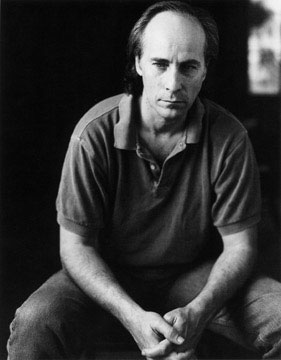
Richard Ford -- Anger Management?
To hell with Martin Amis. For my money, Richard Ford's outdone all of Amis's antics. And we're talking just this week alone. He spat on Colson Whitehead, apparently in retribution for Whitehead's review of A Multitude of Sins. Who knew that the man behind the passive-aggressive Frank Bascombe was so belligerent? Ford is at work on a third Bascombe novel right now, and, at this rate, I'm wondering if Bascombe is going to transform into a Bronsonesque, gun-toting vigilante. (via MacIntyre)
Ruminations After Smirnoff-Enhanced Conversation with Friend
Within mere blocks of 826 Valencia lies an open underworld of drugs, prostitutes, and assorted refuse. Cadaverous figures huddle within the shadows, shooting up what they've managed to collect, greed and addiction flickering within their eyes. What will they get today or tomorrow?
Endless trash covers the streets. Fast food wrappers, leaflets that have drifted from the northwest, bottles rolling under the tires of cars. Skeletal women dressed in nearly nothing, with dark red streaks covering their faces, their arms covered with the tell-tale blotches of a bad heroin habit. These ladies wander to the ends of alleys, looking to spread their legs for a quick score. Cars pass by. Horny bargain hunters who have no problem getting off into victims open their doors. For twenty dollars and a reduction of standards, they jism into an overused orifice.
It is almost impossible to walk down some sections of Shotwell or Capp Streets and not encounter cracked vials or used syringes. It is almost impossible not to be propositioned or hectored by those who would suck cock for a pittance to maintain their addiction.
And then there's the fascinating Hispanic/Caucasian culture war that's been going down since the mid-1990s. Walk along the edges of 16th Street at night and you will find brightly lit neon restaurants and bars that are clearly trying to compete with the urban identity that came before. The telltale signs are through the windows. Smug, pomaded white boys with their pearly whites sitting in their inner sanctums, ordering for their girls from an overpriced menu and ready to hightail it to Marin so they can get the hell out of this godforsaken strange land. Upscale sushi joints adjacent to biker bars, tattoo parlors next to ridiculous oxygen bars. Steel grilles over windows next to walls plastered with flyers for some musical act from Berkeley next to a pizza-by-the-slice joint that welcomes all. But mainly we're talking the doctrine of separate but equal. More delineated than ever before.
But when these white boys saunter down the streets, you can see the fear in their eyes. And it's not just the fact that many of them can't speak a word of Spanish (although they try). You can see them curl their gym-toned arms around the shoulders of their honeys. You see them sidestep around blacks or Latinos raising a ruckus. These white boys are intimidated by volume. They can't seem to distinguish timbre, between folks having a good time and folks trying to intimidate. While it's true that addicts can be found looming in certain quarters, in the eyes of the privileged (for they blow a few Franklins on a Friday night without a second thought) nearly everyone of color is an addict. Addicted perhaps to having a good time, in most cases.
I mention all this because, as I said, this world is within a few blocks of 826 Valencia. It's a fascinating world. And I love it. You can learn a lot about human beings just by standing on the corner of 16th and Valencia for a few hours.
But for all of Dave Eggers' purported streetcred by way of the locale, not once have I seen him dwell upon this cultural microcosm. In fact, in the latest McSweeney's, he boasts about editing the issue at some Northern California B&B. And there is also mention of Daly City, a suburb south of San Francisco that is really no different from any other minimall magnet.
Which makes me wonder what the hell he's doing in San Francisco. I'm pretty hard-pressed to demonize a guy who managed to get William Vollmann's longass treatise fact-checked and published. But if he's so ignorant of the culture that surrounds him, if he cannot recognize the fascinating struggles and conflicts and characters that populate this majestic sector of the City, then frankly he has no business being here.
March 13, 2004
The Literary Hipster's Handbook -- 2004 Q1 Edition
"Book Babe": A book critic who makes crude generalizations and cowers in the face of literature.
"Coetzee": To snarl during an interview. (Ex. The subject prefered to Coetzee rather than answer the stupid question.)
"drowning in Mitchell": Whereby the avid reader obtains the oeuvre of a "difficult" writer, with an overconfident swagger and the vain hope of being ahead of the curve, only to find themselves thoroughly confused by previous books (such as Ghostwritten) in anticipation of the next labryinthine title (e.g., The Cloud Atlas). (Ex. I thought I had the time for the Baroque Cycle and Cryptonomicon, but it looks like Neal has me drowning in Mitchell.)
"Gabo": In its original use, "Gabo" was a nickname for Gabriel Garcia Marquez. Now it is used as shorthand for any author's name that a reader is fearful of uttering in full. Particularly used with names that Caucasians have difficulty pronouncing, such as "Jose Saramago." (Or: Oprah Winfrey.)
"Jayser": An act involving inserting leaflets into multiple copies of a hardback after several shots of hard liquor.
"plowing the dark": Refusing to leave a library or a book collection and failing to experience life. The term was inspired by the obsessive readers drawn to Richard Powers' intricate yet spellbinding books. Often, readers who plow the dark must have a book forcefully extracted from their fingers. The process of plowing the dark is, in most circumstances, altruistic. But somehow a forceful argument must be propounded by the friend hoping to recalibrate a heavy reader's sanity.
"tanner house": To face unreasonable expectations before taking on an important task.
"to Tivoli": The original verb transitive involved an older human behaving like a child. The usage has now broadened to include older readers who read books that that are clearly beneath their regular comprehension. An example would involve a septuagenarian guffawing over Mad Magazine or E. Nesbitt. It is also worth noting that the initial pejorative use has lightened somewhat since its entry into the vernacular in February, and is now used in an affectionate context. (Or. Sarah Weinman)
World Book Day: Any well-intentioned event that falls upon deaf ears.
Funniest Lead of the Week
The Age: "When the US State Department designated a Pulitzer Prize-winning novelist as a 'cultural ambassador', it probably did not plan for him to go around the world calling his president a 'moron' who governs an 'evil empire'. Nor did it expect him to boycott Israel because of US foreign policy, nor to warn Australia that its culture would be 'gobbled up' by a free trade agreement." (via Literary Saloon)
March 12, 2004
Funny, These Images Have Been in My Head for Years
The transition from nice guy to insufferable bastard has been proceeding quite well. But I would be remiss if I didn't stop in and mention Safe for Work Porn, a collection of photos that is pure genius. Particular standouts are the water sports and the man standing behind the couch with the receding hairline. Okay, back to the cocoon, sans Don Ameche. (via Weirdsmobile)
March 11, 2004
An Apology
A few people have been pointing out to me during the past two weeks that I've been too nice. A sweetheart, in fact. Just the other day, a friend of mine threatened to disown me when I dared to buy her lunch. "What the hell are you doing, Ed?" she said. "Only kind and extraordinary people do that sort of thing."
Not only have I had email volleys that have been pleasant, thoughtful and without incident, but the tone and demeanor of these communiques have been too kind and considerate. The cheery level of conversation and socializing has kept me swapping book recommendations and shooting the breeze over literature with equally kind and keen people.
I was getting a little worried about all this. So, tonight, I went to an attitude specialist. Even he had to confess that I was being just too damn friendly to people. The cause of this sudden joy and commiseration, and the reason why I was spending all this time thinking about other people, apparently had something to do with breathing in too much oxygen. A combination of preternaturally beautiful California weather and extra lung capacity garnered from a post-bronchitis state.
Well, frankly, I was astonished by this news. I didn't realize that there was a limit to being nice. And I certainly didn't realize that it had anything to do with oxygen. But the attitude specialist, a gaunt thirtysomething man with bushy hair fond of Hawaiian print shirts, showed me his "Attitude Specialist Certificate." When I saw that the certificate had been notarized by the proprietor of the corner delicatessen (with the notary associated with "the state of Freedonia"), well I was immediately convinced of his qualifications.
So to anyone I've cheered up, to anyone I've given inspiration to, and to anyone who cried on my shoulder, I apologize. I blame the oxygen. The simple truth is that I've been far too nice lately. I promise to be a mean bastard from now on and to call you names. I'll make your children cry, I'll steal your wallets, and I'll be sure to cop a feel from your spouses. The last thing the world needs is more kindness. So I'm going to try and scourge myself up until further notice.
This probably means I won't be posting anything here until Monday.
Really, I'm going to hunt this demon down, this hideous beast that's too kind to be cruel, and I'm going to put this scarabic fucker back into my soul.
And I'm going to breathe less oxygen. If I can modify my life so that my blood pressure will go up, then I guarantee that you will reap the benefits of my cruelty.
Maybe I can take some lessons from Jack Shafer, who clearly needs a hug from Denton.
Tim Robbins Goes Nuts
Tim Robbins has written a play called Embedded. In These Times has an excerpt. And it demonstrates what happens when a well-intentioned writer goes crazy with the preaching:
Dick I’d like to call this meeting of the Office of Special Plans to order.
Gondola Here, here.
Dick War in Gomorrah progress report.
Gondola War in Gomorrah progress report.
Dick Rum Rum, how does it look?
Rum Rum We are currently sufficiently deployed, locked and loaded, cocked and ready, chompin’ at the bit, poised for engagement, steady ready Freddy.
Dick Excellent. How’s the coalition building?
Rum Rum Slow, but good news. Luxembourg is in. As to the rest of them—Germany, France, Russia—I say, fuck ‘em.
Pearly White Double fuck France.
Well, double fuck me.
Tim Robbins has written and directed some compelling movies. Bob Roberts is pointed in its comic targets, Dead Man Walking is gripping as hell, and the finale of Cradle Will Rock is really something special. But there's a reason why Stolen Kisses stands the test of time, and Woodstock (also made around 1968) doesn't. And I'm not sure that Tim Robbins knows it.
Here's a few hints, Tim: All Quiet on the Western Front, Paths of Glory, Grand Illusion.
(via Greencine)
Is Marty Due for a Makeover?
The Son of Kingsley doesn't have a U.S. publisher. To my mind, Martin Amis has made several mistakes. Here's how he can make a comeback.
1. He needs to lose the 1970s high-collar shirts.
2. He needs to realize that a bad boy image is more applicable to Russell Crowe than a guy who's starting to look like Keith Richards.
3. He needs to understand that an author's hubris is deflated when the books turned out are dreadful. Talk the talk when you can walk the walk, Marty.
4. As near as I can figure it, Marty can make a last-ditch effort by playing the sympathy angle along the lines of Time's Arrow.
5. He needs to buy someone off at the Booker Committee.
6. He needs to know that most people scorn privileged sons of great literary figures, regardless of their talent.
(First scouted at Moorish Girl, who I hope is recovering from her terrible flu.)
My Name is Sam Tanenhaus and I Can Outstare Any Book Critic on the Eastern Seaboard

(via the Hag)
Book Babes Watch
Since it appears that Poynter will continue publishing the Book Babes, inspired by Ron, I've begun a Book Babes Watch. Hopefully, drawing attention to the aspects that most of us have found infuriating will help Margo and Ellen improve their work, or Poynter to make the right decision.
This week, the big surprise is Ellen's honesty with regard to criticism: "What's a reviewer to do? Well, maybe the right answer is: Do NOT defend the status quo. We may be so inside the Book Beltway that we're part of the problem instead of the solution. We write too much about marginal books that enhance book publishing's precious image, and too little about the form and substance of fiction that catches the popular imagination. This becomes a problem for publishers of any size."
Well, hell, Ellen, this is what we've been saying all along! I'd like to think that the floodgate of comments which greeted last week's column may have helped Ellen to start asking some solid questions. But I'll give her the benefit of the doubt and suggest that it was the close proximity of other book critics that initiate this brainstorm. I will note that mentioning Richard Flanagan's underrated Gould's Book of Fish is sexy by just about any standard, and a good way to live up to the "book babe" label. And in trying to determine the critic's role in relation to the reader and the publishing industry (specifically how wide the swath is), Ellen has helped start a potential upturn in future columns.
Unfortunately, after Ellen posed an interesting Charles Taylor quote to Margo, Margo responded with yet another tired popular/literary dichotomy. Worse still, Margo fails completely to address Ellen's issue. In light of the regime change over at the NYTBR, it's criminal to ignore the importance of what a critic should cover or to speculate upon recent developments. Do coverage decisions enhance or alter what may influence a reading public (or the uninformed dullards like Stuart Applebaum, who base their tastes on reviews without reading the books)? Margo never addresses this and concludes that the publishing industry is one happy umbrella in which everybody is passionate about books and, presumably, all the wild animals dance together.
Margo also fails to understand the "industry" part of "publishing industry." As unpredictable as the publishing industry is, some people go into the biz to make a profit. It is extremely naive to believe that a publisher isn't hoping for that breakout hit like The Time Traveler's Wife or Cold Mountain, and that they are publishing books merely out of their kindness of their purty li'l hearts.
Ellen responds to this and, rather smartly, returns to the Taylor quote unaddressed by Margo. Plus, she uses "jump the shark" and points out the hypocrisy regarding The Da Vinci Code
CONCLUSION:
Much as Comrades Mark and Ron (among others) have noted, it is the opinion of this Court that the Book Babes are improving, but that ultimately Ellen is the more thoughtful of the two. She also seems to listen. This Court urges the 32-member jury to modify its petition and Dump Only One of the Book Babes. The concept of a dialogue between two bookish ladies is a good one, but a proper dialogue involves two people offering their take on topics, and Margo can't even understand the concept of call and response.
Remember This Philosophy If You Dare to Bite Into a Big Mac
In 1958, Ray Kroc said the following to the McDonald brothers:
"We have found out, as you have, that we cannot trust some people who are nonconformists. We will make conformists out of them in a hurry. Even personal friends who we know have the best intentions may not conform. They have a difference of opinion as to various processing and certain qualities of product....You cannot give them an inch. The organization cannot trust the individual; the individual must trust the organization [or] he shouldn't go into this kind of business."
And that's just what Kroc that of his franchise operators. His customers (meaning you) are another story.
Found in John Love's McDonald's: Behind the Arches, New York: Bantam, 1986.
"Unreadable" is a Code Word for Lazy
David Mitchell's Cloud Atlas has been called "even better than the best sex that you could possibly have" by Time Out, "a novel that will take over your life and prepare you to stalk Mitchell" by the Times Literary Supplement, and "tastier than all the food I ate during my formative years" by the Spectator. But it won't be getting coverage from the Telegraph. Harry Mount, a critic who has actually been paid to review every Dick & Jane book ever published and the author of a 800-page piece of literary criticism entitled The Deep, Deep World of Paddington Bear, has declared Cloud Atlas "unreadable."
Mount's impatience recalls Jack Green's polemic, Fire the Bastards!, which took umbrage over similar boasts made by critics who dealt with William Gaddis's The Recognitions in 1955. Needless to say, if newspapers can find the time to cover Rising Up and Rising Down, then they should provide the same circumspect coverage to "difficult" books. To cop out with the "unreadable" excuse is a bit like damning The Passion of the Christ without having seen it. And besides, some books take a little longer to read. The real question here is whether Mount's ever heard about this nifty concept called note taking. (via Literary Saloon)
March 10, 2004
AudBlog #7 -- Sam the Man
 audio post powered by audblog
AudBlog #6 - Join the Party
audio post powered by audblog
A Special Message from Bill Keller
 3/10/04 12:24:06 PM
Comrades,
I'm excited to report that we've managed to fool everybody all the time. Not only was Sam Tanenhaus selected four months ago, but we deliberately allowed people to believe that there was actually a major race here. Some folks actually thought that their votes and their sentiments counted. Well, I assure you that nothing could be further from the truth.
Not only was Chip McGrath quietly ushered out of the building months ago, collecting his box with all the terrible grace of a mall Santa heading to a dive, but Sam's been the man editing the NYTBR all along. This grand announcement is yet another stone that we should add to Chip's cairn. And what a grand display it is. But what was the poor bastard thinking leaving us like that?
Well, I'll tell you exactly what he was thinking. Profit and attention. Now every book freak has a Tiger Beat spread of Chip cater-cornered to their Proust set. He is, as we all secretly knew and planned all along, hotter than Justin Timberlake. Now that Chip's left, his approval rating in the polls is now, for the first time ever, higher than both Randy Cohen and Maureen Dowd combined! Yes, we here at the Gray Lady watch these demographics like a hawk. And the fact that these foolish journalists and bloggers got all excited about the Book Review (including those silly Book Babes), well, let's just say that I'm getting some special service tonight.
The time has come for endless boasting and complete subservience. I don't just want you to love me. I want you to pledge your firstborn. I want to see your children here at the Times as indentured servants.
Rest assured, you will love Sam. Just as you loved Chip. I will see to it that you will not stop submitting to the Gray Lady.
Your beautiful overlord,
Bill
NYTBR: It's Sam!
My sources tell me that Sam Tanenhaus is the next NYTBR editor. Publishers Weekly has more. Tanenhaus has authored bios of Whittaker Chambers and Louis Armstrong (and has an upcoming one on William Buckley), contributes to The New Republic and is a contributing editor to Vanity Fair. He is a writer primarily known for nonfiction bouncing between politics, biography and literature, which is what Keller was looking for. Here's Tanenhaus on Updike.
[UPDATE: Maud found the link to the memo.]
The Nation Green Preservation Society
Charles has dug up some fascinating info about Bailey's. Apparently, the creamy liquor is preserved through the whiskey. And it can last as long as two years. However, Bailey's suggests that you drink it within six months. Charles, however, was able to detect a suitable creamy taste after a year and a half. Presumably, in sharing this information, the company isn't considering its profits at all. It has only its customers' best interests at heart.
But all this talk of alcohol preservation has me contemplating the future of liquor, should Bush be elected to a second term.
After the Super Size recall and Ashcroft's hijinks, I genuinely suspect that we're going to see bottles that are modified for each individual. A tiny blade will extract a blood sample from each individual purveyor at a liquor store and decide in an instant just how much liquor is good for them. The blood sample will be compared against a database (specifically DUIs and D&D charges), as well as that individual's tolerance for alcohol.
This will be necessary. Because the state remains convinced that people cannot be responsible for their own lives and, with states bereft of funds, there aren't any additional funds to educate people. (Plus, parents and people in general are offended too easily. To introduce anything beyond the limited parameters of the No Child Left Behind Act will cause too much trouble.)
Beyond preserving the national supply of Bailey's, this new bottle technology will raise the price of alcohol (and expand profits and consumer confidence; good for everyone, yo). But, more importantly, it will prevent auto collisions. And the state, in extracting a liberty, will be able to look upon this declining statistic and proudly proclaim its progress. Forget the people thrown in prison on trivial charges or the suspected terrorists hied away to closed military tribunals. Or for that matter the individual's ability to decide how much alcohol s/he can drink.
Meanwhile, the drugs that harm no one and that do not cause a single fatality will remain criminalized. And the street peddlers susurrating "green bud" will be arrested by a renewed police force. Never mind that these small-time merchants have the same preservationist interests at heart and are probably just as ruthless in their dealings as R & A Bailey & Co.
The important result here is that liquor will be preserved. And people will no longer be sauced on a Saturday night. They will stare like lucid does into the headlights of that steamroller about to mow them down and, with stupid uncritical eyes, not understand that their spirits have been diluted.
His Dark URLs
The happy Pullman train doesn't stop with Chabon. The Archbishop of Canterbury notes that despite Phillip Pullman's "anti-Christian" stance, he finds the trilogy a near miraculous triumph. The Left Behind books, meanwhile, remain miraculous only in dramatically underestimating how many readers are willing to defer to guilt and paranoia.
Dame Muriel Spark, best known for The Prime of Miss Jean Brodie, is 86 and still writing, despite arthritis, failing eyesight and an inveterate biscuit addiction. She's just published her 23rd novel.
Harvey Pekar has nabbed a three-book deal with Ballantine. The first will be a followup to American Splendor, dealing with the making of the film, and the next two will be biographies rather than autobiographies. Pekar's wife, Joyce Brabner, noted that, "We can at last afford to add protein to our diet."
Judy Blume must be trying to avoid soup kitchens these days. She's just signed away her books to Disney. Whether Deenie's infamous masturbation will be addressed on screen (preferably with Donald Duck involved) remains to be seen.
Online reference sites have cut into the encyclopedia. If there's any boon to this sad news, it means less encyclopedia salesmen hectoring you at the door. However, Jehovah's witnesses, hoping to take advantage of this downturn, plan to step up their efforts.
Liverpool has come up with a unique way to celebrate its writers: a beer mat. Some of the initial ideas included a commemorative toilet brush, collectible maxis, and an Alan Bleasdale nose hair trimmer. Fortunately, the Liverpool lads settled on the beer mat. Declasse, yes. But truer to the Liverpool spirit.
The PEN/Faulkner nominees have been announced:
Elroy Nights by Frederick Barthelme
Drinking Coffee Elsewhere by Z.Z. Packer
A Distant Shore by Caryl Phillips
The Early Stories by John Updike
Old School by Tobias Wolff
The winner will receive $15,000. The other finalists will nab $5,000. Between the endless New Yorker pieces and the backlist lucre, I'd say Updike's due a tax audit right about now.
A version of Sam Shepard's True West playing at the Baruch College Theater turned the sisters into brothers. Shepard was not amused and ordered the play shut down through his agent. The play's fate is up in the air. (Also in the article: David Talbot has hired Sidney Blumenthal as Salon's Washington bureau chief. Between this and The Clinton Wars, does this sound like a man whose reputation was completely decimated by Matt Drudge?)
The Hollywood Reporter does the math. Mel will get about $115 million from The Passion. Which means he'll never have to work again. Let's hope not.
First, the Age gets intimidated by Coetzee. Now it's frightened by Sara Nelson? Two different writers, same newspaper. What's the matter with journalists at the Age? Are they terrified of all interview subjects? Someone Down Under needs a hug. (via Sarah)
Maud: "She and my stepdad and all the other mourners except my sister and Mr. Maud went to their cars. They were all wringing their hands and shaking their heads, clearly mortified at our behavior. People just don't watch the lowering of the casket in Baptist cemeteries in Bumcombe County, I guess."
March 09, 2004
The Confessions of Christopher Farah
Christopher Farah's second Salon book review has a low-concept spiteful approach that seems perfect for one of those free liberal weekly rags that you pick up at a cafe and read on the crapper. Farah is a critic incapable of enjoying science fiction (apparently, this is how he categorizes any novel involving magical realism), let alone putting aside genre distinctions for the sake of enjoying a book. Farah is a needlessly bitter and angry worm who cannot put aside a goofy premise for the sake of a good read.
Or is he? The review shifts near the end and suddenly plays nice.
Salon wants us to whip out our credit cards for this?
Of course, in a free weekly, the reviewer's name would be subject to ridicule -- and the review would be trite, overly ad hominen and shallow. Perhaps with a touch of genuine passion, but ultimately unprintable in any place publishing serious criticism. Instead, Christopher Farrah's review purports to be a serious work of criticism, housed in an online outlet that believes itself to be PBS, with the ads functioning as surrogate pledge breaks. It is a review written with too many clauses and lots of bitter modifers, presumably with the hope that this will transform what is obviously an out-to-lunch attack piece (or at least half an attack) into an essay that doesn't even understand the basics of speculative fiction.
Imagine a thirtysomething critic that you hope to get a reasonable opinion from on a book. But instead, he pulls down his pants and moons you. Then he calls you an idiot for daring to find something positive about the piece of turd coming out of his ass. And then he turns around and kisses you on the lips.
That is Christopher Farah in a nutshell. No subtlety, no wit. Strange flip-flops (several of them in fact) inside paragraphs. Not even a hint of reason. Just a man going after the strangest targets with unjustified piss and vinegar. It recalls the French revolution in 1789. But instead of crazed mobs calling for "liberty, equality and brotherhood," Christopher Farah calls for the anonybloggers to reveal themselves and books to clarify their literatary categorization. I could be wrong, but there might be more pressing issues of our time.
And now the Tivoli review which, at its essence, is neither a love story, a hate piece, nor fantasy or science fiction. One would hope that its unchecked fire and its cross-spectrum fulminating represents something satirical. But, no, it appears he's serious. What's really odd is how Farah, after spending paragraphs bemoaning the "gimmick," then turns around to call the book "an excellent read."
Either Farah is a schizophrenic writer, or he's unintentionally amusing us. You make the call.
(Hat tip: Beatrice.)
Tenet Demonstrates He's On Top of Intelligence; Withholds First Name Temporarily from Reporters

Words to Live By
"I will permit no man to narrow and degrade my soul by making me hate him." -- Booker Washington
"Confidence comes not from always being right but from not fearing to be wrong." -- Peter T. McIntyre
"Education is a progressive discovery of our own ignorance." -- Will Durant
"One of the keys to happiness is a bad memory." -- Rita Mae Brown
"The opposite of love is not hate, the opposite of love is ignorance." -- Brian Hwang
"If the person you are talking to doesn't appear to be listening, be patient. It may simply be that he has a small piece of fluff in his ear." -- A.A. Milne
"Those who are convinced they have a monopoly on The Truth always feel that they are only saving the world when they slaughter the heretics." -- Arthur M. Schlesinger
"Beware the fury of the patient man." -- John Dryden
"When one begins to live by habit and by quotation, one has begun to stop living." -- James Baldwin
Corpses, Underrated Novelists and Television
He may not be as hunky or as lucrative as Nick Laird, but Boris Starling is cadaver-crazy. Not only are his novels filled with corpses, but he also appeared as one on television. "I've already started making plans for how my own corpse will look like," said Starling. "My family has a proud tradition of being buried in open caskets." Clearly, Jim Crace has nothing on this guy.
Alex Beam calls Charles Portis "the greatest writer you've never heard of." Ron Rosenbaum's also crazy about him. So is Tin House's Cassandra Cleghorn. Portis is having four of his books reisused by the Overlook Press. And if you can't wait, the Atlantic has one of his stories available online.
[UPDATE: Ron points to this helpful Ed Park profile. Today, I read the first four pages of The Dog of the South and laughed my head off. It looks like Portis may live up to the hype.]
Carol Shields' stories are have been adapted for Canadian television. Sarah Polley makes her directing debut with one story. John Doyle suggests this might be the way to market dramatic television to Canadians.
Speaking of television, for those (like me), who don't have cable or (unlike Peter Sellers) don't watch, here's the edited highlights of a conversation with John Updike. Updike writes 1,000 words every morning and says the great secret is "sitting ability." Nothing new under the sun.
On Used Bookstores
Inspired by Sarah's repeated hosannas, the search for Rankin's early Rebus novels continues. No results yet, but on the way home last night, I did find two perfectly good, barely touched Jane Smiley hardcovers left in a box on the street. (The box had been recently put out. Despite bearing a preponderance of chick lit, several people dug into it right after me with telling avarice.) It's amazing what kind of gems people will discard on the streets or at garage sales. It's also fascinating how a particular book you're looking for will crop up when you least expect it.
In the case of Rankin, oh sure, I could have ordered the book through Alibris. But that would be too easy. I enjoy the hunts through used bookstores, the conversations with the proprietors and tome-happy, toe-tapping and criminally underpaid clerks, and the tips other people offer on books. Of course, if I don't find the Rankin book by the end of the month, then I'll go the Alibris route. But I think there's some serendipitous discovery being lost when we order a book online. The spine sticking out adjacent to another book, the different editions, the strange cover art. There's something magical in the way our brains index all this visual intake and retain unexpected authors, which in turn lead us to unexpected books. We may not remember every title, but we are capable of noticing a recherche edition on the stacks that we haven't seen elsewhere.
The online book buying experience doesn't offer anything close. You can't reach for a dusty book at the top of a shelf, or climb to the top of a ladder while impersonating Audrey Hepburn in Funny Face. It doesn't offer anything close to the silent "A-ha" whisper when you enter these sanctums santorum with fellow book freaks. The obscure author, part of this pleasant tomb for the unknown titles, signaled with a protruding finger and a deep assurance that you must read him.
The used bookstore may take time away from one's life. Time away from reading or writing or loving. But it does offer a way for one to amalgamate the reading experience with living. Or possibly the illusion of it. The books, as usual, come first.
March 08, 2004
We Northern Californians Have Book Awards Too
Jay Griffith's A Sideways Look at Time has won the 2003 Discover Award for Non-Fiction. The award, sponsored by Barnes & Noble, grants Griffith $10,000 and heavy promotion in B&N stores. There's just one problem. The people at B&N can't keep track of publishing dates. Griffith's book came out in 1999.
Michael Chabon on Philip Pullham.
The 2004 Northern California Book Award nominees have been announced:
Best Novel:
L'Affaire by Diane Johnson
Dream of the Blue Room by Michelle Richmond
And Now You Can Go by Vendela Vida
Daughter's Keeper by Ayelet Waldman
Old School by Tobias Wolff
Short Story Collections:
Red Ant House by Ann Cummins
Denny Smith by Robert Gluck
How to Breathe Underwater by Julie Orringer
Drinking Coffee Elsewhere by Z.Z. Packer
Poetry:
Life Watch by Willis Barnstone
The Starry Messenger by George Keithley
Notes from a Divided Country by Suji Kwock Kim
Apprehend by Elizabeth Robinson
The Room Where I Was Born by Briane Teare
Non-Fiction:
The Chinese in America: A Narrative History by Iris Chang
Her Husband: Hughes and Plath, a Marriage by Diane Middlebrook
Stiff: The Curious Lives of Human Cadavers by Mary Roach
River of Shadows: Eadweard Muybridge and the Technological Wild West by Rebecca Solnit
Children's Literature:
The City of Ember by Jeanne DePrau
Oh No! Gotta Go! by Susan Middleton Elya
Just A Minute: a Trickster Tale and Counting Book by Yuyi Morales
The Day the Babies Crawled Away by Peggy Rathmann
Vampire High by Douglas Rees
Special Award: Translation: TBA
Lifetime Achievement: Philip Levine
The winners will be announced on March 24, 2004, and since the event is local, I may just be covering it.
And if there's any lesson to be learned from this deal, it's to keep your relationship with a best-selling author and take advantage of the nepotism. Nick Laird has won a six-figure deal for two books. The first one is titled Utterly Monkey. Kyle Smith is no doubt steaming after passing on a date with Z.Z. Packer. (via Maud, who I will never refer to as diminuitive)
Body of Spalding Gray Identified
The X-rays and dental records match up. Spalding Gray is dead. The world is lesser because of it.
And That Includes "Working Class" Millionaires Like Michael Moore
Rasputin: "Trust me on this one. Rich people will be okay. I am officially giving you permission to not give a rat's ass about them. When a person achieves a certain amount of wealth, they become permanently okay forever. In fact, the only thing that can ever unseat them from this vaunted status is their own grotesque stupidity. Now, you don't feel bad when poor people manage to get themselves fucking killed, why should you feel bad when rich stupid people get themselves thrown in jail or rendered poor?"
There's Sarah Jessica Parker and Then There's PEOPLE
Sarah Jessica Parker: "Part of me is happy that people who could not afford HBO will now have the opportunity to meet the four women whose love lives were chronicled on the show."
Who are these people, Sarah? Okies wandering the Midwest? Crazed gypsies? Hobos? The rabble? The great unwashed? With invitations like yours, I'm sure these people that we shall not identify, probably smart enough to do other things than sit on their asses watching HBO all day, will love strutting into your vapid world of shoes and affluence.
I saw the first season of Sex and the City shortly after reading Bushnell's book. I haven't seen a single episode since. Beyond my DVD rental and reading mistakes, I regret nothing.
(via Beatrice)
Heh-Heh-Heh. He Said Muffet.
Mark gives Rose/Birnbaum a run for their money and interviews Dan Rhodes. While there aren't any Elton John-like confessions, the interview's a good read. I hope other literary blogs will start taking it to the next level and start interviewing authors who come through their respective towns.
Marty Beckerman claims that he was misquoted by Rebecca Traister. This isn't the first time Traister's been accused of overeager journalism, though, to Beckerman's credit, he never demands a brawl with David Talbot. (via Bookslut)
Spalding Gray's body may have been found. An autopsy is underway to determine identification.
And a London librarian claims that nursery rhymes are naughty. Of course. We all know that the spider sitting on Little Miss Muffet's tuffet is really a horny dude with eight dicks. The curds and whey are clearly graveside bukkake. We all know that the grandma-eating Big Bad Wolf represents a guy with an older woman fetish and a closet subscription to MILF Monthly. And we all know that Sleeping Beauty was the princess that the rabble couldn't chat up and take back to the inn. Nursery rhymes are indecent! It is my fervent hope that the Bush Administration will prevent this filth from corrupting the minds of our children.
If you don't believe me, one hard look at "Georgie Porgie" should obviate all innocence:
Georgie Porgie, puddin' and pie
[Clearly, the elided G illustrates that the rhyme is not about "pudding," but about "putting it in." Centuries before the naughtiness of American Pie, "Georgie Porgie" establishes in its first line a distinct pastryphilia. The implication of "Poor G" after "Georgie" implies a guilt for the events about to happen. Furthermore, like Nostradamus predicting the threat of Saddam Hussein, the basis for Georgie is not George IV, but George Michael and his infamous bathroom incident.]
Kissed the girls and made them cry.
[If Georgie Porgie intended merely to kiss the girls, then his behavior would be relatively harmless. But the fact that the girls are crying suggests one of two possibilities: (1) either Georgie Porgie has halitosis (unlikely) or (2) Georgie Porgie is a closet rapist, causing untold grief. Note how easy it is to replace the line with "Screwed the girls and made them cry."]
When the boys came out to play.
[Not content with forced debauchery, Georgie Porgie expands his horizons and illustrates to his peers that he swings both ways.]
Georgie Porgie ran away.
[Again, by anticipating the furor over same-sex marriages, the nursery rhyme proves to be well ahead of its time. Instead of coming to terms with his polymorphously perverse nature or indeed atoning for his sins as a rampant rapist, Georgie Porgie decides to run away and return to his cave. The subconscious message being fed to children is that not only is it okay to "make girls cry," but that one's true deviant nature must be kept from the populace, ideally in an isolationist environment, much like the Catholics.]
Maybe It's Because He Puts the TC into THC
A Welsh booklist has been considered too highbrow to be relevant. The Welsh have insisted that booklists aren't for them. A spokesman for the Eisteddfod Preservation Society said that they'd rather spend all day complaining about the weather than caring about contemporary culture. "Besides," said the spokesman. "We were telling stories long before Chaucer."
T.C. Boyle has no hope whatsoever. Beyond that, there's the question of why T.C. Boyle remains hit-or-miss with the literati. The Chronicle doesn't get many answers, but they do get some quirky quotes from Boyle. His National Book Award-nominated novel, Drop City, hit paperback not long ago. He's currently on tour. If you pick up this month's Harper's, you'll find a Boyle story. There's also another great story called "Chicxulub" (referenced in the Chronicle piece) in the March 1, 2004 New Yorker.
Meanwhile, NPR has some fun audio clips up of T.C. Boyle's old band (including T.C. singing "I Put a Spell on You").
If you haven't read Boyle, and you've failed to perceive my mad gushing for the man, some good titles to start with are The Road to Wellville and World's End.
Sara Paretsky has a new V.I. Warshawski novel out. (And I'm curious as to why everyone's favorite mystery blogger has remained so silent on Paretsky, beyond an enigmatic high school connection which nobody need talk about.)
While Yardley dismisses Studs Lonigan, Roger Ebert, of all people, digs up an evening he spent in 1968 with James Farrell. There's some interesting tidbits, including Farrell deliberately avoiding sleep so that he can write 20 hours at a stretch, four of Farrell's novels burned in a fire (and thus unpublishable in the days before computers), and Farrell's personally penned obituary. Even James Brown, having met Farrell early in his career, had to concede "the hardest working man in show business" title to Farrell after discovering his working habits. However, when Farrell died in 1979, the title was officially restored to Brown.
Intersting statistic: Michael Moore sold 1.1 million copies of Stupid White Men in Germany. Probably because the title of Bill O'Reilly's latest book was mistakenly printed up as Are the Crazy American Conservatives Looking Out for You Now? Run Away! They Get Very Angry on Television!
March 07, 2004
The Greatest Promo Ever Sold
The New Yorker: "[Christian historian Elaine] Pagels explained that the four gospel writers of the New Testament probably wrote between 70 and 100 A.D. These were the years following the Roman defeat of the Jews, which left the Temple and the center of Jerusalem in ruins. Acts of sedition by the Jews against their conquerors were met with swift execution. As a result, Pagels said, the Gospels, which were intended not as history but as preaching, as religious propaganda to win followers for the teachings of Christ, portrayed the conflict of the Passion as one between Jesus and the Jewish people, led by Caiaphas. And, though it was the Roman occupiers, under Pontius Pilate, who possessed ultimate political and judicial power in Judea, they are described in the Gospels—and, more starkly, in Gibson’s film--as relatively benign."
Frank Rich: "Thus we see the gospel according to Mel. If you criticize his film and the Jew-baiting by which he promoted it, you are persecuting him — all the way to the bank. If he says that he wants you killed, he wants your intestines 'on a stick' and he wants to kill your dog — such was his fatwa against me in September — not only is there nothing personal about it but it's an act of love. And that is indeed the message of his film. 'The Passion' is far more in love with putting Jesus' intestines on a stick than with dramatizing his godly teachings, which are relegated to a few brief, cryptic flashbacks."
The Washington Post: "The District school system is investigating allegations that a teacher at a Southeast elementary school showed sixth-grade students excerpts of the R-rated movie 'The Passion of the Christ.'"
The Miami Herald: A man in Jacksonville sold out of all Passion-related merchandise.
Reuters: Passion still #1, moves past $200 million mark.
When Nonfiction Becomes Sui Generis
After much writing, revising, and a particularly nasty stomach ache (which may have had something to do with my recent dietary transition to more substantial viands), I went through my back issues of The New Yorker, a stack so severely vertiginous that it threatened to ransack me in the night shortly after transmuting into a carnivorous, vengeful, buckram-bound collected periodical requiring all attentions.
I discovered an exceptionally well-written profile of Lyle Lovett. The profile was written by Alec Wilkinson. At the age of 24, Wilkinson was fortunate enough to befriend the late William Maxwell. (In fact, Wilkinson wrote a memoir about this entitled My Mentor: A Young Man's Friendship with William Maxwell. Here's an excerpt.)
I'm not much of a Lovett fan, but Wilkinson is such an incredible, omnivorous observer that I found myself completely submerged into the story. Here's Wilkinson describing nearly every nicety within Lovett's house:
The house is furnished sparely. In the parlor, the principal adornments are two saddles, each in a corner on a sawhorse. A plaque on the kitchen wall that says “Beware of Bull” commemorates an encounter Lovett and his uncle Calvin had two years ago with a bull in the pasture behind the house. They had delivered a check to a bulldozer operator who was digging a ditch. Walking back across the field, they discussed a pecan tree that had no leaves when it should have and whether it had to come out. The bull walked slowly toward them. Lovett had found the bull in the pasture as a day-old calf. The calf had followed him as he walked through the herd looking for its mother, and when no cow acknowledged it Lovett decided to raise it on a bottle. Once the bull turned two, Lovett stayed out of its way, since it was playful and was big enough to hurt someone without meaning to. Klein, who is sixty-nine, has worked with cattle all his life, so Lovett felt, as the bull approached, that if there was any reason to be worried Klein would tell him. “Usually, you throw a hat down on the ground or slap your leg,” Klein says, “and a bull will stop long enough for you to leave.”
I won't dare reveal what happened to Klein, Lovett, and the bull. You'll have to read the whole thing yourself. But this is the kind of descriptive detail segueing into gripping tale that is the mark of a top-notch writer. Wilkinson certainly picked up a lot from Maxwell. And I was so impressed by his prose that I'm going to try and track down everything the man's ever written. Anybody interested in creative nonfiction needs to check this guy out.
Kerry Uses Old Jedi Mind Trick to Sway Bush & Nader Voters

Thoughts
"What is more, in all three cases, the more demanding the form of [church] involvement -- actual attendance as compared to formal membership, for example -- the greater the decline. In effect, the classic institution of American civic life, both religious and secular, have been 'hollowed out.' Seen from without, the institutional edifice appears virtually intact -- little decline in professions of faith, formal membership down just a bit, and so on. When examined more closely, however, it seems clear that decay has consumed the load-bearing beams of our civic infrastructure." -- Robert Putnam, Bowling Alone
Why isn't there a church for atheists and agnostics? Here we are living in a nation that purports to celebrate the freedom of religion, and yet those who decide to abstain from religion altogether are denied a public place of worship (or, rather, non-worship). We all know that churches actually front as places to meet people (provided, of course, that any given church, as most are, is open to newcomers). And yet while churches have become "tolerant" in opening up their doors to all walks of life, the church concept has failed to take a cue from Flannery O'Connor and whip up a Church Without Christ.
Where are the Churches Without Religion? True, Universal Unitarians come close. But I'm talking about a public hall that isn't hell-bent on serving up insufferable hymns and slack Sunday morning service. A place that ultimately functions as a nexus point for decent people, without the required commitment to a deity.
Then again, who am I to generalize on the subject? Perhaps there is some comparative basis here. Likewise, the nature of social networks within these inner halls are ripe for examination.
These ruminations stem from some major thinking over the last several weeks on the subject and another long-term project that will replace Miguel Cohen's Sunday rantings with something more observed and interesting. The idea, to give credit where credit is due, came from my sister. More to come.
March 06, 2004
You're Entering Another Dimension of Theatre
Okay, I'm breaking the embargo again and then I shall again deactivate the Internet and return to the hard and happy world of revision.
Here in San Francisco, Spanganga Theater is putting on live recreations of Twilight Zone episodes. They'll be performing two every weekend. (It started this week.) Upcoming productions include the paranoid Shatner romp "Nightmare on 20,000 Feet" and another great episode involving moral deterioration, "The Monsters Are Due on Maple Street." SF Weekly has more. Each episode is being staged by a different director and slate of actors. And there are multiple Rod Serlings. This looks like a lot of fun.
Sunday Review Coverage Restored?
Not only can Maud be found in this Sunday's Post, but as Ron notes, the Times has gone ga-ga over Vollman, albeit mammoth nonfiction Vollman. (And, on the whole, this Sunday looks as if it has considerably more fiction coverage than the last three weeks.) Is there hope for the NYTBR? Has Keller been listening? I'm positive that the gang over at the Saloon will have a tally and a summation of this interesting new development.
March 05, 2004
Dennis Moore, Stupid Blogger, Stupid Bitch?
It's official: most popular bloggers are thieves. It ain't just link poaching either. (And because I try not to be a thief, via MeFi.)
Also, who knew? (via Wonkette)
One more thing: Am I the only one who thinks that John Garfield was the Keanu of his time? Garfield has exactly two expressions he resorts to: looking up and looking down. This limited yet distracting dichotomy has worked against my total enjoyment of such films as The Postman Always Rings Twice and Body and Soul (and it's particularly shameful in the latter case). When Garfield offers the rare expression working against the two looks, it comes across as a pretty boy using all six brain cells in his arsenal to come up with something tantamount to the worst community theatre histrionics. Garfield often looks pained when he attempts this, as if he's suffering from hemorrhoids. And his posturing is egregious when he's trying to come off as a tough guy.
I could be totally wrong on this, but frankly I just don't understand why John Garfield should be regarded. Give me the underrated Steve Cochran or even straight-shooter Robert Cummings any day.
Okay, now I'm really outta here.
Rawhide
Ruthless deadlines keep me away from the blog until Monday. I'm not permitted one post, one word, one link until this work backlog's caught up (the downside of getting well). So sayeth the self-discipline imp cracking the whip. I wish Tony Clifton would come in and guest blog while I'm away, but alas. Enjoy some of the fine folks on the left.
Martha Stewart Convicted; Plans for Prison Interior Decorating Show Keep Her Smiling

Tina Brown Makes Desperate Try for Hipster Vernacular
No, Tina. "Eventoid" is a dumb word. Not even Safire on his most addled afternoon could sanction it.
The Known Author
After years bouncing around the courts, the Neil Gaiman-Todd McFarlane trial has wrapped. Heroes can be copyrighted. Gaiman has won $2-5 million from being screwed over. After paying attorney's fees, Gaiman's devoting the remaining sum over to the Comic Book Legal Defense Fund. Gaiman, now in the running for Coolest Guy on the Planet, has been called "a shameful opportunist" by McFarlane. "I'm nice too," said McFarlane. "Just not as nice as Neil."
With Darren Aronofsky, he helped wow and depress the hell out of filmgoers with Requiem for a Dream. Now hard-boiled novelist Hubert Selby, Jr. is back with Fear X. Nicolas Refn is the director. John Turturro stars. Kubrick's cameraman, Larry Smith, was enlisted. Selby co-wrote the script. And instead of the Kornos Quartet, it's Brian Eno on the soundtrack. "The movie is very, very, very depressing," said the Telegraph. "But it's also very good. Even our harshest critic couldn't get out of bed for several days."
The Age talks with Andrea Levy. Her novels are inspired by racial identity, much of it related to her parents coming from Jamaica to Britain, thinking that they would be considered white, only to be singled out.
Here's a new angle for an Anne Rice profile: her relationship with her late husband.
Reason No. 3,624 to Vote for Kerry: States are getting creative with their budgets. Denied resources by a federal government too busy cutting taxes for the rich and spending its way out of control, Alabama has an unusual idea. In an effort to buy school textbooks, a Bingo for Books proposal is on the table.
A Pennsylvania public library has placed five sexual instruction books on the reference shelves, rather than the stacks. Now residents hoping to learn about positions other than missionary or the joys of gay sex will have to do so at a public refectory table, instead of the privacy of their own homes. The number of successful orgasms in Broomall, PA is expected to drop by 16% over the next year.
A chat with J.K. Rowling revealed the following: There may be more than seven books. Harry Potter will continue growing up. Harry Potter will enter a Hogwarts halfway house.
So who is National Book Critics Award winner Edward Jones?
1. He received a telephone message from his agent urging him to continue.
2. Here's an excerpt. The novel, for those who don't know, is about a black slave owner.
3. Jones began to write after being let go from a job he held for 19 years condensing articles for a trade journal. The novel has sold 100,000 copies.
4. Jones is 53 and lives alone in a Washington, D.C. apartment.
5. He grew up poor, moving "18 times in 18 years." His mother could not read or write.
6. Jones couldn't make friends, so he read books (including comic books).
7. Here's an NPR link for audiophiles.
March 04, 2004
National Book Critics Circle Winners
And the winner is Edward Jones!
Additional winners:
General Nonfiction: Paul Hendrickson, Sons of Mississippi
Biography/Autobiography: William Taubman, Kruschev: The Man and His Era
Poetry: Susan Stewart, Columbarium
Criticism: Rebecca Solnit, River of Shadows
I'll have more on Jones during tomorrow morning's update.
When Pimping Becomes Literal
Since the Hag likes Cafe Press so much, Return of the Reluctant proudly joins this populist consumerism.
Ladies and gentlemen, the official "I'm A Bitch" T-shirt.
That Bit About the Drunken Brawl, Could We Leave That Out?
Leave it to the trusty OGIC to have some good inside New Yorker juice (via today's WSJ). Back in 1966, Murray Schumach prepared a lengthy profile on Wallace Shawn. But editor Arthur Gelb caved and gave Shawn article approval. Results: a New Yorker editor holed up with enmity, months of unsuccessful negotiations, and an article that never made it into print. The lesson is unequivocal. But it still dismays me that so many editors cut this kind of deal.
Well, If You Have to Ask, Search Alibris
A number of authors, including JK Rowling, Philip Pullman and Vikram Seth, are leading a coalition against the removal of retail prices from books. Philip Pullman notes that "books are not eggs," midlist authors would suffer, and royalties would be more creatively calculated.
There's actually a simpler way to look at the issue: Does anybody really want to go into a bookstore and be surrounded by books with terrible price tags besmirching their exterior? The affixing paste may ruin the cover. Or the pricetag might become so prominent as to destroy a carefully designed cover. Worse still, the name of a book or an author might be blotted out due to some rushed, underpaid bookstore clerk threatened with a flogging.
New York Times Continues Move to Spineless Temperament
Fiction coverage isn't the only thing getting shafted by the Gray Lady. Ted Rall's editorial cartoons have been pulled because the Times wants to ensure that its content "does not offend the reasonable sensibillities of our audience."
Man, between this and the NYTBR flap, I am this close to cancelling my Sunday subscription in protest.
(via Romenesko)
Bureaucrats Stunned by Height of Thugs Running Pentagon

This Block Party Just Got Bigger
There's a new neighbor on the lit blog block: Rake's Progress.
The Tolkien Conspiracy?
Publisher's Lunch reported this morning that Houghton Mifflin issued a press release that sales were down from last year, with the sentence, "The decrease was due mainly to lower Tolkien book sales and lower sales of children's titles." However, in confirming the info, I noticed that the press release had been removed. Is it possible that Houghton Mifflin is deliberately withholding some pertinent info and that Tolkien has lust its potency? As Uncle Matt Grambo might say, DEVELOPING.
[UPDATE: Never mind. Here's the release.]
Beefcake Novelists and Book Babes
Tonight, the National Book Critics Circle finalists will be announced. Among the nominees is one of my favorite contemporary novelists, Richard Powers, whom the Chicago Tribune catches up with. Powers, the Tribune notes, really talks in the same cerebral way as his books. That isn't really a revelation for Powers fans. But what's really hilarious about the interview is how the Tribune sexes Powers up: "His pale green eyes resemble chips of stained glass. His fingers are long and thin. His hair is dark brown, with the occasional thread of gray, and it falls in a thick curtain, without so much as a hint of curl. Powers, in fact, seems composed entirely of straight lines and right angles: He's tall and lean, and he moves with the efficient grace of an animated T-square."
What next? David Foster Wallace described as "a bracing, tobacco-chomping stallion" for GQ?
Even so, it's good to see Powers getting this kind of major coverage months after his last novel, The Time of Our Singing, was issued quietly in hardback (and all this is a month or two after the trade paperback edition).
The Book Babes respond to the petition. Margo writes that "literary conversation has been left too long in the hands of an elite whose approach is too stuffy for my taste." I couldn't agree more. Which is why it is every literary journalists's duty to maintain literary standards that can be imparted to more people. It's taking the good aspects of the Oprah Book Club idea and raising the bar a bit, getting people excited about books without coming across as a pretentious or ditsy ass. People want to read, and they want to read good stuff. They're always on the lookout for new authors. And the most ardent readers hope to find books and ideas that challenge them. These two have managed to get away with soft interviews with Norman Mailer and Joe Eszterhas, have perpetuated largely uninformed ideas of books, and kept up profiles of popular and middlebrow books that people would read regardless. And that is why I object to these self-described bimbos.
Again, I urge people to sign the petition. Get two people at Poynter who know what the hell they're talking about and who won't devote precious column-inches to whether a middle-aged woman can be a babe or not. Which wasn't the point of Mark's petition.
[UPDATE: Comrade Mark responds in pointed and hilarious form.]
More Rankin. Okay, provided I can find the first Rebus novel, deal me in (in no small part, thanks to Sarah).
The New York Daily News: Women Who Blog. Lots of swell folks, but no Rack?
Years ago, a manuscript thought to be authored by a white abolitionist turned out to be written by former slave Harriet Jacobs. Literary scholar Jean Fagan Yellin published the MS (Incidents in the Life of a Slave Girl Written by Herself) and the book sold 200,000 copies. Yellin's getting a grant from the Ford Foundation to publish all of Jacobs' papers.
Two books about the notorious John Gardner are compared.
Write a well-regarded novel in Japan, and get stalked.
And digital tools are being used to restore texts from a Georgian monastery.
March 03, 2004
Cheap Bastard Context
The Free Dictionary comes very close to beating out dictionary.com. For one thing, there aren't any pop-ups. But the real geeky advantage they have is the contextual examples from classic literature. For almost every word, you'll get at least three quotes from Wilkie Collins, O. Henry or Mark Twain, and you'll be able to click on the precise place they appear. There are some minor problems with this approach. Davenport, for example, seems to bring up character names and the city rather than the sofa. But short of paying big bucks for The OED Online, this isn't too bad of a substitute.
Hopefully Bill Keller Won't Put a Stop to This Policy
Neglected to mention it, but Choire's at the NYTBR.
J.M. Coetzee Will Cut Your Torso In Half With an Icy Glare
J.M. Coetzee came out of the woodworks for the Adelaide Festival of Arts Writers' Week, only to scare the bejesus out of people. Coetzee insisted that he will never give a lecture again, and that he would snap necks if anyone suggested that his Nobel speech or anything coming out of his mouth was a lecture. Coetzee wieleded a truncheon while speaking, randomly beating empty chairs between questions, and sometimes howling to the moon just before stating a declarative sentence. The Nobel winner can no longer be seen during the day. There are unconfirmed reports that fresh blood could be seen trickling down the corners of his mouth.
Jennifer Graham hates Dr. Seuss, noting facetiously that he was a failed novelist because To Think That I Saw It On Mulberry Street was rejected 43 times. Although I think the figure was actually 24 times, even 43 times is still par for the course. Alex Haley received 200 rejections before writing Roots. Zen and the Art of Motorcycle Maintenance was rejected 121 times. Silence of the Lambs was rejected 28 times. The Naked and the Dead was rejected 12 times. Catch-22 was rejected 21 times (hence, the eponymous twenty-two). And, as an experiment (well before his big scandal), Jerzy Kosinski changed the names of the author and manuscript to see if his book would sell. Thirteen agents and fourteen publishers rejected it.
The moral of the story: Just as one can't judge a book by its cover, it's impossible to weigh a manuscript's merits based on the number of rejections.
Spider-Man 3 is in the works. No word yet on whether Michael Chabon will be involved with this one, though Chabon himself doesn't know what's happened to his words on the second film. This confidence does suggest that we might see a continual story arc picked up from the second film, similar to Mario Puzo's work in the first two Superman films. Variety reports that no director or actors have been signed, and the script has not been finalized. Furthermore, Harry Knowles has not yet bombarded the Web with half-assed rumors, near-lies and "inside sources." So perhaps it's premature to report anything before the hype.
Not only is more hip-hop lit being published, but it's selling.
New NYRoB up. To be read later: Richard Horton's "The Dawn of McScience".
Jayson gets petty, claiming that quotes run in the Times broke the embargo and committed copyright infringement. The article quoted a total of 156 words from Blair's book, roughly half the number of words quoted by The Nation in a precedent-setting 1985 Supreme Court decision. Things here aren't helped by Bill Keller, when the ass claimed that copies of Blair's book "have begun to circulate." Chip McGrath's review will run on March 14. Given how petty Blair and New Millenium have been with the Master's House, I hope McGrath gives this little punkass hell.
First, Adam Moss to New York, now Frank Rich?
Sara Nelson weighs in on the Amazon flap. She dishes some dirt and brings up the obvious question of why Amazon is overinflated. But isn't it a bit ironic that she's using column-inches to plug her book in a column probing tainted influence?
March 02, 2004
This Post May or May Not Be Satire
The final word on style:
...
!!!
???
were all so fatigued down here jimmy why dont you crack corn no i dont care seez there sit on my lap with the monkey yes he was good and he grows too if only you understood virility as much as i do even if i'm older than you and yes yes yes bust my basketballs and replace them with breasts mighty casabas and a large pair of pantaloons pantalettes panties pants trouser snakes in the garter strap it on hard backwards see, that way lies excess. it was a tale twice told by idiots signifying nothing. yet how easy twas before. when all the hype glassed emetic, hermetically sealed beneath sugar sugar. aw honey honey now forever associated with bastard bee, smart-looking dapper wings not a bad bone in the little insect's body. there he is strutting around for some cereal. it's enough to make you quit eating all this commercial rubbish, but then try and walk a day without passing the time.
the time had come to shoot the television. why waste hours on that sort of thing? in two hours, you could probably have some long really nice sex, unprotected if you were willing to take a risk. wow, kid, that's gutsy. or in that time you could read half a mystery novel, provided it was entertaining, fast-moving, typeset with very wide line spacing and fairly short. but is that just as bad as the glass orb in the little room?
or you could have a nifty conversation with a stranger, assuming that the stranger sticks around and was willing to spill things about his/her/its life. most people are, you know.
but wither testicles? yes, it's time for the operation. what you'll need to do is slice the side then scoop in with a spoon DON'T FORGET THE MORPHINE remove some fluid that causes this hernia nightmare and then drill DON'T FORGET THE MORPHINE or if you're daring wander about like tom green with only one. what would it be like to have three buttocks and one testicle? what would it be like to have breasts? beyond staring at the mirror all day, i'd probably spend all that time testing their sensitivity. i'd also see how well i'd do DON'T FORGET THE X in a wet t-shirt contest. maybe.
???
hey, trio. get lost. we're trying to free associate.
!!!
yeah, you too. don't be shocked. don't pretend as if this is anything other than rainy day speculation.
...
agreed
It's Silly to Sell Out With Something Named After A Personal Hygiene Ritual
The Literary Saloon takes the piss out of Carole Matthews and product placement in literature. (via Mark)
Cloud Atlas X2
Just so everybody's clear (because my heart plummeted to the ground when I saw it in the bookstore today, only to realize it was a different book), there are actually two novels named The Cloud Atlas. One is a first novel by Liam Callanan. The other is written by Ghostwritten author David Mitchell. Since Mitchell has the hype of a million gods right now, fair is fair. Here's a Detroit Free Press review for the Callanan book, and here's Callanan's website.
Self-Pimping
A self-pimping page for all outside writings is in the works, as is a page for the play and an edrants redesign. But for now, here's the latest review. More are on the way through various outlets.
But This New York Times, It's Personal
Publisher's Lunch reports that word on the street has it that Chip McGrath's successor will be named in a day or two. And McGrath himself will be reviewing Jayson Blair's book.
The Last Disclaimer
This blog exists to amalgamate personal sentiments and information with general satirical tomfoolery. Often, details are placed in posts that are obviously fictitious. The staff leaves readers to infer what is true and what is not true. We are, after all, inveterate jokers, to the point where we are now using first person plural, a stylistic vice that we genuinely hate and previously derided. You see, it is possible to advocate evil for a moment.
Most readers are capable of making the distinction. We respect the readers to use their noggins and click upon the links presented, and to confirm the information. We trust our readers to know when we are being truthful and when we are pulling your leg. Sometimes, we do both simultaneously. And we encourage our readers to respond with equally silly responses or, in the case of arguments, counterpoints, additional angles, or exposes of the issues.
To all who like to play, the lawn is watered every day. If this is not your cup of tea, then you're not alone. Might I recommend instead the upcoming Starsky and Hutch, an upcoming film which looks to be the most straightforward intellectual achievement of the year?
There will be no further disclaimers. But I do intend to boycott Mars.
It's a Little Too Cozy at the Washington Post
It was a cool idea, a fresh kind of quid pro quo for Bookslut. Bring in a journalist, one who had bashed the blogosphere, onto a book blog, and see if she could blog without referencing her peers.
Well, it turns out that in a little over a day, Jennifer Howard doesn't practice what she preaches. And not only that, but her colleagues at the Washington Post don't have the gonads to state their names! Whereas we folks here in the blogosphere stand by our words. Sometimes we're anonymous. But we're always the same people, not some "anonymous blogger" in the wings.
From March 1, 2004, Entry 1: "Now I can spend the rest of the morning trying to figure out why review outlets like the WaPo have to sign confidentiality agreements..."
From March 1, 2004, Entry 2: "And the Post (that's DC, not New York) ran this on Saturday."
From March 1, 2004, Entry 3: No mention of the Post, but a callout to the Complete Review.
From March 1, 2004, Entry 4: "Followup comment from a WaPo colleague."
From March 1, 2004, Entry 5: "That same WaPo colleague." and "my 18-month-old daughter." What's up with the shameful personal details? Fer shame!
From March 2, 2004, Entry 1: Link to Washington Post article.
From March 2, 2004, Entry 2: The first post that doesn't involve the Washington Post or a link to another blog.
In other words, out of seven entries, Jennifer Howard has linked or mentioned the Post six times. Or a Linkwhore Ratio of 85%!
Now, by contrast, let's take a look at the blogs that Ms. Howard attacked in her article on the days she mentioned.
TMFTML, October 30: 8 entries, 1 post referencing Old Hag and Whatevs, 1 post referencing Maud. Linkwhore Ratio: 25%
Maud Newton, November 6: 5 entries, 1 post referencing Old Hag, 1 post referencing Literary Saloon. Linkwhore Ratio: 40%
Moorish Girl, November 7: 4 entries, 1 post referencing Maud and the Old Hag. Linkwhore Ratio: 25%
Old Hag, November 7: 3 entries, 3 entries referencing other bloggers and 1 that day going out of its way for a shoutout. Linkwhore Ratio: 100%
Okay, so Howard may have a point. But then everyone in the blogosphere knows that the Hag rolls around with everyone. So she doesn't count.
But we can't discount the fact that Ms. Howard has greatly outperformed the other ratios. And whereas the other bloggers linked to several people in their posts, Ms. Howard has continuously linked to a single source! What's more, she has not only continously linked to a major newspaper (i.e., the Establishment), but she has failed completely to link to the exciting up-and-comers (like, The Syntax of Things or At Large, to name just two). She has linked to merely one. Furthermore, as my colleague Mark has noted, the erstwhile über-book info source has become dangerously contaminated with Buffy and Oscar references.
Maybe that's the point. In the newspaper world, everybody gets to be a hypocrite.
While the Blossoms Still Cling to the Vine
Today is Dr. Seuss's 100th birthday. As usual, the NEA is hosting its Read Across America program. It is your duty to inform at least one child today that there were never any movies called The Grinch and The Cat in the Hat, and introduce the kid to the wonderful world of Theodor Geisel.
Today is also Super Tuesday. Be sure to vote if you live in California, Connecticut, Georgia, Maryland, Massachusetts, Minnesota, New York, Ohio, Rhode Island or Vermont.
If you live in Texas, today is Texas Independence Day, Texas Flag Day, Sam Houston Day, and Texas is the Center of the World Day. Don't go to work. Please. You get the day off.
Today in Literature: D.H. Lawrence died in 1930. His last words: "I think it's time for the morphine."
Tom Clancy has decided to move back to Maryland. "Really. New York scares the shit out of me," said Clancy. "I need total isolation to develop crackpot conspiracies. My libertarian-minded readers are counting on me."
In two weeks, the New Zealand Prize in Modern Letters will be chosen. The shortlist includes William Brandt, Geoff Cush, Kate Camp, and Glenn Colquhoun. Oddly enough, the judging panel doesn't include a single New Zealander. They're all Yanks.
Ian Rankin gets a big profile in The Milwaukee Journal-Sentinel. One thing I didn't realize was that 10% of all books sold in the UK in 2002 were written by Rankin.
There's a big campaign to save the French language afoot. Maurice Druon, novelist, historian and elder statesman of the Academie Francaise, is urging the French to be snootier, ruder, and merciless in their use of grammar. It is also worth noting that Druon, who is 85, has not laughed once since the 1970s.
Edward Jones: Get canned from your job, write a National Book Critics Award nominated book?
Myrna Blyth, former editor of Ladies' Home Journal and currently burning bridges with a new expose, says, "No one is going to keep me from a Cobb salad at Michael's." But will Michael's keep the Cobb salad away from Blyth? Touche!
March 01, 2004
New Criteria
From The Germatriculator, links at random:
The Olive Press: 51% Evil.
Maud Newton: 50% Evil.
Return of the Reluctant: 42% Evil.
Pullquote: 41% Evil.
The Elegant Variation: 40% Evil.
Wood S Lot: 39% Evil.
About Last Night: 37% Evil.
The Fold Drop: 37% Evil.
Golden Rule Jones: 35% Evil.
Old Hag: 34% Evil.
Gawker: 34% Evil.
Uncle Grambo: 34% Evil
The Literary Saloon: 33% Evil.
Low Culture: 30% Evil.
Wonkette: 28% Evil.
Book Ninja: 25% Evil.
Beatrice: 24% Evil.
Book Slut: 22% Evil.
Sarah Weinman: Page too long. 100% Evil?
Moorish Girl: Page too long. 100% Evil?
TMFTML: Page too long. 100% Evil?
Chicha: Timeout. 75% Evil?
(via Six Different Ways)
Edwards Resorts to Marlon Brando Impressions In Desperate Effort to Win Last-Minute Voters

Boycott Mars
M&M/MARS
Attn.: Consumer Affairs
800 High Street
Hackettstown, NJ 07840
Re: Why I Will Never Buy A Package of M&Ms Again
To Whom It May Concern:
Last night, while watching the Oscars, I experienced one of the most disrespectful and horrid television commercials of my life. The commercial was put out by your company and featured animated versions of your product entering a tableau from The Wizard of Oz – specifically, during the famous closing scene in which Judy Garland is waking up from her trip to Oz, only to realize that her family was representatives in her dream, and that, in fact, there was no place like home.
But instead of seeing her family, Judy Garland now wakes up to talking versions of your candies, and she reacts with delight. That you have violated the awe and wonder of the original scene, failing to respect its wonderful riffs on home and family, transforming it into a shameful sell for your product, and that you have seen fit to air this during a time block that is supposed to celebrate movies, demonstrates to me that not only is your company rapacious and shameless in its self-promotion, but that it has become a company I will now boycott with disgust.
Since you have seen fit to defecate upon a work of art, you have lost my business for life in the same manner that Hoover did years ago when they created a commercial in which Fred Astaire danced with a vacuum cleaner. I will avoid M&Ms, Mars bars, Milky Way bars, Snickers bars, Twix bars. If I ever own a pet, I will likewise eschew Pedigree, Cesar, Whiskas, Sheba, Kitekat, Trill, Aquarian and Winergy. No Uncle Ben’s rice for me. No Dolmio or Suzi-Wan, not that I would ever eat that crap anyway. And certainly no Klix or Flavia to drink.
Since your company cannot respect one of the most popular movies in the most popular medium of our time, I will neither respect nor endorse any of your products. I will encourage all of my friends to do likewise (at least three of them have agreed to boycott your company upon learning about the commercial this afternoon). I will also post this letter publicly on my website, so that others can recognize your company’s evils and refuse to give your company so much as a dime.
It’s probably a wise choice anyway, seeing as how your company hasn’t created a single good thing for the human body. But, oh, how you could have profited from my silly midnight munchies, or even the Halloween candy I buy for the kids each year, if only you had actually thought before destroying the poignancy of a really kickass movie.
Very truly yours,
Edward Champion
Michael Medved: Hatred by Any Other Name (Except Christianity)
Just when you thought it was safe to return to the op-ed battlefield comes Michael Medved. Medved, thankfully reduced to fulminating on the Salem Radio Network, claims that "the source of Jew hatred today is Islamic extremism and secular Leftism -- not Christianity."
RIP WebMonkey
WebMonkey, one of the finest HTML/CSS/JavaScript tutorial sites on the Net, is no more. A MeFi thread makes reference to a tarball file making the rounds on BitTorrent servers. For anyone interested in upping their skillz, it might behoove them to find it before Lycos/Wired takes down the site. In the meantime, the real question is whether or not A List Apart can pick up the slack.
Spiers Speared by Adam Moss
Just because the New York Times has a no-blogging policy, that doesn't mean you bring it with you to the New York Magazine editorship. As Gawker reports, Liz Spiers is no more. If she's replaced by Naomi Wolf digging up twenty year old skeletons on a weekly basis, then we're in serious trouble.
[UPDATE: Rumors of Ms. Spiers' demise are greatly exaggerated.]
She Has Chosen Poorly?
A woman ages and you just gotta love her smile. (via Chicha)
It's Dorothy, Dammit, Not Harry!
Dorothy Potter has become the first poet to win the Australian Primier's Award for Literature. Potter planned to followup her prize-winning novel about Jupiter's moon with a work tentatively titled In Your Face, in which poets take over the Australian government and citizens resolve their disputes through slam sessions instead of courts.
Natsume Soseki is considered to be "the Charles Dickens of Japan." (And that link will take you to the English translation of Kokoro, selected for the UNESCO Collection of Representative Works.) Soseki is so renowned that he can be found on the 1,000 yen note. Japan Today reports that English translations of seven of his works will be published in the United States as early as May.
Some moviegoers are terrified that "666" is appearing on tickets for Passion of the Christ.
Proving that the First Amendment means about as much today as pocket lint, the federal government is warning publishers not to edit manuscripts from Iran and other disfavored nations. Editing paragraphs or correcting syntax amounts to "trading with the enemy" in the eyes of the Treasury Department. But the government hopes that certain forms of subject-verb agreement will demonstrate conclusive proof of an Iraq-WMD link.
Jennifer Howard takes over for Bookslut and is convinced that Monday morning pre-9 a.m. after the Oscars is too early to think about anything literary. Nonsense. The ceremony was so predictable and bland that I haven't thought about it since 10:30 p.m. last night. If anything, one should think about books and crack as many dirty jokes as possible well before 6 a.m. It's either that or a bloody Mary to get the brain working on a Monday morning. [UPDATE: And Howard's doing pretty well so far. Of course, cover David Markson and you've won brownie points with me almost immediately. However, Jen, it's BOOKslut, not FILMslut or WHEDONslut.]
But since we mentioned it, Grambo did a better job than me at capping the Oscars last night. One last thing I'll mention: Naomi Watts is a thin and stunningly beautiful woman. But who was the idiot that put her in a Spandex dress last night? Was this some kind of Twiggy complex? And putting M&Ms in The Wizard of Oz is just plain wrong. The worst thing since Fred Astaire danced with a Hoover. I will never eat a package of M&Ms again. Never. Seriously.