Hell yes! He’s back with the Hag. Which means that Top Jimmy as a feature here is, presumably, no more. My diabolical plans actually worked this time.
Month / March 2005
In Defense of Mocking Literary Figures
Mark has weighed in on the spate of Foer bashing. Of course, anyone who bashes Foer at this point, whether with blunt objects or swizzle sticks, is beating a dead horse. I succombed to it only because the idea of someone as incompetent as Deborah Solomon talking with Foer reminded me of a weekend I once spent at a Days Inn with a venemous journalist who insisted on calling me “Johnny from SF.” She insisted on abbreviating my hometown and didn’t offer an explanation. Needless to say, the weekend fling didn’t pan out, Solomon’s article hit close to home, and, after penning the post, I was reduced to chronic weeping for the next three days. These are some of the unfortunate things that happen behind the scenes here at Return of the Reluctant. I wish I could tell you more about the blood, sweat and tears. But that might be as unfortunately earnest as Foer’s emails were to Solomon.
However, I’m troubled by Mark’s suggestion that making fun of literary figures involves bitterness or his further insinuation that certain people are off limits. Particularly in an age when television that people pay for is being seriously considered as “indecent” and people are being placed on no-fly lists simply because they venture an opinion. I should remind Mark that taking the piss out of someone doesn’t necessarily mean that you despise them. Any good humorist knows this. Beyond this, appreciation or condemnation of another person’s contributions to letters is hardly a black-and-white issue. (To offer a personal example, while I’m not exactly a fan of Dave Eggers’ writing or the way he exploits his volunteers, I nevertheless commend what he’s done with 826 Valencia and have been nothing less than nuts about the comics issue of McSweeney’s, along with the two Chabon-edited anthologies.)
Like any redblooded American, I too read and enjoyed Everything is Illuminated. Even saw the guy when he came out to A Clean, Well-Lighted Place for Books years ago. Seemed nice enough. He was mobbed by youngsters who couldn’t scrape up the dough for the hardcover. And when Foer replied on these pages that he had given his PEN money to people who needed it, I was quick to commend him. As was Poets & Writers.
But there’s a fundamental difference between a writer’s life and the work he puts out. At issue here was Foer’s behavior, which seemed out of step with the privileged life he led that many of us writing in the skids dream about. Not his books.
If Philip Roth had decided to do something as manic and desperate, then, as much as I love Roth’s books and as crazy as I am about The Plot Against America, I would have mocked him to the high heavens. Not because I have anything personal against Roth, but because it helps to communicate to the world that writers are hardly the flawless beacons that the press and the literary community (including the litblogs) make them out to be. Truth be told, the publishing industry is nuts. That can’t be stated enough. In Foer’s case, they have given a young man ridiculous sums of money in the hope that he’ll become an instant literary superstar and, like J.T. Leroy, speak to the next generation of readers and hopefully sell boatloads of books.
I don’t envy Foer’s position or the pressure he has with this new book at all. If anything good came out of all this, it was a greater understanding that Foer’s just as fucked up as the rest of us. Raw talent often is.
But Foer’s also a smart guy. And anyone even remotely familiar with the Sunday New York Times, who has even leafed through the magazine at some point, is aware of Solomon’s tactics. He did something foolish and let himself get set up. And 150 e-mails to a reporter (many of them thousands of words) is, even from a twentysomething, a tad obsessive.
Further, there’s a fundamental difference between mocking and outright loathing. I don’t think that any of the people out there actually hate Foer or that he is being “punished,” as Mark puts it. Foer is not Raskolnikov. People are reacting the same way that they responded to Gerald Ford when he said that there was no Soviet domination of Eastern Europe. For Christ’s sake, we did the same thing to Franzen.
But for what it’s worth, I’m rooting for him too.
We Ames to Please
Jonathan Ames writes that he will be performing at the Fez under Time Cafe, which will be closing down soon. The Fez is where many of Ames shows went down. On March 11, with the doors opening at 8PM and a cover charge somewhere between $14.99 and $15.01, Ames will rock the house with others at 380 Lafayette Street (@ Great Jones), New York, NY 10003. You can call 212.533.7000 for reservations.
No word yet on whether Ames will lather himself up for this performance.
Ames’ tale, “The Story of the Hairy Call,” has been turned into a movie.
And Ames has edited a new book called Sexual Metamorphosis: An Anthology of Transexual Memoirs, to be published April 12 by Vintage.
Because we like Jonathan Ames, we will continue to report any and all Jonathan Ames-related news (true or false) that comes our way. So if you have any Jonathan Ames information, please feel free to send them the usual route and we will post all half-truths, deviant lies, and Ames anecdotes you heard from a friend of a friend of a friend on these pages. We feel it’s our civic duty to unfurl rampant misinformation, as this is the only proper way to call attention to one of those most candid writers of our time.
Nabokov: Not a D.H. Lawrence Fan
The Paris Review DNA Archive has been a bit slow in getting their 1970s interviews up (James M. Cain! Anthony Burgess! William Gass! Kurt Vonnegut! Eudora Welty! And more! Hurry up! It’s past March 1, dammit!). But this interview with Nabokov is a hoot. Some choice excerpts:
INTERVIEWER: And the function of the editor? Has one ever had literary advice to offer?
NABOKOV: By “editor” I suppose you mean proofreader. Among those I have known limpid creatures of limitless tact and tenderness who would discuss with me a semicolon as if it were a point of honor — which, indeed, a point of art often is. But I have come across a few pompous avuncular brutes who would attempt to “make suggestions” which I countered with a thunderous “stet!”
…
INTERVIEWER: Are there contemporary writers you follow with great pleasure?
NABOKOV: There are several such writers, but I shall not name them. Anonymous pleasure hurts nobody.
INTERVIEWER: Do you follow some with great pain?
NABOKOV: No. Many accepted authors simply do not exist for me. Their names are engraved on empty graves, their books are for dummies, they are complete nonentities insofar as my taste in reading is concerned. Brecht, Faulkner, Camus, many others, mean absolutely nothing to me, and I must fight a suspicion of conspiracy against my brain when I see blandly accepted as “great literature” by critics and fellow authors Lady Chatterly’s copulations or the pretentious nonsense of Mr. Pound, that total fake. I note he has replaced Dr. Schweitzer in some homes.
Tanenhaus Watch: March 6, 2005

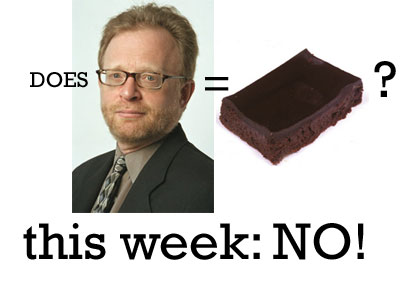
WEEKLY QUESTION: Will this week’s NYTBR reflect today’s literary and publishing climate? Or will editor Sam Tanenhaus demonstrate yet again that the NYTBR is irrelevant to today’s needs? If the former, a tasty brownie will be sent to Mr. Tanenhaus’ office. If the latter, the brownie will be denied.
THE COLUMN-INCH TEST:
Fiction & Poetry Reviews: 2 one-pages (Despite its sneaky layout on the cover and two pages, let’s face the facts: Chip McGrath’s John Ashbery profile, with its liberal quoting and padding, can just about squeeze onto one page), 1 one-page roundup, 2 half-page reviews. (Total books: 8. Total space: 4 pages.)
Non-Fiction Reviews: 3 half-page, 3 full-page. (Total books including Ashbery Selected Prose: 9. Total space: 4.5 pages.)
We suspect that Sam Tanenhaus deliberately tried to make our job difficult this week by listing Chip McGrath’s John Ashbery profile twice in the table of contents: under fiction and nonfiction. Unfortunately, Tanenhaus’s editorial shenanigans haven’t stopped us from applying our column-inch test. To resolve this dilemma (and to give Sam some additional leverage; we do want to send him a brownie one day), we’ve categorized the profile as a “fiction review” while tallying the Collected Prose book under our non-fiction book total.
This week, Tanenhaus has done better. But of the 9.5 pages devoted to reviews this week, only 44.4% are devoted to fiction and poetry. This is close to the 48% required. Admittedly, the John Ashbery profile does complicate matters. But when you factor in the sizable real estate given to blowhard Franklin Foer (which belongs in the Week in Review section, not the NYTBR), the ambiguity over the Ashbery profile dissipates and Tanenhaus’ continued disrespect for solid literature coverage becomes clear.
Too bad, Sam. You could have earned your brownie point had even one of those pages gone to fiction.
Brownie Point: DENIED!
THE HARD-ON TEST:
This test concerns the ratio of male to female writers writing for the NYTBR.
Unlike last week’s chicks reviewing fiction/dudes reviewing nonfiction problem, we’re delighted to report that Tanenhaus has allocated things quite nicely this week. Disregarding the Ashbery profile, men and women cover fiction down the middle. And discounting the Ashbery profile, A.O. Scott is the only dude covering nonfiction this week. The rest are women writers. Too bad that Tanenhaus can’t relinquish more features to the ladies. But we’re still extremely pleased to see women given a shot (including the divine Miss Packer!).
Brownie Point: EARNED!
THE QUIRKY PAIR-UP TEST:
While we’re pleased to see ZZ Packer in print just about anywhere, we have to wonder if she was picked to review Charles Johnson’s latest book because she’s African-American. Since Ms. Packer has proven to be a solid thinker on several topics and since her valuable input on all things literary is a veritable boon for the Times, why not have her weigh in on, say, Ian McEwan’s Saturday? Conversely, why not have Suzy Hansen review Johnson? This is the kind of pair-up that makes us wonder if Sam’s been revisiting Jack Hill’s oeuvre on DVD. This sort of white liberal guilt went out with the pet rock. Just hire a writer because she can write.
Beyond this, there’s really not a whole lot to say, except..
Brownie Point: DENIED!
CONTENT CONCERNS:
Bullshit sentence of the week (from Pamela Paul’s The Sociopath Next Door review): “But just as most of us aren’t having backyard barbecues with the trust-fund set, neither are we living down the street from dangerously ill people whose ruthless behavior constitutes a covert public menace.” Clearly, Ms. Paul has never heard of the Megan’s Law database. Instead of encouraging these broad generalizations, a smart editor would have had Paul take the piss out of the book while recognizing that Americans can live with sociopaths in their neighborhood, perhaps tying this in with The Wisdom of Crowds or Jane Jacobs’ theories on urban watchers, without resorting to alarmist thinking.
If you’re a senior editor of the New Republic, isn’t it a bit self-serving to quote your employer in the second paragraph?
Even if it’s misplaced and tertiary to books (all we have really is a Recommended Reading sidebar), I do applaud the roundtable discussion, not because of its discussions of liberalism, but because it presents a more thoughtful take on current politics than Foer’s essay.
Nary a followup on the “Marilyn as Metaphor” to be found in A.O. Scott’s review, save the silly notion that it takes a book to remind us that “Monroe was a complicated human being.” Wow. Thanks for that glaring insight, Scott.
And Benjamin Markovits’ hypothesis on how British novelists are terrified of American novelists falls apart. He fails to mention that David Mitchell’s Cloud Atlas. Besides transforming into last year’s literary sensation, Cloud Atlas was a finalist for this year’s National Book Critics Award. I’d say that’s progress for Brit lit.
CONCLUSIONS:
Brownie Points Earned: 1
Brownie Points Denied: 2