The Litblog Co-Op has revealed its Spring 2006 choice. Like the last round, there will also be five special podcasts provided courtesy of the Bat Segundo show devoted to all of the nominees (three are in the can), as well as brief interviews with the nominators. In fact, it was Mr. Sarvas himself who was the first to be recorded on one of our new audio toys and who put up with our rather geeky fixation on just how utterly sexy he sounded. Thankfully, none of our enthusiastic asides were preserved in audio form.
Year / 2006
Death! Destruction! Earthquake! Fire! Time to Celebrate!
Tomorrow at approximately 5:12 AM is the 100th anniversary of the 1906 earthquake. Your correspondent won’t be going all out like Frances, but being something of a city history junkie, your correspondent will be getting his ass up before dawn and heading down to Lotta’s Fountain. If you’ll be around, look for the guy with the headphones and the digital camera. Your correspondent hopes that a Lotta Crabtree type or two will perform.
More Author Interviews
I stumbled across Charlie Ruas, a guy who’s talked with David Shipler, Dave King, Lily Tuck, A.S. Byatt and many others. Unfortunately, Ruas is a bit of a frightening interviewer. He speaks in a slow and booming baritone that must be heard to be believed, e-nunc-ee-a-ting each word as if about to take the pulpit. An idle thought: must all literary interviewers be so intense (perhaps the word humorless applies) about literature? Writers are, by their very craft, playful folks. Shouldn’t they be entitled to a bit of playful banter every now and then?
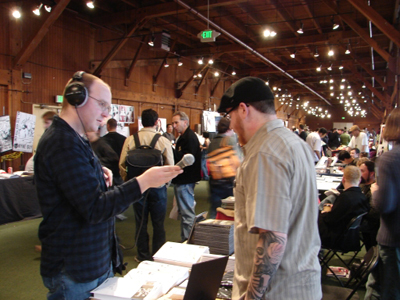
Interviews on the APE Floor
Working Theory
Your advocate, who has spent his Saturday night finalizing his taxes, isn’t so much in a joyous mood (sadly, he has to pay), but is greatly relieved that it’s all over (a pox upon you: Schedule CA (540)!) and is, as a result, unusually jocose.
I put forth the following quandry to the prosecution: Have the critics savaged Colson Whitehead’s Apex Hides the Hurt because The Intuitionist and John Henry Days are both damn good novels and quite possibly, at least in this advocate’s opinion, exceptionally brilliant? Is it because Apex does not live up to these two shining beacons of virtuousity?
Corollary: To what degree can a lesser work by a great novelist be forgiven? Did the critics go after Faulkner because The Hamlet didn’t measure up to The Sound and the Fury? Did they not understand that setting down Snopes in early form might have been a way to get to Intruder in the Dust or the next two (better) books in the Snopes trilogy? And even if some of you in the jury might be snobbish enough to think that everything Faulkner put out after 1940 (a lot of it mysteries) isn’t really worth contemplating, to what extent does the literary community and this court by proxy have to consider good (but not great) works from its authors with less alacrity than the norm? I do not suggest handicaps. I suggest context or a more rigorous study of an artist’s work, if charges are to be leveled against my client. How can the vast divide between the masterpieces which an author puts out early in his career be corraled with the “good but lesser” works he puts out later? How can an author maintain any sense of ambition or evolution when the later works don’t live up to critical and scholarly expectations?
It’s a disingenuous charge that the prosecution puts out, your honor. They want to nail these “early bloomers” to the wall. They’ve gone after Dave Sim for his muddled politics in the latter part of Cerebus, failing to consider the accomplishment of his artwork. They’ve gone after Jane Campion because her most recent films don’t live up to An Angel at My Table or The Piano, even when the later films contain clear flashes of brilliance (such as the vibrant reds and greens of In the Cut and the daring sexual politics of Holy Smoke). And they declare Apex as “technical artistry [which] is in the service of unremarkable themes and ideas,” a book that involves “watching Whitehead sketch out a minor character’s essence with one stroke, while breathtaking, makes one wish the same treatment was afforded the people who ostensibly inhabit the novel’s complex ideas,” and dismiss the plaintiff’s work as “admirable ambition.”
But are these really charges with which to castigate the plaintiff? Does it allow for a proper exegesis? Even if the prosecution wishes to condemn the artist, does it not make sense to give the accused some benefit of the doubt in light of honorable standing and past accomplishments?
I do not wish to curtail rigorous and often vicious criticism, your honor. I merely wish to point out that sometimes a book is more than just a disappointment. And it is worth understanding why a book has failed within the context of previous offerings rather resorting to the altogether too easy approach of casual dismissal.