Gawker and Galleycat have the scoop. TW Books includes Little, Brown (DFW and Rick Moody’s publisher). (via Tayari)
Year / 2006
Three Hours of Sleep
In lieu of content here today, we direct you to the following places:
- At the LBC site, this week’s it’s Edward Falco week. There’s a podcast interview, as well as the beginnings of a weeklong transcript of beer-fueled discussion with Scott, who quite rightly comes across as more coherent than me.
- And speaking of the LBC, David Milofsky has written an article for the Denver Post. Both Mark and the tireless Dan Wickett get some nice airtime.
- I finished Perlman’s Seven Types of Ambiguity, along with several other books last week. Hope to get to the next 75 Books post soon.
- Even though she lived a long and productive life, I’m still a bit stunned by Betty Friedan’s death, particularly with how metaphorical it is in light of current events, and hopefully I’ll have something coherent to say on the subject later. But in the meantime, check out Bad Feminist. I’m sure more will weigh in throughout the course of the day.
- Tom Baker as disembodied cell phone conduit? WTF? (via Phil)
- You want quirky pairups? The NYTBR may be inept on this score, but the Washington Post has paired George R.R. Martin with Stephen King’s Cell. (via Sarah)
- Brian Sawyer on bookbinding.
- “You don’t even know how to spell Delany, bitch.” The “Rick James, bitch” for speculative fiction fans? You make the call.
- Tayari Jones has posted 175 words of her new book.
- Support Pete.
- David Foster Wallace — is he a cunt?
- The Super Bowl and its commercials? Let me put it to you this way. The cheeseball Patrick Swayze TV movie I had on mute last night while finishing up the podcasts was more enthralling.
- More later.
The Bat Segundo Show #20
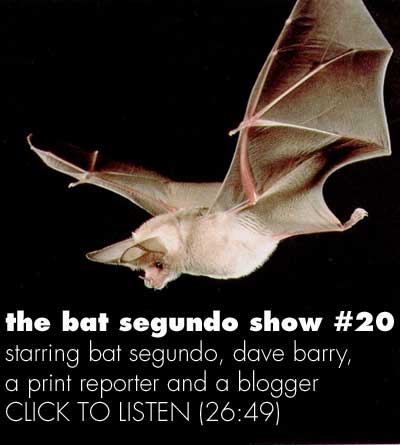
Author: Dave Barry
Condition of Mr. Segundo: Reduced to second-string narrator.
Subjects Discussed: Suze Orman, footnotes, Donald Trump, lawsuits, phone calls from Paul Anka, daily affirmations, indices, sex with ducks, buzz cuts (1960 vs. 2005), the boomerang generation, getting reviewed in the NYTBR, Dave Barry deconstructs our Young, Roving Correspondent’s baroque speaking style, snobbery, humor, Lee Eisenberg, commuting, podcasting, reading books and farting, quitting his column, reader expectations, and working with Jeff McNelly.
[LISTENER’S NOTE: This podcast is probably the strangest one we’ve put out.]
Listen: Play in new window | Download
Fast Thinking
A brilliant piece of local legislation across the Bay.
A Question for Language & Audio Geeks
In the course of engineering audio, I’ve noticed that the bilabial plosive (meaning the b sound when voiced and the p sound when voiceless) is sometimes recorded with too much gain, even when I have placed the microphone at a reasonable distance from the mouth. Meaning that when I open up an audio file, whenever someone says “book” or “picture,” I must meticulously correct it in postproduction. Not having an expensive processing unit, I am wondering if there is a workaround that would save me such time. (I am guessing that switching to condensers is probably the answer.) I am also curious why the bilabial plosive is so prominent (particularly in deep-voiced male speakers). Could it be the not bad yet dynamic microphone I am using? Or perhaps the signal is simply coming in too high.
[UPDATE: It may in fact be audio compression (PDF), but if other podcasters are having sibilance issues, please offer your thoughts, theories and solutions in the comments.]