Well, this is both very unfortunate and very mysterious. I never thought Chris Penn got the credit he deserved. Personally, I’ll never forget Penn’s incredible performance in Abel Ferrara’s The Funeral.
Year / 2006
John Banville Radio Play
As widely reported, John Banville’s radio play, “Todtnauberg,” can be listened to at the BBC site. Banville proved to be more skillful a radio dramatist than I expected.
And as an aside, I have to wonder why American radio (read: NPR) doesn’t offer these sorts of extended opportunities for authors outside of This American Life. Wouldn’t it be great to see Eric Kraft offer a radio adaptation of one of his Peter Leroy novels or any of the Escapist comics rendered into radio plays?
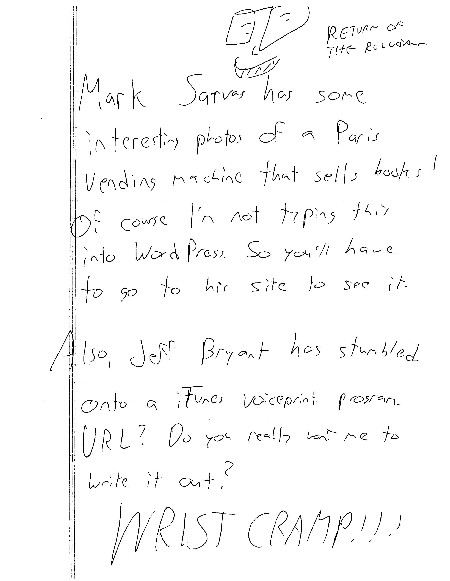
Round the ‘Sphere (by 1995 Fax Machine)
I’m a Novelist, Not A _______
While we’re on the subject of what authors are up, I should note that Mark Haddon has a small chapbook of poetry coming out in April (already out in the UK). Proving to the world that Haddon will likely specialize in extremely long titles until the critical interest grows inflexible, this one’s called The Talking Horse and the Sad Girl and the Village Under the Sea. But the consensus indicates that it’s not so hot. Ranjit Bolt says, “[N]othing could prepare us for the tendentiousness, the unjustified formlessness, the ghastliness, of Haddon’s verse.” Neel Mukherjee of the Times is more encouraging: “If only his muse didn’t fall into the jerky stop-start motion of a nightmarish traffic jam on the M23, and he loosened his lines to let them breathe more.”
Caitlain Flanagan Declares War on Cocksucking
Caitlin Flanagan jumps the shark. No really. This book review has to be read to be believed. Everything from teenage oral sex to Ms. Flangan herself tittering at the prospect of mass fellatio (which, interestingly enough, Flanagan equates to “the province of prostitutes,” leaving us to wonder if Flanagan has somehow existed this long without experiencing the joys of oral sex) to an amateurish investigative effort by Flangan to confirm the mass fellatio. (Yes, really.)
I haven’t read an essay this unintentionally hilarious in a long time. That sentences such as “Somehow these girls have developed the indifferent attitude toward performing oral sex that one would associate with bitter, long-married women or streetwalkers” would be seriously considered in a 21st century magazine of ideas (the essay originally appeared The Atlantic) is astonishing to me. Maybe I just ain’t vanilla, but oral sex is hardly BDSM or felching or bukkake, nor does engaging in it immediately turn you into a jezebel or a gigolo. And by what standard do jejune yentas such as Flanagan determine what’s normal and what’s incorrigible? The magical gremlin permanently affixed to Flanagan’s skull who decides what’s right and what’s wrong after a drunken round of darts?
The kind of willing denial that Flanagan expresses here in lieu of trying to understand the issue (teenagers are becoming more promiscuous, like it or not) and in trying to parse whether the novel in question (Paul Ruditis’ Rainbow Party) answers this societal development is beyond preposterous. It’s dangerous. It promulgates a kind of fashionable bllindness in which it’s perfectly acceptable to remain horrified without trying to understand why one is having an emotional reaction. It imputes a mentality whereby one can never step outside of one’s hermetic paradigm and the results or effects of an sociological development are not just unexamined, but are immediately demonized as “evil.” Never mind that there’s likely some constructive value in trying to figure out why these “forbidden” impulses appeal to certain people, particularly when one is in charge of setting the boundaries. But in taking the myopic road out, Flanagan is no different from a paranoid Caucasian who immediately assumes that an African-American saying hello is out to carjack her.
That Flanagan’s essays have been embraced by the New Yorker and the Atlantic, while fostering such an anti-thinking approach, is a telling indicator that the world of letters isn’t ready for a serious discussion of these issues. It isn’t ready to accept the fact that, yes, teenagers have oral sex. More all the time. It isn’t ready to start answering questions. What does this mean? Is this necessarily bad? How did this develop and will we see teenagers start to embrace more violent and hardcore fantasies? And are these in turn bad? Is any of this a reaction to the way in which sex is so undiscussed in American society, particularly in the classroom? Was Jocelyn Elders ahead of her time?
The continued publication of Caitlin Flanagan’s essays is a disgrace to any magazine interested in raising these questions (or less provocative ones). Thank goodness that at least one of the Holy Trinity (Harper’s) has had the good sense not to publish such a flagrantly anti-intellectual writer.
For a more thoughtful take on a similar subject, see Naomi Wolf’s essay on how porn affects sexual conduct.
(via Jenny D)