BBC: “”The guitarist walked out, leaving his band-mate to complete the interview. Stern later said he was ‘very sorry.’ Townshend left a reply on his website, saying: ‘Howard, let’s have lunch.'”
Year / 2006
Responding to Dawkins
Terry Eagleton on Richard Dawkins: “Imagine someone holding forth on biology whose only knowledge of the subject is the Book of British Birds, and you have a rough idea of what it feels like to read Richard Dawkins on theology. Card-carrying rationalists like Dawkins, who is the nearest thing to a professional atheist we have had since Bertrand Russell, are in one sense the least well-equipped to understand what they castigate, since they don’t believe there is anything there to be understood, or at least anything worth understanding. This is why they invariably come up with vulgar caricatures of religious faith that would make a first-year theology student wince. The more they detest religion, the more ill-informed their criticisms of it tend to be. If they were asked to pass judgment on phenomenology or the geopolitics of South Asia, they would no doubt bone up on the question as assiduously as they could. When it comes to theology, however, any shoddy old travesty will pass muster. These days, theology is the queen of the sciences in a rather less august sense of the word than in its medieval heyday.”
And he’s just getting started.
There’s also an essay by Marilynne Robinson in the November Harper’s.
And this interesting Gary Wolf piece talking with Dawkins and a host of other New Atheists who share the belief that professing one’s atheism is now necessary.
BSS #74: Jeff Bryant & Sidney Thompson
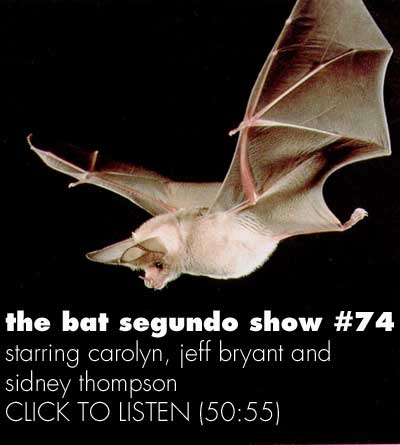
Guests: Jeff Bryant and Sidney Thompson
Condition of Mr. Segundo: Locked away by a Pittsburgh podcaster.
Subjects Discussed: Faulkner vs. R.E.M., Southern fiction, how music influences fiction, observing unusual behavior, Thompson’s musical background, family as a starting point, taboos, the happy medium between shock value and playing it safe, stereotypes, believability, escaping into fiction, misfits and loners, connecting with despicable characters, morality in fiction, racial assumptions at the Atlantic Monthly, presenting racial conflict in fiction, and thoughts on the Southern fiction/blue-state fiction divide.
(A co-production of the LBC, Pinky’s Paperhaus, and The Bat Segundo Show.)
Listen: Play in new window | Download
Good Day Mr. Kubrick
Hilarious. Unsurprisingly, no trace of this guy on the IMDB. (via MeFi)
Esposito on Powers
Scott has an excellent Friday column on Richard Powers:
But if in Powers we lose a sense of mystery, we gain a sense of wonder. One of the most striking aspects of a Powers novel is the sense of genuine amazement at the natural world that the reader is left with. This is no small achievement tn an era in which it is often remarked that space shuttle flights are no longer televised because they have become so commonplace, so banal. Powers reveals a very real, very necessary awe at science and nature. This is no preachy exercise, no citing of facts and figures; it is something that is communicated through the stories and metaphors, something that takes hold of you as you read without Powers needing to lay it out for you. It is humbling, which I believe is exactly Powers’s point, to re-instill a needed sense of humility as humans gain truly God-like powers over their environment. This is something that neither Pynchon nor DeLillo does, something I think only a Richard Powers could do.