New Scientist: “In a recent study, the technology was 70% accurate at predicting whether participants planned to add or subtract a pair of numbers. Paralysed people may one day be able to use devices based on the technique to carry out complex actions, the researchers say. However, ethical concerns have been raised about its possible use in interrogation.”
Month / February 2007
Sleep-Deprived Roundup
- I’m with Jeff on this one. I liked Neal Pollack’s Alternadad, but comparing it to Howl is like calling The O.C. the finest drama since I, Claudius. I can only chalk this bizarre comparison to the precarious employment scenario now going down at Time.
- Responding to the Reason fanfic imbroglio, Tod Goldberg observes that “all uses of the term ‘raging fucktard’ be noted as originating from me.” One would think that this point would be self-evident, but it seems that the Cathy Youngs of the universe require clarification.
- Charlie Anders uncovers a remarkable stereotype in the Star Trek animated series. I hope The women of Charlie Chaplin. (via Quiddity)
- Michelle Richmond is posing for Playboy.
- Banville on Amis. (via Maudier)
- I think the question of whether an author has set foot in the place he’s writing in is moot. Shouldn’t it be about the work? One can look on further than Stephen Crane’s The Red Badge of Courage. Crane never set foot into battle and yet composed chilling imagery.
- Levi Asher hits PBS!
- I wonder if these animators stole the idea from Nick Mamatas’ Move Under Ground.
- Meghan O’Rourke on John Leonard: “It would be fine to leave it at that, if it weren’t that the word ‘enthusiast’ sounds dilettantish, somehow not quite serious. So let us try this: John Leonard is our primary progressive, catholic literary critic; he is also, with the exception of Susan Sontag, the best American literary critic to come of age in the 1960s, when the destabilizing forces of rock ’n’ roll and popular culture ransacked Axel’s Castle, that modernist symbol of aesthetic detachment, and began throwing parties in the inner keep. Like Sontag and Camille Paglia, Leonard has been one of the few literary essayists who can make sense of the erosion of highbrow culture, ruing elements of its loss while embracing the forces of popular culture. He is a man who loves The Beatles and Arthur Koestler, Joan Baez and William Wordsworth; and whom we can trust, now, when he worries that our intellectual culture is being, if not ‘dumbed down,’ then coarsened. He may be an ‘old fart,’ as he describes himself. But in outlook he is still a young progressive — the word-drunk man who has done for literary criticism what Lester Bangs did for rock journalism.” Sam Tanenhaus, take note. (via Complete Review)
- It looks like auctorial doppelgangers are afoot at the Philly Inquirer.
- James Tata on the Echo Maker epigraph.
- Today’s students are unfamiliar with the Beatles, Norman Mailer and Orson Welles. (via Bookblog)
- Nextbook chats with Aline Kominsky Crumb.
- Bookish Love, an excellent site for reading reports by the by, meets Madison Smartt Bell.
- Can today’s newspapers be trusted? (via Bookninja)
- 2007 seems to be the year of vampire novels. Or at least I seem to be reading more of them lately (three so far and we’re barely into February). But Bookburger informs us that John Marks’ Fangland is the one to read.
- Atwood on arts funding. (via Magnificent Octopus)
- Matt Bell reports on a Michael Martone reading.
- A detailed Stephen Dixon interview. (via Matthew Tiffany)
- Is there now a confluence between Internet advertising and newspapers?
- 24 co-creator Joel Surnow’s politics.
- Mystery Morgue interviews Sarah Weinman.
BSS #97: Ngugi wa Thiong’o & Carrie A.A. Frye
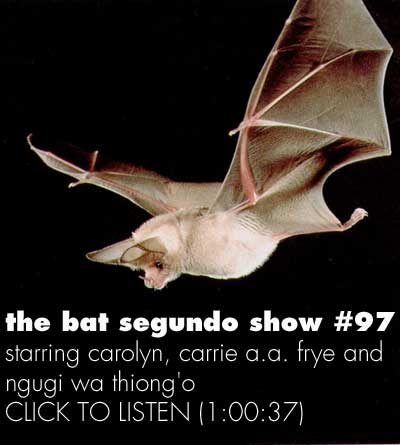
Condition of Mr. Segundo: Avoiding impostor kings.
Guests: Carrie A.A. Frye and Ngugi wa Thiong’o
Subjects Discussed: Satirical plausibility, Wordsworth’s willing suspension of disbelief, narrative explanation and interconnectedness, queuing, The Wizard of the Crow as a history of Africa and a global epic, poverty, truth vs. fiction, metamorphosis in nature, comic literary references, Jonathan Swift, how dialogue carries the narrative, theatrical metaphors, Tajirika as charming villain, writing in Kikuyu and translating in English, Kenyan cultural politics in the 1960s, and being imprisoned for writing in an African language.
(A co-production of the LBC, Pinky’s Paperhaus and The Bat Segundo Show)
EXCERPT FROM SHOW:
Thiong’o: Getting a character mentioning, or the narrator mentioning, something in passing, which may look very almost — if a reader is not careful, he may actually miss it. But then as you go on, the small thing mentioned at the beginning becomes larger and larger, and more and more significant. For instance, the issue of queuing. The way it begins is almost offhand and then, as it goes on, it increasingly becomes more and more important, more and more central, connecting the various events.
Listen: Play in new window | Download