Queen Anne, Ordinary Life and Assorted Schlepping

Lisa Allardice dares to ask a question that some people have answered, but have refrained from voicing, fearful of being labeled some rabble-rouser to be dealt a harsh blow, never again to be invited to those swank cocktail parties: Is Anne Tyler washed up? Since I value my respiratory tract (and I’ve been known to cave when wine and cheese are placed beneath my nose, but only in weak moments), I’ll only say that I’ve liked Tyler’s books in the past, but reading Ladder of Years on a whim was a very bad idea. I suspect my struggle had to do with what Tyler considered to be the ultimate revolutionary choice for a woman: running away from your husband. And this in 1996 with a rising divorce rate. I think we can all agree that this precludes Tyler from the “contemporary literature” canon.

Also in The Guardian is an amusing and forthright essay from Danny Leigh, first-time novelist of The Greatest Gift. Not only does Leigh try to wrestle with the conundrum of whether his protagonist mirrors his life, but he also confesses that, as a human being, he figures his life experience is pretty banal. But that apparently didn’t stop him from discovering things about himself that he could throw an imaginative spin on.

This article on fan fiction doesn’t nail down any conclusions, but does offer a not-bad overview of K/S and other exemplars of fan fervor. (via Graham)

Heru Ptah apparently made a killing selling his book on the subway. To the tune of $100,000 and an MTV Books deal with an advance in the mid-five figures.

Great headline with disappointing followthrough: Diet books with prose to savor? Fat chance. If only. And this fillip in the Philly. I dare a major newspaper to assess the poetic value of The Atkins Diet.

Memo to Writers: Please Stop Dying!

Writer Roy Clarke has been kicked out of Zambia. The cause? Calling President Levy Mwanawasa a “foolish elephant” and two ministers “baboons.” Apparently, Fleet Street tactics don’t get you far in Africa.

Philip Pullman’s trilogy is now a six-hour play. But its staging hasn’t been without controversy. A few febrile fans have planned to picket the theatres. But if playwright Nicholas Wright “includes the Tom Bombadil scene,” the production should be in the clear.

Pulitzer winner John Toland has died at 91. In addition to writing Hitler: A Bigass Biography to Demolish All Bigass Hitler Biographies, Toland won the 1971 Pulitzer for The Rising Sun, which covered the Japanese Empire during the same time period. A few other people who departed from this earth over the weekend: Barbara Jeffris and L.A. underworld novelist Douglas Anne Munson.

And David Kipen has a nice tribute to the recently late John Gregory Dunne.

I’ll try and scoop up more news later, but, as all of you nursing vacation hangovers should know by now, today involves something of a shift back into gangly routine. And it’s probably more abrasive than casually replacing your bar of soap with Brill-O-Pad. In the meantime, why not try some of the folks on the left, many of whom are returning back to their respective perches?

The Un-Ethicist #2

unethicist.jpg
unethicist2.gif

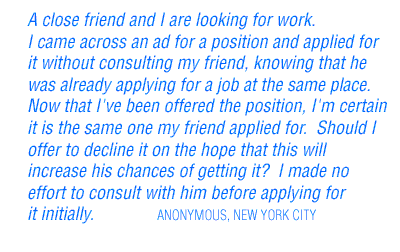
What’s the real story, Lil Miss Anonymous? Do you want to play ball or don’t you? Life’s a bitch, ain’t it? One minute, you’re lying flat on your ass eating Cheetos and faxing resumes, not getting a single interview. The next minute, bang, a job lands in your lap with all the gainful ardor of a chihuahua with a bladder problem.

Your altruism is commendable, if more than a little suspect in a capitalist republic that favors a ruthless dog-eat-dog mentality — to give you a specific analogy, it’s a bit like lapdogs and chihuhuas taking bites out of each other beneath a sneezeguard at a Vegas buffet with a broad culinary swath. First off, did your friend know about this specific ad? The great thing about the help wanted section is how some of these painfully cheery recruiters try to disguise their ads by giving you a private fax number for a specific venue (though tracking the telephonic prefixes and the general language used can easily keep you ahead of the game), or don’t give you any information at all (“Apply: Position #342”), or offer you very strange instructions on how to apply (“Please arrive on Wednesday at 9:30 a.m. Prepare for further application procedures. Bring dungarees.”).

My brother Randy mentioned Samuel Beckett when answering this question, and I have to say that, despite his complacency and attempts to be down with the liberal arts crowd, he’s onto something. If you feel the need to throw in the towel (because your friend will find out), keep in mind that the employment world is so hopelessly Byzantine that with any “Luke, I am your father” revelation to your friend, there’s probably a million variables you can fall back on.

After working for a radio show with a well-known host, I wrote an essay about it, without naming the host or show, although anybody who’d heard the show could have identified both. I did not vilify the host but characterized him with amused detachment. When I mentioned the essay to a friend who works for an organization associated with a show, he implied, without reading it, that publishing it would be wrong. Would it? A.B.S., NEW YORK.

When William Goldman wrote about his experiences (Adventures in the Screen Trade), he had no problem dishing the dirt. He characterized several stars and directors as utter buffoons — in a few cases, outright avaricious ones. You could make the case that Goldman was trying to sabotage his own career. He was, after all, around 51 when he wrote it. So a case could be made that the hostile chronicling arose from a mid-life crisis. But something very strange happened. The book became a bestseller and is often referenced in film classes. And Goldman still has a career, albeit writing crap like Dreamcatcher.

What do you really want to do, A.B.S.? That’s the real question here. Obviously, you have a hankering to publish this puppy (assuming it bears enough merit to be published). But why the hell are you writing to Randy? If you’re not prepared to make a hard decision between your job security and your desire to emulate Rex Reed, then I’d say that you need to put some more complications into your life. Publish it. Accept the consequences. Take a fucking risk for once, you chicken. The fact is, A.B.S., that you’re just too passive-minded for my time. So if you want me (or Randy) to make a decision for you, then I’d favor the harder choice. If only to get these silly journalistic urges out of your system and put a little hair on your chest.

Jesus, the radio business turns people into a bunch of wishy-washy bores, doesn’t it?

Disappearing Books & Some People Just Don’t Understand

In Singapore, Starbucks cafes have initiated a used-book program to get people reading. Read a book, drop it off at a Starbucks, and get $1 off a drink. Of course, there’s one chief problem with the plan beyond this failure to encourage people to read it. (Hypothetically, you can just move a book from the National Library to one of the 17 Starbucks outlets participating.) If the book is bad and likely to put you to sleep, shouldn’t the coffee discount apply before you read the book, rather than after?

At the Three Creeks Community Library, books on the occult are the most likely titles to be stolen. More so than tomes on test preparation or sex. I leave the conspiracy theorists to figure out if the occult books are hexed or not.

Publishers looking for a quick way to pulp their overstock may wish to contact Ed Charon, who holds the Guinness world record for tearing phone books into shreds. Or not. Ed Charon, you see, was just unseated by a thirtysomething. This young upstart can tear 12 1,000-page phone books apart in 12 minutes. “There’s no age or race barriers,” Charon said. “Everybody enjoys this.”

A.S. Byatt writes on the enduring power of the fairy tale and concludes that its legacy can be found on the Web.

The Sunday New York Times reviews Wolves of the Calla and refers to Oy as “the talking dog-badger companion,” while also comparing a conversational exchange involving stew to Widow Douglas’s cooking in The Adventures of Huckleberry Finn. Highbrow attempts to understand popular fiction don’t get any funnier than this. Or maybe they do. Also in the Times: Heinlein’s “first novel,” For Us, the Living is unearthed. No real conclusions about the quality. More of an undergraduate-style summary than anything else. But it does include the blurb-whoring revelation that “the belated publication of this early work is a major contribution to the history of the genre.” Thankfully, John Chute has also taken on the book. He notes that For Us, the Living “promulgates the kind of arguments about sex, religion, politics and economics that normally gain publication through fringe presses, not the trade publishers Heinlein submitted his manuscript to.”

The Green Man Review asks a few spec-fic names (including Charles de Lint, Gwyneth Jones and Ellen Kushner) to spill their favorite books.

And, just as Gene Wolfe’s new book, The Knight, has escaped the floodgates, the folks over at Infinity Plus have an interview up with the maestro.

By the Page

Crazed Hypothesis Which Involves Momentary Shift From Lit-Loving Guy Into Silly Marketing Type (With Extraordinary, Speculative Overtures) And Mischeviously Suggesting That William Goldman’s “Nobody Knows Anything” Maxim Applies to the Publishing World: If a 300-page novel is, by Page 165, something you’re trying to finish reading so you can move on to the next one, can you conclude it’s a good novel (if you admire it in spurts)? Conversely, if it’s something you can’t put down, does it follow that the book is a great one, whether pop or literary?

Is Page 165 is the make it or break it point? Sure, there’s the possibility that the story or prose will pick up in 5-10 pages. But if the reader or critic is not mind-staggeringly drunk over the book by now, then the writer can kiss her shot at being short-listed or getting a rave review goodbye, or face being a literary mid-lister. In which case you hustle the people behind the Today Book Club.

Is this how the publishing world works? Chaos theory?

Here’s where a bit of extremely specious speculation into American lit comes into play. If we examine the last five years of winners by page count, we find the following:

Pulitzer Fiction Winners

1999: The Hours by Michael Cunningham (230 pages)
2000: The Interpreter of Maladies by Jhumpa Lahiri (198 pages)
2001: The Amazing Adventures of Kavalier & Clay by Michael Chabon (656 pages)
2002: Empire Falls by Richard Russo (496 pages)
2003: Middlesex by Jeffrey Eugenides (544 pages)

Average: 424.8 pages
Next Awards Ceremony: May 2004

Of the Pulitzer winners, only The Interpreter of Maladies and The Hours are less than the around-500 page mark. And that’s only because The Interpreter of Maladies is a short story collection. My guess is that The Hours‘s uber-homage to Virginia Woolf led the page count factor to be dismissed. But the Pulitzers seem to favor sprawling epics, whether a Greek family coming to Detroit, two Jewish emigres making a killing in the comic book industry, or Russo’s wide blue-collar swath.

National Book Award Winners

1999: Waiting by Ha Jin (320 pages)
2000: In America by Susan Sontag (400 pages)
2001: The Corrections by Jonathan Franzen (592 pages)
2002: Three Junes by Julia Glass (368 pages)
2003: The Great Fire by Shirley Hazard (288 pages)

Average: 393.6 pages
Next Awards Ceremony: November 16, 2004

The National Book Award winners are more manageable reads, averaging out at the 350 page mark. But page count isn’t so much as a factor, as are consequences over time (World War II in The Great Fire, what happens to characters over a decade in The Three Junes, familial trappings in The Corrections).

The National Book Critics Circle Award

1998: The Love of a Good Woman by Alice Munro (352 pages)
1999: Motherless Brooklyn by Jonathan Lethem (336 pages)
2000: Being Dead by Jim Crace (208 pages)
2001: Austerlitz by W.G. Sebald (304 pages)
2002: Atonement by Ian McEwan (368 pages)

Average: 313.6 pages
Next Awards Ceremony: March 4, 2004

The odd one out here is The Love of a Good Woman, which is a collection of short stories. (And I’m discounting short story collections because, by definition, they’re harder sells than novels.) But it would appear that the National Book Critics prefer breezy, puncutated books with a more quirky style. Ian McEwan has a reputation for whittling his prose down to the bone. Austerlitz is “short,” but the conversations embedded within the novel require work to pick out, being separated by commas. Being Dead is, of course, the ultimate perspective novel in that it follows the disintegration of two corpses. And Motherless Brooklyn has the Tourette’s syndrome hook.

SILLY CONCLUSIONS:

The shorter your book, the more likely you’re going to win the National Book Critics Circle Award. But only if the prose is perspective-oriented and “challenging” enough to impress the critics.

If your novel is a little longer and your book is more centered around time and location, then you stand a shot at the National Book Award.

And if you have a sweeping epic, then the Pulitzer’s your best bet.

This leads me to wonder whether some publishers are more inclined to typeset their books to pander deliberately for specific awards, with abstruse cover art to match, and whether some editors, sensing that a prospective title has some literary merit (i.e., award-winning potential), will press the writer to tailor their books within these guidelines. (“No. Make it a little longer. And can we go off to Bavaria for a few chapters?”)

Of course, all of this is just extremely idle speculation on a rainy day. And I haven’t even taken a look at the finalists, or accounted for timed release dates. But being ill-informed on multiple levels about this sort of thing, I’d be extremely curious to hear from someone inside the publishing industry just how “pre-packaged” a particular book is for these three major awards. It certainly works that way with movies, and, since the risks are just as great (on a smaller financial scale) in fiction, it would seem to me that at least something along these lines would be in place in New York.

Just about every trade paperback edition that comes out has some kind of “Short-Listed” or “Finalist” nod on it, if it can include it. (Even a later edition of A Heartbreaking Work of Staggering Genius had “Pulitzer Finalist” on it when it already had a built-in audience, which mystified me.) You’ll recall that Jonathan Franzen got his panties in a bunch over advertising the Oprah Book Club selection on the first hardcover edition.

So the questions are: Are we seeing a shift towards award-conscious releases (even in first editions)? (The more awards, the merrier.) And, if so, how embedded is this within current publishing house policy? And by what factual criteria do they base these ebullient cover-laden interjections?