Top Films of 2003

A best book list would be futile, for the same reasons that Jessa noted. By my estimate (and I started logging in April), I read roughly around 97 books in 2003. But many of these were attempts to catch up with books published last year, or getting up to speed with the literary canon, or playing the read-the-precursors game with current releases (such as Robert Caro’s LBJ biographies and the Dark Tower books). The book-to-film ratio (and the media consumption-to-life experience ratio) this year dramatically shifted. Nevertheless, there were notable lapses into film geekdom (such as the Castro’s Noir City series and the San Francisco Independent Film Festival) in which I threw in the towel with fellow cinephiles and went hog wild. While I averaged about 1-2 films a week, it’s quite conceivable that I saw fewer films this year than I’ve seen in the past seven years. Despite a conscious attempt to avoid the obvious cinematic bombs (Bad Boys 2 and The Cat in the Hat to name two that come to mind), 2003 was, nevertheless, a solid movie year for the indies and an abysmal year for the Hollywood films. Oddly enough, my favorite film of the year was, in fact, a Hollywood film.

Best Films of 2003:

1. Mystic River
2. Down With Love
3. Spider
4. Teknolust
5. Spellbound
6. Lucky
7. Bad Santa
8. The Magdalene Sisters
9. Intolerable Cruelty
10. The Barbarian Invasions

Honorable Mention: American Splendor, Capturing the Fleischmans, Thirteen, The Cooler, Alien: The Director’s Cut, A Mighty Wind, Dirty Pretty Things, Irreversible

Overrated: The Return of the King, Lost in Translation, Kill Bill Vol. 1, Cremaster 3

Guilty Pleasures: The Core, Terminator 3: Rise of the Machines, Bubba Ho-Tep

Haven’t Seen Yet: The Fog of War, The Company, 21 Grams, In America, Cold Mountain, Girl with a Pearl Earring, Master and Commander, Looney Tunes: Back in Action, The Triplets of Bellville, Monster, Shattered Glass

Worst Films of the Year (or Why Did I Pay $10 For This?):

1. Love Actually
2. The Matrix: Reloaded
3. Scary Movie 3
4. The Recruit
5. Big Fish
Is There Life?

The Science article requires membership to some orgainzation that sounds too much like someone’s rear end, so all we have are generalities in other media outlets to go by. But it looks like the Australians have found a habitable region in the Milky Way where life is likely to exist. Charles Lineweaver notes that there are four components necessary for life: a star, elements to form a planet, evolutionary time, no chance that the star will fall prey to a supernova. But there are three additional facets Lineweaver fails to list: wars triggered by colossal misunderstandings, edible underwear and parking tickets.

New Books, Arty Books, Odd Books

The Guardian has a nuts and bolts profile of John Gregory Dunne, who passed away over the New Year’s weekend. A final novel, Nothing Lost, is planned for publication later this year.

Colson Whitehead’s next book has the man going crazy over New York in a collection of essays. Newsday doesn’t get much out of him, but it does note that Whitehead’s third novel is due out this spring. Oh, and he’s bought a home in Brooklyn with the MacArthur money. Hard reporting that boils down to this: Isn’t it good to be a hot, young thing?

Can you judge a book by its cover? New York book fetishists may want to check out the New York Public Library. Virginia Bartow has selected 90 books, trying to see if the books in questions can say something without being read. Included is Agrippa, a collaboration between William Gibson and Dennis Ashbaugh encoded in the first letters of DNA’s nucleic acids and a poem on a floppy disk that encrypts data upon access.

L. Frank Baum published two books in 1900. One was The Wizard of Oz, the other was The Art of Decorating Dry Goods Windows. Stuart Culver has a little more. Among Baum’s observations: “You must arouse in the observer cupidity and a longing to possess the goods you sell.” “Arousing the cupidity” didn’t actually work for Baum himself though. Most of his business speculations failed, but the Oz books did well.

And a moment of candor from the Post re: blogs? Or are they riffing with alt-weekly angst to keep up? Whatever the case, it’s a strange read from the paper of Woodward and Bernstein. (via Sarah)

[1/21/06 UPDATE: Dunne’s Nothing Lost (called by Kipen a “sloppy, fun swan song”), of course, was completely subsumed by Joan Didion’s memoir, The Year of Magical Thinking, which, like nearly every Didion nonfiction book, has gone on to win nearly every nonfiction award. And I should point out I’m just as defensive about blogs today as I was two years ago. I need to be more critical.]

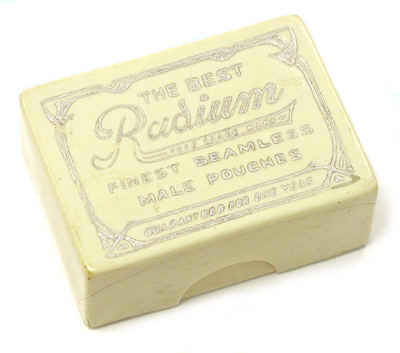
Because When I Think Radioactive Contamination, I Think Warren Beatty

radium1.jpg

Radioactive Quack Cures: Includes revigators and radioactive pads.

Radioactive Curative Devices and Spas: “The Revigator itself was a ‘radioactive water crock.’ A jar made of radium-containing ore, it held several gallons of water, came with its own spigot, and had the following instructions on the side: ‘Fill jar every night. Drink freely . . . when thirsty and upon arising and retiring, average six or more glasses daily.’ The radon produced by the radium in the ore would dissolve overnight in the water. In effect, it served as a ‘perpetual health spring in the home.'”

Radium Cures: “Radium cures, which reached their pinnacle of popularity in the U.S. during the 1920’s, promised to remedy these diseases, restore youthful vigor, and revitalize an ailing sex life.”

Bush Bonaparte?

From Alan Moorehead’s The Blue Nile, explaining the cultural conditions after Napoleon began his Egypt campaign in 1798:

It was perfectly true that the Mamelukes, in moments of violence, behaved infinitely more cruelly to the Egyptians than the French did. But this was not the point. The Mamelukes were the devil they knew, and Bonaparte was not. His sincerity — and there is no doubt at first his approach to the problems of governing Egypt was both very sincere and very intelligent — was misunderstood. The Egyptians naturally looked for duplicity beneath the apparent altruism.