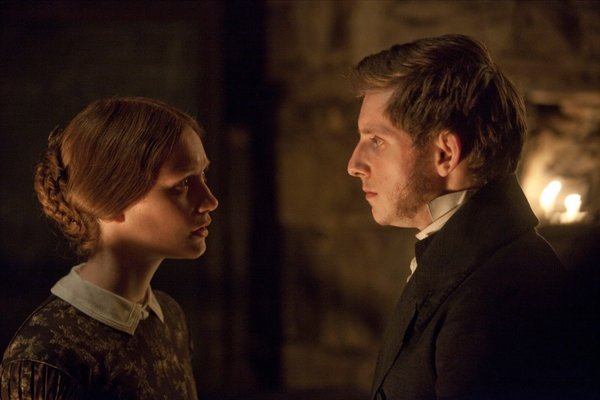
New Directors/New Films: Pariah (2011)

[This is the fifth in a series of dispatches relating to the New Directors/New Films series, running between March 23, 2011 and April 3, 2011 at MOMA and the Film Society of Lincoln Center.]

Last September, in response to Floyd Mayweather’s homophobic rant against Manny Pacquiao, Stanley Crouch wrote an essay suggesting that African Americans “exemplify the modern age in their contradictions as thoroughly as any other ethnic group.” Yes, black voters showed up in California to vote against same sex marriage. But Crouch observed that, thanks to Amiri Baraka, homophobia had been part of black nationalism as early as the 1963 March on Washington. (In a 2009 interview with 3AM Magazine, Baraka claimed that his words emerged from anger that “was part of the mindset” created by numerous political assassinations, but he didn’t apologize for his homophobia.)

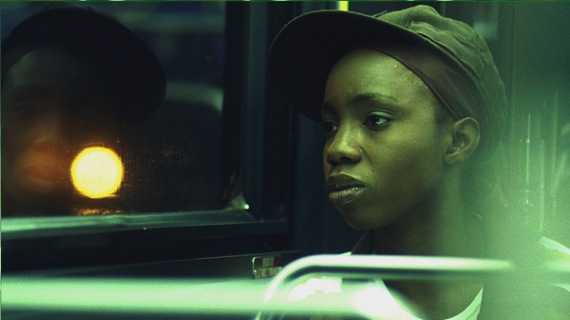
Since black homophobia is often too easily portrayed as a symptom of race rather than a symptom of class, it’s a relief that writer-director Dee Rees has arrived to investigate the matter. Her debut narrative feature, Pariah — an extension of her 2007 short — finds its best footing when illustrating how middle-class aspirations and the desire for stability are often responsible for this lingering atavism. Late in the film, when Audrey (Kim Wayans) reacts to her 17-year-old daughter Alike (Adepero Odeuye) after she defiantly shouts, “I’m a lesbian, I’m a dyke,” the moment’s true horror comes from understanding how Audrey’s materialist desires for a Fort Greene brownstone (rather than a place in Queens, an early life of struggle hinted at throughout Rees’s film) and her efforts to stick with the “right people” at church have permitted a few dormant prejudices to explode within this apparent domestic bliss. (And by making Alike’s father a cop, played by the excellent Charles Parnell, Rees neatly aligns Audrey’s Christian virtues with Alike’s father’s concession to an authoritarian vocation. It isn’t a surprise when we learn that this isn’t a happy marriage.)

Crouch suggested that “consenting adults will win out over all the blather,” but, in his otherwise thoughtful essay, he didn’t answer the equally important question of how children, still struggling to find identity, might cut through this noise. In Pariah, Alike isn’t a terribly rebellious teenager. She sneaks into nightclubs in drag with her friend Laura (Pernell Walker), but spends most of her time inside shyly occupying red velvet couches and struggling with her sexuality. Does she shove a dildo down her pants and pretend to be a man? Does Alike have the “right people” to go to? Even in seemingly civilized Fort Greene, Rees has the courage to suggest that plentiful community resources aren’t always allocated to answering the right questions.

One night, Alike returns home later than curfew and Audrey yells at her. Rather than trying to understand her daughter, who is also a blossoming creative writing student getting good grades, Audrey would rather blame Laura, “that young lady you run out with,” for Alike’s apparent confusion. But surely the mixed signals at home (dad calls her “Allike,” mom calls her “Lee”), buttressed by Alike’s parents trying to squeeze their daughter into their cannibalized notions of success, are the main problem.

Audrey sets Alike up with Bina (Aasha Davis), a girl from church who appears to be a model teenager. Someone who dresses nice, who isn’t likely to corrupt Alike with that Reema Major trash, and who quickly subsumes Laura’s role as regular friend. What Audrey and Alike don’t realize is that the world isn’t nearly as neat as they realize.

Rees is greatly helped by her cast. Oduye, Davis, and Walker all play their teenage roles as if they’re just close enough to self-sufficiency to grow beyond many of these invisible shackles. And this makes it especially painful when some unanticipated development sets their slow progress back.

Unfortunately, the film sometimes tries far too hard to be natural. The handheld camera work, striving for a docudrama approach, sometimes intrudes too much on an organic moment. One scene in a store, in which the question “How does pussy taste?” is presented in front of a few old timers, contains streetcred that is just too forced to be believed. However, one of the film’s best moments is a late night bonding session between father and daughter, where Elika comes very close to telling her dad how she feels. The dialogue itself is okay, but Charles Parnell, who is probably best known for his voiceover work on The Venture Bros., is a very generous actor and sells the scene so that it resonates.

Rees deserves credit for exploring social issues that few American filmmakers are willing to touch. Once she figures out the right balance between realism and drama, she’ll be a very formidable filmmaker. I certainly hope that she isn’t seduced by the less nuanced Hollywood machine.

New Directors/New Films: Curling (2010)

[This is the fourth in a series of dispatches relating to the New Directors/New Films series, running between March 23, 2011 and April 3, 2011 at MOMA and the Film Society of Lincoln Center.]

If Kingpin and The Big Lebowski (or, heck, even Dreamer – a silly movie starring Tim Matheson as a bowler from 1979 that nobody remembers) portrayed the bowling experience from the bowler’s vantage point (natch, given that this is the way most of us comprehend that lengthy lane with the nine pins we hope to topple down in half-drunken triumph), then Curling dares to see it from the middle-aged folks toiling in bowling alleys. This may be because writer-director Denis Côté was born in New Brunswick. In fact, what you may not realize is that five pin bowling, which is quite popular in much of Canada, isn’t nearly as much of a draw in Quebec, New Brunswick, and Nova Scotia. And that is because in some of the French-speaking territories, petite quilles (or duckpin bowling, which is ten pin bowling with fat little bastards replacing the slim pins most of us know in the States; perhaps this is why the obesity epidemic is writ larger south of the 49th parallel) is more the order of the day.

I didn’t intend to write a silly essay about the many variants of bowling, although they certainly excite me. (In fact, my discovery of candlepin bowling upon moving to the East Coast made me both very surprised and very happy.) I am, after all, supposed to tell you about this movie, Curling. What I can say is that Denis Côté isn’t terribly interested in the bowling alley’s culinary offerings, which you’d figure that anyone who speaks French or who enjoys chilli cheese fries (does Côté?) would be keen on investigating. However, as the film’s title suggests, the film itself isn’t about bowling. It also involves a pastime that is insufficiently defined by Wikipedia as “a sport in which players slide stone across a sheet of ice towards a target area.” I don’t wish to come across as overly querulous, but this clinical sentence certainly doesn’t insinuate what makes curling a draw. Having not curled in any meaningful capacity outside of the boudoir, I can safely report that Curling‘s curling moments did fill me with the sense that I had missed something – even if most of the curlers were advanced in years and looked as if they had taken up curling to alleviate the gloomy boredom awaiting them outdoors. Since the Will Farrell comedy Dodgeball is held in high acclaim, I would not be surprised if some crass Hollywood crew appropriated this sport too. After all, like golf, curling did originate in Scotland.

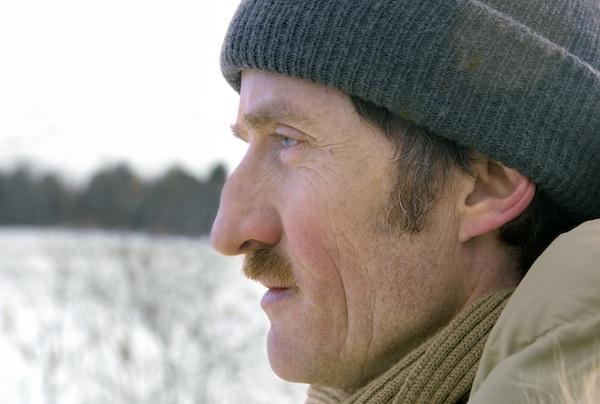
For one unsmiling man with a mustache, Jean-Francois (played by Emmanuel Blidodeau), bowling isn’t so much a joy, as it is a low-paying part-time job in which he sometimes loses bets with his co-workers to clean the bathroom or dress up in preposterous costumes. Jean-Francois’s other gig involves cleaning a motel and, one morning when he discovers a bloody mess in Room 9, he is informed by the owner that his services are no longer required. Of course, it isn’t Jean-Francois’s fault, nor even the fault of the “big Accordion trucker” who stayed the night before who either killed somebody or died bleeding in the wilderness. The owner had planned on closing down the motel anyway. “I don’t have the energy,” says the owner. Well, who can blame the owner when the guests die like this?

Did I mention the fact that some tiger is running loose and that various people are being mauled down in the wintry wilderness? Did I also mention that Jean-Francois is a single dad home-schooling his daughter Julyvonne because it’s so dangerous outside? Jean-Francois takes care of Julyvonne because his partner is locked up in a mental institution. “If you touch a hair on her head,” she shrieks, “I’ll rip your fucking heart out.” Such is the promise of domestic tranquility in this family’s universe, but, in Côté’s defense, I should point out that I grew up in an environment in which such lines were shouted around the dinner table. In fact, the situation here is so bleak that Julyvonne begs her father to play Stacey Q’s “Two of Hearts” through a crappy stereo so that she can dance in a vague manner as Jean-Francois sits on the couch in a moribund manner.

And you thought some of your nights were pathetic. In seeing these scenes, I wondered if the film was set sometime around 1989. Later in the film, when there was talk of cell phones and video games, I felt a genuine sense of shock that this time capsule of a town in the middle of nowhere could be penetrated.

These cinematic results, depending upon your temperament, are either relentlessly bleak or mostly depressing with occasional bright and quietly hilarious spots. At times, Curling made me feel like I wanted to kill myself. And yet I can recommend this mumblecore opus from Quebec. Because the melancholy often functions in a peculiar comic mode. Any film featuring a man dressed up in a bowling pin costume, hassled by a ten year old kid who wants to wear the top portion and who then reveals rudimentary erudition that eludes Julyvonne, can’t be entirely humorless. And any film featuring a fetching employee who has a new hair dye color for every fresh screen appearance is probably suggesting that iridescence can be located in a bleak landscape if you know how to change your stripes. (In fact, chances are that maintaining a silly moustache may be part of the problem.) Then again, this is also a film in which Julyvonne, precluded from painting the town red, humbly requests that her dad paint the bathroom red. Jean-Francois insists that green would be a better shade. Julyvonne is later briefly abandoned because, in Jean-Francois’s view, this contributes to the possibility of him going insane like his partner.

What I enjoyed so much about Curling is that it doesn’t give up its mysteries. We never quite learn why the mother has gone insane. For all I know, it could be a rite of passage in this village. I mentioned earlier that a large cluster of the local population seems to be getting killed or mauled. It could be the tiger. It could be the truck driver. It could be what some folks call cabin fever. I don’t believe the Quebec community is this violent in real life, although I don’t have any fresh crime statistics at my side. Curling presents enough ambiguities to make you wonder whether its village represents some parallel universe occupying Côté’s inventive mind or some part of Québécoise equipoise that just isn’t talked about. It is the rare film that is both a downer and a winner.

Review: Win Win (2011)

Can a woman seeking a $1,500/month guardian stipend truly afford to stay at a New Jersey motel for several weeks? (The Quality Inn in Toms River, New Jersey has kindly informed me that they rent rooms at $39.95/night. Discounting tax, that’s $279.65/week. At three weeks, that’s $838.95.) I suppose she could put it on her credit card, even though she’s just spent a considerable amount of her money in rehab and doesn’t appear to be gainfully employed. But can this same woman also afford to retain an attorney who makes at least three public appearances?

If a pack of cigarettes cost about eight bucks in Jersey, and you are a spendthrift like Mike Flaherty (played by Paul Giamatti), does it make any sense to buy a fresh pack, throw the other nineteen cancer sticks into a dumpster, and then smoke the remainder whenever you need to relieve stress? (For that matter, why are you spending your money on mid-grade scotch you keep in the office? And if your cigarette intake is that why aren’t you relieving stress that way?)

Such story problems emerge up with troubling frequency during Win Win, which isn’t just a subpar mainstream comedy, but a fallacious fantasy. The vastly overrated writer-director Thomas McCarthy (not to be confused with the very smart British novelist Tom McCarthy, who gave us Remainder and C) hasn’t bothered to ask or answer these basic questions. Perhaps it’s because McCarthy lives in a privileged bubble which prevents him from researching or investigating the very people he wishes to depict.

If we are to (rightly) condemn the Tea Party for perpetuating the view that some mythical age of prosperity occurred under Reagan, then we should also (rightly) condemn any huckster who wishes to perpetuate a roseate view of the middle-class instead of one that accurately presents its ongoing erosion (yet still manages to get us to walk away with some faith in humankind: Stewart O’Nan’s novels or Mike Leigh’s films come very much to mind). Because of these problems, Win Win is more feel-good propaganda than respectable entertainment. It’s the kind of movie that a clueless centrist, the type who doesn’t know how to live and who arrogantly claims comprehension of the hoi polloi without actually talking with them, will enjoy without question. I know this, because the film’s generic and gutless humor (1980s rock stars, games called Secret Apprentice, signs on ceilings that read “If you can read this, you’re pinned”) caused the middle-class types I was sitting with to laugh at the carefully engineered, preprogrammed moments.

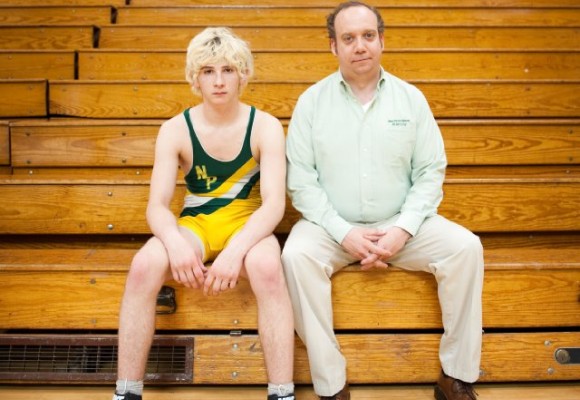
The problem here may be that Win Win is actually two movies awkwardly sandwiched into one. Does it want to be a film about how Mike Flaherty survives in an increasingly unforgiving economy as a sole practitioner who takes up the causes of the elderly and as a part-time wrestling coach? Or a film about how a man who cannot relax finds a new cause to take up with Kyle (Alex Shaffer)? Kyle, a troubled boy, reveals himself to be a very capable wrestler who can shake the wrestling team from its losing streak. (Some hint of Kyle’s troubled past is seen late in the film, where Kyle’s violence shows signs of surfacing to the edge. Between this, and one joke that has Mike hitting Kyle in the face just before a wrestling match, there’s the possibility of a richer film buried beneath the crowd-pleasing claptrap. Alas, McCarthy would prefer to collect the check.) He’s landed into Mike’s life not long after Mike has taken the aforementioned $1,500 monthly guardian stipend from Kyle’s grandfather to help keep his family afloat.

Because the film’s story is so overstuffed, supporting characters who should matter aren’t given the chance to breathe. Amy Ryan, for instance, plays Jackie, Mike’s wife, revealed to be nothing less than a former Jersey girl (with a JBJ tattoo on her ankle: JBJ, of course, being shorthand for Jon Bon Jovi, a shorthand that also condescends to the audience) who now nurtures. The Flaherty family may be having financial difficulties, but why doesn’t the family chip into pick up the slack. Why doesn’t the film give Jackie a chance to get a part-time job? Or even offer us a dramatic moment in which Mike finally cops to Jackie about his inability to make ends meet? Surely, a woman who has observed her husband cheaping out (not fixing the creaky pipes in the office, not sending in the health insurance check on time, not hiring a tree surgeon to cut down the diseased tree) would notice. Even Mike’s office assistant, a woman confident enough to announce her hangovers and carefully tallying the expenses, would probably have some modest clue that the arithmetic doesn’t add up. Presumably, these women don’t confront Mike with these financial issues because they are aware of Mike’s health (he hyperventillates after too much stress). But if Mike has the time to work two jobs, and he’s spending nearly all of his spare time playing Wii tennis and bullshitting with his somewhat loutish friend Terry (Bobby Cannavale), surely he should take some personal responsibility or would at least be called (gently perhaps) on the way he evades what he needs to do. I mentioned a woman earlier who also cannot do the financial numbers. That woman is Kyle’s mother. So that’s three women McCarthy offers who are incapable of understanding basic personal finance. In a world in which The New York Times claims gang rapists to be the victims, I don’t think it’s hyperbolic to call Thomas McCarthy a sexist pig.

Review: Battle: Los Angeles (2011)

Perhaps the strangest aspect of the Battle: Los Angeles screening I attended was Danny DeVito’s presence. Danny DeVito – a supremely underrated actor and director – is just about the last name that comes to mind when I think of derivative science fiction – especially the kind of derivative science fiction that makes Roland Emmerich look like Aeschylus and Battlefield Earth look like Kitchen Sink realism. But there he was, walking out the doors just behind me and archly humming the theme song – his response to this remarkable cinematic travesty. Since Danny DeVito is a professional, and cannot speak ill of a terrible movie, I don’t wish to suggest that Danny DeVito didn’t enjoy the film. But I put forth to you that when a man of his talent reacts like this, this is probably not a sign that Battle: Los Angeles is the 2001 of our time.

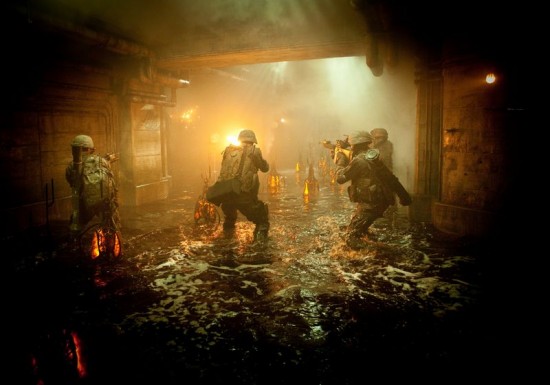
What the hell was Danny DeVito doing at the screening? What the hell was I doing at the screening? I obviously can’t speak for Danny DeVito, but I suppose I was there for the cheese. Then again, the closer I get to forty, the less this answer feels legitimate. Even though I still enjoy laughing at terrible dialogue, which Battle: Los Angeles has in droves. “No promises in combat,” barks Staff Sergeant Michael Nantz (played by Aaron Eckhart as if Nantz were more of an easily ignored plastic chair rather than a flesh-and-blood character). “This is insane,” says another marine, who has not been given adequate dialogue to express what we already fucking know is insane. “I miss him….every…..day,” wails Eckhart later in the film. He may have been referring to Neil LaBute. “They ambushed us like they knew our frickin’ addresses,” says Tech Sergeant Elena Santos (played by the now officially typecast Michelle Rodriguez). Santos, by the by, is the only woman soldier here. And she’s not even an interesting soldier like Private Vasquez in James Cameron’s Aliens. (In fact, being a tech sergeant, she doesn’t even get to gun anybody down until the end.) If that gender disparity isn’t troublesome enough, consider that Nantz gets to say “fucking” while poor Santos only gets “frickin’.’ Where I come from, real women say “fuck.” Alas, this is a 21st century reality lost on writer Christopher Bertolini and director Jonathan Liebesman, who seem to have confused a relentlessly shaky camera for authenticity.

I pretty much lost it when Aaron Eckhart shouted, “Marines never quit,” in his gruff, here-for-the-paycheck bark. But, hey, I had to find my pleasure somewhere. The pleasure certainly wasn’t there in the explosions, which grew tedious, or the characters, which proved to be forgettable despite the X-Files-like captions, or the feeble explanation for the alien invasion, which involved using fuel for water, or the weak military system the alien race sets up, which involved a laughably stupid command center to generate power, or the dialogue, which only served to repeat obvious points.

Given such wretched qualities, cheese is a decidedly immature draw. I should know better at my age. But Danny DeVito is well over forty and he probably came for the cheese too. I was sitting too far away from Danny DeVito to hear if he was laughing. But when I started laughing, during a remarkably terrible and long Eckhart monologue attempting to rally the survivors, I noticed that others started laughing. Perhaps I gave a few audience members permission to laugh. Sony certainly did its best to pretend that this was a worthwhile film, being somewhat more aggressive with confiscating phones (who would pirate this piece of shit?) and even employing a warmup guy to get the audience to reply back “All right” before the screening. Since I had come to this screening as a reviewer, I felt that replying “All right” was inappropriate and not especially journalistic. Still, I can’t blame the studio for doing everything in its power to salvage a turd. On the other hand, a turd is still a turd. As turds go, Battle: Los Angeles is probably one of those turds well on its way to the sewer system by now. So it was probably an unwise decision for the filmmakers to include a plot point involving the Los Angeles sewer system, which only served to remind the audience that they were wading through shit.

Can I find one good thing to say about this failed hodgepodge of Predator, Independence Day, and Assault on Precinct 13? Well, I’ll certainly try. At one point, Nantz cuts away at an alien’s anatomy, trying to find the weak spot. My vast steadfast boredom dissipated for a few moments, and I wondered if the filmmakers would come up with something fairly creative. Maybe the aliens might have a unique digestive system. Perhaps a tentacle might emerge from the carcass and attack the humans. Perhaps the humans could morph into another form. But the only thing these hacks could come up with was a position to shoot at and weapons that were surgically attached to their bodies. And if you can’t be fucking bothered to come up with even some half-assed idea of an alien culture, then why go to the trouble of making the film in the first place?

If this movie had any real courage, it might have killed off its kid characters or shown one of the felled aliens genuinely suffering. Real war is more complicated than the simple-minded malarkey of blowing shit up. Is it too much to ask for even a small dose of All Quiet on the Western Front, Paths of Glory, or Platoon in a movie like this? These days, it is.

Jane Eyre (1990 : 2011 :: Reality : Film Adaptation)

I was a teen when I first read Jane Eyre from beginning to end. The decision to read this Charlotte Bronte classic wasn’t prompted by any authority, but sprang from personal shame. An English teacher had assigned Robert Penn Warren’s All the King’s Men, pairing me up with two other students to write a collective essay in response to the book. I didn’t read the book. It wasn’t because I didn’t try. I just couldn’t read the book. And when I went to one of their comfortable middle-class homes to huddle around one of their computers, the jig was up. I was considered an impostor, with the calumnious sigil embedded invisible on my forehead for weeks.

These two other kids were right. I am still very much an impostor. I grew up in a home sullied by blows both violent and verbal, where shrieks from other family members careened around corners and mice scurried and scratched in the walls. The garage was nothing less than a shelter for junk that my parents lacked the effrontery to throw out, and I would have to climb over all manner of bric-a-brac to get the mail (which included a clandestine Playboy subscription addressed to my name, which I read for the pictures and the articles). Embarrassed friends would telephone me, hearing screaming and saying nothing and sometimes offering their homes as momentary refuge. This made it very difficult to read or concentrate or think or feel or write.

I didn’t have a computer; just an ancient electric typewriter with a highly unreliable ribbon and jittery keys. I had learned how to type 100 words per minute in eighth grade, but the contraption made my skills useless. I would type essays on this baleful beast late at night, when the chances of shouting and interruption were slimmer, often needing an hour to hone a paragraph to make sure that the ink didn’t smudge on the liberated bond and the characters hammered to the paper properly. Even one of these very patient hours, which could only come when I was holed up in my bedroom, still required the dutiful applique of white-out (mostly stolen, not purchased; there wasn’t much money). One of my English teachers – a man named Jim Jordan fond of leaving a tally on the blackboard with my name under the heading INANE COMMENTS (he did the same thing to a nice kid named Nick Hamilton; who knows how many aspiring jesters this man tormented over the years?) and who added a horizontal slice every time I overcame my shyness, announced my associative mind, and got the classroom to laugh — decided to condemn me further when I would turn in papers labored over into the early morning. As far as he was concerned, it wasn’t the content, but the pockmarked presentation, something I couldn’t help due to the poverty of my instruments, that offended this Murphy Brown watcher’s sensibilities.

Factor in all the ruthless ribbing, and this was a tough time for me. Misery at home, misery at school. But I tried my best to see the positive side of things. One needed to develop a thick hide to survive. I figured this neoliberal teacher just hated the poor kid with the wild and crazy hair and the trenchcoat and the hat and the Looney Tunes tees (found very cheap at Marshall’s and treated with some care, given that shopping for clothes was a rare occurrence) preventing him from charming a largely middle-class group as patriarchal pedagogue. It was a wonder, years later, that I ended up finding some dodgy living as a guy who wrote about books and that any page in literature spoke to me more than anything Jim Jordan, who hated genre and hated Stephen King and rebuffed my interest in HP Lovecraft and always let the class know all this, had to say over a semester.
I felt bad about not reading Robert Penn Warren. (Years later, I read the book in its entirety.) I also felt bad when I learned that the two students, whom I thought my friends, ridiculed me to another friend, figuring that I had to be a stupid son of a bitch for not reading Warren. (This third friend defended me, in part because he was also not quite in their class bracket and had some tangible understanding of what I was going through. Vice versa. We’re still friends to this very day. Old soldiers who fought many wars together.) And so I decided to prove to myself that I could read a big book that wasn’t science fiction or fantasy. I plucked a copy of Jane Eyre from a box in another classroom and I brought it home. (I would later do the same thing with George Orwell’s 1984 and Charles Dickens’s A Tale of Two Cities, both of which I was not required to read but did.)

For obvious reasons, I could relate very much to Jane’s early plight in the Red Room and at Lowood. Psychologically abusive family members, teachers who tormented me because I didn’t fit into their suburban idyllic fantasy, feeling stupid and plain – what here wasn’t there to relate to? I had no kind teacher equivalent to Miss Temple at the time, although I would later encounter a marvelous teacher named James Wagner, who not only encouraged me to write by looking upon every essay as an opportunity for fun and mischief, but who paid attention to the prose style contained in my DNA. When my sister took Mr. Wagner’s class a few years later, he said to her, “That’s what I like about you Champions. Short and snappy sentences.”

But once Jane hit Thornfield, I began to despise her and the book. I didn’t like this Rochester fellow who was trying to control her. He reminded me of too many paternal figures who wanted to correct me rather than accept me. And I didn’t like the way that Jane (or Janet, as Rochester called her; a modest corruption of her name that Jean Rhys was to investigate further in Wide Sargasso Sea) wasn’t honest about her feelings. I didn’t like the convenient fortune that Jane encountered later in the book, which seemed a terrible contrivance, and I didn’t like the way that Jane heard Rochester’s voice and how this conveniently urged her to return to Thornfield. Life just didn’t work like this. But I read it to the end and returned the book back to the box, grateful that my fury towards the book would not have to be voiced and shot down by an English teacher who didn’t like me. However, before an eccentric drama teacher (Mr. Cody), I dismissed Jane Eyre as “a Harlequin romance.” I was very surprised when Mr. Cody replied with approbation and enthusiasm.

Still, as much as I hated the book, I have to credit Jane Eyre for giving me a reading discipline I had never known before that time. It hadn’t occurred to me to look at the novel again until there came a time later, more than twice a lifetime later.

* * *

January 10, 2011. I publicly pledge to read the top 100 novels of the 20th century, as decided upon in 1998 (about eight years after I read Jane Eyre and about thirteen years before I made the promise) by the Modern Library of America. What I don’t quite comprehend at the time is that Jean Rhys’s Wide Sargasso Sea -– a prequel to Jane Eyre -– is #94. (April 22, 2011 Interjection: Essay on Wide Sargasso Sea now here.) What I also don’t quite get is that there’s a new film adaptation of Jane Eyre set to be released on March 11, 2011.

A few weeks later, I make the connections. I receive an email from Russell Perreault (I’m on one of Random House’s mailing lists) about the movie tie-in edition. After my high school experiences, there’s no way in hell that I’m going to obtain a fresh copy of Jane Eyre on my own. Not from a bookstore or a library. Yet somehow I cannot resist. Through sheer folly and laziness, I send Perreault an email. Much to my surprise, Perreault humors me and a copy of Jane Eyre shows up in the mail days later. My fate is sealed. I can’t exactly ignore this polite gesture. I must reread the book. Who knows? Maybe my adult self will appreciate what my kid self did not.

I arrange to attend a press screening of the movie, with the idea that I’ll have the book reread before I hit the movie. (What I don’t count on is that all this industry triggers thoughts and feelings outlined in the first part of this essay.) I reread the book. I bang out the following Goodreads review:

It shouldn’t be thoughtless to condemn this terrible book, which I read for the second time in my life. The first time was in high school. I hated it then, but I read it to the end — unprovoked by any force in particular, aside from my own flowering self-discipline. I despise this book slightly less now. But I am now most anxious indeed to read Jean Rhys’s corrective prequel, which appears to be much shorter and has the temerity to condemn such terrible characters. Jane Eyre is almost smug in the end, after 600 pages of near helplessness (especially the unintentionally hilarious chapter of her asking around for food and a job: if she were truly smart, she would have contrived the damn escape over time; what does it say about this diabolical doormat that I longed for her to take up prostitution, hoping in vain that my memory of the book was wrong, but knowing the chirpy fate of this dimwitted damsel in distress, who requires an extra-strong dose of feminist enlightenment). Rochester and St. John are two male specimens whom I would not only outdrink, but out think and out act. When Rochester begs Janet to save him, an image of castrated Williamsburg hipsters beating him to a pulp entered my mind. Alas, such a deserved fate was not to be. Don’t get me started on the doddering St. John.

But of course, being very stubborn-minded, I read this damn book to the bitter end. My partner asked me to leave the room because I was talking back so violently to the book, making sounds resembling “Wah wah wah” or something like that when I had to endure pages upon pages of angst. A critic friend says that he never made it past the first half of this book and suggested that I read Wuthering Heights. He may be right, but I think I’m done with the Bronte Sisters for at least a year. I don’t care how groundbreaking this book was on the Gothic front. It’s just plain hokey. Convenient windfalls from dead relatives, hearing Rochester’s voice from afar. Contrived! So you can’t take responsibility for marrying the crazy woman in the attic? Cry me a river. Man up and deal. Don’t take out your problems on your poor servants, illegitimate children, a governess, and so forth. Hey, Rochester, didn’t you see the sign on the boat to Jamaica? YOU BROKE IT, YOU BOUGHT IT. The fact that you view humans as hairy beasts, sir, is part of the problem. Bronte’s understanding of people, even accounting for the centuries, leaves much to be desired too.

* * *
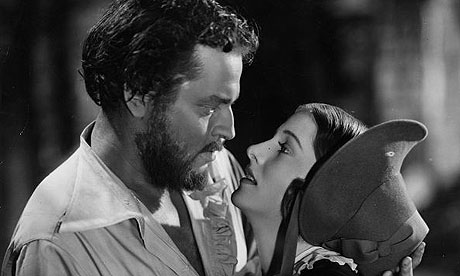
In high school, I understand that many people consider the book to be a masterpiece. And while I don’t share this viewpoint, I do find myself in high school obtaining a VHS copy of the 1943 film starring Orson Welles as Rochester and Joan Fontaine as Jane. I love every damn minute of it. Maybe it’s the melodrama. Maybe it’s the black-and-white. I am familiar then with Citizen Kane and Touch of Evil and the wine commercials and am only just starting to understand what a great cinematic genius Orson Welles was. (My friends only seem to know him from Transformers: The Movie.) There is clearly no better man who can channel Rochester’s oily charisma and convince us why Jane Eyre would fall victim to what would now be very serious sexual harassment in the workplace.

There is, in 1996, a lesser film adaptation with William Hurt in the role. And I learn that George C. Scott has also played him, although I still haven’t seen that version. In college years, I also discover that there’s a 1973 version with Michael Jayston in the part. (I know Jayston as the Valeyard in the 1986 Doctor Who serial, “Trial of a Timelord.”) I track some of these dramatic versions down (not an easy thing to do in the pre-Internet days of video stores and tape trading by mail), but I don’t tell anyone about this adaptation fixation until March 2011, when I write and publish this essay. Perhaps in my secret watching, I am trying my best to find ways of appreciating a book I don’t care for.

“My master’s colourless, olive face, square, massive brow, broad and jetty eyebrows, deep eyes, strong features, firm, grim mouth, — all energy, decision, will, — were not beautiful, according to rule; but they were more than beautiful to me; they were full of an interest, an influence that quite mastered me, — that took my feelings from my own power and fettered them in his. I had not intended to love him; the reader knows I had wrought hard to extirpate from my soul the germs of love there detected; and now, at the first renewed view of him, they spontaneously arrived, green and strong! He made me love him without looking at me.”

Why is Rochester the entry point? Is it because I’m a man? Is it because of this idea of loving someone without the object of your affection looking back at you? I don’t think so. I think it’s because I’m trying to understand why Jane would be so attracted. That’s one of the great narrative mysteries sticking at the back of my mind for years. Even if she doesn’t have much experience with men, and even if the times weren’t exactly friendly for women, it doesn’t make sense that someone brave enough to stand up to the abuses at Lowood would fall for some of Rocheter’s dull philosophy. Yet Rochester, plainly described in that above passage, is charming in these dramatic versions in a way that he isn’t charming in the book.

* * *

March 8, 2011. I’m in the Dolby 88 screening room. I know within a minute of first seeing Michael Fassbender in this movie that he doesn’t have what it takes to be Rochester. And it gets worse as the film goes on. He isn’t fierce enough. He doesn’t have the eyes that men like Orson Welles or Oliver Reed had; the eyes that somehow convince you to jump into an abyss before you know you’re falling. When Rochester sits in a chair, the chair has more screen presence. Poor Fassbender looks as if he’s been asked to do nothing but stare intensely at the camera. His arms and legs have pinioned by bad direction.

It doesn’t help that screenwriter Moira Buffini (responsible for Tamara Drewe) has restructured Jane Eyre so that a good portion of the St. John episode comes first (i.e., the movie begins with Jane’s escape from Thornfield, which in itself is a ballsy and interesting choice), followed by a surprising extension of the early business with the Reeds, with the Lowood stuff getting cheapened into what appears to be digital cardboard decor, which results in Rochester’s first appearance getting postponed and the narrative structure collapsing in on itself.

The “pedestal of infamy” mentioned in the book, which is a metaphor, is mentioned directly by an evil teacher in the movie. That’s how literal-minded the script is. The script also includes numerous moments where characters tell each other what they’re feeling, as if Buffini doesn’t understand that this is a visual medium. “How very French,” replies Fairfax after Adele sings a song. “You’re depressed,” says Rochester to Jane Eyre, who doesn’t look depressed. “Your eyes are full,” he also says when they’re not. “You’re blushing,” he says, when she’s not. This technique certainly worked for Lev Kuleshov, whereby Kuleshov cut a blank expression of a man with a bowl of soup (he’s hungry), a girl’s coffin (grief), and so forth – with audiences praising the blank man’s great acting. But that was almost 100 years ago and it relied on visual cues rather than oral ones. You’d think that such bad narrative dialogue would have the simple explanation of lines cribbed directly from the book. In other words, that essential exposition which works in text was simply plucked wholesale and put into the script. But that isn’t the case at all. Because none of these lines are in the book. Buffini (or some tampering studio executive) has added them. Because she (or someone) believes that the audience is a collection of morons.

There is no Miss Temple in this movie. Indeed, the movie cannot afford to offer us any nuances, anything that strays from the cliches. The red-maned Mia Wasikowska is too luminous to be so plain. The movie’s real “machine without feelings” here is cinematographer-turned-director Cary Fukunaga, who comprehends how to capture a world by lantern and candlelight, and even manages a moment of battledore and shuttlecock. But he doesn’t know that cobwebs and dust and flies often clutter up a dark and expansive mansion. Fukunaga isn’t much interested in creating visual atmosphere. He’s into fake scares through an aggressive sound mix, such as a bird flying up into the air. It doesn’t really enhance the story or the mystery or give us a reason to care.

* * *

I was an adult when I reread Jane Eyre from beginning to end, and when I realized that my feelings for the classic were just as needlessly prejudicial as the teacher’s enmity towards me. I gave it a try anyway, devoting many unknowing hours trying to reconstruct something that I had locked away in the attic of my mind. My own private Bertha was not insane and would not stay caged and would not set the place on fire. I resolved to approach Jane Eyre again in ten years, when the associations were less fresh and I was presumably more human. The next time around, I will judge it not through the prism of its dramatic iterations, but on the very novel itself. After all, wasn’t it Jane herself who said that repentance is said to be its own cure?