NYFF: Hereafter

[This is the ninth in a series of dispatches relating to the 2010 New York Film Festival.]

It seems inconceivable that Clint Eastwood would direct a film that uses the facile falsehood of psychic ability to drive its story, and that Peter Morgan (Peter Morgan! The man behind Frost/Nixon!) would write the screenplay. Eastwood, who told the tale of a bigoted Korean War vet adjusting to multicultural reality in Gran Torino, explored moral complexities with The Unforgiven, and expressed a willingness to invert 20th century historical expectations with his 2006 pair of World War II pictures, is hardly a fool. And he’s certainly not the type who would suddenly show up on late night TV with a psychic hotline – even when one accounts for such late-career misfires as Space Cowboys and Blood Work. But I’m pained to report that Eastwood’s latest film, Hereafter, is so utterly preposterous and condescending that I actually longed to revisit The Eiger Sanction. At least that disastrous film had some soul in the unlikely George Kennedy.

Psychic ability is not only unscientific. It is one of the most egregious and overused plot devices used to advance a story, particularly those which are outside genre. Indeed, even the Star Trek: The Next Generation series bible – a document for a franchise that proved too complacent to steer out of its utopian comfort zone – was careful to forbid its writers from including such omnipotent character types. Psychic ability is the reason why the fourth Indiana Jones movie was such a dud. It is often the reason why some cheesy movies are best enjoyed with friends over beer. And when Spielberg’s regrettable name emerged as executive producer during Hereafter‘s end credits, I immediately wondered if Morgan and Eastwood had been pressured, much as George Lucas and Spielberg had muscled out Frank Darabont during Kingdom of the Crystal Skull, to insert such nonsense into a later draft. After all, consider one side character at a resort who offers the line, “As a scientist and atheist, my mind was closed to this,” and who then states that the evidence is “irrefutable.” It’s almost as if this script was designed to recruit wild-eyed naifs.

What the fuck, Clint?

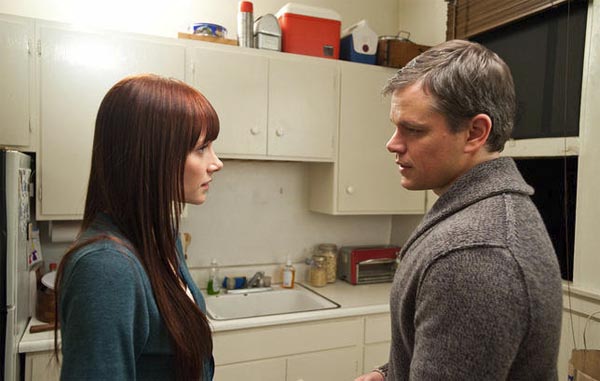
Whatever the film’s production history, I doubt that any of us will be privy to it anytime soon. There’s just too much money and too much power at stake to get an accurate glimpse through the dust motes. Maybe it’s possible that age has finally caught up with the old gunslinger and he’s now firing blanks. But what we have in the meantime is a colossal dud that is easily the worst film of Eastwood’s career. It’s as if Eastwood has traded in his class for the cash. Sure, Eastwood directs a pleasant scene with Matt Damon and Bryce Dallas Howard (who appears as a fresh San Francisco transplant escaping a bad breakup in Pittsburgh – or possibly Pittsburg, over by Antioch; whatever the case, she’s just about the only character in this movie with personality) flirting with each other in a cooking class. One wears a blindfold. The other spoons in mouthfuls of sauce. It’s hardly 9 ½ Weeks (or even Hot Shots), but the two confess their real reasons for attending night school. Alas, just as this promising relationship develops, Matt Damon’s George confesses his secret talent – which is the ability to find psychic connections within people, a “talent” that filled up the coffers in halcyon days. (That George asks each recipient to only reply to these sessions with yes and no answers, and that he wins them over with such painfully leading inquiries – “You’ve lost someone recently” and so forth – leads one to believe that he’s a con. Unfortunately, the film lacks the courage to view George’s ability as even vaguely illegit, and his internal conflict is narrowed as a result. This is too bad for Damon, who offers a quietly commendable performance here. Indeed, his graying hair and sad mug reminded me of a young Gary Cooper.)

In Hereafter, Eastwood is sometimes competent at conveying the visual isolation of his characters by having them depart into dark corners of a room, where their faces blend into the dark murk. Such old school panache would be welcome if Eastwood wasn’t operating off of a script that’s stacked with unacceptable and unpersuasive anti-human twaddle.

Hereafter is a three-plot story that takes place in three countries, and that ties up through several highly contrived circumstances at the London Book Fair. It is a movie so fundamentally stupid that it believes that some kid can call up a publisher and find out which hotel a famous Frenchwoman is staying. It is naïve enough to presume that someone who toils at a sugar factory can pay rent and live alone in what appears to be a spacious North Beach apartment. (The press information sheet I have laughably refers to this character as “a blue-collar American.”) It believes that book publishers will actually have the time and the decency to set up a failed manuscript (written by a troublesome author who can’t even turn in the Mitterrand book she promised) with another house.

What else can one expect of a flick that offers psychic ability as its great instigator? But nobody goes to a Clint Eastwood film to get frequent flashes into a shadowy white realm occupied by dead souls. That’s M. Night Shyamalan territory. And it’s extremely disheartening to see a living legend adept with human nuance debase himself like this.

I didn’t so much mind the surprise tsunami at the film’s opening or the unanticipated explosion close to the film’s end. Such melodramatic interventions are not only the stuff of crass Hollywood, but recent headlines. But I couldn’t abide Morgan’s veneer-thin stereotypes. Aside from the one-dimensional George, you have Marie, the celebrity journalist (so famous that she’s appearing in BlackBerry ads; how’s that for journalistic integrity?) suddenly incapable of asking the tough questions after surviving death and who doesn’t understand why her tale of phony psychic victimhood won’t sell. You have Marcus, the angry kid who pickpockets 200 pounds and won’t talk to an adult about his grief. (Hey, Peter Morgan, ever heard of a little thing called counseling? Social workers don’t just knock on doors.) Morgan doesn’t even nudge us towards how these three vapid and disparate stories will merge together. I mean, even Paul Haggis had the decency to do that. And he doesn’t give us much reason to care.

Amidst such anemic archetypes, Morgan makes a foolish move and references Charles Dickens, informing his audience of a novelist who created quirky and unforgettable characters and telegraphing that, with this script, he’s nowhere near the same league. And if that isn’t enough self-sabotage for you, believe it or not, Morgan actually has George visit Dickens’s house!

And consider these lines:

“I don’t want to be here without you!” (during a moment of angst-ridden confession)

“I promise you I’m not going to let you down.” (during a moment of overwrought crisis)

“It’s what you are! You can’t run from that forever!” (during a moment of confidence building)

“I didn’t know you were going to be here.” (during a “surprise” run-in)

If Peter Morgan is not nominated for a Razzie for these unpardonable cliches, and for such an unfathomable surrender of his faculties, I will be stunned.

But Morgan isn’t the only one here who should be thrown to the wolves. It was Clint Eastwood, a man of advancing years, who signed on for this nonsense. It was Eastwood who knew damn well that he has perhaps a handful of films left in him and who believed that this shoddy material was the place to deposit his talents. This film is beyond embarrassing. It’s indefensible.
NYFF: Old Cats

[This is the eighth in a series of dispatches relating to the 2010 New York Film Festival.]

I am pleased to report that, in addition to the promised titular felines, the film Old Cats features a few dogs and numerous actors in bee costumes. And I don’t think it’s possible to convey in words just how much it tickles my heart to find a film going well beyond the anticipated tally!

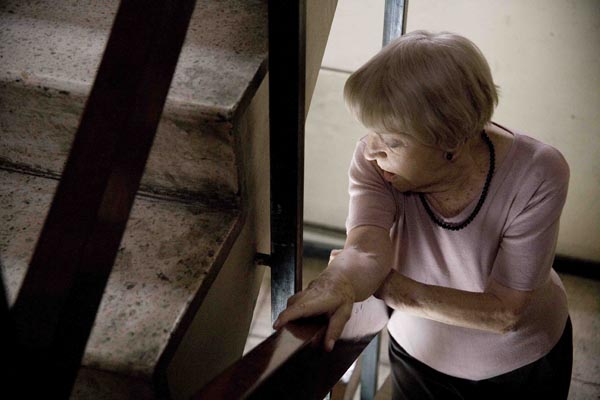
The literal old cats here, living with metaphorical old cats (that is, a couple in their eighties), serve the story well. Their flapping tails reflect the octogenarian couple’s inevitable last sighs. It helps immensely that we’re introduced to Isadora (Belgica Castro) and Enrique (Alejandro Sievking) as they are being lazy in bed. And, indeed, this Chilean flick is most interesting when it sticks resolutely to the interior (in this case, an eighth floor apartment with a malfunctioning elevator) and when it evades narrative demands. It is clear to me that filmmakers Pedro Peirano and Sebastian Silva have a great desire to portray consequential life (more on that rickety lift in just a mite), but they have a distressing distrust towards realism. This is odd, because Peirano and Silva have such a knack for it. When Isadora experiences senility, her declining mental state is telegraphed by a rumbling tone and what sounds like sequenced strings in the background. Considering the film’s China Syndrome-like commitment to drama sans music, and considering the film’s willingness to depict (almost in toto) the failed boot of a dying desktop computer*, these belabored attempts at surreality detract rather than grab.

This may be part of the point. After all, if you’re making a film featuring an older woman with a middle-aged narcissistic daughter who enjoys snorting up coke in her mother’s bathroom (not that Isadora notices this, but at least her writer husband is on the case), then a little perspective is in order. And I wouldn’t ding the directors so much over this lunge towards the phantasmagorical if they hadn’t delivered so many scenes in which the absurdity of a domestic situation hadn’t been sufficiently established already! I’m thinking of such moments as Rosario (the above-mentioned druggie daughter, played by Claudia Celedon) trying to unload some “healing tablets” (bars of soap that, like any phony New Age narcotic, profess to deliver great cures to their users) while visiting her mother. And if this “surprise” isn’t bad enough, sadly timed after Rosario’s nostril tangos with a spoon, Rosario deigns to reads out the instructions to all assembled. Later, when Rosario doesn’t get her way, she’s calling mom “an evil witch” (actually, something worse in Spanish) when she isn’t trying to get her to sign a power of attorney. Oh, and did I mention that Rosario has a lover named Hugo, whose original name is Beatrice, and that Isadora’s failure to comprehend a woman named Hugo forms one of the running gags? (Later in the film, a few stray family members show up to put this troubling Isi-Rosario dynamic in perspective.)

So the film’s first hour has the twisted dynamic you’d expect from an early Mike Leigh movie (Abigail’s Party comes to mind), where the character actions naturally escalate into chaos and lead us to wonder just how much boorish behavior Isi and Enrique will tolerate before they throw Rosario and Hugo out. I mean, they’ve had a wonderfully lazy morning, complicated by the elevator going out (meaning that Isi, who has hip problems, is trapped upstairs). There are cats who are starving and need food. Isi has just had an unanticipated episode in which she has kept the faucets on and overturned a drawer of knick-knacks upon her bed. And then the irksome Rosario shows up, tyrannically demanding that the cats be shuttled away into another room because she’s allergic to them. Anyway you slice it, this is a great setup for a farce or a melodrama. Hell, you don’t even need a plot. Just let the characters wander about and do what they do.

But unfortunately the filmmakers feel some strange need to tie it all together. The strange need to provide an answer to everything is what ultimately simplifies an initially charming domestic mystery. Earlier, I mentioned the dudes in bee costumes. Well, that’s all part of some television commercial that’s shooting across the street from the apartment building. That metaphor, in and of itself, is all that is needed here to illustrate the point that certain atavistic qualities are buzzing about on the outside the building: the insects that will sting, searching for their honey. (That wouldn’t be Rosario and Hugo, would it? Preposterous figures who will sting you in an instant.) And yet the filmmakers opt to return to these bees late in the film that just isn’t necessary when there’s the more fascinating aspect of Rosario being incapable of parsing her mother’s state of mind (“She’s playing the victim!”) or remembering long-term memories.

Thus, I feel compelled to conclude this review with an Emily Dickinson poem:

Like trains of cars on tracks of plush
I hear the level bee:
A jar across the flower goes,
Their velvet masonry

Withstands until the sweet assault
Their chivalry consumes,
While he, victorious, tilts away
To vanquish other blooms.

His feet are shod with gauze,
His helmet is of gold;
His breast, a single onyx
With chrysoprase, inlaid.

His labor is a chant,
His idleness a tune;
Oh, for a bee’s experience
Of clovers and of noon!

* If there are any hard-core geeks or Wired contributors reading this (he posited ever so humbly), are there any other movies that have lingered on a computer booting up? I’m honestly drawing a blank. But Periano and Silva are to be commended for replacing kitchen sink realism with heat sink realism!

Review: Enter the Void (2009)

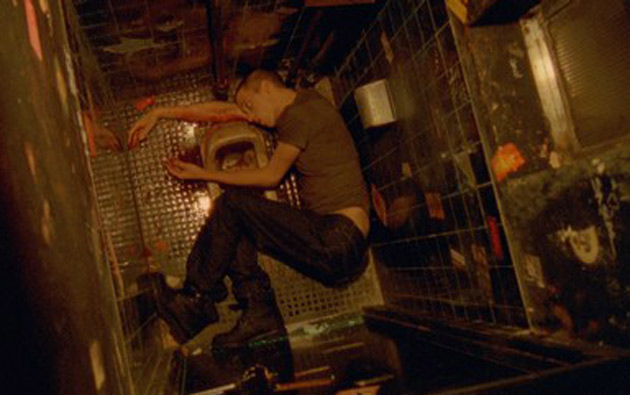
The Void, in Gaspar Noe’s third feature film, is a Tokyo nightclub. This being a Gapar Noe film, the Void is somewhat dicey. It isn’t nearly as bad as the Rectum, that sleazy nightclub with the annoying audio pulse and the vengeful men running in with the fire extinguisher, which appeared at the beginning (the end!) of Irreversible, or even another strip club down the street from the Void. But this does leave one to naturally wonder if Noe’s second film was originally titled Enter the Rectum.

Does Noe considers his audience to be on the receiving end of a two hour sodomizing session? I’m happy to report that I didn’t feel sodomized by Enter the Void – in large part because I think I’ve caught onto what Noe’s trying to do. He presents himself as a provocateur, but he’s really more interested in chronicling an entirely ridiculous human experience on film – masked by the “intensity” of ten minute rape scenes, creepy incest, crude drug addiction, and the like – and seeing if the audience will accept it. This makes Gaspar Noe more of a carnival barker (and personally I have no problem with this) than a bona-fide behavioral chronicler, although I suspect Noe, like any desperate man who thinks he is a revolutionary, would argue that he is serious. (This may also explain why his three feature films have become progressively less “real” and more centered around some outre cinematographic approach. In the case of Enter the Void, the film starts from the perspective of Oscar, a drug dealer tripping the not so fantastic in his Tokyo apartment. And when I say it is from his perspective, the film is literally what he sees through his eyes – a technique that hasn’t been attempted at length since Robert Montgomery’s Lady in the Lake.)

Because most audience members are likely to be shocked (four critics walked out of the press screening I attended: they clearly didn’t know what they were missing!), Noe wins the “game” by default. And for those who hate his movies, the ones who stick around out of obligation or because they don’t want Noe to win, Noe still wins because this audience doesn’t get it.

And then there’s the rest of us: the ones who accept Noe’s films, finding varying degrees of admiration (this funny Frenchman certainly isn’t devoid of talent), but who eventually grow out of them. The last time Noe tried to tie me up in one of his artistic dungeons, I was in my twenties and thus more impressionable. It was a badge of honor to sit through a Gaspar Noe film to the bitter end and find a way to appreciate it. And even though I still admire Irreversible (and, for that matter, I Stand Alone), I don’t think that Noe’s films are going to hold up very well. Before Enter the Void (and in tandem with my recent interview with Vincent Cassel), I decided to watch Irreversible for the first time in eight years. While I still appreciated Noe’s narrative technique (a scene unfolds, and is subsequently followed up with another scene before it), the handheld camera and the long takes (to say nothing of the homophobia) made the movie feel very much like a bad trip-hop band or an angry zine editor from the 1990s who didn’t realize he was repeating an endless cycle: it was something forgotten for a very good reason.

Noe’s approach is very similar to the behavior of an online troll. And it’s too bad that Noe feels the need to cloak his films like this. Because it will cause otherwise astute yet easily offended filmgoers from appreciating his visual innovations and his creative audacity. Here is a man who is willing to include a shot of a vagina, taken from the inside, with the cock sliding in and out. It’s a silly and brazen image, one that recalls the many giant penises throbbing within Ken Russell’s greatly underrated Lisztomania. But no real cultural appreciator can discount a filmmaker who has the balls (so to speak) to risk ridicule like this. (Childish, you say? Lowbrow? Obscene? Well, what makes Noe’s cock any worse than the asshole kissing in “The Miller’s Tale?” Which is not to suggest that Noe should be compared with Chaucer. I don’t want to feed the man’s ego if he’s reading this. But propriety is too delimiting a value with which to assess or experience art.)

So it’s frustrating that Gaspar Noe has given us his best film with Enter the Void, styling it with so many reckless yet incredible ideas (a drug experience captured from first-person; an effort to depict the experience of dying from several camera angles; the camera transcending voyeurism and actually entering a character’s head while fucking; a stripper dancing around a pole from a top angle, with the camera capturing the crude leers of the audience; an overview of Tokyo with cardboard cars and buildings rendered flat; the hilariously inappropriate end credits not appearing at the end, causing uncomfortable audience members to flee the theater before their thoughts are read by others – to name but a few), while lacking the courage to be an adult. Certainly the best way to appreciate a Gaspar Noe film is to accept Gaspar Noe as Gaspar Noe. And the film’s first hour is the most focused work that Noe has done as a filmmaker. It is steeped in isolation and loss, with an older figure, just as dissolute, approaching the young DMT-craving Oscar with new ideas on how to live (and giving him The Book of the Dead). This is all primitive philosophy, to be sure (as is the cosmic camera featured throughout the film, shuttling between live and dead characters; one is viscerally struck by the idea of stray souls conveyed as radio signals, yet when one stops to think about the idea…). As a filmmaker, Noe has never been what one might call a deep thinker. But I appreciated the way that Noe made an attempt to offer a crude framework for his shopworn street material. (And I would argue that Noe’s reliance upon silly character developments and his view of his own characters as mere playthings is his primary weakness, the very quality that prevents him from being one of our greatest filmmakers.) The film sustains this tone for quite a while before Noe the Adolescent returns yet again, playing the incest card in an utterly camp way. (“Do you remember that promise we made?” might almost be viewed as a postmodern line conveying the covenant between audience and filmmaker. There’s one moment midway through the film where “Gaspar” is named as the guy entering a character into a seedy locale. At least this time around, Noe is more transparent about the “game” at work here, which is also mirrored by a prominent portion of the film photographed solely from the back of a character’s head.)

No doubt Noe would accuse me of succumbing to petite-bourgoisie values in my older age for expecting more out of him or for hoping for artistic evolution beyond the visual. (I would reply by showing him by extremely shaky bank statement and my punkass book collection.) But while Enter the Void is very much a movie that I can recommend to a cineaste who doesn’t have a stick up his ass (and one that I will probably see again), I’m wondering if Gaspar Noe even has a persuasive fourth feature film in him, or even a movie that can stand toe-to-toe with someone like Bunuel or Pasolini, both of whom were more genuinely interested in perverse human behavior. You’d think that a man in his mid-forties would have worked out most of his adolescent expressive fixations by now. While the film world certainly needs a guy like Noe, maybe this is all Gaspar Noe has to give the film world.

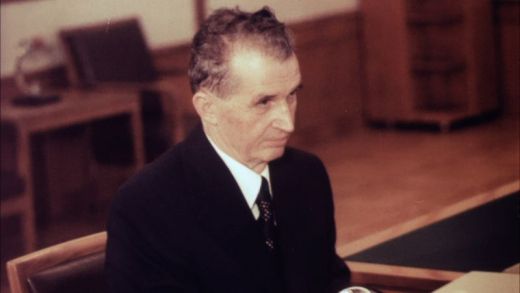
NYFF: The Autobiography of Nicolae Ceauşescu

[This is the second in a series of dispatches relating to the 2010 New York Film Festival.]

“The film we just saw,” muttered a nameless tastemaker just after the screening. “Who is it for? Romanians? Political junkies?”

“Humorless film geeks? Cultural masochists? Those who view watching paint dry as too adventurous?” I was tempted to rejoin. Some random canvassing revealed I wasn’t alone in my assessment. Even so, who was I to judge this film when my own grasp of Eastern European history was so tenuous? My knowledge of Ceauşescu was as dependable as a quadriplegic being asked to prepare a Caesar salad. (Indeed, one could stab both shaky offerings with a plastic fork. I apolgize to Romania.) But it seems to me that a movie collecting the life of a possibly clueless, possibly calculating leader prone to genocide, basking in his private personality cult, and a view of his subjects out of step from the reality of their privations (I believe Ceauşescu’s eventual assassination by Romanian revolutionaries should have been the telltale sign that something was awry on this last point) shouldn’t be so lackluster. I certainly hadn’t felt blasé about Shoah or any of the countless political documentaries with protracted running times that I had wolfed down in my twenties.

I suppose that the dry intellectuals — the so-called film dweeb crowd that certain online lunatics complain about, but who aren’t nearly as bad as paranoia elsewhere would suggest — are likely to appreciate this formalistic exercise. At three hours, this film is so oppressively long, with few pleasures laced within its Bucharest Death March, that the viewer feels very much without options, much like a citizen of Communist Romania. If this is the emotion that director Andre Ujica intended to convey, I can safely report that he has succeeded. It was only my commitment to judging the entire film that prevented me from stomping out of this snoozefest and carrying out my own private revolution with a bottle of scotch.

Let me dwell first on a few aspects I enjoyed: (1) a volleyball game, taken from what appears to be home movies, in which Ceauşescu is physically awkward and hilariously girly, recalling George Herbert Walker Bush’s wimpy image (Remember that pathetic baseball throw? Infinitely worse than Obama and the man was captain of his Yale baseball team!), (2) a ridiculous parade for some Communist triumph featuring surreal floats depicting sporting matches pushing slowly down the streets (two boxers going at it as the individuals holding the ring move forward, a volleyball game in which one team constantly paces backwards, et al.), (3) up to a certain tedious point, the repeat imagery of world leaders jetting away from airport runways, thus demonstrating how ephemeral their alliances with Ceauşescu are, (4) the occasional jarring cuts to Romanians dancing to pop music (I wish there had been more of this, but this film prefers to drag), and (5) Ceauşescu’s failed attempts at aristocratic flourishes (his awkward efforts with a sled, his unpersuasive claim that he is an intellectual, et al.).

In other words, the film is, at times, an amusing counterfactual. Apparently, it truly takes Communist oppression to get filmmakers to take the piss out of their leaders, particularly when Ceauşescu – with his unbrushable childish curls protruding atop his head, his puffed up cheeks, the suit that doesn’t quite fit his chubby form, and that lower lip resembling, at times, a half-inflated condom accident – strongly resembles an assclown. (I wish some enterprising underground filmmaker would make a similar film about Bush the 43rd or Tony Blair. If the Autobiography succeeds at one thing, it demonstrates the elastic nature of contextualized found footage.) Even so, three hours of world leaders shaking hands, Ceauşescu engaging in photo ops, and Ceauşescu supervising projects that we know will fail (inter alia) does get more than a bit tedious. And the moments I’ve mentioned can only be mined after some tedious ten minute setpiece. Andre Ujica does demonstrate a certain flair for visual association (the clean and orderly buildings of Communist China compared against Communist Romania’s industrial chaos, leading one to ponder whether it’s the man, the system, or the people which causes this kind of disparity), but his film is centered more around Ceauşescu as Buffoon. Does a buffoon kill 70,000 people? I suppose that moral question depends upon how swift you are with reductionist assertions and your worldview. But this Autobiography, while not explicitly referencing Ceauşescu’s early days as a peasant, chooses to gloss over the suffering and the death. Yes, I get that Ceauşescu very much did the same thing and that the film is meant to be a vicarious expression of this. But this seems an incomplete and needlessly limiting portrait of a man who, despite his frippery, was as calculating as he was flip.

Review: Heartbreaker (2010)

The Lavender Hill Gang, Dirty Rotten Scoundrels, A Fish Called Wanda, just to name a handful. These films, balancing crime with comedy, work so well because they contained the telltale results of a very specific talent: namely, a peculiar attention to behavioral rhythm. It’s the same skill that can be observed in a mystery master like Donald E. Westlake, who could oscillate between his Dortmunder novels (light comedy) and his Parker novels (wonderfully callous and crisp page-turners!) precisely because he was so committed to portraying every motivation, every nuance, every nicety behind the gambit.

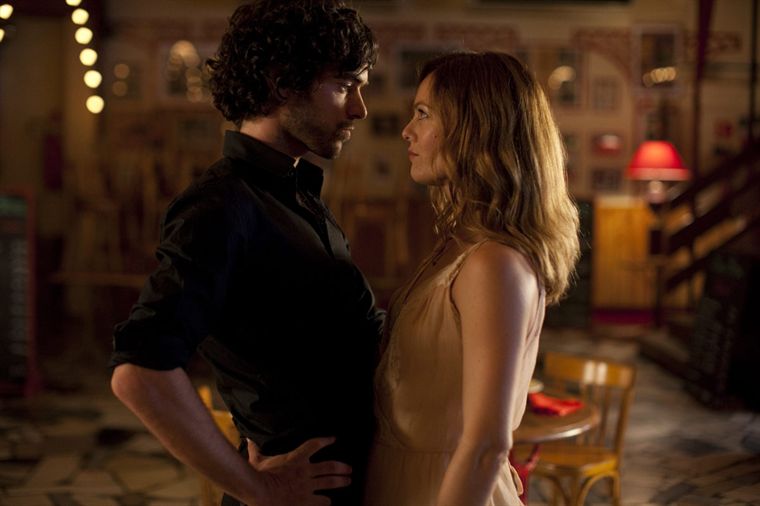
Heartbreaker — a title bearing Benatar allusions, but which I assure you is a French film — doesn’t explicitly deal with crime. But it does concern itself with a close cousin: deceit within the private sector. And even though this charming French comedy contains a rather absurd storyline (three people are privately commissioned to split up relationships; they have a 100% track record at this) and a rather absurd setting (mostly Monte Carlo), it manages to slough away these implausibilities due to its commitment to a post-Lubitsch presentation of an illusion along the lines of Westlake.

Screenwriter Laurent Zeitoun* and director Pascal Chaumeil get us interested by establishing how these three operatives work in a lengthy pre-credit sequence photographed partly from the mark’s vantage point and partly revealing the ruse. The mark here is a woman on holiday who wants to see the dunes. Her boyfriend is more preoccupied with lying by the pool and contemplating the possibility of a wet t-shirt contest. A dashing young man offers to driver her out to the dunes when layabout bf fails to fulfill his pledged transit. Said man (who we later learn is named Alex) mentions something about his dead partner. He offers “treatment” to indigenous kids, which we see to be a staged sham. Alex is romantic to the woman in ways that her present partner is not. We later understand that he recites the same lines, eliciting the same response.

Since a relationship can be essentially dissolved by several lines of code, we’re left wondering if this is some kind of bizarre cinematic conceit. Particularly since none of Alex’s women can detect the ruse. (Indeed, they remain completely understanding why he cannot enter a relationship, even after his anemic yet precise explanation.) So is it the specific turf that Alex is working? Is Alex’s Eliza-like heartbreaking some statement from the filmmakers on the folly of love or the silliness of narrative? Is his inflexible script sustained by the fact that he has two able accomplices capable of donning costumes and roles to impede upon this presentation of reality?

Whatever the reasons, we’re swiftly entertained by Alex and his petty heartbreakers. And this human interest is aided by some not bad casting. As Alex, Romain Duris is competent. But there’s the wonderfully expressive Julie Ferrier (one of the best elements in Micmacs) playing Melanie, Alex’s sister, able to infiltrate a hotel desk faster than a speeding locomotive and Francois Damiens as Marc (married to Melanie), who has been looking for the perfect assignment to try out his own problematic roles.

The films storyline hinges upon whether this trio can split up a very perfect couple in ten days. Juliette (Vanessa Paradis) is a 30 year old wine expert who is marrying Jonathan, a seemingly perfect Englishman, in ten days. (Indeed, Jonathan is so perfect that he donates his doggie bag to the trio, momentarily bedecked in sloppy apparel and confused as vagrants.) In other words, here’s another cliched case of whether an expert can succeed at his toughest assignment, with the additional cliché of Alex falling for Juliette as the job carries on and yet another additional cliché of Alex owing a considerable amount of money to the mob.

Yet I enjoyed the movie as a form of stylistic escapism. Not because of the storyline, but because – much like Micmacs – I was more interested in how the filmmakers would sustain the illusion. There is one funny scene in which Alex, pretending to be Juliette’s bodyguard, insists that he has no feeling in his leg. He claims that it’s the result of an injury. This doesn’t stop another character from stabbing his leg with a fork in order to test Alex’s resolve, leading Alex to wince off the pain. And in an effort to find some connective point with Juliette, Alex preposterously claims that he’s a fan of George Michael and Dirty Dancing (two of Juliette’s cultural interests unearthed during Alex’s research). The former is unconvincing, but the latter results in Alex learning the moves for the film’s final dance in his hotel room and the eventual recreation of said routine. I’m hardly a Dirty Dancing fan (no fault of the dearly departed Patrick Swayze, but I recall much male shouting in video stores on the subject circa 1987), but I was both amused and troubled by the idea of cultural reenactment as a method to win a woman’s heart. I mean, how sad is that? I could buy this behavior from twentysomethings. But these people are professionals in their thirties. And when one considers the deceit motivating Alex’s Swayze replay, if you’re anything like me, then you may very well be able to kickstart some ethical debate with your date for this date movie.

The film does ultimately present a less fabricated form of love (outside Marc and Melanie’s marriage), but this “genuine” presentation isn’t nearly as interesting. I kept hoping that this film would go the distance, portraying Alex as a man who sadly can’t see any option but deceit, even in his non-professional obligations. A coda more befitting its con.

* The press notes offer this oddly phrased CV-like tidbit for Zeitoun: “Visits Paramount Studios in Los Angeles and discovers the profession of screenwriter.” This leads me to wonder if folks now visiting the City of Angels now observe lavish naumachiae bankrolled by Hollywood studios, with the spectators invited upon three Spanish ships to discover unexpected vocations when they aren’t looking for escape routes leading to the West Indies.