Review: Extract (2009)

extract

There’s a Preston Sturges comedy trapped inside Extract‘s enjoyable mess. This is a movie that the New York critics did not seem to appreciate. But if they end up hating this film, don’t listen to them. Even if Extract is imperfect, this is the right step forward for Mike Judge. Extract doesn’t quite match the laughs in Judge’s two previous live action features, but Judge has atoned for this by growing up a bit.

Judge’s central character is Joel Reynolds (Jason Bateman), a married thirtysomething who manages an extract factory but who, like the many seemingly well-educated couples in Idiocracy, hasn’t yet sired children. Back in the day, Joel got lucky with an old family recipe and worked his almond innovations into a money-making winner through his background in chemistry. (The great joke here is that none of the supporting characters who dream of riches are interested in learning how Joel found his ostensible fortune. But with a potential buyout from General Mills, they do seem to think he has more money.) Joel is often sympathetic to his workers. He’s willing to attend one of his worker’s fusion guitar shows. But he’s clearly no Marxist. (While Joel tolerates his workers’ eccentricities, perhaps more so compared with present workplace realities, there’s no indication here that the workers are unionized.) He does, after all, live in a gated community. His house, rather amusingly, doesn’t resemble anything close to a McMansion. One can easily imagine a nearly identical home just outside the gates.

Joel’s home may be his castle. But the patriarchal remnants of English common law don’t stop with his mortgage. His wife, Suzie, puts on her sweatpants at 8:00 PM every night, tying them up like a 21st century chastity belt, and Joel needs to get home fast if he hopes to get some action. He never does. Their relationship and sex life is a mess. And Joel lacks the royal effrontery to tell Suzie that he finds the sweat pants distasteful. The two never think of communicating directly with each other. Dancing with the Stars is the bigger draw. Indeed, Bowling Alone author Robert D. Putnam would probably have a field day with this film, seeing as how most of the problems arise because nobody thinks of directly communicating with each other.

Is this a cartoonish depiction of American domestic life? Even accounting for Judge’s animation background, not quite. This is also a film in which the wonderfully lively character actor J.K. Simmons plays it straight. There are skirmishes with opportunistic interlopers who can’t use the English language. (One makes a sad attempt to use “referral” as a verb.) Well-meaning but socially inept figures try to hold onto a sense of community rooted in Eisenhower-era community. And these social throwbacks are the only thing left. Joel’s neighbor Nathan mercilessly (and hilariously) hectors the Reynolds into buying tickets for a Rotary Club dinner. David Koechner plays Nathan like a cross between Stephen Root’s Milton and Gary Cole’s Bill Limbergh. While the New York intellectual type may quibble with Judge resorting to such archetypes, the truth of the matter is that anybody who has done time in the suburbs has encountered a guy like Nathan. Nathan rattles off phrases like “a real loose bunch” and “You know how it is when the wives are talking.” But is Nathan really the problem? Or is Joel?

Much as we might be inclined to declare Nathan a rube, it’s doubtful that he would hire — as Joel does — an unqualified gigolo to impersonate a pool boy and make the moves on his wife to test her fidelity. (I don’t want to give away the results, but I will say that this plan emerges because Joel spends much of his time hanging around a spacey bartender played by Ben Affleck. And what is more pathetic? The seductive plan that mirrors the most cliched porn formula imaginable? Or the fact that anybody signs on to test such a bullshit hypothesis?)

The film’s view of middle-class life is presented as a flat series of unadventurous incidents centered around dull routine, and the apparent excitement comes through a con artist named Cindy played by Mila Kunis, who may be the most problematic character in the film. Her get-rich-quick scheme relies almost entirely on the fact that the people she exploits are stupid. And not just stupid, but stupid beyond stupid. We are introduced to Cindy stealing a guitar at the beginning and we are asked to believe that a guitar shop would not, as most guitar shops do, have a person at the front checking the merch. This exceeds reality.

But Judge isn’t entirely contemptuous of the slow-witted, well-meaning, and prejudicial naifs that are populating his films with greater frequency. His work here, much like Idiocracy, wavers interestingly between populist comedy and quasi-elitist sentiments. He can never entirely adopt a position one way or the other, and this is what makes Judge’s work intriguing. He’s the only film comedy director who can momentarily convert a populist audience into elitists, but without anyone feeling terribly bad about it. And that’s because his seemingly one-dimensional characters possess interesting ironies. Take Extract‘s Step, an employee at Joel’s factory who hopes to live up to his name by securing the coveted floor manager position. He seems to think that his many years at Reynolds Extract will count in lieu of his professional capabilities. But after he suffers an accident that splices half his manhood, he isn’t interested in suing the factory. Step’s litigious impulses emerge not because of his inherent nature, but because of Cindy’s coercion, as well as an ambulance-chasing attorney (suitably played by the obnoxious Gene Simmons).

It’s worth pointing out that if Idiocracy is the end result of the current American one-two punch of entitlement and stupidity, then Extract serves to chronicle the present conditions. Characters may wrap their lips around a two-liter bottle of soda and guzzle it down, even ordering more soda from Domino’s out of laziness. But can we talk to them?

In age in which desperate men carry submachine guns to town hall meetings, Extract suggests that part of the solution may involve listening to these alleged rubes, and even hiring them despite their glaring inadequacies. The elitists who think that this film may be another laugh riot at the expense of the unwashed masses may be greatly disappointed that Judge has the stones to defy their prejudicial expectations. That, in itself, may be the quiet and possibly unintentional riot.

Review: The September Issue (2009)

septissues

“People are frightened of fashion,” explains the frosty Anna Wintour at the beginning of The September Issue, a documentary concerning itself with the behind-the-scenes assembly of Vogue‘s September 2007 issue. I agree with Wintour. It’s not the fashion that frightens me, but the people who feel compelled to live for nothing but fashion.

Take editor-at-large Andre Leon Talley, a man so hopelessly flamboyant and fussy with his sartorial sensibilities that he cannot be bothered to wear a T-shirt and shorts on the tennis court. Why is he on the tennis court to begin with? Wintour suggested that he get some exercise. Listen to the great dictator. She might end up dancing with your globe.

After seeing this film, I think it’s safe to say that I’d sooner place my head into an open oven with a Zippo than work for Vogue. This is a world run by vicious capitalists in which beauty is prepackaged with all the warmth of a malfunctioning Twinkie machine. An editor can slave for hours to find the perfect colors or a striking look reminiscent of a noir movie, only for Wintour to come in and throw out a $50,000 photo shoot on an aesthetic whim. Young designers like the bright-eyed Thakoon arrive slightly terrified of Wintour, but all too eager to supplicate for photo ops and other forms of commercial whoredom.

What is Wintour’s excuse? Why does this devil wear Prada? Her daughter, Bee Shaffer, quietly explains that she has no interest in getting into the fashion world. And in the film’s only unguarded moment with Wintour, she confesses that her family finds her vocation “amusing.” (Wintour’s brother, Patrick, is a long-time political editor.) This is not someone to be frightened of. This is someone to pity. If you can’t hold your head high after decades in the fashion world, then what’s the point of the work?

“Don’t be too nice,” says creative director Grace Coddington to the young editor Edward Enninful. “Even to me. Honestly, you’ll lose.” Enninful is later seen clutching a giant cup of Jamba Juice to get through the day, and I began to grow concerned over whether he was eating anything. Until I realized he wasn’t even drinking a real smoothie.

In fact, even accounting for the 300 hours of footage here whacked down into two, these people don’t seem to eat. “Stop at Starbuck’s please,” barks the thin-framed Wintour to her driver. Bottles of Fiji water are everywhere, guzzled down in lieu of a hearty meal and never enjoyed with other people. There is one moment in which Coddington pecks at a salad in a plastic container, but it’s only because she’s upset at another one of her meticulously arranged shoots being disposed of. You’ve got to be hungry for the work. You’ve also got to be hungry.

Coddington is the most interesting figure in this film. She’s the only editor at Vogue who still personally dresses the models. She’s also the only person in this film who uses older photographers as reference points. “It hard to go on the next thing,” says Coddington, when asked about so much of her work being thrown out. But she’s had the tenacity to stick it out with Vogue for forty years, just as long as Wintour. She seems tough enough to duke it out with Wintour over an artistic decision. Unfortunately, she’s not the one here with executive privilege. Hence, the sad salad-eating scene. “If the magazine doesn’t sell, I don’t have a job,” she says late in the film.

But to be perfectly fair, Vogue is still capable of some creative spontaneity. With numerous pages to fill at the eleventh hour, this documentary’s photographer, Bob Richman, is recruited to stand in for a shoot, jumping up and down for the camera’s lens to match a model’s gaze. It’s one of the most vibrant photos in the issue. Coddington, to her credit, asks the people not to Photoshop Richman’s paunch.

Sleazy editor after sleazy editor insists that the September 2007 issue of Vogue is “the biggest in our history.” But this is Vogue‘s history, not America’s. Is this really a sustainable fantasy? $50,000 of work thrown out? That’s a good annual salary for an editor who can do great things. Vogue can’t be entirely discounted, but this documentary does show that many things have gone horribly wrong. While I’m not necessarily in favor of seeing the magazine industry fold into oblivion, this film certainly fed my anarchist impulses. Fashion shouldn’t be this cartoonish. Is this the fault of the filmmakers? Were there unused shots of Wintour being human? I certainly hope so. But whatever the film’s oversights, perhaps some of the film’s subjects might be inspired by the depiction to remember the impulse of being alive. If they have souls left. Perhaps Conde Nast’s current financial woes are a self-correcting prophecy.

Review: Taking Woodstock (2009)

takingwoodstock

The realities were already fixed; the illness was understood to be terminal, and the energies of The Movement were long since dissipated by the rush to self-preservation. — Hunter S. Thompson, Fear and Loathing in Las Vegas (1971)

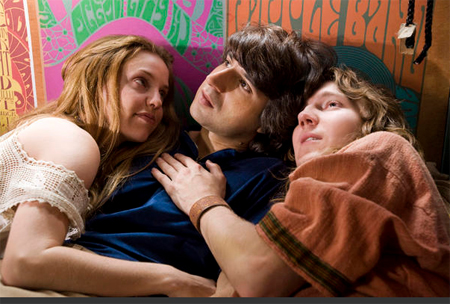
Altamont’s fixed realities are thankfully mentioned at the end of Taking Woodstock, when organizer Michael Lang, portrayed here by Jonathan Groff as a perpetually calm Brian May type, mentions “a truly free concert” in the making that involves the Rolling Stones. Exciting stuff. If only Meredith Hunter had been around to lodge a protest. (Or perhaps he’s the unnamed man seen checking into a motel with a white woman.) But Ang Lee’s film is less concerned with this corruption (although it does thankfully suggests that everybody listens to money). Lee is more interested in how people of all types — Jewish motel owners, the dutiful farmer and local chocolate milk magnate Max Yasgur, acidheads busing across the nation, theatrical performers fond of Happenings and disrobing, a Vietnam vet, a transvestite amusingly played by Liev Schreiber — came together in a anarchic haze to slide in the mud, listen to distant music, and kiss random strangers. Good times. But, as it turns out, the possibilities for unity were there all along. For before the Woodstock organizers roll into Bethel, New York, Eliot Tiber (both in real life and in this movie) was the president of the local Chamber of Commerce, patiently stamping permits and listening to wily eleventh-hour interlopers. And what makes the Bethel diner any different than Yasgur’s rented farmland as an amicable place for congregation?

The film actually shares much in common with Thomas Pynchon’s latest novel, Inherent Vice: an accessible mainstream story, streaks of subdued and audience-friendly eccentricity, a meticulous concern for landscape, and a celebration of misfit life just before its destruction by “progress” (for Pynchon, it’s the toxic qualities of the information age; for Lee and screenwriter James Schamus, it’s the transformation of free love advocates into avaricious capitalists). While Lee and Pynchon approach their respective canvases from two close but different time periods (and from two different coasts), I came away from both works with similar populist-minded emotions. I was greatly delighted to see so many perspectives united through a common mass experience, but very much aware that this is a harder reality in an age where careers can end with the judgmental spread of a sound bite. (Rebecca Solnit’s fascinating new book, A Paradise Built in Hell, offers the argument that disaster is now the only way for disparate souls to band together, although both Lee and Pynchon make persuasive cases that passing along a roach might get some of the stiffs to expand their horizons — a sentiment I don’t entirely disagree with.)

What happened to America’s generous capacity to accept its freaks? Or to embrace those gritty human qualities nestled inside steely opportunistic hulls? It can’t just be Thompson’s self-preservation that lopped off the liberal and attentive ear. But these are questions worth asking four decades after Woodstock’s inadvertently free event altered the cultural landscape. Lacking a chewy antagonist like Bigfoot Bjornsen (the cop in Inherent Vice who shares more in common with the libertine detective Doc Sportello), Lee and Schamus have shifted the conflict inwards to the Teichberg family, the managers of the El Monaco. But the Teichbergs are as stiff as dimensionless characters come until the brownies arrive. Imelda Staunton is given a Jewish stereotype. She runs around the hotel screaming at people, muttering Yiddish curses, and, in one terrible Shylock-like moment, is seen clinging to a stash of money in the closet. Surely the real Sonia Teichberg had more depth.

But maybe these skeletal characters represent part of the point. With Woodstock around, we all become insignificant. And, for what it’s worth, Lee gets decent performances out of the actors who count. As Eliot Tiber, Demetri Martin manages to evince an appealing boyishness that matches his efforts to win the town over and his repressed sexuality. Eugene Levy is an inspired casting choice as Yasgur, particularly because Lee allows Levy to play the role straight. Dan Fogler, who I last saw in Fanboys, again shows great energy as a character actor. It’s too bad the women here have been given very little. Surely, Woodstock was a two-gender affair. (And certainly this film features at least one free-form ménage à trois. They didn’t call it free love for nothing, although it would be interesting to see Chris Anderson plagiarize a book on the subject.) And it’s too bad that Emile (Speed Racer) Hirsch is unconvincing (and often laughably bad) as the aforementioned Vietnam vet.

Speaking of Hirsch, his presence here offers a sensible reminder that he also appeared in Gus Van Sant’s Milk. And like that audience-friendly Trojan horse, Taking Woodstock does succeed very well in recapturing Woodstock’s innocence and making you believe in human possibilities. “Hey, don’t lose that creativity, man,” says a character to Tiber, after he suggests an out-of-the-box solution . But he may as well be addressing the audience. Later in the film, after news of the hippie influx has made the rounds, Tiber finds himself unable to order “the usual” from the diner forming the Bethel social center. But the entire town hasn’t quite turned against him. Happy entrepreneurs rush up to Tiber and thank him. Is capitalism then just as much of a galvanizing force as the Woodstock ideology? It would seem so. Michael Lang pays everyone in cash, bundled in brown bags of money. “$1 for water?” says Tiber’s dad upon encountering some pre-bottled water entrepreneur. “Can you believe it?” (Just imagine if he’d encountered the inflated prices in the Coachella desert.)

The film then, despite being a crowd-pleaser, isn’t afraid to focus on the Movement’s dissipated energies. And while Taking Woodstock may come bundled with supporting characters who contribute little to the narrative, as well as annoying split-screen homages to the Michael Wadleigh film, there’s a marvelous shot — which reminded me of the famous traffic scene from Godard’s Weekend — in which Tiber heads down a jampacked Bethel street (courtesy of a motorcycle lift from a friendly cop) past a man carrying a sign BOB DYLAN PLEASE SHOW UP, bra-burners, war protestors, a booth with a sign reading MAKE YOUR OWN SANDWICH, and much more. Today, when such people gather together for an arts festival or a political rally, there is generally some snarky photographer who wants to snap pix and post the results on Flickr for others to ridicule. But presented within this context, only a mirthless asshole would fail to see the wonder of so many types together.

Lee’s made a film that, like The Ice Storm, succeeds in getting us beyond our present historical reference point and reconsidering some of the virtues we abandoned in the past. And maybe the energies of self-preservation will be dissipated by the rush to collective understanding. Yes, that’s a Utopian ideal. But, as Oscar Wilde once said, a map of the world that does not include Utopia is not even worth glancing at.

Review: Inglourious Basterds (2009)

basterds

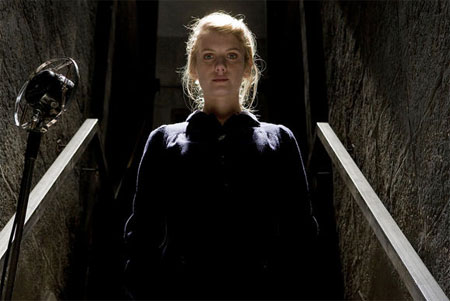
The important thing to understand about Quentin Tarantino is that, as an artist, he has no interest in real life. (Mr. Tarantino’s excellent Crate and Barrel adventure from 2004 does not help his cause, but perhaps there is a reasonable explanation.) Several dour and dense critics, most over the age of 50, cannot see this clear truth before them and have been spending the past few weeks willing their collective blood pressure to rise because they cannot pigeonhole Inglourious Basterds into that neat higher category they desire. (One wonders whether the late Don Edmonds, who gave us the first two Ilsa films, would have faced similar reception in the mid-seventies had he possessed Tarantino’s allure.)

I’ll get to these mostly humorless critics later. They include the normally astute Jonathan Rosenbaum (not this time), Daniel Mendelsohn (who is closer in his assessment, but, not nearly close enough), and the characteristically pompous Ed Gonzalez (who doesn’t seem to ken that Tarantino’s talkathons are part of the point).

The important thing to understand is that Tarantino has never been real. This is the man who didn’t see the humanity in Kirk Blatz’s Reservoir Dogs improvisation. (Blatz played a cop and blurted out the line, “Don’t burn me. I’ve got a kid.” Michael Madsen then told Tarantino, “Quentin, I cannot fucking touch him after he says that to me.” Tarantino’s response? “No, no, I think it’s great. I think it’s wonderful. It brings a whole new element to it.”) This is a man who introduces a kid into the Bride’s domestic brawl with Vernita in Kill Bill Vol. 1 for similar reasons. Character development? Oh, hell no. The kid brings a whole new element. And in Death Proof, when Stuntman Mike is asked why he spends so many hours drinking club soda and lime in a bar, Stuntman Mike says, “A bar offers all kind of things other than alcohol. Women. Nacho grande platters. The fellowships of fascinating individuals like Warren here.” Stuntman Mike turns out to be a psychotic. And it’s easy for any person with a remote understanding of life to see why, given this superficial explanation.

But one should not blame Tarantino for all this. He has, after all, been trying to tell us this for quite some time. Here’s Tarantino in an Entertainment Weekly interview for Kill Bill, Vol. 2:

But one thing that was semi-annoying to me in reading a couple of the reviews for ”Vol. 1” was, ”Oh, this is a very wild technique and style is cranked up and the technique has gone up, but it’s a clear retreat from ‘Jackie Brown,’ and the growing maturity was in there.” ”Clear retreat” says I’m running away from what I did in ”Jackie Brown.” I’ve done it. I don’t have to prove that I can do a [mature character study], all right? And after ”Vol. 1” I don’t have to prove that I can do a good action scene.

Maturity? Leave that for the elder statesmen. Tarantino has done it already. No need to repeat it. So what does Tarantino have to prove exactly? And why does filmmaking have to involve “proving” anything? We expect such claims from a high school jock, not a man in his forties. Maybe it’s because the critical and commercial audiences have expected Tarantino to be real, in the same way that they want Santa Claus, the Easter Bunny, and world peace to be real. Or perhaps Tarantino’s films prove so intoxicating that we really want them to be real. It’s a testament to Hollywood’s failings that Tarantino’s grab bag of cinematic references and outright theft (see Scorsese’s American Boy and Ringo Lam’s City on Fire just for starters) have managed to seem real, particularly for those who cannot see the real before them.

But if Inglourious Basterds were real, then why would we accept Adolf Hitler, Joseph Goebbels, Henrich Himmler, and Martin Bormann hanging around 1944 Paris for a film premiere? Innumerable history books refute this. Why would we accept Lt. Aldo’s Apachesque hunger for Nazi scalps? Or his ridiculously inept effort to impersonate an Italian late in the film? This is a movie that presents Goebbels, sitting with a woman who is not his usual French interpreter. The scene itself equires no additional explanation. It is abundantly clear to any thinking mind that this woman is his fuck buddy. And yet Tarantino feels compelled to insert a quick scene of Goebbels schtupping her. Why? Because this film, contrary to all the high-minded talk, isn’t really about the Holocaust. It is more about America’s cathartic response to violence. There’s no need for the Goebbels scene, but we wouldn’t mind seeing it. After all, when our bloodthirst rises, we won’t remember. And what does this say about us?

There’s no need for a long scene in which the thwacks of one vigilante’s baseball bat carry on at an absurd length — to the point where a histrionic Jeffrey Wells, who clearly has his cardiologist on speed dial, called it “one of the most disgusting violent scenes I’ve ever sat through in my entire life.” More disgusting than the Saw movies? We only hear the sounds. “Morally disgusting, I mean.” Oh. But how?

The vigilante in question, known as the “Bear Jew” by none other than Hitler himself, is played by Eli Roth, known predominantly for helming the Hostel movies, which some have described as “torture porn.” But I don’t think his casting is an accident. This is, after all, a movie in which one Frenchwoman says, a few years before the Cannes Film Festival and Cahiers du cinéma have been established, “I’m French. We respect directors in our country.”

But Tarantino can’t be respected in America. Jonathan Rosenbaum ridicules the film’s title, lambasting it with sics and many other charges, but doesn’t remember that Tarantino’s debut, Reservoir Dogs, bastardized the title of Au Revoir Les Enfants. Rosenbaum suggests that Tarantino’s film is “morally akin to Holocaust denial” and doesn’t understand why Jews are giving Tarantino a free ride for this apparent travesty. Maybe Rosenbaum hasn’t lived a second-generation life of nagging and incessant reminders about the Holocaust. (It’s worth noting Lawrence Bender’s reaction to the script. He called it “a fucking Jewish wet dream.”)

Door #2 reveals Daniel Mendelsohn, a critic so lost in the classics that he can’t familiarize himself with the rampant exploitation film violence of the past four decades. Mendelsohn fixates on the scalping as “post-modern fun,” and reveals his true cathartic cards. Mendelsohn just loves seeing the scalped Nazis, thus proving Tarantino’s point — that we are all equal at the cinema. Mendelsohn is smart enough to determine that Basterds is not real life, but he sees this more as a problem than a possibility. Mendelsohn is also wise enough to pinpoint “the visceral pleasure of revenge,” but isn’t willing to come to terms with his own clear pleasure in seeing the Nazis tortured. Here is a high mind who has fallen into Tarantino’s trap, clearly reveling in the violence. One can see Lt. Aldo recruiting Mendelsohn, had he been born only a few decades earlier, and Mendelsohn capitulating his civilized and critical perch for the “fun” of revenge.

This is not, as Mendelsohn suggests, Tarantino’s “taste for vengeful violence,” but the audience’s. If you find the film’s violence fun or cathartic, you will likely wilt into Tarantino’s snare. But is this really so bad as pretending that you don’t have it in for somebody? Perhaps this is where the virtues of catharsis might be found.

Various film people have been raving about Christoph Waltz as Col. Hans Landa, and with good reason. He offers the most compelling performance in this film, and Tarantino has made him the focus of our rage. Here is a man who asks permission to enter a home but who, like Stuntman Mike’s eating habits, will wolf down a strudel without pausing to taste the meal. (When this occurs, and a Jewish woman disguised as French is forced to eat the strudel, Tarantino lingers through closeups on the cream being served atop the strudel, insinuating a kashrut violation.) Is it so wrong to cheer on the despicable Landa’s inevitable fate (comparable as it is to our blind acceptance of waterboarding)? Or are we complicit, as the film suggests later, in approving of the inevitably real results of our cinematic catharsis?

When the four major Nazis attending the cinematic premiere arrive, Tarantino is quick to highlight their names with optical arrows pointing to their location. Here they are! suggests the underlying semiotics. Do you want me to kill them for you later on in the film? If you have a problem with such underlying autocratic flourishes, this film is probably not for you. But if you are a regular filmgoer, then you might wish to consider these questions anyway.

Since Tarantino has spent a lifetime insisting that cinema may very well be the only focal point that he can start from, I found Basterds‘s candor refreshing and I was able, at long last, to accept a Quentin Tarantino film for what it was. Ed Gonzalez, whose review lede reads like a Philip K. Dick protagonist contemplating the paranoia around him, sadly could not, despite his four star rating (which I suspect I agree with). If you’re determined to see everything as “an allusion” or “a pose,” rather than accepting the visceral discomfort before you, then this film is not for you. Which is not to discount Tarantino’s hubris. A film that dares to call into question our cathartic response is arrogant by its very nature. But if we’re so content to feel outrage about whether a film may or may not be exploiting us, one wonders why we’re so determined to put such energies into the duplicities of narrative rather than the more salient (and fixable) cons before us in the real world. If you tell a lie big enough and keep repeating it, people may eventually come around to believing it. Especially in cinema. Tarantino has told a big lie. And if the town hall lunatics believe that Obama is Hitler, then I suspect that even our most nimble critical minds will have similar thoughts about Tarantino’s vision. For those of us who have accepted (and enjoyed) exploitation films all along, revisiting this source may prove a strange panacea. And if this anodyne lasts beyond our immediate epoch, then it will be Tarantino who has the last laugh. And for this grand illusion, he may rightly deserve the spoils.

Review: Taxidermia (2006)

taxidermia

I don’t know if I would go so far as to call György Pálfi our next Fellini (circa late 1960s), our next Pasolini, or even some predictable filmmaker going out of his way to offend us — even if the visual cues for his most recent film suggests all this. But he does have talent. And Taxidermia, which finally gets a limited and long overdue American release this Friday, is certainly not for weak stomachs or limited-minded men who cloak their shallow prejudicial insights inside the sheltered caverns of higher education. The distinguished critic sitting behind me, not the type to sit through a Saw installment, made numerous sounds of disgust. I kept slouching downward in my seat so that the remnants of some half-digested lunch wouldn’t hit me unexpectedly in the back of my head. But thankfully the critic was civilized.

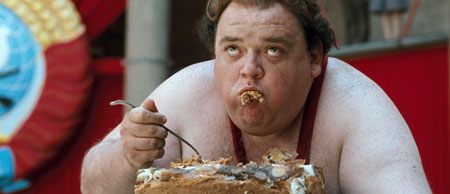
The New York people may not get this film. But then again, they might. For my own part, I feel inclined to applaud it. For there is a regurgitation-heavy eating contest here that makes the “Lardass” scene in Stand By Me look as innocuous as a Disney film. Two men, having just finished shoving spoonfuls of some disgusting stew in their mouth, are now regurgitating their stomachs out of view of the audience. They then begin discussing a woman they’re trying to impress in the audience, all the while puking their guts into a bucket. When they return back to the competition, Pálfi’s camera sweeps through the crowd with an unexpected excitement. I was both disgusted and galvanized by this, and it is a rare film indeed that can dislodge two entirely differing feelings like this at the same time. And this audacious emotional combo made the Hollywood movie I saw afterward seem notably limp by comparison.

But Taxidermia isn’t just a film of scatological shock value. If you’re willing to give this film a chance (and, again, I hesitate to recommend this to those of flaccid constitutions), it offers some inventive visual ideas. A joyful man pisses fire. A camera circles across a floor containing a bathtub, revealing yet another matching bathtub, which houses any number of strange sights in its cavity (an animal carcass, a recently born infant, et al.). An act of bestiality has the violated animal transforming into various women. An enormous man — that champion eater, pictured above, a few decades later — sits permanently in an apartment with endless boxes of chocolate bars. There are giant cats he keeps in a cage and that he keeps big by having his son — a taxidermist — constantly feed them butter. Should I mention the ejaculation mass that shoots into a starscape? Or the creepy pederast we discover in the landscape of a pop-up book? Or, for that matter, the cock (penis) that gets pecked by another cock (animal)?

If such sights trouble you, you should probably blame Lajos Parti Nagy, whose short stories provided the source material for Pálfi to go crazy here. And while the last ten minutes of the film does feature some minor torture porn and the results, on the whole, don’t always work, I doubt very highly that I will see another film in which two champion eaters are enlisted to eat caviar on a boat to celebrate the 20th anniversary of Communist liberation. The film can be cartoonish at times. (Gergely Trócsányi’s shouting as the champion eater grows a bit tedious, but he is replaced by another actor in the next installment. I should probably point out that this film is also a three-part multi-generational epic.) But it’s easily one of the more alive films I’ve seen in a while.