NYFF: RR (2007)

[This is the first part in an open series of reports from the New York Film Festival.]
“You know, I have a copy of The Rape of Europa.”

“The lineup this year was so predictable. It was almost as if they knew how to control my reactions with the programming.”

“I’ve seen so many trainspotting books. So I know what to expect from this film.”

“He’s very enthusiastic about writing for the Web. Yes, it’s not print. But it’s still something.”

These were some of the astonishing sentences that trickled into my upturned ears during the first day of press screenings for the New York Film Festival. And while I plan to cover as many of these films as I can on these pages in a quasi-gonzo style, supplementing these reports with podcasts, I feel the need to declare a few things at the onset: (a) I enjoy writing for the Web and consider it more than just “something,” (b) I have no intention of going into a film and judging on what it might be before I have seen it, and (c) if New York Post film critic Lou Lumenick tries to pull some shit with me, I will kick his ass.

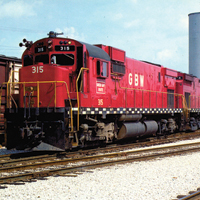
Ozu, of course, loved his train shots. And one of the lengthiest shots in Godfrey Reggio’s Powaqqatsi involves a freight train rolling past the camera, gradually speeding up, for about two minutes. But James Benning’s RR, part of this year’s avant-garde series falls somewhere between a Situationist cinematic exercise and an Andy Warhol film. The film is composed of nothing more than static shots of trains, the camera serving almost as a surrogate driver waiting at a railroad crossing (hence the film’s title, which, if you are a trainspotter, could likewise stand for “rest and relaxation”). Each shot begins with the train arriving and ends with the train leaving. The film, containing nothing more than visuals and sound, intercuts these long takes with a few seconds of black leader. And the film’s 16mm format lends it a grad school feel that admirably deflates its artistic pretensions. I don’t know if it could work as well on 35mm. But it is a rather interesting cinematic experience for anyone fascinated with everyday minutiae.

It is a film that requires patience. I certainly don’t believe that this film quite warranted its 111 minute running time. And RR‘s nearly unwavering commitment to landscape over humans does cause one long for a few souls ambling around in the distance. (Near the end of the film, Benning does give us a gentleman emerging from camera left, walking well into the distance and staring at a passing train to share our vicarious passiveness.)

But the trains, rolling through plains, rusty bridges, snowscapes, and dilapidated freight yards, do cause us to dwell on interesting details. I became acutely aware of vegetation and plant life slowly dying and wildly overgrowing close to the tracks. The multihued boxcars and the rolling shadows frequently overtake these sometimes dull landscapes. But as the film progresses, Benning does something quite interesting. In the film’s early shots, there is a sense of anticipatory timing. When will the train first appear? This offers a brief moment to fixate on a beautiful scene of, say, trees and rivers, before the train occludes the view. When the train does arrive, the viewer is left to fixate her attentions on the scrub weed, abandoned blue plastic bags, and dessicated goldenrods that litter “our” side of the tracks. But as the shots continue to come, Benning gives us less time to get our bearings. And when Benning cuts early, the trains begin including a few vacant boxcars that offer hollow recesses and/or hollow frames. And the train’s recurrent bifurcation becomes so imposing that we then start to focus more on the landscape on our side of the view, only to begin ignoring the train itself. In fact, I became so accustomed to doing this that, at one point, I began to fixate on croaking frogs and almost completely overlooked the fact that the train in question was composed of only one car. There are surprises here. But you have to have an attention span.

As the film began to adjust the camera’s relative distance from the train from shot to shot, I also found myself shifting in my seat: moving forward when the train was too far and moving backwards when the train was too close. I found it quite alarming that there was a set distance in which I was comfortable perceiving the train. And I must express some gratitude to Benning for making me aware of this programmed tendency. Who knew?
When the film juxtaposes radio snippets over its visuals, such as “This Land is Your Land,” some religious nut on the radio, and Eisenhower’s military-industrial complex speech, to impart a bogus significance, I felt the film failed. The film is more true and intriguing when it concerns itself with the unexpected sounds that the train decimates or succumbs to — whether wildlife whooping off-screen, profanity-laced hip-hop blaring from trailers hitched across the tracks, or a loud motorboat speeding beneath a bridge. Benning has claimed in an interview that this film “came to be about consumerism and overconsumption.” But this suggests great political import that really isn’t here. This is a film specializing in the American relationship with landscape. But if it were about the goods transported within freight trains, surely we would have been permitted a glimpse inside? An occasional shot of a bulldozer tied down on a platform or a car bogged down with lumber simply doesn’t cut it. The relationship here doesn’t seem that political to me, even with the film’s final shot in a wind farm. But depending upon how patient or open-minded you are, it may or may not be your kind of ride.
Review: Choke (2008)

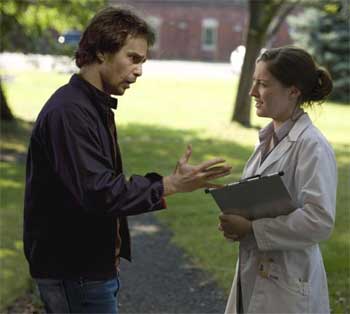
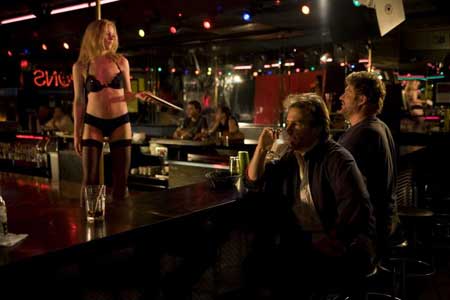
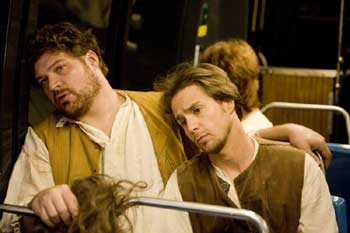
Writer-director Clark Gregg’s adaptation of Chuck Palahniuk’s 2001 novel has a number of things going for it. It has, first and foremost, the intriguing choice of Sam Rockwell cast as sex addict Victor Mancini. Rockwell plays this role as a strange amalgam of Greg Kinnear’s Bob Crane in Paul Schrader’s Auto Focus and Luke Wilson’s detached presence. His lanky mien suggests a Stan Laurel to the slightly chubby Brad William Henke’s Oliver Hardy. And while Henke here is not bad as Victor’s best friend and co-worker Denny, a chronic masturbator unafraid to lust after Victor’s mom (Angelica Houston), this comedic pair-up doesn’t quite anchor the film the way it should. Denny, like many wingmen before him, exists here mainly to pester Victor to move to “the fourth step,” or, in less Erhard-like terms, get on with his life or, as another character tells him later in the film, “to begin at the beginning.” With Victor, Denny attends support group meetings to help the pair get over their sex addiction. But Victor spends most of this time banging an anal bead enthusiast named Nico (Paz de la Heurta) in the backroom.

Rockwell’s look is certainly right. His shaggy brown hair, desperately in need of a haircut, frequently sticks up, suggesting a 1990s Northwestern slacker aesthetic. He wears shirts with gaping holes near the collar. He works a day job as a historical reenactor and, early on, declares directly to the camera, “I am the backbone of colonial America,” a postmodern possibility that Gregg never quite pursues that suggests that his addiction is a throwback to a more early and hypocritical age. Victor insists that he’s an asshole, but maintains a wide-eyed and bemused presence that seems perfectly aligned with the film’s often frustrating inability to decide whether it’s satirical or sincere.

No Country for Old Men‘s Kelly Macdonald appears as Paige Marshall, whose eyes were seemingly invented for the light, but who we know, upon her character’s first step inside the mise en scene, will almost certainly become Victor’s love interest and will almost certainly never live up to Bechdel’s Rule. Which is too bad. Because the more I see of Macdonald, the more I realize how much she has it. And it will take a very intelligent film director, perhaps one with more smarts than even the formidable Coens, to give her the role that will finally catapult her into the superstardom she deserves. Her presence in this film is part of the Big Reveal, which is a substantial copout. But then if you’ve read Palahniuk’s book, you know the Big Reveal already. And Macdonald likewise know it. Her character speaks in a particularly pronounced hayseed vernacular, pronouncing “traumatic” like “TRAW-MA-TIC.” But this permits her to play Paige as if she’s on the inside of a terrible joke.
The terrible joke may very well be the fact that David Fincher was not only the first director to make a film about a Palahniuk novel, but the one to transform it into his masterpiece. One cannot view Choke without being aware of Fight Club‘s imposing shadow. Like Fincher (and screenwriter Jim Uhls), Gregg has one interesting scene that plays as nihilistic absurdism. In Fight Club, it was the moment in which Edward Norton punched himself in the face to blackmail an office manger. In Choke, it’s presented when Rockwell insists to a group of asylum inmates that he’s not a good guy, proceeds to take away a walker from an older woman and smash it against a locker. But while there is something in this scene vaguely reminiscent of Lars von Trier’s The Idiots, the scene plays like some doughty transplant from a pre-9/11 America. It works to establish Victor’s internal dilemma, but it doesn’t feel particularly contemporary.

Gregg is at his best when he avoids this dated approach to shock value for the more troubling truths of the seemingly perverse, such as one moment involving a woman who Victor seeks out for a rape fantasy involving a knife. The woman sets very specific terms, speaking less like a person with fey needs and more like a human resources manager. (The safe word is “poodle.”) There’s also an interesting exchange in which Victor confronts the boyfriend of a woman who has fallen asleep giving him a hand job. Victor urges the boyfriend to turn back and walk away. But these scenes work because of their naturalistic ironies. They present moments that are not particularly normal, but frame them as if they are normal. Even when the dialogue itself feels transplanted from some banal sitcom. And to consider again Victor’s insistence that he is “the backbone of colonial America,” this suggests an American take on the many unusual situations of this type that one finds within Francois Ozon’s early, more daring films. I have neglected to point out that Victor has worked out a scam, whereby he lodges a piece of food in his throat, chokes, and wanders around a restaurant in search of the right benefactor to perform the Heimlich. He does this to earn some pocket money to help pay for his mother’s care in a hospital. It is something that occurs quite frequently throughout this film, but these moments, which should have likewise served as nihilistic absurdism, simply did not stand out for me. Part of this may have to do with Gregg’s inability to push things far enough. Gregg does not entirely understand, as Fincher did, that this is the kind of behavior must be played out as melodramatic in order to work. There is one somewhat funny moment in which the choke confidence game backfires at a Chinese restaurant. But the moment simply doesn’t have the naturalistic irony or the nuanced play of these other scenes I have mentioned. And in a film largely concerning itself with the subject of phoniness, it seems absolutely vital for a filmmaker to get the tone absolutely right.

Gregg’s film does disguise New Jersey locations somewhat successfully as the Northwest. The apartments are laced with tacky wallpaper. There are many dead patches of lawn on the historical reenactment site. There are unwashed radiators, grimy kitchen surfaces, and photographs tacked carelessly to walls. But the film’s many flashbacks to the 1970s and 1980s, containing muted browns and the kind of predictable tan jackets and vests that have become something of a production design cliche, reveal that this is more kitsch than verisimilitude. More of a time capsule than a movie of the moment.

Gregg has been mostly faithful to Palahniuk’s novel. But he doesn’t quite have Fincher’s talent to properly translate Palahniuk’s cartoonish riffs on reality to the big screen. He does have Victor and Denny frequently stare at women and suddenly see them topless, and this tic even extends to an older nun. But this isn’t really pushing the envelope, much less forcing us to ponder the perceptions we keep to ourselves. His efforts to plunge into the scatological, such as a moment in which Denny drinks out of a dish and an incident late in the film involving chocolate pudding, don’t feel particularly offensive and don’t particularly unsettle us the way they did in Palahniuk’s novel. It is also a telling sign that most of the sex scenes occur with clothes on. The vulnerable nature of being naked, which should mean something in light of the film’s dialectic between love and sex, is confined to “being in the circuit” late in the film. But it feels perfectly safe. The kind of thing you’d find within some harmless Skinemax movie from the 1980s.

If a Chuck Palahniuk film adaptation cannot unsettle us, what then is the point of making it?

Edward Douglas, Hopeless Hack and Amental Film “Journalist” — Part Two

Last week, Reluctant Habits initiated a weekly series on New York hack “journalist” Edward Douglas, a creative typist employed by ComingSoon.net and an intellectual coprophiliac quite happy to scarf down the moist cloacal deposits offered by film publicists. Unfortunately, in the last seven days, Mr. Douglas’s work has not improved much. We see traces of anti-intellectualism and a failure to comprehend basic nouns, along with other unpardonable sins.

MR. DOUGLAS’S OFFENSES AGAINST JOURNALISM AND THE ENGLISH LANGUAGE — THE WEEK OF JUNE 8, 2008

Edward Douglas offers this stunningly idiotic sentence:

Director M. Night Shyamalan often gets a bad rap, not because of his movies, whether you like all, some or none of them, but because people claim him to be an arrogant egomaniac.

Not only do we get another typical instance of Mr. Douglas mangling his clauses, but we get the redundancy “arrogant egomaniac.” Is Mr. Douglas then suggesting then that Mr. Shyamalan is a humble egomaniac? Or is he simply clueless with nouns? One thing’s for sure. Mr. Douglas has no problem wrapping his well-oiled orifice in Mr. Shyamalan’s presence. While boasting about his “10-minute lightning round interview” (such insight!), Mr. Douglas writes, “You have to admit that he doesn’t make movies haphazardly though, always spending a good amount of time thinking about every aspect of the story and characters and how they might be perceived by the public at large.”

There are many filmmakers, of course, who spend a good deal of time thinking about movies. Consider the time that Michael Cimino expended to think about every detail in Heaven’s Gate, right down to the period underwear. And we all know how that film is currently regarded. But it does not logically follow that, because a filmmaker has used up time and energy, he has put out a quality film.

Mr. Douglas’s paralogia can also be witnessed in such dunce questions as “With all the paranoia in the air, can this movie still be seen as escapism?” (presumably, Mr. Douglas has a limited definition of the escapist blockbuster) and “This is a very short movie compared to your other movies, but it’s only 90 minutes and I was curious about that.” In clinging to such boilerplate, Mr. Douglas remains as graceful as a two-year-old who requires a life preserver in a wading pool.

Mr. Douglas also suggests that Scientific American “grilled” Mr. Shyamalan in asking about science. I must presume that Mr. Douglas is referring to the innocuous question, “Do you see part of this movie being a statement about science and technology being all you need in the world?” If this question did indeed come from Scientific American, it does not grill in the slightest. It is a question founded on legitimate inquiry. Perhaps by “grilled,” Mr. Douglas is referring to a vaguely intellectual area he will never inhabit. But rather than asking more specific questions about The Happening‘s relationship with science (Scientific American‘s George Musser had the decency and the smarts to ask him aboutthe great Guy Maddin. But don’t let Mr. Maddin’s importance fool you into thinking that Mr. Douglas offered anything approximating interesting inquiry. Early in the conversation, Mr. Maddin offers an intriguing answer about Michael Burns okaying a rough outline for My Winnipeg. And rather than asking Mr. Maddin about just how loose he can get with Burns and the level of rejection he receives as a maverick filmmaker, Mr. Douglas asks instead, “Did you still do any kind of research at all?” (Incidentally, Mr. Burns was recently fired, which leaves one to wonder about Maddin’s remaining allies at the Documentary Channel and the freedom he still has a filmmaker. But, of course, Mr. Douglas is too gutless a questioner to follow up.) He doesn’t even ask about the relationship between writing with wholesale invention and relying upon preexisting fact, which would seem an important component to a film dealing with urban legends in some form.

When one interviews someone like Guy Maddin, the interview practically writes itself. But there are too many times in which Mr. Douglas cannot parse the conversational trajectory in front of him. Mr. Douglas’s interview is a fine example for anyone wondering how not to conduct an interview.

Edward Douglas, Hopeless Hack and Amental Film “Journalist” — Part One

New York hack “journalist” Edward Douglas, a creative typist employed by ComingSoon.net and an intellectual coprophiliac quite happy to scarf down the moist cloacal deposits offered by film publicists, recently left a comment. Mr. Douglas writes that telling the truth about Hollywood and the junket system is “the reason why blogs like [sic] shouldn’t be considered viable outlets to do these interviews.” Is that so?

In a moment, I’ll address the question of whether Mr. Douglas is a writer with enough credibility to make such a claim. But for now, there is a more pertinent question: What makes Mr. Douglas’s idiot tinkerings at ComingSoon.net any different from a blog? It appears that Mr. Douglas doesn’t write for newspapers. In fact, he writes exclusively online. Could it be that Mr. Douglas is merely a piss-poor journalist? Could it be that Mr. Douglas’s isn’t that good of a writer? Could it be that he is a small insect creeping his way up the dunghill of film journalism? A mere mite to be smashed with a robust and responsible Doc Marten?

In an effort to determine precisely why and how Mr. Douglas is a lazy and inept journalist, I’m initiating a weekly series that will examine Mr. Douglas’s work (if his scrabbling can be called that) as it appears on his site, ComingSoon.net. This is the first installment.

MR. DOUGLAS’S OFFENSES AGAINST JOURNALISM AND THE ENGLISH LANGUAGE — THE WEEK OF JUNE 1, 2008

On June 5th, Mr. Douglas interviewed Jon Favreau. Instead of using this time to investigate Iron Man 2 at length or ask Favreau about some of the interesting connections between his earlier and more “real” films (Swingers and Made) and these newer fantasy blockbusters, Mr. Douglas preferred to state the obvious to Mr. Favreau, asking him the vapid question, “So now you are back to being in front of the camera and goofing off?” Clearly, it is Mr. Douglas who is the one goofing off here with this slipshod inquiry. But, of course, since Mr. Douglas (and the other junketeers who were present for this interview) is a consummate ass-kisser, this early question was merely a setup to stroke Mr. Favreau’s ego with this scintillating observation concerning all potential superhero epics now in the planning stages: “I guess you will have to direct all of them.” Again, we see that Mr. Douglas and his unsearing peers prefer constant assuaging over journalism.

Also on that day, Mr. Douglas wrote this amazingly idiotic piece of hackery in relation to Anand Tucker. Marvel at this atrocious sentence!

It must have been a bittersweet departure, because it would have been a fantastic film under Tucker’s guidance and he was a big fan of the books, but leaving the film allowed the director to successfully dodge the bullet and the backlash when the movie bombed horribly, something that many felt greatly accelerated the decline and death of New Line in its previous guise.

Mix your metaphors much, Mr. Douglas? Split your infinitives much, Mr. Douglas? Separate your clauses at all, Mr. Douglas? Are you even aware of Strunk & White, Mr. Douglas? Does anybody edit your pieces, Mr. Douglas? Unable to deploy a figurative metaphor (“the bullet”) for his object, Mr. Douglas feels a strange need to introduce a literal one (“the backlash”). And who are the “many” who felt that The Golden Compass was responsible for New Line’s decline? Is this like the tribunal scene at the end of M? Mr. Douglas suggests by this cavalier item that he is an insider. But he is a dilettante. A proper journalist would offer a link or a specific authority for others to follow.

Let us also ponder the modifier “exclusive” — a word that Mr. Douglas seems peculiarly fixated upon. An exclusive interview suggests that Mr. Douglas is nabbing these interviews on his own, that he is obtaining bits of information that nobody else has. Mr. Douglas is not in the habit of confessing when he’s at a press conference or a sharing a roundtable interview with other journalists. So perhaps he has deluded himself into thinking that he’s getting an “exclusive.” Or this is what he tells the people who pay his checks. Either way, he is a liar. And further examinations into the “exclusive” nature of Mr. Douglas’s material are forthcoming.

But for now, I note that Mr. Douglas reported that he had “an exclusive” item involving Werner Herzog’s upcoming movie, Bad Lieutenant, with Herzog claiming that his film was not a remake of the Abel Ferrara film. But if Douglas had such an “exclusive,” why then did the same news (with a strikingly similar quote) crop up on Defamer one day before Douglas’s report? Could it be that Defamer’s S.T. VanAirsdale (who also blogs at The Reeler) was at the same junket/press conference? (VanAirsadle, to his credit, had the humility and the decency to avoid the word “exclusive,” pointing to “some minor miracle/apparent PR botch” that permitted this interview to happen.)

On June 3, the hopeless Mr. Douglas posted his conversation with documentary filmmaker Nina Davenport, where one can see Mr. Douglas’s considerable deficiencies as an interlocutor. Davenport was commissioned to film an Iraqi film student. The resulting film became an altogether different documentary named Operation Filmmaker. Sounds like an intriguing exposé into cultural transition, yes? Well, not for Mr. Douglas. He was not so tickled at putting forth remotely challenging questions on, say, how much Davenport and her camera might have been inadvertently responsible for the film student’s erratic behavior. In fact, since Mr. Douglas is apparently incapable of using his noggin (or unwilling to) for his questions, we get three questions from Mr. Douglas that rely upon the “It must have been hard”/”Was it difficult?” interviewing cliche.

Let us consider this hackeneyed phrase. In what world do you utter such a conversational banality and not get your ass kicked? You don’t ask a dentist if it’s “difficult” for him to fill in a cavity. You don’t tell a barista that “it must have been hard” to make that latte for the last customer. Why are amental hacks like Mr. Douglas so content to treat their interview subjects like children? (Answer: Because today’s junketeers aren’t interested in adult conversations. They remain inveterate assuagers.)

Douglas really thinks his readers are idiots. Why else would he write, in relation to a junket with Kung Fu Panda co-director John Stevenson, “A lot of what he had to say will certainly be of interest to anyone hoping to one day break into the animation or computer effects field.” Even discounting the fact that Douglas (or one of his fellow roundtable junketeers) foolishly compares the Head of Story position with ADing, is Douglas arrogant enough to believe that aspiring animation students will be going to ComingSoon.net to get technical information? Compare Mr. Douglas’s condescending flummery with Steve Fritz’s more comprehensive and informed interview of both Kung Fu Panda directors, where Fritz not only gets answers on how fight moves were animated and carried out, but even obtains a concise paragraph on key frame animation.

It will, of course, take some time to examine the spineless atavist known as Edward Douglas. I should observe that Mr. Douglas’s affronts to journalism are, as I have intimated with the comparisons above, by no means endemic to film journalism as a whole. I have my problems with David Poland, but at least Poland is attempting some basic ratiocination. One cannot say this of Mr. Douglas, whose execrable word spewing makes Poland look like F. Scott Fitzgerald. It is not just the ineluctable conclusion that Mr. Douglas writes with all the dependability and precocity of a malfunctioning dot matrix printer that should trouble us. He actually gets paid for this.

It is now my goal to inform those who pay Mr. Douglas for his services that they are getting a terrible deal. It is he who is the one not deserving of any credibility. It is he who is the one who should be confined to a go-nowhere office job without the benefit of air conditioning. Future dispatches will follow.