
Review: Bad Teacher (2011)

If Bad Teacher is a vocational reworking of Terry Zwigoff’s masterful Bad Santa, with Cameron Diaz’s lazy, money-grubbing, breast implant-seeking schoolteacher filling in for Billy Bob Thornton’s lazy, money-grubbing, alcohol-seeking mall Santa, then it’s a curiously tepid cousin needlessly sanitized by its good intentions. Diaz’s Elizabeth Hasley drinks bottles of whiskey hidden in her desk drawer, bluntly informs a kid who wears his abandoned father’s sweatshirt several times a week that he has no chance with the prettiest girl at school, and embezzles money from the seventh-grade car wash (shortly after using her body to spike up the funds and causing a police car to crash)*. But Hasley isn’t mean and interesting in the way that Billy Bob’s Willie T. Stokes captured our attentions. Instead of having a fast-talking dwarf Marcus as a sidekick, Hasley has the passive Lynn Davies (played by Phyllis Smith, best known as Phyllis from The Office), who looks forward to her three months off in the summer (with numerous trips to the zoo) and sees a surprise milk choice at the cafeteria (“2%? 1%? Chocolate?”) as a high point. What Bad Santa understood was that having a seemingly modest character constantly criticizing a middle-aged loser made us more interested in why the latter lived the way that he did. Hasley has no such luck with Lynn. Indeed, it’s Hasley who is the one to encourage Lynn to talk with two cowboys at a bar. Which works against the idea that her character is supposed to be, well, bad.

Perhaps screenwriters Gene Stupntsky and Lee Eisenberg (both veterans of The Office) should be faulted because they’ve been working too long within the needlessly restrictive limits of American television. They don’t seem to understand that an R-rated movie featuring a mean character really should be dangerous, but their floundering wit is here in spurts. There’s one funny moment early on when Hasley’s man shouts about the need for opera to be passed on to the next generation. And when Bad Teacher was especially irreverent, such as Justin Timberlake’s squeaky-clean teacher making racially insensitive remarks about a new Ethiopian restaurant or an especially aggressive method of getting kids to remember the details of To Kill a Mockingbird, I longed for the film to transcend into additional cringe comedy. But then the film would present another weak or gutless or repetitive moment, not understanding that incriminating photos of a naked administrator or Lucy Punch’s chirrupy Amy Squirrel getting a few comeuppances were mere variations on hackeneyed comic situations we’ve seen too many times before.

Jake Kasdan’s flat direction is also a big problem. I don’t know what has happened to Kasdan ever since his fine work on Freaks and Geeks and his very underrated debut feature, Zero Effect, but I fear that Lawrence’s son is now a lost cause. I’m fairly certain that Cameron Diaz was slightly miscast, but I don’t know for sure. Because she delivers her lines with heavy aspiration on the consonants rather than hitting the vowels hard. And because Diaz’s voice is mellifluous, this disastrous direction causes Diaz to lose the authority she so desperately needs to win our attention, especially because Hasley is rejected by several men when she tries to use her looks and she’s someone who spends cash so wantonly. And while I recognize that Justin Timberlake has about as many dramatic options as a home pregnancy test, a good director will understand that mixing up the only two settings available (as David Fincher did in The Social Network) is better than sticking with one. There’s something deeply unpleasant about seeing a 30-year-old guy who believes he’s in sync with Stanislavsky resort to the same terrible stage-hogging case of the cutes that he used in his twenties. Sure, Timberlake isn’t much of an actor. But can’t he at least pretend to be an adult?

The one actor I can commend here is Jason Segel as an underestimated gym teacher persistently trying to woo Hasley. I liked Segel in Knocked Up and Forgetting Sarah Marshall, and he seems to be the only actor in this movie who is having any fun, perhaps because he knows how to use his face to suggest a social awareness that other characters lack. But Segel isn’t a mugger: he knows how to enter a scene without dominating it and he knows how to make his fellow actors look good. If we’re not drawn to Cameron Diaz in this movie, then Jason Segel serves that role.

But enough about Jason Segel, who hardly needs any help from me. In our post-Bridesmaids landscape, the time has come for women to be rude, crude, mean, and dangerous in mainstream comedies without being kept on a leash. Bad Teacher cannot live up to this basic requirement, and, in failing to be even modestly subversive, it becomes an instantly regressive and instantly forgettable offering.

* — A brief note on this movie’s recidivist exploitation of the physical female form: If Bad Teacher has been designed in any way as a double X counterweight to male-dominated comedies, why are the filmmakers here so desperate to use Cameron Diaz’s body like this? Furthermore, why does she seek a breast implant rather than cold hard cash? Still furthermore, in an opening scene, there is one fellow teacher — a slightly overweight (that would be “normal” weight) woman played by Jillian Armenante, whom I remember playing a sensitive therapist from The Sarah Connor Chronicles — who appears, expressing enthusiasm. She raises her arm. We see the sweat spots in her armpits. And that’s it. There is an additional moment when a woman’s breasts are there to be ogled for their silicone perfection by all and sundry. And that’s it. I submit to the reader that a movie that maintains such a superficial interest in women instantly loses credibility, especially when Eisenberg claims in the production notes: “We would see so many funny women on Saturday Night Live and on talk shows, and they’d be hysterical and charming, and then we’d go to the movies and they’d be props to get two guys to become friends or whatever. We really wanted to write a project for a comedienne.” Eisenberg may have wanted to write a project for a comedienne, but the film clearly views much of its supporting women as props.
Review: Green Lantern (2011)

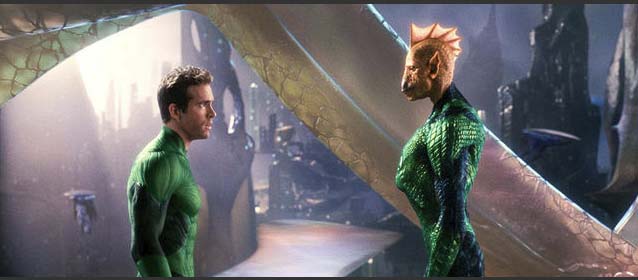
Green Lantern isn’t as awful as The Green Hornet, but if this year’s cinema has taught us anything, it’s this: don’t trust a movie with “green” in the title. There are perhaps seven good minutes of action scattered within a soporific salmagundi of stilted scenes and here-for-the-paycheck performances. Our hero pulls off a few fun feats, such as responding to an energy bolt by creating a catapult in seconds, bouncing it back at his enemy. Green Lantern, famous among shut-ins who spend most of their time shrink-wrapping comics in basements for a fairly impressive party trick that transforms energy into solid matter, is tailor-made for CGI’s fluidity, especially because what Green Lantern creates (chainsaws, two jets attempting to steer him from the sun’s gravitational pull, and, most impressively, wheels attached to a helicopter and a corresponding racetrack) reveals his personality in modest ways.

It’s too bad that this effects-based commitment to character can’t be found anywhere in the lumbering script. One must sit through a plodding 90 minutes, including a murky beginning needlessly complicating a pedestrian origin story, to get to the good bits. And speaking of good bits, Ryan Reynold’s Hal Jordan has a chiseled body born to be ogled by a camera. Even as a straight man, I understood immediately why Scarlett Johansson felt compelled to ride his magic wand. Alas, this mighty chunk of sirloin doesn’t have much of a soul. Reynolds is a top gun firing blanks: a low-rent Maverick who never stops to wonder why Merlin is 25 years older, now answering to the name of Senator Robert Hammond, and playing father to an actor (Peter Sarsgaard) only twelve years younger. Unlike Tim Robbins, Sarsgaard’s Hector Hammond actually has a bit of fun being evil: he sips the rim of a margarita glass with arch relish, looks at strangers slightly askew, and has an adorably ridiculous moustache. For large chunks, Sarsgaard proves more capable of containing this movie than Reynolds Wrap. Alas, this wry fun is curtailed when the filmmakers slather too much makeup on Sarsgaard and ask the poor man to put a little spittle into his cornball dialogue.

Martin Campbell’s Green Lantern (written by Greg Berlanti, Michael Green, Marc Guggenheim, Michael Goldenberg, and who knows how many other script doctors) appears to have pilfered Emerald Dawn (a miniseries revisiting Hal Jordan’s origin story authored by Jim Owsley, Keith Giffen, and Gerard Jones) for its narrative. But the filmmakers have failed to plunder the conflict that counts. Emerald Dawn featured Hal as an alcoholic whose selfish behavior caused his friend Ryan to die in a hospital. Campbell’s Hal, by contrast, merely wakes up late and can’t get over his father’s fiery death years ago testing an aircraft. As internal conflicts for a thirtysomething man go, this is exceptionally feeble material, especially given the insistence on an internal will vs. internal fear conflict that we’ve seen perhaps dozens of times just in the past three years.

This is a film so stupid that it flashes a SIX MONTHS LATER title card in a different galactic sector, not comprehending that time measurement is often determined by length of solar orbit. This is a film so naive that it actually expects us to believe that Hal Jordan can change the minds of the Guardians of the Universe, who are many thousands of years old, with a facile defense of human fallacy (“We’re young. We have a lot to learn.”). This is a film so laughably derivative that the filmmakers have somehow misunderstood Green Lantern’s ring to be easily interchangeable with Peter Jackson’s Lord of the Rings trilogy. Sinestro looks suspiciously like Hugo Weaving’s Elrond. There is even talk of forging rings (with an arrogant ending that opens up a sequel). We even see the Green Lantern insignia contained within a giant edifice, yet another Mordor ripoff. Did I mention a circular device seen in the background that looks very much like the Stargate portal but that serves no function at all? One almost believes that the set designer was ordered by marketing forces to include random visual references to other geek-friendly TV shows and movies. A training scene with Kilowog has the feel and bad dialogue of a video game orientation, leaving one to search in the dark for a nonexistent controller.

But most criminally, the film cheats us of spectacular battles, which are few and far between, and a clearly identifiable hero we can root for. We see several Green Lanterns early on, but they never get to use their cool superpowers. They are merely eaten up by a boring marble-mouthed villain named Parallax. It takes a long while for Hal Jordan’s Green Lantern to show up. Indeed, thirty minutes into the film, I heard one very confused and very disappointed six-year-old ask his dad, “Is that Green Lantern?” as another meaningless character soared across the universe.

When multiplexes are saturated with so many superhero movies, why spend $300 million on another flick that means nothing?

BAMcinemaFest: On Tour and Where Soldiers Come From

This is the second in a series of dispatches pertaining to this year’s BAMcinemaFest, which runs from June 16th through June 26th.

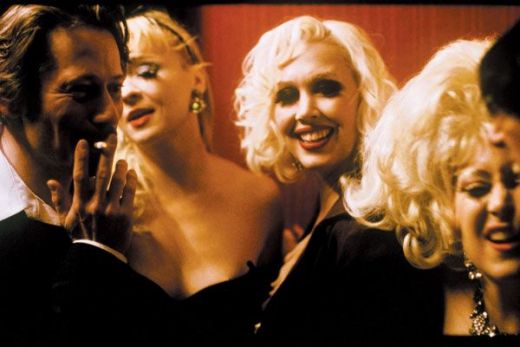
I should probably confess from the onset that I’m a sucker for movies that depict show business. Mathieu Amalric’s On Tour, which concerns effervescent burlesque dancers as they play various gigs in France, is somewhat overstuffed (especially when compared against Abel Ferrara’s smooth and sleazy Go Go Tales). But it’s still a delightful diversion, greatly aided by Amalric’s energetic (and sometimes over-the-top, as seen during one moment on a train) performance as Joachim, a disgraced television producer turned low-rent showbiz manager.

Joachim may or may not be capable of dignity or redemption. But that’s a moot point. Because On Tour is at its best when depicting backstage process: the application and removal of pasties accompanied by bubbly banter, rehearsal sessions featuring women wiggling out of coiled rope, and attempts to woo the dancers back to their hotel rooms with bottles of champagne. (Joachim’s insistence that champagne will do the trick more than other methods says much about his management techniques and his understanding of women.) It is not quite on firm footing when investigating what Joachim has given up: the former lover occupying a hospital, his status as prodigal son and brother who has fallen from grace, and Joachim simultaneously looking after his children and the dancers. There is one absurd moment when Joachim asks his kid to hold the phone to his ear as he slobbers down Kentucky Fried Chicken. Amalric might have pursued this decided incompatibility between personal business and show business further.

But his camera is understandably drawn to the dancers, who include the balloon-popping Dirty Martini, the piano-playing Kitten on the Keys, and the alluring and curvaceous Mimi Le Meaux. Filmed burlesque, of course, can’t compare to the real thing. (With this in mind, the good folks at BAM have wisely planned a burlesque show to accompany this film’s June 24th spotlight screening.) And aspirations don’t necessarily translate into captivating talent. There’s one sad moment in Amalric’s film which illustrates this latter harrowing point: a woman working the grocery checkout counter, having seen the burlesque show the night before, lights up when seeing Joachim and one of his dancers purchase some goods. The woman attempts a sloppy and impromptu tease and, when denied, she shrieks at Joachim for being spurned as he leaves the store. It’s a sober reminder that all art, even the seemingly low strains, requires fluency and commitment overshadowing such envious fast track aspirations. The rest of us who understand this can enjoy the dancing.

“I don’t like hippie films where you watch a balloon for an hour and a half,” says one of the soldiers in Heather Courtney’s moving Where Soldiers Come From. It’s a message that may be lost on the film nerd set. This gripping documentary tracks three young men (Dominic Fredianelli, Cole Smith, and Matt “Bodi” Beaudoin) in the Michigan Upper Peninsula fresh out of high school who sign up for the National Guard, serve stints in Afghanistan, and return home permanently altered. Myopic film snobs clinging to desperate cinematic references like stray driftwood clogging up a human river will probably make comparisons to The Deer Hunter. Thankfully, this is an association that Courtney deals with fairly early on.

Courtney is after the bigger and little discussed picture of how sharp young people, attracted by the money and a desire to serve their country, don’t entirely comprehend the consequences until they’re in too deep.

It’s good to see a serious movie like this get programmed in with all the nauseating and forgettable offerings made by talentless hipsters. Courtney has not only skillfully earned the trust of all parties, but her coverage is comprehensive (even following them to Afghanistan) and her editing is highly organized. We see the training officer who can’t pronounce “Hamid Karzai,” bombarding his trainees with a decidedly reductionist overview of the country. Parents smoke sad cigarettes and work long hours. Girlfriends clutch teddy bears and patiently prepare for the shifts in mood and the traumatic brain injury when their men return. There are technical snafus when families try to connect with the soldiers through Skype. Dominic, before he is shipped overseas, is a talented artist. And right before he’s sent to Afghanistan, Courtney strings together a series of visuals where Dominic and his friends tag the interior of a decaying edifice with maps of the country, maps of Michigan, and other depictions of their lives. This ephemeral art wryly (and painfully) mimics how top brass perceives their services as soldiers. When he returns home and he’s flailing around to find a place, it’s a genuinely touching moment when his art teacher gives him a wall to paint a mural.

This film works so well because these young men aren’t mindless automatons. They’re aware of what happens when they single out a landowner to be searched (“I affected that guy’s life for the rest of this life. But the IED wont explode. So it goes both ways.”). They want to believe in the Afghan population, but the hard and thankless slog has caused these men to “learn to hate” them. They’re also aware of how disposable they are. As one soldier confesses, “Pretty much you’re nothing. Unless you rule a corporation, you’re pretty much shit.”

Where Soldiers Came From is a vivid cinematic portrait well worth your time and long overdue for distribution beyond the film festival circuit.

BAMcinemaFest: Weekend, Letters from the Big Man, and The Color Wheel

This is the first in a series of dispatches pertaining to this year’s BAMcinemaFest, which runs from June 16th through June 26th.

After bracing the buckling collision of books, bad advice, and crass commercialism known as BookExpo America, I retreated to the air conditioned confines of the BAM Rose Cinema the following week, where press screenings for this year’s BAMcinemaFest were being held. The hope was that many of these independent offerings would replenish my soul and cause me to dance variegated jigs in the street. While there were several quiet and knowledgeable peeps kind enough to answer my questions about esoteric filmmakers unfamiliar to me, there were nevertheless a few self-absorbed “critics” (in particular, one dark-haired dunce who I had observed before a 92nd Street Y crowd gushing like some junior varsity neophyte and who felt the need between screenings to blab loudly about her remarkably uninteresting life) talking nonstop about film programming gigs that they felt entitled to. (“Oh, is he going to leave?”) Something about persuading a bigshot teetotaler to drive her to some needlessly affluent affair so that she could spend the weekend completely plastered, life presumably passing by like nonbiodegradable plastic. Not my idea of fun. A year ago, I had moved from Manhattan to avoid this unpleasant type. Yet this doddering parvenu, who claimed the sui generis Tree of Life to “have slow spots,” was a sober reminder that, even in Brooklyn, obnoxious and entitled tastemakers have replaced the rough-and-tumble enthusiasts who really count. I report all this in the event that some of my BAMcinemaFest dispatches are declared needlessly sour or mean and so that the reader might understand some of the atmospheric conditions in which I caught these artsy flicks.

The first offering was Andrew Haigh’s Weekend — a film having nothing to do with Godard’s masterpiece and everything to do with the possibility of sustainable romance over a whirlwind weekend. If you’ve lived adventurously enough, you’ve probably experienced a few of these yourself. If not, you’re probably retreating to movies to tell you what it’s like so that you might “program” these feelings in the future. Independent cinema has been curiously reticent in exploring a gay naturalistic version of the Before Sunrise story. And I very much appreciated Haigh’s commitment to capturing the coke-snorting, tea-making, and jizz-splaying-across-chest moments that most purported mavericks steer clear from. What I didn’t know is that Haigh has apparently upset Joe Clark for reasons that, I must confess, aren’t entirely clear to me, but have something to do with Haigh mischaracterizing Clark’s early enthusiasm as “the kind of movie straight guys would like” and assistance that was largely unrequited (an admittedly tacky move on Haigh’s part). What I can say is that Haigh isn’t nearly as talented as everybody thinks he is; he’s more interested in how people look rather than how they behave. That’s a far cry from someone like Lisa Cholodenko, who has escaped being pegged precisely because, if we want to get all humanist about this, she’s an excellent observer and chronicler.

Haigh’s two actors are both very good (especially Tom Cullen as the slightly more squeaky-clean of the pair), but the capable Chris New (playing an artist who is somewhere between David Thewlis in Naked and an aging hunk with lunky billiard balls still cracking around upstairs) is directed to play to the camera like a peacock when he really needs to crackle off the screen like Richard E. Grant in Withnail & I.

A tape recorded confession bookending the romance (along with several shots of surveillance cameras and additional angles that look as if they’ve been captured by surveillance cameras) may very well be Haigh’s own admission that he knows how to capture an early morning postcoital murmur like “I smell of cock and bum,” but that he doesn’t quite have the emotional depth and the true candor to communicate inner torment. Haigh isn’t helped by having his characters spout callow philosophy (“Gay people never talk about it in public unless it’s just cheap innuendo”) when he’s already presented them as much smarter than this. If Haigh’s the kind of guy who would slag off a potential advocate for being straight, that’s probably part of the problem. Yet Weekend stands only vaguely for the Other, but really wants you to like it. That stance may win you points among the sneering film nerd set, but it isn’t really conducive to lasting art.

Christopher Munch’s Letters from the Big Man probably doesn’t stand a chance of nabbing distribution. That’s too bad. For me, it was one of the high points. One doesn’t expect references to Zane Grey and Farley Mowat in a Sasquatch movie, much less incongruously formal dialogue like “I really don’t want the inconvenience of being the last person to see you alive” or a character who addresses the mosquitoes who are biting her. This is also a movie that presents smart people who openly confess that they’re too smashed to follow a Shakespeare production. While it’s true that these moments are buried under a somewhat muddled philosophy, I felt very inclined to appreciate the film for what it was.

Swamp Thing gave us Adrienne Barbeau’s breasts. Letters presents us with Sarah Smith, a hydrologist played by Lily Rabe self-sufficient in the wild and not easily charmed by men. When one smarmy suitor insinuates that he has the mind as well as the meat, I was delighted to see him rebuffed and flailing. I also liked the way Munch didn’t bother to have his Sasquatch (the titular Big Man) occluded in shadows or cockeyed angles. When we see the Big Man for the first time, we see him in full form. Which is just as it should be.

Sarah is also an artist, sketching images both real and subconscious. The Big Man possibly inhabits our world and possibly does not, but he does make his way to Sarah’s sketchpad. At one point, Sarah says, “I can feel you nearby. Thank you for being here.” Some East Coasters may be put off by this New Age vibe, but as a native Californian, I didn’t mind this so much. If cinema can’t present us with off-kilter introspection every so often, then what’s the point of making movies?

To take the edge off some of the forthcoming vitriol, I have included an image of two happy dolphins. The next film I saw was so terrible that I can state with fair certainty that one would be better served locating two dolphins, such as the very nice ones pictured above, and spending 83 minutes with them instead.

Before watching The Color Wheel (shot in black-and-white: how eye-roooooooooooonic!), I had no idea who Alex Ross Perry was. Now I wish I had never learned his name. Perry is a filmmaker so incompetent with comedy that he presents us with a stock situation in which a young man named JR (naturally, played by Perry and far removed from the great Gaddis novel) accidentally breaks a vase. He is told by the shopowner that he must pay for it and that it’s worth $500. JR doesn’t have the money. Instead of Perry finding a solution for this, he abruptly cuts to the next scene. In other words, Perry can’t be bothered to resolve the scene. Is this laziness or someone “hip” and detached? Either way, this is a technique one expects in 1991, not 2011. And it makes me wonder if The New Yorker‘s Richard Brody (and, hey, I’ll even give Brody Ishtar) was off his fucking rocker in commending this film’s alleged “exquisite comic timing and incisive comic framing.”

In this way (and many others), The Color Wheel plays like the mentally handicapped love child of Kevin Smith and Diablo Cody. The film, shot in 16mm. is so grainy that I truly believed all of the actors were experiencing bad cases of dandruff. And that’s hardly the least of Perry’s witless amateurism. There is also a very long take of perhaps twelve minutes (was Perry running out of film stock?) in which Perry consummates the incest that we knew would go down from the beginning and in which moments that are intended to be spontaneous are revealed to be amateurish rehearsal.

As an actor, Perry has a high-pitched voice that is so monotone that it makes Michael Cera appears as if he has the range of a Mel Blanc or a Frank Welker. Despite such clear limitations, Perry has the effrontery to offer something vaguely approximating a Buster Keaton look. But where Keaton’s face invited mystery, Perry’s face only encourages anger.

A dolphin’s face, by contrast, does not encourage anger. And I will be spending a good chunk of the time between this BAMcinemaFest installment and the next watching this pleasant dolphin video to remind myself that there are at least 25 million better things that one can do than consider or acknowledge Alex Ross Perry.

Review: Puzzle (2009)

Narratives featuring older women are in short supply these days. But writer-director Natalia Smirnoff’s marvelous debut, Puzzle, arrived this weekend to cure this needless deficit.

Puzzle introduces us to Maria, subtly underplayed by Maria Onetto, a suburban housewife. The film’s first shots are handheld, following Maria as she serves canapés and cooks and cleans up at a party. We learn that this is her own party, and that this is the manner in which she is celebrating her fiftieth birthday. I know that, if you are an Englishman, it is customary to buy everybody drinks. I have no idea if this practice has escalated further in Argentina, whereby not a single soul thinks to help the birthday girl out. But the failure of Maria’s husband and her children to chip in for such a once-in-a-lifetime occasion suggests very highly that there’s a problematic power balance in her marriage. Thanks in large part to Onetto’s incredible performance, which telegraphs Maria’s complexities even in the way she walks, it would be wrong to characterize Maria as completely meek. There is clearly an intelligence within her as she listens to one son attempt to embrace veganism. Yet it’s also clear that she’s chosen a life in response to her husband, an entrepreneur who runs a small business but who expects Maria to remember to replenish his favorite cheese (rather than going to the store and getting the groceries himself). The reason she’s stuck with her husband so long may be temperament. It may be that she simply hasn’t found the right angle in life.

Then Maria opens a present. It’s a jigsaw puzzle. With the family away, she starts putting the puzzle together. And the look in her eyes as she’s doing this (accompanied by musical thumps suggesting, quite deliberately, a quasi-Egyptian tone) suggests that this is one thing she’s very good at and that makes her very happy.

As someone who listens a good deal and observes much and remains frustrated by the failure of film (and books) to capture such quiet and magical moments occurring so very often in life, I can’t possibly tell you how rare and wonderful it was to see a filmmaker like Smirnoff surprise us like this. Like many of the game critics cracking vodka jokes (because, hey, nobody knew who Smirnoff was and the notes were nebulous), I had expected some goofy movie about jigsaw puzzles. But what I discovered was a deeply poignant movie about what it is to stick at some idiosyncratic interest that everybody tells you is wrong.

Maria wants more puzzles. “What’s the point of this?” asks her husband. “I like it,” responds Maria. Shouldn’t this be enough? When Maria’s husband denies her a new puzzle when they are out shopping, the moment is truly heartbreaking — especially because we know that her family doesn’t appreciate the nuances of her cooking. But when Maria finds a store that specializes in nothing but puzzles, the look of bliss on her face just killed me. Especially when she sees a 20,000 piece puzzle. One might argue that Maria is committing a form of adultery with her puzzles (and, as we see very subtly later, there is a sexual charge Maria gets from these puzzles). As she constructs more puzzles, she has to hide the puzzle-in-progress on a board underneath the couch. But surely Maria’s husband (who so upset me that, even in writing this quick essay, I cannot compel myself to name him) can spare a few minutes to encourage her hobby in late bloom.

But Maria is undaunted. She answers an ad reading “Seeking Companion for Puzzle.” But the way she answers it is complicated. For the man on the other end has an email address. And she has never touched a computer. Is it Smirnoff’s suggestion that giving into a quirky passion like puzzles is almost a pre-Internet idea that we can no longer talk about? Or is this a smart dramatic device that communicates just how much Maria has not been allowed to learn during her marriage? Whatever the case, the scene in which Maria is patiently trying to comprehend email as another woman tries to help her is expressed as a valiant struggle to move forward. Maria may be slow and quiet, but her passion will find fruition.

I’ve suggested that this film plays like a low-key version of Madame Bovary, with a sexual tension contained within Maria’s pursuit of the puzzle. What’s admirable about Smirnoff’s direction is the way she broaches this issue without pushing it too fast to the surface. The man that Maria meets, who does indeed want to take Maria to a puzzle championship in Germany, does make more than a few passes at her. But for Maria, it is the puzzle interest first and foremost that she’s lying to her family about. And when they do not entirely respect this singular pursuit, Maria’s decisions become more justifiable. In a late moment in the film, she orders the family to help her clean out a spare room. Again, it does seem the least that they can do. And in this act of cleaning, the family begins to dance in a rather spontaneous way after finding an item. So Smirnoff’s optimistic suggestion is that the fun moments in life often happen when you help those who are closest to you with their interests, however crazy or ordinary they may seem. The incurious counterpoint is a relationship founded on another person’s will.

Like any art investigating a subculture (and there’s certainly one here, complete with specific puzzle building techniques and some modest intensity), Puzzle reveals that there’s more to the ordinary if you know where to look and if you stick it out. As someone who has seen many of his friends and acquaintances sacrifice their voices and their spirits for crass materialistic gain, I’m grateful to this film for demonstrating that it’s never too late for anyone.