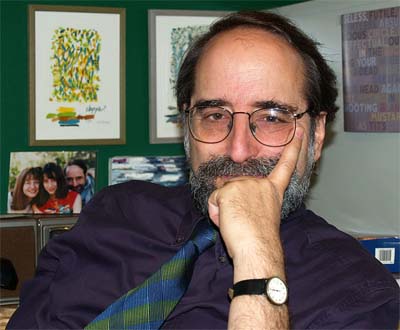
Lawrence Weschler is most recently the author of Uncanny Valley.
Listen: Play in new window | Download (Running Time: 45:13 — 41.4MB)
Condition of Mr. Segundo: Feeling 95% himself, wondering why he recoils at his mirror image.
Author: Lawrence Weschler
Subjects Discussed: Masahiro Mori’s “uncanny valley,” Zeno’s paradox, the difficulties of animating the face, getting past the uncanny valley in our lifetime, Quidditch matches, the human face as the welter of emotions, Paul Ekman’s Action Units, how humans are attuned to the slightest variation, human and robotic faces, engineers and college experiments, Nicholas of Cusa and his arguments with Aquinas, circles and polygons, the beginnings of the “leap of faith,” narrative, Peter Paul, and Mary’s “The Great Mandala,” “Marcel the Shell With Shoes On,” Avatar, the human brain secreting stories, the Capgras delusion theory, the Oakes twins, reconfiguring perspective onto a convex plane, Stephen Wiltshire, Oliver Sacks’s An Anthropologist on Mars, tracing the world purely through the eyes, the difficulties in confining thoughts to footnotes, Kepler and how to observe comets, Cinerama, curved projection and straight perception, David Hockney, the illusory nature of “straight” streets, architects who cannot compensate for bowing, natural bowed perception and digital rectilinear recreation, Walter Murch, In the Blink of an Eye, teaching a class with 50% poets and 50% reporters, analog vs. digital editing, the Apocalypse Now Valkyrie sequence reconfigured in Jarhead, crazy remarks uttered by John Milius, whether or not war films inevitably transform into war pornography, Anthony Swofford, authentic war movies, Samuel Fuller, contemplating the idea of a film capable of killing an audience through its authenticity, confusing moths for motes within the twin lights of the 9/11 WTC memorial, Decasia, trusting visual associations when our ocular proof is so unreliable, Everything That Rises, apophenia, confronting paradoxical forms of art, Freud’s unheimlich, a 1982 anti-nuclear protest at Denmark’s Louisiana Museum, responding to David Ulin’s knee-jerk hostility to anarchism, Occupy Wall Street, whether protest is nullified if the activists aren’t aware of the symbolism, Bill Zimmerman, comparisons between the Occupy movement and Polish resistance in the 1960s, politics as theater, “No Drama” Obama, Tahrir Square, the generational conditions of protest, comparisons between Ugandan corruption and American corruption, the lack of an “enoughness” concept, and the acquisition of wealth and the uncanny valley.
EXCERPT FROM SHOW:
Correspondent: Let’s start off with the basis of this book. The uncanny valley. Masahiro Mori’s notion where at a certain point in the evolution of robots — maybe 90 or 95% — suddenly humans tend to recoil if the look or the feel is just not human. The opening essay in this book, which appeared in Wired nearly a decade ago, juxtaposes this issue against Zeno’s paradox, where you’re forever trying to travel the half distance, then the half distance after that, and you’ll never actually reach the end point. You declare “Close Enough for All Practical Purposes” to be the engineer’s ultimate response — this essay, of course, being one in regard to animating the face. But I’m wondering if there’s any legitimate way to reconcile Mori and Zeno. And also, based off of recent developments, is getting past the uncanny valley possible in our lifetimes on the robotics front? What of this? Let’s start off here.
Weschler: (laughs) Well, lots of stuff there. The piece is indeed a piece that I was doing about digital animation of the face. The first of the many pieces in the book. But it sets up a whole set of themes in the book, as you say. At the time, ten years ago, the digital animators had gotten to the point where they could do a hand. They could do a body. They could do a war. They could do a Quidditch match. They could do all kinds of things. But they seem to have hit this wall with the face. And they were getting to the point where it’s interesting — because the face on the one hand is possibly the welter of emotion and things that happen on the face may be the most complicated thing we know. Much the way that it is emphatically the case that the human brain is the most complicated thing we’ve encountered in the world. The human face may be the most complicated thing we’ve encountered in nature in the sense of — it’s a thing where 42 muscles, many of them not attaching on their own, but to other muscles with incredible subtlety and so forth.
Correspondent: Ekman and his Action Units. Unfortunately reduced by Gladwell.
Weschler: Right. Well, there you go. But the point is that, on the one hand, the face itself is complicated. On the other hand, and parallel to that, humans are incredibly attuned to the slightest variation. You could look across the street and see what somebody is looking at. Think about that for a second. Basically, what you’re doing is you’re zoning in on where the whites of the eyes are compared to the pupils and how much squint is happening. There’s tons of stuff going on in the brow. But that allows you to triangulate from — if you think about how tiny a part of your visual field that is, you get all that information. So we are incredibly attuned to that! We’re not particularly attuned to bellies or to kneecaps. But faces we’re attuned to. So indeed you get this problem that it’s both the most complicated thing and we have the most complicated response to it. And the question that was beginning to arise with these people was whether it was ever going to be possible at all to do it. And they indeed talked about the uncanny valley. Now interestingly, Mashairo Mori’s idea was about robots. And he would say that if you got 95%, great. That was fantastic. But 96%, suddenly it was revolting. It was a kind of revulsion. And one way of thinking about that is that, at 95%, it’s a robot that’s incredibly lifelike. And 96%, it’s a human being with something that’s wrong. You can’t figure out what. Now the interesting thing about robots. Forget the face for a second. But robots — the valley you go into, where it’s revolting, maybe only goes up to about 98% and then it comes out of it again. The whole thing is that you do get out of the uncanny valley. The questions with faces is whether you ever get out of the uncanny valley. Whether if you made it 99.999999% perfect, it would still be icky. In fact, we’d get ickier and ickier. In some vague way that we can’t quite identify.
Correspondent: And even if you could, perhaps there would be a new uncanny valley with which to mimic.
Weschler: Well, and that brings us to Zeno’s paradox. The paradox of: you can get halfway there and halfway to halfway. The whole point was that if you shoot an arrow, and the arrow gets halfway to its target, and gets halfway to its target again, before it gets halfway to its target in that remaining distance, therefore it could never get to its target.
Correspondent: There’s also a Cal Poly variation of that. Where they have these students gradually move half the distance, half the distance, with a very attractive woman at the other end.
Weschler: And that’a a variation on the old joke about the Oxford dons. They’re talking with each other. One of them’s an engineer. The other’s a mathematician. I think you referred to that in your opening question. And they’re talking about Zeno’s paradox. And at that moment, a beautiful woman walks by. And the mathematician despairs of ever being able to attain her, but the engineer knows that he can get Close Enough for All Practical Purposes.
Listen: Play in new window | Download (Running Time: 45:13 — 41.4MB)