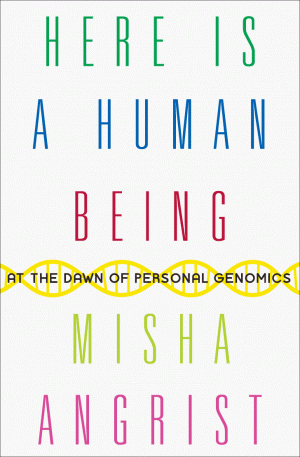
Misha Angrist is the tenth person to participate in the Personal Genome Project and is most recently the author of Here is a Human Being.
Listen: Play in new window | Download (Running Time: 51:13 — 46.9MB)
Condition of Mr. Segundo: Wondering how sequencing relates to funking people up.
Author: Misha Angrist
Subjects Discussed: Mapping your own neuroses vs. mapping your own genomes, attempts to interview James Watson, being more interesting than a palm tree, the awful nature of science books, Annie Murphy Paul, the book as deterministic, requiring a therapist, sending one’s spit to 23andme, genetic companies and infringement upon genetic patents, Myriad Genetics’s legal problems, the selling of the PGP, George Church’s relationship with the NIH, combating the institutional mindset, private companies funding personal genomics, whether the retail mindset is compatible with the progress of science, Facebook and grumpiness, the libidinous qualities of lipids, Google’s “Don’t be evil” mantra, the APOE status, James Watson and Steven Pinker, three card poker, the complaints of IT people, speculation on genes that determine dancing, Richard Powers’s “The Book of Me,” the sheer amount of information contained within genetic data, balancing curiosity and reticence about personal genomics, whether genomic information is useless and dangerous, response to warfarin and the genes which detect this response, Navigenics and carrying a card containing genetic data, Kirk Maxey and sperm donation, the evil side of humans, the Donor Sibling Registry, privacy concerns, insulin exhibits, Elliot P. Joslin, the societal good of understanding science, the diversity of the PGP subjects, race and perpetuating bad ideas about the underclass, a Head Start program for genetics, human genes and strawberries, volunteering at schools, and speculating on the implementation of a national genetics curriculum.
EXCERPT FROM SHOW:
Correspondent: What’s most curious about this book is that it seems to be very much about mapping your own neuroses as much as your own genome. It’s almost as if your quest to understand the implications of the PGP has led you to understand the implications of the implications of your own particular attitude. For instance, you write that you and your wife had a rough patch. There’s the point where you declare that Loudon Wainwright’s “Therapy” as your theme song, which was astonishing to me. You attempt to interview James Watson and you have this $83 paperback that you purchase, but you don’t actually get the interview. Which made me feel for you, I must say. And the sly suggestion here, I think, is that self-reflection may very well be just as important as understanding the genome. So what of this? Why did this strategy go into writing this book?
Angrist: Well, I think to call it a strategy is very generous of you. You know, I wanted it to be a first-person personal narrative that was going to be about personal genomics. I started graduate school in 1988. And I finished my postdoc in 1998, and went on to cover the biotech industry and market research in a fairly miserable job. And I should say that Ed’s Rants and Confessions of an Idiosyncratic Mind were great friends to me during those years in the desert.
Correspondent: Wow! You make us seem like we’re palm trees or something.
Angrist: (laughs) You’re a lot more interesting.
Correspondent: Than a palm tree?
Angrist: Yes.
Correspondent: But we’re talking about you.
Angrist: But you gave me succor.
Correspondent: We’re talking about you and your self-reflection. I only just met you now. I just want to be clear on this.
Angrist: Yes. But it doesn’t feel that way. To me, anyway. You may want to pretend that we never met. So then I got a job as a science editor and I continued to watch the field grow and change. And so I had many years of stuff that built up inside me that I felt I needed to say. So I think that’s one thing. Another thing is when I read George Church’s article in Scientific American in 2006, it was a real lightbulb moment. And I felt like here was a guy who was articulating things that I felt for a long time, but didn’t know I felt them. And so that sort of brought me clarity. And then finally — and I alluded to this a moment ago — so many science books that are intended for popular audiences are just awful. So many trees have given their lives so that people with the best intentions wind up writing cheerleading, didactic, anti-cheerleading…
Correspondent: Polemical. Let’s not forget that.
Angrist: I’m sorry?
Correspondent: Polemical books as well.
Angrist: Yes. Right. Screeds.
Correspondent: Rants.
Angrist: Yes, rants. I mean, those are just shameful.
Correspondent: Yeah, absolutely. Expatiations.
Angrist: (laughs) So I wanted a book that had real people in it.
Correspondent: And looking in the mirror, you saw a real person.
Angrist: Well, I saw something.
Correspondent: You saw someone who was worth sacrificing trees?
Angrist: I saw something that I knew something about. I was on a panel with Annie Murphy Paul. And someone asked her, “How did you make the decision to put yourself in your book?” And she said, “Well, I happen to have access to my own thoughts and feelings.”
Correspondent: Not always mapped on a genome.
Angrist: That’s right.
Correspondent: So you’re getting the stuff that isn’t mapped. And mapping that. That was the suggestion with my question.
Angrist: Well, I think people who glance at the book probably look at it or assume that it’s this deterministic thing. And I wanted to be very clear that that’s not where I was coming from. On the other hand, I’m not interested in making the case that it’s useless. I simply wanted to take a picture of where we are now and where we might be headed and what some of the contingencies are.
Correspondent: I’m wondering. To what degree does having access to your genomic data altered your notions of privacy? I mean, this is a very confessional book.
Angrist: Yes.
Correspondent: As I said, that’s kind of why I felt the need to give you a hug right before you sat down. Because I very much worried about you during the course of reading this book. I worried that you would slip further, the more you discovered about yourself through the genome. I’m curious if your neuroses deepened as you accessed more information. Similar to this dilemma of: Well, here we have all this genomic data and we can’t map it all. Because there’s just a shitload of it.
Angrist: Right. I would say that my neuroses had relatively little to do — I’m sorry. Let me rephrase that.
Correspondent: Little to do? I was going to call you on that. (laughs)
Angrist: I would say that my genome had relatively little to do with my psychic ups and downs. And my therapist at one point tried to gently make the case that the whole book was sort of an exercise in acting out and I don’t know.
Correspondent: You required a therapist to complete the book?
Angrist: Expiation. Uh, I required a therapist. Period. (laughs)
Correspondent: Okay. Did your genome require a therapist?
Angrist: Well, probably everyone’s does. But of course, everyone’s doesn’t. I mean, this is one of the things that, being among the first, is. You know, you sit down at a computer and you look at an Excel file full of broken genes. And you think, “You know, I should be dead fifty times over.” But of course that’s a reflection of how little we know and what a redundant system we are.
Correspondent: Well, I’m going to try and make things a little bit more pithy and important with my next question.
Listen: Play in new window | Download (Running Time: 51:13 — 46.9MB)
Great show.