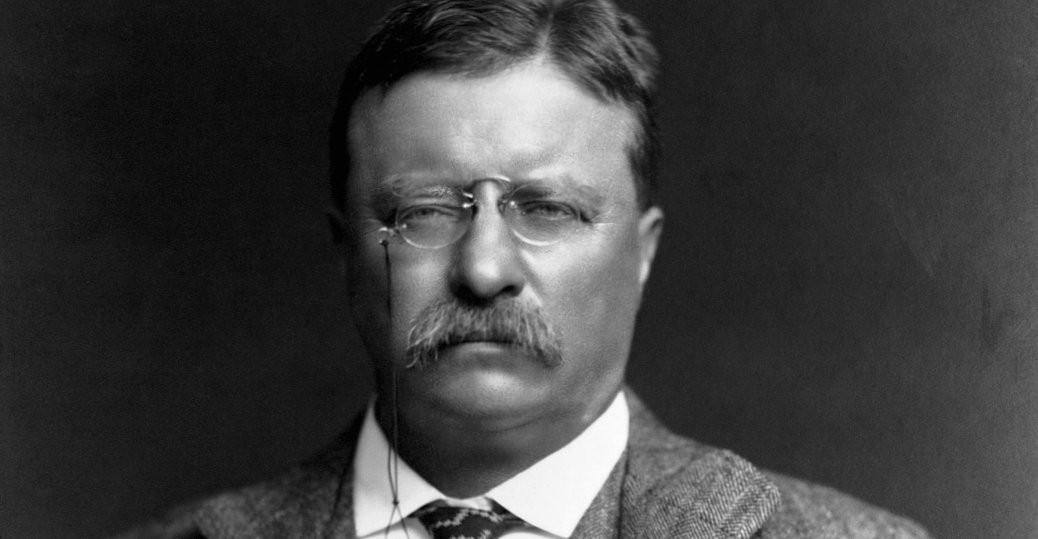
The Rise of Theodore Roosevelt (Modern Library Nonfiction #79)

(This is the twenty-second entry in The Modern Library Nonfiction Challenge, an ambitious project to read and write about the Modern Library Nonfiction books from #100 to #1. There is also The Modern Library Reading Challenge, a fiction-based counterpart to this list. Previous entry: Studies in Iconology.)
One of many blistering tangerines contained within Mark Twain’s juicy three volume Autobiography involves his observations on Theodore Roosevelt: “We have never had a President before who was destitute of self-respect and of respect for his high office; we have had no President before who was not a gentleman; we have had no President before who was intended for a butcher, a dive-keeper or a bully, and missed his mission of compulsion of circumstances over which he had no control.”

He could just as easily have been discussing the current doddering charlatan now forcing many otherwise respectable citizens into recuperative nights of heavy drinking and fussy hookups with a bespoke apocalyptic theme, but Twain’s sentiments do say quite a good deal about the cyclical American affinity for peculiar outsiders who resonate with a populist base. As I write these words, Bernie Sanders has just decided to enter the 2020 Presidential race, raising nearly $6 million in 24 hours and angering those who perceive his call for robust social democracy to be unrealistic, along with truth-telling comedians who are “sick of old white dudes.” Should Sanders run as an independent, the 2020 presidential race could very well be a replay of Roosevelt’s Bull Moose Party run in 1912.

Character ultimately distinguishes a Chauncey Gardner couch potato from an outlier who makes tangible waves. And it is nearly impossible to argue that Teddy Roosevelt, while bombastic in his prose, often ridiculous in his obsessions, and pretty damn nuts when it came to the Rough Riders business in Cuba, did not possess it. Edmund Morris’s incredibly compelling biography, while subtly acknowledging Teddy’s often feral and contradictory impulses, suggests that Roosevelt was not only the man that America wanted and perhaps needed, but reminds us that Roosevelt also had the good fortune of being in the right place at the right time. Had not Vice President Garret Hobart dropped dead because of a bum ticker on November 21, 1899, and had not a sour New York Republican boss named Tom Platt been so eager to run Teddy out of Albany, there is a good chance that Roosevelt might have ended up as a serviceable two-term Governor of New York, perhaps a brasher form of Nelson Rockefeller or an Eliot Spitzer who knew how to control his zipper. Had not a Russian anarchist plugged President McKinnley two times in the chest at the Temple of Music, it is quite possible that Roosevelt’s innovative trust busting and his work on food safety and national parks, to say nothing of his crazed obsession with military might and giving the United States a new role as international police force, would have been delayed altogether.

What Roosevelt had, aside from remarkable luck, was a relentless energy which often exhausts the 21st century reader nearly as much as it fatigued those surrounding Teddy’s orbit. Here is a daily timetable of Teddy’s activities when he was running for Vice President, which Morris quotes late in the book:

7:00 A.M. Breakfast 
7:30 A.M. A speech
8:00 A.M. Reading a historical work
9:00 A.M. A speech
10:00 A.M.  Dictating letters
11:00 A.M. Discussing Montana mines
11:30 A.M. A speech
12:00 Reading an ornithological work
12:30 P.M. A speech
1:00 P.M. Lunch
1:30 P.M. A speech
2:30 P.M. Reading Sir Walter Scott
3:00 P.M. Answering telegrams
3:45 P.M. A speech
4:00 P.M. Meeting the press
4:30 P.M. Reading
5:00 P.M. A speech
6:00 P.M. Reading
7:00 P.M. Supper
8-10 P.M. Speaking
11:00 P.M. Reading alone in his car
12:00 To bed

That Roosevelt was able to do so much in an epoch before instant messages, social media, vast armies of personal assistants, and Outlook reminders says a great deal about how he ascended so rapidly to great heights. He could dictate an entire book in three months, while also spending his days climbing mountains and riding dozens of miles on horseback (much to the chagrin of his exhausted colts). Morris suggests that much of this energy was forged from the asthma he suffered as a child. Standing initially in the shadow of his younger brother Elliott (whose later mental collapse he callously attempted to cover up to preserve his reputation), Teddy spent nearly his entire life doing, perhaps sharing Steve Jobs’s “reality distortion field” in the wholesale denial of his limitations:

In between rows and rides, Theodore would burn off his excess energy by running at speed through the woods, boxing and wrestling with Elliott, hiking, hunting, and swimming. His diary constantly exults in physical achievement, and never betrays fear that he might be overtaxing his strength. When forced to record an attack of cholera morbus in early August, he precedes it with the phrase, “Funnily enough….”

Morris is thankfully sparing about whether such superhuman energy (which some psychological experts have suggested to be the result of undiagnosed bipolar disorder) constitutes genius, only reserving the word for Roosevelt in relation to his incredible knack for maintaining relations with the press — seen most prominently in his fulsome campaign speeches and the way that he courted journalistic reformer Jacob Riis during his days as New York Police Commissioner and invited Riis to accompany him on his nighttime sweeps through various beats, where Roosevelt micromanaged slumbering cops and any other layabout he could find. The more fascinating question is how such an exuberant young autodidact, a voracious reader with preternatural recall eagerly conducting dissections around the house when not running and rowing his way with ailing lungs, came to become involved in American politics.

Some of this had to do with his hypergraphia, his need to inhabit the world, his indefatigable drive to do everything and anything. Some of it had to do with deciding to attend Columbia Law School so he could forge a professional career with his new wife Alice Hathaway Lee, who had quite the appetite for social functions (and whose inner life, sadly, is only superficially examined in Morris’s book). But much of it had to do with Roosevelt regularly attending Morton Hall, the Republican headquarters for his local district. Despite being heckled for his unusual threads and side-whiskers, Roosevelt kept showing up until he was accepted as a member. The Roosevelt family disapproved. Teddy reacted in anger. And from moment forward, Morris writes, Roosevelt desired political power for the rest of his life. Part of this had to do with the need for family revenge. Theodore Roosevelt, Sr. suffered a swift decline in health (and quickly died) after Roscoe Conklin and New York State Republicans set out to ruin him over a customs collector position.

These early seeds of payback and uncompromising individualism grew Roosevelt into a fiery oleander who garnered a rep as a fierce and feisty New York State Assemblyman: the volcanic fuel source that was to sustain him until mortality and dowdiness sadly caught up with him during the First World War. But Roosevelt, like Lyndon B. Johnson later with the Civil Rights Act (documented in an incredibly gripping chapter in Robert A. Caro’s Master of the Senate), did have a masterful way of persuading people to side with him, often through his energy and speeches rather than creepy lapel-grabbing. As New York Police Commissioner, Roosevelt upheld the unpopular blue laws and, for a time, managed to get both the grumbling bibulous public and the irascible tavern keepers on his side. Still, Roosevelt’s pugnacity and tenacity were probably more indicative of the manner in which he fought his battles. He took advantage of any political opportunity — such as making vital decisions while serving as Acting Secretary of the Navy without consulting his superior John Davis Long. But he did have a sense of honor, seen in his refusal to take out his enemy Andrew D. Parker when given a scandalous lead during a bitter battle in New York City (the episode was helpfully documented by Riis) and, as New York State Assemblyman, voting with Democrats on March 7, 1883 to veto the Five-Cent Bill when it was discovered to be unconstitutional by then Governor Grover Cleveland. Perhaps his often impulsive instincts, punctuated by an ability to consider the consequences of any action as it was being carried out, is what made him, at times, a remarkable leader. Morris documents one episode during Roosevelt’s stint as Assistant Secretary of the Navy in which he was trying to build up an American navy and swiftly snapped up a Brazilian vessel without a letter. When the contract was drafted for the ship, dealer Charles R. Flint noted, “It was one of the most concise and at the same time one of the cleverest contracts I have ever seen.”

Morris is to be praised for writing about such a rambunctious figure with class, care, and panache. Seriously, this dude doesn’t get enough props for busting out all the biographical stops. If you want to know more about Theodore Roosevelt, Morris’s trilogy is definitely the one you should read. Even so, there are a few moments in this biography in which Morris veers modestly into extremes that strain his otherwise eloquent fairness. He quotes from “a modern historian” who asks, “Who in office was more radical in 1899?” One zips to the endnotes, only to find that the “historian” in question was none other than the partisan John Allen Gable, who was once considered to be the foremost authority on Teddy Roosevelt. Morris also observes that “ninety-nine percent of the millions of words he thus poured out are sterile, banal, and so droningly repetitive as to defeat the most dedicated researcher,” and while one opens a bountiful heart to the historian prepared to sift through the collected works of a possible madman, the juicy bits that Morris quotes are entertaining and compelling. Also, to be fair, a man driven to dictate a book-length historical biography in a month is going to have some litters in the bunch.

But these are extremely modest complaints for an otherwise magnificent biography. Edmund Morris writes with a nimble focus. His research is detailed, rigorous, and always on point, and he has a clear enthusiasm for his subject. Much of Morris’s fall from grace has to do with the regrettable volume, Dutch, in which Morris abandoned his exacting acumen and inserted a version of himself in a biography of Reagan. This feckless boundary-pushing even extended into the endnotes, in which one Morris inserted references to imaginary people. He completely overlooked vital periods in Reagan’s life and political career, such as the Robert Bork episode. Given the $3 million advance and the unfettered access that Morris had to Reagan, there was little excuse for this. Yet despite returning valiantly to Roosevelt in two subsequent volumes (without the weirdass fictitious asides), Morris has been given the Wittgenstein treatment (“That whereof we cannot speak, thereof we must remain silent”) by his peers and his colleagues. And I don’t understand why. Morris, much like Kristen Roupenian quite recently, seems to have been needlessly punished for being successful and not living up to a ridiculous set of expectations. But The Rise of Theodore Roosevelt, which rightfully earned the Pulitzer Prize, makes the case on its own merits that Morris is worthy of our time, our consideration, and our forgiveness and that the great Theodore Roosevelt himself is still a worthwhile figure for contemporary study.

Next Up: Martin Luther King’s Why We Can’t Wait!
Studies in Iconology (Modern Library Nonfiction #80)

(This is the twenty-first entry in The Modern Library Nonfiction Challenge, an ambitious project to read and write about the Modern Library Nonfiction books from #100 to #1. There is also The Modern Library Reading Challenge, a fiction-based counterpart to this list. Previous entry: The Face of Battle.)

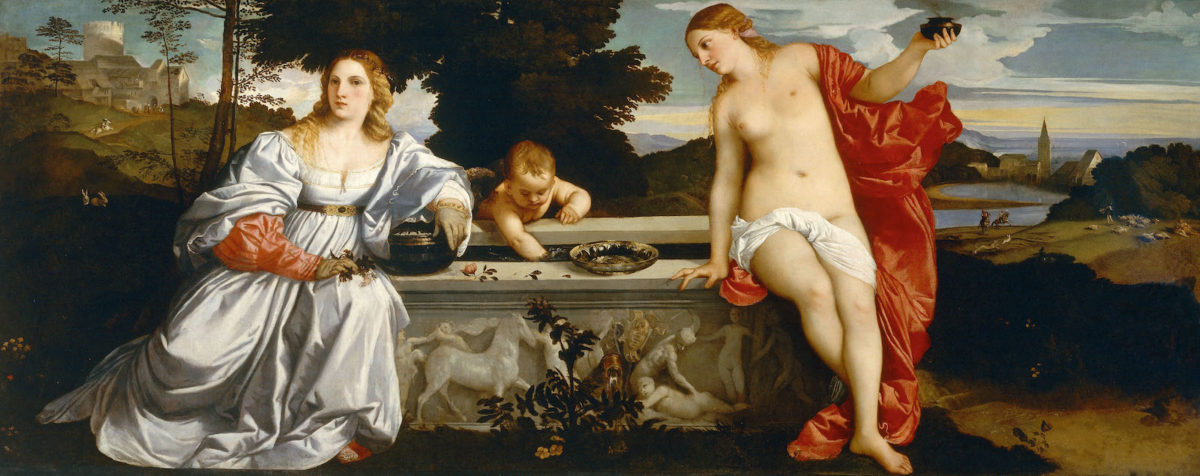
Titian’s Sacred and Profane Love (pictured above) is one of my favorite paintings of the 16th century, in large part because its unquestionable beauty is matched by its bountiful and alluring enigma. We see two versions of love at opposing ends of a fountain — one nearly naked without apology, but still partially clad in a windswept dark salmon pink robe and holding an urn of smoke as she languorously (and rebelliously?) leans on the edge of a fountain; meanwhile the other Love sits in a flowing white gown on the other end, decidedly more dignified, with concealed legs that are somehow stronger and more illustrious than her counterpart, and disguising a bowl that, much like the Kiss Me Deadly box or the Pulp Fiction suitcase, could contain anything.

We know that the Two Loves are meant to coexist because Titian is sly enough to imbue his masterpiece with a sartorial yin-yang. Profane Love matches Sacred with a coiled white cloth twisting around her waist and slipping down her left leg, while Sacred has been tinctured by Profane’s pink with the flowing sleeve on her right arm and the small slipper on her left foot. Meanwhile, Cupid serves as an oblivious and possibly mercenary middleman, his arm and his eyes deeply immersed in the water and seemingly unconcerned with the Two Loves. We see that the backdrops behind both Loves are promisingly bucolic, with happy rabbits suggesting prolific promiscuity and studly horsemen riding their steeds with forelegs in the air, undoubtedly presaging the stertorous activity to commence sometime around the third date.

Sacred’s backdrop involves a castle situated on higher ground, whereas Profane’s is a wider valley with a village, a tableau that gives one more freedom to roam. The equine motif carries further on Sacred’s side with a horse prancing from Sacred to Profane in the marble etching just in front of the fountain, while Profane’s side features equally ripe rapacity, a near Fifty Shades of Grey moment where a muscled Adonis lusts over a plump bottom, hopefully with consensual limits and safewords agreed upon in advance. Titian’s telling takeaway is that you have to accept both the sublime and the salacious when you’re in love: the noble respect and vibrant valor that you unfurl upon your better half with such gestures as smoothing a strand of hair from the face along with the ribald hunger for someone who is simultaneously desirable and who could very well inspire you to stock up on entirely unanticipated items that produce rather pleasurable vibrations.

There are few works of art that are so dedicated to such a dichotomous depiction of something we all long for. And Titian’s painting endures five centuries later because this Italian master was so committed to minute details that, rather incredibly, remain quite universal about the human condition.

But what the hell does it all mean? We can peer into the canvas for hours, becoming intoxicated by Titian’s fascinating ambiguities. But might there be more helpful semiotics to better grasp what’s going on? Until I read Panofsky’s Studies in Iconology, I truly had no clue that Titian had been influenced by Bembo’s Asolani or that the Two Loves were a riff on Cesare Ripa’s notion of Eternal Bliss and Transient Bliss, which was one of many efforts by the Neoplatonic movement to wrestle with a human state that occupied two modes of shared existence. Panofsky also helpfully points out that Cupid’s stirring of the fountain water was a representation of love as “a principle of cosmic ‘mixture,’ act[ing] as an intermediary between heaven and earth” and that the fountain can also be looked upon as a revived sarcophagus, meaning that we are also looking at life and love springing from a coffin. And this history added an additional context for me to expand my own quasi-smartypants, recklessly dilletantish, and exuberantly instinctive appreciation of Titian. In investigating iconology, I recalled my 2016 journey into The Golden Bough (ML NF #90), in which Frazer helpfully pointed to the symbolic commonality of myths and rituals throughout multiple cultures and across human history, and, as I examined how various symbolic figures morphed over time, I became quite obsessed with Father Time’s many likenesses (quite usefully unpacked by Waggish‘s David Auerbach).

Any art history student inevitably brushes up against the wise and influential yet somewhat convoluted views of Erwin Panofsky. Depending upon the degree to which the prof resembles Joseph Mengele in his teaching style, there is usually a pedagogical hazing in which the student is presented with “iconology” and “iconography.” The student winces at both words, nearly similar in look and sound, and wonders if the distinction might be better understood after several bong hits and unwise dives into late night snacks, followed by desperate texts to fellow young scholars that usually culminate in more debauchery which strays from understanding the text. Well, I’m going to do my best to explicate the difference right now.

The best way to nail down what iconography entails is to think of a painting purely in terms of its visuals and what each of these elements means. Some obvious examples of iconography in action is the considerable classroom time devoted to interpreting the green light at the end of The Great Gatsby or the endless possibilities contained within the Mona Lisa‘s smile. It is, in short, being that vociferous museum enthusiast pointing at bowls and halos buried in oil and doing his best to impress with his alternately entertaining and infuriating interpretations. All this is, of course, fair game. But Panofsky is calling for us to think bigger and do better.

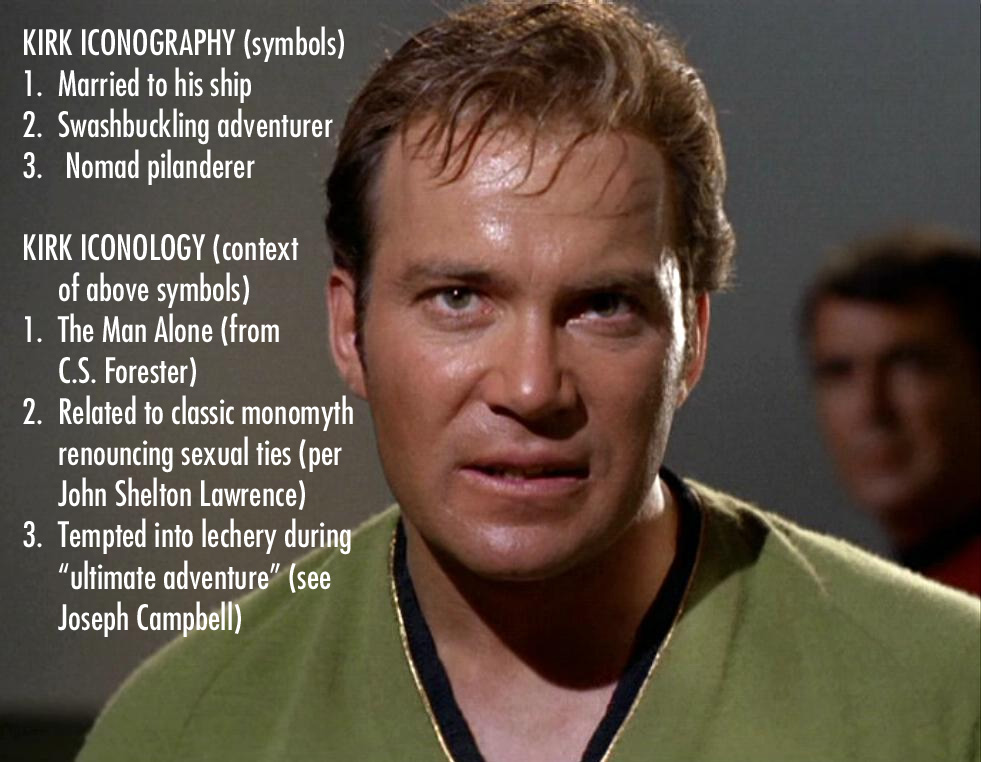
Enter iconology, which is more specifically concerned with the context of this symbolism and the precise technical circumstances and historical influences that created it. Let me illustrate the differences between iconography and iconology using Captain James T. Kirk from Star Trek.

Here are the details everyone knows about Kirk. He is married to his ship. He is a swashbuckling adventurer who gets into numerous fights and is frequently seen in a torn shirt. He is also a nomadic philanderer, known to swipe right and hookup with nearly every alien he encounters. (In the episode “Wink of an Eye,” there is a moment that somehow avoided the censors in which Kirk was seen putting on his boots while Deela brushes her hair.) This is the iconography of Kirk that everyone recognizes.

But when we begin to examine the origins of these underlying iconographic qualities, we begin to see that there is a great deal more than a role popularized by William Shatner through booming vocal delivery, spastic gestures, and an unusual Canadian hubris. When Gene Roddenberry created Star Trek, he perceived Captain Kirk as “Horatio Hornblower in Space.” We know that C.S. Forester, author of the Hornblower novels, was inspired by Admiral Lord Nelson and a number of heroic British authors who fought during the Napoleonic Wars. According to Bryan Perrett’s The Real Hornblower, Forester read three volumes of The Naval Chronicle over and over. But Forester eventually hit upon a trope that he identified as the Man Alone — a solitary individual who relies exclusively on his own resources to solve problems and who carries out his swashbuckling, but who is wedded to this predicament.

Perhaps because the free love movement of the 1960s made the expression of sexuality more open, Captain Kirk was both a Man Alone and a prolific philanderer. But Kirk was fundamentally married to his ship, the Enterprise. In an essay collected in Star Trek as Myth, John Shelton Lawrence ties this all into a classic American monomyth, suggesting that Kirk also represented

…sexual renunciation, a norm that reflects some distinctly religious aversions to intimacy. The protagonist in some mythical sagas must renounce previous sexual ties for the sake of their trials. They must avoid entanglements and temptations that inevitably arise from satyrs, sirens, or Loreleis in the course of their travels…The protagonist may encounter sexual temptation symbolizing ‘that pushing, self-protective, malodorous, carnivorous, lecherous fever which is the very nature of the organic cell,’ as Campbell points out. Yet the ‘ultimate adventure’ is the ‘mystical marriage…of the triumphant hero-soul with the Queen Goddess” of knowledge.

All of a sudden, Captain Kirk has become a lot more interesting! And moments such as Kirk eating the apple in Star Trek II: The Wrath of Khan suddenly make more sense beyond the belabored Project Genesis metaphor. We now see how Roddenberry’s idea of a nomad philanderer and Forester’s notion of the Man Alone actually takes us to a common theme of marriage with the Queen Goddess of the World. One could very well dive into the Kirk/Hornblower archetype at length. But thanks to iconology, we now have enough information here to launch a thoughtful discussion — ideally with each of the participants offering vivacious impersonations of William Shatner — with the assembled brainiacs discussing why the “ultimate adventure” continues to crop up in various cultures and how Star Trek itself was a prominent popularizer of this idea.

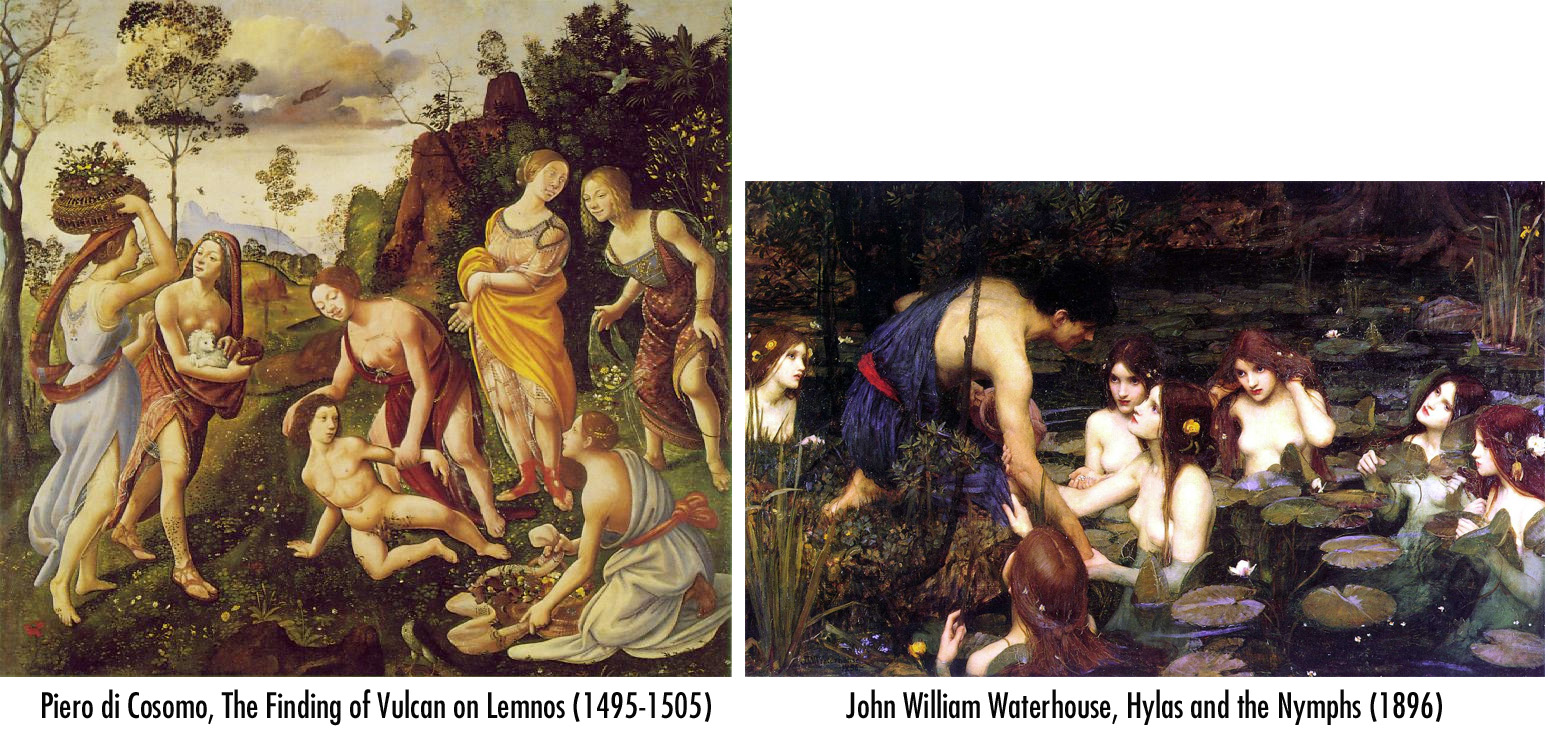
Now that we know what iconology is, we can use it — much as Panofsky does in Studies in Iconology — to understand why Piero di Cosimo was wilder and more imaginative than many of his peers. (And for more on this neglected painter, who was so original that he even inspired a poem from Auden, I recommend Peter Schjeldahl’s 2015 New Yorker essay.) Panofsky points out how Piero’s The Finding of Vulcan on Lemnos (pictured above) differs in the way that it portrays the Hylas myth, whereby Hylas went down to the river Ascunius to fetch some water and was ensnared by the naiads who fell in love with his beauty. (I’ve juxtaposed John William Waterhouse’s Hylas and the Nymphs with Piero so that you can see the differences. For my money, Piero edges out Waterhouse’s blunter version of the tale. But I also chose the Waterhouse painting to protest the Manchester Art Gallery’s passive-aggressive censorship from last year. You can click on the above image to see a larger version of both paintings.) For one thing, Piero’s painting features no vase or vessel. There is also no water or river. The naiads are not seductive charmers at all, but more in the Mean Girls camp. And Hylas himself is quite helpless. (The naiad patting Hylas on the head is almost condescending, which adds a macabre wit to this landlocked riff.) Piero is almost the #metoo version of Hylas to Waterhouse’s more straightforward patriarchal approach. And it’s largely because not only did Piero have a beautifully warped imagination, but he was relying, like many Renaissance painters, upon post-classical commentaries rather than the direct source of the myths themselves. And we are able to see how a slight shift in an artist’s inspiration can produce a sui generis work of art.

Panofsky is on less firm footing when he attempts to apply iconology to sculptures and architecture. His attempts to ramrod Michelangelo into the Neoplatonic school were unpersuasive to me. In analyzing the rough outlines of a monkey just behind two of Michelangelo’s Slaves (the “dying” and the “rebellious” ones) in the Louvre, Panofsky rather simplistically ropes the two slaves into a subhuman class and then attempts to suggest that Ficino’s concept of the Lower Soul — which is a quite sophisticated concept — represents the interpretive smoking gun. This demonstrates the double-edged sword of iconology. It may provide you a highly specific framework for which to reconsider a great work of art, but it can be just as clumsily mistaken for the absolute truth as any lumbering ideology.

Then again, unless you’re an insufferable narcissist who needs to be constantly reminded how “right” you are, it’s never any fun to discuss art and ideas with people who you completely agree with. Panofsky’s impact on art analysis reminds us that iconology is one method of identifying the nitty-gritty and arguing about it profusely and jocularly for hours, if not decades or centuries.

Next Up: Edmund Morris’s The Rise of Theodore Roosevelt!

The Face of Battle (Modern Library Nonfiction #81)

(This is the twentieth entry in The Modern Library Nonfiction Challenge, an ambitious project to read and write about the Modern Library Nonfiction books from #100 to #1. There is also The Modern Library Reading Challenge, a fiction-based counterpart to this list. Previous entry: The Strange Death of Liberal England.)

Thy fanes, thy temples to the surface bow,
Commingling slowly with heroic earth,
Broke by the share of every rustic plough:
So perish monuments of mortal birth,
So perish all in turn, save well-recorded worth;

— Lord Byron, Child Harolde’s Pilgrimage

I must confess from the outset that the study of armed human conflict, with its near Spartan fixation on tactics and statistics, has long filled me with malaise. It is among the least sexiest subjects that a polymath of any type can devote her attentions to, akin to cracking open a thick, limb-crushing tax code volume written in a way that obliterates all joy and finding a deranged pleasure within this mind-numbingly dull amalgam of numbers and turgid prose. As Margaret Atwood once quipped in a poem, the military historian says, ā€œI don’t ask why, because it is mostly the same.ā€ And when the song remains the same, why would anyone other than a ketamine fiend dance to it?

I’ve long pictured the military historian as some aging jingoistic white male whose idea of a good time involves blasting John Philip Sousa from a set of speakers that should be devoted to happening hip-hop: a lonely and humorless parasite who moves cast-iron figures across a threadbare map in some dusty basement, possibly talking to himself in a gruff tone that uncannily mimics Rod Steiger’s inebriated cadences. He seems overly enamored of the dry details of ordnance, mirthless arrows, and terrain circles. Perhaps he fritters away his time in some homebuilt shack far off the main artery of Interstate 76, ready to reproduce well-studied holes with his Smith & Wesson should any nagging progressive come to take away his tattered Confederate flag or any other paleolithic memorabilia that rattles his martial disposition. But let’s say that such a man is committed to peace. Then you’re left with his soporific drone as he dodders on about some long dead general’s left flank attack in the most unpalatable ramble imaginable. He prioritizes a detached tabulative breakdown over the more palpable and poignant truths that motivates men. He doesn’t seem to care about how a soldier experiences trauma or summons bravery in impossible conditions, or how these battles permanently alter nations and lives. The military historian is, in Napoleonic short, a buzz killer despite his buzz cut. Indeed, military history is so embarrassing to read and advocate that, only a few weeks ago, I was forced to hide what I was reading when a woman started flirting with me at a bar. (I sheepishly avoided revealing the title to her for fifteen minutes. Nevertheless, she persisted. And upon seeing The Face of Battle, the woman in question rightfully headed for the hills, even after I offered to buy her a drink.)

There are quite a few military history books on the Modern Library list. So I’m more or less fucked. It is not that war itself does not interest me. Human beings have been fighting each other since the beginning of time and only a soulless anti-intellectual fool resolutely committed to the vulgar act of amusing himself to death would fail to feel anything pertaining to this flaw in the human makeup. The podcaster Dan Carlin, who specializes in military history, is one of the few people who I can listen to in this medium for many hours and remain completely enthralled. But that is only because Carlin is incredibly skilled at showing how the paradigm shifts of war influence our everyday lives. Christopher Nolan’s Dunkirk was a remarkable film that hurled its audience into the dizzying depths of war, but this is merely a vicarious sensory experience. I can get behind Paul Fussell’s The Great War and Modern Memory (ML NF #75) because of that book’s cogent observations on how war influenced literary culture. Neil Sheehan’s A Bright Shining Lie (ML NF #84) remains a journalistic masterpiece that I very much admire — in large part because of its razor-sharp commitment to human psychology, which in turn allows us to understand the miasmic madness of making tactical decisions (see that book’s incredible “Battle of Ap Bac” chapter). But I’d hesitate to categorize either of these two brilliant volumes within the exacting genre of unadulterated military history. I’ve always had the sense that there’s an underlying bellicosity, if not an outright advocacy of warfare, with books that are exclusively dolled up in camo.

So upon reading The Face of Battle, it was something of a relief to see that John Keegan was up front from the get-go about what military history fails to do, and why accounts of battles are so problematic. He begins the book saying that he has never seen or been in a battle. And this is a hell of a way to open up a book that professes to give us the lowdown on what war is all about. It is a genuinely humble statement from someone who has made a career out of being an expert. He openly points to military history’s major weakness: “the failure to demonstrate connection between thought and action.” “What of feeling?” I thought as I read this sentence. According to Keegan, historians need to keep their emotions on a leash. And the technical example he cites — the British Official History of the First World War — is an uninspiring passage indeed. So what is the historian to do? Quote from the letters of soldiers. But then Keegan writes, “The almost universal illiteracy, however, of the common soldier of any country before the nineteenth makes it a technique difficult to employ.” Ugh. Keegan!

From Ilya Berkovich’s Motivation in War: The Experience of Common Soldiers in Old-Regime Europe:

Considering the social origins of most eighteenth-century soldiers, one might think that literate soldiers were uncommon. However, literacy among the lower classes in old-regime Europe was becoming less exceptional. It is estimated that up to 40 per cent of the labouring poor in Britain were literate. Between 1600 and 1790, the portion of French bridegrooms singing their parish records doubled to about half of the total male population. Interestingly, the corresponding figures in northern and eastern frontier regions, which provided most French recruits, were much higher, with some areas coming close to universal literacy. Literacy rates in the Holy Roman Empire fluctuated widely, yet it is telling that over 40 per cent of the day labourers in mid-century Coblenz were able to sign their names. In rural East Prussia, one of the poorest regions in Germany, comparable figures were reached in 1800, although this was still a fourfold increase compared to only half-a-century before….

And so on. Fascinating possibilities for scholarship! It seems to me that someone here did not want to roll up his sleeves and get his hands dirty.

You see the problems I was having with this book. On one hand, Keegan wants to rail against the limitations of military history (and he should! you go, girl!). On the other hand, he upholds the very rigid ideas that stand against the execution of military history in a satisfying, fact-based, and reasonably emotional way that allows voluble chowderheads like me an entry point.

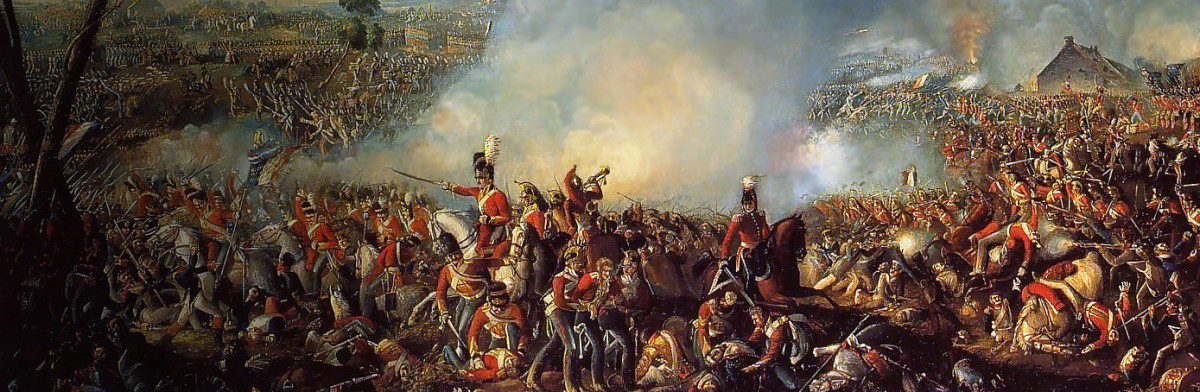
But that’s not the main focus of this book. Keegan settles upon three separate events — the Battle of Agincourt on October 25, 1415, the Battle of Waterloo on June 18, 1815, and the first day of battle on the Somme (July 1, 1916) — to seek comparisons, commonalities, and various parallels that we might use to understand military mechanics. He is duly reportorial in each instance, but overly fond of taxonomy rather than tangibility. Still, there are moments when Keegan’s bureaucratic obsessiveness are actually interesting — such as his examination of British archers and infantry running up against French cavalry during Agincourt. After all, if a horse is charging its way into a man, either the horse is going to run away, men are going to be knocked down, or there’s going to be a “ripple effect” causing open pockets on each side of the horse. So it’s actually quite extraordinary to consider how the French got their asses kicked with such a clear advantage. Well, the British did this with stakes, which impaled the horses. And the threat of this obstacle caused the French to retreat with their backs to the British, resulting in archers lobbing arrows into their vertebrae.

Keegan informs us that “the force of unavoidable circumstances” sealed the fate of the French and allowed Henry V to win at Agincourt. When Keegan gets to Waterloo, we see a similar approach adopted by Napoleon near the end. Large crowds of French infantry rushed towards the British line, landing within mere yards. The two armies exchanged fire and the French, at a loss of what to do, turned around and fled. This was not an altogether smart strategy, given the depleting reserves that Napoleon had at his disposal. But it does eloquently demonstrate that battles tend to crumble once one side has entered an unavoidable choice. The rush of men on both sides at the Somme in 1916, of course, in the trenches not only escalated this to an unprecedented scale of atrocity, but essentially laid down the flagstones for the 20th century’s practice of mutually assured destruction.

These are vital ideas to understand. Still, I’m not going to lie. Keegan was, in many ways, dull and soporific — even for a patient reader like me. I learned more about Henry V’s campaign by reading Juliet Barker’s excellent volume Agincourt, which not only unpacked the incredible logistics of invading northwestern France with engrossing aplomb but also juxtaposed this campaign against history and many vital realities about 15th century life. And a deep dive into various World War I volumes (I especially recommend Richard Aldington’s surprisingly ribald novel, Death of a Hero) unveiled a lot of unanticipated sonic transcriptions that inspired me to draft an audio drama script that I hope to produce in a few years. Keegan is certainly helpful in a dry intellectual manner — the equivalent of being served a dull dish of desiccated biscuits when you haven’t eaten anything for days; I mean, there’s a certain point in which you’ll gorge on anything — but he’s not the man who inspired me about battle. Hell, when one of the most boring and pretentious New Yorker contributors of all time espouses Keegan’s “matchlessly vivid pen,” you know there’s a reason to hide beneath your blanket. Keegan is undoubtedly on this list because nobody before him had quite unpacked war from the bottom-up approach rather than the general’s top-down viewpoint. But like most military historians, he didn’t have enough of a heart for my tastes. There’s a way to present a detailed fact-driven truth without being such a detached fussbucket about it. And we shall explore and exuberantly praise such virtuosic historians in future Modern Library installments!

Next Up: Erwin Panofsky’s Studies in Iconology!

The Strange Death of Liberal England (Modern Library Nonfiction #82)

(This is the nineteenth entry in The Modern Library Nonfiction Challenge, an ambitious project to read and write about the Modern Library Nonfiction books from #100 to #1. There is also The Modern Library Reading Challenge, a fiction-based counterpart to this list. Previous entry: Vermeer.)

It was a picnic-perfect summer in 1914. The rich flaunted their wealth with all the subtlety of rats leaping onto a pristine wedding dress. The newspapers steered their coverage away from serious events to pursue lurid items about sports and celebrity gossip. A comic double act by the name of Collins & Harlan recorded an absurd ditty called “Aba Daba Honeymoon,” which Thomas Pynchon was to describe fifty years later as “the nadir of all American expression.” Few human souls twirling their canes and parasols in these conditions of unbridled frivolity could have anticipated that an archduke’s assassination in late June would plunge Europe into a gruesome war that would leave twenty million dead, permanently altering notions of honor, bloodshed, and noblesse oblige.

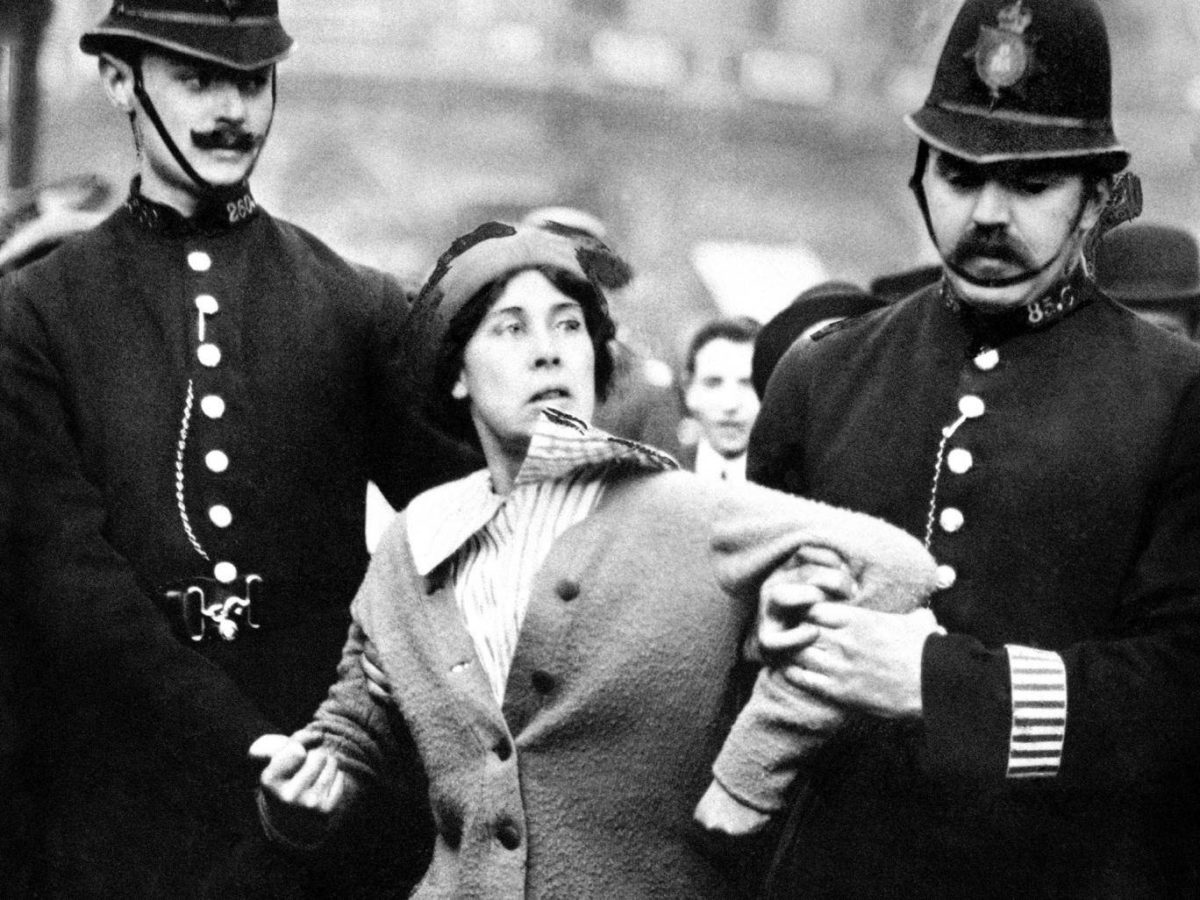
But even a few years before the July Crisis, there were strong signs in England that something was amiss. Politicians demonstrated a cataclysmic failure to read or address the natural trajectory of human progress. Women justly demanded the right to vote and were very willing to starve themselves in prison and burn down many buildings for it. Workers fought violently for fair wages, often locked into stalemates with greedy mining companies. They were intoxicated by a new militant brand of syndicalism from France then popularized by Georges Sorel. The atmosphere was one of increasing upheaval and escalated incoherence, even among the most noble-minded revolutionaries. The influx of gold from Africa inspired both lavish spending and an inflated currency. The liberals in power were supposed to stand up for the working stiffs who couldn’t quite meet the rising prices for boots and food and clothes with their take home pay. And much like today’s Democratic Party in the States, these tepid Parliamentary wafflers past their Fabian prime revealed a commitment to ineptitude over nuts-and-bolts pragmatism. They allowed the Tories to play them like rubes losing easy games of three-card monte. Amidst such madness, England became a place of oblivious tension not dissimilar to the nonstop nonsense that currently plagues both sides of the Atlantic. With the middle and upper classes keeping their heads in the clouds and their spirits saturated in moonbeam dreams and a bubble gum aura, is it any wonder that people were willing to incite war and violence for the most impulsive reasons?

George Dangerfield’s The Strange Death of Liberal England examines this crazed period between 1910 and 1914 with an exacting and quite entertaining poetic eye. Dangerfield, an erudite journalist who parlayed his zingy word-slinging into a teaching career, is somewhat neglected today, but his remarkable knack for knowing when to suggest and when to stick with the facts is worthy of careful study, a summation of the beautifully mordant touch he brought as a historian. He describes, for example, the “dismal, rattling sound” of Liberalism refusing to adjust to the times, and eloquently sends up the out-of-touch movement in a manner that might also apply to today’s neoliberals, who stubbornly refuse to consider the lives and needs of the working class even as they profess to know what’s best for them:

[I]t was just as if some unfortunate miracle had been performed upon its contents, turning them into nothing more than bits of old iron, fragments of intimate crockery, and other relics of a domestic past. What could be the matter? Liberalism was still embodied in a large political party; it enjoyed the support of philosophy and religion; it was intelligible, and it was English. But it was also slow; and it so far transcended politics and economics as to impose itself upon behaviour as well. For a nation which wanted to revive a sluggish blood by running very fast and in any direction, Liberalism was clearly an inconvenient burden.

Dangerfield knew when to let other people hang themselves by their own words. The infamous Margot Asquith, the starry-eyed socialite married to the Prime Minister who led England into World War I, is quoted at length from her letters to Robert Smillie, the brave union organizer who fought on behalf of the Miners’ Federation of Great Britain. Asquith, so fundamentally clueless about diplomacy, could not understand why meeting Smillie might be a bad idea given the tense negotiations.

I did feel that Dangerfield was unduly harsh on Sylvia Pankhurst, one of the key organizers behind the suffragette movement. His wry fixation upon Pankhurst’s indomitable commitment — what he styles “the fantastic Eden of militant exaltation” — to starvation and brutality from the police, all in the brave and honorable fight for women, may very well be a product of the 1930s boys’ club mentality, but it seems slightly cheap given how otherwise astute Dangerfield is in heightening just the right personality flaws among other key figures of the time. The Pankhurst family was certainly eccentric, but surely they were deserving of more than just cheap quips, such as the volley Dangerfield lobs as Christabel announces the Pankhurst withdrawal from the WSPU (“She made this long-expected remark quite casually — she might almost have been talking to the little Pomeranian dog which she was nursing.”).

Still, Dangerfield was the master of the interregnum history. His later volume, The Era of Good Feelings, examined the period between Jefferson and Jackson and is almost as good as The Strange Death. One reads the book and sees the model for Christopher Hitchens’s biting erudite style. (The book was a favorite of Hitch’s and frequently cited in his essays.)

But it is clear that Dangerfield’s heart and his mischievous vivacity resided with his homeland rather than the nation he emigrated to later in life. In all of his work, especially the material dwelling on the United Kingdom, Dangerfield knew precisely what years to hit, the pivotal moments that encapsulated specific actions that triggered political movements. As he chronicles the repercussions of the June 14, 1911 strike in Southampton, he is careful to remark upon how “it is impossible not to be surprised at the little physical violence that was done — only a few men killed, in Wales in 1912, and two or three in Dublin in 1913; in England itself not a death. Is this the effect of revolutionary methods, and, if so, do the methods deserve the word?” He then carries on speculating about the pros and cons of peaceful revolution and ties this into the “spiritual death and rebirth” of English character. And we see that Dangerfield isn’t just a smartypants funnyman, but a subtle philosopher who leaves human possibilities open to the reader. He is a welcome reminder that seeing the real doesn’t necessarily emerge when you lock eyes on an alluring Twitch stream or a hypnotic Instagram feed. It comes when you take the time to step away, to focus on the events that are truly important, and to ruminate upon the incredible progress that human beings still remain quite capable of making.

Next Up: John Keegan’s The Face of Battle!

Vermeer (Modern Library Nonfiction #83)

(This is the eighteenth entry in The Modern Library Nonfiction Challenge, an ambitious project to read and write about the Modern Library Nonfiction books from #100 to #1. There is also The Modern Library Reading Challenge, a fiction-based counterpart to this list. Previous entry: A Bright Shining Lie.)

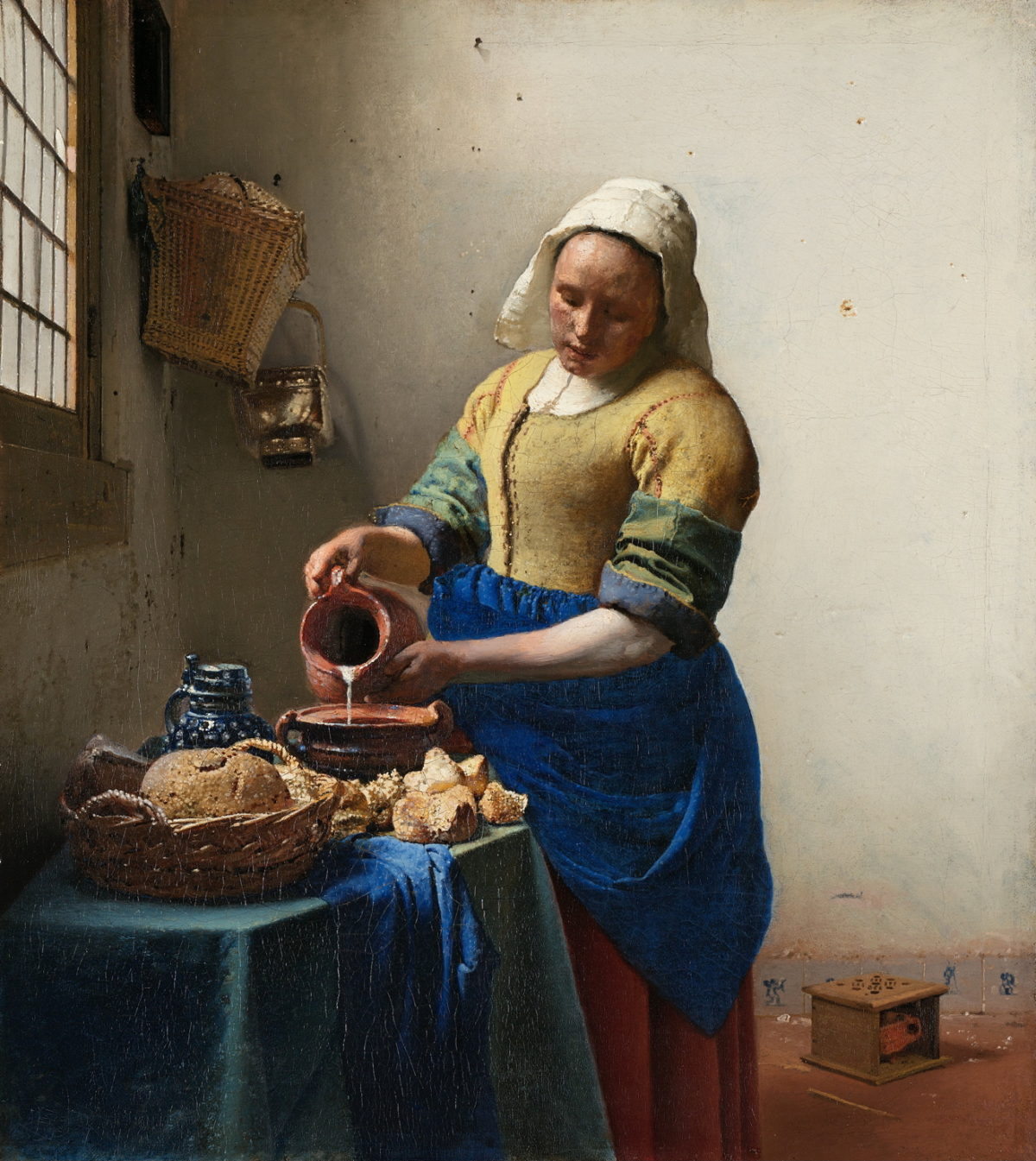
Johannes Vermeer was the Steph Curry of 17th century painters: a dazzling mack daddy who spent lengthy periods of his choppy forty-three year life layering lapis lazuli and ultramarine and madder lake onto some of the most beautiful paintings ever created in human history. To ask how he perfected the glowing pour of his domestic scenes through painstaking brush strokes is to court trouble. Did he do so through mirrors and lenses? Does the Hockney-Falco theory have any real bearing on appreciating his work? Vermeer famously left no record of how he achieved his elegant handwrought touch, which has left many to become obsessed with the question, even taking the trouble (as Tim Jennison, subject of the controversial Penn and Teller documentary, did) to learn Dutch, which is a maddening language by all reasonable standards.

The great mystery of how this genius mastered light purely by eye and through no apparent line work, all two centuries before the camera’s invention, has been taken up by such feverishly committed investigators as Philip Steadman, an architect who meticulously measured Vermeer’s interiors and constructed a one-sixth scale model of his room to uphold the theory that Vermeer used a camera obscura. For now, our attentions are with Lawrence Gowing, a self-taught art historian whose Vermeer obsession resulted in a highly useful and slyly passionate book, a short but smart volume bizarrely downplayed in The New York Times‘s Gowing obituary, but a title that the Modern Library judges were at least munificent enough to rank above the likes of Robert Caro eight years after Gowing kicked the proverbial bucket of paint.

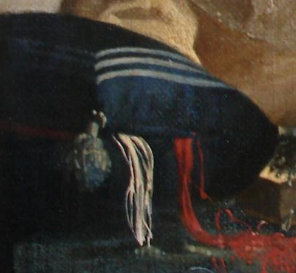
Gowing frames Vermeer’s achievements by observing that this painter, unlike his 17th century Dutch peers GabriĆ«l Metsu and Jan Steen, eschewed line and overt modelling work. Vermeer’s purity as an artist emerged with his curious pursuit of diffuse light at all costs. He remained quite impartial about how light spilled into his scenes. As Gowing notes, even a detail such as The Lacemaker‘s cushion tassels (pictured left) “have an enticing and baffling bluntness of focus.” In an age when anyone can instantly snap a picture to memorialize how light drifts into a room, this revolutionary approach cannot be understated, especially because Vermeer was confident enough in his aesthetic to push against the mercantile herd even as he served as head of the Guild of Saint Luke. In the seventeenth century, painters wanted to be noticed. They were, after all, artists with constantly grumbling bellies. So they tended to emphasize particular objects, even if it meant exaggerating the look, in an attempt to stand out. They might approach a patron and say, “Ha ha! I am Hendrik Van de Berg, the greatest painter of Maastricht! I have fifty thousand followers on…well, just imagine a world, preposterous as this may sound, in which short text messages determine your stature among peers and, yup, that would be me! Art King of Maastricht! Anyway, that nifty apple in the far right corner may look a little unnatural, but, dude, I think we can both agree that it really pops! And it will look good in your study while your starving servant polishes your boots and dreams of something to eat! Oh, I know you can’t pay your servants and that you are, in fact, fond of flogging them. But I am an artist and surely you can pay me! I’ll even throw in a complimentary whipping if you buy my work! Think of it as a patron reward!” Vermeer, by contrast, willfully blurred the apple. Vermeer’s peers in his hometown of Delift understood what he was doing, but the cost of being an artist was, alas, premature death due to exasperated financial stress.

Gowing’s gushing critical distinctions are a welcome reminder that it’s sometimes more important to know why art stands out rather than how it is created. The “No haters” crowd, fed on the soothing alfalfa sprouts of director’s commentaries and lengthy pop culture oral histories, would rather view Vermeer as a magician or a technical wizard than an artist. If Vermeer did use a camera obscura, he was certainly not the only Dutch painter doing so at the time. Gowing emphasizes that Vermeer’s style went above and beyond merely accumulating details. What should concern us is why he was so committed to the optical. What counts is Vermeer’s commitment to the visual experience: commonplace scenes that are somehow both radiant and persuasive depictions of reality. Gowing helpfully points out that any Vermeer investigation of life was never direct. The paintings were often established at an oblique angle. He singles out Vermeer’s “inhuman fineness of temper,” a tranquility that is quite extraordinary given that Vermeer was working with ten kids running around and the financial turmoil he had to endure.

Gowing is also very good at only drawing upon Vermeer’s biography when it is pertinent. Vermeer’s detachment and his slow output certainly hinges upon disappointments and setbacks he contended with during the last years of his life. Still, one only needs to look at Vermeer’s paintings to feel their somewhat passive but stirring view of humanity. Gowing distinguishes Vermeer from other painters by observing that “with the passivity characteristic of his thought, he accepted this part of his nature as the basis of the expressive content of his style.” Somehow Vermeer could inject his view on humanity purely through style. And somehow in this stylistic transformation, what seems passive is actually carefully rendered depth. Despite confining his paintings to two rooms, Gowing finds enough common qualities within these limitations for us to get a sense of what Vermeer was up to:

In only three of the twenty-six interiors that we have is the space between painter and sitter at all uninterrupted. In five of the others passage is considerably encumbered, in eight more the heavy objects interposed amount to something like a barrier and in the remaining ten they are veritable fortifications. It is hard to think that this preference tells us nothing about the painter’s nature. In it the whole of his dilemma is conveyed.

The book’s second part is more akin to descriptive liner notes for a must have box set and doesn’t quite match the first part’s perspicacity. But Gowing does provide several useful antecedents (such as Jan Van Bronkhorst’s The Procuress) that allow us to track Vermeer’s development as an artist. Again, because Vermeer didn’t leave much behind on his life or methods, it has been left for us to speculate on how he cultivated his exquisite style. But Gowing is too sharp a critic to be seduced by gossip and thankfully confines his findings to other paintings, showing us several paths leading us to Utrecht Caravaggism and trompe l’oeil.

I must warn you, however, that Gowing’s Vermeer, despite its ostensibly breezy length, will likely have you losing many hours studying Vermeer. What Gowing could not have foreseen is that his ruminations would be even more vital in a climate where some otherwise smart people believe that an ire-inducing and ill-considered think piece cobbled together in an hour constitutes serious thought.

Next Up: George Dangerfield’s The Strange Death of Liberal England!