The Golden Bough (Modern Library Nonfiction #90)

(This is the eleventh entry in The Modern Library Nonfiction Challenge, an ambitious project to read and write about the Modern Library Nonfiction books from #100 to #1. There is also The Modern Library Reading Challenge, a fiction-based counterpart to this list. Previous entry: Shadow and Act.)

mlnf90It is somewhat difficult to obtain a decent print edition of the Third Edition of The Golden Bough without getting fleeced by some squirrely operator working out of a shady storage unit in the middle of nowhere. For nobody seems to read the whole enchilada anymore. This is hardly surprising in an age, abundantly cemented last week, when most people are more inclined to celebrate regressive stupidity, melting their minds in any self-immolating pastime rather than opening a book. But I was able to find an affordable edition with the help of a British antiquarian. I had no idea what I was in for, but some initial research suggested very strongly that I should not settle for the abridged edition that is much easier to acquire. Certainly the sheer time-sucking insanity of the Modern Library Reading Challenge, one of the many dependable bastions I have left in a bleak epoch, demands that I go the distance on all entries, even if it means becoming ensnared by a particular title for several weeks, often answering texts from pals checking in on me with fun little snippets from Estonian folklore quebraditaing somewhere within a “Fine. How are you?” Such is the life of a book-loving eccentric with a ridiculous self-imposed mandate that involves refusing to let terrible setbacks get in the way of happy rumination. We find hope and courage and new ideas and fierce fortitude in remembering that not a single authoritarian entity or pernicious individual can ever crush the possibilities contained within our minds, our hearts, and our souls.

The thirteen volume set landed at my feet with a promising thud after a month-long voyage by boat across the Atlantic Ocean, where it occupied my reading time for many months and proceeded to change my life. I realize that such a claim may sound trite in light of the devastating and life-altering results of the 2016 U.S. presidential election, but, if there’s anything we can learn from Stefan Zweig’s suicide, we must never forget the importance of patience, of working long and hard to fight and endure while steering humanity’s promising galleon back on the right course even as we look to culture’s power to sustain our spirits in the darkest times.[footnote]Even those debased in the Nazi concentration camps were able to protest through music with “Moorsoldatenlied,” a song regularly prohibited by the SS.[/footnote]

James George Frazer’s The Golden Bough proved so galvanizing that I began to marvel more at trees and desired to spend more time beneath their magnificent branches. I began picking up the junk that other New Yorkers had so thoughtlessly deposited under their glorious leafy crowns. I began naming some of the trees I liked, saying “Hello, Balder!” (styled after the Norse god) to a beloved maple near the southwestern edge of Central Park. I started paying closer attention to the modest superstitious rituals that most of us take for granted, wanting to know why we feared black cats crossing our path (it started in the 1560s and originated with the idea that black cats were witches who had transformed their corporeal state) or worried ourselves into years of bad luck from walking under a ladder (it goes back to the Egyptians, who believed that walking under any pyramid would attenuate its mystical power). And, of course, I began to wonder if other superstitious rituals, such as voting for a vicious sociopathic demagogue to make a nation “great” again, originated from similar irrational fears. Despite being a secular humanist, I was stunned to discover that I had modest pagan proclivities and started to ask friends to engage in rather goofball offshoots of established rites in a somewhat libertine manner, much of which is unreportable. And if you think such a reaction is idiosyncratic (and it is), consider the strange takeaway that D.H. Lawrence memorialized in a December 8, 1915 letter:

I have been reading Frazer’s Golden Bough and Totemism and Exogamy. Now I am convinced of what I believed when I was about twenty — that there is another seat of consciousness than the brain and the nerve system: there is a blood-consciousness which exists in us independently of the ordinary mental consciousness, which depends on the eye as its source or connector. There is the blood-consciousness, with the sexual connection, holding the same relation as the eye, in seeing, holds to the mental consciousness. One lives, knows, and has one’s being in blood, without any references to nerves and brain. This is one half of life, belonging to the darkness. And the tragedy of this our life, and of your life, is that the mental and nerve consciousness exerts a tyranny over the blood-consciousness, and that your will has gone completely over to the mental consciousness, and is engaged with the destruction of your blood-being or blood-consciousness, the final liberating of the one, which is only death in result.

When I finished Frazer’s final volume, I certainly wasn’t prepared to suggest that any part of my consciousness was tyrannizing the others because of some eternal human connection to myths and rites enacted to answer and make sense of the presently inexplicable. But Lawrence did have a point about the way humans are naturally drawn to unusual ceremonies and celebrations that go well beyond Carolina Panthers coach Ron Rivera wearing the same shoes on game days, with the impulse often defying any steely rationalism we may use to make sense of our inherently animalistic nature, which any glance at a newspaper reveals to be quite frighteningly present.
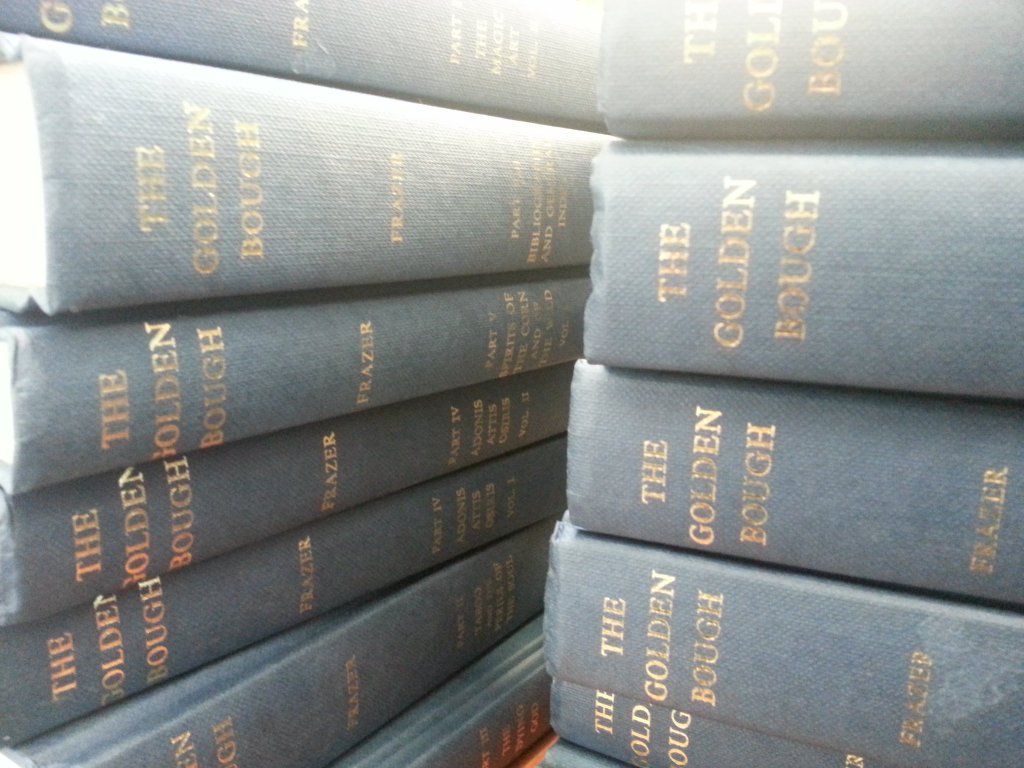
goldenboughset

More importantly, The Golden Bough changed everything I thought I knew about storytelling and myth. It forced me to see commonalities within many cultures. To cite one of Frazer’s countless comparative examples, consider the way that humans have approached the bear hunt. After the Kamtchatkans had killed a bear and eaten its flesh, the host of the subsequent dinner party would bring the bear’s head before the assembled guests, wrap it in grass, and then conduct a panel of sorts where the host, serving as a moderator only slightly less ballistic than Bill O’Reilly, would ask the bear if he had been well-treated. Much like many wingnut “journalists” irresponsibly publishing claims in Slate today without robust evidence (and failing to tender corrections when pwned), the Kamctchatkan host would blame the Russians. The American Indians likewise implored the dead bear not to be angry for being hunted and would hang the bear’s head on a post, painting it red and blue rather than donning it with vegetation. They also addressed it, much in the manner that dog owners chat with their uncomprehending pets when nobody’s around. The Assiniboins also held feasts after a hunt and also mounted the bear’s head, shrouding it in strips of scarlet cloth, and respected the bear so much that they offered the head a pipe to smoke, not unlike the poor dog who sits outside Mets games with a pipe in his mouth. And looking beyond Frazer, one finds in Alanson Skinner’s Notes on the Eastern Cree and Northern Saulteaux a similar bear’s head ceremony that involved sharing a pipe before the participants took a bite from the bear’s flesh and, with the old Finnish custom of karhunpeijaiset, a bear’s head mounted upon a young tree, venerated and addressed as a relative or the son of a god. And according to the Russian ethnographer Vladimir Arsenyev (and I found this bit by sifting through James H. Grayson’s Myths and Legends from Korea), the Udegey people of the Russian Far East also had a bear ceremony and believed, “To throw the head away is a great sin….The cooked bear’s head is wrapped in its own skin with its fur outwards and tied up with a thin rope,” with a communal ceremony quite similar to the Finns.

I could go on (and indeed Frazer often rambles for pages), but there’s an undeniable awe in learning that something so specific about bears (head mounted, party organized, head covered, bear respected), much less anything else, arose independently in so many different parts of the world. It proves very conclusively, and perhaps this is especially essential for us to understand as we reconcile a vast and seemingly incurable national division, that humans share more in common with each other than we’re willing to confess and that the seemingly unique rituals that we believe define “us” are quite likely shared many times over in other parts of the nation, much less the world.

The reason it took me so long to read The Golden Bough was not because of its many thousand pages (aside from some sloggish parts in the Spirits of the Corn and of the Wild volumes, the books are surprisingly readable[footnote]Frazer is often so footnote-happy that one often turns a page finding a mere five lines to read above a double-column fiesta of references that would require a lifetime or two to dive into.[/footnote]), but because my imagination would become so captivated by some tale of trees esteemed above human life or a crazed orgiastic release (see Saturnalia) that I would lose many hours in the library seeing how much of this was still practiced. It has been more than a century since Frazer published the Third Edition, but his remarkable observations about shared rituals still invite us to dream and believe and to perceive that, Frazer’s regrettable references to “savages” and “primitives” notwithstanding, we are not so different from each other.

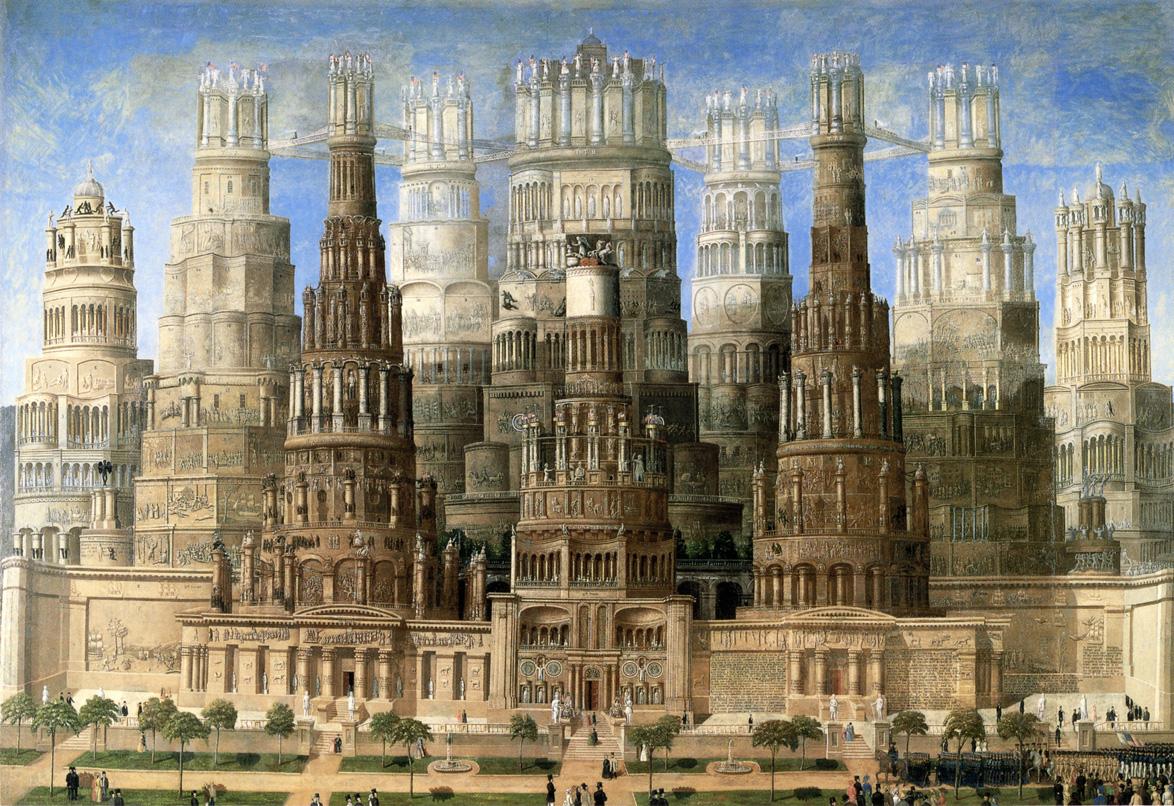
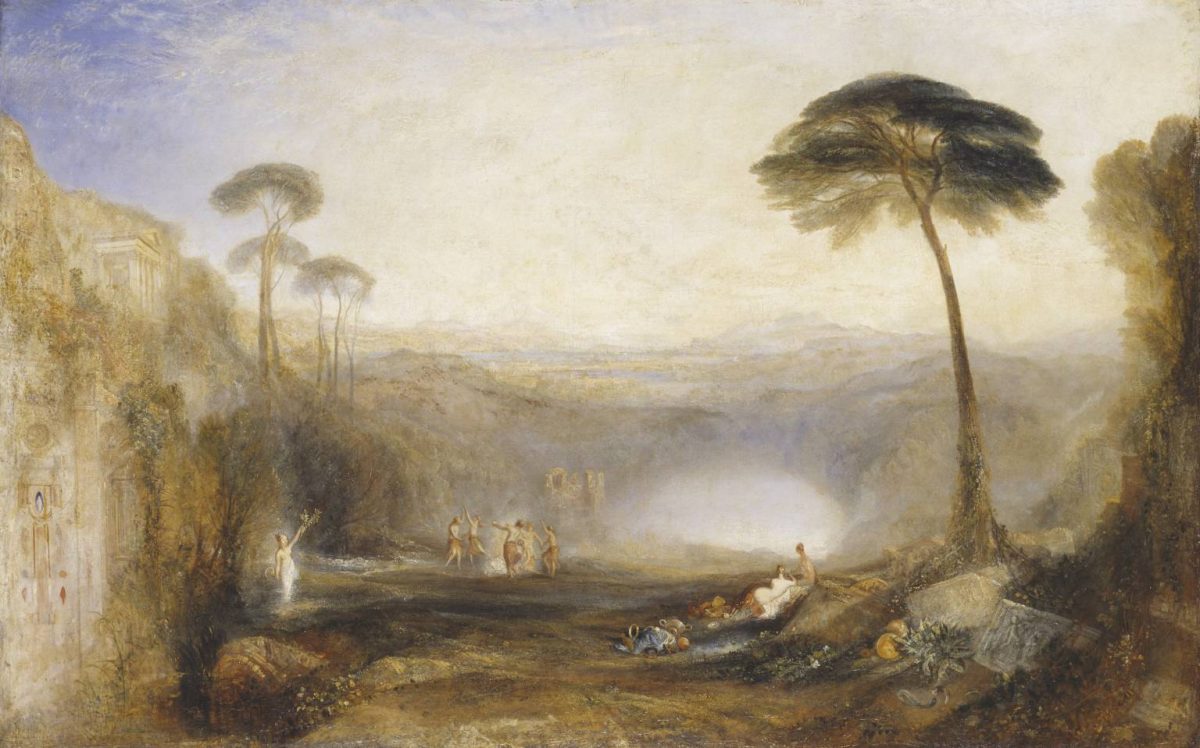
Frazer’s explanation for these common qualities — epitomized by the famous J.M.W. Turner painting (pictured above) sharing the same name title as Frazer’s capacious opus — rests in the sylvan lake of Nemi and an ancient tale in which a priest-king defended a singular tree. The priest-king, who was an incarnation of a god wedded to the world, could only be overpowered by a fight to the death and, if he was slain, he would be replaced by his victor, with the cycle perpetuating ad infinitum. Frazer believed that nearly every story in human history could be traced back to this unifying myth, with most of the tales triggered by our imagination arising out of what he called “sympathetic magic,” whereby humans often imitate what they cannot understand. So if this meant building effigies or participating in elaborate and often unusual rituals that explain why the sun scorched the crops to an unsustainable crisp in the last harvest or helped more animals to multiply for grand feasts next season, magical thinking provided both the bond and the panacea well before Robert B. Thomas came up with the Old Farmer’s Almanac.

There are two components to sympathetic magic: the first is Contagion, or physical contact, which involved a transfer of “essence” by physical contact (among other things, this would account for why humans have been especially careful about bear’s heads, as described above); the second was Similarity, whereby “the magicians infers that he can produce any effect he desires merely by imitating it: from the second he infers that whatever he does to a material object will affect equally the person with whom the object was once in contact, whether it formed part of his body or not.”

One of The Golden Bough‘s most fascinating volumes, The Scapegoat, reveals how a human belief in “essence” may be the root of our most irrational fears. Contagion often led to humans trying to transfer their disease and miseries to other people, if not reinforcing their own biases about people or groups that they disliked. I am indebted to the terrific podcast Imaginary Worlds for steering me to the work of Carol Nemeroff, whose psychological considerations of Frazer’s findings are are especially constructive in understanding disgust. Nemeroff and her colleagues conducted a series of studies in which they placed a sterilized dead roach in a glass of juice and asked subjects to eat fudge that resembled dog feces. The natural reactions (recoiling at the roach and the shit-shaped fudge) showed that sympathetic magic is still very much a mainstay of our culture.

Indeed, sympathetic magic drives most of our cherished rituals today. In one of his most controversial (but nevertheless true) observations, Frazer observes in Adonis Attis Osiris that, although the Gospels never cited a hard date for Jesus Christ’s birthday bash, Christians have adhered to their churchgoing rituals with the same practiced regularity one sees in fundamentalist homophobics holding up cardboard signs that misquote the Bible to reinforce their hate. The original celebration date of Christ’s alleged birth was January 6th. But because heathens celebrated the birthday of the Sun on December 25th, and this was often a draw for the Christians because the heathens were more fun, the Church agreed to set December 25th as the official day. If Christmas did not exist, it would be necessary for humankind to invent it. For such useful observations, The Golden Bough is incredibly handy to have in one’s library, if only to remind us that most of our beliefs, the recurring rituals we are expected to adhere to, are predicated upon some ancient explanation that we failed to shake from the Magic 8-Ball of our daily existence. So Colin Kaepernick really doesn’t need to stand for the national anthem. While this conformist rite is admittedly improved from the Nazi-like Bellamy salute, standing for The Star-Spangled Banner is little more than a quaint superstition that one is pressured to participate in to “belong.”

Frazer’s scholarship, while impressive, is sometimes inexact in the effort to find a Theory of Everything. Midway through putting together the Third Edition, Frazer was challenged by Dr. Edward Westermarck, who pointed out that fire festivals did not originate from fire reinforcing the sun’s light and heat, but rather a need to celebrate purification. Frazer did correct his views in Balder the Beautiful, but it does leave one contemplating whether sympathetic magic served as Frazer’s knee-jerk goto point in his noble quest to reconcile several folkloric strands.

Still, one cannot disavow the conclusion that much of our behavior is not only similarly ceremonial across cultures, which would indeed suggest a common source. Frazer managed one last volume, the Aftermath, in 1937, just four years before his death. While this volume is little more than a collection of B-sides, it does have leave one wondering what Frazer would have made of Nuremburg rallies or even our current default mode of walking like zombies in the streets, heads down, eyes bulging at the prospect of another chapter in a Snapchat story. The gods and the sympathetic magic may be a tad more secular these days, but we still remain seduced. Myths and stories and rituals are as old as the Chauvet Cave paintings. One cannot imagine being human without them.

Next Up: Annie Dillard’s Pilgrim at Tinker Creek!
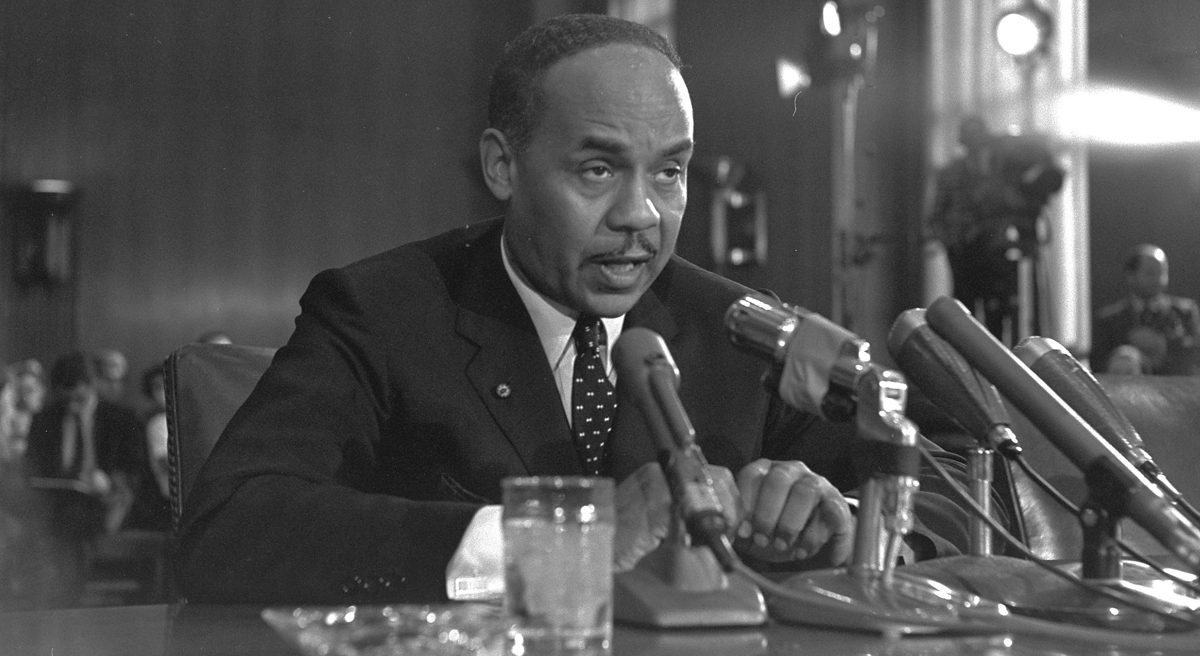
Shadow and Act (Modern Library Nonfiction #91)

(This is the tenth entry in The Modern Library Nonfiction Challenge, an ambitious project to read and write about the Modern Library Nonfiction books from #100 to #1. There is also The Modern Library Reading Challenge, a fiction-based counterpart to this list. Previous entry: The Power Broker.)

mlnf91When I first made my bold belly flop into the crisp waters of Ralph Ellison’s deep pool earlier this year, I felt instantly dismayed that it would be a good decade before I could perform thoughtful freestyle in response to his masterpiece Invisible Man (ML Fiction #19). As far as I’m concerned, that novel’s vivid imagery, beginning with its fierce and intensely revealing Battle Royale scene and culminating in its harrowing entrapment of the unnamed narrator, stands toe-to-toe with Saul Bellow’s The Adventures of Augie March as one of the most compelling panoramas of mid-20th century American life ever put to print, albeit one presented through a more hyperreal lens.

But many of today’s leading writers, ranging from Ta-Nehisi Coates to Jacqueline Woodson, have looked more to James Baldwin as their truth-telling cicerone, that fearless sage whose indisputably hypnotic energy was abundant enough to help any contemporary humanist grapple with the nightmarish realities that America continues to sweep under its bright plush neoliberal rug. At a cursory glance, largely because Ellison’s emphasis was more on culture than overt politics, it’s easy to see Ellison as a complacent “Maybe I’m Amazed” to Baldwin’s gritty “Cold Turkey,” especially when one considers the risk-averse conservatism which led to Ellison being attacked as an Uncle Tom during a 1968 panel at Grinnell College along with his selfish refusal to help emerging African-American authors after his success. But according to biographer Arnold Rampersad, Baldwin believed Ralph Ellison to be the angriest person he knew. And if one dives into Ellison’s actual words, Shadow and Act is an essential volume, which includes one of the most thrilling Molotov cocktails ever pitched into the face of a clueless literary critic, that is often just as potent and as lapel-grabbing as Baldwin’s The Fire Next Time.

For it would seem that while Negroes have been undergoing a process of “Americanization” from a time preceding this birth of this nation — including the fusing of their blood lines with other non-African strains, there has been a stubborn confusion as to their American identity. Somehow it was assumed that the Negroes, of all the diverse American peoples, would remain unaffected by the climate, the weather, the political circumstances — from which not even slaves were exempt — the social structures, the national manners, the modes of production and the tides of the market, the national ideals, the conflicts of values, the rising and falling of national morale, or the complex give and take of acculturalization which was undergone by all others who found their existence within the American democracy.

This passage, taken from an Ellison essay on Amiri Baraka’s Blues People, is not altogether different from Baldwin’s view of America as “a paranoid color wheel” in The Evidence of Things Not Seen, where Baldwin posited that a retreat into the bigoted mystique of Southern pride represented the ultimate denial of “Americanization” and thus African-American identity. Yet the common experiences that cut across racial lines, recently investigated with comic perspicacity on a “Black Jeopardy” Saturday Night Live sketch, may very well be a humanizing force to counter the despicable hate and madness that inspires uneducated white males to desecrate a Mississippi black church or a vicious demagogue to call one of his supporters “a thug” for having the temerity to ask him to be more respectful and inclusive.

Ellison, however, was too smart and too wide of a reader to confine these sins of dehumanization to their obvious targets. Like Baldwin and Coates and Richard Wright, Ellison looked to France for answers and, while never actually residing there, he certainly counted André Malraux and Paul Valéry among his hard influences. In writing about Richard Wright’s Black Boy, Ellison wisely singled out critics who failed to consider the full extent of African-American humanity even as they simultaneously demanded an on-the-nose and unambiguous “explanation” of who Wright was. (And it’s worth noting that Ellison himself, who was given his first professional writing gig by Wright, was also just as critical of Wright’s ideological propositions as Baldwin.) Ellison described how “the prevailing mood of American criticism has so thoroughly excluded the Negro that it fails to recognize some of the most basic tenets of Western democratic thought when encountering them in a black skin” and deservedly excoriated whites for seeing Paul Robeson and Marian Anderson merely as the ne plus ultra of African-American artistic innovation rather than the beginning of a great movement.

shriversombreroAt issue, in Ellison’s time and today, is the degree to which any individual voice is allowed to express himself. And Ellison rightly resented any force that would stifle this, whether it be the lingering dregs of Southern slavery telling the African-American how he must act or who he must be in telling his story as well as the myopic critics who would gainsay any voice by way of their boxlike assumptions about other Americans. One sees this unthinking lurch towards authoritarianism today with such white supremacists as Jonathan Franzen, Lionel Shriver, and the many Brooklyn novelists who, despite setting their works in gentrified neighborhoods still prominently populated by African-Americans, fail to include, much less humanize, black people who still live there.

“White supremacist” may seem like a harshly provocative label for any bumbling white writer who lacks the democratic bonhomie to leave the house and talk with other people and consider that those who do not share his skin color may indeed share more common experience than presumed. But if these writers are going to boast about how their narratives allegedly tell the truth about America while refusing to accept challenge for their gaping holes and denying the complexity of vital people who make up this great nation, then it seems apposite to bring a loaded gun to a knife fight. If we accept Ellison’s view of race as “an irrational sea in which Americans flounder like convoyed ships in a gale,” then it is clear that these egotistical, self-appointed seers are buckling on damaged vessels hewing to shambling sea routes mapped out by blustering navigators basking in white privilege, hitting murky ports festooned with ancient barnacles that they adamantly refuse to remove.

Franzen, despite growing up in a city in which half the population is African-American, recently told Slate‘s Isaac Chotiner that he could not countenance writing about other races because he has not loved them or gone out of his way to know them and thus excludes non-white characters from his massive and increasingly mediocre novels. Shriver wrote a novel, The Mandibles, in which the only black characters are (1) Leulla, bound to a chair and walked with a leash, and (2) Selma, who speaks in a racist Mammy patois (“I love the pitcher of all them rich folk having to cough they big piles of gold”). She then had the effrontery to deliver a keynote speech at the Brisbane Writers Festival arguing for the right to “try on other people’s hats,” failing to understand that creating dimensional characters involves a great deal more than playing dress-up at the country club. She quoted from a Margot Kaminski review of Chris Cleave’s Little Bee that offered the perfectly reasonable consideration, one that doesn’t deny an author’s right to cross boundaries, that an author may wish to take “special care…with a story that’s not implicitly yours to tell.” Such forethought clearly means constructing an identity that is more human rather than crassly archetypal, an eminently pragmatic consideration on how any work of contemporary art should probably reflect the many identities that make up our world. But for Shriver, a character should be manipulated at an author’s whim, even if her creative vagaries represent an impoverishment of imagination. For Shriver, inserting another nonwhite, non-heteronormative character into The Mandibles represented “issues that might distract from my central subject moment of apocalyptic economics.” Which brings us back to Ellison’s question of “Americanization” and how “the diverse American peoples” are indeed regularly affected by the decisions of those who uphold the status quo, whether overtly or covertly.

Writer Maxine Benba-Clarke bravely confronted Shriver with the full monty of this dismissive racism and Shriver responded, “When I come to your country. I expect. To be treated. With hospitality.” And with that vile and shrill answer, devoid of humanity and humility, Shriver exposed the upright incomprehension of her position, stepping from behind the arras as a kind of literary Jan Smuts for the 21st century.[footnote]To this litany of country bumpkin calumnies from a Literary Establishment that purports to Know All, one must also include the superficial contributions of the wildly overrated Joyce Carol Oates, whose novel The Sacrifice demonstrated equally ignoble failings to consider complex identity and authenticity in fictionalizing the Tawana Brawley case. These inadequacies were smartly called out by Roxane Gay in The New York Times Book Review. Rather than consider how she had failed as an author, Oates, true to the clueless xenophobia she regularly chirrups on Twitter, suggested that Gay had failed.[/footnote]

If this current state of affairs represents a bristling example of Giambattista Vico’s corsi e ricorsi, and I believe it does, then Ellison’s essay, “Twentieth-Century Fiction and the Black Mask of Humanity,” astutely demonstrates how this cultural amaurosis went down before, with 20th century authors willfully misreading Mark Twain, failing to see that Huck’s release of Jim represented a moment that not only involved recognizing Jim as a human being, but admitting “the evil implicit in his ’emancipation'” as well as Twain accepting “his personal responsibility in the condition of society.” With great creative power comes great creative responsibility. Ellison points to Ernest Hemingway scouring The Adventures of Huckleberry Finn merely for its technical accomplishments rather than this moral candor and how William Faulkner, despite being “the greatest artist the South has produced,” may not be have been quite the all-encompassing oracle, given that The Unvanquished‘s Ringo is, despite his loyalty, devoid of humanity. In another essay on Stephen Crane, Ellison reaffirms that great art involves “the cost of moral perception, of achieving an informed sense of life, in a universe which is essentially hostile to man and in which skill and courage and loyalty are virtues which help in the struggle but by no means exempt us from the necessary plunge into the storm-sea-war of experience.” And in the essays on music that form the book’s second section (“Sound and the Mainstream”), Ellison cements this ethos with his personal experience growing up in the South. If literature might help us to confront the complexities of moral perception, then the lyrical, floating tones of a majestic singer or a distinctive cat shredding eloquently on an axe might aid us in expressing it. And that quest for authentic expression is forever in conflict with audience assumptions, as seen with such powerful figures as Charlie Parker, whom Ellison describes as “a sacrificial figure whose struggles against personal chaos…served as entertainment for a ravenous, sensation-starved, culturally disoriented public which had but the slightest notion of its real significance.”

What makes Ellison’s demands for inclusive identity quite sophisticated is the vital component of admitting one’s own complicity, an act well beyond the superficial expression of easily forgotten shame or white guilt that none of the 20th or the 21st century writers identified here have had the guts to push past. And Ellison wasn’t just a writer who pointed fingers. He held himself just as accountable, as seen in a terrific 1985 essay called “An Extravagance of Laughter” (not included in Shadow and Act, but found in Going with the Territory), in which Ellison writes about how he went to the theatre to see Jack Kirkland’s adaptation of Erskine Caldwell’s Tobacco Road. (I wrote about Tobacco Road in 2011 as part of this series and praised the way that this still volatile novel pushes its audience to confront its own prejudices against the impoverished through remarkably flamboyant characters.) Upon seeing wanton animal passion among poor whites on the stage, Ellison burst into an uncontrollable paroxysm of laughter, which emerged as he was still negotiating the rituals of New York life shortly after arriving from the South. Ellison compared his reaction, which provoked outraged leers from the largely white audience, to an informal social ceremony he observed while he was a student at Tuskegee that involved a set of enormous whitewashed barrels labeled FOR COLORED placed in public space. If an African-American felt an overwhelming desire to laugh, he would thrust his head into the pit of the barrel and do so. Ellison observes that African-Americans “who in light of their social status and past condition of servitude were regarded as having absolutely nothing in their daily experience which could possibly inspire rational laughter.” And the expression of this inherently human quality, despite being a cathartic part of reckoning with identity and one’s position in the world, was nevertheless positioned out of sight and thus out of mind.

When I took an improv class at UCB earlier this year, I had an instructor who offered rather austere prohibitions to any strain of humor considered “too dark” or “punching down,” which would effectively disqualify both Tobacco Road and the Tuskegee barrel ritual that Ellison describes.[footnote]Earlier this year, in The Baffler, Ben Schwartz offered some cogent and provocative thoughts on the problems with such ultimatums. His essay is very worth reading if you’re interested in painting outside the lines as an artist or a thinker.[/footnote] These restrictions greatly frustrated me and a few of my classmates, who didn’t necessarily see the exploration of edgy comic terrain as a default choice, but merely one part of asserting an identity inclusive of many perspectives. I challenged the notion of confining behavior to obvious choices and ended up getting a phone call from the registrar, who was a smart and genial man and with whom I ended up having a friendly and thoughtful volley about comedy. I had apparently been ratted out by one student, who claimed that I was “disrupting” the class when I was merely inquiring about my own complicity in establishing base reality. In my efforts to further clarify my position, I sent a lengthy email to the instructor, one referencing “An Extravagance of Laughter,” and pointed out that delving into the uncomfortable was a vital part of reckoning with truth and ensuring that you grew your voice and evolved as an artist. I never received a reply. I can’t say that I blame him.

Ellison’s inquiry into the roots of how we find common ground with others suggests that we may be able to do so if we (a) acknowledge the completeness of other identities and (b) allow enough room for necessary catharsis and the acknowledgment of our feelings and our failings as we take baby steps towards better understanding each other.

The most blistering firebomb in the book is, of course, the infamous essay “The World and the Jug,” which demonstrates just what happens when you assume rather than take the time to know another person. It is a refreshingly uncoiled response that one could not imagine being published in this age of “No haters” reviewing policies and genial retreat from substantive subjects in today’s book review sections. Reacting to Irving Howe’s “Black Boys and Native Sons,” Ellison condemns Howe for not seeing “a human being but an abstract embodiment of living hell” and truly hammers home the need for all art to be considered on the basis of its human experience rather than the spectator’s constricting inferences. Howe’s great mistake was to view all African-American novels through the prism of a “protest novel” and this effectively revealed his own biases against what black writers had to say and very much for certain prerigged ideas that Howe expected them to say. “Must I be condemned because my sense of Negro life was quite different?” writes Ellison in response to Howe roping him in with Richard Wright and James Baldwin. And Ellison pours on the vinegar by not only observing how Howe self-plagiarized passages from previous reviews, but how his intractable ideology led him to defend the “old-fashioned” violence contained in Wright’s The Long Dream, which, whatever its merits, clearly did not keep current with the changing dialogue at the time.

Shadow and Act, with its inclusion of interviews and speeches and riffs on music (along with a sketch of a struggling mother), may be confused with a personal scrapbook. But it is, first and foremost, one man’s effort to assert his identity and his philosophy in the most cathartic and inclusive way possible. We still have much to learn from Ellison more than fifty years after these essays first appeared. And while I will always be galvanized by James Baldwin (who awaits our study in a few years), Ralph Ellison offers plentiful flagstones to face the present and the future.

SUPPLEMENT: One of the great mysteries that has bedeviled Ralph Ellison fans for decades is the identity of the critic who attacked Invisible Man as a “literary race riot.” In a Paris Review interview included in Shadow and Act, Ellison had this to say about the critic:

But there is one widely syndicated critical bankrupt who made liberal noises during the thirties and has been frightened ever since. He attacked my book as a “literary race riot.”

With the generous help of Ellison’s biographer Arnold Rampersad (who gave me an idea of where the quote might be found in an email volley) and the good people at the New York Public Library, I have tracked down the “widely syndicated critical bankrupt” in question.

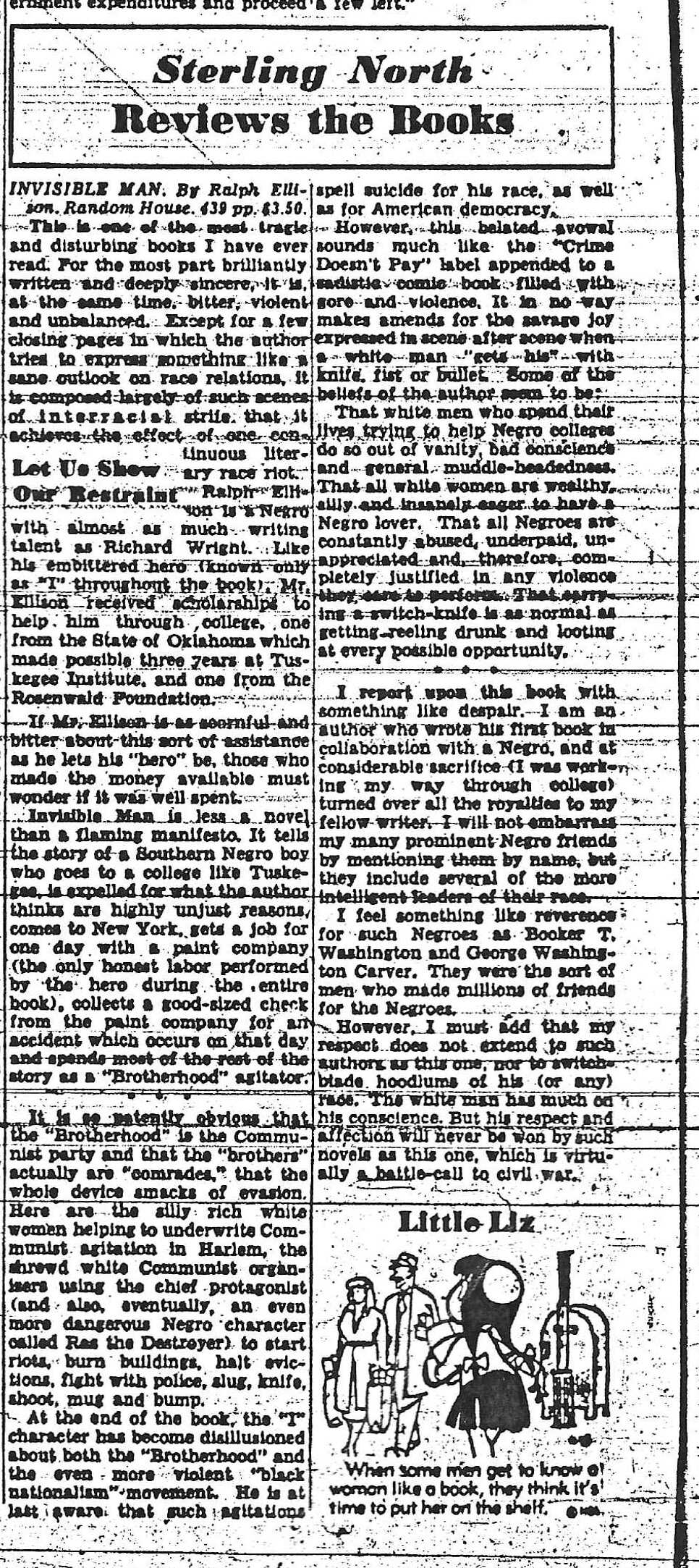
sterlingnorthHis name is Sterling North, best known for the children’s novel Rascal in 1963. He wrote widely popular (and rightly forgotten) children’s books while writing book reviews for various newspapers. North was such a vanilla-minded man that he comics “a poisonous mushroom growth” and seemed to have it in for any work of art that dared to do something different — or that didn’t involve treacly narratives involving raising baby raccoons.

And then, in the April 16, 1952 issue of the New York World-Telegram, he belittled Ellison’s masterpiece, writing these words:

This is one of the most tragic and disturbing books I have ever read. For the most part brilliantly written and deeply sincere, it is, at the same time, bitter, violent and unbalanced. Except for a few closing pages in which the author tries to express something like a sane outlook on race relations, it is composed largely of such scenes of interracial strife that it achieves the effect of one continuous literary race riot. Ralph Ellison is a Negro with almost as much writing talent as Richard Wright. Like his embittered hero (known only as “I’ throughout the book, Mr. Ellison received scholarships to help him through college, one from the State of Oklahoma which made possible three years at the Tuskegee Institute, and one from the Rosenwald Foundation.

If Mr. Ellison is as scornful and bitter about this sort of assistance as he lets his “hero” be, those who made the money available must wonder if it was well spent.

North’s remarkably condescending words offer an alarming view of the cultural oppression that Ellison was fighting against and serve as further justification for Ellison’s views in Shadow and Act. Aside from his gross mischaracterization of Ellison’s novel, there is North’s troubling assumptions that Ellison should be grateful in the manner of an obsequious and servile stereotype, only deserves a scholarship if he writes a novel that fits North’s limited idea of what African-American identity should be, and that future white benefactors should think twice about granting opportunities for future uppity Ellisons.

It’s doubtful that The Sterling North Society will recognize this calumny, but this is despicable racism by any measure. A dive into North’s past also reveals So Dear to My Heart, a 1948 film adaptation of North’s Midnight and Jeremiah that reveled in Uncle Tom representations of African-Americans.

North’s full review of The Invisible Man can be read below:

sterling-north

Next Up: James George Frazer’s The Golden Bough!

The American Political Tradition (Modern Library Nonfiction #93)

(This is the eighth entry in The Modern Library Nonfiction Challenge, an ambitious project to read and write about the Modern Library Nonfiction books from #100 to #1. There is also The Modern Library Reading Challenge, a fiction-based counterpart to this list. Previous entry: The Contours of American History.)

mlnf93Before he became famous for delineating “the paranoid style in American politics” and honing every principled bone against the feverish anti-intellectualism one now sees embodied in everything from long-standing philistine Dan Kois decrying “eating his cultural vegetables” to lunatic presidential candidate Ted Cruz declaring gluten-free meals as a politically correct “social experiment,” historian Richard Hofstadter spent four years on a fiercely independent book that would go on to sell close to a million copies. The American Political Tradition was a Plutarchian overview of illustrious American figures ranging from vivacious abolitionist Wendell Phillips to Woodrow Wilson as closeted conservative. It was aimed at winning over a high-minded American public. Like William Appleman Williams, Hofstadter was very much following in Charles Beard’s footsteps, although this historian hoped to march to his own interpretive drum. Reacting to the toxic McCarthyism at the time, Hofstadter’s cautious defense of old school American liberalism, with the reluctant bulwark hoisted as he poked holes into the foibles of celebrated icons, saddled him with the label of “consensus historian.” With each subsequent volume (most notably The Age of Reform), Hofstadter drifted further away from anything close to a scorching critique of our Founders as hardliners enforcing their economic interests to a more vociferous denouncement of agrarian Populists and numbnuts standing in the way of erudite democratic promise. Yet even as he turned more conservative in later years, Hofstadter insisted that his “assertion of consensus history in 1948 had its sources in the Marxism of the 1930s.”

Such adamantine labels really aren’t fair to Hofstadter’s achievements in The American Political Tradition. The book is by no means perfect, but its Leatherman Wave-like dissection of American history unfolds with some sharp and handy blades. While Hofstadter is strangely reluctant to out Andrew Jackson as a demagogue (“He became a favorite of the people, and might easily come to believe that the people chose well.”) and far too pardonable towards John C. Calhoun, a rigid bloviator with a harsh voice who was one of slavery’s biggest cheerleaders and whose absolutist stance against tariffs under the guise of moderatism would later inspire the South to consider secession as a legitimate nuclear option[footnote]”He talked on the most abstruse subjects with the guileless simplicity of a prattling child,” assessed Thomas Edward Watson in The Life and Times of Andrew Jackson. This juicy quote, served up by Hofstadter, comes from one of Calhoun’s admirers![/footnote], Hofstadter at his best slices with a necessary critical force into many hallowed patriarchs. For it is the sum of their variegated and contradictory parts that has caused some to view the American trajectory in Manichean terms.

One of the book’s standout chapters is Hofstadter’s shrewd analysis of Lincoln as an exceptionally formidable man who dialed down his egalitarian ardor to zero the meter for his shrewd and very rapid political rise. In just four years, Lincoln advanced from an obscure attorney in Illinois to a prominent party leader in that same state’s House of Representatives. But Hofstadter cogently argues that Lincoln was far from the outspoken abolitionist who would later lay down some very strong words against those who would deny other people freedom. Lincoln not only kept his enemies closer than his friends, but he was exceptionally careful with his rhetoric, even though one eye-popping 1836 declaration proposed extending suffrage to women.[footnote]One of Lincoln’s fascinating strategies involved sneaking in bold political positions into bills or campaigning that often reflected an altogether different goal, such as this oft cited passage protesting income inequality in a defense of protective tariffs. The quote is cited by Hofstadter.[/footnote] Much as Franklin D. Roosevelt was very savvy about letting his political opponents make the first move before he acted, Lincoln used the Declaration of Independence’s very text as ammunition and inspiration for his justification for abolition, which come much later — Lincoln’s first public condemnation of slavery arrived when Lincoln was forty-five — than Lincoln’s many admirers are often willing to admit.

Hofstadter points out that Lincoln’s seeming contradiction between revolutionary politics and pragmatic interpretation of the law was not especially peculiar, but part of a nuts-and-bolts perpetuation of an ongoing political tradition, one that can be seen with Lincoln’s hard maneuvering with the 1851 conditional loan he issued to his stepbrother John D. Johnson. Lincoln’s famous House Divided speech was masterful rhetoric urging national reconciliation of the slavery issue, but he didn’t exactly go out of his way to out himself as an abolitionist. Hofstadter points out that in 1858, seemingly Honest Abe spoke in two entirely different manners about racial equality in Chicago and in Charleston (see the second paragraph of his first speech). Yet these observations not only illustrate Lincoln’s political genius, but invite parallels to Lyndon Johnson’s brilliant and equally contradictory engineering in passing the 1957 Civil Rights Act (perhaps best chronicled in a gripping 100 page section of Robert A. Caro’s excellent Master of the Senate). The American political tradition, which Hofstadter identifies as a continuity with capitalist democratic principles, is seen today with Hillary Clinton struggling against a young population hungry for progressive change unlikely to happen overnight, despite Bernie Sanders’s valiant plans and the immediate need to rectify corporate America’s viselike hold on the very democratic principles that have sustained this nation for more than two hundred years.

Yet this is the same tradition that has given us long years without a stabilizing central bank, the Trail of Tears, the Civil War, the Credit Mobilier scandal, robber barons, and Hoover’s unshakable faith that “prosperity was just around the corner,” among many other disgraces. Hofstadter is thankfully not above condemning lasseiz-faire absolutism, such as Grover Cleveland’s unrealistic assumption that “things must work out smoothly without government action, or the whole system, coherent enough in theory, would fall from the weakness of its premises” or the free silver campaign that buttressed the bombastic William Jennings Bryan into an improbable presidential candidate. On Bryan, Hofstadter describes his intellectual acumen as “a boy who never left home” and one can see some of Bryan’s regrettable legacy in the red-faced fulminations of a certain overgrown boy who currently pledges to make America great again. A careless and clumsy figure like Bryan was the very antithesis of Lincoln. Bryan failed to see difficult political tasks through to their necessary end. He would adopt principles that he once decried. His well-meaning efforts amounted to practically nothing. Think of Bryan as Fargo‘s Jerry Lundegaard to Lincoln’s Joe Girard. Hofstadter suggests that “steadfast and self-confident intelligence,” perhaps more important than courage and sincerity, was the very quality that Bryan and this nation so desperately needed. Yet in writing about Teddy Roosevelt and pointing to the frequency of “manly” and “masterful” in his prose, Hofstadter imputes that these “more perfect” personal qualities for the political tradition “easily became transformed into the imperial impulse.”

This is, at times, a very grumpy book. One almost bemoans the missed opportunity to enlist the late Andy Rooney to read aloud the audio version. But it is not without its optimism. Hofstadter places most of his faith in abolitionist agitator Wendell Phillips. But even after defending Phillips from numerous historical condemnations and pointing to Phillips’s “higher level of intellectual self-awareness,” Hofstadter sees the agitator as merely “the counterweight to sloth and indifference.” But Hofstadter, at this young stage of his career, isn’t quite willing to write off agitators. He does point to why Phillips was a necessary and influential force providing equilibrium:

But when a social crisis or revolutionary period at last matures, the sharp distinctions that govern the logical and doctrinaire mind of the agitator become at one with the realities, and he appears overnight to the people as a plausible and forceful thinker. The man who has maintained that all history is the history of class struggles and has appeared so wide of the mark in times of class collaboration may become a powerful leader when society is seething with unresolved class conflict; the man who has been valiantly demanding the abolition of slavery for thirty years may become a vital figure when emancipation makes its appearance as a burning issue of practical politics. Such was the experience of Wendell Phillips: although he never held office, he became one of the most influential Americans during the few years after the fall of Fort Sumter.

thealternativefactorThe question of whether you believe Hofstadter to be a consensus historian or not may depend on how much you believe that he viewed the American political tradition much like two Lazaruses forever duking it out for existence in the old Star Trek episode “The Alternative Factor.” He certainly sees a nation of political pragmatists and obdurate agitators caught in an eternal dead lock, which is not too far from the progressive historians who styled their interpretations on class conflict. But his fine eye for ferreting out the Burkean undertow within Woodrow Wilson’s putative liberalism or exposing how Hoover’s faith in unregulated business had him quivering with disbelief after Black Thursday suggests a historian who is interested in countering ideological bromides. Perhaps if Hofstadter had stretched some of his chapters across a massive book, his reputation as a consensus historian wouldn’t have been the subject of so many heated arguments among political wonks.

Fortunately, the next Modern Library essay in this series will investigate how one man fluctuated his politics to serve his own ends and reshaped a major metropolis through the iron will of his personality. That very long and very great book may be the key that turns the consensus lock. It will certainly tell us a lot more about political power.

Next Up: Robert A. Caro’s The Power Broker!

The Contours of American History (Modern Library Nonfiction #94)

(This is the seventh entry in The Modern Library Nonfiction Challenge, an ambitious project to read and write about the Modern Library Nonfiction books from #100 to #1. There is also The Modern Library Reading Challenge, a fiction-based counterpart to this list. Previous entry: The Promise of American Life.)

mlnf94

History is never the thrilling Zapcat powerboat ride it can and should be when we remain committed to oaring through the same exhausted legends about American exceptionalism and bogus democratic promise. Much as we may find new insights into human existence by tilting our canoes to the ripples contained within a storyteller’s cadences, so too may we discover more complete ways of contending with our historical contradictions through the viewpoint of a responsible revisionist armed with the facts and rejecting the hard establishment line.

The revisionist historian, that charming and sometimes infuriating rabble-rouser never to be confused with some creepy Holocaust denier flailing in a sea of empty Cheetos bags and crackpot pamphlets, often gets needlessly maligned in America. Before Annette Gordon-Reed offered conclusive evidence of Thomas Jefferson’s relationship with Sally Hemings (upheld by a 1998 DNA test), Fawn Brodie was attacked by vanilla-minded legacy holders two decades before for pushing beyond James Callender’s tawdry trolling, daring to suggest that there was good reason to believe that our much heralded champion of the rights of man had skeletons in his closet that were vital to understanding his philosophy. Brodie’s book, despite its psychobiographical failings, led to a reckoning with our myths and assumptions about the Sage of Monticello, one that continues to this very day with college students demanding the removal of Jefferson statues on campuses.

Provided that their efforts do not involve going out of their way to Bowlderize troubling if incontrovertible parts of the story and the results are as expansive and as rigorous as their more timorous mainstream counterparts, revisionists are often vital reconcilers of the public record. It is the facile propagandist who ignores Rosa Parks’s radicalism to paint a roseate image of a meek and tired seamstress who refused to give up her seat on a bus (“small,” “delicate,” and “little,” as belittled by Bill Clinton in 2005) or who upholds the lie that Abner Doubleday created baseball.

In recent decades, many young students have ardently clutched their copies of Howard Zinn’s A People’s History of the United States with the taut adamantine grip of a Fallout 4 junkie reluctant to capitulate her controller. Zinn’s thoughtful volume has been vehemently denounced by some establishment historians who have questioned the perceived polemical emphasis of class conflict at the expense of other issues. But before Zinn, there was William Appleman Williams, a brash energetic troublemaker who was arguably a more rigorous scholar than Zinn and who was among the best and the boldest of the firebrand 20th century historians who emerged from a Charles Beard afterglow with ass to kick once the bubble gum supply ran out.

William Appleman Williams unpacked the economic motivations of American expansion and foreign policy in The Tragedy of American Diplomacy and broadened this scholarship further with The Contours of American History, a punchy volume examining how imperialism and liberalism became a sordid double stitch intertwined in the American quilt well before the Sons of Liberty spilled massive chests of desperately offloaded tea into Boston Habor. Yet Williams’s often nimble analysis, riddled as it sometimes is with conceptual overreach, robustly articulates the ever-changing and contradictory American Weltanschauung that has motivated nearly every governmental decision since. He documents a worldview that started off with the relatively benign goal of creating and sustaining an economic nation that provided for everyone, but devolved under the autocratic yoke of Jacksonian democracy and Gilded Age greed to the corporate capitalist nightmare we are all trying to awake from today. And because Williams’s challenge to the so-called “American experiment” was so unprecedented in the mid-20th century, this historian was tarnished, besmirched, and condemned by other putative progressives who might have enlarged their rigid notions of national identity if they had been more willing to dive into the subtle words and actions directing the unshakable financial impetus.

Williams was harassed by the House Committee on Un-American Activities, that despicably despotic body that ruined the lives of so many, with a demand to produce the unfinished Contours manuscript. The HUAC would order Williams to testify in Washington and then cancel the appearance by telegram once he’d hopped on a train to the Beltway. Even after he testified for ten minutes and the HUAC abandoned its witch hunt, the IRS harassed him in various forms for nearly twenty years. Williams was hounded by the neoliberalism critic Arthur Schlesigner, Jr., who dutifully condemned Williams as “pro-communist” to the American Historical Association’s president. Even as late as 2009, an academic called Williams an “idiot” before a Society of Historians of American Foreign Relations panel, decrying Williams’s approach to history as a crude retooling of Charles Beard’s infamous assault upon our Founding Fathers’s pecuniary predispositions.[footnote]Beard too saw his reputation suffer in the 1950s as mainstream historians — in particular, the self-described “paleoconservative” historian Forrest McDonald, who recently passed away — went out of their way to refute Beard on numerous points. Yet in recent years, Beard’s work has been reappraised and defended in book form by the historian Clyde W. Barrow, suggesting that the hit men who went after Beard misunderstood his conclusions in their empirically driven takedowns. It is very much part of an established American tradition to condemn anyone who stands against the herd, only for the actual work to be reexamined and taken more seriously long after most people have stopped caring.[/footnote]

But Williams was far from a typical progressive. He was a registered Republican when he first came to Wisconsin. He voted for Nixon as the lesser evil in 1960. And even in Contours, he defended Herbert Hoover’s hands-off Depression era policies, seeing this as a necessary tactic to forestall property holders from creating a business-friendly fascism that could have had a more diabolical effect on our clime than the many Hoovervilles that had mushroomed across the nation. Williams argued that Hoover’s perceived failure to do anything represented a more active resistance against special interests than the Progressive Movement was willing to acknowledge or act upon at the time. And that’s the way this jazz-loving Midwestern historian rolled. As Williams was to write in a 1973 essay, the revisionist’s duty was to “see basic facts in a different way and as interconnected in new relationships. He is a sister and a brother to those who use old steel to make a zipper, as contrasted with those who add new elements to make a better steel.”

In my previous Modern Library essay, I castigated Herbert Croly for the historical developments that he could not see ahead of him, for erring too much in his perfervid belief in a central government and for diminishing the justifiable grievances of protesters. William Appleman Williams may very well represent the opposite problem: a historian who could see the implications of any action all too well, one who was willing to articulate any interpretation of the facts even if it meant being alienated by the jingoistic minds who needed to reconsider the other fateful historical trajectories upholding the status quo.

Williams’s highly specific examples very much allow him to sell us on his interpretation. In Tragedy, for example, Williams’s deductive prowess is in high gear when he examines how Woodrow Wilson’s March 1913 decision to refuse a government loan to China, one long coveted by American industrialists at the time (and later attempted privately), actually fell within the framework of the Open Door Policy. Many historians have interpreted Wilson’s pushback as a betrayal of American expansionism at the time, but Williams points to the lack of private capital available to fulfill the job as well as the possibility that any governmental loan, even one secured with the help of other financiers, may have been perceived as a very clear threat to neighboring Japan. The Open Door Policy, for all of its flaws and its needless sullying of China, was intended to provide a peacefully imperialist framework for a burgeoning American empire: a GATT or IMF before its time, though regrettably without much in the way of homegrown protest. (Rebellion would come later in Beijing with the May Fourth movement.) The ostensible goal was to strengthen China with fresh influxes of low-risk private capital so that it could withstand troublesome neighbors looking for a fight, even as the new obligations to American entrepreneurs forged hot rivulets of cash rolling back to the imperialist homeland. Wilson’s decision was, as discerned by Williams, a canny chesslike stratagem to avoid war and conflict, one that would keep China a servant to America’s riches. From the vantage point of the 21st century, this useful historical interpretation reveals Wilson to be a pioneer in the kind of venal and now all too commonplace globalization that morally bankrupt neoliberals like Thomas Friedman have no problem opening their old steel zippers for. Their free trade fantasies possess all the out-of-sight, out-of-mind justification of a revenge porn junkie ignoring another person’s real world humiliation for fleeting sociopathic pleasure.

It was with Contours that Williams blew the lid off the great American lie, exposing the American liberal’s failure to confront his own implication in much of the lasseiz nous faire madness. Williams traced the origins of our mercantilist approach to Anthony Ashley Cooper, the Earl of Shaftesbury. In the 17th century, Shaftesbury was a political figure who opposed harsh penalties and absolutist government. He stood up for the nonconformists and called for regular parliaments, and would go on to found and lead the early Whig party in the wake of the British Exclusion Crisis. While traveling to Oxford to remove an abscess from his liver, he hit it off with a young doctor by the name of John Locke. (There weren’t as many cafes back then as there are today. In the 1600s, you had to take whatever mingling opportunities you could get.) Locke, of course, would later have many ideas about the social contract, a scheme about inalienable natural rights that would eventually find its way into a number one ditty penned by Jefferson that would become known as the Declaration of Independence.

But there was a twist to this tale. As Williams points out, Locke’s ideas were a corruption of Shaftesbury’s more inclusive and democratic efforts. Where Shaftesbury was willing to rebel against the King to ensure that courts and alternative political parties were in place to prevent the government from becoming an absolute tyranny, even going to the trouble of building a coalition that extended across all classes to fight for these safeguards when not putting together the Habeas Corpus Act of 1679, it was Locke who limited Shaftesbury’s remarkably liberal contributions by undercutting individual rights. Locke believed that those who owned property were perfectly justified in protesting their government, for they were the ones who had entered into a social contract. But the rabble who didn’t own property could more or less buzz off.[footnote]This interpretation of Locke has also been promulgated quite notably by C.B. Macpherson in his book, The Political Theory of Possessive Individualism, though it is not universally accepted. This useful Locke breakdown outlines a few alternative interpretations, including an eccentric tomato juice metaphor from the epistemological philosopher Robert Nozick. While I am inclined to stand with both Williams and Macpherson on early American suffrage descending from a Lockean notion that merely included property owners (Richard Hofstadter also adopts this line in The American Political Tradition, with many useful and persuasive examples of our Founders’s antidemocratic views on this point), I have spent far more time than I should seeking the “smoking gun” inside Two Treatises, and I must confess that I can’t entirely settle this question. Williams has, rather inconveniently, opted not to quote the Lockean passage that would make his argument on this point more airtight. But the many examples Williams provides throughout Contours suggest very strongly that, whether fueled by Locke or not, this nation continues to subscribe to a clear set of expansionist parameters riffing off the mercantilist Weltanschauung.[/footnote] As Williams put it, “[I]ndividualism was a right and a liberty reserved to those who accepted a status quo defined by a certain set of natural truths agreed upon a majority. Within such a framework, and it is a far narrower set of limits than it appears at first glance, the natural laws of property and labor were deemed sufficient to guide men’s pursuit of happiness.”

Yet those who subscribed to these early mercantilist standards believed that this classically liberal idea of “corporate structure” involved a basic responsibility to provide for everyone. And the way of sustaining such a benevolent national juggernaut was through the establishment of an empire: a Pax Americana predicated upon the promise of a democracy promulgated by patriarchs who not so quietly believed that the people were incapable of it.[footnote]Alexander Hamilton, who was hardly the antidemocratic foe that many concerned by his formidable administrative genius and his calls for a central government, would falsely paint him as, cut through the bullshit quite marvelously during the Federal Convention: “The members most tenacious of republicanism…were as loud as any in declaiming against the vice of democracy.”[/footnote] Williams observes how the Quakers in Philadelphia, who opposed expansion and much of the onslaughts against Native Americans, were very much committed to noblesse oblige, setting up hospitals, education, and philanthropic endeavors to take care of everyone. But this generous spirit was no match for the free trade nabobs or the hard-hearted Calvinists who increasingly shifted such solicitude to the propertied class (one can easily imagine Alec Baldwin’s Glengarry Glenn Ross “Always be closing” speech spouted by a Calvinist), leading the great theologian Jonathan Edwards to offer righteous pushback against “fraud and trickishness in trade.”

Against this backdrop, post-Revolutionary expansion and the Monroe Doctrine allowed mercantilism to transmute into an idea that was more about the grab than the munificent results, with visions of empire dancing in many heads. By the time Frederick Jackson Turner tendered his Frontier Thesis in 1893, mercantilism was no longer about providing for the commonweal, but about any “self-made man” looking out after his interests. Williams points to Chief Justice John Marshall’s efforts to enforce safeguards, such as his Gibbons vs. Ogden decision regulating interstate commerce, against the monopolies that would come to dominate America near the turn of the century. Marshall’s immediate successor, Chief Justice Taney, expanded the flexibility of the Constitution’s Contract Clause with his 1837 Charles River Bridge v. Warren Bridge decision, permitting states to alter any contract as it saw fit. While Taney’s decision seemed to strike the death knell against monopolies, it was no match against the consolidated trusts that were to come with the railroads and the robber barons. Rather curiously, for all of his sharp observations about free trade and expansionist dangers during this time, Williams devotes little more than a paragraph to the 1836 closing of the Second Bank of the United States:

[Nicholas Biddle] did a better job than the directors of the Bank of England. Under his leadership the bank not only established a national system of credit balancing which assisted the west as much as the east, and probably more, but sought with considerable success to save smaller banks from their own inexperience and greed. It was ultimately his undoing, for what the militant advocates of lasseiz nous faire came to demand was help without responsibilities. In their minds, at any rate, that was the working definition of democratic freedom.

Talk about sweeping one of the greatest financial calamities in American history under the rug! I don’t want to get too much into Andrew Jackson, who I believe to be nothing less than an abhorrent, reckless, and self-destructive maniac who claimed “liberalism” using the iron fist of tyranny, in this installment. I shall preserve my apparently unquenchable ire for Old Hickory when I tackle Arthur Schlesinger, Jr.’s The Age of Jackson in a few years (Modern Library Nonfiction #36). But Jackson’s imperious and irresponsible battle with Biddle, complete with his Specie Circular, undoubtedly led to the Panic of 1837, in which interest rates spiked, the rich got richer, a fixable financial mess spiraled out of control and became needlessly dangerous, and buyers could not come up with the hard cash to invest in land. Considering Williams’s defense of Hoover in both Contours and Tragedy, it is extremely curious that he would shy away from analyzing why some form of central bank might be necessary to mitigate against volatility, even though he adopted some fascinating counterpoints to the “too big to fail” theory decades before Bernanke and Krugman.

This oversight points to the biggest issue I have with Williams. His solution to the great imperialist predicament was democratic socialism, which he called “the only real frontier available to Americans in the second half of the 20th century.” While this is a clever way of inverting Turner’s thesis, to uphold this, Williams cites a few examples such as the courage of Wendell Phillips, a few throwaway references to social property, and a late 19th century return with Edward Bellamy and Henry Demarest Lloyd to the Quaker-like notion of “a commonwealth in which men were brothers first and economic men second.” But while Williams is often a master of synthesis, he falls somewhat short in delineating how his many historical examples can aid us to correct our ongoing ills. If the American Weltanschauung is so steeped in our culture, how then can democratic socialism uproot it? This vital question remains at the root of any progressive-minded conversation. But now that we have a presidential race in which socialism is no longer a dirty word and the two leading Democratic candidates bicker over who is the greater progressive, perhaps the answer might arrive as naturally as Williams anticipated.

Next Up: Richard Hofstadter’s The American Political Tradition!

The Promise of American Life (Modern Library Nonfiction #95)

(This is the sixth entry in The Modern Library Nonfiction Challenge, an ambitious project to read and write about the Modern Library Nonfiction books from #100 to #1. There is also The Modern Library Reading Challenge, a fiction-based counterpart to this list. Previous entry: In Cold Blood.)

mlnf95Before The New Republic devolved under Chris Hughes into a half-worthy husk of knee-jerk platitudes just a few histrionic clickbait headlines shy of wily Slate reductionism, it was a formidable liberal magazine for many decades, courageous enough to take real stands while sustaining vital dialogue about how and when government should intercede in important affairs. The source of this philosophical thrust, as duly documented by Franklin Foer, was the greatly diffident son of a prominent newspaperman, an unlikely progenitor who entered and exited Harvard many times without ever finishing, someone who suffered from severe depression and who, for a time, didn’t know what to do with his life other than play bridge and tennis and write about obscure architecture. But Croly found it in him to spill his views about democracy’s potential, what he called the “New Nationalism,” into a 1909 book called The Promise of American Life, which served as something of a manifesto for the early 20th century Progressives and became a cult hit among political wonks at the time. It partially inspired Theodore Roosevelt, who was proudly name-checked by Croly as “a Hamiltonian with a difference,” to initiate his ill-fated 1912 Bull Moose campaign as an outsider presidential candidate. (Historians have argued over the palpable influence of Croly’s book on Roosevelt, but it’s possible that, had not Croly confirmed what Roosevelt had already been thinking about, Roosevelt may not have entered the 1912 race as ardently as he did. With a more united Republican coalition against Wilson, America may very well have carried on with a second Taft term, with an altogether different involvement in World War I. Taft’s notable rulings as Chief Justice of the Supreme Court, which included extending executive power and broadening the scope of police evidence, may not been carried out in the 1920s. A book is often more of a Molotov shattering upon history’s turf than we are willing to accept.)

Croly’s book touched a nerve among a small passionate group. One couple ended up reading Croly’s book aloud to each other during their honeymoon (leaving this 21st century reader, comparing Croly’s thick “irremediable”-heavy prose style against now all too common sybaritic options, to imagine other important activities that this nubile pair may have missed out on). The newly married couple was Willard Straight and Dorothy Whitney. They had money. They invited Croly to lunch. The New Republic was formed.

So we are contending with a book that not only created an enduring magazine and possibly altered the course of American history, but one that had a profound impact on the right elite at the right time. So it was a tremendous surprise to discover a book that greatly infuriated me during the two times I read it, at one time causing me to hurl it with high indignant velocity against a wall, for reasons that have more to do with this gushing early 20th century idealist failing to foresee the rise of Nazism, the despicable marriage of racism and police brutality, growing income inequality, corporate oligarchy, draconian Common Core educational standards, and dangerous demagogues like George Wallace and Donald Trump.

But it is also important to remember that Croly wrote this book before radio, television, the Internet, women’s suffrage, two world wars, the Great Depression, smartphones, outrage culture, and 9/11. And it is never a good idea to read an older book, especially one of a political nature, without considering the time that it was written. I did my best to curb my instincts to loathe Croly for what he could not anticipate, for his larger questions of how power aligns itself with the democratic will of the people are still very much worth considering. Croly is quite right to identify the strange Frankenstein monster of Alexander Hamilton’s pragmatic central government and Thomas Jefferson’s rights of man — the uniquely American philosophical conflict that has been the basis of nearly every national conflict and problem that has followed — as a “double perversion” of our nation’s potential, even if Croly seems unwilling to consider that some “perversions” are necessary for an evolving democratic republic and he is often too trusting of executive authority and the general public’s obeisance to it. That these inquiries still remain irreconcilable (and are perverted blunter still by crass politicians who bellow about how to “make America great again” as they eject those who challenge them from the room) some 107 years after the book’s publication speaks to both the necessity and the difficulty of the question.

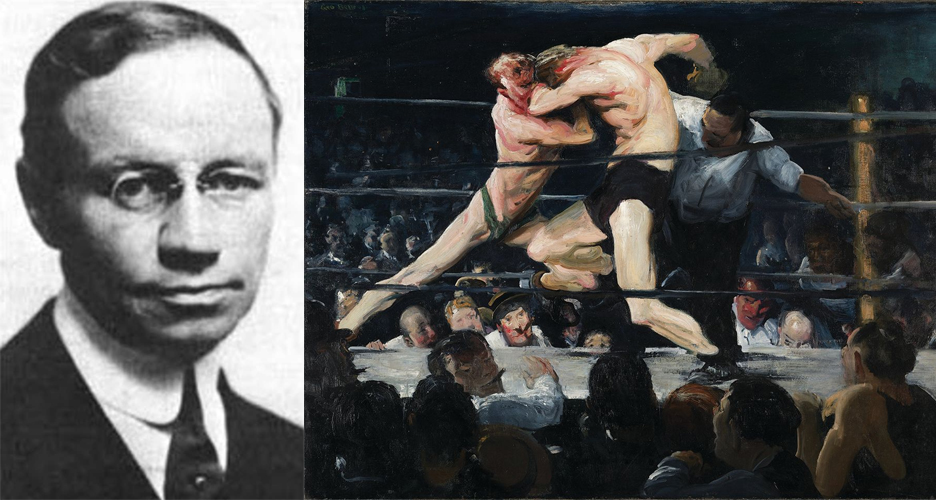
I’ve juxtaposed Croly’s meek-looking law clerk mien against George Bellows’s famous boxing painting (unveiled two years before Croly’s book) because there really is no better way to visualize the American individual’s relationship to its lumbering, venal, and often futile government. Croly’s solution is to call for all Americans to be actively engaged in a collaborative and faithful relationship with the nation: “to accept a conception of democracy which provides for the substantial integrity of his country, not only as a nation with an exclusively democratic mission, but as a democracy with an essentially national career.” On its face, this seems like a reasonable proposition. We all wish to belong in a democracy, to maintain fidelity to our country, and to believe that the Lockean social contract in which the state provides for the commonweal is a workable and reasonable quid pro quo. But it is also the kind of orgiastic meat and potatoes mantra that led both Kennedy and Reagan to evoke mythical American exceptionalism with the infamous “shining city upon a hill” metaphor. Dulcet words may make us feel better about ourselves and our nation, but we have seen again and again how government inaction on guns and a minimum wage that does not reflect contemporary living standards demands a Black Lives Matter movement and a “fight for $15.” And when one begins to unpack just what Croly wants us to give up for this roseate and wholly unrealistic Faustian bargain, we begin to see someone who may be more of a thoughtful and naive grandstander than a vital conceptual pragmatist.

Croly is right to demand that America operate with a larger administrative organ in place, some highly efficient Hamiltonian body that mitigates against “the evil effects of a loose union.” He smartly points out that such evils as slavery resulted from the American contradictions originating in the strange alliance between our poetic Jeffersonian call for Constitutional democracy and individualistic will and the many strains of populism and nationalism that followed. In his insistence on “the transformation of Hamiltonianism into a thoroughly democratic political principle,” Croly is suspicious of reformers, many of which he singles out in a manner strikingly similar to Norman Mailer’s “Quick and Expensive Comments on the Talent in the Room.” He calls William Jennings Bryan an “ill conceived” reformer, claims the now nearly forgotten William Travers Jerome to be “lulled into repose” by traditional Jeffersonian democracy (never mind Jerome’s successful crusades against Tammany Hall corruption, regrettably overshadowed by his prosecution of Harry K. Thaw during the Stanford White murder trial), interestingly pegs William Randolph Hearst as someone motivated by endless “proclaimation[s] of a rigorous interpretation of the principle of equal rights,” and holds up Teddy Roosevelt as “more novel and more radical” in his calls for a Square Deal than “he himself has probably proclaimed.”

But Croly’s position on reform is quite problematic, deeply unsettling, and often contradictory. He believes that citizens “should be permitted every opportunity to protest in the most vigorous and persistent manner,” yet he states that such protests “must conform to certain conditions” enforced by the state. While we are certainly far removed from the 1910 bombing of the Los Angeles Times building that galvanized the labor movement, as we saw with the appalling free speech cages during the 2004 Republican Convention, muzzling protesters not only attenuated their message but allowed the NYPD to set up traps for the activists, which ensured their arrest and detention — a prototype for the exorbitant enforcement used to diminish and belittle the Occupy Wall Street movement a few years later. Croly believes that the job of sustaining democratic promise should, oddly enough, be left to legislators and executives granted all the power required and sees state and municipal governments as largely unsuccessful:

The interest of individual liberty in relation to the organization of democracy demands simply that the individual officeholder should possess an amount of power and independence adequate to the efficient performance of his work. The work of a justice of the Supreme Court demands a power that is absolute for its own special work, and it demands technically complete independence. An executive should, as a rule, serve for a longer term, and hold a position of greater independence than a legislator, because his work of enforcing the laws and attending to the business details of government demands continuity, complete responsibility within its own sphere, and the necessity occasionally of braving adverse currents of public opinion. The term of service and the technical independence of a legislator might well be more restricted than that of an executive; but even a legislator should be granted as much power and independence as he may need for the official performance of his public duty. The American democracy has shown its enmity to individual political liberty, not because it has required its political favorites constantly to seek reëlection, but because it has since 1800 tended to refuse to its favorites during their official term as much power and independence as is needed for administrative, legislative, and judicial efficiency. It has been jealous of the power it delegated, and has tried to take away with one hand what it gave with the other.

There is no room for “Act locally, think globally” in Croly’s vision. This is especially ungenerous given the many successful progressive movements that flourished decades after Croly’s death, such as the civil rights movement beginning with local sit-ins and developing into a more cogent and less ragged strain of the destructive Jacksonian populism that Croly rightly calls out, especially in relation to the cavalier obliteration of the Second Bank of the United States and the Nullification Crisis of 1832, which required Henry Clay to clean up Jackson’s despotic absolutism with a compromise. On the Nullification point, Croly identifies Daniel Webster, a man who became treacherously committed to holding the Union together, as “the most eloquent and effective expositor of American nationalism,” who “taught American public opinion to consider the Union as the core and crown of the American political system,” even as he offers a beautifully stinging barb on Webster’s abolitionist betrayal with the 1850 speech endorsing the Fugitive Slave Act: “He was as much terrorized by the possible consequences of any candid and courageous dealing with the question as were the prosperous business men of the North; and his luminous intelligence shed no light upon a question, which evaded his Constitutional theories, terrified his will, and clouded the radiance of his patriotic visions.”

But Croly also promulgates a number of loopy schemes, including making representative legislatures at any level beholden to an executive who is armed with a near tyrannical ability to scuttle laws, even as he claims that voters removing representatives through referendum “will obtain and keep a much more complete and direct control over the making of their laws than that which they have exerted hitherto; and the possible desirability of the direct exercise of this function cannot be disputed by any loyal democrat.” Well, this loyal democrat, immediately summoning Lord Acton’s famous quote, calls bullshit on giving any two-bit boss that kind of absolute power. Because Croly’s baffling notion of “democracy” conjures up the terrifying image of a sea of hands raised in a Bellamy salute. On one hand, Croly believes that a democracy must secure and exercise individual rights, even as he rightly recognizes that, when people exercise these rights, they cultivate the “tendency to divide the community into divergent classes.” On the other hand, he believes that individuals should be kept on a restrictive leash:

[T]hey should not, so far as possible, be allowed to outlast their own utility. They must continue to be earned. It is power and opportunity enjoyed without being earned which help to damage the individual — both the individuals who benefit and the individuals who consent — and which tend to loosen the ultimate social bond. A democracy, no less than a monarchy or an aristocracy, must recognize political, economic, and social discriminations, but it must also manage to withdraw its consent whenever these discriminations show any tendency to excessive endurance. The essential wholeness of the community depends absolutely on the ceaseless creation of a political, economic, and social aristocracy and their equally incessant replacement.

There’s certainly something to be said about how many Americans fail to appreciate the rights that they have. Reminding all citizens of their duties to flex their individual rights may be a very sound idea. (Perhaps one solution to American indifference and political disillusion is the implementation of a compulsory voting policy with penalties, similar to what goes on in Australia.) But with such a middling door prize like this handed out at the democratic dance party, why on earth would any individual want to subscribe to the American promise? Aristocrats, by their very nature, wish to hold onto their power and privilege and not let go. Croly’s pact is thus equally unappealing for the struggling individual living paycheck to paycheck, the career politician, or the business tycoon.

Moreover, in addition to opposing the Sherman Antitrust Act, Croly nearly succumbs to total Taylorism in his dismissal of labor unions: “They seek by the passage of eight-hour and prevailing rate-of-wages laws to give an official sanction to the claims of the unions, and they do so without making any attempt to promote the parallel public interest in an increasing efficiency of labor. But these eight-hour and other similar laws are frequently being declared unconstitutional by the state courts, and for the supposed benefit of individual liberty.” Granted, Croly’s words came ten years before the passage of the Adamson Act, the first federal law enforcing a mandatory eight-hour day. But Croly’s failure to see the social benefits of well-rested workers better positioned to exercise their individual liberty for a democratic promise is one of his more outrageous and myopic pronouncements, even as he also avers how the conditions that create unrestricted economic opportunities also spawn individual bondage. But if Croly wants Americans to “[keep] his flag flying at any personal cost or sacrifice,” then he really needs to have more sympathy for the travails of the working stiff.

Despite all my complaints, I still believe some 21st century thinker should pick up from Croly’s many points and make an equally ambitious attempt to harmonize Hamilton and Jefferson with more recent developments. American politics has transformed into a cartoonish nightmare from which we cannot seem to escape, one that causes tax absolutist lunatics like Grover Norquist to appear remotely sane. That we are seeing a strange replay of the 1912 election with the 2016 presidential race, with Trump stepping in as an unlikely Roosevelt and Bernie Sanders possibly filling in for Eugene Debs, and that so many Americans covet an “outsider” candidate who will fix a government that they perceive as a broken system speaks to a great need for some ambitious mind to reassess our history and the manner in which we belong to our nation, while also observing the many ways in which Americans come together well outside of the political bear trap. For the American individual is no longer boxing George Bellows-style with her government. She is now engaged in a vicious MMA match unfurling inside a steel cage. Whether this ugly pugilism can be tempered with peace and tolerance is anyone’s guess, but, if we really believe in democracy, the least we can do is try to find some workaround in which people feel once again that they’re part of the process.

Next Up: William Appleman Williams’s The Contours of American History!