Review: Due Date (2010)

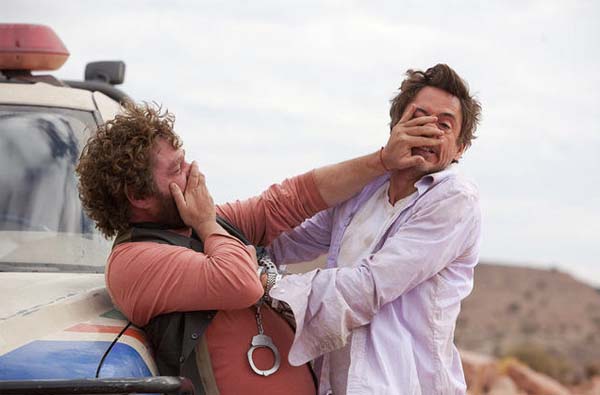
A comedy featuring a masturbating dog certainly hits the right stroke. Thankfully, there are capable hands behind Due Date, a gutsy and often side-splitting movie that further cements Todd Phillips’s rep as a comedy auteur far more interesting than Adam McKay and Nicholas Stoller. Like those two directors, Phillips often relies on stock situations – predominantly featuring men – to propel his unapologetically adolescent anarchy. Men in early middle age start a fraternity in Old School. Four men celebrating a bachelor party in Vegas can’t remember what happened the night before in The Hangover. And in Road Trip, The Hangover, and Due Date, it often takes a long drive to work out these lingering issues of rootlesness.

Despite all this late stage wandering, one detects a grown-up somewhere within Phillips. With his two most recent films, Phillips seems to be working the territory somewhere between Terry Zwigoff’s hilariously bleak assaults on the American climate and Seth MacFarlane’s free association. In The Hangover, Mike Tyson (playing Mike Tyson) factors into the plot. We see Carrot Top and Wayne Newton in the closing credits slideshow. In Due Date, the sitcom Two and a Half Men becomes a part of the story.* RZA turns up as a TSA man. .

Given such attention to the real and the imaginary, Slavoj Zizek could very well host a Lacanian kegger after taking in the Phillips oeuvre. (It’s worth pointing out that Phillips cut his teeth with the controversial documentary, Frat House, in which Phillips and co-director Andrew Gurland faced allegations that they paid fraternity members and staged several scenes.) But if Phillips’s films were only about this (and, more importantly, if his films weren’t flat out funny), they probably wouldn’t be worth considering. Any Family Guy viewer knows damn well that a promising installment often flounders when MacFalane’s writers rely too much on reference.

But Phillips has Zach Galifianakis’s Belushi-like presence to counterbalance all this. I enjoyed Galifianakis’s raucous mania in The Hangover, but felt that he had exhausted his possibilities in the HBO series, Bored to Death. It turns out that I was mistaken. Jonathan Ames’s lazy and ungenerous writing, which fails to view Galifianakis as anything more than a fat guy foil for Jason Schwartzman, was largely to blame. In Due Date, Galifianakis bustles as brightly as he did in The Hangover. The man has the talent to turn a physical gag on a plane with his belly into something that somehow makes us less aware of his physicality and more intrigued by his character. (Chris Farley was one of the few portly comic actors to do this as well: most notably in his famous Chippendale’s sketch with Patrick Swayze on Saturday Night Live.) As aspiring actor Ethan Tremblay, Galifianakis knows how to deliver his lines so that the audience is constantly recalibrating its estimation of Tremblay’s intelligence. (And in light of the film’s observations about underestimating people, and a nation that relies too much on swift judgment, this performance helps steer the film in the right direction.)

There’s a scene in which Galifianakis’s character is asked to perform material within a public restroom, so that he can prove to the disbelieving Downey that he’s a bona-fide actor. Tremblay delivers an unexpectedly poignant performance, using the edge of a bathroom stall as a wall. And this moment works on several interesting levels: (1) Todd Phillips is communicating to his audience that Galifianakis is more than just a funny fat man, (2) Ethan Tremblay is communicating to his snobbish white-collar traveling companion that he has some serious chops, (3) Ethan Tremblay is being asked to give it his all in a public restroom, quite possibly the most ignoble venue to prove himself (and the one you are least likely to see chronicled in the newspapers), and (4) the savvy symmetry between (1) and (2) gives Phillips some leverage to continue his exploration of the real and the fictional.

That all this is going on, while Phillips is presenting his populist audience with a genuine emotional moment, suggests very highly that the director who once gave us Starsky & Hutch has more moves than any half-literate moviegoer could have anticipated six years ago. How’s that for underestimation?

John Hughes’s Planes, Trains, and Automobiles serves as Due Date‘s obvious template. Yes, Phillips and his writers have taken the blue collar/white collar framework of Planes, updating the film to reflect a post-9/11 America. Yes, they have taken an actor known in part for his wackiness (here, Robert Downey, Jr., previously, Steve Martin) and made him grumpy and straitlaced. Yes, they’ve even taken whole lines from Hughes (“I have a winning personality”) and converted them over.

But Phillips has also paid close attention to what Hughes did so well visually in the motel room scenes: the blue colors for John Candy, the white colors for Steve Martin. In one notable moment from Planes, we see Martin grabbing a blue blanket covering Candy and putting it over his frame, a nice visual suggestion of class integration in a motel room bed (like the restroom moment in Due Date, also evocative of the dignity discovered within “low” environments).

Twenty-three years after Planes Trains, and Automobiles, the income disparity between the rich and the poor has worsened. So in Due Date, our white-collar protagonist now wears a purple shirt, as if his white collar had become somehow stained by blue-collar contact. (It is also interesting that, when Downey’s character breaks his arm, his cast is blue.) Meanwhile, the Tremblay character wears blue jeans (2010’s answer to Candy’s blue collar pajamas?) and a red shirt (post-Dubya assumption about red staters). Additionally, the pregnant white-collar wife stuck at home wears a pristine white sweater, bearing faint blue stripes. Is she imprisoned by class? Or is she besmirched by it? And what does it say that Downey’s character suspects a black man of having an affair with her? Might he be just as capable as Tremblay of rallying with an OBAMA = SOCIALIST sign? What does it say that Tremblay lets a “zebra baby” epithet slip from his lips that is entirely accidental? If our language and our actions remain under constant scrutiny, how then can we learn from our mistakes?

It’s a lesson that both sides can profit from. Because class lines are more ruthless than they were in 1987. In Due Date, the the yuppie is much meaner. At one point, Robert Downey’s architect character, Peter Highman, clips a kid in the stomach to get him to stop harassing him. Is this brutal solution a harbinger of fatherhood to come? (Or violent liberals to come?) Meanwhile, Ethan Tremblay commits far more destruction than John Candy’s Del Griffith. Forget Michael McKean’s cop. Phillips ups the stakes and brings in the border patrol. Minutes into the movie, Tremblay manages to get Highman on a no fly list. These skirmishes against authority make Due Date a more political film (think gleeful anarchism) than Planes, Trains, and Automobiles. But like Zwigoff’s movies, Due Date skillfully uses politically incorrect humor to defuse any hypothetical political agenda and thus make these considerations more palatable to the common man, which is very much where Due Date‘s heart is. And rightfully so. The reason why this movie works so well is because our fragmentation is more common than most of us are willing to accept.

* The use of Two and a Half Men is suspiciously well-timed, leading one to imagine an iniquitous PR flack, happily trading in misfortune for money, encouraging Charlie Sheen to engage in more headline-grabbing behavior right before the film’s release.

Review: The Girl Who Kicked the Hornet’s Nest (2009)

In my review of The Girl Who Played With Fire, I expressed my disappointment that writer Jonas Frykberg and director Daniel Alfredson had failed to include one moment relating to Billy’s Pan Pizza — that mysterious Swedish brand that could rev you up for a day of stealing motorcycles while your name was being smeared in the newspapers. While an unidentified pizza brand does factor into two moments of The Girl Who Kicked the Hornet’s Nest, the third film in the Millennium trilogy, I regret to report that these pizza moments fail to revive a cinematic snoozefest. One curious facet of the Millennium film trilogy is its inverse ratio to the books. As the books get better, the movies get worse. It’s a great disappointment to see our beloved Blomkvist played by Michael Nyqvist as if he is a narcoleptic. There were several times in which I felt compelled to brew a pot of coffee and send it through the screen. It’s also incredibly sad to see the page-turning trial scene transformed into commonplace courtroom drama, which isn’t helped by the film introducing a cost-cutting scene in which the judge orders all non-essential people to leave the courtroom due to the private nature of the matter. (Nice way to cut down on extras. But, man, does that grand courtroom look so lonely!)

The film appears to have suffered a severe shortfall in financial resources. It looks and feels cheap. Aside from the trial scene, it is so cheap that an early moment in the book, offering a reason for Blomkvist and Berger to spend the night at a hotel after some unknown nutjob has messed with Berger’s car, has been excised — presumably because the filmmakers couldn’t afford the car. The spontaneous decision for casual sex has no motivation (and furthermore, if it’s all for crass tits and ass, it’s seen off-screen!). During the press conference and paparazzi moments, there are laughably scant reporters covering this major news story. Larsson’s lurid book worked so well precisely because it demanded to be read as a pulpish opera. But little ambition can be found in this film adaptation.

Unlike the previous two films, the photography here is pedestrian, often containing little contrast or pizazz (this being a production originally made for television) save for a scene within the Constitutional Protection Unit in which cinematographer Peter Mokrosinski lights a cross on the wall behind Blomkvist and a window light hitting against the wall behind his interlocutors. These moody touches would have worked well, had there been more placed throughout the movie. Alas, it is not to be. For goodness sake, the novel constantly makes reference to “a glass cage” that Salander works in. Larsson, for all of his silliness, gripped us because of his hyper-specific detail, which often extended into the visual.

But it isn’t just the lackluster visual execution that sinks this movie. The film’s main problems are with Frykberg’s script. The compelling stalker subplot in the book, in which a creep is sending Berger emails reading WHORE, has been severely downplayed. Not only has the Svenske Morgon-Posten newspaper been eliminated (thus neutering the book’s competitive attitude about journalism, which nicely balances Salander’s redemption), but by merging the SMP subplot into Millennium, the total staff has been reduced to about four people. Thus, there’s hardly a threat or even a red herring (the lovely character Holm) for us to care about. And the stalker’s emails contain relatively silly messages compared to the book. Instead of the novel’s threatening messages (YOU’RE GOING TO GET FUCKED IN THE CUNT WITH A SCREWDRIVER. WHORE!), we get YOU SLEEP WITH THE LIGHT ON? ARE YOU SCARED? I get emails like that all the time. Not from enemies, but from friends. So when Millennium responds to these emails with hysterics, you have to wonder if some harmless YouTube cat video will be enough for them to file a restraining order.

The movie is better with Niedermann (that unfeeling giant who likes to sneak up behind family members and cheerfully announce, “Hello, little sister”) than the book is, balancing the blond titan better against the many subplots. But the women in this film aren’t nearly as badass as they are in the novel. (And on this point, screenwriter Frykberg doesn’t offer much of an alternative. Because he has watered down the subplots where women fight back, he has diminished the women — a strange choice in light of the novel’s curious gender politics. Oh well, let’s hope that Fincher and Zallian make this work, should they adapt the last two books into Hollywood movies.) Because the Berger stalker subplot has been toned down, we never get a chance to see her confront the man who’s harassing her. And because this is a cinematic medium, we don’t get anything close to Salander’s internal thoughts within the novel. She’s more of a laconic type who takes in what occurs around her when she isn’t using slings to stretch her legs against the bed (another cost-cutting tactic that cheapens Salander). This gives the perfectly capable Noomi Rapace very little to do. Sure, I liked her Goth appearance in the courtroom. But anyone who has read the book know that, with Salander, looks aren’t everything.

I enjoyed the first two films. But The Girl Who Kicked the Hornet’s Nest lacks the vitality that was there in the novel. It seems more of a contractual obligation rather than a fun pulp ride.

Why Devin Faraci is Unfit to Practice Journalism

I am generally quite supportive of fledgling cultural sites, both high and low. And it was with this spirit in mind that I took a quick peek at Badass Digest, a new venture run by the Alamo Drafthouse (a venue I wholeheartedly appreciate) and edited by a man named Devin Faraci, whom I now understand to be in the habit of berating people when he can’t get his way. I was unaware of Faraci’s history when I stumbled upon this erroneous report, claiming that director John Carpenter had “suffered a seizure at Florida’s Spooky Empire convention on Saturday October the 8th.” As someone who hopes that John Carpenter lives long enough to turn out a few more films, I was greatly concerned by this apparent “news.”

The problem was that Dread Central, the site that had initially reported this false rumor, got its news wrong. After someone named “Uncle Creepy” has posted the item, Carpenter’s wife had contacted Dread Central, informing the site that Carpenter did not have a seizure in Orlando and that he had collapsed from exhaustion. Dread Central had the decency to include this update (even if it did not change its misleading headline).

Badass Digest’s Devin Faraci didn’t change his headline either. Indeed, even at the onset, Faraci preferred reveling in the news with his tasteless headline, “Okay, Who Showed John Carpenter Rob Zombie’s HALLOWEEN?” (Never mind that, as interviews with both Rob Zombie and John Carpenter demonstrate, Carpenter urged Rob Zombie to make the film his own. One commenter in the thread would later point this out.)

I left this perfectly reasonable comment:

John Carpenter did not suffer a seizure. According to his wife, Carpenter had a flu and was exhausted. Dread Central updated its post. Please try doing some actual reporting (what real badasses do) rather than spreading misinformation like a common amateur.

Faraci responded in the comments:

Hi Ed. Rather than commenting like a common moron, maybe you could have noticed that this article was published on October 11th, before Dread Central updated its post. Yes, Ed, I was publishing content here before it was public. How embarrassing for you to be calling someone else out on an error when you’re in fact completely wrong. Or do you pick up copies of the New York Times from 2007 and become enraged that they refer to President Bush?

Ed, I hope you deal with the personal problems that would lead you to comb through a newly launched blog in an effort to deliver a correction. Or you can get fucked, whichever suits you best.

Never mind that I had observed in my comment that Dread Central had updated its post. I was aware that this was an October 11, 2010 item. But, on October 22, 2010, the item had not corrected the misinformation.

Indeed, as of today, the post still falsely states that Carpenter was “suffering a seizure.”

Why is this important? Well, let’s frame this as a crass thought experiment. Let us suppose that I am the “common moron” that Faraci suggests me to be. As a common moron, I am too busy to look up from my laptop to see that Faraci’s father is being raped with a night stick. Dread Central has reported that Faraci’s father is merely being kissed by another man. There is tangible experience before me that will help me to get a better handle on the story, if not aid the victim — namely, that Faraci’s father is screaming for help. But under the Faraci School, I must not believe anything else but a single source on my computer.

Just as there is a difference between “seizure” and “flu,” there is also a pivotal distinction between “raped” and “kissed.” Faraci’s father, in addition to recovering from a vicious rape that the insensitive “common moron” has failed to report properly (let alone assist in stopping), now has to spend a good deal of time attempting to clear up the misinformation that the alleged journalist has helped to promulgate.

Yet this is precisely the line of reasoning that Faraci promulgated in relation to John Carpenter. Had Faraci been an actual journalist, he would have picked up the phone. He would have called Carpenter’s people. He would have called the Spooky Empire convention. He would have contacted the hotel. He would have enlisted social networks to fish for eyewitness confirmation. He would have called the hospital. He would have talked to a doctor. In short, Faraci would have conducted actual reporting. Confirmation of rumors before reporting them.

All this would have made Faraci a journalist instead of some amateurish hack junketeer who screams at publicists like a petulant infant when isn’t given his rattle and who tells anybody calling out his slipshod standards to get fucked.

Rather than tell Faraci to get fucked, I have attempted to frame his incompetence through a crude patois he might understand. Let me attempt a more dignified approach.

Getting the details right are important. If you don’t believe this to be the case, then your blog — whether newly launched or well established — simply has no right to exist. You have no right to call yourself a news site. You have no right to be taken seriously by anyone.

For what it’s worth, I didn’t comb through Faraci’s site to find the Carpenter error. I stumbled upon it after devoting perhaps 30 seconds of my time to the site. But I think I will take up Faraci’s suggestion in an effort to demonstrate why he is unfit to practice journalism and why Badass Digest is deserving of either death or serious improvement (perhaps through a more capable employee than the incompetent Faraci).

Beyond the ignoble Carpenter gaffe, the real question here is just how much misinformation Devin Faraci can spread in one day. The unsurprising answer — based on going through a random day at Badass Digest (October 22) — is a quite considerable tally.

Adam Green post: Faraci erroneously refers to Hatchet II (Roman numeral) as Hatchet 2.

Green Lantern report: Faraci describes the forthcoming Green Lantern as “the most cosmic superhero movie ever,” proceeding to note that its “scope is so big it spans from the West Coast of the US to a planet at the center of the galaxy.” Aside from the needless hyperbole (which comes, apparently bought and purchased by studios, after Faraci had “visit[ed] the New Orleans set of the film”), if Faraci actually knew what the word “cosmic” meant, he’d understand that its extraterrestrial definition stands in sharp contrast to the earth itself, and that his vapid praise extends to misunderstanding the very modifier in question. But then Faraci is a guy so naive and unquestioning that he sees “life-sized cardboard cut outs of Tomar-Re and Kilowogg, the alien GLs who help train Hal Jordan,” and it never occurs to this incompetent that these cutouts might be red herrings to throw junketeers off. Has Faraci read the script? Has he talked with the director about this issue to get confirmation of Tomar-Re and Kilowogg’s appearances? He has not. But he has talked with the director, although not about any of the information he purports to be true (whether any of his hunches will prove to be the basis for the later report Faraci tends to file is a mystery, but his unwillingness to impart even one quote in support of his assertion should demonstrate his unquestionable indolence). Yet he is more happy to impart that “there was a Sinestro-themed cake for [Mark Strong] at lunch.” Journalism’s just desserts!

It also doesn’t occur to this profoundly naive man that he might have been invited to attend the set precisely because he had expressed his disappointment with footage at Comic Con 2010.

Faraci states that he got “the impression that Johns – the guy who has been writing Green Lantern’s comic book adventures for the past couple of years – was incredibly influential on the tone and direction of the movie.” But he never actually interviews Johns, who is standing right there, or anybody else to confirm that Johns’s Secret Origins storyline was part of the Green Lantern movie. In other words, Faraci is your typical rube taken in by flash and filigree. The writing equivalent of a baby elephant who jumps on his forelegs whenever he sees a bag of peanuts. The dog trained to salivate by Pavlov. One goes to Comic-Con to encounter dweebs like this. That they would believe themselves to be journalists merely by standing within five feet of a notable figure reveals the lax standards of present cultural journalism.

Of course, since “this isn’t the full report,” Faraci “can’t tell you too much.” Which begs the question of why he’s even bothered to file this piece in the first place. Journalism shouldn’t contain secrets. It should contain answers to questions. Quotes. Information that nobody else has. Confirmation of information. We get nothing even close to rudimentary journalism in Faraci’s blog post. But he’s happy to impart some “incredible concept art” that was given to him by the studio, urging his readership to “put this stuff on the side of a van” rather than parse it. Faraci, the used car salesman in action.

Over the Top toy story: Faraci’s lede: “Remember when Sylvester Stallone’s arm wrestling opus Over the Top changed the world for professional arm wrestlers everywhere? Probably not. In fact, if you think about cinematic arm wrestling at all you probably think about The Fly, which came out the year before, and had Jeff Goldblum snapping a fellow’s armbone [sic] through his skin during a heated bar match.” An “armbone,” eh? Is it the humerus? The forearm? Aside from the wretched prose, one is stunned that Faraci would be incapable of being more specific bout what is snapped — particularly since Brundlefly snaps his opponent’s wrist.

This lede offers some clues as to Faraci’s motivations. Here we have an aging man motivated by cinematic nostalgia, circa 1986 and 1987, that most adults have forgotten. (This pathetic nostalgia is also in place when Faraci appraises Black Francis as “one cool guy.”) Indeed, the nostalgia is so contagious that Faraci has only an approximate idea of what he’s seen rather than a working knowledge of it. Then again, this is the same misogynist who writes, “So what did you think of Paranormal Activity 2? Were Katie’s boobs as good as the first?” It is unclear whether Faraci is referring to the actress Katie Featherston or her character. One gets the discomfiting sense that this boob-hunting boob is probably referring to the former. As Joanne McNeil suggested back in September, “If you do something sexist, I think you are as dumb as the creationists. In some cases maybe even dumber.” (And Faraci says that I’m the one with personal problems.)

Faraci is indeed dumb as come. And that stupidity extends to more hypocrisy one post earlier when Faraci points to a double standard (indeed, the one that so many other journalists had brought up earlier in the day) between Mel Gibson being sacked from The Hangover 2 and Mike Tyson, a convicted rapist, appearing in The Hangover without a problem. How can a man, whose primary reason for seeing a horror film is to see if “Katie’s boobs [were] as good as the first,” even attempt to comment on such a moral issue? Faraci even closes his “editorial” by writing, “We love art and entertainment, not gossip and bullshit.”

“Were Katie’s boobs as good as the first?” The Green Lantern report laden with gossip and bullshit? Faraci’s feeble statement couldn’t be anything further from the truth.

Rabbit Hole trailer: “What else is it about? I don’t really want to know; all I need to know is that my buddy Scott Weinberg is quoted on the trailer giving effusive praise. And he’s a horror guy!”

More worthless speculation. Not only does Faraci announce how incurious and lazy he is in finding out more about the movie (“I don’t really want to know”), but the man is relying on a blurb from a suspicious review, in which Weinberg claims Rabbit Hole to be “flawless” and “quite simply, one of the best films I’ve ever seen at a festival.” Such over-the-top praise, coming from either a friend or a stranger, should make any real journalist suspicious. But Faraci, as has been clear all along, isn’t even a real writer. His puny excuse for a mind can’t even perform the most basic investigative inquiry, even if you pushed a pistol into his temple. His writing appears to have been purchased, whether by blind loyalty to a friend or blind loyalty to a studio. He doesn’t have the courtesy to link to Weinberg’s review to provide his audience with context. He doesn’t link to other reviews that might cast the film in a different light. Devin Faraci is no different from a hypnotized conformist staring into the camera, saying, “I loved it. It was much better than Cats. I’m going to see it again and again.”

Faraci also incorrectly italicizes Pulitzer. He refers to the Toronto International Film Festival as the “Toronto Film Festival.”

Spielberg a badass? If Faraci is seriously claiming Steven Spielberg, one of the most mainstream directors, to be capable of delivering “badass sci-fi,” then he clearly has no taste — particularly if he’s holding up War of the Worlds — a movie as safe as a turkey dinner — as a “badass” film.” (He makes no mention of Minority Report, which would arguably be more closer film to “badass” territory. This may be because, while Faraci apparently longs for 1980s nostalgia, his memory is worthless for any film in between what is instantaneously released and the movies he barely remembers from his wasted youth.) With typical illiteracy, Faraci doesn’t even mention Daniel H. Wilson’s name. Wilson is merely “the dude who wrote How to Survive a Robot Uprising, one of those 150 page, double spaced impulse buy novelty books that make people rich while you still work in a cubicle.” On the contrary, Wilson was a doctoral candidate at Carnegie Mellon’s Robotics Institute when he wrote the book. I’m also curious how someone can be an “ex-Buffy alum.” To my knowledge, Drew Goodard hasn’t renounced the widely regarded program which helped to kickstart his writing career. An alumni is a former member of an association. So Drew Goodard is merely a Buffy alum. Devin Faraci again demonstrates how little he comprehends the words he uses. He throws words around like a sad drunk walking into the kitchen and claims to be a culinary expert simply by recklessly swinging a hatchet.

The Spider-Man WTC poster: Once again, Faraci lets sensationalism preside over the facts. This time, he gets several facts wrong about a Spider-Man poster recall. The poster, issued before 9/11, featuring the World Trade Center reflected in Spidey’s eyes. On September 12, 2001 (not September 13, as Faraci claims), Sony issued a letter to theaters, asking:

Due to the devastating events that took place yesterday and out of respect for those involved, Sony Pictures Entertainment is requesting that all Spider-Man teaser posters and trailers be taken down and returned to the studio.

There is nothing in this statement to indicate that Sony wanted these posters to be destroyed, as Faraci suggests. But then what else can you expect from a man who uses the phrase “expense trailer?”

* * *

All of the above occurred during a 24 hour period. I shudder to think how many additional embarrassments I could find, should I decide to waste my life poring through this sad excuse for a website any longer. In one day, Faraci managed to misinform his readers, mangle the English language, fudge the facts, express casual misogyny, wiggle his sycophantic tongue in response to information he didn’t bother to investigate, get movie titles wrong, encourage his readers to blindly consume concept art that a studio fed him, wallow in nostalgia, and epitomize conformist opportunism at nearly every moment.

On August 19, 1896, when Adolph S. Ochs began to manage the New York Times, he published this announcement:

It will be my earnest aim that The New York Times give the news, all the news, in concise and attractive form, in language that is permissible in good society, and give it as early if not earlier, than it can be learned through any other reliable medium; to give the news impartially, without fear or favor, regardless of party, sect, or interest involved; to make of the columns of The New York Times a forum for the consideration of all questions of public importance, and to that end to invite intelligent discussion from all shades of opinion.

It is clear by the evidence that Devin Faraci is not only unwilling, but incapable of living by anything close to this credo. Here is a man who does not have exclusives. He cannot deliver the news impartially. He laps up any half-truth from the studios, living in fear that he will be ejected from screenings and garnering favor so that he won’t (which gives him license to shriek at publicists). He is utterly incapable of considering questions of public importance and, most importantly, incapable of inviting intelligent discussion from all shades of opinion.

Should Mr. Faraci decide to respond to the claims contained in this 3,000 word essay, and I certainly invite him to do so, it is doubtful that he will have much to offer beyond “you can get fucked.” And how does that make him any different from a common thug? How does such erratic behavior, such steadfast sloppiness, and such laughable entitlement make him any more qualified than some random guy plucked from a bar?

The answer is simple: By any standard, Devin Faraci is unfit to practice journalism in any form.

[UPDATE: An earlier version of this post, apparently loaded up from WordPress through a previous draft and not the correct one, misspelled Scott Weinberg’s name at one point as “Feinberg.” That error, noted by a reader, has been corrected. Additionally, Devin Faraci, despite the fact that he told me to “get fucked” on Badass Digest, has decided to ban me from commenting further on Badass Digest. He seems to think that I have started a fight with him or that I’m trying to drum up traffic. He is wrong on both counts. I don’t hate Mr. Faraci. I merely wish for him to examine what he is doing. But any kind of examination along those lines is outside his purview. Mr. Faraci has refused to respond to this article, claiming that I have mental problems and that this post is merely “an epic accounting of my typos.” He is wrong on both counts (again), but, to paraphrase Voltaire, I will defend his right to spout forth what he wishes. Unlike Mr. Faraci, I will let the readers make up their own minds about this article. And unlike Mr. Faraci, I will certainly not tell any commenter responding to this article to get fucked.]

[UPDATE 2: So I step away from the Internet for six hours to live my life, and I return home to find that Devin Faraci is accusing me of spamming his site. When, in fact, I haven’t visited it since he banned me. Again, Mr. Faraci demonstrates that he’s more interested in false accusations than pursuing facts, which continues to support my thesis that he is unfit to practice journalism.]

The Bat Segundo Show: Joe Dante

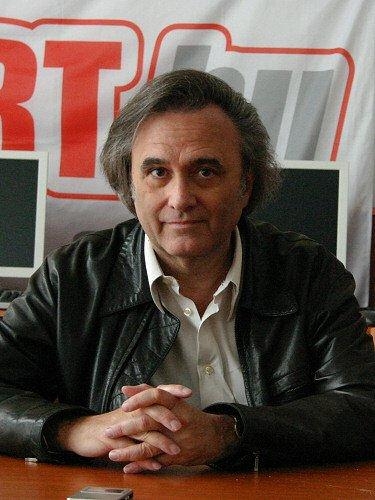
Joe Dante appeared on The Bat Segundo Show #359. He is most recently the director of The Hole.

Condition of Mr. Segundo: Doing his best not to feed Mr. Dante after midnight or before 10:10 AM on October 10, 2010.

Guest: Joe Dante

Subjects Discussed: [List forthcoming]

EXCERPT FROM SHOW:

Correspondent: I want to talk about the inside jokes. There are a few in The Hole. I noticed the yellow smiley face from The Howling in the background at one point. But it seemed to me that you were almost dialing down the inside jokes within the shots with this movie.

Dante: I did. Because, at heart, it’s kind of a sad movie, if you think about it. When you find out what’s in the hole, it’s much more melodramatic and personal than you would expect. It’s not little monsters coming out. And so the tone of the movie, it’s a little tricky to do a lot of those nudge nudge wink wink things, which I learned early on in my career. That you can’t do things at the expense of people who don’t know what you’re talking about. In The Howling, I had a scene in which Roger Corman looks for a dime in a phone booth. And it was funny to people who knew Roger. But when people didn’t know Roger, it was like, “Well, the scene is over. Why are you lingering on this extra piece? Because it didn’t mean anything to me.” And I realized that you can’t do that. You have to play within the rules. And if you do something that’s off the point, it should be done as an aside or in the background or as a tail — so that people maybe notice the second time when they see the picture.

Correspondent: Well, this is interesting. You’re talking about a lingering moment. And this leads me to wonder if it’s more difficult these days — not just from a financial standpoint, but also from an aesthetic standpoint — for you to convince a producer to give you work. Because your movies do, in fact, linger on that beat. Like that Corman moment in The Howling you were just mentioning. I even watched your episode of CSI out of morbid curiosity, and I’m seeing all these really great Dante master shots that unfortunately are being butchered by the crazy editing that goes on with that show. So the question is: How can a guy like you, who is extremely skillful with these Panavision-like shots, the 70mm that you did in Explorers and the like — I mean, is this more of a tougher sell?

Dante: It’s not a tough sell. People hire me for various reasons. But when you sign on to do a TV series, you must adopt the style of the TV series. Now I can shoot the stuff any way I want. But I know that in TV, you do your cutting. You hand it in. And then you see it on TV. And it’s always different. Because the show runners come in. And they change it to the style that they prefer. So you shoot a lot of long takes. But you just have to give them enough material for them to turn it into what they want. It’s never an expressive job. You don’t really feel you’re putting yourself into it. Although as much as I could, I stuck myself into it. And I stuck people who were familiar to working with me in the show. And it was, I think, a little bit different. A little bit offbeat from the usual episodes of the show. But the problem with doing a show like that, there’s an overarching storyline that happened before you came and that’s going to continue after you’re gone. So there’s really not a lot of space for you to insert yourself. Because you’re doing a job of work. And you’re not the auteur of the show. The auteur of the show is the writers. Because they’re the ones who are mapping out this entire scenario. The great thing is if you can get in on the ground floor and get in on the pilot.

Correspondent: Yes.

Dante: If you do the pilot for the show, which I did for Eerie, Indiana, then you get to not only choose the cast.

Correspondent: You set the aesthetics.

Dante: You set the aesthetic and you get to influence the way the stories go and which direction they go. And even sometimes who’s hired to direct them. So that’s very creative and interesting and fulfilling. Doing one-offs is financially rewarding and a chance to work with a lot of talented people that you probably wouldn’t get to see otherwise. But it’s never like making a feature. It’s never like saying, “Okay, this is my movie.” And that’s why I prefer on TV to do anthology shows. Because it’s much more like doing a short film than it is to coming in and doing it. Illustrating an episode of somebody’s series.

Correspondent: Is it also a way of staying in shape so you don’t atrophy?

Dante: Well, it’s also a way of paying the mortgage.

Correspondent: (laughs) That’s true. That’s really the reason you did the CSI: New York episode.

Dante: Uh, I did it because it would be fun. But also, yeah, I did it because I wasn’t working. The great thing about Eerie, Indiana was that if I was going a feature, I could do that. I could go away and then do more Eerie, Indianas. But then it went off the air. And then I couldn’t do that anymore. So the trick is to try and find a way to keep yourself employed that doesn’t turn you into a hack. Basically. I mean, I always try and do things that — for movies, my yardstick is I don’t make movies that I wouldn’t go see. And I think if more people did that, we’d have better movies.

The Bat Segundo Show #359: Joe Dante (Download MP3)

This text will be replaced

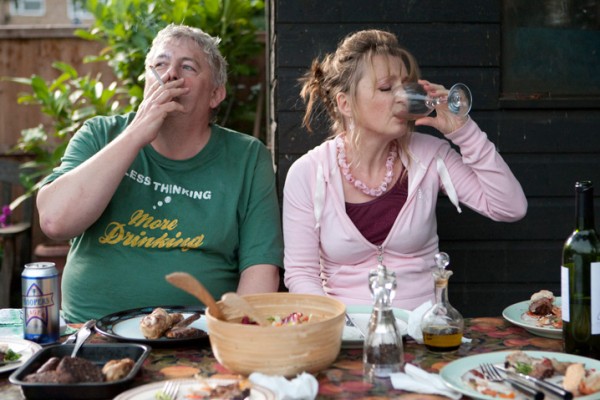
NYFF: Another Year

[This is the tenth in a series of dispatches relating to the 2010 New York Film Festival.]

“I’m concerned in making films that talk to people. Like anybody, I only want to talk to anybody who wants to listen, who wants to know, who wants to share, or have a conversation with me, as it were. I can’t deal with the kind of media-obsessed, decadent position that can’t decode the film for what it actually is. Which is to say an open, honest look at real people and how real people are, with their needs and all their vulnerabilities. Warts and all. If you can’t embrace that, then go away basically. You’re quoting people at Cannes. Journalists, no doubt, who say that these are people I wouldn’t want to meet at a cocktail party. Well, you know, you’re not going to meet these people at a cocktail party. Clear off to the cocktail party and don’t worry about this sort of film. Because you’re not interested basically. And if people are not interested, I can’t do anything about it.” — Mike Leigh, in a soon-to-be-aired Bat Segundo interview conducted on October 4, 2010

It is a ubiquitous truth that distinctive art often polarizes. But Mike Leigh’s films often cause some of the more catholic critics to reveal their unadventurous sensibilities. (One of Leigh’s masterpieces, Naked, was, by way of depicting particularly nasty behavior, declared misogynist.) While there’s nothing wrong with responding to a movie like one of Harry Harlow’s monkeys from time to time, a cinema intake composed of nothing more than genetically modified bananas will inevitably cause an otherwise sound mind to bray for his cloth mother.

Yes, I’m a Mike Leigh fan, but not slavishly so. Topsy-Turvy is overlong, but quite admirable in its historical ambition. (And it was absolutely the film Leigh needed to make to get to his next “historical” film, Vera Drake, which is one of his masterpieces.) Secrets & Lies, for all of its brilliance, resolves too tidily. I’ll take Abigail’s Party over Life is Sweet, even though I revere both flicks (and enjoy Alison Steadman in both). But aside from these very minor complaints, Leigh’s characters — whether you like them or not — may be more realized than those of nearly any other living filmmaker.

As Leigh’s films have defiantly chronicled the human in an age more concerned with calculating clinging, certain critics have revealed their not so closeted misanthropy — in other words, an innate disposition towards an unchallenging and predictable type of film.

Yes, Mike Leigh’s latest film, Another Year, features a very sad and troubling character clinquant in dimension played by Lesley Manville. The cookie-cutter protagonists and antagonists you asked for are available at the multiplex, thank you very much.

But I’m convinced that Another Year‘s mixed reception at Cannes (alas, a few rumblings were overheard in the Walter Reade Theater) can be squarely divided between those who are interested in life and those who are not. For Another Year dares to show several sides to kindness, a topic that has been very much at the forefront of Leigh’s films since Vera Drake. Leigh seems to share the sentiment behind Kurt Vonnegut’s famous declaration from God Bless You, Mr. Rosewater: “God damn it, you’ve got to be kind.” But he’s also smart enough to understand that societal forces threaten to crush this human spirit. Thus, housekeeper Vera Drake sees her illegal abortions as an act of kindness (and receives no pay for this) and is almost incapable of perceiving her actions as wrong, even as her family and others attempt to explain why she’s in such trouble. Merciless government permanently transforms her. Happy-Go-Lucky, by contrast, sees a very happy character, Poppy, finding her natural temperament tested — particularly, by a humorless driving instructor — and is, even at film’s end, asked not to be so nice (or kind) to everyone. She defies this. And in Another Year — the first of Leigh’s films to be squeezed into a yearlong sectional narrative (although certainly not the first to concern itself with cyclical behavior) — the human spirit’s effort to flourish is very much determined by vocational expectations. (And, as my moviegoing companion and I agreed, one minute of Another Year contains more understanding of people than the whole of Jonathan Franzen’s Freedom.)

But let’s first consider the naysayers (with much gratitude to David Hudson for rounding them all up). The Hollywood Reporter‘s Ray Bennett complained that most of the film’s characters would be the type “whom you would go out of your way to avoid at a party.” Time‘s Mary Corliss offered similar sentiments: “All the actors make the most of their time before the camera; eventually a plot emerges and a narrative crescendo is reached. It’s real life, processed for the cinema in Leigh’s practiced style. But the real life it simulates is too often that of an evening that turns into an endless night with friends one wishes might just get their coats and get out.” Never mind that Bennett and Corliss fail to see certain advantages to “meeting” such apparently unpleasant people on film. Yes, they rightly compare Leigh’s film to a cocktail party, but they don’t seem to understand that a forty foot screen protects them from social immersion. The audience is not chatting up these characters, but Leigh presents them so vividly (the final look on one character at the end of a long dolly shot, Manville’s masterful head and shoulder bobbing as Mary, a widower’s laconic vernacular and the look in his eyes as he observes the madness around him; to cite just three) that it is nearly impossible not to lose yourself (as my moviegoing companion and I did, sitting still and mesmerized for 129 minutes) and feel that You Are There. And the idea of going to a movie, whether for entertainment and enlightenment, to have your worldview confirmed strikes me as antithetical to existence — diametrically opposed to why any enthusiast soaks up culture. In other words, why did these critics bother to go to Cannes anyway?

And then there’s Todd McCarthy’s schematic assessment via blog: “For me the film is obvious, schematic and lacking in interesting undercurrents or subtext.” Never mind that McCarthy is unwilling to describe what precisely that “obvious” and “schematic” perception is. But thankfully, his tepid criticism can be easily rejoined by what is contained within the movie.

You cannot call Another Year‘s Tom and Gerri “obvious” and “schematic,” because, despite the fact that this couple is somewhat privileged (an apparently stable marriage, reliable middle-class income from geologist Tom and counselor Gerri, a garden allotment, and so forth) and permits maladjusted people into their home with a kind of liberal guilt and empathy that may not be entirely reconciled, they do not offer any defense when friends ridicule Mary (over the fact that she doesn’t know the precise engine type in the used car she has just purchased). Gerri, despite being trained to recognize a narcissist, nevertheless permits Mary to crash into her family home with the same shaky skill she has behind the steering wheel. And when there is the inevitable skirmish during the autumn, Gerri still waits until the winter to state, “You have to take responsibility for your own actions.” Which is something she has been meaning to say all along. There’s also something slightly predatory about the way Tom and Gerri invite friends who are less successful than they are into their house, such as their old portly friend Ken, who appears in the summer, but is a few beers short of a cardiac arrest. Yet Ken, despite being lonely and unhappy, has refused retirement. He is content to “eat, drink, and be merry,” but, from the vantage point of Tom and Gerri, he is “better” than Mary by way of remaining employed in a more lucrative job. (Mary toils as a secretary; interestingly enough, at the same workplace as Gerri. When Gerri invites her for a drink, Mary says that she has only an hour to spare — the exact amount of time that she would devote to a patient) One is left wondering whether Ken would be in worse mental shape, were he to be toiling in a similar position as Mary. (In an ironic bit of casting, no doubt entirely unintentional, Leigh has cast Peter Wight as Ken. Wight played the security guard in Naked, who urged Johnny not to waste his life.)

Aside from this intriguing relationship between happiness and class, there is also Janet (played by Vera Drake lead Imelda Staunton), who appears at film’s beginning (in spring). She is a cautionary character and, if we are to look at Another Year as a cycle, she represents what Mary may very well transform into. Janet is depressed. She cannot sleep. She rates herself 1 on a scale of 1 to 10 on how she feels. And when we are first introduced to her, the camera initially concentrates on little else but Janet’s face. We gradually see more of the doctor who is treating her, and the first detail we notice is that the doctor is pregnant. Thus, Janet (like Mary) is very much consumed by her own internal world. Does society then have a duty to treat people like Janet and Mary? Is it “kinder” to retreat from miserable people (as the above mentioned critics clearly have) or to let them into your home with the hope that your kindness will help them figure life out?

Since this is a Mike Leigh film, there aren’t any easy answers. But the film’s commitment to such concerns is a much needed reminder for any humanist, whether lapsed or well-practiced. Another Year, like the best of Leigh’s films, is very much a Rorschach test. It will be appreciated and understood and felt by anyone who understands that even the unpleasant and the marginalized have souls. I haven’t even begun to scratch the surface of this considerably embedded masterpiece, but it’s definitely one of the year’s best films. And I’ll probably have another go at it just before release date. Anyone who compares Another Year to “an endless night” probably doesn’t have the guts to leave her cloistered comfort zone.