Review: [REC] 2 (2009)

Nobody seems to agree on the precise pronunciation of [REC]. And I haven’t even brought up the potentially controversial notion of pronouncing the brackets. (A throat-clearing sound?) I had been saying it wrek — in large part because I spent some of my childhood living in a sketchy apartment complex with a dubious “rec room,” and enjoy a little symmetry in my horror nomenclature. I talked with a friendly horror aficionado before the screening who insisted on spelling it out ar-ee-see, as if the title were an acronym. Another film critic pronounced it with a long e. I must presume that the film’s title, much like the film itself, is what you make of it.

But just how do you name a sequel in a franchise based around a camera button? [REC] Again has little zip, suggesting to the audience that they’ve made some mistake, perhaps missing the taping of some vital House installment. [REC] with a Vengeance insinuates that the button has become sentient, transforming into some mechanical Charles Bronson-style vigilante. (This wouldn’t be entirely out of line for the [REC] films, seeing as how the camera is just as much of a character in as the reg folks gone aggro.) In the end, writer-directors Jaume Balagueró and Paco Plaza have opted for numerical superscript for their sequel — much like the Aliens films. I am pleased to report that the camera perspectives do indeed live up to this squared sensibility.

For those of you who have no idea what the hell I’m talking about, you should probably check out the original [REC]. Unlike many mindless horror franchises, the [REC] movies feel as if the filmmakers have given serious thought to the environment. (Or perhaps they know how to improvise better. The Saw series’s endless “twists” — in which the Jigsaw Killer’s plan becomes increasingly more baroque and laughably improbable with each installment — have readily revealed the creative bankruptcy in milking a cash cow.)

But with [REC] 2, you may be just as lost as the survivors if you haven’t experienced the previous film. Made in 2007, the first [REC] is a pretty terrific little horror film that presents a zombie plague entirely from a single camera perspective. Like The China Syndrome, there isn’t any music. But the results aren’t obnoxious like Mike Figgis’s disastrous (and dated) Timecode — surely the last decade’s answer to Woodstock or More American Graffiti.

A cameraman and a television presenter named Angela Vidal — both filming a disposable reality TV series called While You’re Asleep — visit a firehouse to find out just what firemen do. Angela awkwardly asks the fire chief, “You’re the boss, right?” She puts on a firehat and a uniform, jumping about for camera-friendly frivolity. She suggests to another fireman she’s interviewing that the alarm should go off for full dramatic effect. There is a basketball game that is interrupted by an alarm, which takes yawning firemen and bored camera crew to an apartment building, where a zombie infection is underway.

Life, in other words, needs to be shaped into a juicy narrative by the camera crew. But the viewer is part of a different narrative, thanks to the unedited tape that comes with the epidemic. While this may seem to echo the setup of George A. Romero’s Diary of the Dead (more satirical), The Blair Witch Project (a narrative designed out of a savvy marketing strategy), and Cloverfield (the handheld gimmick used to present a pedestrian Hollywood narrative in a “different” way), [REC] works so well because the camera is instrumental in portraying the panic. When the camera is hit, the audio gets bumped right along with it. Near the end of the film, the camera must rely on night vision.

The camera crew makes desperate efforts to maintain some journalistic facade when sealed in the building by mysterious government forces, continuing to conduct interviews with the survivors. But these efforts soon dwindle as the need to survive becomes more pressing. As the environment becomes more unruly, the cuts between the camera being on and off tell additional stories. Where Diary of the Dead placed its faith in the idea that young people would continue to seek fame when there wasn’t much of an audience left, and where Cloverfield‘s camerawork often proved ridiculously stable near cantilevered edifices, [REC] considered how people would act to apocalyptic events and how the camera would be instrumental in conveying this behavior. And this approach, thanks to Manuela Velasco’s fish-out-of-water performance as Angela and the more naturalistic acting (for horror, anyway), strongly suggested that Balagueró and Plaza had carefully studied The Battle of Algiers (certainly a good deal more than the Blair Witch bunch, who should be commended for bamboozling the American public).

[REC] 2 doesn’t quite match the first film’s gripping suspense, but it comes extremely close. Like the first film, the behavior, dictated by the camera, changes through the movie. We’re introduced to soldiers who are rather by-the-book and not particularly insubordinate. The ostensible commander insists on recording everything. But as the film progresses, a more human element of fear and frustration creeps in, and, with this, a very pleasing sense of revolt that is perhaps best signified by the liberal use of firearms.

[REC] 2‘s narrative feels more like a Valve video game or the Sunday New York Times crossword puzzle — a journey to be filled in once you’ve explored the unknown space.

OBJECTIVES: 1. Get blood vial. 2. Go downstairs. 3. Find Patient Zero.

You get the idea. And if you can’t get behind this crass fun, then I sentence you to a lifetime of soporific Merchant-Ivory movies.

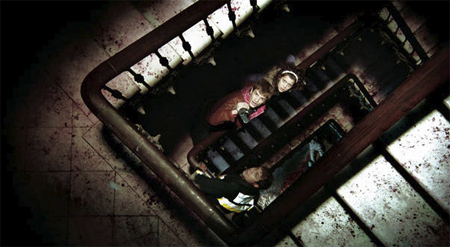
One POV shot, in which a soldier blows away zombies with a machine gun, comes across like a Left 4 Dead installment five years from now, with a better engine and more heat-sensitive hardware. There is a moment in which snipers shoot at the building that had me wondering if I was re-experiencing Half-Life 2. There is even a secret door leading to a bonus world, further cementing the gaming comparisons. Should cinema resemble a first-person shooter? In most cases, I would advise against it. But because the [REC] films are very much about playing with our narrative expectations with the camera-audience relationship, this cross-media mimesis somehow works. It wouldn’t work without the camera. And while sometimes this feels like a cheat, we are given enough unexpected developments to keep feeding in our quarters.

There are more cameras here than the first film — including several lipstick cams placed upon soldier helmets, reminiscent of the second Aliens film, that are occasionally patched into. There’s a second perspective emerging midway through the film. There are more characters — including a group of foolish teenagers. But there are also more opportunities for zombie destruction. Aside from some head explosions, there is also a very satisfying moment in which a zombie flails about with a bottlerocket in its mouth. At one point, when a zombie runs towards the camera, the image freezes on its quite open and terrifying mouth. The filmmakers also offer a greater attention to accumulating scrapes and bruises as our intrepid heroes are attacked.

If you can accept that [REC] 2 is a carnival ride, then you’ll probably like this flick as much as I did. I certainly enjoyed [REC] 2, despite all of its supernatural contrivances, considerably more than the boring art house film I’d seen earlier that day. And maybe that’s because Jaume Balagueró and Paco Plaza really love making movies — in a way that seems to have eluded the pretentious and the avaricious.

The Bat Segundo Show: John Waters

John Waters appeared on The Bat Segundo Show #342. Mr. Waters is most recently the author of Role Models.

(Considerable gratitude to Wayman Ng, who resuscitated this conversation from the data grave.)

Condition of Mr. Segundo: Comparing himself to unspecified reference groups in Mertonian social situations.

Author: John Waters

Subjects Discussed: [List forthcoming]

EXCERPT FROM SHOW:

Correspondent: You observe that listening to what Tennessee Williams has to say could save the reader’s life too. But how can Tennessee Williams save the life of, say, a humorless tax auditor?

Waters: They won’t read him. So I’m not saying he can save anybody’s life. But if the humorless tax auditor — and I actually know one tax auditor who does have a sense of humor.

Correspondent: Yeah.

Waters: If they read Tennessee Williams, maybe they could save their life. Maybe they would overlook one receipt that wasn’t exactly deductible for business if they thought the person was doing art.

Correspondent: Yeah. That’s true. In Role Models, you note that you drink every Friday night. Now in Crackpot, you observe that in your final year of smoking, you smoked only on Fridays.

Waters: Yeah.

Correspondent: Why would you confine vice to one day of the week?

Waters: Well, because the cigarette thing. Didn’t smoke. I used to. I haven’t smoked in — I write it down every day. I could tell you how many days. I’d have to look at my file card. But today — and even before then, I only smoked for three days. I fell off the wagon. But when I smoked every Friday night, it got to be — I couldn’t do that. Because at Thursday night at 11:59, I would light up and hotbox. Do you know what that means? Where you take one drag on a cigarette burn.

Correspondent: Oh yeah.

Waters: A carton! Like right in a row. So I learned that I can’t chip. I am an addict with cigarettes. So that’s why. Friday nights? Because I don’t work on Saturday. And every other ngiht’s a schoolnight to me. I write in the morning. I can’t write with a hangover. I can’t. And when I drank on Friday — I did smoking on Friday night because I knew that I didn’t have to work the next day. I was going to drink too. I might as well do it all.

Correspondent: This is your answer to Shabbos?

Waters: No. It’s just how I get through life really. That I’m very organized during the week. And as I said, I believe if you’re going to have a hangover, it should be planned on your calendar three weeks in advance.

Correspondent: But you can’t plan everything.

Waters: I do plan everything.

Correspondent: You do plan everything.

Waters: Everything! I never have a spontaneous moment. I don’t want a spontaneous moment.

Correspondent: Really.

Waters: Order is important to me. It brings me happiness. Which makes my assistants insane.

Correspondent: Really?

Waters: Yeah.

Correspondent: What do you do when a curveball shows up?

Waters: I plan. Well, a curveball? I deal with it. But I’m saying that I won’t not do something that’s going to be great fun because I didn’t plan it.

Correspondent: Yeah.

Waters: But I make sure that I have great fun planned so I don’t wait around for someone to knock on my door and give me great fun.

Correspondent: (laughs)

Waters: I go out to have great fun. And plan it.

Correspondent: Well, how rigidly do you plan your life?

Waters: Rigidly enough.

Correspondent: Are you like a senator?

Waters: Let’s just say…

Correspondent: Do you schedule when you shit? I mean…

Waters: No. But I usually do that around the same time too. And I get on an airplane. And I can adjust my watch to whatever time it is. Get off and be on that time. I’m organized, yes. But if something — you know, when I go out on Friday nights, something can happen. It’s not like I know what’s going to happen. But I have certain people I go with to different places. Because I don’t want to drink and drive. So I have a great pool that I go out with. And they’ll go to any weird bar. You’ve seen the bars I like to go to. There’s a whole chapter on that.

Correspondent: But I’m curious. Do you allot a two hour time to just go out and observe people? Or something along those lines?

Waters: Well, I’m always observing people. It doesn’t matter. On the subway, I’m observing people. I take the bus in San Francisco a lot to observe people. I watch people in airports get off the plane. I make up stories about every person. And if you look, the ugliest people get off first. They aren’t first class. The cuter they are, the worse seats they have on an airplane. It’s awful. It almost is foolproof. I know that sounds ridiculous. The poorest planners. The ones that lasted till the last minute and got the middle seat in the last row?

Correspondent: Yeah.

Waters: They’re cuter than the ones who are rich or smart enough to plan to use their frequent flyer miles to get one of the few seats available in first class. They’re never that good looking.

The Bat Segundo Show #342: John Waters (Download MP3)

This text will be replaced

Review: Cyrus (2010)

“What kind of comedy would you say that was?” said the man.

The marketing guy had observed my considerable laughter during the movie. While I don’t believe in withholding my emotional response within a screening room, and while I cannot in good conscience fall into that dishonest “Oh, I loved the movie!” mode practiced by certain joyless New York film critics judging a flick after observing the collective herd, my approach does run the risk of Bernaysian collisions.

“I’ll give you a hint,” I said. “Albert Brooks.”

Surely my insinuation would lead the man to remember the great film, Modern Romance, where Brooks played a film editor attempting to grapple with his romantic neuroses. Surely this mention would cause the gentleman to observe that John C. Reilly’s character was also a film editor, and just as neurotic as Brooks. Alas, Albert Brooks, as great as he is, cannot be called “box office draw” even after the most creative fudging of the numbers. Alas, this marketing man was more concerned with general taxonomies. This was hardly a matter of artistic comparison. It was crass bean counting.

“Well, is it black comedy?” he said. “Quirky comedy?”

“Psychological,” I replied, beating a hasty retreat to the elevator and hoping to consider my thoughts and feelings on the subway home.

I want to be clear that the man was perfectly nice and was only doing his job. But the idea that a “psychological comedy” — particularly one as well-made as Cyrus — can no longer be marketable is something I must object to. When we live in a world in which a self-serving BP executive bemoans wanting his life back and in which millions of unemployed individuals cannot find jobs (with their unseen plights ignored by media and government alike), it would seem to me that the need to convey American psychology is more pressing than ever. Not through marketing, but through artistic representation.

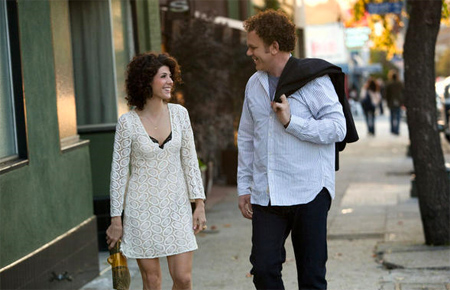
I am delighted to report that Cyrus lives up to this task. Written and directed by Jay and Mark Duplass, and featuring John C. Reilly, Marisa Tomei, and Jonah Hill in plum roles, Cyrus is one of the few American comedies in recent memory where the character dysfunction invites us to examine motivations rather than bask in base American Idol-style ridicule. It’s a great relief to see the Duplass brothers reclaim reality television’s handheld camera work for their film, which neither overplays its quietly empathic hand nor resists portraying embarrassing truths. This Duplassian commitment establishes itself with our first introduction to John (John C. Reilly), ostensibly in the midst of masturbation. “I have jock itch,” John explains to his ex-wife Jamie (Catherine Keener), who has showed up, unannounced, to check up. It continues when Jamie invites John to a cocktail party, where “people who will stimulate you intellectually” fail to do so. After our intoxicated hero strikes out with libidinous prospects, he goes outside to pee, meeting up with Molly (Marisa Tomei), who quickly responds, “Nice penis. Go ahead. Finish up.” But the two hit it off. They return inside. The Human League’s “Don’t You Want Me?” — which John considers to be “the greatest song” — causes John to dance and embarrass himself further. Molly joins him. Our two middle-aged heroes return to John’s, where John declares Molly “a sex angel.” John awakes to a note reading JOHN: THAT WAS AWESOME. CALL ME. And after Molly accepts an invitation that very evening to a home-cooked meal at John’s, an impromptu relationship is formed.

“My life is really complicated right now,” explains Molly. John drives out to Molly’s house the next morning to knock on her door. His efforts are interrupted by the titular Cyrus (Jonah Hill), who is revealed to be Molly’s son. Cyrus is a boomerang kid — one of those post-teens who clings to parental comforts rather than making a move in the real world. He’s pursuing a dubious music career involving avant-garde keyboard compositions. “Sounds like Steve Miller,” says John after Cyrus plays a sample. “No, it doesn’t,” replies Cyrus. But Cyrus has unspecified psychological problems and a morbid sense of humor. “Don’t fuck my mom,” says Cyrus, once the parental relationship has been laid out. “I’m just kidding,” he says next without skipping a beat.

The Duplass brothers are extremely effective in using our established ideas of these actors to their advantage. Jonah Hill’s warmhearted presence takes some of the edge off Cyrus. And because of this, we become tremendously curious about the hold Cyrus has over his mother. And if John were played by an actor other than John C. Reilly, we might interpret his morning drive to Molly’s home as stalking. Yet Reilly is so good at maintaining an avuncular balance between loneliness and a goodhearted nature that we accept his moves.

And while Marisa Tomei is extremely good in this movie, I’m wondering just how long she’ll be able to play the middle-aged woman who has seen it all and yet quietly accepts her fate. Cyrus follows The Wrestler and Before the Devil Knows You’re Dead in this line. And while these films have permitted Tomei to shine, I’m baffled as to why filmmakers haven’t centered their films around Tomei, rather than making her the supporting nurturer.

Perhaps the answer to that latter concern has much to do with the marketing man who accosted me during the closing credits. Fox Searchlight threw a considerable amount of cash attempting to promote Cyrus. In the week before its release, the film sponsored numerous WNYC programs. Pop-up ads invaded several major movie-related websites. Yet my conversation, which I felt compelled to note here in the interest of ethical transparency, would seem to indicate that today’s studios don’t see “psychological comedy” as an audience draw. That’s truly a pity. Because Cyrus demonstrates why it’s so important to pay attention to the smaller people around the corners. For their stories are often more fascinating than the loud explosions.

The Bat Segundo Show: Reed Cowan

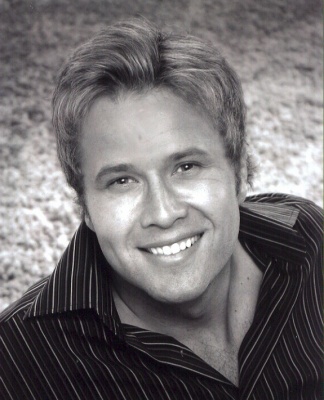
Reed Cowan appeared on The Bat Segundo Show #341. Mr. Cowan is most recently the director of 8: The Mormon Proposition, which opens in numerous theaters on June 18, 2010.

Condition of Mr. Segundo: Conducting investigations on Dick Van Pattern’s possible Mormon connections.

Guest: Reed Cowan

Subjects Discussed: [List forthcoming]

EXCERPT FROM SHOW:

Correspondent: I wanted to also ask about the box of secret documents. You don’t actually cite a source. And there’s no indication in the film that you made efforts to corroborate this with the LDS. Or to even contact the names that were possibly on the emails or the memos. I mean, I’m a viewer — let’s say — who is on the fence. I see this. There’s no provenance. Did you make any steps to confirm the provenance? And why isn’t this in the film? I mean, is there some sort of website component here that one can use to find authenticity?

Cowan: I’ve actually met the person with the documents out of the Church offices. Out of the archives. So there was some corroboration that went on there. And also, what a lot of people don’t know is that, during the federal case that’s going on right now, those documents were provided to the case as well. Which led to subpoenas of other documents from the Mormon Church. In those subpoenas, we were able to see that the documents the Church had to hand over correlated with the ones we have. So it’s a matter of court record, from my understanding with the people inside the trial, that they match.

Correspondent: Which court record is this? Which case?

Cowan: In the federal trial that’s going on right now. Perry vs. Schwarzenegger.

Correspondent: Okay. Got it. And speaking of which, I actually wanted to ask you why you didn’t cover Strauss vs. Horton — the three cases that were consolidated into the California Supreme Court. And the Supreme Court upheld Proposition 8. It would seem to me that that’s just as much a part of the story as the Mormon mobilization. And also the efforts to try and take Proposition 8 off the ballot that were again rebuffed by the California Supreme Court.

Cowan: Well, the thesis of our film is “8: The Mormon Proposition.” And so really the onus is on us to prove their strategy, right? And to prove to the audience how it came together, how the strategy was formed. And so we feel like we did that. And anything else is outside of that focus. And, you know, there’s so much here. I mean, you’re right. There is so much here that if the citizenry really wanted to see what’s going on, I mean, you could produce ten, fifteen hours of programming. Just in the federal trial alone. I mean, the fact that they are not allowing the testimony to be televised, to me, is sickening. And could be hours and hours and hours of documentary material that we could obviously add to the film.

Correspondent: Hours and hours of dramatization as well.

Cowan: Sure. Sure. But I don’t know an audience that wants to sit through ten hours of documentary. And so look for the books, I guess. Look for other documentaries. And I hope there are more made.

Correspondent: I’m wondering if you believe that any Mormon can believe in same sex marriage.

Cowan: I do. I know that some of my high profile Mormon friends believe that I have the same rights as they do. And I have the right to claim those rights. It would be surprising, I think, to a lot of Mormons to know that one of the most popular governors in the state of Utah, Jon Huntsman, and his wife Mary Kaye are dear friends of mine. Jon has now been appointed the Ambassador to China by President Obama. And they are very close friends of mine. And Jon Huntsman has gone so far in that state — now a lot of people wouldn’t like that he didn’t come out and advocate for marriage, but he advocated in that state for civil unions. And that was a huge step. And Mary Kaye said to me, “You realize why we took this stand and took the heat. It was because of you and your partner. It was because of our relationship and friendship with you.” So can Mormons get it? Absolutely. Absolutely.

Correspondent: Then I’m wondering why you didn’t profile, for example, Laura Compton, who started that site MormonsforMarriage.com. I mean, that seems to me a decided apostasy in relation to this particular issue. That not all Mormons are some sort of Borg-like collective.

Cowan: Yeah. You know, there were a few who did dare speak out. There were many who were punished in certain ways for speaking out. And that created a culture where they didn’t dare. So people like Laura are heroes. But again, the thesis was to prove “Look, this was their proposition.” It wasn’t the Catholic proposition. The Mormons were the man behind the curtain. And so again, I welcome any documentary who can profile her or the other few, the minority of Mormons who stood up for marriage equality. And continue to do so. And who are now crossing the aisle and seeing where the inequity happened.

Correspondent: Surely deflecting criticisms from the Mormon Church by having someone like Laura Compton in your documentary would have allowed, I suppose, for those sitting on the fence to consider the issue perhaps a little bit more.

Cowan: Maybe she would have provided a light that people could follow. But again that’s not what the film was about. The film was to show the inequity. Because that was the great wrong that happened. And, you know, in an hour and twenty minutes, that’s the time we had. The time we had to try to prove that case.

The Bat Segundo Show #341: Reed Cowan (Download MP3)

This text will be replaced

Review: The Karate Kid (2010)

Age has always been a dicey variable in the Karate Kid universe. In The Karate Kid, Part III — perhaps the most preposterous entry in the series — the 28-year-old Ralph Macchio passed himself off as a “kid” abandoning college, with his character dating the 17-year-old Robyn Lively (thus lending a creepy and statutory quality to the relationship). One of Daniel-San’s adversaries was the 27-year-old Thomas Ian Griffith, a scenery-chewing babyface who tried to pass himself off as a military man who served in ‘Nam with the 43-year-old Martin Kove. Meanwhile, the 57-year-old Pat Morita claimed battle experience for a war that went down when Morita was a preteen.

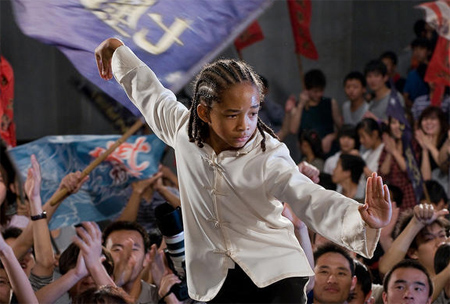
But these mathematical discrepancies are harmless solecisms when compared to the remake’s shaky moral framework. This time around, the “kid” is truly a kid — even if the “karate” is kung fu and not karate. (I must assume that Hollywood’s rule for any Karate Kid film is to get just one of the two right.) The martial arts here, a watered-down take on Yuen Woo-ping, are both hilarious and disturbing. Here is a film that asks us to celebrate Jaden Smith beating another 12-year-old in the face — a move that would surely have disqualified him from the 1984 original’s All Valley Karate Tournament — shortly after he has pinned his opponent on the mat. The remake’s aggressive sound mix invites us to revel in the bone-crunching prospects of children being thrown into the air and viciously attacked, demonstrating that America’s post-Guantanamo moral laxity has expanded considerably since Jack Bauer first waterboarded a suspect. And I’ll certainly be curious if some family values moralist emerges from the log cabin to condemn the film’s fondness for having kids beating the shit out of each other.

Here is a remake that imbues ridiculous infographics into the tournament finale, where digitized avatars of the participants rotate like some Ritalin-happy bastard progeny conceived between Mortal Kombat* and FOX News, and every round’s most violent moment is replayed for the crowd. This is all quite amusing, but it’s worth pointing out that John G. Avildsen only needed ringside cutaways, medium shots of the fighting, and Joe Esposito’s silly song, “You’re the Best” to generate suspense. (Watch that linked clip and you’ll see that Avildsen, who co-edited the movie, was smart enough to avoid long shots of the crowd. He photographed the tournament more as a vicarious experience. And because Robert Mark Kamen’s script was smart enough to layer Daniel’s predicament with serious stakes, we were very much invested in the outcome. It became surprisingly easy to forget that The Karate Kid was a film directed by the same guy who helmed Rocky.) The remake, by contrast, is more concerned with making the arena loud and large, rather than giving us ringside seats for a conflict that we hope will end all the needless violence.

Director Harald Zwart feels more compelled to give us spectacle with this remake. He scores some points with the supporting cast. If Jackie Chan’s Mr. Han can’t hold a thespic candle to the Oscar-nominated Pat Morita, Taraji P. Henson’s single mother is good enough to match Randee Heller in the original. (Heller was drawn to California for a computer job. But here’s one unsettling aspect of the remake. It’s intimated that Henson’s character, who has moved to China from Detroit and works in an “auto factory,” is a manager at some plant paying Chinese workers a pittance. I can only speak for myself, but the film’s inadequacies might best be expressed by the fact that I found myself far more troubled by this narrative aspect than anything that Jaden Smith was going through.) Even better is newcomer Wenwen Han as Meiying, Jaden Smith’s love interest, who displays a strong talent for expressing contained emotions, even if the material doesn’t give her the opportunity to slug a caddish boy in the face. (I feel compelled to point out that Lady Gaga’s “Pokerface” replaces Bananarama’s “Cruel Summer” for the film’s Golf N’ Stuff-like moment. This is an acceptable choice, but a DDR-like machine is hardly a substitute for a hockey machine’s conversational possibilities.) Zwart has a decent cinematographer (Roger Pratt) rigging some impressive Fincheresque dissolves between several shots using the same computer-controlled camera motion and opting for a more handheld feel for the coverage. Zwart is also sensible enough to hire a composer (James Horner) who is just as overblown (if not more so) than the original film’s composer (Bill Conti).

The problem here isn’t Zwart’s direction, but Christopher Murphey’s workmanlike script. While Murphey offers a few new spins on Miyagi’s “wax on wax off” training techniques and skillfully transposes many of the original film’s scenes (and even a good deal of the dialogue) into the new China setting, Jaden Smith’s Dre Parker isn’t nearly as winning as Daniel Larusso. Where Daniel was a decent kid from New Jersey who immediately introduced himself to a crazy old woman in the apartment building and brought her dog a bowl of water, immediately securing audience sympathy, Dre is more of a spoiled brat who drops his jacket on the floor, whines too much, and doesn’t even have Daniel’s soccer ball bouncing moves to impress the girl. (Instead, Dre, after attempting a vicious top spin move in a ping-pong match, gets his ass handed to him by an old man.) It also doesn’t help that Jaden Smith has an annoying habit of mugging for the camera. He rolls his eyes and folds his face to the spectator instead of inhabiting his character the way that Macchio did. Perhaps the charm Smith offered in The Pursuit of Happyness was less rooted in acting and more associated with being in close proximity to his real-life father. Whatever the case, in all my years, I never thought I would ever write the next sentence. I actually longed for Ralph Macchio.

Because of this, even though it’s more entertaining than most remakes, 2010’s The Karate Kid can’t come close to matching the original. And that’s because the 1984 movie was something of a masterpiece. Aside from the original’s clever method of using the Protestant work ethic as a pretext for “training” (one might make a case that Daniel’s dawn-to-dusk shifts are one of Hollywood’s greatest portrayals of efficacious slave labor), the movie was a sneaky parable about cultural appropriation. Kreese (the Martin Kove character), the military man turned dojo master, and the Cobra clan, with its Erhardian “No Fear! No Mercy!” mantra, not only presented us with a shameful bastardization of karate’s peaceful roots, but it certainly helped that Kreese, Johnny, and the various lieutenants acted like a cokehead asshole brigade. Miyagi lost his wife and daughter for reasons that involved a Japanese internment camp — one of the most disgraceful moments in American history. And the class divide between Daniel and “Ali with an I,” when taken with the feminism of Ali pursuing Daniel (rather than the reverse) and clocking the boorish Johnny, created an environment where hard work and a commitment to discipline could pull you through the American nightmare. Sure, these were Protestant values. But it did the trick for mainstream audiences.

But the remake has done away with most of this. Like Miyagi, Han has lost his wife and daughter. But it’s not rooted in historical precedent, and the scene is played out with Chan sobbing with overwrought tears. Avildsen was right to portray the moment in one long take, not have Miyagi break down, and center the scene around Daniel’s discovery. But in the remake, Dre exists to comfort Han. And the film itself exists to comfort the audience, who will instantly forget it.

All this is too bad. Because had the remake’s script considered the original film’s underlying principle — that resorting to violence is only applicable when there are no other choices — it might have packed a greater punch.

* — Maybe some reader can confirm this. This review has become much longer than I anticipated and I’m too lazy to look it up. But I understand that the first cultural usage of “Finish him!” originated in the 1984 version of The Karate Kid. Mortal Kombat then appropriated this phrase. And, sure enough, the phrase has returned to the 2010 remake. So the Mortal Kombat infographics do make a certain amount of sense. The only real surprise is that nobody thought to include this in 1994’s The Next Karate Kid, which appeared in theaters two years after Mortal Kombat enticed kids in video arcades.