Golden Hour

“Golden Hour,” which was shot at and around Riverside Park, is the third of what I’m calling my “anthropological films.” You can watch it above or click through to YouTube to see it in HD. (The series started with “Bubbles: A Consideration” and continued with “Dia de los Vivos.”) Like the other two films, this installment deals with certain glimpses of New York that most New Yorkers seem to ignore or fail to appreciate. This latest film chronicles aspects of how we live that were put into place decades ago by developer Robert Moses. (I recommend Robert A. Caro’s The Power Broker, if you’re not familiar with the subject.) But you don’t need to be know New York history to experience the film.

I plan to shoot a total of ten “anthropological films” before the end of the year. There may even be more, depending upon how deeply I plunge into these variations on a theme.

[UPDATE: I have created an “anthropological films” page for anyone who cares to chart the progress. I will update this page with additional information pertaining to the interconnected themes of these films as it becomes available.]

Review: Pleasure at Her Majesty’s (1976) and The Secret Policeman’s Ball (1979)

secretpoliceman

You know that cultural journalism is in a sorry state when only four people show up for a screening, and not a single dead soul (save for myself, still chortling with pulse) has the courage to laugh at legendary comedy material or get excited by consummate performers tinkering with sketches like tetchy scientists.

I was in a darkened theater for a film called Pleasure at Her Majesty’s, part of The Secret Policeman’s Film Festival, which kicks off this Friday at the Lincoln Center. The Festival even includes, for those cineastes saddled with an equine constitution, a full screening of the 660 minute film, A Conspiracy of Hope — essentially Amnesty International’s 1986 answer to Live Aid, but probably not up there with The Rolling Stones Rock and Roll Circus. Despite the hopeful title, you won’t find Freddie Mercury wowing at Wembley. This screening seems to be a wild gamble on the Film Society’s part. For who out there in New York is really interested in 23-year-old footage of Jackson Browne and Bryan Adams? (Then again.)

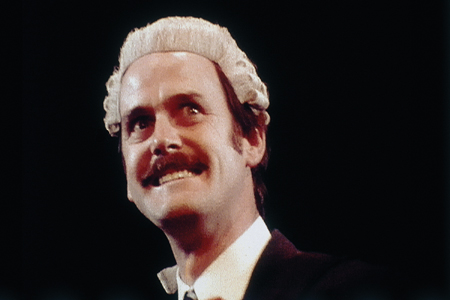
The common assumption is that, if an esteemed film society is holding something called The Secret Policeman’s Film Festival, you should probably check out the main film. But I’m here to tell you that you can probably skip the primary offering. The true can’t-miss movie here is Pleasure at Her Majesty’s, which features some fascinating behind-the-scenes footage of, among many geniuses, the Monty Python troupe (sans Eric Idle) rethinking the Courtroom Sketch. We see the Python team trying to pinpoint why the sketch doesn’t entirely work. They make changes. They argue. And even after they have performed the sketch later in the film and have received laughs, John Cleese walks off-stage and remains unconvinced that it worked with the audience.

This is fascinating if you’re interested in dramatic rhythm. And it isn’t just Python here. Deep division among the Beyond the Fringe performers is intimated in a conversation with Alan Bennett and Terry Jones, both seemingly unaware of the camera. “I could never do anything you do,” says a wan-faced Bennett. “The atmosphere with you is different. You don’t seem competitive in the way we were.” And we begin to wonder if Beyond the Fringe’s anti-authoritarian comedy was motivated by internal strife. At what social cost does one break new ground?

The Secret Policeman’s Ball, which doesn’t permit us these interesting peeks behind the curtain and features more music in the place of many comedy sketches, remains an enjoyable if badly dated film. The Amnesty organizers began changing the formula. And the contrast can be seen in the choices. Pleasure has Neil Innes’s delightful “Protest Song.” Policeman gives us Tom Robinson’s “Glad to Be Gay”: brave at the time, but precisely the kind of sanctimonious fury that Innes was satirizing.

In Policeman, Peter Cooks’s sendup of the Jeremy Thrope 1979 trial is funny, but only if you know all the scandalous details. It is indeed ironic that the very sketch Cook wrote in response to criticisms that the Amnesty shows contained nothing more than regurgitated material has secured its own time capsule. And the less said about Billy Connolly, the better.

On the other hand, one of Policeman‘s highlights is a wild and wonderful performance from a pre-Doctor Who Sylvester McCoy. McCoy hammers a four inch nail into his nose and attempts to dodge a toy train approaching his testicles with a fork while he remains chained to a chair. The late David Rappaport is even involved. McCoy’s antics, which involve jumping atop audience heads while wearing a kilt, are almost unthinkable today. McCoy — and Rowan Atkinson, who appears in an early version of his Schoolmaster sketch — presents the kind of free-wheeling comic anarchy no longer welcomed in our sanitized corporate atmosphere, where uncourageous Establishment types like John Hodgman stand before an audience, tell them the “clever” niceties they like to hear, and fail to challenge their assumptions. (Stephen Colbert, on the other hand, had stones.)

But Policeman stands in the shadow of Pleasure. Unlike Policeman, which features “slight direction by John Cleese,” Pleasure really permits us to see just how brilliant Cleese is on stage. A filmed version of a stage show limits itself by necessity to subjective camera angles, but the sheer authoritative energy that Cleese brings to the Dead Parrot sketch (with the line “This is your nine o’clock alarm call” added when he beats the parrot) is a marvel to behold.

Pleasure‘s vérité format permits us to witness a strange old boy’s world where John Cleese is seen with a McDonald’s cup of coffee in one hand and a cigarette in the other, and everybody is fiercely competitive. There’s one moment in which Jonathan Miller and Barry Humphries puff nervously on their smokes and bitch about who’s the oldest. Small wonder that it took a high-energy legend like Miller to corral these guys together.

But the lack of women in both films, aside from Eleanor Bron and Carol Cleveland, is unsettling. A few decades (and a few more Policeman films) later, women are now finally permitted to be funny, even when Christopher Hitchens declares that they aren’t. It’s just too bad that comedy remains shoehorned by the cobblers who wish to keep talent running inside the track. The Policeman films document a bygone era in which you could get crazy for a good cause. Perhaps it’s still possible today, if some innovator with deep pockets conjures up some charitable comedy that’s feral and progressive and inclusive.
Review: Dead Snow (2009)

deadsnow

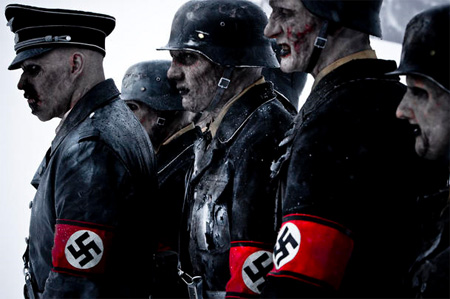
Earlier this year, numerous enthusiasts exploded in their pants over a movie that had not yet snagged American distribution. If you were among the throbbing throng to take in the trailer — yet another eyeball-attracting rite encouraged by the Internet’s discouragement of cultural apostasy — you may very well have shouted, “HOLY SHIT! NAZI ZOMBIES! WELL, PINCH MY EARS AND CALL ME A JELLY DONUT! I MUST SEE THIS MOVIE! I MEAN, IT EVEN HAS FUCKING SUBTITLES!” It was the geek equivalent of a thirteen-year-old boy wrestling with a nervous urge to jump any girl in the room, settling instead for the Oui centerfold that some trucker had left behind in a public restroom.

In hindsight, it was probably the subtitles that seduced us. Subtitles, on the whole, suggest rueful miscommunication or a strangeness extant only because we don’t speak the language. And with subtitles applied to a high concept like undead Einsatzgruppen, we conveniently forget the trash cinema innovators who came before. Tommy Wirkola’s Dead Snow is not the first movie to feature Nazi zombies. There was 1977’s Shock Waves, which featured Peter Cushing as a Nazi scientist hoarding SS zombies on a boat. Before that, there was 1966’s The Frozen Dead, which involved Dana Andrews holding onto the heads of Nazi war criminals alive to attach upon ripe bodies for a new Third Reich. (I find it someone surprising that Dana Andrews, a white bread actor who had all the appeal of stale toast, was one of the involved parties. This is a bit like expecting Tom Hanks to be the first Hollywood actor to penetrate an orifice in a Hollywood film.)

While filmmaker Tommy Wirkola includes literal and visual nods to the first two Evil Dead films, April Fool’s Day, Star Wars, Indiana Jones and the Temple of Doom, Braindead (aka Dead Alive), and The Simpsons, don’t let these flagrant pop cultural references fool you. Wirkola has robbed from the mausoleum of horror movies that passed on in 1981: Jean Rollin’s Zombie Lake (undead Nazis assaulting isolated setting, emerging here from the snow instead of a lake) and Jess Franco’s Oasis of the Zombies (army of Nazi zombies guarding gold).

Which is not to say that Dead Snow is bad. While the zombies arrive much later than they probably should and the early character development doesn’t quite compensate for the reduced early gore, there is ample intestine ripping and even a few funny lines. “We should have gone to the beach like I told you,” says someone just after the kids start dying. This time, the kids who meet Muhammad at the mountain cabin are medical students — a smart creative decision permitting the characters to take on death and hack off limbs without flinching or freezing up. (One character even stitches up his own neck.) There’s great potential in having more educated youngsters stand in for the usual libertine losers. Alas, the interesting early chatter of how to use spit to escape an avalanche subsides to the accustomed lackluster scenarios.

This is a movie that knows it’s a retread — a dependable retread, but a retread nonetheless. The kid dusting off the mountain cabin kitchen at the beginning could very well be Wirkola himself. The cabin resembles the Evil Dead cabin. Wirkola even mimics Sam Raimi’s chainsaw montage from Evil Dead II (minus the “Groovy”). And it’s often quite frustrating that these characters are developed through Hollywood references instead of human behavior. One wonders if Wirkola even understands young people. These kids actually complain about playing co-ed Twister, failing to consider the libidinous possibilities. Why play Twister? “Because Hollywood told us that it’s so much fun.” But is that line an actual joke or contempt? The movie’s token film geek, Erlend, wears a Braindead t-shirt throughout and is commanded by his peers to stop talking about movies for an hour. But at least he gets lucky in an outhouse. The Seth Rogen archetype has made its way to Norway.

Here is a movie that’s skillful enough to have someone dangling over a cliff with an intestine serving as a rope, but that doesn’t have the instincts to make any of its characters Jewish. (And wouldn’t that present some interesting conflict?) Yes, we do briefly see the remnants of a Nazi lair. And the Nazi zombie leader (named Herzog, perhaps in deference to the filmmaker now gutting Abel Ferrara) does order his soldiers to “arise” from the snow. But wouldn’t these zombies be infinitely more interesting if they tried to mimic behavior from World War II? It’s too easy to have the zombies simply hunt down these kids for gold. This movie might have had real guts — pun fully intended — if these Nazis attempted to carry out the Final Solution.

Of course, any horror movie that stops for a moment of Norwegian hospitality — with coffee unappreciated by the guest — can’t be entirely discounted. Wirkola himself is a hospitable filmmaker and he’s off to a good start. It’s just too bad that he isn’t nearly as cavalier as Don Edmonds — the wild director of the first two Ilsa films who passed away only a few weeks ago. With such audience-friendly horror as Nacho Vigalondo’s Timecrimes and Sam Raimi’s Drag Me to Hell seen in theaters in the past six months, Wirkola is going to have to work harder to make schlock horror fun and dangerous again.

Bubbles: A Consideration

On June 12, 2009, I attended a bubble battle in New York. But the event wasn’t really a battle — at least not in the traditional sense. Hundred of people who didn’t know each other gathered in Times Square to blow bubbles. It seemed like such a simple act, but it turned out to be so much more. And I hope that the above film, “Bubbles: A Consideration,” gives anyone who wasn’t able to attend a sense of the possibilities.