Review: Hey, Boo (2010)

Hey, Boo, a largely hagiographical overview of the great Harper Lee, has the finest cinematic aesthetic that 1986 has to offer. Or maybe with all of the talking heads, it’s the finest television aesthetic. I wasn’t surprised to learn that the film’s director, Mary McDonagh Murphy, worked at CBS News for twenty years. Unfortunately, this experience has translated into a indolent, superficial, and largely unhelpful film in which we get to see Oprah Winfrey tell us how she “devooooooooooooooured” To Kill a Mockingbird when she first read it. We must endure the unctuous Scott Turow, who has resembled an empty oil barrel both in look and intelligence since his divorce, commending Lee’s “bravery” in writing about race in 1964. But given the novel’s quiet and diligent origins (Lee given a check by her friends Joy & Michael Brown to write anything she wanted for a year, nervous first editorial meeting at Lippincott, two years of vigorous editing), wasn’t Lee’s purpose less about shaking up the social landscape and more about writing the best novel she could? Hasn’t Turow been around the block enough times to comprehend that writers, even those who pen masterpieces like Mockingbird, often become blockbuster successes by fluke?

You’d think that Murphy would question her subjects. After all, there’s no point in including big names unless they have something to say. (Even Wally Lamb, while offering quasi-generalizations about Scout being “an extension of a Huck Finn character,” comes across as fairly thoughtful.) But Murphy isn’t especially interested in nuance. Her narrative is damaged by her editor’s tendency to kill the mood, lopping off crackling moments just as they’re catching fire. When Murphy’s camera briefly escapes the studio and enters the field, I was genuinely stunned that the filmmakers had managed to get off their sedentary asses. Talking with kids about what Mockingbird means to them is a foolproof method of investigating Harper Lee’s durability. But just as these future readers are getting jazzed up, the editor then cuts back to the literary luminaries (which include Tom Brokaw, for some inexplicable reason) sitting in chairs, doing their best to sustain excitement as their collective wisdom is reduced to audience-friendly platitudes. Richard Russo begins telling an interesting story about his father, only for the tale to be killed at press of a button. (You don’t give Richard Russo the cane. You let the man talk. Especially when your “feature” documentary is only 82 minutes. If this is Murphy’s idea of inclusiveness, why did she bother to include it?)

Murphy is also fond of simplifying her story, perhaps because she is terrified by the prospect of challenging an audience. When Lee’s childhood friend Truman Capote is brought up, he is, of course, portrayed as an inveterate wastrel. But even accounting for Capote’s jealousy (which involved spinning prevarications that he had secretly written Mockingbird and that Lee’s mother was mentally unbalanced, even attempting to kill the young Lee twice), one cannot easily ignore that Capote was Lee’s best friend during a significant period of her life and that, contrary to the film’s insinuations, Capote and Lee reportedly stayed in contact up to the former’s death in 1984.

Lee, by contrast, is an angel who can do no wrong. It never occurs to Murphy (or her subjects, at least as they appear on camera) that Lee had her faults: her failure to complete books (including an In Cold Blood-like project she abandoned in the 1990s, never mentioned in the film), a refusal to suffer fools, and a sensitivity to anybody bringing up To Kill a Mockingbird in person. Efforts to reveal some of these complexities, an admittedly difficult proposition, can be found in Charles Shields’s Mockingbird. There are faults with Shields and his book, but the man has pounded the pavement. You’d think that Murphy would enlist him to be part of this project, but, rather tellingly, Murphy hasn’t interviewed him.

While we aren’t privy to Murphy’s questions, one senses that she has fired little more than softballs at her subjects. For fascinating figures such as Lee’s lively 99-year-old sister, Alice Finch Lee, this isn’t a problem. Alice speaks her mind, irrespective of the interlocutor’s deficiencies. But it does become a thorny issue when Murphy elicits answers from one especially sheltered Caucasian writer (“to be crying for a black man was so taboo!”) and when James Patterson, with typical hubris, compares his own hackwork to Lee’s (“Lee kept building and building and building. Obviously, I try to do this with my work.”). Such crass remarks demand that an interviewer call bullshit. But Murphy is a head nodder rather than a listener. When the distinguished Andrew Young says “not a lot of black people read” Mockingbird back in 1960, one wishes that Murphy had the capacity to pursue the bigger picture instead of waiting around for the power quotes.

BAMcinématek: Hal Ashby

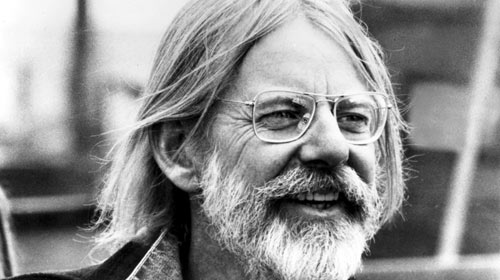
I don’t know if Hal Ashby is in serious danger of being forgotten. But judging by the scant attendance at two recent press screenings for an ongoing retrospective at the Brooklyn Academy of Music (now playing through May 24th), I suspect that the cineastes are tired of talking him up. And that’s really a goddam shame. I certainly don’t know anybody under 40 who speaks of Hal Ashby with the same gusto devoted to such active 1970s directors as Brian De Palma, Martin Scorsese, Stanley Kubrick, or even William Friedkin and Walter Hill. (They’re certainly not going to bring up Joan Micklin Silver or Gillian Armstrong. But I’ll save comments on this regrettable gender disparity for another essay.) But like Alan J. Pakula, the recently departed Sidney Lumet, and Bob Rafelson, Hal Ashby often gets taken for granted.

Ashby began his career as an editor, winning an Oscar for his work on In the Heat of the Night in 1967. Three years later, Norman Jewison told Hal Ashby that he was a director. Jewison produced Ashby’s first feature, The Landlord — an iconoclastic, hard-to-find, zany, and one-of-a-kind satire written by Bill Gunn in which a Southern gentleman (Beau Bridges) becomes the landlord of a tenement building (in the now gentrified Park Slope) and has an affair with one of his tenants. (Her boyfriend is involved with the black power movement.)

The Landlord is filled with scenes (starting at around the 0:50 mark in the above clip) where the wild premise, which deals with race, white guilt, and false notions of entitlement, is topped by something out of left field. In this case, the kid not only blackmails Bridges’s milquetoast landlord for two dollars, but, after securing the two bucks, he offers the landlord a cigarette and lights up one for himself. Yet Ashby stages the scene so innocuously — complete with the kid ordering, “Home, landlord!” — that it deflates any potential discomfort and allows the audience to confront and enjoy the behavior.

Ashby’s third film, The Last Detail, continues in this vein. The film follows two US Navy sailors played by Jack Nicholson and Otis Young, escorting the young sailor Randy Meadows (Randy Quaid) to a naval prison. Meadows has received a harsh eight-year sentence for the minor crime of stealing $40. So the two sailors decide to show Meadows a good time. Ashby decided to direct Robert Towne’s razor-sharp and beautifully profane script in chronological order, traveling the same route as the sailors. This not only allowed the inexperienced Quaid and Young to get their sea legs over the course of the production, but it encouraged the magnetic naturalism that we see in the moment above. Watch the way Ashby neatly aligns the sailors by height or the way Nicholson slaps himself on the side of the head, foreshadowing the great explosive moment.

To some degree, you could call Hal Ashby a faithful chronicler of very recent history. Bound for Glory, his faithful biopic of Woody Guthrie, is his only real period piece, but it’s also the first movie to use the Steadicam. But Ashby was very concerned with recent events. Consider the way in which 1975’s Shampoo reckons with 1968’s sexual politics or the manner in which 1978’s Coming Home approaches the same year from the vantage point of the Vietnam War, taking the interesting step of casting Jane Fonda (who protested the war) as a very believable military wife who sees her world change when she meets a disabled Vet played by Jon Voight. It’s possible that The Social Network‘s recent success had much to do with similar revisitations of recent history. But is there any director working today capturing the last ten years the way that Ashby did?

Ashby worked so close with his actors that he often had them work on the scripts. Warren Beatty co-wrote Shampoo. No doubt his womanizing added some authenticity to the hairdresser juggling numerous paramours. 1982’s Lookin’ to Get Out, in which Ashby fought the studios for final cut, was co-written by Jon Voight. The original version of this film, as cut by Hal Ashby and as discovered in 2009, is playing as part of the retrospective. While there’s a gripping showdown in a casino club room, and some thespic chemistry between Voight and Burt Young (including one great early moment where Voight plays the scene spooning soup from a can as his character confesses losing a great deal of money), the film suffers from an implausible storyline and too many incoherent moments.

Did Hal Ashby lose his artistic chops in the Reagan era? I don’t think so. The above confrontation between Jeff Bridges and Andy Garcia in 1986’s 8 Millions Way to Die (this underrated film has become so maligned over the years that I was truly shocked to see it in the BAM lineup) demonstrated that Ashby could take something as innocuous as snow cones and turn it into a quirky tension builder. It’s the little tics that build this scene: Garcia moving to straighten his tie, Garcia’s lieutenant hovering in the back, and Bridges curling his fingers just after taking a bite. But when Garcia explodes at Bridges, the moment is especially startling because of how tightly framed the three men are, along with the overlapping chatter. I also love the way Garcia dispenses with his snow cone (similar to the way he kills the cigarette at the beginning of the scene; this is a character who always needs to have something in his hands to destroy). Oliver Stone’s dialogue in this scene is a bit silly (“My fault. I’m sorry. I didn’t get laid today.”), but can one imagine such blocking and gestures in movies today? Every time I see this juicy scene, I want to tear every goddam kid away from making CGI movies on his computer and force them to work with the nuts and bolts of human nuance.

Review: The Beaver (2011)

When it comes to neglected narrative subjects, there’s no better figure than the middle-aged white male with disposable income and psychological problems. At least that’s the attitude a regressive moviegoer might have had in 1976, the year Jodie Foster appeared on screen as two altogether different characters using their bodies for altogether different purposes: Taxi Driver’s Iris, a teenage prostitute, and Freaky Friday‘s Annabel Andrews, whose body was occupied by her mother. Thirty-five years later, Jodie Foster has now directed a film called The Beaver that takes this dysmorphic approach to drama much further.

One morning, Walter Black (Mel Gibson), a depressed man who has run his toy company into the ground, begins speaking to his workers through a hand puppet. The voice is that of an apparent beaver, somewhere between Cockney and Australian. We are told that this is experimental puppet therapy, although nobody in the film considers Googling it. (Even assuming that these people are technologically illiterate, you’d think that the human resources manager or the insurance people would at least make a few phone calls when the CEO starts disseminating a dubious card. Given the film’s lack of logic, it’s almost as if this was set in….well, 1976. Which makes the appearances of Matt Lauer and Terry Gross in this film that much weirder and that much funnier.) We hear the beaver’s voice for the first time just after Black tries to kill himself in a hotel room.

Madness appears to run in the family. Walter’s son Porter (played by the excellent Anton Yelchin) is also something of an impostor, although he doesn’t require a hand puppet to uphold his craziness. He ghost-writes high school papers so that he can save up for a cross-country road trip to find himself before attending Brown University. But Porter also has this tendency to bang his head repeatedly against the wall. In one of the film’s many heavy-handed metaphors, Porter hides the hole with a map. In another heavy-handed metaphor, we see that the Black home contains numerous leaks. Walter’s wife Meredith (played by Foster) seems to accept all this without so much as a bat of the eyelash. I presume that her neglect has something to do with the fact that she is some kind of a structural engineer for rollercoasters. But this is rather spurious logic. I have known seemingly hippie mothers irresponsible in matters beyond the family who have stopped everything to repair a decaying home or take care of their children. And they have done this with meager income. Yet The Beaver isn’t quite brave enough to pursue this blatant hypocrisy. And that’s because, when it comes to women, this odd and creepy movie is also stuck in the 1970s, adopting the Diana Trilling position in Town Bloody Hall.

Women have two choices in this film.

(1) They remain quiet nurturers waiting for the men to relinquish their positions (such as Walter Black’s Vice President, played by Cherry Jones, who agrees to Black’s crazy plans without question, much like a glorified administrative assistant). They say absolutely nothing when men do stupid and crazy and reckless things. They are even willing to give up their bodies to men as they do stupid and crazy and reckless things, as we see during a sex scene in which Walter bangs Meredith in bed and in the shower while wearing the puppet.

(2) They must wait for the right moment to express some minor and only slightly fulfilling moment of rebellion. Meredith may think that she’s a “rebel” by designing rollercoasters, but it’s worth pointing out that we only see her doing this on her own time, when Walter is away. Likewise, Norah (Jennifer Lawrence) is a student who hires Porter to write her paper. Porter discovers that she was once a graffiti artist. But Norah has seen her younger brother OD. Crippled by grief, she is denied the ability to commit a rebellious act of artistic expression. She is understandably upset when Porter pushes her into tagging a building. But it is ultimately Porter’s grief that causes Norah to become the “rebel.” But if Meredith and Norah’s acts of “rebellion” are related to patriarchal encouragement, are they really acts of rebellion? In committing “rebellion,” aren’t they in fact doing so to nurture the men?

As a man who considers himself to be modestly enlightened, I believe this false dichotomy to be an unacceptable position in the 21st century. That this narrative worldview comes with psychiatrists and psychotherapists out of the picture is also strangely suspicious, more reminiscent of a Scientologist training video or a batshit circular disseminated by Jenny McCarthy. It’s certainly something you don’t anticipate from the seemingly wise mind who directed the not bad Little Man Tate and the astutely observed Home for the Holidays.

On the other hand, The Beaver is fairly entertaining as failed art. The movie is a curious blend between Lawrence Kasdan’s greatly underrated Mumford, in which an alleged psychologist moves to a small town and becomes popular just by listening to people, and Hal Ashby’s* Being There, in which a man becomes a media sensation by simply making the rounds. When Walter becomes a hit on the talk show circuit, and a toy product involving using one’s hands to construct wood becomes momentarily popular, the film shows a brief flash of sinewy satirical muscle. Unfortunately, because the film’s philosophy is so muddled, it never quite flattens the flab.

Part of this may have something to do with the privileged feel of the movie. I realize that I’ve spent a good deal of time railing against the film’s strange anti-women slant, but I should point out that I only developed such indignation after thinking about the film for a good week and a half. Still, when I saw the movie, it didn’t feel especially dangerous to me.

Even so, The Beaver does make you feel embarrassed for Mel Gibson, who, never mind the psychotic telephone conversations, doesn’t seem to understand that his day is now over. Earlier this year, Julie Klausner and Natasha Vargas-Cooper served up one of the best explanations for why this kind of man should no longer be depicted in present cinema. Klausner noted quite rightly that, viewed within the context of 2011, Warren Beatty is “a semi-soft erection of a towering skyscraper.” It’s too bad that Klausner hasn’t seen The Beaver. To jump off from Klausner’s metaphor, Mel Gibson can’t even get it up after downing five bottles of Viagra. He’s lucky that he still has friends like Jodie Foster, who seem to have no idea that they are closet enablers.

* — I feel compelled to point out that there is a Hal Ashby retrospective playing at BAMcinématek between now and May 24th. An essay on why Hal Ashby is important and why you should see him on the big screen is forthcoming, but I’m slightly behind on film coverage, largely because I am preparing for a 32 mile walk around Manhattan’s perimeter. Because the good folks at BAM were kind enough to let me sample some of the goods, I hope that this notice will suffice in the meantime. For the moment, I hope you will take my word that this is indeed a cool thing.

BAMcinématek: De Palma Suspense

If all De Palma films come from Hitchcock, then all words written about De Palma must originate from Pauline Kael. Kael once identified De Palma’s style as “a perverse mixture of comedy and horror and tension” that came with “a lulling sensuousness. He builds our apprehensions languorously, softening us for the kill.”

That’s a highfalutin and reserved way of ignoring one possible takeaway: if Brian De Palma were not a filmmaker, he may have ended up as some kind of felon. Indeed, so subtly disturbing is his imagery, murderously more so on the big screen, that one is tempted to give the man a movie camera before he hurts someone. I’ve had conversations with film buffs over the years and I’ve been relieved to learn that I am not alone in having these momentary thoughts. But “softening us for the kill” or speculative homicidal impulses don’t really permit us to understand De Palma.

Now thanks to a retrospective series that you can still catch at BAMcinématek, there’s an opportunity to see just how potent the man’s films are. There are three films left in the De Palma Suspense series. There’s Raising Cain, a somewhat unfairly condemned late period movie that Peter Travers once described as a “De Palma movie made by a forger who can barely conceal his contempt for the artist he’s copying.” But was De Palma mimicking Hitchcock or the Hitchcock pilferer he was always being pegged as? More promising than Raising Cain is the vibrant and elegant Femme Fatale, in which De Palma more successfully embodies homage into homage, including a brazen “seven years later” flashforward, a film festival within the film, and numerous cinematic archetypes.

But the last film still playing is Dressed to Kill, one of De Palma’s masterpieces. Its mixture of sex and violence proved to be too much for some audiences in 1980. It was protested by at least one group that declared in its circular: “DRESSED TO KILL ASSERTS THAT WOMEN CRAVE PHYSICAL ABUSE; THAT HUMILIATION. PAIN, AND BRUTALITY ARE ESSENTIAL TO OUR SEXUALITY.”

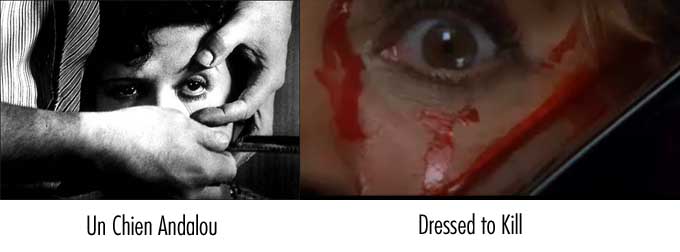
This is a misread, I think. One only needs to discern the manner in which the camera cranes in on a closing elevator door, catching the reflection of a woman being murdered, to see that voyeurism has much to do with this brutality. As the grisly scene plays out, we see (above) a connection to Un Chien Andalou. Yet while Dali and Bunuel were eager to slice the eyeball, De Palma does not. He leaves the razor there and slices the cheek. Is all violence equal in cinema? Or is De Palma’s razor the new tongue? If the latter, it’s a very twisted joke.

There is something valiantly creepy about De Palma’s films before Bonfire of the Vanities. It’s probably a mistake to ascribe some ethical code, whether religious or not, to movies that have the effrontery to depict atavistic human emotions. (I especially admire this attempt to comprehend De Palma through his lack of religious affiliation: “There is no indication that De Palma was an active churchgoer or member of an organized congregation or denomination as an adult.”) But the boldness cuts both ways, so to speak. One can feel unsettled by the needless punishment that Angie Dickinson receives for having an affair in Dressed to Kill (even as one remains dazzled by that movie’s museum scene), while also applauding the bravery in broaching intense father-daughter relationships in Obsession.

To some degree, this willingness to depict the unpleasant aligns De Palma with such iconoclasts as Lina Wertmüller (declared misogynist by many for Swept Away) and Dario Argento (whose hands have always portrayed the hands of any male murderer he depicts on screen). But by cementing human behavior in cinematic history, he’s suggesting something more dangerous and intriguing. In cinema, all emotion is valid. Cinematic language permits us to confront our darkest emotions in the smoothest of terms. If that is one method of appreciating his films, then it seems incumbent for any serious filmgoer to see his work on a movie screen. From what I understand, this is becoming an increasingly dicier situation. I am informed that Sisters requires forty to fifty thousand dollars worth of restoration work and that most of the prints, save two (owned respectively by producer Ed Pressman and MOMA), are largely faded.

Review: Arthur (2011)

Let’s say you’re a billionaire in your mid-thirties. You spend one evening banging three princesses, but you have no recollection of the orgy that transpired. In fact, there are many fleeting women in your debauched and privileged life. You even describe yourself as a metrosexual. Your image is frequently in the tabloids. You drink. But for the purposes of this scenario, that’s not important. What’s important is this: One night, you have a choice.

Option (A) You can spend the night with a woman who is dressed in a metal outfit, and who is somewhat drunk but lucid. She’s hiding in your bedroom, and your bed incidentally is a magnetic platform. She would like to give you a night of carnality, one that you didn’t expect. She has a whip. She declares herself a cat.

Option (B) You can spend the night with a woman who dresses in a childish polka dot dress, one whom your butler Hobson (played by Helen Mirren, who is phoning it in here) rightfully describes as “Minnie Mouse.” The second woman is nothing less than timorous. She marvels over the Pepe Le Pew cartoon playing in your private screening room. This woman, unlike another woman once played by Liza Minelli who stole ties and smoked cigarettes and encouraged mischief and dressed interestingly, is about as hot and dangerous as a dying titmouse squiggling in a glue trap.

Call me crazy, but I’m pretty sure that most men – unless they are gay, shy, highly introverted, or celibate – would choose Option (A). But Arthur, played by Russell Brand in his 2011 incarnation, chooses the second option.

Why doesn’t the Arthur remake work? Well, we can accept toothless director Jason Winer’s complicity in this implausible story logic. After all, Winer cut his teeth directing episodes of Modern Family, a television series so toothless that it did not included a moment in which its gay characters, Mitchell and Cameron, kiss on screen during its first season.

Yet when one considers that screenwriter Peter Baynham — a man who has worked alongside such accomplished comedians as Christopher Morris (The Day Today), Steve Coogan (It’s Alan Partridge), and Sacha Baron Cohen (Borat) – was involved, then it becomes necessary to pinpoint the insufficient hackwork of these scabrous sellouts.

Let’s say that you’re a calculating studio executive who misunderstands human nature (or a craven screenwriter known named Peter Baynham bending at the knees when offered a large bag of cash). Your mind is likely to come up with sentiments along these lines:

ROMANTIC COMEDY = WOMEN AUDIENCE
WOMEN AUDIENCE WANT NICE GIRL TO WIN
1981 SCRIPT HAS FEMALE CHARACTER
FEMALE CHARACTER IS APPEALING, BUT NOT ENTIRELY NICE GIRL
GEEK MOVIES = MONEY
WOMEN AUDIENCE = MONEY?
NICE GIRL + GEEK STEREOTYPE = MONEY + MONEY
SANITIZE ALL QUALITIES THAT NOT = NICE GIRL
????
MAKE MONEY MAKE MONEY
$$$$$$$$$$$$$$$$$$$$$!!!!!!!!!!!!!

Unfortunately, in your pursuit of money, you fail to comprehend that none of your reworking makes any fucking sense. Your decision to rethink the elements of the original Steve Gordon script that worked so well (an alcoholic wastrel discovers that love encourages his dormant empathy and pro-active behavior; he is more true to himself and doesn’t feel as alone) becomes something illogical (a wastrel, who is kinda alcoholic and not terribly active at anything, discovers that people will do his bidding with or without money).

Consider the beginnings of the two films. In the original, a drunken Arthur (Dudley Moore) rudely accosts two prostitutes from the window of his Rolls-Royce. We see that his chauffeur Bitterman also has to suffer through his terrible jokes, but isn’t merely a doormat. He actually resists Arthur’s commands. (Indeed, this inversion of class expectations was one of the reasons the originalArthur was such a hit.) Director Gordon is careful to instruct Moore to have his glass of scotch arched upward during his exchange with the prostitutes. Visually, we understand that this man has a drinking problem. Emotionally, based on Bitterman’s actions, we understand that he may be a decent guy when he’s away from the hootch. In the remake, Bitterman is seen squeezing into a Robin costume, with his paunch pushing out (thus, unlike the original film, establishing a lack of dignity). Arthur is dressed as Batman. The car that Bitterman drives isn’t a Rolls-Royce, but the Batmobile. What does this say to the audience? Visually, we have no clue that Arthur is an alcoholic. He comes across more as a spoiled brat and we can only find sympathy in the character through Russell Brand’s enormous energy. Emotionally, we are invited to laugh at Bitterman’s willingness to do anything to appease his master. (Just imagine the comic potential of Luis Guzman, the talented fast-talking character actor who plays Bitterman in the remake and who is needlessly wasted, upbraiding Arthur in ways that only the audience can perceive!) And because the character relationship is so predictable, we have little reason to care.

Russell Brand shouldn’t be blamed here, but he will if this movie tanks hard at the box office. The wild anarchy that made Brand such a draw as Aldous Snow in Forgetting Sarah Marshall and Get Him to the Greek is only here in spurts. Consider one moment in a prominent candy bar (deliberately unnamed to discourage product placement), where Brand, dressed in a gummy costume, is briefly seen swigging a flask while entertaining children. That split-second moment might have inspired some inappropriate comedy, but company man Winer (the Zack Snyder of comedy?) doesn’t want to upset his soul-sucking overlords and keeps Brand on a leash.

Even accounting for these limitations, Baynham’s script and Winer’s direction just isn’t capable or courageous enough to give the talented Brand an opportunity to develop a character. In the original film, Moore’s overbearing laugh always signaled to the audience that Arthur was drunk, and how Moore often drifted into lucidity. This careful telegraphing suggested a good-hearted man beneath the excess. The 1981 Arthur was brazen enough to drive to Queens while drinking from a brown bag. No such disastrous pro-active behavior from the 2011 Arthur, who has to be driven everywhere and doesn’t even know what Outlook is.

Yes, both films feature a moment in which Arthur hands his love interest a check and she rips it up. But the 1981 Arthur learns from that moment, while the 2011 Arthur does not. It’s understood in the 1981 version that Arthur will let Linda (the Liza Minnelli character) pursue her acting ambitions through her own initiative (the underlying assumption is that both Arthur and Linda will love each other outside of Arthur’s wealth, because they accept each other; Arthur is still a drunk at the end). But in the 2011 version, Arthur actually purchases Naomi’s dream, which is to become a published writer. I won’t even get into the film’s laughable ignorance of the publishing world, which had my moviegoing companion (a publishing reporter) and I howling. Let’s forget all that. If you’re a woman who has worked long and hard on a manuscript and has seen it accepted rather swiftly for publication, and you discover that the man trying to woo you (a man, incidentally, who has lied about having a fiancee) has had his company purchase your manuscript, can you honestly forgive him for deflating your shaky sense of meritocracy? (It doesn’t help that Naomi is played by the thespic cipher Greta Gerwig. She’s nothing less than a smiling doormat expressing nothing less than enthusiasm, even as Arthur downs loads of alcohol. She reminded me just how annoying Bonnie Langford was as the chirpy and clueless companion Melanie Bush on Doctor Who.)

Class, which guided the original Arthur, has been largely dispensed with. In 2011, “working class” means visiting a woman who lives off the elevated subway line. (The beauty of the original Arthur is that the rich only needed to mention the subway to taint it.) The 1981 film also allowed Bitterman to drop Linda off in front of her apartment complex, so that she could fool her neighbors and Bitterman could play mock chauffeur. This moment allowed both Linda and the audience to parse the frivolous nature of wealth. By contrast, the 2011 remake uses inflated excess as the basis for its romance, with Arthur wooing Naomi by closing off Grand Central and having a dinner at a table surrounded by rosebuds, with acrobats bouncing around on another level. What’s for dinner? Dispenser candy. If that isn’t romantic enough for you, then consider the many permutations of SpaghettiOs (never named, presumably because the studio couldn’t get Campbell’s to agree to shell out the chowder for product placement) that Arthur and Naomi eat for dinner.

The original Arthur offered a perfectly reasonable fantasy that one may find a comfortable adulthood while also keeping the inner child alive. By contrast, as the childish menu options I’ve cited above suggest, the remake is about how one’s adulthood is defined by being nothing more than a passive and entitled child. It’s a troubling sign that the Comic-Con geek mentality has crept into mainstream romantic comedy. What the filmmakers don’t understand is that fantasies must have some element of reality in order to persuade. But Arthur, much like its protagonist, gives nothing to the audience. It is a spoiled movie written and directed by spoiled people who deserve to be sent to the poorhouse.