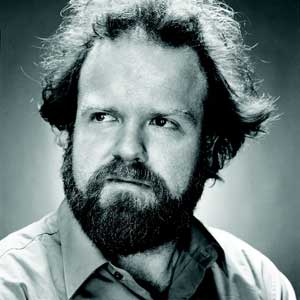
Ander Monson appeared is most recently the author of Vanishing Point, as well as a poetry collection called The Available World, which nobody had thought to send to Mr. Segundo’s motel room. Contrary to photographic evidence, Mr. Monson does not have a beard.
Mr. Monson previously appeared on The Bat Segundo Show #21, just before Mr. Segundo had finally switched over from Betamax to VHS.
Listen: Play in new window | Download (Running Time: 47:55 — 43.9MB)
Condition of Mr. Segundo: Pointing at the designated vanishing spot.
Author: Ander Monson
Subjects Discussed: [List forthcoming]
EXCERPT FROM SHOW:
Correspondent: The subtitle for this book is “Not a Memoir.”
Monson: Yes.
Correspondent: Is it safe to say that you’re not a writer and I’m not a journalist. Maybe we can establish some terms here.
Monson: I think so. Yeah, I think so. I mean, it’s a little tongue-in-cheek. But I don’t consider it to be a memoir. But at the same time, as soon as you call something “Not a Memoir,” it sets the tone of the conversation.
Correspondent: Yes.
Monson: So a number of the reviews have been suggesting the ways in which it is a memoir. But it’s also explicitly not a memoir, in the sense that the book is really not — is interested in taking apart the idea of memoir.
Correspondent: Yeah. But it’s also not a manifesto.
Monson: It’s also not that.
Correspondent: Yeah.
Monson: That’s true.
Correspondent: Maybe you need a subtitle to grab the reader’s attention for more conceptual stuff.
Monson: No, it’s true. The subtitle was actually suggested by one of the designers at Graywolf. I think they were looking for something besides “Essays.” And I actually liked it. I thought the subtitle worked quite well. Because it’s a little bit in your face.
Correspondent: In your face? Just by saying “Not a Memoir?”
Monson: I think so.
Correspondent: Really?
Monson: Yeah, I think so.
Correspondent: But then again, you can always…
Monson: I mean, “in your face” as far as nice Midwestern boys writing experimental literature.
Correspondent: I didn’t find it that way. I found it more of a playful thing.
Monson: Well, it is.
Correspondent: Yeah.
Monson: I think so too. But some of the reviews have taken it as a shot across the bow or whatever.
Correspondent: Really? I didn’t see thee reviews.
Monson: There was a review — I want to say one of the first reviews it got — Booklist maybe? Or Library Journal. One of the two did a review of it, with eighteen new memoirs.
Correspondent: Yeah.
Monson: But seemed to review it as a memoir. Which kind of pissed me off. Because it’s…
Correspondent: It’s very clearly on the title. “Not a Memoir.”
Monson: Yeah. It says very specifically. I don’t know. It’s hard to be pissy. Because it’s gotten really good reviews otherwise.
Correspondent: Yeah, but what if this thing gets categorized in the memoir section? Then what are you going to do?
Monson: Well, it kind of has to be. In a certain sense. Or else like what? Cultural criticism? They say it’s “Literature/Essays.” I mean, [John] D’Agata’s book is “Cultural Criticism.” Which I guess is apt, but…
Correspondent: I wanted to talk about this idea of the memoir. Because near the end of the book, you suggest that by reading memoir, we pretend to comprehend a life. I’m wondering if it’s more accurate that a reader, by way of seeing a life placed in narrative, might comprehend a pretense of some kind. That pretense is probably more truthful than any cold and clinical declarations of the truth.
Monson: I mean, I think so. I think that the thing that attracts readers to memoir is that you read memoir to understand your own life. In as much as you understand some semblance of a life. That whatever — simulation, which is kind of what the memoir genre offers. So I think in that sense, that’s right.
Correspondent: Well, on the subject of karaoke, I’m wondering how a song can be truly liberated from its original form. I mean, aren’t we talking about possibly some secondary or supplemental component that comes with the karaoke? Aren’t we talking more about performance than the actual song?
Monson: Well, you know, karaoke is a complicated thing. It’s partially because what it does. It allows readers or listeners to participate in the song in a way that I think people want to do now. With film, now people can remix. There’s a billion — like, homegrown — versions of Star Wars. And those kids who are doing the shot-by-shot remake of the Raiders of the Lost Ark film.
Correspondent: The Super 8 version.
Monson: Yeah. So there’s this real participatory instinct. But there hasn’t been ways to do that in books in a certain sense. Which is partially why the book is structured kind of the way that it is. You can type in some into the website and so on. But karaoke is trickier. There are songs that, by singing them, you liberate it from the original context of the crappy version, and how you felt about it, and who you were when you first heard that song. And how much you disliked it. And in some ways, it is sort of overlaying the one on the other. But it really does become a new thing by singing. If you’re doing it at all well. And there is certainly an element of performance, which is a big part of why people are successful at singing karaoke. You’ve got to deliver the rock if you’re going to sing a rock song. So there is that element. But it’s also interesting to see the way that people decide to do it. Because some people — do you choose to try and sing it like the original singer? Or it’s sort of like the ironic guy, who’s going to do the kind of William Shatnerization of things.
Correspondent: Sure.
Monson: Or are you even trying to do the voice? Which a lot of people try to do the voice. Which is also what keeps me doing AC/DC.
Correspondent: But if you’re talking also about camp, I mean, some people find a voice through an artificial delivery of a preexisting song.
Monson: They do. They do. And I think that’s in some ways that’s kind of an analogue for the ways in which a lot of writers — I mean, you learn by imitation. You love this thing. You sort of try to get it inside you and you do it. And even if you’re not doing that intentionally, trying to copy The Sun Also Rises — like type out every line. Which is not a bad exercise for a writer. You know, I read Underworld by DeLillo one summer. And I wrote a story, which is in Other Electricities, which is a very DeLilloesque story. And I still kind of recognize that in a weird way. I think the story works on its own. So there is a sense in which — I mean, you do get to a sense of your own personal voice by either opposing or working from other models. And some of those models are, just like the thousands of songs you’ve heard, the ways you’ve heard people sing, it’s pretty hard to do something really original.
Listen: Play in new window | Download (Running Time: 47:55 — 43.9MB)
1 Comment