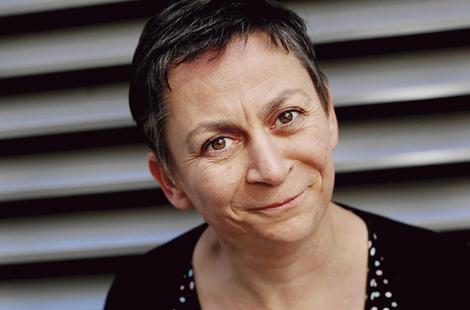
Anne Enright is most recently the author of The Forgotten Waltz.
Listen: Play in new window | Download (Running Time: 27:45 — 25.4MB)
Condition of Mr. Segundo: Troublesomely willing to sign on the dotted line.
Author: Anne Enright
Subjects Discussed: Writing a novel as a minute allegory of the Celtic Tiger, Gresham’s law, books with shifting moral alignment, marriage as a financial relationship, punctuation and subordinate clauses in prose, David Mamet, Caryl Churchill, people who interrupt each other, male and female dialogue, Enright being one of the great penis chroniclers in contemporary literature, the hydraulics of hard-ons, Yeats’s “Sailing to Byzantium,” The Gathering vs. The Forgotten Waltz, flesh and fat in fiction, how women think about anatomy, stigmas against women writers, how character names can be used to describe fraught relationships, unsuccessful attempts to find a sexy Irish name for a man, Australian men, material that Enright would not write about, Catholicism and blasphemy, the specific conditions it takes to earn an injury, the relationship between spirituality and sensuality, Leonard Cohen, reflections and looks within Enright’s fiction, interior and exterior description, whether the world would be better if it were run by 12-year-old girls, characters who cling to what remains of youth, candid moments, the repression of consciousness, being blatant through the spirit of omission, faux partitive noun phrases, “the luxury of the kiss,” the origins of the character name Fiarcha, bountiful character populations in a novel, and old-fashioned knowledge.
EXCERPT FROM SHOW:
Correspondent: I wanted to first of all ask you about the notion of this book possibly serving as a mini-allegory or a minute allegory. I noted that there was the Gresham Hotel, which nicely mimics Gresham’s law in this book. And there were a number of lines about the acquisition of things. Flirting with someone just to flirt with someone. So I have to ask how you honed the right amount of allegory for this. Or was that even important? Was it kind of a bonus that came to your interesting series of squabbles here?
Enright: Yeah. I think the thing about allegories is that they stay still. And what I wanted to do was to write a book that shifted morally. So it was more morally poised than an allegory might be. So it’s a book that can be read by the likes of the readers themselves. So whatever the reader thinks of Gina Moynihan, who is the central character and who is either a woman in love, wonderfully in love, or a homewrecker — depending on your point of view. So I wanted the readers to maybe even shift their points of view about what Gina’s up to. So it does parallel the boom in Ireland. So there is a kind of allegorical content there for adultery, that feeling of just getting what you want, of getting away with it, was very suitable to Ireland in the last ten years before the boom. When there was so much glee and a kind of fantasy and a kind of denial that was going on. Also a huge amount of belief. You had to believe. If you didn’t believe in the economic miracle, you were kind of heretic, you know? Because if you take belief out of the system, there’s nothing left. There’s only debt and not money anymore. It’s a confidence trick. So I thought all of that was brilliant for an adulterous affair. Because you’re living at two levels at the same time, which was pretty much what people were doing.
Correspondent: What’s interesting though is that it is money that has Gina and Conor marrying. Which I found to be an interesting choice. Gina’s view in terms of her relationships — whether it is Conor or Sean — is very much predicated upon, well, it happens to be there. And so this leads me to ask if this kind of moral concern predated the alignment with the Celtic Tiger and the like.
Enright: Money is both important and interesting. It’s also quite highly taboo. People don’t talk about their money. They think about money all the time. And they never or rarely articulate their relationship with money. Yeah. Gina and Conor get a mortgage almost before they get the wedding reception. But that was the reality. That is the reality in Ireland as it was. And I think in many places in the Western world, it was hard to find a place. And it was better to find a place if you were with somebody else. And I think marriage is also a financial relationship.
Correspondent: Yes.
Enright: Whether it’s primarily a financial relationship is — well, that varies from couple to couple. But I don’t think it was primarily here. I mean, Gina, she’s quite materialistic. But she’s not a greedy girl. I mean, she does think about money. But she’s not relentlessly acquisitive. It’s just that wanting is problematic when money is involved.
Correspondent: I also wanted to ask about the use of commas and dashes throughout the prose.
Enright: Oh! Nightmare!
Correspondent: A nightmare?
Enright: My nightmare! (laughs)
Correspondent: Well, it’s interesting because it does lend itself to a very conversational voice. But on the other hand, thinking of like The New York Times Book Review where you can always spot where they’ve edited it, where they have the dash and some sort of subordinate clause and then the dash, I’m curious as to how this worked for you. Whether some of these dashes and commas and various thoughts entered into the editing or were they there from the get go?
Enright: It was always a painful decision about punctuation. Gina is addicted to qualifications, subordinate clauses. A little bit more, a little on the side. The sentences don’t run really simply. It mirrors the way people think. I have a real problem, and I’m going to confess it to you now, with the run-on sentence and the semicolon. But I do like putting a clause in the middle of a sentence to disturb it a little.
Correspondent: The dashes, I suppose, are a more pure unit than say the colon.
Enright: Yes, they are. And they give a bit of space on the page. I like typing. Because I like the rhythm of typing. To me, it’s like dancing on a sprung floor. I like a bit of trip and a bit of rhythm in the prose. Because my narrators are often not omniscient. They don’t know exactly what the end of the sentence is. I like to surprise. I like to see their surprise as their thoughts leap along.
Correspondent: It would seem to me that this more free-form approach to prose will probably lend you to discover more about the characters.
Enright: For sure. But all the time, the content for me is a kind of given. And all the time, I’m trying to make the cadences and the rhythms somehow beautiful. And somehow to get the emotion and the poignancy into that rhythm. I mean, that to me is what it’s all about. And so I love the spoken voice on the page. I love the challenge of it. I mean, if you put a tape recorder on someone, they don’t speak in sentences.
Correspondent: Sure.
Enright: And the prose. Of course, even if you write in realistic type, first-person, it’s a mannered thing. David Mamet. There’s a guy who I love to read as well as…
Correspondent: The earlier Mamet. Not the more recent one. (laughs)
Enright: The earlier Mamet. And, you know, I worked in the theater very early on. And Caryl Churchill as well. Do you know Churchill puts a forward slash before interruptions?
Correspondent: Yes.
Enright: People interrupting each other on stage. Which is actually the way women talk. They rap off each other. It’s more improvisational. A kind of jazz thing that they do. So they’re always interrupting each other. Men are slightly more territorial about their speech. I’d love to be able to do that on the page. But, you know, it would wreck people’s head.
Listen: Play in new window | Download (Running Time: 27:45 — 25.4MB)