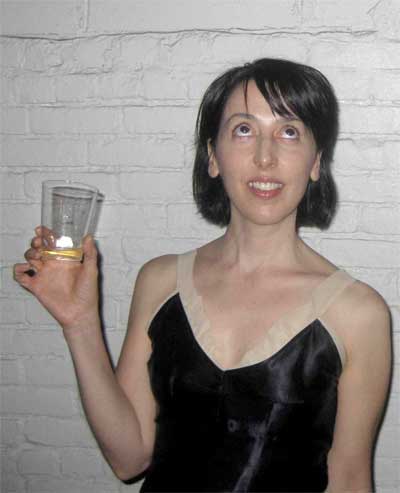
Deb Olin Unferth appeared on The Bat Segundo Show #386. She is most recently the author of Revolution.
Listen: Play in new window | Download (Running Time: 46:41 — 42.7MB)
PROGRAM NOTE: Just before the tape rolled, Our Correspondent, who met with Deb Olin Unferth at a Vegan restaurant, had casually mentioned (in an entirely different context) that he was a meat eater. Our Correspondent’s revelation was rejoined by a scowl from a man sitting directly behind Ms. Unferth. The scowl was so minatory that Our Correspondent, not an especially homicidal individual, wondered if he had killed a few random New Yorkers on the way to the restaurant. And then he realized that he had unthinkingly revealed his carnivorous habits in a Vegan restaurant. Had the story stopped there, it would not be worth reporting. But as it turned out, the Vegan’s fury made its way into our program. At about the 35:30 mark in this program, Ms. Unferth noted that a strange man was photographing both she and Our Correspondent through the window, just outside the restaurant. And this wasn’t just a one-time snapshot, but multiple angles. For all we know, there are photographs of us on some “meat is murder” website. Our Correspondent fully accepts the blame for his gustatory effrontery. Our Correspondent respectfully requests that Ms. Unferth, who is a very nice person and not a meat eater, not be implicated in any Angry Vegan movement that arises from this conversation.
Condition of Mr. Segundo: Wondering if he accidentally signed up for a revolution sometime in the late 1980s.
Author: Deb Olin Unferth
Subjects Discussed: The nonfiction volume Revolution containing echoes of the fictional Vacation, the Bowles-like distinction between tourist and traveler, Unferth’s early efforts to write about her Nicaraguan experiences as a murder mystery, Minor Robberies as a warmup for the memorialized document, the key qualities that Unferth sought in a revolution in 1987, the influence of Marxism, taping people for interviews, capturing history, lasting urgencies vs. ephemeral urgencies, how urgencies are captured into text, the Farabundo Marti National Liberation Front, the El Salvador peace accords of 1992, revolutionizing your way into legitimacy, remembering what you did at eighteen, confusion and youth, sufficiently recapturing certain feelings in book form, being harassed by men, violence from men as a deliberate omission, making choices about what to reveal in a book, whether two bad boat tales are balanced by one good tail, having confidence in adages, alliteration, Gertrude Stein’s The Autobiography of Alice B. Toklas, comedy and disturbing situations that are poignant, the pleasant sound of “so say sailors,” whether it’s possible to run away and have it mean something, the fear of being left, being rejected as a writer, early success with McSweeney’s, the inspiration that comes from fleeing, multiple acts of creation, Unferth’s storytelling efforts as a child, unanticipated reverberations in life that aren’t remembered, taking dialogue verbatim from old notebooks, La Prensa and censored newspapers, competing mnemonic notions of what you lived, contending with Angry Vegans taking photographs of Our Correspondent and Deb Olin Unferth, tracking down an ex-fiance, the need for corroboration, the private investigator’s role in assembling the memoir, legal reasons as a convenient excuse, “if I could write the book,” the first question Unferth would say to her ex-fiance, and chronicling the unique voice.
EXCERPT FROM SHOW:
Correspondent: As the interviewer, I feel compelled to ask why you felt taping the people was the best way for understanding them. You describe this bundle of tapes. And later you were stopped because of these particular tapes. And thankfully they weren’t actually played. But it is rather curious that recording these stories seemed to be the best way for you to try and understand them. Why do you think that was?
Unferth: That’s a good question. I think it was that we felt that maybe the tapes — we would be able to go back and listen to the tapes later. That the tapes would be useful in some way at a later date. That we felt that we could understand the people we were interviewing better and have opportunities to meet them if we had a tape recorder and were saying, “You know, we’re asking questions.” I don’t know. I could ask you the same question. Why do you feel it’s important to interview people?
Correspondent: Well, that’s a good question. Well, to my mind, in some vague way, I perhaps would like to — and this almost sounds hubristic, even though I don’t mean it to sound like that. I would like to think that I’m recording a history of some kind. That let’s say, in ten years, you Deb produce your masterpiece. And we can go back ten years before and see, well, what were you thinking before these germinations? The three books leading up to what ended up being an even bigger book. Well, there’s the trajectory right there. It’s also why I like to talk with people multiple times. I’ve talked with TC Boyle now four times. And even then, I find that he’s a little bit different each time. So maybe history was perhaps the draw for you at a very young age?
Unferth: Yeah. But if I think about you, and what you do, it seems like you’re also recording the echoes of contemporary culture.
Correspondent: Yes.
Unferth: So you are getting — because you’ve interviewed quite a few people. So you’re getting a wide swath of contemporary letters and what are people thinking about in contemporary letters at this time.
Correspondent: Yes.
Unferth: And so I would say that it’s a similar thing to what we were trying to do. To establish the tone and the concerns of liberation theologians and people who were involved in these revolutions at the time.
Correspondent: We have to capture the present moment in an effort to see it differently five years from now. Or ten years from now. Or twenty years from now.
Unferth: That’s true. Yeah.
Correspondent: Does text for you serve the same function? Or a similar function? Or is it a little bit different? By coming at it from memory, from research, from your notebooks at the time, I presume. You allude to those in the book. What is the effort of this cycle for you? What is the ultimate purpose? That’s a very general question. But since we’re talking about this.
Unferth: The ultimate purpose of writing Revolution?
Correspondent: Yes! Exactly!
Unferth: Well, I mean, it felt like an urgent thing to do. It felt like I really really wanted to write it. Which is also how it felt with Vacation and Minor Robberies. And I haven’t felt that way about many other things in my life. So I would say that’s the primary thing. It’s a personal urgency. And just a desire to untangle the questions that were being asked for myself. But then if I look at it with a broader — like what place does this book have? I really wanted it to contribute to the conversation about memoirs. Was one thing. I wanted to be thinking about what a memoir is. And I wanted to expand that a little bit. I wanted to do something a little different from most memoirists. Because I feel like memoir is such an interesting form. And then I wanted to write a coming-of-age story that isn’t quite as simple as “something is learned and then someone grows as a result of it.” I mean, I think that there are so many different ways to approach coming-of-age stories. And so in this one, it’s almost like someone becomes slowly disillusioned. And that’s how the coming of age is accomplished in some way. So I think that was part of it. And then also I think my continued fascination with those countries — especially Nicaragua. Nicaragua to me just seems like such a fascinating place. And El Salvador. Both just fascinating places. And they were these people who did these incredibly courageous things and developed whole philosophies and risked their lives and all these things. And now we’ve just forgotten about it.
Correspondent: Sure.
Unferth: And I find that to be so heartbreaking. I haven’t forgotten. So I want to talk about it.
Correspondent: Well, to go back to what you were saying at the beginning of that answer about this sense of urgency. It is very interesting to me that you have chosen perhaps the least urgent of all mediums. The book, which takes a long time to write. Which then has to go through editing. Which then has to sit in drydock for two years before it’s published. And then here you are two years later talking about something. And we’re not talking about the urgent moment. This is the difficulty, I suppose, of some of these conversations. Because you’re probably working on something else right now. And yet, that spirit of urgency is what was the guiding principle of this particular project. Why try urgency in such a slow burn medium?
Unferth: Because my moments of urgency last a long time.
Correspondent: Aha! So it’s lasting urgency you seek.
Unferth: Yeah. It’s not that my urgencies aren’t something that sweep in on me and last for a moment and then flee. They just sit inside me for a long time.
Correspondent: So, for you, some of your very taut paragraphs, your one-sentence paragraphs, they’re almost an attempt to capture a lasting urgency. And then the ephemeral urgencies don’t actually make it into your book. Would that be safe to say?
Unferth: What do you mean by my ephemeral urgencies?
Correspondent: Well, would you say that all of your urgencies are lasting? Or is some of it ephemeral?
Unferth: No. Some are. I guess in many ways we’re all sort of a bundle of urgencies, right? We’re all trying to do all sorts of things to stay calm. To try and stay calm. And some of those things are satisfied very easily. Just by eating something if I’m hungry. And others feel deep and existential and possibly without solution.
Correspondent: Yeah.
Unferth: So there are many different levels of urgencies, I suppose.
Correspondent: When your urgencies are captured into text, is it less urgent? Or does it still last?
Unferth: Maybe it feels less urgent once it’s done and out there. Like this particular topic. Now that it’s written and it’s done and the book is out, I don’t feel as urgent about that topic anymore.
(Image: Meghan Kenny)
Listen: Play in new window | Download (Running Time: 46:41 — 42.7MB)
Good episode.