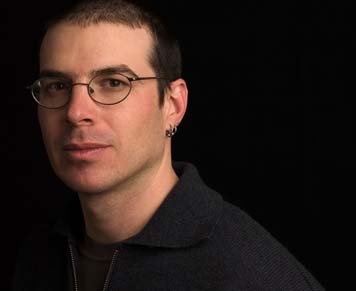
Paolo Bacigalupi is most recently the author of Ship Breaker. His short story collection, Pump Six, has been recently issued in paperback.
Listen: Play in new window | Download (Running Time: 43:47 — 40.1MB)
Condition of Mr. Segundo: Attempting to juggle several bleak futures.
Author: Paolo Bacigalupi
Subjects Discussed: How to stay writing after getting four novels rejected, Schopenhauer and the will to write, Mr. Bacigalupi’s bleak temperament, the relationship between personal temperament and fictional temperament, why short fiction markets are more open to a dark vision, talking specifically about specifics, imaginative detail in Bacigalupi’s early stories, William Gibson and hyperspecificity, permitting the reader to fill in the gaps, improvisation and what details emerge from the memory banks, devising an imaginative concept vs. the influence of phrasing, the relationship between language and spontaneity, the importance of manipulative violence, whether or not addicts can be sympathized with, stylistic momentum, past tense verbs and participles, getting annoyed with language tics, getting self-conscious about repetition, the frequency of words, the mysterious obsession of the (ology) site, John Banville, using the word “spray,” dreaming space, cannibalizing from the four unpublished novels, uprooting reader expectations through the Windup reading order, origin stories, the disadvantages of writing within established universes, cheshires and megadonts, contending with the logical fallacies of a really cool imagined creature, how the location of a calorie company created numerous narrative variables, the influence of Katrina on the Windup universe and the Ship Breaker universe, descriptive teeth and metaphorical Teeth, the inspirational qualities of biting and tearing, body metaphors, analyzing one’s own writing patterns, J.G. Ballard, Empire of the Sun, speculative narrative extrapolated from details in the present moment, consequential details vs. making things up, global warming, liquified coal, applying an aesthetic to data points, Lewis Carroll, missing hands and facial scars, Heinlein’s Friday, the Dauntless, James Lennox Kerr, Patrick O’Brian, Citizen of the Galaxy‘s heavy influence, and extrapolating from facts vs. extrapolating from books.
EXCERPT FROM SHOW:
Bacigalupi: It’s almost all improvisation, actually. Very little is planned out. There’s a detail that I have in my bank. And I use it. And you’re always acquiring material, whether that’s from visiting your in-laws or whether that’s from reading a novel. If it’s somebody else’s novel, you’re reading some natural history of the world. Whatever it is. You’re always gathering material. And so then it’s just there. And I don’t even know why, oh, at this moment, I’m looking for a detail that does this kind of a thing. I want to indicate the scope of the world. Or in this particular case, I want to indicate the scope of the calorie companies. Things like that. And, okay, where can I go to do that? What do I have in my repository that seems like it’s a useful tool for that? And then I’ll start pulling things down. So is there an intention that I have? There’s something I want to illustrate. There’s an experience I want to get deeper into. Then which pieces are going to go into it? That’s very much on the fly.
Correspondent: In terms of this being on the fly, how does this work in relation to you devising an imaginative concept versus language? Does phrasing sometimes kickstart a concept more than what you have in the bank, so to speak? I mean, I note for example “cillin” instead of “penicillin.”
Bacigaulpi: Right.
Correspondent: Little things like that we often find in your universes.
Bacigalupi: Right.
Correspondent: So the question, I suppose, is how much language motivates the spontaneity versus how much some leg that you have motivates that particular spontaneity?
Bacigalupi: I don’t know. It’s sort of a combination. You know, the spot where I actually remember a piece of language inspiring me to write a story was more connected to “The People of Sand and Slag.” When I wrote that short story, there had been a little piece of microfiction that I’d written. I had written a paragraph. And it was all about these people lying out on the beach and chopping each other up. And it was sort of compelling. But I didn’t have any idea what to do with it. But I liked the prose. I liked the rhythms of it. And there was something so bizarre about it that I knew that I liked it. That became a part of the bank. That went in and sat there for a very long time until, much later, I was starting to play around with some other concepts for “The People of Sand and Slag.” And suddenly that thing was there. Oh, I get it. These people are immortal. These people are regenerative. They can do all of these things. And this is the perfect illustration for this cascade. And so this piece of — we’ll call it “poetic prose,” and almost none of it survived or entered into the story. But the prose of that, the experience of it for me, resonated for me strongly enough that it could then form an entire piece.
Correspondent: Well, I’m glad you brought that up. Because I actually do want to ask about a recurrent theme. It’s here in Ship Breaker as well. In “Sand and Slag,” we have violence directed towards girls or women. The Windup Girl has that with Emiko. “The Fluted Girl,” of course, has that. And it concludes on an act of revenge. I’m curious as to why you are really drawn to the kind of really degrading violence towards girls and women like that. Whether it’s just part of the bleak temperament or you feel that that’s really a good way to get the audience to feel sympathy towards these particular characters. Or whether it’s just an environmental reality that you need to convey.
Bacigalupi: Honestly, I think this actually comes in different moments for different stories.
Correspondent: Yes.
Bacigalupi: And you’re really illustrating very specific things. The violence that you see for Emiko is pretty manipulative violence. Because you’re really trying to get to a point where you generate enough empathy for her, so that later on she can go on a slaughterfest. And that you feel that that’s entirely reasonable. One of the things that’s interesting to me is that I felt very comfortable depicting her being degraded at one early point in the story and yet I didn’t depict her doing the slaughter later on. And the reason is, I don’t want to lose — I want to maintain character empathy in her. And if you see more than just the blood on the walls, if you see her tearing every single piece of meat and bone out of every one of her enemies, then you might not have that later empathy for her at the very end of the story. And so a lot of this is just manipulation honestly. It’s just flat-out manipulation. And it’s interesting. So in “The People of Sand and Slag,” the guy is the one being dismembered as an experiment in sex fun. And so I’m not sure. It definitely shows up every once in a while. “Softer,” the woman is definitely killed by her husband. And that one too has some disturbing aspects. Who knows? Maybe I’m a misogynist.
Correspondent: I’m not going to go ahead and put that label down. But I am curious about this. We’re talking about manipulation vs. empathy. And this also leads me to ask you about Lopez in Ship Breaker. The father. He’s a very brutal character. I’m wondering if there were efforts on your part to try to make him more sympathetic. When does a character, I suppose, become violent? Almost serving as a manipulative way to get the audience to sympathize with the hero?
Bacigalupi: Right. Yeah, with Lopez — Richard Lopez, he’s sort of based on my own — I had a next door neighbor who was sort of a crystal meth addict. And so I’ve never really had much sympathy for addicts anyway. And so I was perfectly happy to have that villain role fulfilled by him. Honestly, I wanted to illustrate a certain — in a lot of ways — over-the-top idea about what point you look around at family and say that family is no longer family. That they aren’t really valuable anymore. That they need to be done away with. And I tend to think of almost all human relationships as contingent relations. Everything is dependent on good behavior. I don’t really believe in the idea of family as family, or that friends are friends. It’s whether or not, every day, you’re sort of earning your friendship or earning the connections and support of your family. And vice versa. And so, for me, I just really wanted to illustrate Richard Lopez’s break with any sense of his obligations. The mutual obligations of family.
Listen: Play in new window | Download (Running Time: 43:47 — 40.1MB)
2 Comments