From Here to Eternity (Modern Library #62)

(This is the thirty-ninth entry in the The Modern Library Reading Challenge, an ambitious project to read the entire Modern Library from #100 to #1. Previous entry: The Wapshot Chronicle.)

American history has always been a series of tranquil and joyful moments just before some terrible spill of the cosmic wheelbarrow. The ebb and flow of American life, as it has been and as it always will be, can be perceived as a recurring nightmare: of life, love, felicity, and possibility cast asunder in an unsettling uproar claiming some permanent end to innocence. The hanging chads and butterfly ballots ushering in a presidential monster, only to be eclipsed (and even normalized) sixteen years later by an even greater beast, a lusus naturae even more unhinged and more unsettling. The planes hitting the towers. A pandemic wiping out more than one million Americans. And, of course, the planes that attacked Pearl Harbor and stirred America from its slumber, shoving us into the Second World War.

In our rush to wrap our shivering minds in the warm blanket of nostalgia, as we recall epochs that were seemingly safer and stabler, we often forget that living did not stop and progress was not halted by the deafening clamor of sinister cornets warbling from left field. The best artists have always understood that each deep stab of history’s merciless dirk is answered by reflection and repose, of the battered and bruised emerging triumphantly from these setbacks with resilience and rejuvenation.

We were never like that. We were always like that. The push and pull continues unabated by the “winners” snorting with sow-soaked hubris at the top of the media food chain, with scant regard given to the unsettling totality.

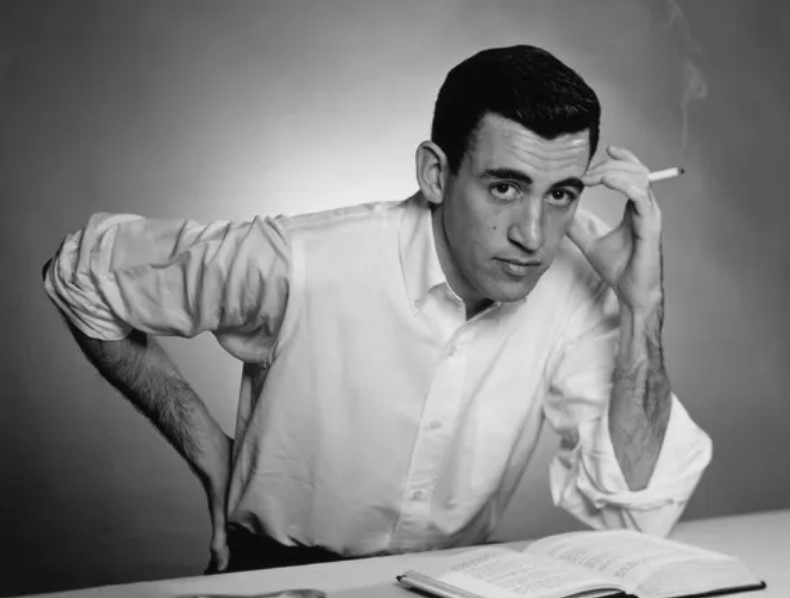
Enter James Jones in 1951, whose massive masterpieces From Here to Eternity and The Thin Red Line are little remembered by anyone under fifty today.

I may very well be the last person under fifty to have signed on for the full James Jones experience. Not even the perspicacious film critic Glenn Kenny finished the Jones doorstopper that he named his thoughtful blog after, but I did.

* * *

From Here to Eternity is a peacetime novel bolstered by a trinity of misfits: a former boxer who grew up poor and who invites trouble named Private Robert E. Lee Prewitt (or Prew), a total maniac from Brooklyn who works in the kitchen named Private Angelo Maggio (in other words, a violent and unhinged toxic man who would be immediately canceled, if not arrested on sight, in 2024), and Sergeant Milt Warden, who is having an affair with Karen Holmes, naturally the wife of Captain Dana Holmes, who is the man in charge of G Company. Ther’s also Mess Sergeant Maylon Stark, who, while a minor character in Eternity, I mention here because Jones would take the names and temperaments of these men and reuse them for The Thin Red Line and Whistle, the next two books in his World War II trilogy. So in The Thin Red Line (another Jones masterpiece), Prewitt becomes Witt, Stark changes into Storm, Warden transmutes into Welsh. Then Whistle comes along and Witt is Winch, Prew is Prell, and Stark is Strange. It’s a clever move by Jones to show the interchangeability of certain personality types within the military-industrial complex. Thirty years before Richard Gere famously wailed “I got nowhere else to go!” in An Officer and a Gentleman, Jones understood the painful truth about rudderless men flocking to the military more than anyone.

Mention From Here to Eternity to anyone today and they will probably remember (that is, if they do remember) the famous love scene on the beach with Burt Lancaster and Deborah Kerr. But as undeniably romantic as this cinematic moment is, I would say that “Re-Enlistment Blues” probably captures the spirit of the book better than the waves sweeping across gorgeous Hollywood actors (and, hey, I’m not going to deny that Lancaster and Kerr are both incredibly sexy in that scene). I’ve taken the liberty of covering the song, if only to remind the world that it was Jones who wrote the lyrics (since fewer people read these days, why not set the record straight on TikTok?):

You see, Jones rightly perceived the military as an all-encompassing instrument designed to turn fuckups into soldiers through often brutal regimentation. (One can see the full unforgiving horrors against the more libertine and free-thinking men on display in the novel’s brutal chapters in the stockade.) In a December 8, 1939 letter to his brother Jeff, Jones wrote, “I, who am better bred than any of these moronic sergeants, am ordered around by them as if I were a robot, constrained to do their bidding. But I can see their point of view. Nine out of every ten men in this army have no more brains than a three year old. The only way they can learn the manual and the drill commands is by constant repetition. It is pounded into their skulls until it is enveloped by the subconscious mind. The tenth man cannot be excepted. He must be treated the same as the others, even if in time he becomes like them.” A little less than four decades later, Jones would hold to this unsettling truth in his compelling memoir, WWII: A Chronicle of Soldiering: “Men who had been raised to believe, however erroneously, in a certain modicum of individual free-thinking were being taught by loud, fat, devoted sergeants to live as numbers, by the numbers. Clothes that did not fit, when they could see clothes on the shelves that did fit…Being laughed at, insulted, upbraided, held up to ridicule, and fed like pigs at a trough with absolutely no recourse or rights to uphold their treasured individuality before any parent, lover, teacher or tribune. Harassed to rise at five in the morning, harassed to be in bed by nine-thirty at night.”

When From Here to Eternity dropped in 1951, few novelists — with the possible exception of Richard Aldington’s bracingly sardonic Death of a Hero — had dared to betray this unspoken memorandum of understanding. That the truth arrived in fiction six years after the surrender of Japan suggests that it was meant to be confronted, though not in expedient fashion. Three years before, Norman Mailer had merely presented the loneliness and dehumanization of his soldiers. But Jones was prepared to go much further than this, tackling military life with all of its blunt involutions. And it is testament to Jones’s great talent as a writer that Angelo Maggio — the anarchic id at the center of this massive novel — remains an inexplicably poignant figure, a character who charmed Frank Sinatra and, according to his biographer James Kaplan, caused Ol’ Blue Eyes to brood at night speaking his lines from the book and insisting that only he could play the part. (The role salvaged Sinatra’s then flailing career. Sinatra would go onto win an Academy Award for his performance in the 1953 movie. Indeed, it can be plausibly concluded that Sinatra would never have been Sinatra without James Jones. Without Maggio, Sinatra would have ended up as a forgotten crooner, some footnote in 20th century history.)

* * *

In stitching all these threads together, Jones was hindered by Scribner’s legal team, which demanded a low-salt version of the authentic soldier dialogue. Only a few years before, Norman Mailer had caved to the censors to get The Naked and the Dead published, using “fug” in lieu of a now commonplace word that one hears frequently from the mouths of enthusiastic teenagers (and causing Dorothy Parker to say, upon being introduced to Mailer, “So you’re the man who can’t spell ‘fuck.'”).

But Jones saw the revision as a creative challenge. In his poignant memoir, James Jones: A Friendship, Willie Morris (who was so tight with Jones that he finished writing the final installment of the World War II trilogy, Whistler, after Jones’s death) got the inside skinny from editor Burroughs Mitchell on how Jones approached this:

It was very hard work; Jim’s ear was so exact that you couldn’t easily remove a word from the dialogue or substitute for it. But he kept doggedly at it, and eventually he began to treat the job as a puzzle, a game, and was delighted with himself when he found solutions. It was characteristic of him, then and afterward, that when an editorial decision was made, a look of anguish would come over his face, he would get up and pace, and finally he’d either accept or say, “I just can’t change that,” looking even more anguished. Finally I reported to Mr. Scribner that we had cut all the fucks we could cut, although not the lawyers’ full quota, and Mr. Scribner cheerfully accepted the situation. That was certainly part of reason why, when Charles Scribner died suddenly, Jim insisted on going to the funeral. He said he knew that Mr. Scribner had been worried about Eternity — but he had gone ahead and published it.

In our present age of sensitivity readers and books being banned or unpublished for spurious reasons, righteous career-destroying ideologues are no less wild-eyed or humorless than their right-wing, anti-art, anti-Critical Race Theory, and casually transphobic counterparts — the kind of regressive dipsticks who wrongly complain about how Russell T. Davies’s new stories for Doctor Who are “too woke” because of pronoun recognition, Davies equipping the TARDIS with a wheelchair ramp (and proudly introducing Ruth Madeley as a disabled UNIT adviser), and the marvelous inclusion of nonbinary characters. But make no mistake: tyranny against expression is not confined to any political affiliation. It is difficult to fathom any modern day corporate publisher who would possess the stones to stick with an author’s artistic vision in the way that Charles Scribner did. (Only four decades after the publication of From Here to Eternity, a gutless vulgarian by the name of Richard E. Snyder, head of Simon & Schuster (which would gobble up the Scribner imprint in 1993), would kibosh the publication of Bret Easton Ellis’s American Psycho, before it was picked up by Vintage, where it would become a huge success (and be reinvented by the inventive Mary Harron as an unforgettable film adaptation mocking toxic masculinity, much as Ariel Levy and John Turturro recently adapted Philip Roth’s Sabbath’s Theatre for the stage in similar fashion). Thankfully, Snyder had the decency to drop dead of heart failure last June after living a long and spineless life lining the coffers of his corporate overlords by publishing “inoffensive” tomes.)

Jones wandered into the writing world a bit too late to get the full Maxwell Perkins treatment (he famously demanded to see Perkins in person as a young writer; Perkins received him and encouraged him, but passed away before he could devote his editorial energies to the entirety of Eternity), but he did have timing on his side, with the valves of permissible dialogue being slowly loosened in the early 1950s, culminating in the opprobrium that Grace Metalious would receive five years later for Peyton Place.

The uncensored version of From Here to Eternity was published by The Dial Press a few years back and, having read both the original and the uncensored versions, I would say that the latter is far superior. There are small differences, such as Maggio allowing a man to go down on him to land some extra cash:

“Oh, sall right. I admit its nothing like a woman. But its something. Besides, old Hal treats me swell. He’s always good for a touch when I’m broke. Five bucks. Ten bucks. Comes in handy the middle of the month.”

But these restored scenes really tell you about the quiet desperation of soldiers. They wait for payday. They augment their meager pay with card games in the latrine. They spend ridiculous amounts of money on sex workers. And they do this because, well, there is nothing else for them. In her incredibly underrated book Stiffed, Susan Faludi documented this problem in the 1990s from a variety of vantage points and concluded that the repugnant patriarchal cues and the way that American culture is conveniently superficial about anxieties that scar lives is equally applicable to men as well as women. And we cannot even begin to solve the underlying problems unless we are honest about all this. As journalists now lose their jobs and sites like The Messenger close their doors and kill their content without notice, it’s incumbent upon us to find the ballsy artists like Jones and stick up for them even when their honest sentiments are offensive or make us uncomfortable. More than five decades after its publication, From Here to Eternity still makes a valiant case for the need to tell and publish the truth.


Next Up: Willa Cather’s Death Comes for the Archbishop!

The Wapshot Chronicle (Modern Library #63)

(This is the thirty-eighth entry in the The Modern Library Reading Challenge, an ambitious project to read the entire Modern Library from #100 to #1. Previous entry: The Catcher in the Rye.)

Despite focusing almost exclusively on the upper and middle classes in his fiction, John Cheever was that rare New Yorker regular whose short stories never came across as off-puttingly imperious, superficially urbane, or especially pretentious (although he did don a mannered Mid-Atlantic accent for his television appearances; his 1981 appearance with John Updike on The Dick Cavett Show is highly recommended). But to be fair to Cheever, this Quincy native was also good for a number of gentle tales featuring small-town types trying to live out their grandiose dreams in the big city, as seen in “O City of Broken Dreams” and “Clancy in the Tower of Babel.”) One gets the sense from Cheever’s stories and his diaries that, for all of his hard drinking and his tormented sexuality, the man genuinely loved people and marveled over bizarre jewels mined from the commons. His writing voice led many to call him “the Chekhov of the suburbs,” although that appellation doesn’t do full justice to Cheever’s stratospheric talent or surprising range.
This emphasis on pedigree has caused many contemporary readers to align Cheever — much to the understandable chagrin of The Millions‘s Adam O’Fallon Price — with the equally great Raymond Carver, whose penetrating portraits of blue-color realism showed a similar talent for exhuming the irresistible madness buried within the quotidian. (Carver’s baker in “A Small, Good Thing” — with the surreal quality of his incessant phone calls to a grieving couple — could be a Cheever character. And indeed, Cheever and Carver were drinking buddies.) But Cheever worked a slightly less verisimilitudinous room that, even with its quasi-fantastical wainscotting, proved just as truthful as Carver’s grit. Cheever’s finest stories — “The Enormous Radio,” “Torch Song” (one of my personal favorites), and “The Swimmer” — nimbly corral the motley flocks of common anxieties into quietly surrealistic pastures situated somewhere between speculative fiction and magical realism. But Cheever’s bold storytelling strokes (a radio that airs the conversations of neighbors, people who age or who never age in strange ways) never seem to come across as overly conceptual or call attention to themselves because his characters are so vivid in their behavior. (“I wish you wouldn’t leave apple cores in the ashtrays,” says one of the overheard people in “The Enormous Radio,” “I hate the smell.” As a former smoker who practiced significant pulmonary zest while slowly killing himself, I’ve never seen anyone do this — not even the chain-inhaling slobs I shivered outside with in my dorm room days.) It’s an emphatic lesson that seems to have eluded priapic spec-fic hacks like David Brin, Orson Scott Card, and John Scalzi, who are more interested in bloviating and showing how “clever” they are rather than practicing the art of writing fiction, much less humility, in any notable manner (and, in Card’s case, a monotonously homophobic one).

Buoyed by his elegant and subtly expansive prose, Cheever somehow inoculated himself against being typed — especially after the success of The Wapshot Chronicle, the masterpiece on the Modern Library list which beckons this essay and the novel that got me so passionate about Cheever again that I reread the full oeuvre, delaying yet another installment and once again hedging the unknown number of days I have left in my life against the completion of this insanely ambitious project. Bullet Park is a laudable though not entirely successful effort to break out of the zany New England métier. But Falconer? That novel is a fucking knockout that truly shows just how much range Cheever had. He captured the speech and mannerisms of prisoners in a way completely beyond the abilities of Updike or, for that matter, many of the smug and privileged novelists you see on BlueSky boasting daily about how “woke” they are, even as they can be observed in real life nervously crossing the street whenever they see a Black person approaching them. Decades before Alan Hollinghurst, Cheever had this knack for describing the seedier pastimes of sexuality as if this was the most beautiful thing in the world. But he also rightfully earned respect from the mainstream literary establishment at a time in which writers wrangling with anything even remotely high-concept were often pushed needlessly and ignominiously into the dodgy shadows of the pulp markets.

While Cheevermania thankfully remains somewhat alive in the 2020s — with both Mary Gaitskill and Emma Cline stumping for him at the last New Yorker festival — note how Vulture reporter Brandon Sanchez emphasizes the short stories while shutting out the novels. Even my fellow Cheever booster O’Fallon Price, who rightly points to the “binary choice between dull routine and utter chaos” frequently explored in Cheever’s fiction, offers nothing more than an oblique reference to Bullet Park in his Cheever essay. None of these people seem to have heeded the wisdom of the late great critic John Leonard, who demanded that we express love and generosity to a sui generis talent (just as he did in his review of Cheever’s final novel, Oh What a Paradise It Seems, which is still very solid Cheever, particularly the ice skating and supermarket scenes).

The Wapshot Chronicle is utterly breathtaking, often very funny, and poignant. Less seasoned readers have dismissed Wapshot as the work of a “master short story writer teaching himself how to write a novel” and, while they are not wrong on this point, I think this is a significant underestimation of what Cheever has accomplished here. Wapshot deserves to be held high with the same adulation reserved for his short stories. For one thing, Wapshot is also the first Book of the Month Club selection with the word “fuck” in it. This “transgression,” which must have scandalized pearl-clutching moralists of the lowest order, surely gives Cheever a small amount of punk rock streetcred.

Avoid kneeling in unheated stone churches. Ecclesiastical dampness causes prematurely grey hair.

That silly advice comes from retired sea captain, endearing crank, and old patriarch Leander Wapshot. Stylistically speaking, Leander’s fascinating clippy patois is what stands out on the first reading. But there’s also a shrewd piss-take on Booth Tarkington‘s device of an omniscient storyteller who makes his presence known with picayune details of family lines and furtive glimpses into certain subcultures:

It is the perhaps in the size of things that we are most often disappointed and it may be because the mind itself is such a huge and labyrinthine chamber that the Pantheon and the Acropolis turn out to be smaller than we had expected.

Wapshot was not the first time that Cheever used this trick. His 1955 story “Just One More Time” does this as well. But with Wapshot, the almost satirical formality serves to create an epic structure for the eccentric Wapshot family to run wild. (And in the case of Leander’s two sons, Moses and Coverly, they literally flock to many corners of the nation — particularly Coverly after he becomes a Taper and is sent to far-off regions: the military base, in Cheever’s hands, is sent up gloriously and Cheever would continue with this in The Wapshot Scandal by satirizing the McCarthy trials.) Much like the fantastical concepts in his stories anchored strange behavior, so too does the Tarkingtonesque narrator frame the family adventures.

I also loved the marvelously quirky Cousin Honora, who controls the family pursestrings and who has a highly unusual method of paying for her bus fare:

Honora doesn’t put a dime into the fare box like the rest of the passengers. As she says, she can’t be bothered. She sends the transportation company a check for twenty dollars each Christmas. They’ve written her, telephoned her and sent representatives to her house, but they’ve gotten nowhere.

My only minor quibble about Wapshot — and this is a point that a certain misogynistic predator who was forced to bail from the publishing world lacked the acumen to consider — is how Melissa, the woman who marries Moses, is short-changed by Cheever. It’s clear that she is not happy in the marriage. Cheever, to his credit, would make a noble stab to atone for this in The Wapshot Scandal by having her run off with a 19-year-old grocery boy named Emile. But even in the sequel, I felt that Cheever didn’t quite flesh out this character. It’s not that Cheever couldn’t write women (see Honora, for one) or didn’t understand what it was like to be trapped in a thankless marriage. (Julia Weed in “The Country Husband” is a far better portrayal of this problem than Melissa.) But sometimes the best pilot can’t always stick the landing. And I’m not about to pull one of those Zoomer hissy fits and cancel Cheever simply because he fumbled an important issue. Especially because there’s so much to admire about Wapshot: its wit, its heart, the way that it embraces certain strains of Southern literature only to abandon this tone once Moses and Coverly go off and live their lives, its beautiful depiction of naivety at every age, and the hilarious tally of weird accidental deaths. I also feel obliged to point to Steven Wandler’s interesting essay in which he argues that the two Wapshot novels are similar while presenting contradictory views of the world. Another literary Ed — one who has greater cachet than this irksome Brooklynite — has made a savvy argument that much of this stemmed from the contradictions of Cheever’s life. And aren’t contradictions exactly the reason why we reread great novels?

Next Up: James Jones’s From Here to Eternity!

James Joyce (Modern Library Nonfiction #73)

(This is the twenty-eighth entry in The Modern Library Nonfiction Challenge, an ambitious project to read and write about the Modern Library Nonfiction books from #100 to #1. There is also The Modern Library Reading Challenge, a fiction-based counterpart to this list. Previous entry: Florence Nightingale.)

“Mr. Joyce, first of all, is a little bourgeois Irishman of provincial tastes who has spent a lifetime on the continent of Europe in a completely fruitless attempt to overcome the Jesuit bigotry, prejudice, and narrowness of his childhood training. Mr. Joyce began his literary career as a fifth-rate poet, from there proceeded to become a seventh-rate short-story writer, graduated from his mastery in this field into a ninth-rate dramatist, from this developed into a thirteenth-rate practitioner of literary Mumbo-Jumboism which is now held in high esteem by the Cultured Few and I believe is now engaged in the concoction of a piece of twenty-seventh-rate incoherency, as if the possibilities in this field had not already been exhausted by the master’s preceding opus.” — Thomas Wolfe, The Web and the Rock

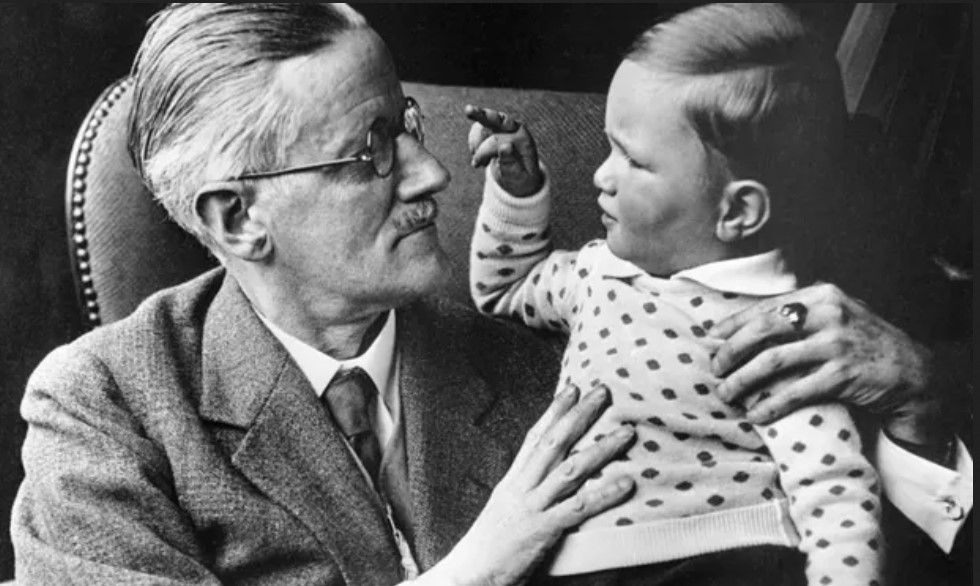
James Joyce was probably the greatest writer of the 20th century, although opinions vary. (Many of today’s young whipper-snappers sound astonishingly similar to a dead-inside academic like Thomas Wolfe’s Mr. Malone when dispensing their rectal-tight rectitude and uncomprehending pooh-poohs on social media.) But as a wildly ambitious literary athlete nearing fifty (353 books read so far this year, with a little more than a week left), I cannot think of any other writer whom I have returned to with such regularity and gusto. Even the dreaded “Oxen of the Sun” chapter in Ulysses, which caused at least six hundred grad students to faint from fatigue in the last year (and a good dozen young scholars to permanently lose their minds), demands that you peruse it anew to appreciate its multitudinous parodies.

Only a handful of living writers can summon a similar obsession in me through the power of their words. But even when these hypergraphic bards descend from the Mount with their thick portentous volumes, they are hopelessly outmatched by the Dublin bard’s mighty polyglot yardstick. (Certainly Anthony Burgess spent his prolific literary career forever lost in Joyce’s formidable fug and forever resented the fact that his best known work, A Clockwork Orange, with its captivating NADSAT, caught on, perhaps because it represented some attempt to mimic Joyce’s word-soaked playfulness.)

When I visited the Martello Tower at Sandycove Point not long before the pandemic, it was the closest thing that an atheist like me has ever had to a religious experience. It had never occurred to me — a relentlessly abused white trash kid who fought off bullies (and still has to do so in his forties) when not filling his voracious noggin with too many books, a reader from the age of two, an accidental provocateur who still manages to piss off PhDs and varying mediocre literary types whenever I quote long passages from memory culled from books they claim to have read but have somehow forgotten — that I would ever have the divine privilege of standing at the very location where “Telemachus” begins. My first walk alongside the Mississippi River last summer in deference to another literary hero of mine was close, but Joyce was the clear winner when it came to summoning such heartfelt psychogeographical wonder. As I sauntered along the swerve of shore to bend of Scotsman’s Bay back to the Dublin train, I trembled with tears of joy, feeling great shudders push me into a state of awe that I did not know was writhing within me. I simply could not believe it. I had already been impressed by the social code of the great Irish people, who would always give you at least five minutes of banter and who were never shy in expressing their opinions and who immediately unlocked the key to further appreciating “Ivy Day in the Committee Room” through their innate conversational finesse. But was I actually standing in the same room in which Samuel Trench (the basis for Haines) had shot at an imaginary panther that had plagued him in his sleep? And was that truly Joyce’s guitar? The good people who run this landmark were incredibly kind to this wildly voluble and incredibly excited Brooklynite. I flooded their robust Irish souls with endless questions and an irrepressible giddiness. A kind woman, who did her best to suppress laughter over my ostentatious literary exuberance, remarked that they had not seen such a visitor display such bountiful passion in months.

But I am and always will be a Joyce stan. I own five Joyce T-shirts, including an artsy one in which the opening words of Finnegans Wake are arranged in a pattern matching one of Joyce’s most iconic photographs. Before I deleted all of my TikTok accounts, my handles were various riffs on Joyce’s most difficult volume. There has rarely been a week in which I have not thought about Ulysses or “The Dead” or, on a whim or in need of a dependable method to restore my soul, picked up my well-thumbed copy of Finnegans Wake and recited pages and laughed my head off. When I went through the roughest patches of my life nine years ago, it was James Joyce who helped save me. I reread Ulysses while living in a homeless shelter. And had I not had that vital volume on me to renew my fortitude and passion, it is quite likely that I would be dead in a ditch somewhere and that the words I am presently writing would not exist.

So I’m obviously already in the tank for Joyce and deeply grateful to him. He has proven more reliable and loyal to me than my toxic sociopathic family. These moments I have chronicled would be enough. But Richard Ellmann hath made my cup runneth over. He somehow achieved the unthinkable, writing what is probably the best literary biography of all time. Other biographers have combed through archives and badgered aging sources, hoping to stitch their tawdry bits with dubious “scholarship.” Small wonder that Joyce himself referred to these highfalutin ransackers, who have more in common with TMZ reporters than academics, as “biografiends.”

But one cannot lay such a mildewed wreath at Ellmann’s feet. There are very few details in Ellmann’s book that do not relate directly to the work. We learn just how invaluable Stanislaus Joyce was to his brother. Stanislaus — an adept peacemaker who documented his fractious fraternal relationship in his own book, My Brother’s Keeper — is liberally excerpted. If Stanislaus hadn’t pushed back hard on the alleged “Russian” feel of Joyce’s great short story “Counterparts,” would we have had “The Dead”? (“The Dead” was written three years after the other fourteen tales contained in Dubliners.) To cite just one of many Ellmann’s cogent connections between Joyce’s life and work, we learn that Edy Boardman — Gertie McDowell’s friend in the “Nausicaa” chapter of Ulysses — represented faithful recreations of neighbors that the Joyce family knew on North Richmond Street and that “the boy that had the bicycle always riding up and down in front of her window” was, in fact, a callout to one Eddie Boardman, who had the first pneumatic-tired bike in the hood. Joyce’s crazed jealousy towards any man whom he suspected had designs on Nora Barnacle — with his insecure interrogations of Nora by letter and in person — are duly chronicled. The boy that Nora had dated before Joyce came along was Sonny Bodkin (who died tragically young of tuberculosis) and she was initially attracted to Joyce because of their close physical resemblance. And while Joyce was forward-thinking when it came to presenting Jewish life in Dublin (and arguably creating one of the most fully realized Jewish heroes in literature with Leopold Bloom), his regressive masculinity could not stand the notion that his great love’s heart had stirred long before he came along. And yet, even with his nasty and unfair and unreasonable accusations, he was able to find a way to broach this in fiction with Gretta Conroy recalling her dead lover Michael Furrey in “The Dead.” It is often the darkest personal moments that fuel the best of fiction.

And let’s talk about that ugly side of Joyce. The great Dublin exile was also an unapologetic leech, a shrewd manipulator, and a master of dodging creditors. He fantasized about pimping his wife Nora out to other men while also being naive enough to believe Vincent Cosgrave’s claim that Cosgrave was sleeping with Nora before him in the fateful summer of 1904, nearly sabotaging his relationship with a series of angsty transcontinental missives. For better or worse, Joyce refused to see the full extent of his poor daughter Lucia’s troubles. He treated many who helped him very poorly. And, of course, he despised explaining his work. He wanted to keep the scholars busy for centuries. And he succeeded. Here we are still discussing him, still mesmerized by him. Even when his life and work are often infuriating.

If there is any weakness to Ellmann’s formidable scholarship, it is with the women who were vital to Joyce’s life. Ellmann was so focused on finding precise parallels between Joyce’s life and work — but usually only including Jim and his brother Stanislaus at the center — that he often portrays these invaluable lieutenants in superficial terms — that is, if he even mentions them at all. Let us not forget that Joyce was a man terrified of dogs, violence, and thunderstorms. The women in his life empathized with the effete qualities of this indisputable genius and provided financial and scholarly resources for Joyce to continue his work, even when they found Finnegans Wake baffling and not to their taste. Perhaps most criminally, there is no mention in Ellmann’s book of Myrsine Moschos (who was Lucia Joyce’s lover at one point), the dutiful woman who toiled at the famous bookstore Shakespeare & Company and spent long days in the dank chambers of Parisian libraries, sifting through decaying volumes that often crumbled to dust in search of obscure words and other arcane lexical associations that Joyce included in Finnegans Wake. Moschos often returned from these scholarly journeys so exhausted that Sylvia Beach — arguably the greatest bookseller in all of human history and the woman who took significant risks to get Ulysses published — had stern words for Joyce about Moschos’s health.

In 2011, Gordon Bowker published a biography — something of a quixotic project, given the long imposing shadow cast by Ellmann — that was more inclusive of Nora Barnacle, Sylvia Beach, and Harriet Shaw Weaver. But I do recommend Brenda Maddox’s Nora, Carol Loeb Schloss’s Lucia Joyce: To Dance in the Wake (with significant reservations), and Noel Riley Fitch’s Sylvia Beach and the Lost Generation as volumes that fill in these significant gaps that Ellmann, in his efforts to portray Joyce as his own master, often failed to address. (Even Jo Davidson, the sculptor who was instrumental in making the New York theatrical run of Joyce’s play Exiles happen, is merely afforded a footnote by Ellmann.)

Can one literary biography be the all-encompassing volume that captures a life? Even one that was as complicated as Joyce’s? Perhaps not. But Ellmann has certainly come closest. Now that Joyce’s famously hostile grandson Stephen has passed away and the copyright for much of Joyce’s work has at long last been released into the public domain, it’s possible that another biographer will be better situated to come closer to revealing the Joyce mystique without being strangled by the bitter hands of some unremarkable apple twice removed from the great tree. But I doubt that any future scholar will match Ellmann. For all of his modest limitations, he was the right man at the right time to capture a seminal literary life in perspicacious and tremendously helpful form.

(Next Up: Elaine Pagels’s The Gnostic Gospels!)

The Catcher in the Rye (Modern Library #64)

(This is the thirty-seventh entry in the The Modern Library Reading Challenge, an ambitious project to read the entire Modern Library from #100 to #1. Previous entry: A Clockwork Orange.)

Like many semi-literate members of my generation, I first read The Catcher in the Rye at the age of fifteen, following the ethereal rites and cadences of older kids turned on by the same seductive anthem to nonconformity. At that angsty teenage time in my life, Holden Caulfield appealed to my rebellious and anti-authoritarian streak. This reaction, in and of itself, is not especially unusual. Salinger has continued to be assigned to high school English curricula in large part because you can inveigle kids into reading by making the titles forbidden. (Witness how Art Spiegelman’s Maus became a surprise bestseller last year after some boneheaded martinets banned the evocative Holocaust graphic novel from Tenneessee school libraries.)
I am now in my late forties and I still remain as iconoclastic and as boundary-pushing (though a tad less loutish) as I was when I was a mere stripling, although I’d like to think that my temperament has been made more palatable by my greater commitment to pragmatism. In that intervening time I avoided rereading Catcher until last year, dreading the disagreeable revisitation when this classic at long last emerged on this insanely ambitious project like some former crush at the twenty year high school reunion inviting you to a hotel room after spilling the tatters of her doomed marriage. You instinctively know that you’re better off chatting up some comely and perspicacious stranger at the hotel bar, someone without a loose thread dangling from a varsity sweater in mothballs. Because who you were when you knew nothing is quite different from the middle-aged person you are now who knows slightly more than nothing. There’s enough cognizance in the tank to suggest that a freeform hookup consummated long after your adolescent lust has shriveled up is a very bad idea. Particularly one in which you aid and abet nuptial dissolution by your own selfish spasms.

And while I will stand by most of Salinger’s Nine Stories and, in particular, the far more interesting thoughts of the precocious Glass family (I’m even willing to stump a bit for the problematic “Hapworth 16, 1924,” which is far more interesting in its uncompromising stance than anything gurgling from Holden Caulfield’s mouth), I can no longer hold up The Catcher in the Rye as great literature — not that it was ever really my goto choice. (James Baldwin, James M. Cain, F. Scott Fitzgerald, and Henry Miller (yeah, I know) proved far more formative to me in my younger days than Salinger ever could.)

I find Holden Caulfield to be an insufferable and entitled monster, a budding sociopath who can only find joy in snow and his younger sister Phoebe when he’s not breaking windows and getting into dust-ups and treating everyone around him (particularly the poor girls who have the misfortune of dating him) like shit, which could explain in part why John Hinckley, Jr. took to Salinger like a box jellyfish flocking to corral shortly before trying to gun down the Evil Gipper. Upon rereading Catcher last month to take assiduous notes, I was astonished by my hate-read glee and how loudly I cheered during the moment when the pimp/elevator operator Maurice storms into Holden’s room at the Edmont Hotel, trying to collect an additional five dollars from this monied and mottled brat. Given Holden’s precious olfactory sense (even while smoking?) and the way he sneers at everyone around him, the detestable little bastard had it coming.

Holden is not even a proper punk because he cares about nobody other than himself. I felt sorry for the poor taxi drivers who had to contend with Holden’s facile riddle about where the ducks in Central Park go during the winter. His ties to his family only exist as pretexts to defend his braggadocio and his dubious victimhood, which Salinger feels the need to cram down our throats with Holden’s dead brother Allie. His ethos, if it can be called that, revolves around relentless narcissism and feigned sybaritism. What does it say that I found myself wanting to spend more time with Alex in A Clockwork Orange rather than this infernal sixteen-year-old misanthrope with his hideously obnoxious “I really did,” “phony,” “goddamn,” and “crumby” (to say nothing of Salinger’s annoying tendency to italicize the first syllable of a word, a stylistic practice that has fortunately not been picked up by his fiction-writing sycophants). At least Alex was committed to classical music and “the heighth of fashion” (the word “heighth” appears three times in Catcher and one can’t help but ponder how much the novel may have influenced Anthony Burgess) when he wasn’t busy raping and murdering ten-year-olds. What does Holden Caulfield even stand for? His Weltanschauung is little more than a collection of easy shots at obvious targets. My views on Holden Caulfield are quite similar to film critic Glenn Kenny railing against Ferris Bueller. But unlike Kenny, I actually like Ferris Bueller! In fact, I’d argue that the difference between John Hughes and Salinger is that Hughes loved his characters. Whereas Salinger didn’t really find that type of auctorial love until he wrote about the Glass family. (Joyce Maynard informs us that he protected the Glasses like jeweled treasure.) And if David Shields and Shane Salerno’s quirky and engaging Salinger bio is anything to go by, Holden Caulfield represented Salinger himself far more than any of his other characters. (Salinger insisted that he was the only person who could play Holden in any dramatic adaptation.) Given how broken Salinger was after battling in the Hürtgen Forest and witnessing the horrors of the Holocaust death camps, an argument could be made that Catcher represents more of an artistic exercise in self-loathing rather than a free-wheeling celebration of anarchic adolescence.

The way I see it, The Catcher in the Rye is more of a myth than a literary achievement. The vainglorious rush to throw a risibly wide net of influence from Catcher — simply on the basis of the novel selling 65 million copies over the years — is best epitomized by a surprisingly myopic assessment from Louis Menand on the occasion of Catcher‘s fiftieth anniversary. Menand cited Jay McInerney’s Bright Lights, Big City and Dave Eggers’s A Heartbreaking Work of Staggering Genius as “Catcher in the Rye rewrites.” Never mind that — even accounting for his Salingerphilia — Eggers’s book was a memoir mining from lived experience rather than a novel. (Did Eggers deliberately live out his twenties like Caulfield? For all of his ignoble public image management, I greatly doubt it.) In 2010, writing on the occasion of Salinger’s passing, McInerney confessed that he had been “baffled” by the comparisons, pointing out that he not read Salinger for years while working on his debut novel.

Now some of you, knowing how outspoken and take-no-prisoners I can be with my little essays, probably came here for a salacious hit piece. Maybe you’re gleefully steeping your fingers awaiting a knee-jerk drive-by on the long dead Jerome David (or Jerry, as his closest pals called him). But I don’t want to write that. I am just one hardcore reader trying to be honest here. And nothing that I say will diminish Catcher‘s immense popularity. Its stature and its legacy are safely preserved. Additionally, the highfalutin thuggery of clickbait doesn’t interest me. It’s far too easy to write. As it so happens, I actually like Saligner’s writing. In my reread of Salinger’s oeuvre, “Raise High the Roof Beam, Carpenters,” “Franny” (which anticipates the dangers of toxic masculinity by decades), and “Seymour: An Introduction” spoke to me far more in my middle-aged years than ever before.

No, I’m more interested in interrogating why I despised the novel so much as a grownass man. Where did things go wrong between Holden and me over the last thirty years? I certainly don’t feel this way about such troublemakers as Huck Finn, Ignatius J. Reilly, Bart Simpson, Calvin and Hobbes, Peeves, A Fan’s Notes‘s Fred, Sam Lipsyte’s Lewis Miner, or Denis Johnson’s Fuckhead — many of whom were arguably more plagued than Holden Caulfield. I cannot gainsay that Catcher remains very well-loved (my girlfriend’s teenage daughter speaks highly of it) and that there was a time (sort of) when it spoke to me. If I were a hopelessly moronic and hubris-riddled hack like Dan Kois — who recently learned his lesson the hard way — then I’d probably cleave cheaply to this enmity and arrogantly take my lumps without learning a goddamned thing. The truth of the matter is that I wish I could love Holden Caulfield more. Because much of Salinger’s other work is amazing.

I think it is Salinger the person who I cannot stand. His grooming and victimization of Joyce Maynard, Jean Miller, and many others. His savvy manipulation of New Yorker editor William Shawn (just as private and as isolated as Saligner). The strange contradiction of his reclusiveness and his exhibitionism. Saligner outed people and details when he was alive and wrote letters and unpublished essays to control the narrative (particularly in relation to Tom Wolfe’s notorious hit piece on The New Yorker) rather than allowing the world to pass him by. The gruff meanness to “intruders” and the lack of grace or humility about his success. Small wonder that the likes of Alfred Kazin and John Updike started lobbing rocks at him when it came to the Glass family. Salinger’s biographers will tell you that this was a case of envious competitors using their gatekeeping advantages to keep Jerry in place. But I think it had more to do with the more toxic qualities behind the talent that they innately detected but could not quite pinpoint until Catcher had become a classic. (Even an endearing oddball like Ron Rosenbaum, no stranger to Salinger enthusiasm, confessed that he suffered from “Saligner fatigue,” even as he wrongly impugned anyone (including Shields and Salerno) from reading Catcher as a symbiosis between author and fictional creation.) Kazin rightly points out that Holden Caulfield is “cute” only because we expect boys of his age to be “consciously appealing and consciously clever.” Updike notes how Salinger’s post-Catcher work has the author “never rest[ing] from circling his creations, patting them fondly. He robs the reader of the initiative upon which love must be given.”

So if you’re in the “Salinger’s Glass family stories are better” camp like me, you have no problem with an author who was willing to steer the reader a little harder to get to a more Zen-like artistic place. If you’re in the “Catcher is better” camp, I would contend that you are more willing to be captivated by Holden’s “cute” and “loving” charms without considering the problematic scaffolding that props all this up.

But for the Catcher stans, consider how much more pointed and playful Buddy Glass’s nonconformist missives are in “Seymour — An Introduction”:

In this entre-nous spirit, then, old confidant, before we join the others, the grounded everywhere, including, I’m sure, the middle-aged hot-rodders who insist on zooming us to the moon, the Dharma Bums, the makers of cigarette filters for thinking men, the Beat and the Sloppy and the Petulant, the chosen cultists, all the lofty experts who know so well what we should or shouldn’t do with our poor little sex organs, all the bearded, proud, unlettered young men and unskilled guitarists and Zen-killers and incorporated aesthetic Teddy boys who look down their thoroughly unenlightened noses at this splendid planet where (please don’t shut me up) Kilroy, Christ, and Shakespeare all stopped…

And so on. This beautiful rant from Salinger — which rhythmically evokes Goethe’s idea of “the whole, the good, and the beautiful” sans one syllable — is as punk rock as it gets and has greater crags to cling to than any of Holden Caulfield’s cheap and tedious nihilism:

Grand. There’s a word I hate. It’s a phony. I could puke every time I hear it.

Or:

God, I hate that. I don’t see why the hell they can’t talk in their natural voice. They sound so phony when they talk.

Or:

It isn’t important, I know, but I hate it when somebody has cheap suitcases. It sounds terrible to say it, but I can even get to hate somebody, just looking at them, if they have cheap suitcases with them.

At times, Holden’s complaints about the world read like a very rich and incredibly elitist standup comic who isn’t very funny — someone as detestable as Bill Maher.

We know that Salinger worked very hard on Catcher, impressively writing the bones of Catcher in the World War II battlefields, sending these early stories off to New York (some getting published), and, years later, holing up in the New Yorker office and other hermetic Manhattan foxholes for a year to polish and perfect Catcher. Catcher can certainly be commended as the work of an artist baring himself completely in ways that — much like Kerouac — were unprecedented at the time, only for Salinger to bury all these truths behind ambiguities that feel a little too on-the-nose, such as Mr. Antolini patting Holden on the head (awkward drunken tenderness or molestation?). But it’s also a study in a tormented man running away from his demons (i.e., Holden refusing to grow up) rather than confronting them head-on such as he did so well with the trauma of World War II veterans in “A Perfect Day for Bananafish.”

And that, to my mind, is the great tragedy of Salinger. Here was this master of the short story and the novella who wanted to grow beyond what he was best known for and become an even greater artist. But he was curtailed from publishing anything beyond “Hapford” by a reproachful and imperious literati who ultimately wanted more of the same. He beguiled readers with a beatific looking glass that, upon closer study, reveals more than a few fissures. And when he tried to reinvent himself, it was much too late.

Next Up: John Cheever’s The Wapshot Chronicle!

A Clockwork Orange (Modern Library #65)

(This is the thirty-sixth entry in the The Modern Library Reading Challenge, an ambitious project to read the entire Modern Library from #100 to #1. Previous entry: Of Human Bondage.)

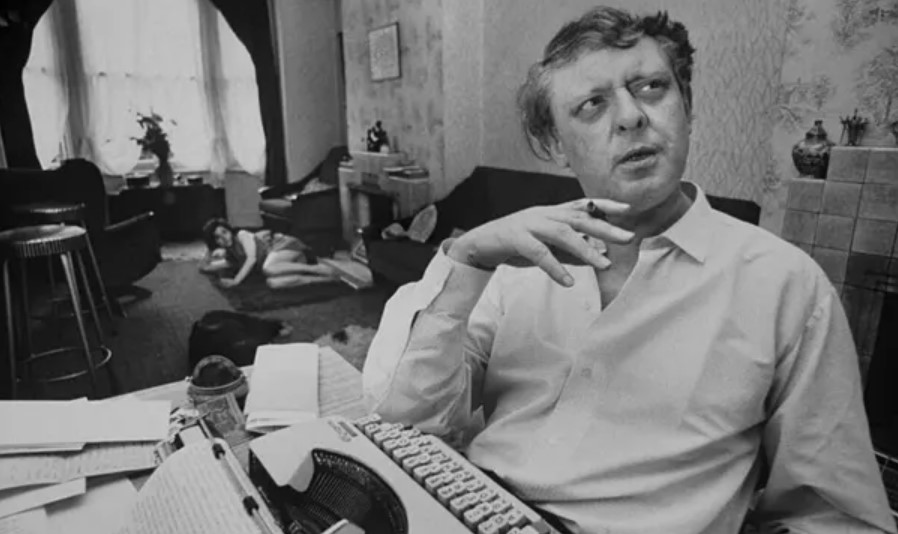
It’s become quite fashionable to bash the ridiculously prolific and mock pompous Mancunian with the combover. Never mind that anyone with a remote familiarity for how theatre comes together recognizes that Anthony Burgess perfected a magnetic if abrasive persona, frequently appearing on television with the likes of Dick Cavett when he wasn’t banging out his daily 1,000 words and, over the course of his life, appearing in every magazine known to humankind. (There’s a great joke in Alan Hollinghurst’s The Line of Beauty in which Nick Guest sees his article placed behind Burgess.) Burgess was a ferocious polymath who claimed to pick up languages in weeks and even devised the prehistoric patois for Quest for Fire. He was a composer and a provocateur who was sensible enough to find an instinctive way to piss off everyone: an old school virtue that is increasingly at odds with our age and that has the unintended consequence of stifling truths we need to talk about. He was the type of British writer who was catnip to a budding young California punk like me. Much like the equally neglected filmmaker Lindsay Anderson, he combined erudite anarchism with a gentle and often curiously lugubrious propriety. (I don’t think it’s an accident that Malcolm McDowell was both an Anderson staple and starred in Kubrick’s version of A Clockwork Orange.) One doesn’t see too many artists like this anymore on either side of the Pond.

It would be tempting to suggest that Anthony Burgess’s wildly pugnacious, spectacularly bitter, and inarguably pathetic biographer Roger Lewis had something to do with this state of affairs, though that would be ascribing too much credit to this spiteful little worm, the living embodiment of what Joyce called a “biografiend.” (Lewis’s book, incidentally, is the worst and nastiest literary biography I have ever read. This is not a recommendation. It isn’t even enjoyable as a hate read.) Speaking ill of Burgess has become something of an unspoken duty among literary nerds ever since the erstwhile John Wilson bit the big one in 1993. When I interviewed Will Self in 2007 and mentioned Burgess, Self’s eyes lit up with the blood-curdling rancor of Van Helsing spotting Dracula and he called Burgess a “monster” with deep solemnity. Another literary writer, a MacArthur fellow, told me off the record that he detested Burgess with all of his heart. Even the mild-mannered blokes behind the terrific podcast Backlisted have gently condemned Burgess from time to time.

But I’ve always taken a shine to Burgess — in large part because I have always been deeply fond of arcane words, larger-than-life personalities who rub anyone owning more than three pair of pants the wrong way, and iconoclastic ambition within artists. Earthly Powers and the Enderby books, in particular, are great literary achievements, though their bloom has been dulled by the fact that mid-to-late career Burgess worked in a peculiarly learned comedic mode. You could argue, and many have, that Burgess was operating in the great shadow of Joyce, whom he greatly revered. Burgess wrote two entertaining (though somewhat lightweight) books on the great Irish genius: Joysprick and Re Joyce. And I suspect that this literary alignment has allowed me to forgive his more venomously obnoxious moments, which include insulting Graham Greene, accepting a Male Chauvinist Pig of the Year Award from a feminist press, and causing a cockalorum like Roger Lewis to waste many forlorn years of his go-nowhere life detesting him. (Fortunately, the more even-keeled Andrew Biswell has graced us with The Real Life of Anthony Burgess. And there are two volumes that Burgess himself wrote: Little Wilson and Big God and You’ve Had Your Time, both of which are hilarious collections of grandiose lies delivered with Burgess’s trademark self-importance.)

What’s most curious about A Clockwork Orange is how Burgess himself disowned it — even as he wrote introductions, made television appearances, and even quietly adapted into a musical. Throughout his life, Burgess felt he had “a sort of authorial duty to it.” Burgess resented not being known for his other works, but, given how regularly he stumped for M/F, a literary puzzle that has not held up very well, one suspects that Burgess himself was not his best critic. (Indeed, in April 1963, Burgess reviewed his own novel, Inside Mister Enderby, which was originally published under the name Joseph Kell. He gave a bad review to one of his most enjoyable books and lost his position at the Yorkshire Post over this mischief.)

A Clockwork Orange doesn’t fit tidily next to the humorous name-dropping flaunt of Earthly Powers‘s Kenneth Toomey or even the satirical dystopia of The Wanting Seed, in which heterosexuality is taboo in an effort to curb the global population rate. It is something else entirely: a pre-Riddley Walker exercise in invented slang (known as NADSAT) that is smoothly discernible (likely because Burgess was, by all reports, an excellent teacher), an examination of free will and moral agency, and an often disturbing portrait of Alex, a fifteen-year-old thug who casually kills, rapes, and/or assaults the homeless, some poor bastard who regularly checks out crystallography books from the local library branch, and ten-year-old girls. To this very day, there are many who find Kubrick’s largely faithful film adaptation disturbing, but the novel is probably more unsettling — in large part because we have to imagine all the violence, which is framed within the context of a decadent “modern age” that, much like Terry Gilliam’s Brazil, is set “somewhere in the 20th century.”

Kubrick needed Malcolm MacDowell’s charm to carry the picture. But Burgess kept you reading by way of the hypnotic slang. But even an adult character like Deltoid, who punctuates his speech with endless yeses, reads as if it was specifically written for Aubrey Morris, who is brilliantly hilarious in Kubrick’s film. One doesn’t need a glossary to divine that “veck” is man or that “slooshy” is to listen or that “gulliver” is head because Burgess’s context is grammatically precise. And while anyone tackling the likes of Russell Hoban or Finnegans Wake is likely to throw these two masterpieces against the wall at some point, the sense of discovery in A Clockwork Orange (to say nothing of the modest length) makes the reading experience far more pleasurable — even when one is also contending with a monstrously violent protagonist who sharpens his savage instincts with drugged milk and leads three droogs to rip up public seats and assault and pillage anyone in sight. Burgess’s argot has the added benefit of bolstering the modest weaknesses of the novel. If A Clockwork Orange had been written in traditional English, then some of the more pat observations about self-serving government officials (in this case, the Minister of the Interior or the Inferior and his accomplice Dr. Brodsky, who, justifying the Ludovico technique that makes Alex recoil against violence, says, “We are concerned only with cutting down crime”) and the choice to be violent may not have landed as well. But even a reader drawn to Burgess’s lexical allure needs a breather from time to time. And Burgess seems to intuitively know when to break up the flow with his adult characters. So when the writer F. Alexander — who shares Alex’s name, though as a surname, suggesting how ubiquitous a thirst for violence is — tells Alex, “But the essential intention is the real sin. A man who cannot choose ceases to be a man,” Burgess is better able to sell this because of the contrast with the main language.

And while one might quibble over why there isn’t a single character in this book other than the prison chaplain who doesn’t seek some form of revenge, Burgess, writing in 1962, is remarkably prescient on what awaits the world. Of the swastika, Alex describes it as “a Nazi flag with that like crooked cross that all malchicks at school love to draw.” And while such an idea was horrifyingly unthinkable less than two decades after the end of the second world war, recent headlines demonstrate that Burgess is merely “reporting” from the future. The rundown apartment block where Alex lives with his “P and M” could pass for a contemporary housing development in a rundown part of town: it is defaced with graffiti and has an elevator that doesn’t work. Just five years before the Beatles televised “All You Need is Love” in front of a worldwide television audience, Burgess depicts “worldcasts,” “meaning that the same programme was being viddied by everybody in the world that wanted to, that being mostly the middle-aged middle-class lewdies.” In 2023, these “worldcasts” immediately remind anyone of today’s relentless live streaming. What would Burgess have made of Twitter or TikTok?

Burgess also anticipated certain Dirty Harry criminological attitudes that, as evidenced by the merciless trolls I fend off daily on TikTok, are still quite popular with today’s reactionaries. Forgiveness? Hell no! A prisoner must still be vilified after he has “done his time.” And even when he is “cured” through conditioning, he’s still suspect. Or, as Dr. Brodsky, the head of the Ludovico Technique, puts it:

What a change is here, gentlemen, from the wretched hoodlum the State committed to unprofitable punishment some two years ago, unchanged after two years. Unchanged, do I say? Not quite. Prison taught him the false smile, the rubbed hands of hypocrisy, the fawning greased obsequious leer. Other vices it taught him, as well as confirming him in those he had long practised before. But, gentleman, enough of words. Actions speak louder than. Action now. Observe, all.

Later, the lodger Joe observes of Alex, “He’s weeping now, but that’s his craft and artfulness.” Throughout all this, Alex paints himself as a victim. Bereft of his criminal tyranny, and the ability to act upon it, he is “a victim of the modern age,” reduced to suicidal ideation.

Of course, we must remember that this novel is being told exclusively from Alex’s first-person perspective and is thus unreliable. While we can plausibly believe that Alex murdered the cat-happy baboochka, which sends him to prison — given how frequently he reflects on it — can we fully believe that the drinks that Alex and his droogs bought for the Duke of New York regulars from the “pretty polly” they stole were received with the great cheer he describes? Did he really pick up two ten-year-olds from the Melodia? Were the scientists truly that callous? We can’t know for sure. And these ambiguities create a fascinating tension that roils just as loudly as the NADSAT. And this is decades before cyberpunk. On the other hand, Alex does tell us that “this biting of their toe-nails over what is the cause of badness is what turns me into a fine laughing malchick. They don’t go into the cause of goodness, so why of the other shop?” (Emphasis in original.) Perhaps this is another way that Alex justifies his criminal behavior after the fact. But he does have a point about how happiness is usually accepted in our world without exegesis.

The most repeated phrase in A Clockwork Orange is “the heighth of fashion.” And that is no accident. Much like a child with a case of the giggles putting on grown-up clothes in a fitting room, Alex yearns to be a man and actually does possess some manners, such as beating the shit out of his fellow droog Dim when he is rude to a singer. If Burgess seriously believed that all people are naturally violent, then how often are our true instincts hiding beneath that civilized veneer? It’s no wonder why this novel appealed to Kubrick so much. Alex is as fond of classical music as he is of violence, longing for “a big feast of it before getting my passport stamped, my brothers, at sleep’s frontier.” And this contrast still feels disconcerting in the 21st century.

One other great detail about A Clockwork Orange that rarely gets commented upon is how the street names reference authors. There’s “Kingsley Avenue,” named after Amis, “Wilsonway,” named after Burgess’s real name, Boothby Avenue, Priestly Place, and so forth. (Roger Lewis has jumped off from this to suggest Clockwork is a sinister codex.. In one of many signs of his decidedly unbalanced scholarship, Roger Lewis puts forth the dodgy conspiracy theory that Burgess collaborated with a CIA officer named Howard Roman to secretly reveal mind control experiments conducted by the government. Lewis’s “source” — an apparent spook he met on a public bench who may have just been some lonely dude who wanted to talk to someone — claims that “the capitalized lines on page twenty-nine of A Clockwork Orange give the HQ location of the pschotronic warfare technology.” I suppose that, if you stare at any great novel long enough, you’ll create your own Pizzagate.)

Burgess also has a great deal of fun inventing fictitious composers and bands. The teenyboppers at the Melodia listen to Johnny Zhivago. (And indeed the New Wave band Heaven 17 took its name from Burgess.) Alex doesn’t just listen to “Ludwig Van.” He’s also a fan of Friedrich Gitterfenster’s opera Das Bettzeug. (And I’m sorry. But if you don’t snicker at least a little over the name “Gitterfenster,” then you have no soul.) Or how about Otto Skadelig? “Skadelig” is “harmful” in Norwegian. All this madcap invention gives A Clockwork Orange an incongruously urbane feel despite all the invented Cockney-Russian slang.

These fecund imaginative details transform A Clockwork Orange into one of the rare old novels that has aged far better that Burgess could have ever predicted (and to his great regret). Much like Knut Hamsun’s Hunger (published in 1890!), you can read A Clockwork Orange at any point in history and still feel as if it was written in the last decade. That’s not an easy trick for any author to pull off. And, if he did indeed write this in three weeks, it’s one very big reason why Anthony Burgess deserves a lot more respect for his literary achievements.

Next Up: J.D. Salinger’s The Catcher in the Rye!