The Bat Segundo Show: Steve Erickson II

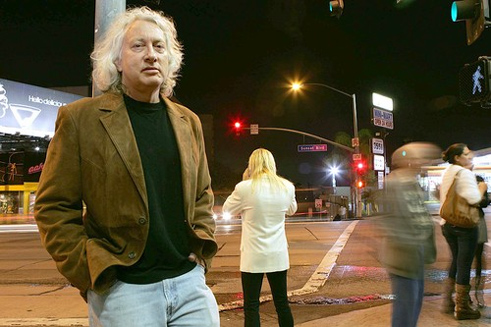
Steve Erickson appeared on The Bat Segundo Show #447. He is most recently the author of These Dreams of You. He previously appeared on The Bat Segundo Show #180.

Condition of Mr. Segundo: Contriving plans to join a community of one half.

Author: Steve Erickson)

Subjects Discussed: Writing a novel around short bursts, plagiarizing the future, The Sea Came In at Midnight, the novel as kaleidoscope, rationale that emerges midway through writing a novel, losing 50 pages in These Dreams of You, not writing from notes, Zan’s tendency to hear profane words from telephone conversations, the considerable downside and formality of being dunned, fake politeness and underlying tones of contempt, not naming Obama, Kennedy, or David Bowie, Molly Bloom in Ulysses and Molly in These Dreams of You, Erickson’s commitment to the ineffable, letting a reader find her own meaning, defining a character in terms of story instead of public and historical terms, listening to David Bowie to get a sense of Berlin, Erickson’s cherrypicked version of Bowie’s Berlin Trilogy, not capitalizing American and European throughout Dreams, using autobiographical details for fiction, Jeanette Winterson’s Why Be Happy When You Could Be Normal?, “part fact part fiction is what life is,” dating a Stalinist, why fiction is more informed by real life, how invented details encourage a conspiracy, the dissipating honor of being true to what is true, the last refuge of a bad writer, what a four-year-old can and cannot say, bending the truth when it sounds too fictional, Kony and Mike Daisey, combating the needs for believability and readers who feel defrauded, authenticity within lies, kids and photos who disappear in Dreams, striking a balance between the believable and the phantasmagorical, fiction which confounds public marketeers from the outset, postmodernism’s shift to something not cool, limitations and literary possibilities, the burdens of taxonomy, living in a culture that wishes to pigeonhole, why Zeroville and These Dreams of You gravitate more toward traditional narrative, reviewers who are hostile to anything remotely unconventional, writing a novel from the collective national moment, the relationship between history and fiction, being a man “out of time,” thoughts on how a private and antisocial reading culture is increasingly socialized, having an antisocial temperament, writers who cannot remember the passages that they write, the pros and cons of book conventions, and being “a community of one.”

EXCERPT FROM SHOW:

Erickson: We do live in a culture that wants to pigeonhole things. I don’t know whether that’s a function of late 20th century/early 21st century culture or is a function of American culture, or some combination of the two. In Japan, for instance, they don’t seem to worry about that when it comes to my novels.

Correspondent: But with Zeroville and with Dreams, we have moved a little bit more toward traditional narrative. I mean, maybe the impulse was always there. But do you think this has just been symptomatic of what you’ve been more occupied with of late? Fusing that traditional narrative with, say, some of these additional ideas of disappearance, of inserting words into sentences, and so forth?

Erickson: Right. Well, it’s hard for me to know. There are still a lot of people out there who would read this novel, These Dreams of You, and think it’s a pretty damn unconventional novel. They may not have read Our Ecstatic Days and thereby see this novel as whatever you want to call it: more accessible. But I can tell from the reviews I’ve gotten on this novel, which have largely been somewhere between good and better than good, nonetheless there are reviewers out there who really don’t quite know what to make of even this particular novel, which I think you’ve rightly said steers a little bit toward the conventional than earlier novels. And in the case of Zeroville, again, I had a strategy from the beginning, having thought about this novel for a while. I had started the novel at one point and I was writing it differently. And I was writing it — I don’t mean differently in terms of my earlier books. It was written more like my earlier books. And I stopped. I threw it out. Because I felt that this novel is about loving the movies, being obsessed with movies. It should have some of the energy of a movie. It should follow some of the narrative laws of a movie. So you had a lot of dialogue and a lot of the story being told in external terms. Being told in dialogue. Being told in action. Not a lot of motivational stuff. The main character in that novel, we never quite know where he’s coming from. We never know if he’s some kind of savant, or socially and mentally challenged. We never know.

In the case of this novel, I was aware at some point that, first of all, I was writing a story about a family, which I had never done. And, secondly, I was writing a story that it became clear to me, really from the first scene, that addressed the national moment and a moment that any reader could recognize in a way that none of my other novels quite had. Los Angeles was not submerged in a lake or covered by a sandstorm. It was out of that opening scene of the novel, which was the real-life scene that led to writing the novel. I merged a story that I thought would be recognizable to most readers. And I didn’t want to completely lose that. There are a lot of times in the novel that I think that is challenged. That recognizability. Or that recognition rather of the contemporary moment. Halfway through the book, the story suddenly changes track. But even as I was taking the reader, even as three quarters of the way through the book I knew the reader was going to be saying “Where is this thing going?” I didn’t want to lose that connection between the book and a moment of national history. It’s a history that’s still going on. It’s not a history of the past, but of the present. I didn’t want to lose that connection.

Correspondent: But why did you feel at this point, with this novel, that you needed to respond to the national moment? I mean, history is something, especially as it is unfolding, that one doesn’t necessarily feel obliged to respond to. So now you’re getting into questions of, well, is it possible that you are giving into the reader somewhat? In light of the conditions that we were describing earlier. Where did this need to respond to the 2008 climate come from?

Erickson: Well, I think it was completely personal. I was sitting on the sofa watching the election in November 2008 — Election Night — with my black daughter. And I knew this was a singular moment for me. And I knew this was a singular moment for her. And it was a singular moment for the country. And it was one of those cases where the story made itself manifest to the point of screaming at me. Here’s a story that not many other people are in a position to tell, given the circumstances of their lives as those circumstances were coinciding with the circumstances of the country.

Correspondent: Sure. I wanted to actually go back into the intertextuality within the novel. You have this character — J. Willkie Brown, the Brit who invites Zan over to give the lecture on “The Novel as a Literary Form Facing Obsolescence in the Twenty-First Century, Or the Evolution of Pure History to Fiction.” Now if we call journalism the first draft of history, it’s interesting that you also describe that “Zan’s single triumph over Brown is that, in time-honored journalistic tradition, the world-famous journalist always longed to write a novel.” It’s also interesting that Zan must return to his American roots: the original British origin point, right? To collect his thoughts on how he has dealt with words. And I’m wondering how much this relationship between history and pure fiction is predicated on Anglo-American relations. Can any novel or any life entirely deflect “the crusade against gray” that you mention?

Erickson: The crusade against what?

Correspondent: The crusade against gray. It’s when you’re describing Ronnie Jack Flowers and the specific content of his views. I wanted to talk about him, if it’s possible too.

Erickson: Yeah. That’s a big question. Early on, Zan wonders — or actually an omniscient narrator wonders by way of Zan — if this is the sort of history that puts novelists out of business. And I’m not sure I’ve got a sweeping cultural answer for all this. At some point early on in my life, well before the 21st century, I knew that I was a man out of time. I knew that the great art form of the 20th century was film. And I still believe that. And at the same time, popular music was rendering other media obsolete or, in terms of relevance, was usurping all of these other forms. But my talent and my temperament is to write novels. You know, and I should probably have been born fifty years earlier. And so as much as I would love to convince myself that I am operating in the central cultural arena of the time, I know I’m not. I know that fiction becomes not a fringe form, because too many people still read. And not even a secondary form. But a form that becomes more private. That is not shared with the culture at large. I mean, people read novels in private. Whereas they still tend to watch movies in public. Even as we watch more and more movies by ourselves at home. Even as they tend to respond still to music in public, whether they’re in the car with their sound system. So it’s just…it’s what I do. And it’s what I’m stuck doing. And the relevance or significance of fiction in relationship to history or journalism is almost beside the point for someone like me.

Correspondent: So working in a cultural medium that is below the mass culture omnipresence is the best way for you to negotiate these issues of history and fact?

Erickson: Well, I think…

Correspondent: A more dignified way?

Erickson: No, I think, Ed, it’s the only way I know. That’s all. I don’t know that it’s the best way or the more dignified way. I mean, I can’t rationalize it in those terms. In a way, I would like to be able to. You know, at some point early on, I thought a lot about filmmaking. When I was in college, I was actually a film student.

Correspondent: Yes.

Erickson: But I recognized at some point that, for better or worse, whatever talent I had — I felt I had some talent writing fiction. I had no idea whether I’d have any talent making movies. But perhaps even more importantly, temperamentally fiction is the province of a loner. Fiction is about locking yourself up in a room and having as little social interaction with other people as possible, and living in this world that you’ve created. There is nothing collaborative about it in the way that film is, or even making music is. So the answer to your question is entirely personal. It’s entirely personal. It’s what I was just meant to do.

Correspondent: You just have an anti-collaborative temperament.

Erickson: Absolutely I do. I mean, it’s more than that. I have an antisocial temperament. I teach in a writing program back in California and I have a lot of problems, actually, with writing programs and writing workshops. And I tell my students this. I say, the thing is, the paradox is that a writing program socializes what is really an antisocial endeavor. There’s something very strange about shutting yourself off from the rest of society to create this world or reality that’s completely yours and that you don’t share with anybody until it’s done, and even then you share it on a very private basis. If someone’s sitting across the room, and they’re reading one of my novels, I’m going to leave. You know, I don’t want to be there. Because even though I know that the public has complete access, what I did still remains so private to me, I don’t want to be around when somebody’s reading my work. Except for cases like this, I don’t especially want to have casual conversations about it. Perhaps strangest of all, and I’ve heard a number of other writers say this — I heard Jonathan Lethem say it a few weeks ago — people will come up to me, for instance, and ask me about a section of a book and I have no recollection of what they’re talking about. I have no recollection of writing it. I have no recollection of what I was thinking when I wrote it. I often have to ask them to show me what it is. Because I was utterly immersed in that, and then it’s done, and I need to leave it behind.

Correspondent: Running away from people who are reading your books. I mean, does this create any problems for you to go about your life? If you’re interested in the types of things that Steve Erickson readers are likely to be interested in, this could create some intriguing social problems.

Erickson: Well, as uncomfortable as it may make me to be in the same room, I would love to tell you that my life is littered with scenes of people reading my books everywhere I go. But that’s not the case. So it doesn’t happen that often. But I don’t have a lot of conversations with people who are casual friends about my work. And I don’t want to. So in that sense, the antisociability — is that the right word for it? The antisociability of the writing and the work, it does go on. It bleeds outside the lines of the life of that work, and it bleeds into areas of my other life, where I don’t, even though I’m always a writer, I don’t want to be interacting with people as a writer.

Correspondent: So is there any place for community? An increasing term used, I find, in writing. We have a “literary community” and so forth. Is this a logical extension of what some people find in, say, AWP or MFA workshops? Is there any possible place for community for you? Or that you find of value?

Erickson: For me, not especially. For other writers, perhaps. And I’ve been to AWP. And I’ve been to book conventions. The LA Times Festival of Books. And I can even drive a certain amount of pleasure for 24 hours to meet other writers. But the only community that gets any writing done is a community of one. And at the point that it becomes too much a salon, then I check out of it.

Correspondent: So for you, being antisocial is the truest temperament for an artistic writer.

Erickson: Well, I don’t know how you can be anything else. Certainly at the moment that when you’re doing the work. For me, that’s true, yeah. I can’t speak for other writers.

(Photo: Stefano Paltera)

The Bat Segundo Show #447: Steve Erickson (Download MP3)
This text will be replaced

The Bat Segundo Show: Nancy Cohen

Nancy Cohen appeared on The Bat Segundo Show #446. She is most recently the author of Delirium: How the Sexual Counterrevolution is Polarizing America.

Condition of Mr. Segundo: Getting in touch with his humanist side.

Author: Nancy L. Cohen

Subjects Discussed: Rep. Darrell Issa and the contraception hearing, Komen for the Cure, when the Republican Party was better about women’s rights, the Equal Rights Amendment, the McGovernik principle that has crippled progressivism, challenging Thomas Frank’s What’s the Matter with Kansas?, the 2010 special election in Massachusetts in which Scott Brown won Ted Kennedy’s seat, Stanley Greenberg and Reagan Democrats, why gay marriage is only accepted in certain states, Prop 8, the Defense of Marriage Act, civil unions, the Democratic reluctance to embrace gay marriage, Chris Christie, parallels between civil rights and gay rights, Howard Dean’s early efforts to embrace the Internet, Democrats who “run into the present,” Reagan’s nomination of Sandra Day O’Connor, Reagan’s silence on AIDS, conservatism as a three-legged stroll, silly attempts at a political Theory of Everything, Phyllis Schlafly, Ford’s support of the ERA, Carter blaming the feminists, political pragmatism as an excuse for diffidence, reproductive rights as a core right, Carter’s personal opposition to abortion, the Tea Party Express’s financial contributions, the influence of money on politics, the Arkansas Project, David Brock’s Blinded by the Right, why birth control hearings is now a wedge issue, the Tea Party as a rebranding of the Christian Right, efforts to dismiss Hillary Clinton, Gail Sheehy’s attacks on Hillary, attracting mythical male voters through the Margaret Thatcher strategy, motivating young people to vote as a winning progressive strategy, Obama’s timidity on reproductive/gay rights, the clown car of presidential candidates, the lingering effect of Sarah Palin, whether Republican women voters can be courted by Democrats, Lieberman as the first Democrat to denounce Bill Clinton about Lewinksy from the Senate chamber, Sen. Moynihan settling a score with Clinton, the mythical conservative middle, the problems with the 2000 Presidential election, Gore’s centrist campaign, the influence of the far right sexual fundamentalists, Mitt Romney’s effect on the sexual counterrevolution, and women’s rights in 2013.

EXCERPT FROM SHOW:

Correspondent: Your timing is quite impeccable. Because I’m talking with you the day after Representative Issa to basically not allow a woman to testify at the all-male hearing on contraception. I’m talking with you a week after Komen for the Cure initially pulled its funds from Planned Parenthood, saying, “Well, we can’t support any organization that is under congressional review,” and then changing this to be “Well, we can’t support any organization that is referring out its mammograms.” So I gotta say, maybe this might be the opportune time to discuss how we got to this point in American political history. How does this constantly wavering excuse fit into the political strategy of the religious right and the forces of what you identify as the sexual counterrevolution? How did this come into play?

Cohen: Well, I’m an evil genius. And when I came up with this idea a couple years ago, I planned for these hearings to take place.

Correspondent: Aha.

Cohen: No, seriously, the first line of my first chapter is “Perhaps if the pill hadn’t been invented, American politics would have turned out very differently.” And at the time, it was kind of a literary allusion. A way to get some history down. So what we’re seeing is really the logical end point of what I call the sexual counterrevolution. Delirium tells the story about how a small group of reactionaries who want to control sex have hijacked American politics. And what we’re seeing this week, and last week, is really the essence of the Republican Party. The id of the Republican Party coming out to play because they are so intoxicated with the power that they got in the last elections.

Correspondent: Yes. Well, the id wasn’t always there. As you point out in the book, I mean, it’s become increasingly id-like over the years. What of the sensible conservative idea? What of the rational reactionary?

Cohen: The sensible conservative ideas Back in the ’60s and the ’70’s, the Republican Party was the small government/personal freedom party. They actually meant it. They were better on women’s rights. They were better on sexual freedom really. Even before the sexual revolution, the Republican Party was better. But what happened was, with the sexual revolution and feminism and gay rights, a group of people — surprisingly mostly women — were appalled, freaked out about all these changes and sexual life and women’s roles and gays coming out of the closet. And they organized on a grassroots level against these changes. And so they went up against the Equal Rights Amendment. And they won. And then they went after publicly financed child care. And they won. And then they took civil rights away from gays. And they won. And then they methodically started taking over the Republican Party from local, state, and county committees on to the school board until 2008, when they had one of their own, Sarah Palin, on the presidential ticket.

Correspondent: Let’s get into this. You point out that George McGovern is one of the key figures responsible for Democratic timidity in relation to the sexual counterrevolution. You suggest that McGovern losing his temper, telling a voter to kiss his ass — that was one factor. The really terrible decision he made involving ordering milk with a liver sandwich in a Jewish deli. Not exactly the smartest choice. There was also this idea that McGovern, because he encompassed this cultural radicalism and failed, that this was what encouraged the Democrats to backpedal. So I’m wondering to what degree is this political temperament and to what degree is this, I suppose, a cultural radicalism that Democrats are afraid of? I mean, 2004, you have Howard Dean’s famous scream. And even before that, everybody was like, “Wow, this guy’s finally standing up for progressivism.” I mean, it seems to me that if you have a situation where the Democratic presidential candidates are limited in what they can say and how they can act, that this kind of progressive idea of, say, supporting something like the Equal Rights Amendment, you’re almost not allowed to do that. So how did this state come to be and what solutions do we have for the future?
Cohen: Good question. So the sexual counterrevolution has affected both parties. And in the Democratic Party, it’s really about their overreaction to every time they lose. And the way it goes back to McGovern’s election is that they convinced themselves that the reason McGovern lost by a landslide is because of all the gays and feminists and multiculturalists that he associated himself with. And so there’s this idea that Democratic progressives alienate mainstream America. Mainstream America is conservative. That idea is a fixation of the Democrats. But if you look at the studies of elections and you look at the studies of public opinion, it’s not true at all. Democrats have actually won elections for being the more culturally progressive party on women’s issues and gay issues and race issues. And so Democrats, I believe, would actually do better if they did embrace their voters’ live and let live attitude about people’s personal lives and stood on principle for civil rights for every American. But Democrats are timid and they have convinced themselves that they lose on this issue. So it would be good for them to start to recognize that it’s a winning issue.

Correspondent: But what data are they using? I mean, it can’t just be McGovern that’s the linchpin for this.

Cohen: No. So what they generally look at is exit polls and focus groups. And to get a little wonky here…

Correspondent: Sure. Feel free.

Cohen: What I looked at in the books so that no one else really has to — except maybe Democratic strategists can start looking at this stuff — is a lot of research by political scientists and sociologists that do regressions of public opinion polling and elections, and conclusively show that all the things we think are true — you know, that the white working-class man is an economic populist, but a social conservative? Wrong. It’s the reverse. He’s pro-choice and doesn’t like the Democrats’s economic policies. That Bush won the election on gay marriage? Wrong. No evidence. That Democrats lose elections for being pro choice? Wrong. Clinton won the election in 1992 on a huge upsurge of pro-choice women and pro-choice men.

Correspondent: You challenge Thomas Frank’s ideas in What’s the Matter with Kansas? by saying that he was condescending in believing that Kansans were duped into voting for more right-wing candidates and so forth. How do we go ahead and factor in, oh say, scenarios like Scott Brown in Massachusetts? Which is very much a scenario in which arrogance and technocratic approaches tend to destroy a Democratic seat. I mean, how does this play into the sexual counterrevolution? And how do you reconcile this, what seems to me, legitimate Thomas Frank idea with this?

Cohen: So I do criticize Tom Frank for being condescending. But I also criticize him for having no empirical evidence for his argument. And that’s the main case. His idea is premised that, one, the working class doesn’t vote for Democrats. They actually do. It’s premised on the idea that Kansas has been some bulwark of Democratic politics. It’s actually been a bulwark of right-wing evangelical fundamentalism. So there’s a number of other factual errors. I actually went into the book assuming that I was going to extend Tom Frank’s thesis. And I found that it actually went back to this anti-McGovern idea and discovered that there was no evidence for it. And that’s when I started moving in this other direction on the sexual counter-revolution. So an election like Scott Brown’s, a lot of health care money went in there. A lot of the people that they say are white working-class populist men are actually middle income or better off people. So what you have in a lot of these elections, like 2010 and the Scott Brown election, is you have very low turnout from poor Democratic groups. Young people. Single women. Low income people. And so when the exit polls do show a surge of white men, they often don’t figure out, well, where are these men economically? And I do agree that the smugness of the Democratic candidate in that election.

Correspondent: Who we don’t want to name. (laughs) And you didn’t name in the book and I won’t name on this show.

Cohen: Yes.

Correspondent: Traitor!

Cohen: I think she’s probably reformed. So I do think that was a case of a sense of the Democrats being entitled to a seat and didn’t really see this both right-wing and corporate money coming into that election that year.

Correspondent: If Tom Frank is so wrong with his evidence, then why is that book constantly cited? Why over many decades does the idea of the McGovernik still hold within the Democrats? I think that’s the thing I really don’t get. If all of the scientific evidence says otherwise, then why are serious Democratic leaders going by this?

Cohen: Well, actually, serious Democratic leaders aren’t going by it anymore.

Correspondent: It only took them several decades. (laughs)

Cohen: Yes, well, they read the polls and they read exit polls and they do their own political polling. They don’t necessarily read the academic literature. But the key person who articulated this idea of the McGovernik, about the Reagan Democrat: Stanley Greenberg, who I hear is a wonderful man and has done a lot of good work for progressive causes, was one of the people who kept this idea alive. And he runs a polling company. And he uses his own polls. So just after, since 2008, he’s basically said, “You know what? The Reagan Democrats aren’t the key voting bloc anymore. Democrats need to go for this multiethnic, cosmopolitan, progressive base and they’ll pick up enough of these white working-class men to win elections. So it is Tom Frank — and I haven’t read his new book, so I don’t know how he’s amended his thesis. But there has been a shift among the leadership of the Democratic Party. And I think you see with Obama not defending DOMA [Defense of Marriage Act], right? Saying, “I think it’s unconstitutional.” This is a sign that they’re starting to see that good principles are good politics.

The Bat Segundo Show #446: Nancy Cohen (Download MP3)

This text will be replaced

The Bat Segundo Show: Alain de Botton

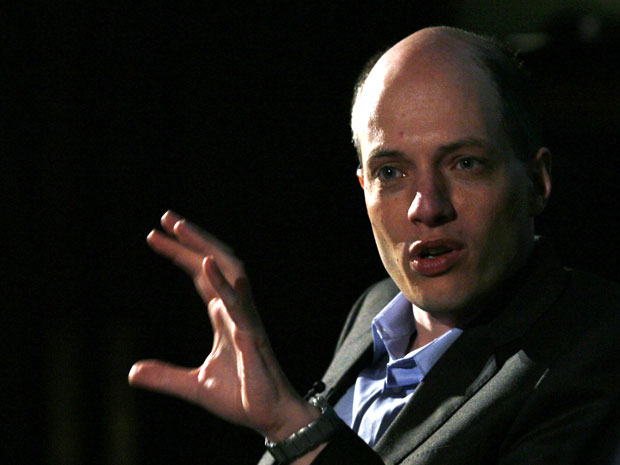
Alain de Botton appeared on The Bat Segundo Show #444. He is most recently the author of Religion for Atheists.

Condition of Mr. Segundo: Seeking pragmatic forms of belief.

Author: Alain de Botton

Subjects Discussed: The difficulties of turning other people onto enthusiastic concepts, why religion draws extremists on all sides of the debate, attempting to fight capitalism through a new belief system, the Agape Restaurant, Susan Cain’s Quiet, including introverts within community-based ideas, the Day of Atonement, mandatory voting in Australia, attempts to reach people who are not inclined to forgive, voluntary mediators, a temple for atheism, the need to feel small, feeling small through extra human forces, the power of awe, aesthetic uses of science, being awed by the city and knowledge, the mass appeal of Proust and Tarkovsky, South Park, competing notions of awe and boredom applied to the same idea, religion as a populist medium, the upside of vulgarity, high and low culture, Tarkovsky as a joke high culture figure, superbia, egotistical notions in getting to know someone through prosaic conversational questions, social status as a way of fending off other people, dependence, religious distinction through coherent brand identities, role models, reductionism and marketing, responding to architecture, touching people through their senses, São Paulo’s prohibition of advertising, religion’s reliance upon advertising, making a public claim for certain states of the soul, the Kony 2012 campaign, the pros and cons of shame, how humans can be more interesting than a smartphone, how technology forces humans to relearn essential concepts, and how human life is in permanent competition with superficial biases.

EXCERPT FROM SHOW:

Correspondent: Your books very often have this moment where you describe a very funny yet sometimes socially awkward encounter where you attempt to impart some concept or some amazing idea in your head that you are excited about and that the person who is receiving this intelligence often expresses some dismay. I think of, for example, your long speech at the Mojave Airport Graveyard in The Pleasures and Sorrows of Work or your attempt to pitch yourself as a writer-in-flight to the British Airways head honcho Willie Walsh. Obviously, I think, based off of this, you are aware that some of your excitement is being misperceived. So in light of trying to consider a scenario along the lines of what you’re preaching in Religion for Atheists — where you’re trying to have certain concepts stick in other people’s heads and religion is more fraught, more sensitive than the norm — how do you get through to these people? I mean, if you’re aware of these things, you’re probably going to have moments even more extreme than the two I’ve cited. So what of this predicament? How do you go ahead and convert these people over to your side?

De Botton: Well, I suppose, when it comes to religion, you’ve got extremists on both sides of the debate. You’ve got religious believers who are very fervent in their belief and think that anything else, anything besides full conversion to their creed is not acceptable. And at the same time, you have very fierce atheists who think that any involvement with religion is evil and to be resisted. And I’ve tried to write a book that’s somewhere in the middle of those two. It’s a book that tries to say that, as an atheist, you can nevertheless engage with aspects of religion. And indeed those aspects may be very enriching for your understanding of secular society. So it’s a weird book. Because it really is fairly in the middle of something that most people would consider to be incompatible, which is atheism and religion. It’s arguing that atheism should engage in, and can engage, with aspects of religion. And it can be shot at from both sides. But I also think there is a silent majority that is actually in sympathy with the approach I’m taking. But that is a silent majority that don’t have the pulpits.

Correspondent: But if the movers and shakers, such as the man at the graveyard, require twenty dollar bills to advance things, I’m wondering how you can instill these ideas into a new belief system if everything is centered around commerce, centered around capitalism, centered around the need to get ahead, centered around some unusual man asking to see the airplanes and so forth. I mean, this, I think, is one of the interesting takeaways I get from your book. So how do you solve this?

De Botton: Well, I think that the proposals that I make are aiming to get secular capitalist people in secular capitalist societies to rethink their positions on things. I’m arguing that there are certain things missing from modern society. Though we’ve been fantastically good at delivering material improvements and supplying material needs in the developed world, there are some other needs, which you might call spiritual — and I use that word without any supernatural implications. But spiritual, psychological needs have been left slightly unattended. I’m thinking here of things like our need for community, our need for moral structure, our need for certain guidance through the challenges of life. These things have not been so well done by the secular world and I’m arguing that one of the ways which we can plug some of the gaps in the secular world is to look back at the lessons of religion. And my book is full of examples, of concepts, of practices, of rituals that one might rescue or at least learn from as atheists in a secular world.

Correspondent: Well, there’s one idea — the Agape Restaurant — where you have different types of people sitting at the same table, sharing their stories and so forth. But I’m wondering what safeguards you have in place for people who are shy or who are introverted. There’s a new book by Susan Cain called Quiet that gets into the amount of social energy one has to exert if one is introverted or even ambiverted. And so this also leads me to ask — well, if I go into a situation and I’m asked to share my most intimate secrets with a stranger, I’m not certain if I would want to do that. Because maybe someone there might want to steal my identity or so forth. We would enter such a social arrangement with understandable suspicion. And if you’re an introvert, you may be very scared or it may actually be a little intimidating to be asked to engage in this extroverted activity. So what of these kinds of problems here? What are your solutions? What are your workarounds?

De Botton: I guess my starting point is that the modern world is not so good at community building. There’s a lot of loneliness. Because much of who we are doesn’t get an expression in social life. And this is surprising. Because with Facebook and other social media, we were supposed to have cracked this. But I think people will still complain that in many areas, we don’t have good communities. And religion’s unparalleled at building communities. Now how do religions build communities? One of the things they do is they gather people around a table every now and then and get them to break bread together and get them to talk. That’s how early Christianity started. It started as a series of meals between the followers of Jesus who remembered his lessons and got together to eat. And, as I say, you find this in all faiths. That somehow the stranger is invited to the table and is welcome to the table and a stranger is turned into a friend. It’s a beautiful idea. A simple idea. And I couldn’t help but contrast this with the modern world, where we’re obsessed with eating. And newspapers and media are full of places to eat. The restaurant world is high on the agenda. But what’s never really spoken of is the meal as a source of a social engagement. As a source of discovery of another person. And that is really what interested me. And so with the example of religion in mind, one of the things I do in my book is to suggest how we might learn from the tradition of communal dining of religions, and precisely set up meals between strangers. Now, of course, some of them may feel uncomfortable. And some people like to eat on their own. So it wouldn’t be for everybody. But I think in many of us, there is a desire to shed the armor which we normally have to wear in daily life and to eat with others and to discuss our shared and common humanity.

Correspondent: But what I’m saying is that the introvert who is very fond of, say, one-on-one exchanges, as opposed to mass group exchanges — I mean, how does such a communal dining experience account for that? They may feel very uncomfortable. There may be a lot of social energy. You’re saying that they should go ahead and answer very deep questions about what they fear. And so how do you account for them?

De Botton: Well, look, it’s not for everyone. As I say, if someone wants a one-on-one meal, if someone’s not interested in community, then it might not be for them.

Correspondent: Well, how do you get them involved in the community? If the ideal here is to get everybody on the same page, how…

De Botton: Well, it doesn’t have to be everybody. But it has to be those among us who hunger for community, as many of us do.

Correspondent: But introverts do hunger for community. They just go about it in a different way.

De Botton: Yeah. Well, I couldn’t speak for them.

Correspondent: Okay. Early in the book, you bring up the Day of Atonement — the moment on the Hebrew calendar where Jews must identify all those who they have hurt or behaved unjustly towards. Now those who are part of the Day of Atonement are inclined to forgive any offenders for annoying them or causing them grief. But it is an undeniable truth that very often when you apologize to someone in the secular world, well, they’re not exactly going to have the same degree of understanding sometimes. In fact, your apology may aggravate the other person further. So I’m wondering. To get something along the lines of a Day of Atonement for a secular or non-religious group, I’m wondering: Does it take a specific secular rite? For example, in Australia, if you go and vote, 95% of the people turn out. Because if you don’t vote, then you’ll actually get fined. So I’m wondering if a Day of Atonement along the lines of what you’re talking about would require something like a government mandate for everybody to apologize to everybody. What of this dilemma?

De Botton: Well, I don’t know. I mean, what strikes me as a secular person is how intelligent religious communities are at realizing that community is a very nice thing in many ways. But it’s also very challenging. And you find, throughout the history of religion, mechanisms to ease social tensions. And it struck me that the Jewish Day of Atonement was particularly clever and insightful in recognizing that what holds communities back is grudges. Things that are undigested in the past. And what it encourages people to do is to both accept that another person may have a grudge to bring up, but also that it behooves you not to drag out that grudge. So there’s a kind of mutual responsibility on both sides not to drag out an argument and to move towards forgiveness. And the underlying assumption is that God is the only perfect being. And anyone else is going to be flawed. And so we have to forgive on the basis of our fragility and flawed natures. And I think that’s a very beautiful idea. Look, the specifics of how an atheist might do this can yet be worked out. But it’s food for thought. I think, for me, what’s interesting here is that the psychological mechanism of forgiveness based on a recognition of imperfection. And this is something that the modern world struggles with.

Correspondent: How do you reach, though, someone who is not inclined to forgive? Or who may not in fact be on the same page? I mean, I’m all for you. I would love to see everybody forgive everybody for their sins or their errors or their sleights or what not. But the fact is that a lot of people are just not going to. So what does it take to really bring people around? Does it take constant promotion of idealism along the lines of what you’re saying or what?

De Botton: Well, in the Jewish Day of Atonement, what gets people motivated is a sense that it is normal both to forgive and to have a grudge that you need to bring up. And I think that too often when people annoy the mood for discussing issues, of discussing grudges, it’s because they feel that they’re not going to get a proper hearing, that it might be embarrassing to do this, and that dialogue with another is impossible. So it’s a kind of pessimistic position. And sometimes we may need a bit of help. We may need a third person.

Correspondent: Mediators.

De Botton: Mediators.

Correspondent: Voluntary mediators.

De Botton: And that, in a sense, was the role that God was playing in the Jewish community at that point. He is a mediator.

Correspondent: Yeah. So in addition to having a temple for atheism, we also need to get a mediator army of volunteers. Would this also help to spread further good will and bonhomie?

De Botton: I think you’re focusing a little bit unfairly on the practical aspects of this. I’m really writing as a psychologist. I’m interested in psychology of religion and the psychology of the dynamics that are being explored. So how exactly this might apply, how a secular person might absorb this into their life is capable of many different interpretations?

Correspondent: But aren’t pragmatics important when considering the psychological possibilities of what human beings are capable of?

De Botton: Sure. Absolutely. Absolutely But we don’t have to decide today.

Correspondent: I’m just picking your brain here.

De Botton: Sure. Of course.

The Bat Segundo Show #444: Alain de Botton (Download MP3)

This text will be replaced

The Bat Segundo Show: Louis Hyman

Louis Hyman appeared on The Bat Segundo Show #443. He is most recently the author of Borrow.

Condition of Mr. Segundo: Wondering why the banks don’t cut him off like the bartenders do.

Author: Louis Hyman

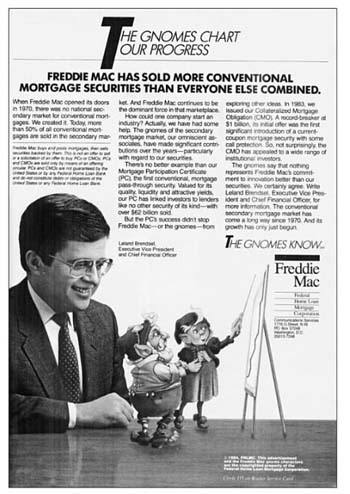
Subjects Discussed: How common American notions of cash and credit shifted in less than a hundred years, an alarming Freddie Mac ad involving magical gnomes, the history of mortgages, the 1930s mortgage crisis, mortgage-backed securities, whether American citizens can be held responsible for permitting corporations to seize control of the financial system, Jack Welch’s mass firing of employees and restructuring of GE, why the postwar economy was prosperous on credit, middle-class aspirations, top tax rates throughout American history, the reasonableness of a 91% tax rate on the wealthy, the rise of discount stores in the 1960s, the beginnings of Kmart and Target, Macy’s early resistance to credit, the inability to fight the revolving credit system during the 1960s, how specialty stores like Ann Taylor catered to the middle-class, why credit cards became necessary for the newly distributed economy in the 1960s, department store credit and credit cards, the beginnings of Master Charge (later Mastercard) and BankAmericard (later VISA), how the need to dress up if you wanted to go to a department store in 1961 helped encourage the rise of the discount store, the early cash-only success of The Gap in the 1970s through computer inventory, why college students should not have credit cards, how the Maruqette Supreme Court decision paved the way for credit cards, the near total decimation of anti-usury laws, the Constitution’s commerce clause, RICO, why Congress is reluctant to protect consumers, how South Dakota became the center for finance, market regulation, protecting consumers from bad decisions, the inability for most people to do the math on exorbitant credit rates, working people who become reliant upon credit cards, living paycheck to paycheck, William H. Whyte and budgetism, the difficulty of introducing regulatory mechanisms when so many people believe in unfettered personal responsibility, the creation of the Federal Housing Authority, the housing battle between James A. Moffett and Harold Ickes in the 1930s, marshaling the business class to fulfill social ends, Henry Ford’s opposition to the extension of credit, Ford vs. GMAC in the early days of auto loans, regulation and property rights, the duty CEOs say they have to maximize profit for their shareholders, Jack Welch’s invented heroism, investing pension in the right areas, the rise of the aerospace industry, the Chicago debacle of 1966 where bankers flooded the market with credit cards without thinking, the beginnings of FICO, desperate efforts by bankers to make banks exciting, John Reed risking his career at Citibank on credit cards, Joseph Miraglia‘s pioneering efforts to scam the credit card industry, the present social stigma on using cash instead of credit, credit cards and securitization, the savings and loans crisis, fair and transparent forms of securitization, why Murray’s Cheese can’t get a bank loan, and acceptable forms of Wall Street wizardry.

EXCERPT FROM SHOW:

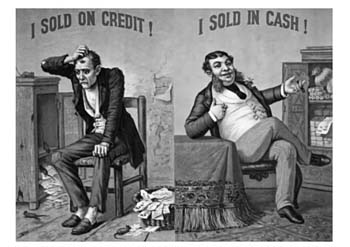
Correspondent: You start this book with a late 19th century image of the fat and prosperous man who sold in cash and the skinny man who sold on credit. I think that more than a century later, it’s safe to say that those roles have now been flip-flopped. You also write, “In the era of the CMO, the smart bank could be like the Skinny Man, its vaults nearly empty, with a pile of IOUs in a nearby basket.” I have to ask you, Louis. You are the debt man. Why were so many people willing to place their faith in the supernatural qualities of the collateralized mortgage obligation? Your book describes a Freddie Mac ad that appeared in a 1984 issue of the American Bankers Association Journal which contained magical gnomes. And they frightened me when I saw that picture.
Hyman: As well they should.

Correspondent: So why were people willing to believe in gnomes? Is it possible for you to explain in plain English what in the hell a CMO is? And why did Freddie Mac even need a new financial instrument? Just to get this party started.

Hyman: Well, that’s about fifteen different questions.

Correspondent: Yes!

Hyman: I will start with the most important question.

Correspondent: Okay.

Hyman: Which is why did people want to put money into these mysterious supernatural instruments.

Correspondent: Gnomes!

Hyman: Yeah. Only the gnomes know. It’s hard to describe it over the radio. But it’s an image of gnomes advising the head chief financial officer of Freddie Mac and saying even he does not understand how these things work. Only gnomes know. It’s terrifying to comprehend that no one understood what they were doing. But the truth of the matter was that they knew what they were doing in that what they thought that they were doing. What they thought they were doing was taking together a bunch of risky things, combining it in different ways using magical alchemical transformations, and in the process they thought they were reducing the overall level of risk. And then they were making those sellable in the form of bonds to people who ordinarily would not buy them. To understand this, you need to understand the back history of mortgages and how they were financed and sold in America, which I’m very happy to talk about.

Correspondent: Feel free!

Hyman: And it’s what I talk about in the book before the time of the gnome hegemony.

Correspondent: Pre-gnome. More level-headed times.

Hyman: Yeah. Before the dwarven under kingdom began to rule us in the night.

Correspondent: Before investment bankers cleaved to the Return of the King appendix and started speaking in Elvic langauge.

Hyman: Exactly. So you need to understand that it used to be that it was very difficult to get loans in America of any kind. And that’s why I start the book off with that picture. Because the picture of the Skinny Man, who is nervous and afraid because he had lent on credit to his customers in his store. It was a picture that would be hung in a 19th century store. And the reason I start with that is because I think more than a graph, we are all besieged by numbers these days. More than a graph, it gets at the different mentality, the different practice of lending in the 19th century. That lending was something that was not profitable. It was something that in terms of cash loans wasn’t even legal. And yet today it’s the center of our capitalism. So how did that transformation happen?

So with mortgages, the story is a long one. And I’ll spare you the details. Though in the book, the details are quite intriguing, I hope. The basic idea is that, before the 1930s, you could get a mortgage from a local bank. They were very expensive and they tended to be funded by — they were balloon mortgages like we have today. We imagine that they were recent inventions. But they actually were commonplace in the 1920s. And they fueled the housing boom. Because they allowed people to pay only the interest every month on their mortgage. Which meant that they could buy more of a house. And the banks, in turn, would resell little bonds, mortgage bonds, to pay for all those mortgages going out. And so we have something like the mortgage-backed security is today. And with all that money from the investors, they could then lend to all these people to buy. Now the problem was, of course, that as soon as the stock market crash happened, all those panicked bonds people stopped buying bonds. All those panicked investors stopped buying bonds. And then suddenly the banks ran out of money to lend for mortgages and those balloon mortgages all came due.

Correspondent: We’re talking about the mortgage-backed securities period with the participation certificates.

Hyman: They were called participation certificates. That’s the technical term from the 1920s. And what happens is that suddenly they had to foreclose on all these houses and you have the housing crash of the Great Depression. It wasn’t because people lost their jobs as much as they lost their investors. Which I think is a really counterintuitive finding from what we think about when we think about the Great Depression. And so after this, the government creates the FHA. And the FHA and Fannie Mae together, what they do is they say, “Look, little bank. You can lend money to this home buyer. And then we will sell it to distant investors. Like in New York City.” So insurance companies, for the most part, bought these mortgages whole. The entirety of them. And then that money can be used to pay for a house in Texas. But these kinds of bonds, which fueled this wild, crazy, free-for-all kind of atmosphere in the 1920s — those went out of style. Investors didn’t want to buy them. Because they had all gone toxic. And the Fed actually prevented banks from using them at all. And so this period from the ’30s to the ’70s, they’re outside. They’re no longer in our economy. But the problem is that if you want to get more money into the housing market, you want people to have more money to invest in houses like they did in the late ’60s and early ’70s — predominantly to fund housing of the poor.

Correspondent: Section 235.

Hyman: Section 235. Correct. It’s as if you read a book recently on the topic.

Correspondent: Your book perhaps!

Hyman: Perhaps a book I am acquainted with. This money was to be used for that. And it was because they confused the cause for the effect in the postwar period. They looked around them. They saw on the one hand impoverished cities and, on the other hand, prosperous suburbs. And they thought, “Well, let’s make the cities like the suburbs.” And instead of realizing that the reason why the suburbs were prosperous was because of all the jobs that the well-to-do white people had, that made them prosperous, they thought, “Oh, it was just because of their houses.” They confused cause for effect. And they created this program to bring back the mortgage-backed security, which then these bonds could be sold to new kinds of investors. Not just insurance companies, but pension funds. To all kinds of people. And actually to these small banks, it turns out. They turned out to be the biggest buyers initially of these mortgage-backed securities. And so what you have is this system which actually collapses in a year or two under George Romney’s administration of the Housing and Urban Development. But the mortgage-backed security survives and becomes the new basis for our economy.

Correspondent: And they also use the term “participation certificate,” leaving one to wonder — at least this reader to wonder — why they would use the same name of a clearly failed idea.

Hyman: It had been several generations. And so they were vaguely…

Correspondent: People forget.

Hyman: People forget. They forgive. And they think that it would be different this time. Because they were tradeable in the secondary market, which the ones in the 1920s were not. They were born toxic almost in the 1920s. But they thought, “Well, these will be fine. They’ll be like FHA loans.” Which had worked for several generations. And actually they worked fine. The securitization worked fine for a long time. From the mid-1970s on for about thirty years. They worked fine.

Correspondent: Just as the participation certificates worked fine until things started to happen.

Hyman: Until things fall apart. Things work fine until they fall apart. That’s how it is. You survive every accident you have until the one that kills you.

Correspondent: So why do these financial people, who should know this — because the historical examples repeat and repeat and repeat — why are they so short-term in their thinking when they consider credit ideas or debt ideas? Or even the extension of credit? I mean, this is what gets me. That nobody seems to have a memory longer than a few years. It’s like, “We’ve got some money! We’ll go ahead and blow it!” I’ll get into the hilarious Chicago credit card thing in a bit, which I thought was funny. But also remarkably short-sighted.

Hyman: No. It is really surprising. I think people are just intoxicated by reason. They think that if a model works, then it will work in the real world too. But the way things work on the ground and the way things ought to work can be quite different. And I think that’s one of the lessons of all of this. That we should trust our experience more than our thinking on some level. Our thinking can be wildly off. Everything made sense. But when you look at the models that people actually use for all this kind of lending, they only use three or five years of data. They don’t even use a full business cycle. And they did that because that was the data that they had.

Correspondent: Well, I guess the question here is: we are looking at this from the vantage point of financial people. The question I have is whether American citizens can be held accountable for some of the problems that occurred. To what degree should they be held responsible for borrowing, believing, going ahead and taking the extension of credit options that were given to them so that they could live their middle-class lifestyles? Does historical precedent reveal that our parents and our grandparents are victims of various strains of predatory lending? Or is it really these middle-class aspirations? How do we look at this?

Hyman: Our grandparents lucked out. So if you look at the actual Federal Reserve data, you see that people began to borrow like crazy after World War II. But what was different was that they actually had good jobs. And they were able to pay back all those debts. So the amount of borrowing goes up. But so does the amount of repayment. So it looks like no one’s borrowing.

Correspondent: Sure.

Hyman: But they’re actually using car payments for their big-finned cars. They’re using mortgages for the suburban housing. They’re using charge-a-plates at the mall. They’re doing all kinds of things that require debt. Now are they better people than us? No, they just live in a different time. So that today, it’s very difficult to have the same job over your entire life. That kind of job security is no more. Wages have stagnated for forty years for average people. And people get sick. They lose their job. And they’re stuck with these bills. So they have credit cards to fall back on. Though I don’t think it’s the people who have gotten dumb or become immoral. I think it’s that the world around them has changed.

Correspondent: But when one considers such transitions as Jack Welch’s decision to move GE’s resources from manufacturing capital to financial capital, and essentially eliminate jobs that give people money that allow them to purchase goods that allow them to perpetuate an economy, the question is…

Hyman: Are we responsible for that?

Correspondent: Are we responsible for that?

Hyman: Yeah. I think on some level we were fools to let this happen.

The Bat Segundo Show #443: Louis Hyman (Download MP3)

This text will be replaced

The Bat Segundo Show: Catherine Chung

Catherine Chung appeared on The Bat Segundo Show #442. She is most recently the author of Forgotten Country.

Condition of Mr. Segundo: Wondering if he left his car keys in Korea.

Author: Catherine Chung

Subjects Discussed: How Forgotten Country emerged from multiple stories, finding inspiration from disappearance, mysterious ghost monks that couldn’t float their way into the narrative, getting to know a character’s family by telling other stories, bad fictional boyfriends, Korean American identity as seen through reflection, character depth that springs from an aesthetic, how Chung keeps her characters separate from her identity, drawing from emotional experience, the difficulties of finding details in grief, losing your parents, giving additional details to personal experience, loneliness expressed as a dialogue between author and characters, growing up in the Midwest, “Chinaman Costumes,” racist products sold at chain stores, being surprised by people speaking against injustice, first-generation Korean Americans and second-generation Korean Americans, being bullied while growing up, being pushed into a brick wall, how schools used to react to bullying, dwelling on childhood incidents, moving around a lot as a kid, not being accepted, changing perceptions of bullying over the past few decades, grief as a way of understanding cultural identity, “From the Ruins,” whether any city or location can offer true respite, escaping to Leipzig, poorly buried corpses during the Korean War, animal-based mythology, how the subconscious fits personal anecdotes into fiction, unanticipated symbols which emerge in life, paying attention to things that seems like signs, the burdens of an analytical subconscious, finding the mathematical precision within sentences, Chung’s math background, the messier process of half-formed thoughts, the difficulties of not knowing, whether or not block is productive, obsessively circling a problem, Csikszentmihalyi and flow, using the least amount of words possible in a sentence, being concerned with a readership, how style is shaped through unexpected means, abuse and ambiguity, the creative showdown between God Cathy and Janie’s Voice, the troublesome results of divine creative intervention, and control in fiction and in life.

EXCERPT FROM SHOW:

Correspondent: I know that Forgotten Country emerged from a number of different stories that you were working on at the same time. You have, of course, this idea of the boy falling out the window, which is at the very beginning. The mysterious hermit girl who crops up later in this book. And then you also have this story that was inspired by your father’s sister, who disappeared when you were a child. It’s really interesting to me that, first of all, these stories fused their way together into a novel and that, secondly, this came before this massive family unity of complicated relationships. So I’m curious, first and foremost, if you could describe how these stories came together in novel form and how you were able to fuse them together, and whether you needed some of these orbiting asteroids to circle around and become the planetary family unit.

Chung: Yeah. Well, you make it sounds as if I did it so intentionally.

Correspondent: (laughs) No, it never is intentional, of course. But I’m wondering how the connections came about.

Chung: Yeah. I think that they came about after a lot of time. There’s one character telling all these separate stories. And that’s what linked them. I didn’t really know what they were doing with each other or how they were related. There are other stories that were also in this book that eventually dropped out.

Correspondent: Oh really? Like what?

Chung: So there was a flying ghost monk.

Correspondent: Really?

Chung: Yeah. He was eradicated fairly early on. But he was totally in there and for a long time, he was carrying a great deal of weight in terms of just the number of pages.

Correspondent: That’s quite a feat, given that he was a ghost.

Chung: Yeah. He was a ghost. He was on a trek to find his lost daughter. And that was one of those stories I realized in my mind was related to the other three stories, right? Because all those stories are about loss and about trying to find what’s been lost once you’ve moved on. It’s almost impossible to do that. But in terms of the narrative arc, he didn’t work. And part of the reason he didn’t work was because the main narrator really was Janie, who was the protagonist and the narrator of the novel. Because he was carrying on his own story and I thought, “Well.”

Correspondent: You can’t very well have him being narrated by Janie.

Chung: Yeah. And in my mind, he was related. But in terms of the book, he didn’t fit.

Correspondent: So how then did the family come about if Janie was the narrator for these three stories?

Chung: Ah! Because she’s totally preoccupied by her family.

Correspondent: Oh, I see. In the act of telling these other stories, you got to know her family.

Chung: Yeah! That’s exactly right. These are the stories that I was really interested in. But the other stories that she was also interested in, I had to create a character who could tell these stories. But I think that she was interested in these stories because of the light they shed on her own experience. And as she told these stories, she’s sort of a secretive, hard-to-get-to-know person. So these were the stories that she wanted to tell. But then there were these underlying stories of her own life that came to play as she was telling them.

Correspondent: And allowed you to work out the connections with the sister, with the aunt, and so forth. Well, this leads me to wonder, did you have the competitive relationship between the sisters in place before the father-daughter relationship? Which of those came first?

Chung: Which of those came first? I think that the father-daughter relationship came first. Hannah’s disappearance came first.

Correspondent: Of course.

Chung: It was the absolute first thing to happen. But their competitive nature came as I was discovering why Hannah would leave and why it would be difficult to find her. I discovered what their issues were.

Correspondent: It’s interesting that competitiveness would come from disappearance. (laughs)

Chung: Yeah! And I think that the competitiveness also arose not early on in the novel — but I think Janie gets jealous with all the attention that’s focused on Hannah while she’s missing.

Correspondent: You were mentioning ghosts earlier. We’re talking about disappearance.

Chung: Yeah.

Correspondent: I’m wondering if subtraction might in fact be the way for you to pinpoint what a story or what, in this case a novel is all about.

Chung: That’s a really interesting point. I think that a lot of what I’m interested in and a lot of what I focus on is what’s missing or what’s longed for. Or what’s gone.

Correspondent: Were there any instances when you were writing this where you simply had too much and you had to remove an element? I mean, we were talking earlier…

Chung: Like a flying ghost monk.

Correspondent: Like a flying ghost. Or a character perhaps. Or some angle that just didn’t allow you to get that emotional precision that I think is there throughout the book.

Chung: Yeah. I was thinking the other day just about how many pages I removed. And I would say the book is about 300 pages, but I think I must have deleted at least six or seven hundred. Probably more like a thousand as I was going through the drafts. So entire storylines fell out. Like the flying ghost monk. There was a character. Janie’s love interest also ended up getting cut out.

Correspondent: Oh, I see.

Chung: And so as I went…

Correspondent: Is this the guy in college? Or just another love interest?

Chung: No, it was another love interest.

Correspondent: Oh! Another love interest!

Chung: There was another.

Correspondent: What was he like?

Chung: What was he like? Well, you know, I think he wasn’t all that interesting. Which is why I took him out. He wasn’t really holding his weight. I realized it wasn’t about him.

Correspondent: Well, I also wanted to ask about Hannah. The thing that’s fascinating to me about her is that she almost seems like a reflection of Janie. I mean, I think specifically about the scene in the hotel elevator, where Hannah follows her in and is essentially tailing her and mimicking her. And then you also have Hannah, which is a palindrome.

Chung: Yeah.

Correspondent: But also you observe of her at another point in the book, “how strangers, even adult men, would pause in the street to look at her, and how easily she held their attention.” So she’s also, on the other hand, resistant to Korean food. Which leads me to also wonder if her reflective nature came to mimic the idea of America or an American identity mimicking the original Korean identity that Janie has. And I’m wondering if you could talk about if Hannah came from almost a reflective pool from dwelling on Janie like this.

Chung: That’s such an interesting question, and one I haven’t heard yet. But I think that’s exactly it. Or at least that’s the source or the core of Janie’s resentment to Hannah. I think that because Hannah not only reflects Janie, but also gets to do some of the things that Janie doesn’t get to, but would like to, Janie feels that that’s been taken from her. That she only gets to be a certain kind of person because Hannah has already taken this other part of her. This reflection, exactly as you’re saying, is reflecting some part of her that is also slightly different. And so Janie is very competitive and jealous about that. But I also think that that link that you made to how her Americanness is a reflection of how her Koreanness could be a reflection is also very interesting. Because of the ways in which people change or mimic each other or come to copy an idea of what they should be. So, yeah, those were things that were with me the whole time that I was writing this book. And I just think that it’s really cool that you picked up on that.

Correspondent: But when you considered Hannah, did she first come to you as this aesthetic person? And did you need to flesh her out by this reflective thing we’re talking about? By imbuing in her some sense of her being looked at by other people? By people who were not, in fact, Janie?

Chung: Maybe. And I think that the thing that I kept getting caught on with this question is that I have often thought of both Janie and Hannah as reflections of parts of myself as well.

Correspondent: Yes. Of course. They’re your secret sisters. (laughs)

Chung: Yeah! Who live inside my head. But I was interested in Hannah as the object of attention, right? As a kind of reflection. And I think part of Hannah’s problem is that it’s hard for her to — and Janie’s problem as well — it’s for them to think of themselves, or they get tripped up on the way that they’re being looked at by other people. And it’s hard when you see yourself as a reflection. Because then what are you?

The Bat Segundo Show #442: Catherine Chung (Download MP3)

This text will be replaced