The Bat Segundo Show: Ken Russell

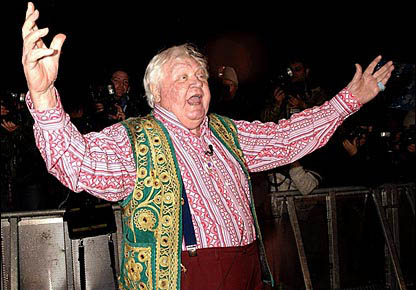
Ken Russell recently appeared on The Bat Segundo Show #348. Mr. Russell is the director of such films as The Devils, Women in Love, Tommy, The Music Lovers, and Altered States. Beginning today, Russell’s films will be playing at the Film Society of Lincoln Center for one week (many of which are unavailable on video), where Russell himself will be appearing each evening. Considerable thanks to Elize Russell and Shade Rupe for their invaluable assistance.

Condition of Mr. Segundo: Wrestling nude with 83-year-old directors.

Guest: Ken Russell

Subjects Discussed: [List forthcoming]

EXCERPT FROM SHOW:

Correspondent: You got into a fight with Alexander Walker, a man who, by the way, you’ve outlived. Other critics have called your films monstrously indecent. Walker was not the first one. So why did you hit tap him on the head, or beat him on the head, with a newspaper. I’m curious. Do you remember what was going on in your mind at the time? Or did you finally have enough of all these critics who were needlessly shitting upon what I think is a remarkable output?

Russell: Well, I guess I got tired of him putting me down. When he said, “You change things. We actually see Oliver Reed’s testicles crushed.” And I said, “Excuse me. That’s in your mind.” We don’t see his testicles crushed. Because they weren’t crushed. Only in your dirty little mind, you pig. And so he took exception to that. So I hit him over the head with his own review. Which happened to be a tissue of lies from start to finish. So that was a reason.

Correspondent: One of the few filmmakers to really get pugilistic about your critics there.

Russell: Yeah, well, he shouldn’t have said that. I mean, we didn’t see Oliver Reed’s testicles crushed. He may have wished we had. But we didn’t.

Correspondent: It was really — you were sticking up more for Ollie than you were for yourself?

Russell: That’s right. Yes.

Correspondent: I’m curious about a couple of things I’ve heard. One being that Oliver Reed apparently slammed you to the kitchen floor so that you would include the nude wrestling scene in Women in Love. I’m not sure if that’s true. Wanted to run that one by you. There’s another rumor going around that Ollie and Keith Moon were so drunk on the set of Tommy that they were improvising their lines. And then there’s another one that you guys got kicked out of the resort that you were filming at because of Ollie’s behavior. First of all, I wanted to find out if these stories were true. And second of all, given that this obviously must have been a very difficult working relationship at times and I know that you Ollie again until Prisoner of Honor, what accounts for the delay between Tommy and Prisoner of Honor?

Russell: Well, the delay between the two films was simply down to the fact of availability. Oliver Reed was only available at certain times and he wasn’t available. In Prisoner of Honor, that was why I didn’t use him before.

Elize Russell: You got along with him well.

Russell: Yeah, I got along with him very well. He…

Elize Russell: He called him Jesus.

Correspondent: He called you Jesus?

Russell: Yes. That wasn’t a compliment.

Correspondent: (laughs) So a little tempestuous there.

Russell: (laughs) Yeah.

Elize Russell: But he did throw you to the floor and you said that he convinced you to do the scene.

Russell: Oh yes. Yes, he did. I wasn’t going to do the nude wrestling scene. Because I couldn’t think of a way to do it. Because nude wrestling was frowned upon in British cinema.

Correspondent: In more ways than one.

Russell: In more ways than one, yes. So finally, he agreed to do the nude wrestling as long as there was no nude wrestling to be seen. (laughs)

Elize Russell: And how did he convince you to do it in front of the fireplace?

Russell: Well, he dropped round to my house for supper and said, “It could be done! It was very simple to do.” And he showed me how easy it was. You just faced each other, put out your hand and shook it, and threw each other onto the ground.

Correspondent: Did he often persuade you to insert scenes along these lines? Because I’m sure it couldn’t have been limited to Women in Love.

Russell: No. It was one of his favorite methods of perusasion.

Correspondent: Throwing you to the kitchen floor? That wasn’t the only time then.

Russell: Oh no.

Elize Russell: There was a sword fight.

Correspondent: Aha!

Elize Russell: But you won that one by mistake and closed your eyes.

Russell: Yeah.

The Bat Segundo Show #348: Ken Russell (Download MP3)
This text will be replaced

Review: Get Low (2009)

There is a type of moviegoer, generally between the age of 30 and 45, who will witness Bill Murray in a movie and laugh at his every tic, his every moment, his every step forward. Yes, Bill Murray is a very gifted comic actor, quite possibly the 21st century’s answer to Buster Keaton. But such a preprogrammed response misses the point of Bill Murray. It suggests very highly that he is some jester for our steadfast amusement rather than a soul to be genuinely interested in. Small wonder then that the roles that Murray has taken in the last ten years have involved sad loners in their autumn years.

Given such thespic expectations (and such tittering moviegoers: two of whom were at the screening I attended), it’s a relief to see Murray playing an opportunistic funeral director named Frank Quinn in Get Low, a supporting role comparable to Wild Things‘s Ken Bowden, Cradle Will Rock‘s Tommy Crickshaw, and Mad Dog and Glory‘s Frank Milo. Few filmmakers seem to ken that Murray best anchors a film when his hangdog mug scatters into the background. Maybe director Aaron Schneider gets this because he’s also a cinematographer. But a movie set in the 1930s concerned with how misfits are judged by a town square’s cruel metric works better with Robert Duvall cast as the misunderstood “freak” and Murray as the lonely man riding his coattails.

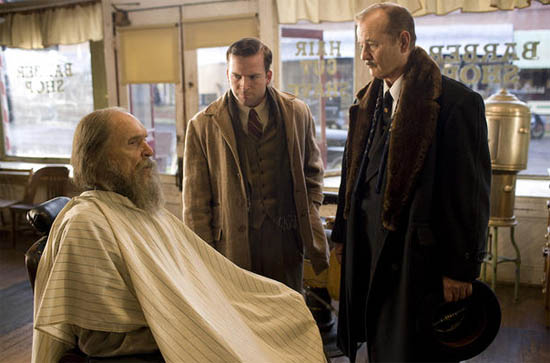
Get Low takes it inspiration from Felix “Bush” Breazeale, the nearly forgotten figure who, according to James Ewing’s It Happened in Tennessee, decided to attend his own funeral on June 16, 1938. Breazeale’s funeral was heavily publicized in the papers, in part because Breazeale had been charged with murder many years earlier, with the charges later dropped. But where the real-life Breazeale sifted through the crowd at funeral’s end, signing programs and shaking hands, this movie’s “Felix Bush” views Breazeale’s eccentric act less as an individual’s unusual exertion of identity and more as the tragic aftermath of a misfit’s whims skimmed over and ignored by a capitalist system. This Felix Bush is picked on by the local townsfolk. He introduces a raffle component to his funeral during a radio appearance, encouraging greater throngs to attend. The film’s Uncle Bush is more familiar with marketing techniques. He takes a photograph with his long mane in disarray, only to have a barber trim himself for the big day. (Not so for the real Uncle Bush.) This film’s funeral is held so that Felix Bush can see what stories have circulated about him, whereas the real Bush was a fastidious type who wanted to see his service conducted in the right manner. Get Low takes the position that Bush’s funeral is an act of corrective catharsis, of setting matters straight before a hostile crowd.

Yet despite these concessions to conventional narrative, Get Low mostly works. It feels less like a biopic because of its leisurely pace, its efforts to establish a small town atmosphere, and its willingness to maintain Bush’s personal secret for so long. It understands that, when you have actors as good as Duvall, Sissy Spacek, Lucas Black, Murray, and Gerald McRaney, you let them play out the moments. It has some funny lines, most of them delivered by Murray. Frank Quinn defines his sales track record when he grumbles, “I sold twenty-six of the ugliest cars in the coldest day of Chicago.” Shortly after Bush threatens to put the kibosh on the gambit, Quinn says, “Is it just me or is he extremely articulate when he wants to be?” Yet Murray’s character, for all of his quips, is lonelier than Bush, even when he’s sitting around a table and taking in local gossip. We’re left to wonder why this man had to flee Chicago so late in life. Quinn offers some nebulous story about switching sides of the bed shortly after his wife left him, but it’s just one small part of the story. Just as the stories circulating about Uncle Bush, very much the local recluse, hardly tell us anything we need to know about the man.

And this narrative approach, helped in large part by screenwriters Chris Provenzano and C. Gaby Mitchell, very much turns a shaggy dog tale into something more memorable. There’s a certain irony in this movie opting to print Felix Breazeale the legend, rather than Felix Breazeale the man. Sometimes, Get Low needlessly overplays its hand — such as the brazen need to telegraph its time period with “I’m Looking Over a Four Leaf Clover” or the lost love plot that never quite congeals, even when Duvall bangs on the door in the pouring rain. But its efforts to capture some impression of a bygone time, fusing these with an undervalued human gusto, reminded me of a needlessly forgotten 1999 film called Man of the Century. American culture has been too preoccupied with condemning the oddballs. It’s a relief when a small movie like Get Low comes along to remind us why they’re so interesting, and why Murray isn’t just some aging goofball.

The Bat Segundo Show: Sally Potter

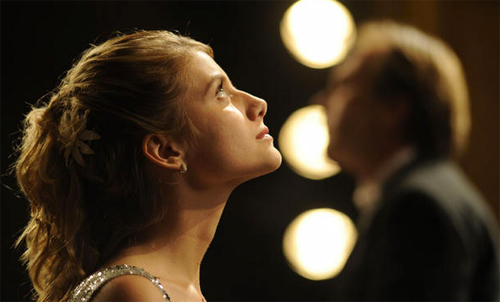
Sally Potter appeared on The Bat Segundo Show #347. Ms. Potter is the writer and director of the 1992 film Orlando, adapted from the Virginia Woolf novel, which opens in re-release on July 23, 2010.

Condition of Mr. Segundo: Hoping to live forever or die trying.

Guest: Sally Potter

Subjects Discussed: [List forthcoming]

EXCERPT FROM SHOW:

Correspondent: One interesting aspect about Orlando, from my standpoint, is that it’s almost a textual collage. You don’t really use a lot of the prose that’s in Virginia Woolf’s book. And if you do use it, you often modify one word or two words. There’s Spenser’s The Faerie Queene. There’s Joseph Addison’s The Tattler. There’s Shelley’s “I Arise From Dreams of Thee.” If you’re a literate person, there’s a smorgasbord of collage and possibilities. And I’m curious why you made this particular decision. Was the idea here to reinforce some of the sexism of the literary world? That Virginia Woolf’s true prose would not be represented in the film version of her work? What happened here?

Potter: Well, I think the essence of her prose is the skeleton of the film. I tried to make a distillation of what she’d done to further distill her own project of distillation. She writes in her diaries about wanting to exteriorize consciousness, writing in images rather than language. And where usually she was working with a kind of inner monologue — the stream-of-consciousness project through the word — in this case, she was working through the description of images that were like watching the inner mind unfold, but not as one individual’s mind. A kind of collective mind. Now she was also working with a tapestry of references. So the book is littered with one reference after another. When you go back to her diaries, and look at her essays — which I did — and go back to her sources, you see that she was doing a kind of postmodern collage herself.

Correspondent: Yes.

Potter: So all I tried to do was stay true to that principle, but make it work in cinematic terms. Anything else would have been a disservice to her as a writer.

Correspondent: But in terms of using the other — mostly; in fact, all male — writers, instead of specific quotes — with the exception of, for example, the trial and the poetry scene with Greene, I’m curious how you made that selective process. Did some reference in the book cause you to grab for the Norton Anthology? What happened there? And also, I was curious in terms of changing one specific word from a passage. Did you encourage the actors to paraphrase from the script? Or did you actually have the…

Potter: Oh no no.

Correspondent: Okay.

Potter: No. But I did so many drafts. My first draft — in fact, when I took it to my script editor at Faber & Faber. He picked it up, weighed it, and said, “Go and take out a hundred pages.” It was really long. The first adaptation. So it was clear that it had to be cut. And some words work spoken. And some words work written. And so through the very long development process — I mean, multiple redrafts and redrafts and redrafts. And Tilda [Swinton] reading aloud to me. And so on. First of all, I learned about the importance of things actually working, rather than working in theory, as you intended them, and to try to be very open to listening and observing what worked, and make things fit so that they had, in a sense, a natural feeling for voice and body of that particular actor who’s manifesting the idea. So that entails changing things from time to time. But, for example, Nick Greene’s satiric poem about Orlando and Orlando’s bad poetry are not in the book. I had to write them.

Correspondent: I figured as much.

Potter: From clues. So I had to fill in, in a way, certain gaps that, had she written them on the page, they would have had a different status. And also, from her, she does a sort of sketch of 18th century authors. And you know who she’s referring to. And again, I had to fill them with actual quotations. So my guiding principle always was: Stay true to the spirit and the intention, but not to the letter of the book.

The Bat Segundo Show #347: Sally Potter (Download MP3)

This text will be replaced

Review: The Concert (2009)

Here are some of the reasons why The Concert does not work:

1. Eran Kolirin’s The Band’s Visit — a highly charming movie in which an Egyptian police band accidentally goes to the wrong town and learns quite a bit about existing along the way — hangs in recent memory. There is little doubt in my mind that The Concert was acquired by The Weinstein Company or set into motion by its motley group of multinational financiers with this association. But its premise — a ragtag Russian group of musicians impersonates the Bolshoi Orchestra to play in Paris — is problematic.

2. The premise is problematic because it asks us to suspend our disbelief again, and again, and again. This causes us to resist the movie. We’re expected to believe that, because one fax has been intercepted, a fax that wouldn’t be followed up with an email, a phone call, or any other attempt to verify provenance, the ersatz Bolshoi commanded by our hero would happen. We’re expected to believe that the Théâtre du Châtelet, a long-standing house that premiered Stravinsky’s Petrouchka and is home to the Kirov Opera, would throw around a good deal of money without, say, consulting the Bolshoi’s website to ensure that these people are who they say they are. We’re expected to believe that these impostors can get away with their scheme when a Russian TV crew is chronicling them, and it is quite likely that friends and loved ones of the true Bolshoi would proffer hysteria and consternation when seeing the con unfold. We’re expected to believe that an entire symphony, nearly all of them out of practice, will somehow get its act together. And we’re expected to believe that, in a post-9/11 age, not a single fabricated passport, nearly all obtained at the eleventh hour, would be scrutinized by a single authority. And obviously, since a world-class orchestra is attending press, there are likely to be journalists or bloggers who are going to be checking into the Bolshoi performers. (Then again, what if nobody cared about the Bolshoi Orchestra in Paris? What if the reason why this phony orchestra passed for the real thing was because classical music had become less valued? Even in a metropolis priding itself on culture! Suddenly, there’s a more legitimate tension here over whether or not the impostors will be discovered or even appreciated!)

3. In short, scenarist and director Radu Mihaileanu hasn’t thought these basic questions through. Strangely, Matthew Robbins, the screenwriter who wrote such campy movies as Corvette Summer, Warning Sign, and The Legend of Billie Jean, is credited as one of the collaborators. “Collaborator,” in this case, is rightly associated with the connotation I derived from Isser Woloch’s Napoleon and his Collaborators: The Making of a Dictatorship. What we have here is an illogical mess that will frustrate any thinking audience member. Never mind that Aleksei Guskow is actually quite good as the disgraced former conductor of the Bolshoi Orchestra toiling decades later in the Bolshoi as a janitor and who sees the ruse as a way of restoring his reputation. The points I’ve raised in the previous paragraph work against story logic. Furthermore, the secret daughter plot introduced deep in the film’s second act disastrously detracts from the redemption narrative.

4. Look, I get that the movie wants to be the 21st century answer to Ernst Lubitsch through a Russian prism. (The Concert immediately reminded me of the much superior Ninotchka, and I grew antsier as the film progressed.) But Lubitsch (and Billy Wilder, one of Ninotchka‘s co-writers) understood that when you’re creating fantastical elegance of a somewhat implausible ilk, it needs to be buttressed by such ideas as a champagne pop being confused with a gunshot or funny lines like “The last mass trials were a great success. There are going to be fewer but better Russians.” And while there’s a certain amusement in seeing the fates of several symphony members (a few elderly musicians are now providing the orgasmic soundtrack of a porn movie), as well as a gypsy musician prove himself before edified musicians, The Concert doesn’t have what it takes to invite us into its deception. Furthermore, in explaining the plot, it relies upon an obnoxious strobe effect for belabored flashbacks. And in these flashbacks, the film hasn’t even bothered to make its fifty-year-old composer look or feel like a man in his early twenties.

5. I forgot to mention one of the film’s subplots involving a man attempting to revitalize the Communist Party with a speech delivered on the night of the Bolshoi performance. This story angle is neither funny nor interesting. A long-winded speech, check. A reduced audience, check. Flags and uniforms rescued from the mothballs, check. What’s lost within all these cliches is the true cost of attempting to recapture a past identity. The film’s ultimate failure comes with its diffidence to confront genuine human emotions, save through a work camp flashback that comes near the end, which feels appended by some slick marketing type wanting to ensure that “all the elements are in place” for mass consumption. A film coming from France and Russia shouldn’t feel like some thoughtless bibelot churned from a Hollywood machine.

Review: The Girl Who Played with Fire (2009)

When I read Stieg Larsson’s The Girl Who Played with Fire, I learned that it was possible to subsist on little more than Billy’s Pan Pizza when taking down a shadowy human trafficking organization. I learned that Billy’s Pan Pizza could get you through the day when your name was slandered in various Swedish broadsheets, and when your family’s malicious nature was revealed, and when you needed to hack into computers using tactics that the 2600 crowd would surely find dubious. Eat enough Billy’s Pan Pizza and you too would be able to access a powered down laptop! Perhaps it was a surrogate for a wild weekend involving a bag of shrooms and a fifth of scotch. Or merely the workaholic’s answer to intense labor. But it was certainly enough to alter reality and make it persuasive. If you had two breaks for Billy’s Pan Pizza, you could spend most of the day at your computer “with only a big bottle of Coca-Cola for company.” This was a Donnean existence to be sure, but then Billy’s Pan Pizza could take you quite far. If you walked into a 7-11, it was absolutely impossible not to walk out with several boxes of Billy’s Pan Pizza, along with an obsessive need to announce your shopping list to the reader. Because of this, I felt very sorry when Salander had exhausted her Billy’s Pan Pizza supply. Without the pizza, there was no way for her to win.

So I was considerably disappointed when the film adaptation failed to understand the true power of Billy’s Pan Pizza. Yes, it pimped Vaio and Mac and IKEA and other non-food products. The Swedish television industry (for this cinematic release is actually the first half of a TV miniseries) has learned a thing or two about product placement. But the problem here was that the filmmakers haven’t considered the right item to pimp. Aside from an unidentified pizza box tossed against a kitchen wall, there was no indication of Billy’s Pan Pizza maintaining its essential role. For this reason alone, I must condemn writers Soren Staermose and Jon Mankell and director Daniel Alfredson for this lackluster offering. The Millennium trilogy has been a remarkable commercial bonanza. Is it not fitting to maintain the commercialism in these cinematic counterparts? If these filmmakers cannot comprehend the importance of such a vital frozen food product, then they are as morally dissolute as tax cheats.

But maybe this criticism isn’t entirely fair. While I could complain about my failure to read the Swedish subtitles due to the crowded house and the screening room’s highly acute grade, I won’t. I’ll only say that I was seated behind The Girl Who Didn’t Understand That Her Fat Head Prevented Others from Reading the Subtitles. This extenuating circumstance may have had some bearing on my ability to review the film properly. Nevertheless, I was able to make out 95% of the missing words by listening. And I was delighted to encounter more overlap between Swedish and English word roots than I anticipated.

While I could point out that Staermose and Mankell don’t quite have the knack of synthesizing a mammoth novel that the previous writers (Nikolaj Arcel and Rasmus Heisterberg) had with The Girl with the Dragon Tattoo, I should point out that they are good enough to make the book’s “giant” relatively laconic. Director Alfredson has cast a rather silly blonde man named Micke Spreitz as Ronald Niedermann. He isn’t quite Richard Kiel. He resembles what might have happened if some Tiger Beat model from twenty years ago grew up and replaced his morning Wheaties with steroid shakes. Menace isn’t exactly his strong suit. He’s preposterous and not nearly as intense as he should be. But he’ll do.

There is semi-hot lesbian sex, which I’m sure will please a certain redblooded demographic too diffident to walk past the beads into a video store’s adult section. Not exactly Deneuve and Sarandon from The Hunger, but it will also do. Salander’s surprise breast implants didn’t find their way into the film, suggesting some mammary diffidence. The hospital flashbacks are shot in black-and-white, suggesting a chiaroscuro commitment to spelling out the bleeding obvious. But Michael Nyquist (Blomkvist) and Noomi Rapace (Salander) aren’t too bad in this. Yes, Nyquist and Rapace don’t really get many moments to confirm their onscreen chemistry this time around. And Nyquist, who was quite the studly lothario in the last one, doesn’t quite have the “talent” that Larsoon was keen to delineate in the book. My hope here is that Nyquist will be getting his rocks off in the next film to demonstrate how old school journalists are the new stallions.

Thanks to budgetary constraints, the Millennium‘s office (this time around) looks more like some fly-by-night startup rather than a major muckraking magazine. I was also disappointed that the juicy line “Your mother was a whore!” was uttered so calmly. For goodness sake, this is Swedish melodrama! We need such lines to be uttered with scenery-chewing integrity!

Nevertheless, I had fun with the film. Even if I did notice that other critics were baffled by the plot. I am not certain that they had read the book. And I’m still not sure if the Millennium film trilogy quite captures Larsson’s lurid feel. These films are certainly not the Red Riding Trilogy. But they’ll do.