
David Denby recently appeared on The Bat Segundo Show #261.
David Denby is most recently the author of Snark.
Please also see our lengthy essay, in response to Adam Sternbergh’s review. This conversation represents an effort to get Denby to answer questions raised by both pieces.
Condition of Mr. Segundo: Ordered against using a snarky tone.
Author: David Denby
Subjects Discussed: Whether or not Denby feels battered, unsuccessful attempts to pinpoint the definition of snark, the club of the clued-in, newspapers and narratives, Denby’s reservations about the Web and decentralization, snark’s relationship to voice, Sturgeon’s law, panic in mainstream journalism, satire and a corresponding set of virtues by implication, prototypical voice, the Sarah Palin prank, Spy, contempt for New York celebrities vs. contempt for money and power, investigative reporting and the Web, peer-to-peer journalism, Josh Marshall and the attorney scandal, Private Eye, Sgt. Pepper’s Lonely Hearts Club Band, the need to take sacred cows to task, Pitchfork, “Ugandan discussions,” endearing jargon vs. in-the-know references, why Denby doesn’t find Gawker and Wonkette funny, fickle public memory and disappearing websites, Perez Hilton at 40, fighting slander, accounting for corrective impulses on the Web, privacy as a bourgeois triumph, whether or not Denby can truly have an informed opinion on Twitter if he’s never used it, quibbling with Denby’s uniform assessments of mediums, accounting for the visual innovations of Spy Magazine, the visual notion of snark, Kurt Andersen and Graydon Carter, circumstances in which being ruthless towards someone is okay, Mike Barnacle, nastiness and self-deprecation, Penn Jilette, snark practitioners as flip-floppers, Maureen Dowd, superfluous anger vs. righteous indignation, constructing a narrative in which you can locate yourself, Alcanter de Brahm’s irony symbol, Perez Hilton’s lack of anonymity, defending Tom Cruise, why photographers haven’t fought Perez Hilton, legal remedies, being dragged into the celebrity culture, and raising an army of thoughtful writers.
EXCERPT FROM SHOW:
 Correspondent: Let’s talk about this idea of trash talk vs. snark. You indicate in this book that it’s okay to have a vituperative remark or a savage wit, if there is a corresponding set of virtues. And, in fact, you say “a corresponding set of virtues by implication.” Now “implication,” I think, is the important word here. Because to go back to the Sternbergh review, I would argue, to defend him briefly, that he is attempting to point out that Television Without Pity and the snark tone that he champions — I mean, is there not a corresponding set of virtues perhaps that is in the initial stages? In the prototypical stages perhaps? I mean, don’t people have to start from somewhere before they reach this level of thought that you are advocating in this particular book?
Denby: Well, we don’t know, do we? But I don’t see much of that in Television Without Pity. Mostly, it seems to me, whenever I look, it’s enormously long plot summaries with a lot of snarky adjectives. And it’s fun. Because it’s like friends who gather at a house to watch a TV show, and you compete with one another to see who can be funnier. But I would forgive them everything if they jumped up and down with joy when something original and difficult came out. Like in their movie stuff, I don’t notice them celebrating There Will Be Blood or The Diving Bell and the Butterfly. What gets their jets going is trash like Bride Wars. In other words, they’re invested in trash. And that’s why I say that these people are really thugs of the conglomerate in a way. In other words, they’re part of the commercial system. They’re not really interested in anything adversary. For all of their nasty tone, they’re part of the commercial system. They’re not adversarial at all. They don’t push the little guy — you know, the protest against the system or the artistic revolutionary. That’s not what they’re into. They’re into fandom. Now let me come back to Sternbergh.
Correspondent: But also to point out the initial thrust of this question. As a prototypical model, for some people, snark is the way to get to this more virtuous plane that you’re advocating here.
Denby: Well, I hope you’re right. And maybe they’ll just…
Correspondent: I can say this from experience. Because I was a little snarky when I started writing.
Denby: But people get older and they realize that I’m not pushing my weight. That this is too easy.
Correspondent: Yeah. Jessica Coen, who ended up going from Gawker to New York Magazine. She wrote an essay. I’m sure you’re familiar with this. You don’t quote it in the book. But I’m sure in the course of your research, you found it out. She pointed to the negative feelings that she had, and she wanted to go to this more thoughtful plane.
Denby: Right.
Correspondent: So I’m saying that perhaps, maybe, instead of essentially fanning the flames of discontent against this type, it’s steering them in the right direction. Which you do do in this book. Maybe this is just a growing stage before they blossom into some writer of virtue.
Denby: Well, that would be nice. Also, I think they’re naive if they think that they can make a whole professional career out of this. Because you cannot underestimate the ruthlessness of editors. In other words, this is something that Adam Sternbergh doesn’t know. That his kind of wise guy stuff pales very quickly. And when styles of humor change, editors get rid of you if you don’t keep up. So there can be something naive. It’s a way of gaining a professional foothold. But you’ve got to move beyond it pretty fast. But just to return to Sternbergh, as I remember, the main thrust of his critique was that snark is an appropriate response to a corrupt and dishonorable world. Well, I’m not going to argue with his characterization. I think it is a corrupt and dishonorable world. But the appropriate response to it is not snark. The appropriate response to it is criticism, analysis, and, best of all, satire. Which is what I praise over and over again. The kind of stuff that Stewart and Colbert do. Most of snark is weak. It’s mostly impotent. It’s more a confession of defeat than an appropriate response to anything. I mean, he’s way off on that.
Correspondent: Okay, well, to look at this question of prototypical voice from a different vantage point, you suggest that Philip Weiss’s infamous Spy article, in which he infiltrated Bohemian Grove “discovered only where power hung out and what its vulgar habits are.”
Denby: Yeah, who took a pee where?
Correspondent: Yeah. But if we are to discount this article as nothing more than an amusing prank, I point to the Quebec comedy duo who revealed Sarah Palin’s lack of qualifications with this wonderful prank. And while their particular tone may not have been thoughtful or political, it did lead to people rethinking Sarah Palin’s qualifications.
Denby: Absolutely.
Correspondent: Isn’t there something to be said about how people react to a particular prank or an act? Or how people run with the ball of, say, the Bohemian Grove scenario? And try to investigate it further? I mean, that’s what thought is.
Denby: Yeah, but that’s what Spy never did. I mean, it kept promising more than it delivered. The Sarah Palin prank was brilliant. And that she didn’t catch on for, what was it? Ten minutes? They had her going. It’s just astounding. But the trouble with Spy was that it never did investigative reporting. It did a kind of junior league infiltration of the powerful, rather than the hard work of going to the library and looking up records, and so on and so forth. That true investigative reporting requires before you can nail someone in dishonest behavior or corrupt behavior or collusive behavior. So it never actually delivered. And since it was written basically for people who wanted to join the money….
Random Stranger Shouting Into Mike (Presumably Disenfanchised): Wha…what?
Denby: (to Stranger) Thank you. That was good.
Stranger: You’re welcome.
(Photo credit: Casey Kelbaugh)
BSS #261: David Denby (Download MP3)
Listen: Play in new window | Download

 The most truthful moment contained within Roberta Grossman’s documentary,
 Correspondent: Going back to the issue of preparation, perhaps you can talk about it in light of this particular movie. I’m curious if there is such a thing as overpreparation for you. For a performance like this, for a performance elsewhere. Where if you plan something too much, then you’re going to lose the spontaneity, you’re going to lose the naturalness of human behavior, and the like.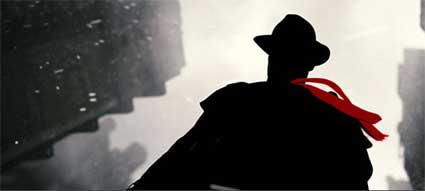
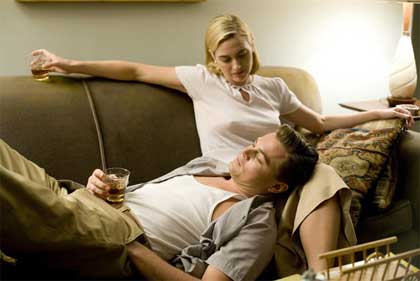
 Instead of the backstories associated with this disastrous local theater run, we see Leo and Kate (certainly not anything close to Yates’s Frank and April, and considerably removed from Cameron’s Jack and Rose) looking across at each other at a party. But we have no real sense in the film of why these two would be attracted to each other, and, because of this, there’s no real reason to care. It doesn’t help that the Wheeler household looks more like a Pottery Barn catalog than a middle-class dwelling in 1955. And it doesn’t help that Mendes cannot even depict two pivotal acts of carnality with accuracy. (In the Mendes universe, couples have passionless sex and finish each other off in twenty seconds without even the tiniest whimper of pleasure. This is as preposterous and implausible as Sharon Stone’s over-the-top masturbation scene in Sliver. In a narrative that demands close verisimilitude, this is an inexcusable artistic decision.)
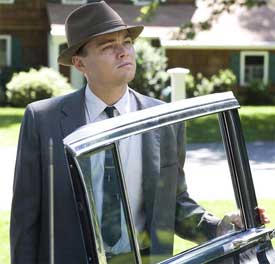 Leonardo DiCaprio is not that man. He demonstrates little thespic understanding of what it means to be stifled. He gives us nothing in the way of sorrow, save the cartoonish wails and the exaggerated throwing of physical objects from surfaces. DiCaprio has been relying on this ever since a few people convinced him that he was a serious actor. But he is unable to present us with some of the reasons why Frank would be tempted by an extramarital affair. He can access the territory of knowing he’s not good enough to be someone special. But when we learn how Frank Wheeler’s cavalier act gets him ahead, it is not because of DiCaprio. It is because Haythe and Mendes spoon-feed it to us ad nauseum. A scene at a beach, a scene with his co-workers at a diner, a scene with April. This is an inefficient and an insulting waste of minutes. We need not be told twice, let alone three times, that Frank Wheeler has what it takes to get ahead at Knox Business Machines. It should be self-evident in the way that Frank Wheeler acts on screen. But DiCaprio here cannot merge into the tempo established by his environment.
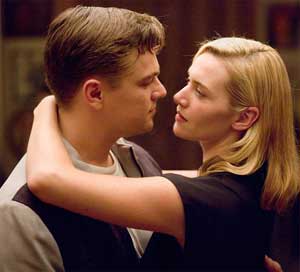 Instead, Mendes and Haythe, who appear to be a writer-director working team about as competent as Akiva Goldsman and Joel Schumacher, see Yates’s endlessly nuanced novel as an opportunity to remake American Beauty for the 1950s, with a number of sexist nods to Mad Men thrown in for commercial appeal. “I must scoot. Toodle-ooo,” says one bubbly neighbor. And this cornball emphasis suggests that Mendes and Haythe don’t see the 1950s as a time in which real people lived and wrestled with serious decision. It is a decade to be played merely for cheap laughs.