Shadow and Act (Modern Library Nonfiction #91)

(This is the tenth entry in The Modern Library Nonfiction Challenge, an ambitious project to read and write about the Modern Library Nonfiction books from #100 to #1. There is also The Modern Library Reading Challenge, a fiction-based counterpart to this list. Previous entry: The Power Broker.)

mlnf91When I first made my bold belly flop into the crisp waters of Ralph Ellison’s deep pool earlier this year, I felt instantly dismayed that it would be a good decade before I could perform thoughtful freestyle in response to his masterpiece Invisible Man (ML Fiction #19). As far as I’m concerned, that novel’s vivid imagery, beginning with its fierce and intensely revealing Battle Royale scene and culminating in its harrowing entrapment of the unnamed narrator, stands toe-to-toe with Saul Bellow’s The Adventures of Augie March as one of the most compelling panoramas of mid-20th century American life ever put to print, albeit one presented through a more hyperreal lens.

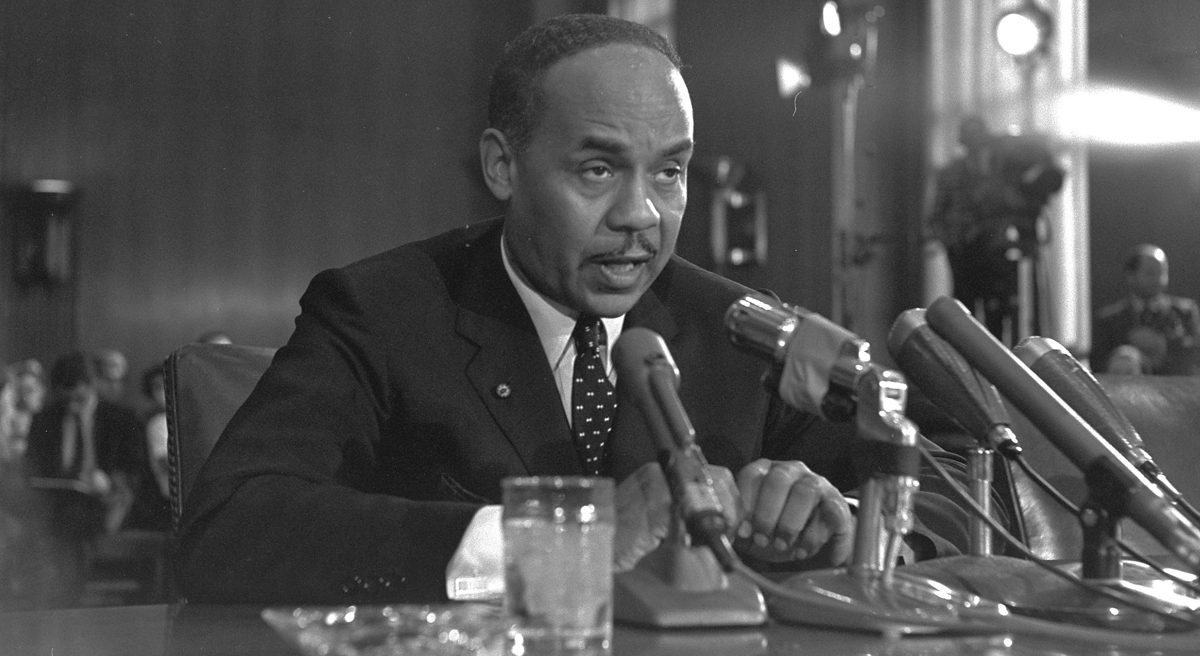
But many of today’s leading writers, ranging from Ta-Nehisi Coates to Jacqueline Woodson, have looked more to James Baldwin as their truth-telling cicerone, that fearless sage whose indisputably hypnotic energy was abundant enough to help any contemporary humanist grapple with the nightmarish realities that America continues to sweep under its bright plush neoliberal rug. At a cursory glance, largely because Ellison’s emphasis was more on culture than overt politics, it’s easy to see Ellison as a complacent “Maybe I’m Amazed” to Baldwin’s gritty “Cold Turkey,” especially when one considers the risk-averse conservatism which led to Ellison being attacked as an Uncle Tom during a 1968 panel at Grinnell College along with his selfish refusal to help emerging African-American authors after his success. But according to biographer Arnold Rampersad, Baldwin believed Ralph Ellison to be the angriest person he knew. And if one dives into Ellison’s actual words, Shadow and Act is an essential volume, which includes one of the most thrilling Molotov cocktails ever pitched into the face of a clueless literary critic, that is often just as potent and as lapel-grabbing as Baldwin’s The Fire Next Time.

For it would seem that while Negroes have been undergoing a process of “Americanization” from a time preceding this birth of this nation — including the fusing of their blood lines with other non-African strains, there has been a stubborn confusion as to their American identity. Somehow it was assumed that the Negroes, of all the diverse American peoples, would remain unaffected by the climate, the weather, the political circumstances — from which not even slaves were exempt — the social structures, the national manners, the modes of production and the tides of the market, the national ideals, the conflicts of values, the rising and falling of national morale, or the complex give and take of acculturalization which was undergone by all others who found their existence within the American democracy.

This passage, taken from an Ellison essay on Amiri Baraka’s Blues People, is not altogether different from Baldwin’s view of America as “a paranoid color wheel” in The Evidence of Things Not Seen, where Baldwin posited that a retreat into the bigoted mystique of Southern pride represented the ultimate denial of “Americanization” and thus African-American identity. Yet the common experiences that cut across racial lines, recently investigated with comic perspicacity on a “Black Jeopardy” Saturday Night Live sketch, may very well be a humanizing force to counter the despicable hate and madness that inspires uneducated white males to desecrate a Mississippi black church or a vicious demagogue to call one of his supporters “a thug” for having the temerity to ask him to be more respectful and inclusive.

Ellison, however, was too smart and too wide of a reader to confine these sins of dehumanization to their obvious targets. Like Baldwin and Coates and Richard Wright, Ellison looked to France for answers and, while never actually residing there, he certainly counted André Malraux and Paul Valéry among his hard influences. In writing about Richard Wright’s Black Boy, Ellison wisely singled out critics who failed to consider the full extent of African-American humanity even as they simultaneously demanded an on-the-nose and unambiguous “explanation” of who Wright was. (And it’s worth noting that Ellison himself, who was given his first professional writing gig by Wright, was also just as critical of Wright’s ideological propositions as Baldwin.) Ellison described how “the prevailing mood of American criticism has so thoroughly excluded the Negro that it fails to recognize some of the most basic tenets of Western democratic thought when encountering them in a black skin” and deservedly excoriated whites for seeing Paul Robeson and Marian Anderson merely as the ne plus ultra of African-American artistic innovation rather than the beginning of a great movement.
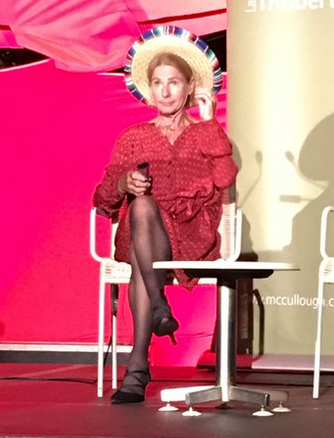
shriversombreroAt issue, in Ellison’s time and today, is the degree to which any individual voice is allowed to express himself. And Ellison rightly resented any force that would stifle this, whether it be the lingering dregs of Southern slavery telling the African-American how he must act or who he must be in telling his story as well as the myopic critics who would gainsay any voice by way of their boxlike assumptions about other Americans. One sees this unthinking lurch towards authoritarianism today with such white supremacists as Jonathan Franzen, Lionel Shriver, and the many Brooklyn novelists who, despite setting their works in gentrified neighborhoods still prominently populated by African-Americans, fail to include, much less humanize, black people who still live there.

“White supremacist” may seem like a harshly provocative label for any bumbling white writer who lacks the democratic bonhomie to leave the house and talk with other people and consider that those who do not share his skin color may indeed share more common experience than presumed. But if these writers are going to boast about how their narratives allegedly tell the truth about America while refusing to accept challenge for their gaping holes and denying the complexity of vital people who make up this great nation, then it seems apposite to bring a loaded gun to a knife fight. If we accept Ellison’s view of race as “an irrational sea in which Americans flounder like convoyed ships in a gale,” then it is clear that these egotistical, self-appointed seers are buckling on damaged vessels hewing to shambling sea routes mapped out by blustering navigators basking in white privilege, hitting murky ports festooned with ancient barnacles that they adamantly refuse to remove.

Franzen, despite growing up in a city in which half the population is African-American, recently told Slate‘s Isaac Chotiner that he could not countenance writing about other races because he has not loved them or gone out of his way to know them and thus excludes non-white characters from his massive and increasingly mediocre novels. Shriver wrote a novel, The Mandibles, in which the only black characters are (1) Leulla, bound to a chair and walked with a leash, and (2) Selma, who speaks in a racist Mammy patois (“I love the pitcher of all them rich folk having to cough they big piles of gold”). She then had the effrontery to deliver a keynote speech at the Brisbane Writers Festival arguing for the right to “try on other people’s hats,” failing to understand that creating dimensional characters involves a great deal more than playing dress-up at the country club. She quoted from a Margot Kaminski review of Chris Cleave’s Little Bee that offered the perfectly reasonable consideration, one that doesn’t deny an author’s right to cross boundaries, that an author may wish to take “special care…with a story that’s not implicitly yours to tell.” Such forethought clearly means constructing an identity that is more human rather than crassly archetypal, an eminently pragmatic consideration on how any work of contemporary art should probably reflect the many identities that make up our world. But for Shriver, a character should be manipulated at an author’s whim, even if her creative vagaries represent an impoverishment of imagination. For Shriver, inserting another nonwhite, non-heteronormative character into The Mandibles represented “issues that might distract from my central subject moment of apocalyptic economics.” Which brings us back to Ellison’s question of “Americanization” and how “the diverse American peoples” are indeed regularly affected by the decisions of those who uphold the status quo, whether overtly or covertly.

Writer Maxine Benba-Clarke bravely confronted Shriver with the full monty of this dismissive racism and Shriver responded, “When I come to your country. I expect. To be treated. With hospitality.” And with that vile and shrill answer, devoid of humanity and humility, Shriver exposed the upright incomprehension of her position, stepping from behind the arras as a kind of literary Jan Smuts for the 21st century.[footnote]To this litany of country bumpkin calumnies from a Literary Establishment that purports to Know All, one must also include the superficial contributions of the wildly overrated Joyce Carol Oates, whose novel The Sacrifice demonstrated equally ignoble failings to consider complex identity and authenticity in fictionalizing the Tawana Brawley case. These inadequacies were smartly called out by Roxane Gay in The New York Times Book Review. Rather than consider how she had failed as an author, Oates, true to the clueless xenophobia she regularly chirrups on Twitter, suggested that Gay had failed.[/footnote]

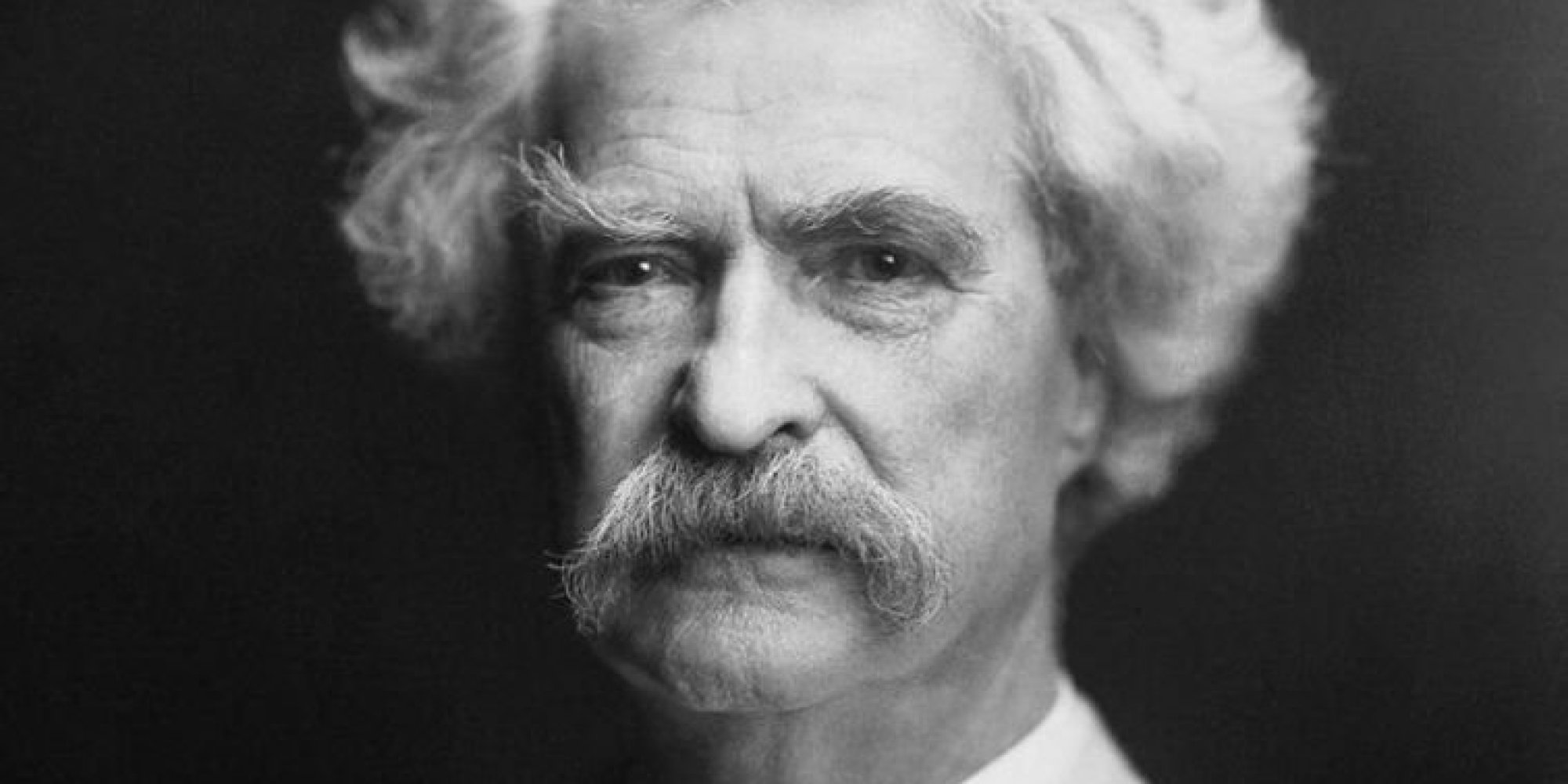
If this current state of affairs represents a bristling example of Giambattista Vico’s corsi e ricorsi, and I believe it does, then Ellison’s essay, “Twentieth-Century Fiction and the Black Mask of Humanity,” astutely demonstrates how this cultural amaurosis went down before, with 20th century authors willfully misreading Mark Twain, failing to see that Huck’s release of Jim represented a moment that not only involved recognizing Jim as a human being, but admitting “the evil implicit in his ’emancipation'” as well as Twain accepting “his personal responsibility in the condition of society.” With great creative power comes great creative responsibility. Ellison points to Ernest Hemingway scouring The Adventures of Huckleberry Finn merely for its technical accomplishments rather than this moral candor and how William Faulkner, despite being “the greatest artist the South has produced,” may not be have been quite the all-encompassing oracle, given that The Unvanquished‘s Ringo is, despite his loyalty, devoid of humanity. In another essay on Stephen Crane, Ellison reaffirms that great art involves “the cost of moral perception, of achieving an informed sense of life, in a universe which is essentially hostile to man and in which skill and courage and loyalty are virtues which help in the struggle but by no means exempt us from the necessary plunge into the storm-sea-war of experience.” And in the essays on music that form the book’s second section (“Sound and the Mainstream”), Ellison cements this ethos with his personal experience growing up in the South. If literature might help us to confront the complexities of moral perception, then the lyrical, floating tones of a majestic singer or a distinctive cat shredding eloquently on an axe might aid us in expressing it. And that quest for authentic expression is forever in conflict with audience assumptions, as seen with such powerful figures as Charlie Parker, whom Ellison describes as “a sacrificial figure whose struggles against personal chaos…served as entertainment for a ravenous, sensation-starved, culturally disoriented public which had but the slightest notion of its real significance.”

What makes Ellison’s demands for inclusive identity quite sophisticated is the vital component of admitting one’s own complicity, an act well beyond the superficial expression of easily forgotten shame or white guilt that none of the 20th or the 21st century writers identified here have had the guts to push past. And Ellison wasn’t just a writer who pointed fingers. He held himself just as accountable, as seen in a terrific 1985 essay called “An Extravagance of Laughter” (not included in Shadow and Act, but found in Going with the Territory), in which Ellison writes about how he went to the theatre to see Jack Kirkland’s adaptation of Erskine Caldwell’s Tobacco Road. (I wrote about Tobacco Road in 2011 as part of this series and praised the way that this still volatile novel pushes its audience to confront its own prejudices against the impoverished through remarkably flamboyant characters.) Upon seeing wanton animal passion among poor whites on the stage, Ellison burst into an uncontrollable paroxysm of laughter, which emerged as he was still negotiating the rituals of New York life shortly after arriving from the South. Ellison compared his reaction, which provoked outraged leers from the largely white audience, to an informal social ceremony he observed while he was a student at Tuskegee that involved a set of enormous whitewashed barrels labeled FOR COLORED placed in public space. If an African-American felt an overwhelming desire to laugh, he would thrust his head into the pit of the barrel and do so. Ellison observes that African-Americans “who in light of their social status and past condition of servitude were regarded as having absolutely nothing in their daily experience which could possibly inspire rational laughter.” And the expression of this inherently human quality, despite being a cathartic part of reckoning with identity and one’s position in the world, was nevertheless positioned out of sight and thus out of mind.

When I took an improv class at UCB earlier this year, I had an instructor who offered rather austere prohibitions to any strain of humor considered “too dark” or “punching down,” which would effectively disqualify both Tobacco Road and the Tuskegee barrel ritual that Ellison describes.[footnote]Earlier this year, in The Baffler, Ben Schwartz offered some cogent and provocative thoughts on the problems with such ultimatums. His essay is very worth reading if you’re interested in painting outside the lines as an artist or a thinker.[/footnote] These restrictions greatly frustrated me and a few of my classmates, who didn’t necessarily see the exploration of edgy comic terrain as a default choice, but merely one part of asserting an identity inclusive of many perspectives. I challenged the notion of confining behavior to obvious choices and ended up getting a phone call from the registrar, who was a smart and genial man and with whom I ended up having a friendly and thoughtful volley about comedy. I had apparently been ratted out by one student, who claimed that I was “disrupting” the class when I was merely inquiring about my own complicity in establishing base reality. In my efforts to further clarify my position, I sent a lengthy email to the instructor, one referencing “An Extravagance of Laughter,” and pointed out that delving into the uncomfortable was a vital part of reckoning with truth and ensuring that you grew your voice and evolved as an artist. I never received a reply. I can’t say that I blame him.

Ellison’s inquiry into the roots of how we find common ground with others suggests that we may be able to do so if we (a) acknowledge the completeness of other identities and (b) allow enough room for necessary catharsis and the acknowledgment of our feelings and our failings as we take baby steps towards better understanding each other.

The most blistering firebomb in the book is, of course, the infamous essay “The World and the Jug,” which demonstrates just what happens when you assume rather than take the time to know another person. It is a refreshingly uncoiled response that one could not imagine being published in this age of “No haters” reviewing policies and genial retreat from substantive subjects in today’s book review sections. Reacting to Irving Howe’s “Black Boys and Native Sons,” Ellison condemns Howe for not seeing “a human being but an abstract embodiment of living hell” and truly hammers home the need for all art to be considered on the basis of its human experience rather than the spectator’s constricting inferences. Howe’s great mistake was to view all African-American novels through the prism of a “protest novel” and this effectively revealed his own biases against what black writers had to say and very much for certain prerigged ideas that Howe expected them to say. “Must I be condemned because my sense of Negro life was quite different?” writes Ellison in response to Howe roping him in with Richard Wright and James Baldwin. And Ellison pours on the vinegar by not only observing how Howe self-plagiarized passages from previous reviews, but how his intractable ideology led him to defend the “old-fashioned” violence contained in Wright’s The Long Dream, which, whatever its merits, clearly did not keep current with the changing dialogue at the time.

Shadow and Act, with its inclusion of interviews and speeches and riffs on music (along with a sketch of a struggling mother), may be confused with a personal scrapbook. But it is, first and foremost, one man’s effort to assert his identity and his philosophy in the most cathartic and inclusive way possible. We still have much to learn from Ellison more than fifty years after these essays first appeared. And while I will always be galvanized by James Baldwin (who awaits our study in a few years), Ralph Ellison offers plentiful flagstones to face the present and the future.

SUPPLEMENT: One of the great mysteries that has bedeviled Ralph Ellison fans for decades is the identity of the critic who attacked Invisible Man as a “literary race riot.” In a Paris Review interview included in Shadow and Act, Ellison had this to say about the critic:

But there is one widely syndicated critical bankrupt who made liberal noises during the thirties and has been frightened ever since. He attacked my book as a “literary race riot.”

With the generous help of Ellison’s biographer Arnold Rampersad (who gave me an idea of where the quote might be found in an email volley) and the good people at the New York Public Library, I have tracked down the “widely syndicated critical bankrupt” in question.
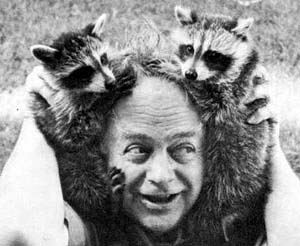
sterlingnorthHis name is Sterling North, best known for the children’s novel Rascal in 1963. He wrote widely popular (and rightly forgotten) children’s books while writing book reviews for various newspapers. North was such a vanilla-minded man that he comics “a poisonous mushroom growth” and seemed to have it in for any work of art that dared to do something different — or that didn’t involve treacly narratives involving raising baby raccoons.

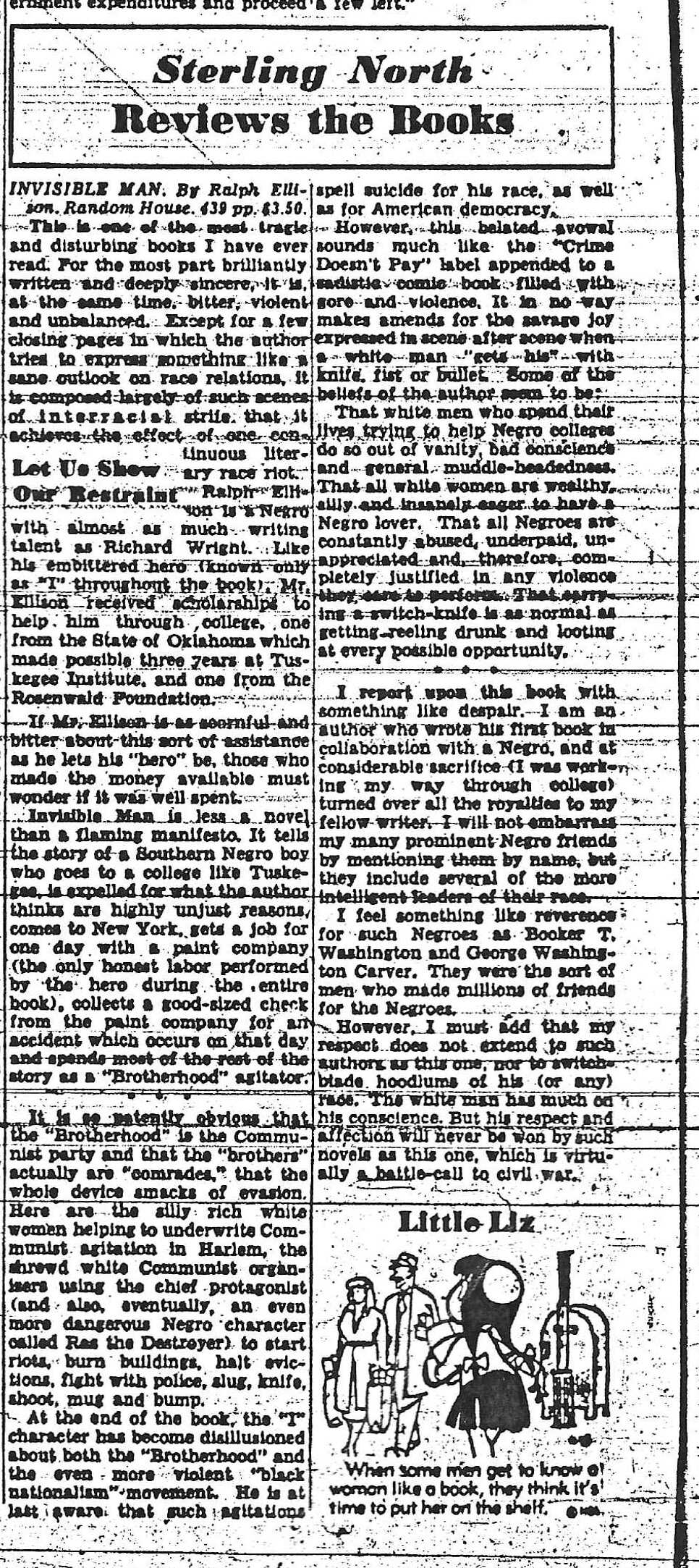
And then, in the April 16, 1952 issue of the New York World-Telegram, he belittled Ellison’s masterpiece, writing these words:

This is one of the most tragic and disturbing books I have ever read. For the most part brilliantly written and deeply sincere, it is, at the same time, bitter, violent and unbalanced. Except for a few closing pages in which the author tries to express something like a sane outlook on race relations, it is composed largely of such scenes of interracial strife that it achieves the effect of one continuous literary race riot. Ralph Ellison is a Negro with almost as much writing talent as Richard Wright. Like his embittered hero (known only as “I’ throughout the book, Mr. Ellison received scholarships to help him through college, one from the State of Oklahoma which made possible three years at the Tuskegee Institute, and one from the Rosenwald Foundation.

If Mr. Ellison is as scornful and bitter about this sort of assistance as he lets his “hero” be, those who made the money available must wonder if it was well spent.

North’s remarkably condescending words offer an alarming view of the cultural oppression that Ellison was fighting against and serve as further justification for Ellison’s views in Shadow and Act. Aside from his gross mischaracterization of Ellison’s novel, there is North’s troubling assumptions that Ellison should be grateful in the manner of an obsequious and servile stereotype, only deserves a scholarship if he writes a novel that fits North’s limited idea of what African-American identity should be, and that future white benefactors should think twice about granting opportunities for future uppity Ellisons.

It’s doubtful that The Sterling North Society will recognize this calumny, but this is despicable racism by any measure. A dive into North’s past also reveals So Dear to My Heart, a 1948 film adaptation of North’s Midnight and Jeremiah that reveled in Uncle Tom representations of African-Americans.

North’s full review of The Invisible Man can be read below:
sterling-north

Next Up: James George Frazer’s The Golden Bough!
The Contours of American History (Modern Library Nonfiction #94)

(This is the seventh entry in The Modern Library Nonfiction Challenge, an ambitious project to read and write about the Modern Library Nonfiction books from #100 to #1. There is also The Modern Library Reading Challenge, a fiction-based counterpart to this list. Previous entry: The Promise of American Life.)

mlnf94

History is never the thrilling Zapcat powerboat ride it can and should be when we remain committed to oaring through the same exhausted legends about American exceptionalism and bogus democratic promise. Much as we may find new insights into human existence by tilting our canoes to the ripples contained within a storyteller’s cadences, so too may we discover more complete ways of contending with our historical contradictions through the viewpoint of a responsible revisionist armed with the facts and rejecting the hard establishment line.

The revisionist historian, that charming and sometimes infuriating rabble-rouser never to be confused with some creepy Holocaust denier flailing in a sea of empty Cheetos bags and crackpot pamphlets, often gets needlessly maligned in America. Before Annette Gordon-Reed offered conclusive evidence of Thomas Jefferson’s relationship with Sally Hemings (upheld by a 1998 DNA test), Fawn Brodie was attacked by vanilla-minded legacy holders two decades before for pushing beyond James Callender’s tawdry trolling, daring to suggest that there was good reason to believe that our much heralded champion of the rights of man had skeletons in his closet that were vital to understanding his philosophy. Brodie’s book, despite its psychobiographical failings, led to a reckoning with our myths and assumptions about the Sage of Monticello, one that continues to this very day with college students demanding the removal of Jefferson statues on campuses.

Provided that their efforts do not involve going out of their way to Bowlderize troubling if incontrovertible parts of the story and the results are as expansive and as rigorous as their more timorous mainstream counterparts, revisionists are often vital reconcilers of the public record. It is the facile propagandist who ignores Rosa Parks’s radicalism to paint a roseate image of a meek and tired seamstress who refused to give up her seat on a bus (“small,” “delicate,” and “little,” as belittled by Bill Clinton in 2005) or who upholds the lie that Abner Doubleday created baseball.

In recent decades, many young students have ardently clutched their copies of Howard Zinn’s A People’s History of the United States with the taut adamantine grip of a Fallout 4 junkie reluctant to capitulate her controller. Zinn’s thoughtful volume has been vehemently denounced by some establishment historians who have questioned the perceived polemical emphasis of class conflict at the expense of other issues. But before Zinn, there was William Appleman Williams, a brash energetic troublemaker who was arguably a more rigorous scholar than Zinn and who was among the best and the boldest of the firebrand 20th century historians who emerged from a Charles Beard afterglow with ass to kick once the bubble gum supply ran out.

William Appleman Williams unpacked the economic motivations of American expansion and foreign policy in The Tragedy of American Diplomacy and broadened this scholarship further with The Contours of American History, a punchy volume examining how imperialism and liberalism became a sordid double stitch intertwined in the American quilt well before the Sons of Liberty spilled massive chests of desperately offloaded tea into Boston Habor. Yet Williams’s often nimble analysis, riddled as it sometimes is with conceptual overreach, robustly articulates the ever-changing and contradictory American Weltanschauung that has motivated nearly every governmental decision since. He documents a worldview that started off with the relatively benign goal of creating and sustaining an economic nation that provided for everyone, but devolved under the autocratic yoke of Jacksonian democracy and Gilded Age greed to the corporate capitalist nightmare we are all trying to awake from today. And because Williams’s challenge to the so-called “American experiment” was so unprecedented in the mid-20th century, this historian was tarnished, besmirched, and condemned by other putative progressives who might have enlarged their rigid notions of national identity if they had been more willing to dive into the subtle words and actions directing the unshakable financial impetus.

Williams was harassed by the House Committee on Un-American Activities, that despicably despotic body that ruined the lives of so many, with a demand to produce the unfinished Contours manuscript. The HUAC would order Williams to testify in Washington and then cancel the appearance by telegram once he’d hopped on a train to the Beltway. Even after he testified for ten minutes and the HUAC abandoned its witch hunt, the IRS harassed him in various forms for nearly twenty years. Williams was hounded by the neoliberalism critic Arthur Schlesigner, Jr., who dutifully condemned Williams as “pro-communist” to the American Historical Association’s president. Even as late as 2009, an academic called Williams an “idiot” before a Society of Historians of American Foreign Relations panel, decrying Williams’s approach to history as a crude retooling of Charles Beard’s infamous assault upon our Founding Fathers’s pecuniary predispositions.[footnote]Beard too saw his reputation suffer in the 1950s as mainstream historians — in particular, the self-described “paleoconservative” historian Forrest McDonald, who recently passed away — went out of their way to refute Beard on numerous points. Yet in recent years, Beard’s work has been reappraised and defended in book form by the historian Clyde W. Barrow, suggesting that the hit men who went after Beard misunderstood his conclusions in their empirically driven takedowns. It is very much part of an established American tradition to condemn anyone who stands against the herd, only for the actual work to be reexamined and taken more seriously long after most people have stopped caring.[/footnote]

But Williams was far from a typical progressive. He was a registered Republican when he first came to Wisconsin. He voted for Nixon as the lesser evil in 1960. And even in Contours, he defended Herbert Hoover’s hands-off Depression era policies, seeing this as a necessary tactic to forestall property holders from creating a business-friendly fascism that could have had a more diabolical effect on our clime than the many Hoovervilles that had mushroomed across the nation. Williams argued that Hoover’s perceived failure to do anything represented a more active resistance against special interests than the Progressive Movement was willing to acknowledge or act upon at the time. And that’s the way this jazz-loving Midwestern historian rolled. As Williams was to write in a 1973 essay, the revisionist’s duty was to “see basic facts in a different way and as interconnected in new relationships. He is a sister and a brother to those who use old steel to make a zipper, as contrasted with those who add new elements to make a better steel.”

In my previous Modern Library essay, I castigated Herbert Croly for the historical developments that he could not see ahead of him, for erring too much in his perfervid belief in a central government and for diminishing the justifiable grievances of protesters. William Appleman Williams may very well represent the opposite problem: a historian who could see the implications of any action all too well, one who was willing to articulate any interpretation of the facts even if it meant being alienated by the jingoistic minds who needed to reconsider the other fateful historical trajectories upholding the status quo.

Williams’s highly specific examples very much allow him to sell us on his interpretation. In Tragedy, for example, Williams’s deductive prowess is in high gear when he examines how Woodrow Wilson’s March 1913 decision to refuse a government loan to China, one long coveted by American industrialists at the time (and later attempted privately), actually fell within the framework of the Open Door Policy. Many historians have interpreted Wilson’s pushback as a betrayal of American expansionism at the time, but Williams points to the lack of private capital available to fulfill the job as well as the possibility that any governmental loan, even one secured with the help of other financiers, may have been perceived as a very clear threat to neighboring Japan. The Open Door Policy, for all of its flaws and its needless sullying of China, was intended to provide a peacefully imperialist framework for a burgeoning American empire: a GATT or IMF before its time, though regrettably without much in the way of homegrown protest. (Rebellion would come later in Beijing with the May Fourth movement.) The ostensible goal was to strengthen China with fresh influxes of low-risk private capital so that it could withstand troublesome neighbors looking for a fight, even as the new obligations to American entrepreneurs forged hot rivulets of cash rolling back to the imperialist homeland. Wilson’s decision was, as discerned by Williams, a canny chesslike stratagem to avoid war and conflict, one that would keep China a servant to America’s riches. From the vantage point of the 21st century, this useful historical interpretation reveals Wilson to be a pioneer in the kind of venal and now all too commonplace globalization that morally bankrupt neoliberals like Thomas Friedman have no problem opening their old steel zippers for. Their free trade fantasies possess all the out-of-sight, out-of-mind justification of a revenge porn junkie ignoring another person’s real world humiliation for fleeting sociopathic pleasure.

It was with Contours that Williams blew the lid off the great American lie, exposing the American liberal’s failure to confront his own implication in much of the lasseiz nous faire madness. Williams traced the origins of our mercantilist approach to Anthony Ashley Cooper, the Earl of Shaftesbury. In the 17th century, Shaftesbury was a political figure who opposed harsh penalties and absolutist government. He stood up for the nonconformists and called for regular parliaments, and would go on to found and lead the early Whig party in the wake of the British Exclusion Crisis. While traveling to Oxford to remove an abscess from his liver, he hit it off with a young doctor by the name of John Locke. (There weren’t as many cafes back then as there are today. In the 1600s, you had to take whatever mingling opportunities you could get.) Locke, of course, would later have many ideas about the social contract, a scheme about inalienable natural rights that would eventually find its way into a number one ditty penned by Jefferson that would become known as the Declaration of Independence.

But there was a twist to this tale. As Williams points out, Locke’s ideas were a corruption of Shaftesbury’s more inclusive and democratic efforts. Where Shaftesbury was willing to rebel against the King to ensure that courts and alternative political parties were in place to prevent the government from becoming an absolute tyranny, even going to the trouble of building a coalition that extended across all classes to fight for these safeguards when not putting together the Habeas Corpus Act of 1679, it was Locke who limited Shaftesbury’s remarkably liberal contributions by undercutting individual rights. Locke believed that those who owned property were perfectly justified in protesting their government, for they were the ones who had entered into a social contract. But the rabble who didn’t own property could more or less buzz off.[footnote]This interpretation of Locke has also been promulgated quite notably by C.B. Macpherson in his book, The Political Theory of Possessive Individualism, though it is not universally accepted. This useful Locke breakdown outlines a few alternative interpretations, including an eccentric tomato juice metaphor from the epistemological philosopher Robert Nozick. While I am inclined to stand with both Williams and Macpherson on early American suffrage descending from a Lockean notion that merely included property owners (Richard Hofstadter also adopts this line in The American Political Tradition, with many useful and persuasive examples of our Founders’s antidemocratic views on this point), I have spent far more time than I should seeking the “smoking gun” inside Two Treatises, and I must confess that I can’t entirely settle this question. Williams has, rather inconveniently, opted not to quote the Lockean passage that would make his argument on this point more airtight. But the many examples Williams provides throughout Contours suggest very strongly that, whether fueled by Locke or not, this nation continues to subscribe to a clear set of expansionist parameters riffing off the mercantilist Weltanschauung.[/footnote] As Williams put it, “[I]ndividualism was a right and a liberty reserved to those who accepted a status quo defined by a certain set of natural truths agreed upon a majority. Within such a framework, and it is a far narrower set of limits than it appears at first glance, the natural laws of property and labor were deemed sufficient to guide men’s pursuit of happiness.”

Yet those who subscribed to these early mercantilist standards believed that this classically liberal idea of “corporate structure” involved a basic responsibility to provide for everyone. And the way of sustaining such a benevolent national juggernaut was through the establishment of an empire: a Pax Americana predicated upon the promise of a democracy promulgated by patriarchs who not so quietly believed that the people were incapable of it.[footnote]Alexander Hamilton, who was hardly the antidemocratic foe that many concerned by his formidable administrative genius and his calls for a central government, would falsely paint him as, cut through the bullshit quite marvelously during the Federal Convention: “The members most tenacious of republicanism…were as loud as any in declaiming against the vice of democracy.”[/footnote] Williams observes how the Quakers in Philadelphia, who opposed expansion and much of the onslaughts against Native Americans, were very much committed to noblesse oblige, setting up hospitals, education, and philanthropic endeavors to take care of everyone. But this generous spirit was no match for the free trade nabobs or the hard-hearted Calvinists who increasingly shifted such solicitude to the propertied class (one can easily imagine Alec Baldwin’s Glengarry Glenn Ross “Always be closing” speech spouted by a Calvinist), leading the great theologian Jonathan Edwards to offer righteous pushback against “fraud and trickishness in trade.”

Against this backdrop, post-Revolutionary expansion and the Monroe Doctrine allowed mercantilism to transmute into an idea that was more about the grab than the munificent results, with visions of empire dancing in many heads. By the time Frederick Jackson Turner tendered his Frontier Thesis in 1893, mercantilism was no longer about providing for the commonweal, but about any “self-made man” looking out after his interests. Williams points to Chief Justice John Marshall’s efforts to enforce safeguards, such as his Gibbons vs. Ogden decision regulating interstate commerce, against the monopolies that would come to dominate America near the turn of the century. Marshall’s immediate successor, Chief Justice Taney, expanded the flexibility of the Constitution’s Contract Clause with his 1837 Charles River Bridge v. Warren Bridge decision, permitting states to alter any contract as it saw fit. While Taney’s decision seemed to strike the death knell against monopolies, it was no match against the consolidated trusts that were to come with the railroads and the robber barons. Rather curiously, for all of his sharp observations about free trade and expansionist dangers during this time, Williams devotes little more than a paragraph to the 1836 closing of the Second Bank of the United States:

[Nicholas Biddle] did a better job than the directors of the Bank of England. Under his leadership the bank not only established a national system of credit balancing which assisted the west as much as the east, and probably more, but sought with considerable success to save smaller banks from their own inexperience and greed. It was ultimately his undoing, for what the militant advocates of lasseiz nous faire came to demand was help without responsibilities. In their minds, at any rate, that was the working definition of democratic freedom.

Talk about sweeping one of the greatest financial calamities in American history under the rug! I don’t want to get too much into Andrew Jackson, who I believe to be nothing less than an abhorrent, reckless, and self-destructive maniac who claimed “liberalism” using the iron fist of tyranny, in this installment. I shall preserve my apparently unquenchable ire for Old Hickory when I tackle Arthur Schlesinger, Jr.’s The Age of Jackson in a few years (Modern Library Nonfiction #36). But Jackson’s imperious and irresponsible battle with Biddle, complete with his Specie Circular, undoubtedly led to the Panic of 1837, in which interest rates spiked, the rich got richer, a fixable financial mess spiraled out of control and became needlessly dangerous, and buyers could not come up with the hard cash to invest in land. Considering Williams’s defense of Hoover in both Contours and Tragedy, it is extremely curious that he would shy away from analyzing why some form of central bank might be necessary to mitigate against volatility, even though he adopted some fascinating counterpoints to the “too big to fail” theory decades before Bernanke and Krugman.

This oversight points to the biggest issue I have with Williams. His solution to the great imperialist predicament was democratic socialism, which he called “the only real frontier available to Americans in the second half of the 20th century.” While this is a clever way of inverting Turner’s thesis, to uphold this, Williams cites a few examples such as the courage of Wendell Phillips, a few throwaway references to social property, and a late 19th century return with Edward Bellamy and Henry Demarest Lloyd to the Quaker-like notion of “a commonwealth in which men were brothers first and economic men second.” But while Williams is often a master of synthesis, he falls somewhat short in delineating how his many historical examples can aid us to correct our ongoing ills. If the American Weltanschauung is so steeped in our culture, how then can democratic socialism uproot it? This vital question remains at the root of any progressive-minded conversation. But now that we have a presidential race in which socialism is no longer a dirty word and the two leading Democratic candidates bicker over who is the greater progressive, perhaps the answer might arrive as naturally as Williams anticipated.

Next Up: Richard Hofstadter’s The American Political Tradition!

Amanda Vaill (The Bat Segundo Show #549)

Amanda Vaill is most recently the author of Hotel Florida.

Author: Amanda Vaill

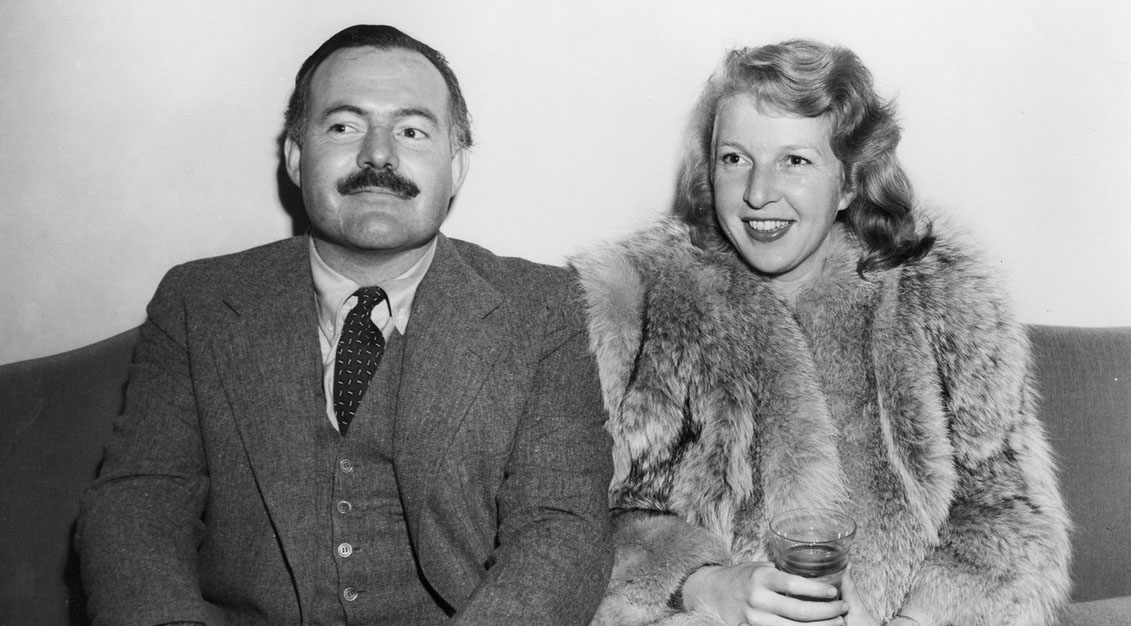
Subjects Discussed: Household accidents, Robert Capa’s “Falling Soldier” and various claims attesting to its authenticity, staged photography, Capa’s origins, Ernest Hemingway’s bluster, his journalistic weaknesses, Virginia Cowles’s bravery, the dubious qualities of To Have and Have Not, John Dos Passos, journalistic skepticism, Hemingway’s disillusionment with the Spanish Civil War, Martha Gellhorn, Gellhorn’s 1983 interview with John Pilger, Gellhorn’s condemnation of government, Gellhorn’s relationship with Eleanor Roosevelt, Gellhorn making up the facts (fabricating a Mississippi lynching) for her news story, “Justice at Night,” Henry Luce’s attention to Robert Capa, what coverage of the Spanish Civil War was real, Spain as the front line against Hitler, constraints of journalists on the Nationalist side, whether or not any amount of art and journalism could have averted the fate of Spain, the Non-Internvention Agreement, American isolationism, the civil war within the Civil War, left-wing factions squabbling against each other, Arturo Barea’s The Forging of a Rebel, Barea as a late bloomer, Barea’s stint as the Unknown Voice, confidence and post-traumatic stress, how to determine the precise words that floated through someone’s head or mouth from seven decades ago, Hemingway’s The Fifth Column, The Spanish Earth and the current print status of Spain in Flames, Archibald MacLeish and Contemporary Historians, Inc., orphan business entities, the brawl between Orson Welles and Hemingway during voiceover recording sessions, the fight between Hemingway and Max Eastman, what women thought of all the needless male fighting, George Seldes’s reception in the Spanish Civil War, Henry Buckley’s The Life and Death of the Spanish Republic, the legend of the luggage that Martha Gellhorn took to Spain, Joan Didion in El Salvador, Love Goes to Press, the American matador Sid Franklin, Ilsa Kulcsar, Gellhorn’s bravery and influence upon Hemingway, the recent Russia press gag on bloggers, comparisons between the Spanish Civil War and Syria, photographs as Instagram in slow time, whether there’s any Hemingway again, and contemplating J.K. Rowling going to the Crimea to write a novel.

EXCERPT FROM SHOW:

Correspondent: You’re doing okay, I take it.

Vaill: Except for my broken finger.

Correspondent: Oh, you broke your finger?

Vaill: Yes, I did. I had one of those household accidents. I tripped over my shoes.

Correspondent: And, of course, it’s the right hand as opposed to the left hand.

Vaill: Of course it is. So I cannot write and I cannot shake hands and I cannot sign my name. Except that it is getting better so I can now do that.

Correspondent: Although you have a good shot at taking over Spain.

Vaill: I hope so.

fallingsoldier

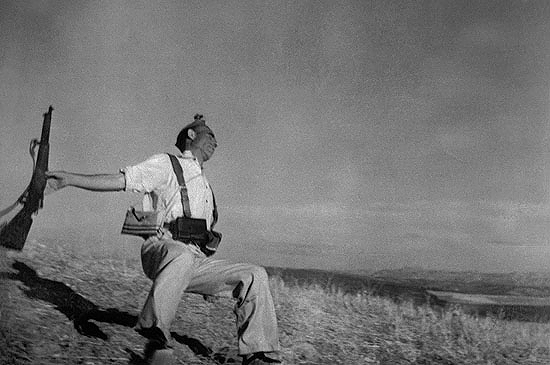
Correspondent: The Spanish Civil War. We have many characters and many figures and I’ll do my best to get to all of them. But let’s start with good old Robert Capa. One of the fascinating and oft argued issues in photography is, of course, Robert Capa’s “Falling Soldier” — the picture of the militiaman on the Andalusian hill falling to his death in battle. Some have contended that it is fake. Some have contended that it is real. Some have, as you have, tried tracking down interviews. You tried to find an NBC Radio interview with Alex Kershaw on October 20, 1947 in which Capa claimed to have killed the miliciano. But the purported truth of the story behind the photo is almost as murky as the purported truth of the photo, which in turn has us contending with the purported truth of the War. So how do even begin to come to terms with the photo — in terms of scholarship, in terms of authenticity? And how does the struggle affect our ability to wrestle with the complexities and the ideological involutions of the Spanish Civil War? Just to start off here.

Vaill: Well, that I could write a whole dissertation on. And people have. But let’s start first of all with the word “fake,” which is a…

Correspondent: Staged.

Vaill: Yes. There is a big difference. Something that is faked is in some way manipulated so that something that is not true can be made to be true. Something that is staged is something that is perhaps not quite as extreme as something that is faked. And you have to bear in mind that in 1936, when this photograph was taken, there was no history of war photography at all. No one had taken live action photographs on a battlefield. Matthew Brady took pictures of corpses, which he manipulated and moved around so that they would be in a pose that he liked. In World War I, you couldn’t go on the battlefield. You were not allowed. And furthermore there was no equipment that you could take on there. You have big cumbersome cameras and slow film. And it was only in the 1930s, when you had 35mm film and cameras that could accommodate it, that you could take your camera onto the battlefield. So there was no rulebook for how you handled photography in wartime and no one was used to allowing photographers to be where there was combat. So when Capa and Gerda Taro, his lover and cohort in photography, came to Spain, they at first were not even allowed to go onto the battlefield. They were only given access to troops behind the lines and they tried to make them look good. But this was just not happening. They couldn’t get anything that looked like real battle. And finally, when they were near the area of Córdoba, on the Córdoba front. They had this chance to take photographs of a group of soldiers and Capa has told many stories about what happened and how he got this shot. He was an inveterate tale-teller. He was a real entertainer, Capa. He loved to charm and entertain people.

Correspondent: He felt compelled to create his own legend.

Vaill: He totally did. And he did. He created his name. He was born Andrei Friedmann in Budapest. So he created a whole persona of Robert Capa, the famous photographer, and he created not just that, but this legend of himself that he felt perhaps compelled to live up to. In 1936 though, remember, he’s 22 years old. He’s just a kid. He doesn’t know what he’s doing really. And it is my belief, based on interviews — they aren’t even interviews; conversations that he had with those close to him at times when he, in fact, was not on. The conversation that I base most of my reconstruction on this incident on is one that was with a friend. He wasn’t trying to entertain this person. He wasn’t showing off for an interviewer. He was confessing something. And what he confessed was that a real man had been killed by something that he had done and he was conscious-stricken about it, which is the kind of thing that really squares with the portrait that I received of Capa. That Capa was a very kind, very generous, very loving person and easily hurt by things and didn’t want to give pain to others. And that this thing had happened, I think, was horrifying to him.

Correspondent: Since we are talking about various artists who came to Spain and essentially either set themselves up as legends or became legends later, let’s move naturally to Ernest Hemingway. For all of his bluster about being a “real man” and a “real journalist,” he didn’t actually cover Guernica in April 1937. And he didn’t mention this devastating battle in his dispatches from Spain. Virginia Cowles, on the other hand, she headed into the Nationalist zone and not only covered it, but did so when a Nationalist staff officer said, “You probably shouldn’t be writing about this.” So you write in the book that Hemingway may not have thought this important enough, but why do you think he ignored it? Was he just not that thorough of a reporter?

Vaill: Well, actually, I hate to say this, but he wasn’t that thorough of a reporter. For all that he had a great background as a gumshoe reporter back in the day, when he was at the Kansas City Star, when he was in Toronto, he was a newspaperman. He was on the city beat and he was the cub reporter sent out to cover fires and God knows what all else. But by the time he went to Spain, he had become a legend. And he was a legend, in part, in his own mind, as much as in the minds of others, and I think he got to the point where what he really wanted to do was to sit at the big table with the big boys and get the big story, and let somebody else worry about all the little details. And in this case, Guernica happened in the Basque Country. It was in a zone that it was almost impossible for him to get to without great difficulty.

Correspondent: But that didn’t stop Cowles.

Vaill: Well, it didn’t. Because, of course, she was still building her reputation. I think Hemingway felt he didn’t have to pry. I also feel that he didn’t think it was that important. And he didn’t think it was that important because the very contemporary news reports of it were very dismissive at first. It really wasn’t until people like Cowles found out what had gone on there that it became evident that there had been a horrific disaster. So Hemingway just basically thought, “I’m going to give this a bye. It’s too much trouble. I’ll risk my neck getting there. I don’t need it. I’m heading back. Screw it.”

Correspondent: I will confess that your book had me finally, after many years, reading To Have and Have Not.

Vaill: (laughs)

Correspondent: I had been avoiding this for a long time and, as it turns out, rightfully so. Brilliant in parts, terrible in others. I mean, was Hemingway just not up to snuff during this particular period?

Vaill: I think he was struggling. And I think that many writers do. They reach a period where they’re trying to break through to some other level and they’re not comfortable. The instrument isn’t sharp in the way that they want it to be sharp to do the work that they suddenly have decided they want to do. Hemingway after writing two extraordinarily well-received novels and an amazing bunch of short stories and maybe two of his, I think, finest works — “The Snows of Kilimanjaro” and “The Short Happy Life of Francis Macomber.” I think he was looking to do something different. The ’30s were a period of great relevance. The engagé writer was what you were supposed to be and he hadn’t been. And even though he scoffed at a lot of this stuff and said that he didn’t want to get that involved in politics and he didn’t want to hue to any -isms of one kind or another and all he really believed in was freedom, he couldn’t help noticing, particularly when his friend John Dos Passos ended up on the cover of Time Magazine in the summer of 1936, that writers who were writing about the big political themes were getting a lot of attention, the kind of attention he had always gotten, and I think he was looking for some way to do that and To Have and Have Not represented that kind of fiction for him. He wasn’t comfortable writing it, I think, and I think that was the problem of it.

Correspondent: Speaking of Dos Passos, I felt tremendous sympathy for this poor man. I mean, he comes to Spain. He’s looking into the mysterious disappearance of his friend, Jose Robles Pazos, and he’s spurned by Hemingway.

Vaill: Oh yeah.

Correspondent: Hemingway is well-connected with the Loyalists and he tells Dos Passos, “Don’t put your mouth to this Robles business. People disappear every day.” Which is an extraordinarily callous statement. Why did Hemingway have difficulties getting around his romantic vision of the Republicans? Why couldn’t he ask the difficult questions that Dos Passos had no problem in investigating?

Vaill: Well, I think it goes back to Hemingway’s wanting to be at the big boys table.

Correspondent: And he was.

Vaill: And he was. We’ve seen some of this same problem with journalists in our own day. The New York Times‘s Judith Miller, for example. And other writers writing about our involvement in the Iraq War, they wanted to just take the story that somebody wanted to hand out. Because that person was well-connected and high up in a tree.

Correspondent: And that trumps any journalistic integrity.

Vaill: Or any journalistic — I think it would be — doubt. Just the feeling that, oh wait.

Correspondent: Skepticism.

Vaill: Maybe I can take this story.

Correspodnent: Questioning.

Vaill: Your skepticism instrument is just not working when that happens. It’s lulled into some false quiescence by all this access that you suddenly have. And I think that’s what really happened to Hemingway here. He was so in love with the access he had and he was so taken up with his passionate identification with the cause of the Spanish Republic, which I can certainly understand. They were the democratically elected government of Spain and a bunch of right-wingers wanted to nullify an election and just take things back to the way they were before.

Correspondent: So in order to get over the crest to For Whom the Bell Tolls, an absolute masterpiece, he had to go through all these needless romance and this big review point and then he had to have his heart crushed.

Vaill: And then he had to be disillusioned. And I think the problem for him was — yes, exactly, he did have his heart broken in a way. And For Whom the Bell Tolls came out of that feeling of disillusionment. He called not just what had happened in the Republic, but also what happened at Munich — the whole thing and the dismissal of the international brigades from Spain. All that to him was what he called a carnival of treachery on both sides. And that’s pretty strong language.

The Bat Segundo Show #549: Amanda Vaill (Download MP3)

This text will be replaced

The Forgotten Tower

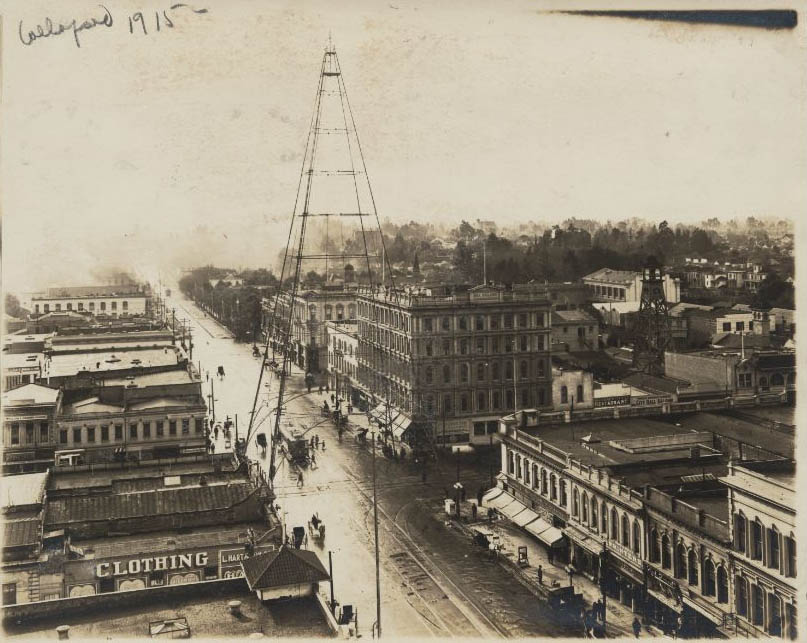
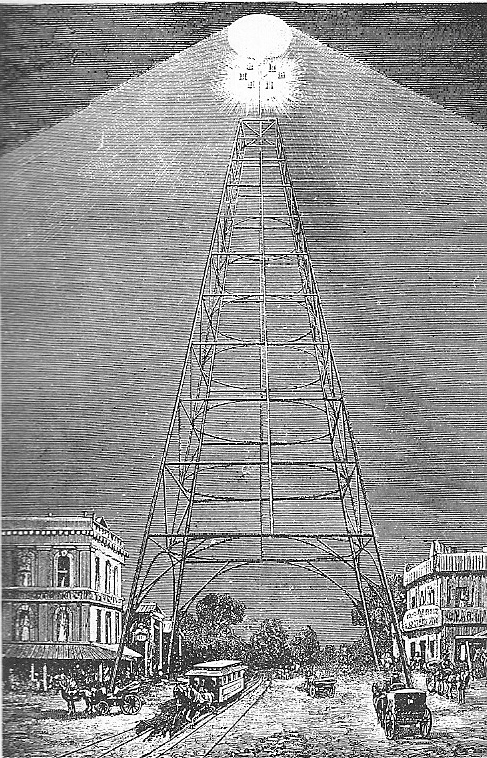
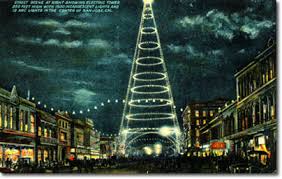
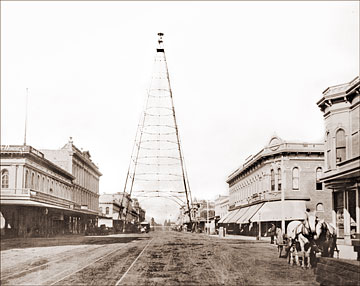
The first fallen structure that I ever admired was a 237-foot tower that once stood at the intersection of Market and Santa Clara Streets in San Jose, California. It was known as the Electric Light Tower and was hurled into the real from a newspaperman’s idealistic vision. James Jerome Owen knew that electric lighting was the future and, on May 13, 1881, he wrote an editorial in the San Jose Daily Mercury calling for the construction of an enormous tower looming over two streets, an electric landmark that would stub out the gaslights, showering evening luster onto the city with the same indomitable force as the sun. It took only seven months for the idea to seize the imagination of locals, and the tower was constructed and lighted by December 13, 1881.

electriclight1The tower never produced the searing glow that Owen longed for, but it served as a symbol of hope and progress to the people of San Jose. Electricity had only just arrived and the frame of the tower was juiced up by sizzling refulgence. Birds often smacked into its tempting bones, lured by the light, and it is said that policemen cadged a bit of pin money by hawking fallen duck corpses at local establishments. Drunkards often attempted to scale it. Moreover, San Jose had beaten Paris to the punch. Alexandre Gustave Eiffel pilfered the plans and, eight years after Owen’s gigantic tower was raised, Eiffel constructed his own version. This French treachery caused San Jose to sue Paris in 1989 for the century-long appropriation. In the trial, the architect Pierre Prodis claimed that the Eiffel Tower was merely a “trace job” of Owen’s vision. Paris triumphed in the court, but not without the famous engineer’s legacy sullied.

electrictower1I learned of the tower when I was five, attracted to the pointillist rings glowing on photos and postcards. I was smitten by the great circular aura shooting into the onyx skyscape from the six carbon arc lamps planted at the tower’s peak. And when my parents took me to Kelly Park, I became overcome with tumultuous wonder when my little eyes snagged onto a replica of the tower built in History Park. The replica was only 115 feet tall, recently constructed, and I remember asking the tour guide why it was so small. I had somehow remembered the height of the original, plucking it from some stray placard that most tourists ignored. What was the point of reproducing a tower if you couldn’t put it in the right place or match the previous height? The tour guide, sifting through his mental arsenal for general historical information to answer my question, told me how the original tower fell. Gale force winds had ravaged the tower on December 3, 1915. It was the deadliest part of a vicious storm. The center of the massive metal structure wended and wobbled and, just before noon, pipe and metal poured onto San Jose’s streets. I closed my eyes and began to imagine the beautiful tower destroyed, and I remember silently crying, knowing that the tower’s end was needlessly permanent. I don’t remember the tour guide’s exact words, but there was a peremptory tone in his voice, a suggestion that it was mad folly to build another tower and cause harm to future San Jose residents. San Jose still suffered from wintry winds every now and then. And there was still the possibility, especially given the freak 1976 snowstorm from a few years before, that the tower could do more damage.

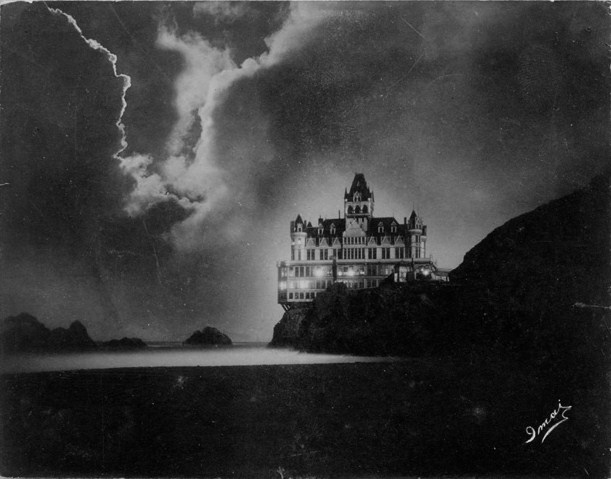
CliffHouseStormI didn’t remember the snowstorm because I was an infant at the time. But like the Electric Light Tower, it had been captured in family photographs assembled in blue-covered albums identified sequentially by numbered stickers, so that I could trace the precise moment that the memories of my life aligned with the photographs. I had no memory of the snowstorm, but I had lived through it. I was forming memories of the electrical tower, visions that made it more real than any representation, yet I hadn’t been fortunate enough to be alive during the time of its existence. (I would have similar feelings for the Victorian version of the Cliff House constructed by Adolph Sutro in 1896, a magnificent multiroom palace with sharp gables famously captured in photographs during a thunderstorm. It burned to the ground on September 7, 1907 — another architectural tragedy, another great structure destroyed on a whim.)

electriclight2There hasn’t been a year when I haven’t thought about the tower. Yet I wonder how long I can keep its vision alive in my heart and mind. Nobody seems to remember it or care about it outside San Jose. Nobody wants to honor the tower that once attracted international attention. I can’t talk about the Electric Light Tower with anyone, especially on the East Coast. It is, like many funny ideas in the history books, an eccentric and possibly nonsensical idea. But for a decent stretch in history, it held one city together.

Ben Tarnoff (The Bat Segundo Show #541)

Ben Tarnoff is most recently the author of The Bohemians.

Author: Ben Tarnoff

Subjects Discussed: Why 1860s California was especially well suited to literary movements, draft riots, Thomas Starr King, how Atlantic Monthly editor James Fields interacted with numerous emerging writers, the New England influence vs. the need to rebel, Charles Stoddard, rustic towns vs. cities battling each other in California over poetic merit, Bret Harte’s aesthetic tastes, how Harte transformed from critic to short story pioneer, how Mark Twain used the door-to-door subscription model to popularize The Innocents Abroad, the influence of the railroads upon what people read, Twain’s inability to command literary respect in America during his time, Twain’s popularity in England, the disreputable qualities of Twain’s appearance, Twain’s drawl, William Dean Howells, the Eastern literary establishment’s regressive assessment of Western style, how Twain used the lecture circuit to generate vital income, early standup comics in America, Artemus Ward the first standup comic in America, New York’s emergence as a media capital in the late 19th century, the development of Twain’s iconoclasm, present day interpretations of Twain as a cuddly avuncular type, Twain’s explosive temperament, Twain’s failed attempts at suicide, how original literary movements can spring from a unique location, present day Brooklyn writers who play it safe, how Twain’s lecture persona allowed him to escape becoming a newspaper hack, Twain vs. Ed Koch as meeter-and-greeter in the streets, the Bret Harte/Mark Twain friendship and feud, Bret Harte’s creative decline upon leaving California, Margaret Duckett’s Mark Twain and Bret Harte, the mysterious inciting incident in 1877 that set Twain off on Harte, Twain’s difficulties in getting his early short story collections published, the death of irony throughout American history, disparaging reports of Anna Griswold Harte (and attempts to find positive qualities about her), how much Bret Harte is responsible for Anna’s alleged sullenness, Bret Harte’s arrogance, Harte’s abandonment of his family, Harte’s aristocratic airs, Harte’s insistence upon a cab when arriving on the East Coast, Bret Harte’s hipster-like sideburns, “Ah Sin,” Twain and Harte perpetuating racist Chinese stereotypes, Twain selling out his principles, yellowface and the Cloud Atlas movie, Twain’s unremitting vengeance against Bret Harte, Twain’s obsessive detail in depicting his grudges, Twain’s tremendous rage and his tremendous love, Twain blaming himself for the death of his son Langdon, parallels between Charles Stoddard and Walt Whitman, Stoddard’s need for approval, Stoddard seeking autographs, Stoddard’s retreat to Hawaii, attempts to determine how much transgressive behavior there was in San Francisco during the late 19th century, Bret Harte rebuffing his literary friends when he moved to the East Coast, Ina Coolbrith as the first woman poet laureate in the United States in 1911, Coolbrith’s “When the Grass Shall Cover Me,” the crushing domestic responsibilities faced by Coolbrith (and stalling Coolbrith’s literary career), grueling library hours in the late 19th century, Stoddard’s South-Sea Idyls, Harte’s remarkably swift dissolution, Harte’s inability to take root in the East, Ambrose Bierce, whether Bierce arrived too late on the scene, pulp writers who lived at the Monkey Block in the early 20th century, Fritz Leiber’s Our Lady in Darkness, and whether any literary movement today can recapture the risk-taking feel of the Bohemians.

EXCERPT FROM SHOW:

Correspondent: Mark Twain and Bret Harte seem to be the big stars of this book. But what do you think it was about this particular area at this particular time that created this particular literature?

Tarnoff: Well, San Francisco in the 1860s has a lot of advantages for a writer. It’s peaceful. The Civil War never comes to California. So there’s no fighting on the coast and there’s no draft. Because Lincoln never applies the draft west of Iowa and Kansas.

Correspondent: And no draft riots.

Tarnoff: Right. Exactly. No draft riots. So it’s peaceful. It’s a great place to wait out the war. It’s very rich. Because it’s the industrial, commercial, and financial center of the region. So the massive amount of wealth that’s being generated in the City finances a range of literary papers. And it’s also very urban. It’s got about 100,000 people in the 1860s and that makes it by far the biggest city in the region, really the biggest city west of St. Louis. And that population is pretty cosmopolitan. Because of the legacy of the gold rush, you have people there from China, from South America, from all different countries in Europe. And I think that all of those are important factors behind producing the literary moment.

Correspondent: And for a while, speaking of St. Louis, it had the largest building west of St. Louis with City Hall.

Tarnoff: That’s right.

Correspondent: For a while. Until it got — I can’t remember which building it was that actually uprooted it. But it was a city of great progress and great buildings. I wanted to start off also by getting into the preacher Thomas Starr King. He’s this figure I have wanted to talk about forever. Because I have read, I’m sure as you have, the Kevin Starr books. The wonderful California Dream series. I’m grateful that your book has allowed me a chance to talk about him here. You know, it has always seemed to me that without King, you could not have had the literary culture that emerged. Because he was this really odd figure. He promoted New England writers. So he was kind of an establishment guy. But at the same time, he’s also the guy who introduces Bret Harte to James Fields, the Atlantic editor, in January 1862. Charles Stoddard — this wonderful poet — also held King up in great esteem. So he’s almost this insider/outsider figure who seems to corral the many literary strands of San Francisco that are burgeoning during this time and forming this new kind of movement that you identify as a Bohemian movement. So I’m wondering. What is your take on Thomas Starr King? Do you think that San Francisco would have been San Francisco if it had not been for that? And do you think that when The Overland Monthly appeared, that this was kind of the replacement for Thomas Starr King? Because at that point he had passed away. What of this?

Tarnoff: Well, Thomas Starr King is a fantastic figure. I think he really is a forgotten founding father of California. He’s so foundational politically, culturally, as you point out from the literary scene. He’s a fantastic mentor figure. You mentioned Charles Stoddard. There’s a scene in my book where Stoddard has just published his first poems in a big literary paper. He’s extremely shy and nervous. And Thomas Starr King comes to the bookshop where he works and tells him personally how much he loved his poems. So he’s a guy with a really personal touch and really cultivates these writers and offers them criticism. He’s an important figure from the point of view from the point of view of the Civil War as well, which is I think how he’s better known today. Because he travels throughout the state during the first year or two of the Civil War and preaches the importance of California staying in the Union. Which it probably would have stayed in anyway. But King is certainly a very persuasive champion of the Union and of abolition.

Correspondent: Yeah. But in terms of his literary contributions, I mean, he was again, like I was suggesting with this last question, this guy who was there to rebel against and this guy to garner favor with so you could actually get into some of the outlets. How did that work? Am I perhaps overreaching with my estimation of King as this great mirror that Twain, Harte, and all these other people looked at in order to find their own voices? To find their own particular perch to break into San Francisco journalism, literature, and all that?

Tarnoff: Well, I think he builds a link between the Eastern literary establishment and San Francisco. You mentioned his introduction of Harte to James Fields, the editor of The Atlantic Monthly. He also is friends with Longfellow and Emerson and all these literary lions who are really the most famous writers in the country at that point. And he gives these wonderful lectures on American literature in San Francisco. So he absolutely is a link between the East and the West. But he’s also someone to rebel against. I mean, he’s the father figure. You’re also trying to kill your father. And a lot of these guys — particularly Harte — you see him strain from that New England mold. Thomas Starr King sadly dies in 1864 young and prematurely. And in the coming years, Harte really develops his own style, which I think contrasts pretty sharply with those New England influences.

Correspondent: So what was essentially taken from King and even the New England influence? What made this particular area of the country the natural place to establish new voice, original voice, a rebellious voice, an iconoclastic voice?

Tarnoff: Well, Thomas Starr King has this great phrase in one of his sermons where he tells Californians they need to build Yosemites in the soul. And his point there, I think, is that they’ve been blessed with this majestic epic monumental landscape. This incredible natural beauty. And they need to create a culture and a literature, an intellectual scene, that’s commensurate with that great beauty. And the Bohemian scene really takes that advice seriously. And the West, I think, is such a fertile place for a new type of literature to develop. Which really does deviate from the path that King himself had hoped it would take. I mean, he wants California to follow closely in the footsteps of New England. He has a letter where he says California must be Northernized thoroughly by Atlantic Monthlies, by schools, by lecture halls. But the scene that he mentors after his death really takes things in a different direction, but I think makes good on his command to build Yosemites in the soul.

Correspondent: Well, it’s interesting how we’re talking about the variegated territories of California. Because Bret Harte would edit this poetry anthology and get into serious trouble. Because some of the rustic towns didn’t like the fact that they weren’t included. And he was flummoxed with all sorts of poetry entries for this thing. And he ended up choosing a lot of poems that dealt in the metropolises. So there was this rivalry and Harte was accused of being this florid sellout by some of the rustic towns. You point out in the book that actually the metropolises and the rustic towns and the mining settlements and all that had actually far more in common than they actually realized. So what accounts for this fractiousness and territorial temperament? Fractiousness in literary voices and literary temperament?

Tarnoff: Well, California’s a place where everyone wants to be a writer.

Correspondent: Like Brooklyn today!

Tarnoff: Right. Exactly. It’s like Brooklyn in 2014. But poetry in particular has a real prestige. Poets are pop stars. Poems are read at every public gathering. You need poetry in the public sphere all the time. And so all of these Californians — people who live in the countryside, people who live in the city — all think of themselves as a poet. So when Bret Harte is tasked with putting together a representative anthology of California poetry in 1865, he is overwhelmed with submissions and has a lot of fairly sarcastic, disparaging things to say about the quality of those submissions and ends up producing this fairly small volume with mostly his friends, like Charles Stoddard and Ina Coolbrith. And this ignites a kind of literary war between the city and the country. But as you point out, the distinction between the city and the country is not actually that great. I mean, the California countryside in terms of the mining and the farming operations is itself pretty heavily industrialized. We’ve got big economies of scale, a lot of heavy machinery. Places like Virginia City, in Nevada, where Mark Twain is for a few years, are highly urbanized areas. So the notion that it’s these kind of he-men in the frontier vs. the effete Bohemians in the city, it’s not totally accurate representation.

Correspondent: Well, in this sense, you’re essentially saying that the sphere of influence in both rustic town and big city is essentially homogeneous. That people are perhaps being inspired from the same physical things? I mean, what of literary tastes? What of the way that people express themselves? I mean, isn’t there an argument to be made that maybe these guys were right?

Tarnoff: Well, there’s certainly a distinction in terms of literary taste. I mean, I think both camps are living fairly urban industrialized lives. But they certainly have very different opinions about what constitutes good poetry. And Harte in particular, who is the editor of the volume, shies away from topics that he feels are too pastoral. That have too much of a certain type of California flavor, which he associates with the amateur poets. And he writes a parody of what one of those poems would look like in The Californian, which he edits. But Harte really wants to push California literature in general to a more metropolitan, to a more Bohemian, to a more sophisticated level and is very dismissive of what he feels is the kind of amateurish literary karaoke quality of some of the countryside poets.

Correspondent: Well, what is that sophisticated nature that Harte is demanding? What are we talking about? Are we just talking about endless poems devoted to being in the middle of nowhere? Essentially that’s what he’s railing against? He’s asking California to take itself more seriously, to write about civil, social, political topics? What are we talking about here?

Tarnoff: Well, the problem with Harte in these years — the mid 1860s — is he’s very good at being a critic. He’s very good at lambasting the quality of California literature, at its climate, at its boosters and philistines and capitalists. But he’s not great at producing good literature of his own. And that comes a little bit later in the decade when he starts to write these wonderful short stories. “The Luck of Roaring Camp” being the best known. And it’s not until that moment that I think he really makes good on his earlier promise to redeem California literature.

Correspondent: So he’s essentially quibbling with what he doesn’t like in order to find out what he does like and what he can actually build from the ashes he demonizes, so to speak.

Tarnoff: Exactly. He’s definitely in a more critical phase at that moment.

(Loops for this program provided by Martin Minor and nilooy. Also, Kai Engel’s “Chant of Night Blades” and Kevin MacLeod’s “Ghost Dance” through Free Music Archive.)

The Bat Segundo Show #541: Ben Tarnoff(Download MP3)

This text will be replaced