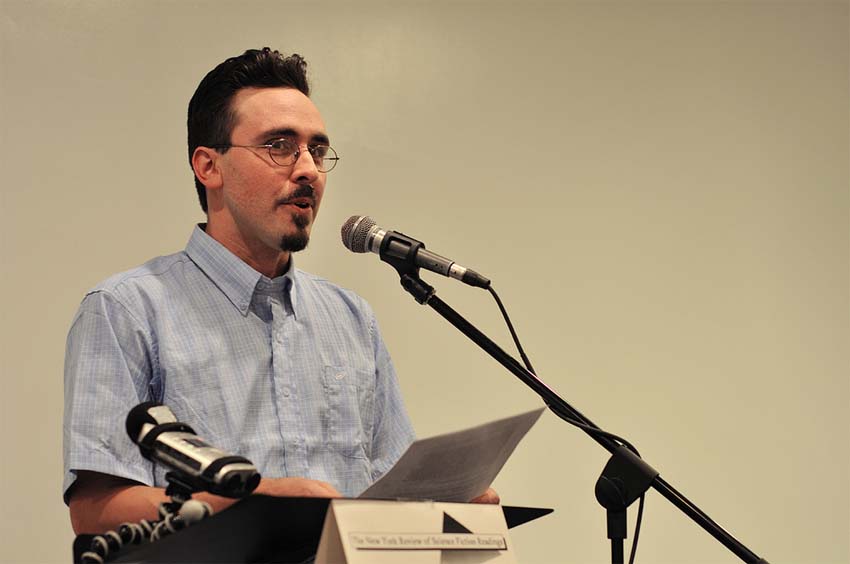
Brian Francis Slattery is most recently the author of Lost Everything and previously appeared on The Bat Segundo Show #142.
Listen: Play in new window | Download (Running Time: 1:01:44 — 56.5MB)
Condition of Mr. Segundo: Hammering in the morning, the evening, and the afternoon.
Author: Brian Francis Slattery
Subjects Discussed: Radio programs which force authors to starve for an hour, the glut of dystopian novels after 2008, taking criticisms to heart, distinguishing many forms of sarcasm and irony, a segue with two friendly gentlemen with hammers, the bleakness within Lost Everything, the seriousness of a major economic collapse, hope in the “Who knows?” area of bleakness, the possibility of restoration in Liberation vs. the unknown storm (The Big One) in Lost Everything, “squanch” as a word, Lost Everything‘s wandering narrator, using up a quota of semicolons, starting a sentence with a verb, faith and spirituality, agnosticism, the philosophical value of Christopher Reeve quotes, agnostics who dodge questions of faith, Nicholas Wolterstorff, the pacifistic and apolitical nature of taking Christianity seriously, the balance between forgiveness and righteousness, moral codes that are mishmashes of philosophy and religion, discussing issues in both religious and secular terms, the physical limitations within the Carthage, not providing the answers to the reader, deliberate ambiguities, super-omniscient narrators, narrators who match character predicaments, resisting the word “fun” when investigating nightmarish human predicaments, Russian roulette, violence and bleak humor as a defense mechanism, working at a social science research foundation, the choice between laughing and becoming serious when presented with genocide, how much a human life is worth, Guatemala vs. the Ukraine, life being cheaper in certain parts of the world, superfluous playground warnings, judgement of other parents over trifling details, sugar as a disruptive force, being reprimanded for saying “fuck” joyfully in a Park Slope restaurant, reading bleak books, finding the value in everyone, engaging in reckless behavior, when the removal of safeguards creates unanticipated possibilities, writing about a world devoid of electricity, 19th century human existence, how people live without electricity now, Darwin’s Nightmare, Hubert Sauper’s Kisangani Diary, Rwandan refugees who have nothing when coming across as a sanctuary, a maturing point in Slattery’s career, guilt, taking things seriously, a writer’s commitment to human existence, form following function, George Clinton and Bob Dylan as inspirational forces for (respectively) Spaceman Blues and Liberation, basing a narrative voice on the way people talk, Dock Boggs, Skip James, and 1920s music, expressing resistance through music, musicians authorized to marry people and given authority by the author, free spirited life in the face of chaos, music grounded in social reality, partying when everybody is freaked out, the house, river, and highway structure in Lost Everything, Life on the Mississippi, Kerouac, finding the specific region in America for Lost Everything, comparisons between Lost Everything and Race for Your Life, Charlie Brown, modeling novels from The Odyssey, the Susquehanna River being underutilized in American fiction, Slattery navigating the Susquehanna River in a canoe, William T. Vollmann, “Sunny Jim” Rolph, Captain Mendoza and Lydia Mendoza, character names, eels coming out of mattress, and making sure the constant degradation wasn’t repetitive.
EXCERPT FROM SHOW:
Slattery: Thanks for letting me eat and drink while I’m talking with you.
Correspondent: Yes.
Slattery: Which I’ll be doing.
Correspondent: It’s one of the very rare programs that allows authors to drink and eat.
Slattery: It is.
Correspondent: Most programs allow authors to starve for an hour. Anyway, we don’t do that here. Well, first of all, how are you doing? I didn’t quite get that question answered. You’re doing okay?
Slattery: How am I doing? Oh, I’m great. I’m good.
Correspondent: Alright. Well then, let’s get right down to business. For some inexplicable reason, and I have no idea why — maybe you might have a few ideas — but since roughly around 2008 — again, I have no idea why — there’s been a great rush of dystopic novels. Dystopian novels. Doom and gloom. And here we have number three from you, sir. So just to start off here, I’m wondering, when you started writing Lost Everything, were you aware of what might be called a glut or what might be called an overpopulated filed of dystopian novels? Did you care about such an output that was going on simultaneously as you were working on a book?
Slattery: I guess I should say that I was mildly aware, but not that aware. It’s not something I pay that much attention to, I guess. Even in stuff that I read, I read a ton of nonfiction. So I’m sort of vaguely aware of trends in fiction. But they have to be pretty big for me to be aware of them, I’m afraid. But yeah, it’s not something that I think about that much. The idea of chasing a trend or worrying about a trend, you just have to sort of — at least for me, I just worry about whether I can write a good book or not, and I see where it turns out. And in the case of the third one, it was like, from the first to the third one, one grew pretty naturally out of the other. There were questions that I liked in the first one that I never got around to that I did some of in the second one. And then there was still some left over. So there’s another book. Quite a bit.
Correspondent: Such as what? What specific questions are we talking about here?
Slattery: Gosh, let me think. I think that from the second to the third one, probably the best thing was — you know, the reception to it was really great. It was really very gratifying. One of the things that I ended up taking to heart though was that there were people who were being too flippant.
Correspondent: Really?
Slattery: And I thought, “That’s fair.”
Correspondent: You took that to heart?
Slattery: I did.
Correspondent: Does this explain why this one is really very bleak at times?
Slattery: It is.
Correspondent: It’s not to say that it’s devoid of humor. Because you do have the music.
Slattery: No, no. It is. It’s quite a bit darker. And for a while, I got halfway through it and I thought, “God, this book is really dark.” And then I thought, “Well, at least I should finish it.” And then I finished it and I thought, “No, it’s still really dark.” And there’s a part of me that — because, you know, I’m not really that serious of a person. And I was really kind of surprised that I’d written such a serious book. But it also seemed like — you know, there’s a point where, for the first two books, I think that there was a really conscious endeavor to make sure that the stakes weren’t so high that you couldn’t joke about it. And then eventually the stakes are high enough that it seemed kind of creepy to joke about it. It was like, you know, nobody would be joking in this kind of situation. Nobody would be just kind of horsing around. There’s no place for it anymore. And so I tried to find the humor where I could get it. But it felt increasingly forced to go for it. And it also seemed like kind of a fair trade. I felt like I was trading sarcastic for creepy. And I’m sort of okay with that.
Correspondent: You are. Well, what do you define as sarcasm? Having joy and having fun against an especially bleak or depressing environment, to my mind, isn’t sarcasm. And I don’t think it has been sarcasm in either Liberation or Spaceman Blues. I think it was a sense of irony. So how do you distinguish between irony and sarcasm here? And I’m really curious about the fact that you decided to…
Slattery: That’s a fun question to ask me, actually. Because I consider myself to be a pretty sarcastic person, but also kind of anti-irony. If that makes sense. And I think that what it comes down to is that I don’t — the way that I — I mean, this is obviously the pop culture version of irony. It’s not the lit crit version of it. But, you know, the pop culture version of it is that at the end, the joke is everybody not really sure what the person’s intentions are. Like the person has done a lot to hide what they actually think. And I don’t try to do that. So like…
[Food arrives.]Slattery: No, this looks great.
Correspondent: Did you want to pause? So you can actually eat that.
Slattery: No, no, no.
Correspondent: Okay.
Slattery: So it would be like — I try to joke around and I try to be kind of honest about it. If that makes sense. And to not be really ambiguous about what it is that I’m trying to say.
Correspondent: Okay. Well, in terms of distinguishing between lit crit irony and pop culture…
Gentleman with Hammer: Sorry. Are you recording?
Correspondent: Yes.
Gentleman with Hammer: Because I’m going to use the hammer for a few. Do you have a long time?
Correspondent: Probably thirty or forty minutes or something like that?
Gentleman with Hammer: Okay. Do you mind? Just for five minutes. I will tell you.
Correspondent: Okay, why don’t we…?
Slattery: We’ll stop.
Correspondent: We’ll stop. Five minutes.
Correspondent: Okay. So back in action here. So we were talking about irony and sarcasm and humor and the differences between pop culture irony and lit crit irony. And then two gentlemen decided to start construction on us. And they stopped thankfully.
Slattery: Yes.
Correspondent: They were very nice.
Slattery: And it looks really good.
Correspondent: Yes, it does really look good. So we were trying to peg what you view your humor to be.
Slattery: Right.
Correspondent: And I insisted that it was working in some quasi-ironic mode.
Slattery: (laughs) That’s nice of you.
Correspondent: A sincere irony, I suppose. Or I suppose the joys of contradiction. And you were saying, “No, no, no, Ed, actually….”
Slattery: No, no, no. We’re probably talking about the same thing.
Correspondent: Yeah. We’re probably talking about the same thing.
(Image: Houari B.)
Listen: Play in new window | Download (Running Time: 1:01:44 — 56.5MB)