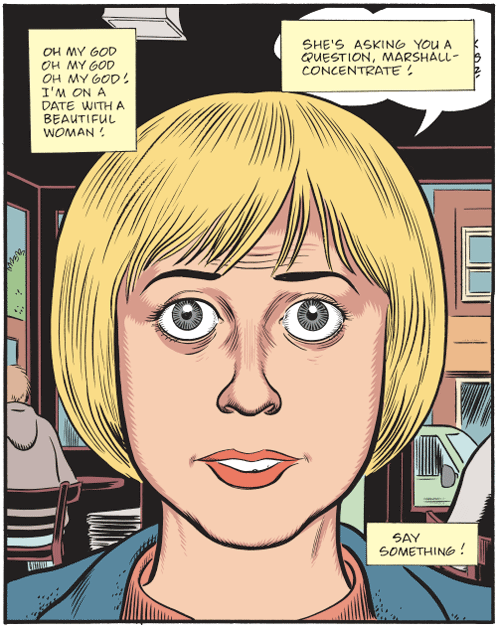
Daniel Clowes recently appeared on The Bat Segundo Show #394. He is most recently the author of Mr. Wonderful.
Listen: Play in new window | Download (Running Time: 42:19 — 38.7MB)
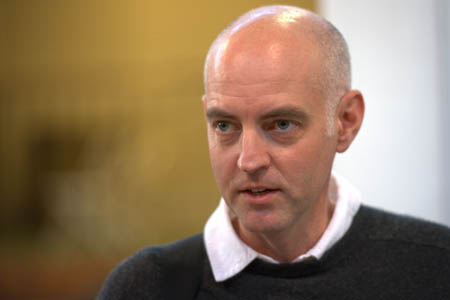
Condition of Mr. Segundo: Uniting with the bald community.
Author: Daniel Clowes
Subjects Discussed: Moments of simultaneous consciousness, creative methods of beating imposed deadlines, being intrigued by thought balloons, Superman and narrative urgency, formal lettering, what motivates words in Daniel Clowes’s life, the type of lettering that causes one to read narration in a robotic voice, sound effects and newspapers, CHOFF CHOFF vs. SMOOTH SMOOTH, mass readership and not receiving significant mail, Eightball reader responses vs. New York Times reader responses, angry Southerners who object to the word “Jesus,” following Like a Velvet Glove Cast in Iron versus following Mr. Wonderful on a sequential basis, pre-Internet audiences, “Check out my blog!” as a recurrent audience response, the advantages of insulation, the general sense of distant feedback, Chris Ware homages in Ice Haven, the amount of detail compressed in any individual frame, not wanting to cheat the reader, the complex issue of bald spots in comics, the many permutation of Wilson’s look, depicting eating in visual mediums, Terry Zwigoff’s enthusiasm for eating, the difficulties of illustrating table settings, reference shots, drawing pay phones, drawing without reference shots, the consequences of fussing over an illustration too much,
EXCERPT FROM SHOW:
Correspondent: As a fellow gentleman who also has the male pattern baldness, I feel compelled to ask you about bald spots. In Wilson, his physical form changes from set to set to set. He’s often chunkier. He’s often muscular. He’s receding in different places each time. And I noticed in Mr. Wonderful, when you expand to one of these large panels, we do in fact see this silver of a bald spot.
Clowes: He has a bald spot throughout, I think.
Correspondent: Yeah. But we don’t really see it so much in some of the smaller panels.
Clowes: No. It looks weird if you have this little dot of flesh in a small panel.
Correspondent: To wrestle with the idea of bald spots in comics, is it really just a matter of liking to draw these?
Clowes: I’m trying to support our community.
Correspondent: Oh yes. Exactly. You meet in the secret halls as well as I do.
Clowes: Yes. Yes.
Correspondent: They don’t know how much we are…
Clowes: Again, I’m trying to normalize our ilk for the rest of the world.
Correspondent: What about the six panel approach of Wilson? I mean, sometimes we see….
Clowes: There’s seven or eight.
Correspondent: Sometimes we see at the very bottom of the row, we see three there. But I’m curious if that formalism caused you to shift Wilson’s appearance. I was always curious about why. Was it just a matter of trying to have almost every type of reader reading this finding her version of Wilson in the actual…?
Clowes: That was — that was part of the intent. We all see ourselves very differently from day to day. And I was trying to capture all the various ways that Wilson sees himself and feels about himself. And each one of those looks gives something specific to each of the strips. And I wanted each of them to have their own identity. They exist in this, as you say, very severe structure where it’s six, seven, and eight panel gag strips. And so I wanted them to have that, but also to have this way where they’re drastically differentiated from each other.
Correspondent: Sure. I mentioned Marshall eating a French fry earlier. And I did tell you that I had a followup question. I had a rather elaborate one.
Clowes: Bring it on.
Correspondent: I have — and this might just be an expression of my obsessions — but I have been very interested in the notion of depicting eating in visual mediums. You see a film sometimes. And often they’ll go to a restaurant or a diner or a bar or a cafe and nobody will eat. Similarly, I have noticed in your work that there is a reticence — especially in the early work, although we’re increasingly seeing more of a development in terms of depicting characters eating. Although I should point out that in the film of Ghost World, there’s a great moment where Bob Balaban is eating that toast.
Clowes: There’s lots of eating in that film.
Correspondent: Yeah, there’s lots of eating.
Clowes: Zwigoff enjoys eating.
Correspondent: Yes.
Clowes: Often, if he can’t think of anything else, he would just tell an actor, “Just put a bagel in your mouth and do the line that way.”
Correspondent: But in Ghost World the comic, we don’t actually see Enid and Rebecca eating. We see Josh eating.
Clowes: They’re too busy talking, I think.
Correspondent: They aren’t too busy talking. People talk and eat. They talk and eat in Ghost World the movie.
Clowes: It looks weird though. It makes someone look sort of vulgar if they’re talking and eating. And so you have to be careful with things like that. There are very subtle little things in comics. You have just this one panel to express something. And it confuses the audience if you’re not…you know.
Correspondent: Well, have you tried to get more eating? For example, the hospital in Mr. Wonderful, where incidentally Marshall feels more comfortable there than in the diner. Suddenly, Clowes feels more comfortable depicting picking at food and actual eating. I was reading this, championing the characters eating.
Clowes: Well, I think he’s relaxed. Before, he’s sort of taking a little bite and he’s not even thinking about eating. If you show someone eating, they seem at ease. And so I wanted to show that he’s given up. He’s totally relaxed. And he’s free to just eat his French fries.
 Correspondent: Well, have you agonized over depicting eating moments over the years at all?
Clowes: It’s all intuitive. You don’t think about the details of it. You’re thinking about how to get across the performance of the character and how best to do that. Drawing table settings is really difficult. It’s one of the more difficult things you can do. Because you have to draw plates and perspectives and you have to kind of keep everything in the right place. You know, people don’t consciously notice if a glass moves from one side of the table to the other. But they unconsciously know that something’s off. And so it’s not at all easy. So I try not to write around that. I try to do my work and get it in there.
Correspondent: So being a script supervisor for your own work, it would seem, is part of the perfectionist in you.
Clowes: Table settings are famously the script supervisor’s nightmare.
Correspondent: Is there anything more difficult for you for the comics than table settings? In terms of getting things consistent?
Clowes: Oh yeah. I mean, there are many things that I have written around. I can’t imagine drawing a detailed battle scene. I mean, if I had to do it, I would. But it’s not my idea of fun, you know? It would be a chore. Or to draw people riding horses is the one I’ve tried a few times. And my horses look very weird. I’d have to spend three weeks just working on the horses and get some way to do that down before I could do a Western I think.
Correspondent: In the Ghost World special edition, there is a reference photo that you provide indicating that this is the model for the Ghost World hardcover photo. This leads me to ask, since we were talking about panel size before, how much reference you actually need. In the case of horses, I’m wondering if part of the difficulty has been getting enough horses to model for you or to be photographed.
Clowes: There’s certainly plenty of reference nowadays on the Internet. And as it’s gotten more and more available, I’ve tried to use less and less of it. Because I find that I can look back at my work and say, “Oh, I just looked at a photograph of a pay phone.” There’s something much stronger about trying to remember what a pay phone looks like. And that way you capture both the essence of a pay phone and you also capture what your vision of a pay phone is. And so I try and only use reference if it’s something where I just can’t get a clear picture in my head. I mean, that reference of my wife for the back cover of Ghost World, that was for doing a very specific kind of detailed painting. I wanted it to look like an old pinup painting. And so I wanted it to have that kind of phony posed look. And so I would use a photo for something like that. But I would almost never, for a person, use a photo.
Correspondent: At what point, do you just simply draw a gesture without reference? Some people say that you can tell when a cartoonist is coming into a room. You immediately know who he is. Because that’s exactly like the drawings. Is there a similar predicament in just wanting to be off the reference altogether and just using your imagination to get something a little unreal? What do you do in a situation like that?
Clowes: I try to always go in that direction. I’m much more interested in making things up. It doesn’t always work out. And then you have to go back and fix it. But very often it’s much truer than if you’re fussing over it too much and trying to get things perfect.
Correspondent: But when you’re talking about capturing the essence of a pay phone, if you fuss over it too much, is it going to have an impact on capturing the essence?
Clowes: No. I mean, if you fuss over it too much, it pulls it out of the rest of the world, which is not fussed over. I try to draw as naturally as I can. Which took me forever. You know, my early work, I look at it and it makes my hand ache from thinking how agitated I was trying to get everything a certain way and not getting there. It was just constantly frustrating. And I was always throwing pages out the window and starting over and whiting out entire faces and pasting things on. And it was never pleasurable. And in the last five or six years, I’ve gotten to the point where I can feel good about without absolute agony. Or at least I know how to fix it at this point. I know that everything is fixable.
Listen: Play in new window | Download (Running Time: 42:19 — 38.7MB)