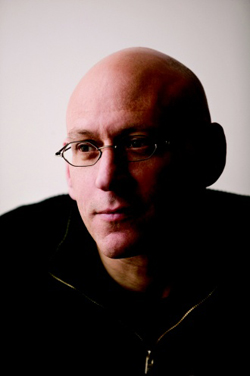
David Shields is most recently the author of Reality Hunger.
Listen: Play in new window | Download (Running Time: 54:15 — 49.7MB)
Condition of Mr. Segundo: Settling for a quesadilla or some reality for lunch.
Author: David Shields
Subjects Discussed: The origins of the novel and the pretense of actuality, Shields’s dismissal of Myla Goldberg’s forthcoming novel based solely on a catalog description, the creative possibilities that emerge from mishearing, Sherman’s March, the mutability of text, Bloom’s The Anxiety of Influence, whether a truer creative impulse comes from misappropriation, common reality and the individual reception of a novel, Spenser’s “Mutability Cantos,” espousing work that is true to human consciousness, Shields’s view as the lyrical essay as the best opportunity for investigation, dreamworlds, Shields’s hatred of the exit door within the novel, Shields’s dismissal of Lolita as a “masturbatory book” that is “smug, so sure of itself,” laden with “purple prose” and “full of condescension,” Shields’s boredom with the “monuments,” Shields’s opinion on “formulaic” plot, the Ca’pn Crunch moment in Neal Stephenson’s Cryptonomicon, the Huey Lewis and Genesis chapters in American Psycho, Saul Bellow’s Herzog, Shields’s view of novel reading as a “childish” and “frivolous” activity, Vollmann’s The Royal Family, challenging Shields on the “fun” of reading, Sarah Waters, David Markson, Shields’s boredom with The Great Gatsby, a lengthy attempt to find a Lou Reed-related quote in the book, the value of the “hyperfake,” the Gormenghast books, China Mieville’s City and the City, Shields’s failure to maintain a “story gene,” Wittgenstein’s Mistress, Sebald, Rothko, quibbling with Shields’s definition of “a great artist,” David Foster Wallace and Tom Clancy, the meshing of high and low culture, Shields’s distaste for DFW’s fiction, Ulysses, “in no way is Infinite Jest a great novel,” Laura Miller’s review, the contradiction of Shields dissing a book without finishing it, and Shields liking Franzen’s The Corrections when sick and then getting over the flu and retrieving his brain to loathe it.
EXCERPT FROM SHOW:
Correspondent: Let’s start with the beginning of the novel. I think that’s pretty appropriate. You write, “The origin point of the novel lies in its pretense of actuality.” You point to Defoe and Fielding’s efforts to suggest “real” accounts. But I’m wondering if any effort to offer a pretense of actuality in our present age, whether it’s through a remix or a collage, really represents an inevitable return to this antediluvian form. This pretense of actuality.
Shields: Exactly. I’m going to see if I can find this wonderful quote by Adam Gopnik in the book. And maybe you can help me find it. But he basically says that the only kind of — I’ve been trying to find it of late. Let me see if I can find it.
Correspondent: You didn’t memorize all 600? (laughs)
Shields: I’ve memorized most if them. But see if you can find the Gopnik. But anyway, there’s this incredible passage by Gopnik, who says that the only kind of work that can move us is work that is full of a kind of gallows humor and, above all, has an authentic disorder.* I think he’s talking about Francis Bacon. I’m not sure what. But I don’t know. Perhaps later, we’ll find it. But I think that’s right. That in a way, you’ve cut to the core of it. And Gopnik has. And I hope I have. Which is: any such gesture like, for instance, I must admit I was looking at the Knopf catalog. You know, I visited the Knopf office and they send you home with a catalog. That’s their big gift to you. And I’m looking at some of the books described. Various mainstream novels. And I’m just thinking, “You cannot be serious.” That in 2010, you’re publishing this book by this person. It seemed like such an unbelievably antebellum thing. I mean, it’s like, what does this possibly have to do with life lived at the ground right now? It just seemed absolutely preposterous. I just started bursting out in laughter.
Correspondent: Such as what exactly?
Shields: Well, the book that was being described — and no offense to her; I haven’t read her work — but it was a book by somebody named Myla Goldberg. Do I have her name right?
Correspondent: Yeah.
Shields: And, my god, talk about a formulaic text with these little plot points. (to waiter) Thanks a lot.
Waiter: You’re welcome.
Shields: You know, with these little plot points everywhere. (to waiter) Some more water when you have a moment?
Waiter: Sure, I’ll be back.
Shields: And it was just like, I don’t know what. You know, probably an intelligent, well-meaning, well-read writer. It’s like, “Wow!” This is so — you may as well be writing the most formulaic sitcom. And she’s a respected — and I think somewhat respected, somewhat commercially successful writer.
Correspondent: But you’re also…
Shields: And I was like — anyway, this is a longwinded answer of saying.
Correspondent: Yeah.
Shields: You’ve cut to it. Any such gesture now strikes me as antediluvian indeed. Absolutely.
Correspondent: But you’re also judging this not on the book, but on the description of the book. So therefore, we get into meta territory. So how can you make a judgment based off of a catalog description. If I did that, then I would probably avoid most books.
Shields: True.
Correspondent: Because they’re often written in this corporate copy.
Shields: Of course. But I’ve read enough of her other book. I’ve flipped pages to realize that catalog copy was all too relevant to the book. And also I love the line of Borges in the book, where he says something like, “Why write the book? Let’s just write the commentary of the book. The book can be summarized in ten sentences. Let’s write the meta commentary and cut to the point.” So the meta commentary interests me at least as much as the text itself. So in this case, it did not seem to be doing a disservice to the book.
Correspondent: Even though you haven’t actually flipped through the book.
Shields: Well, I’ve read her earlier — I’ve read in and around her earlier books. And it seemed the way — frankly, the way in which the book can be entirely summarized as a narrative machine — seemed to me a very, that very fact meant it was, by definition, for me, a dead text. I mean, there wasn’t a single thing discussed, but “this happened” and “that happened” and “this happened” and “that happened.” I mean, you might as well have had — it was just really embarrassing. It was embarrassing to read.
Correspondent: Embarrassing? You felt embarrassed?
Shields: I felt embarrassed that I was part — I mean, I think it was a Doubleday book. I was embarrassed that I was a publisher that had a relationship to that. I was like, “What does this have to do with the advancement of culture?” You know, nothing.
* — The specific passage Shields is trying to locate can be found in Paragraph 365, and reads: “It may be that nowadays in order to move us, abstract pictures need, if not humor, then at least some admission of their own absurdity — expressed in general awkwardness, or in an authentic disorder.” It’s taken from Gopnik’s “What Comes Naturally,” The New Yorker, July 20, 1992, pp. 66-69.
Listen: Play in new window | Download (Running Time: 54:15 — 49.7MB)
3 Comments