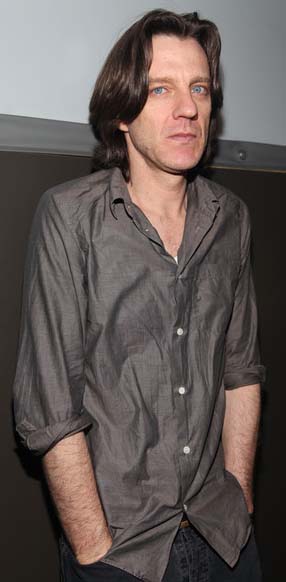
James Marsh is most recently the director of Project Nim, which opens in theaters on July 8, 2011.
Listen: Play in new window | Download (Running Time: 22:09 — 20.3MB)
Condition of Mr. Segundo: Pondering unethical experiments that might slide by today’s authorities.
Guest: James Marsh
Subjects Discussed: States of exhaustion, Project Nim’s purported origins of the 1970s hippie residue, scientific ethics and Columbia code of conduct, attempts to teach a chimpanzee to use sign language, Professor Herb Terrace, the transgressive aspects of ripping an animal from his mother, Skinner, Harry Harlow’s experiments, Terrace’s efforts to seek media coverage, Nim Chimpsky’s attacks on grad students, Terrace’s concerns for insurance issues over harm and suffering to students, Washoe, a filmmaker’s obligation to history, contending with demands from studio executives, when Marsh recreates moments in a documentary, dramatic reconstructions, murdering poodles, the inherent danger in cutting too much, audience imagination and the dangers of being too literal, balancing the needs of individual perspective and audience reaction, having ongoing debates while editing a documentary, some of the qualities that cause a documentary filmmaker to become prickly, the potential conflict of interest of obtaining film clips from the very subjects you’re interviewing, having sexual feelings for a chimp, being faithful to the honest confessions of documentary subjects, viewing documentary subjects as actors, earning trust as a filmmaker, Philippe Petit, whether discomfort is required in the questioning process, asking a question in ten different ways, trying to get a scientist to reveal he committed an affair, why people should trust James Marsh, the moral implications on Catfish, the possibilities that Catfish is a fake documentary, and phony indignation.
EXCERPT FROM SHOW:
Correspondent: You don’t bring up the Washoe project. Allen and Beatrix Gardner and Herb Terrace had a huge rivalry going on at the time. And it’s almost like East Coast/West Coast, Biggie/Tupac…
Marsh: Well, there’s another film to be made about all that stuff. There’s quite a few PBS type documentaries that get into the whole language experiments that Washoe, the Gardners, and that whole debate. That would be a film about science, a film about ideas. And our film is a drama about a chimpanzee and people. So I was aware of that context and many people spoke about it in the course of our interviews. But I thought it was going to be a blind alley for me as a filmmaker to get into that too much. It may be an oversight on my part. But that’s a different film. If you want to go see that film, someone else can make that. That’s not my film.
Correspondent: But don’t you think you have an obligation to present, to some degree, the history…
Marsh: No.
Correspondent: Of all of these animal language…
Marsh: Why?
Correspondent: Why? Because Washoe ended up having 350 words she “learned” of sign language. You can just do a brief mention.
Marsh: Well, you see, here’s my feeling about that. It’s that a brief mention is not good enough. That’s when you’re playing with it. If you’re just trying to flirt with something and say, “Well, I can mention Chomsky and I can mention Washoe and the Gardners.” You may know about that. But my brother watching the film won’t know anything about that. So I’m not trying to be — I’m being a little defensive here. But that wasn’t the film I wanted to make. That’s a different kind of film. And that film? Go online. Nova has done that film. Washoe, the fucking dolphins — you know, the Gardners, signs. But the bottom line is that the experiment failed. And that chimps do not learn language. So I can get caught up in this whole discussion about who was right and who was wrong, and who learned the most words. That’s not a story. That’s a discussion about the practice of science and the nature of these experiments. And so I wanted to focus on a dramatic story as opposed to the issues and the context. And, of course, someone like yourself, who is very….who is familiar with this stuff, probably feels a bit cheated. Because I don’t explain and give you the context you are sort of dimly aware of or know a little bit about. But that’s a very conscious choice on my part. Not to get caught up in things you can’t really fully explain and will, I think, be a sort of sideshow to what I think my interest in the story, which is my interest in the drama of it and the life story of this chimpanzee. Now if you’re a Nim, what does he fucking care about Washoe and dolphins and the Gardners? He isn’t going to know nothing about these things. So I’m trying to put you. You know, his life story is where I’m focused here. Not so much on this whole fascinating internexual climate that you’re aware of and the film doesn’t really get into.
Correspondent: To go ahead and correct your impression that I felt cheated, what I’m actually talking about here is how you as a documentary filmmaker make the choice to not include Washoe. Is it really a consideration of “Oh, well here’s a rabbit hole that will create a three hour film”?
Marsh: Yeah. Or where is my interest in this story? Where do I think the narrative is in this story? As opposed to — I think you could cram the film with reference points to other experiments and to other thinkers and linguists. And on and on. But that isn’t the film that I think would work for me as a filmmaker, or the one I’m interested in making. And so to distill my view into I want to tell you the story of this from the point of view of the chimpanzee, who would have no awareness of the other chimpanzee lab experiments and no interest in them either, I think.
Correspondent: So to some degree, it sounds to me that when you make a film — especially one that deals with science as opposed to, say, an event that numerous people see such as Man on Wire — your problem, I suppose, is that you’re enslaved to narrative to some degree. Is that safe to say?
Marsh: Well, that’s my interest in narrative. I guess I’m a little prickly about this. Because there’s quite a lot of pressure around the making of the film of this sort. Explaining to people. “Give me more context. Give me more science. Show me the scientific debate here.” And so I’m prickly about it because it caused me a lot of trouble as I was filming it, getting these comments from people — executives involved with the film — that they wanted more of this stuff. And they’re saying, “Well, I want a narrator for the film.” And I began to get quite pissed off about this. Because it wasn’t the kind of film that I was making, nor did I say that I was going to make this film. I was making the story of Nim the chimp. And films tend to not deal with ideas terribly well. It’s not what films are good at doing. I mean, some films do it extraordinarily well. But it’s not what they’re best for. I think film is best as a medium for storytelling. And so that’s where my interest is in this particular story again.
Listen: Play in new window | Download (Running Time: 22:09 — 20.3MB)