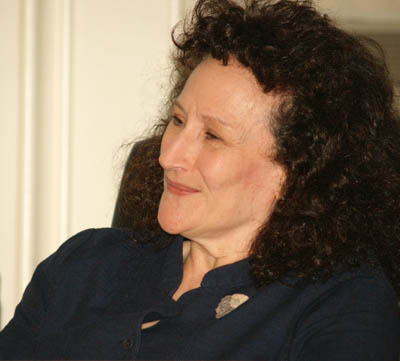
Lynne Tillman is most recently the author of Someday This Will Be Funny.
Listen: Play in new window | Download (Running Time: 36:57 — 33.8MB)
Condition of Mr. Segundo: Wondering if he should laugh today or five years from now.
Author: Lynne Tillman
Subjects Discussed: Giddy book titles, William S. Burroughs as a slob, Flaubert’s writing maxim, how writers stay adolescent, the soul-sucking atmosphere of Forbes magazine, the story behind the writing of the story “Dear Ollie” as perpetuated by Lynne Tillman and Paul Maliszewski, mining from personal history, the death of cats, audience reaction to animals, material that readers fill in themselves, the essaylike trajectory of American Genius echoed in “That’s How Wrong My Love Is” and “Impressions of an Artist With Haiku,” editors who have been confused about what Tillman is trying to teach them, fiction and pedagogical requirements, whether women writers are allowed to play with ideas in the way that men are, Nicholson Baker, neurotic women protagonists, Moby Dick, daily minutiae, when ideas emerge from perspective, American Genius originating from the concept of sensitivity, pronoun happy prose, Tillman’s reluctance to initially name character names and what the reader earns, first name familiarity with celebrities, disconsolate shorthand for people in American Genius, using plain names in Haunted Houses, choosing names that are sturdy, clarifying Tillman’s stance on “backstory,” Hemingway’s iceberg theory, the appropriateness of ambiguity, Method acting, film and theater crossing into contemporary fiction, Antonioni’s L’Aventura and Edith Wharton, architecture indicating people’s positions in life, when certain aspects of fiction are spelled out too much for a reader, Cast in Doubt, approaching sex and relationships from an oblique vantage point, thinking about sex every seven minutes, Weird Fucks and “getting the fucks out of your system,” Edmund White’s sexual imagination, the tongue being privileged with information, Dennis Cooper, Tillman’s apothegmatic moments, whether shame is a necessary component of fiction, Leslie Fiedler and guilt shaping the American novel, and being shocked by what you’ve written.
EXCERPT FROM SHOW:
Tillman: I’m happy that I was finally able to title a book Someday This Will Be Funny. And if you’ve noticed, there’s no story called “Someday This Will Be Funny.”
Correspondent: Exactly.
Tillman: In the book.
Correspondent: It’s literally a grab bag for the reader. They can determine if it’s funny or it’s not funny. Or if it will be funny tomorrow or six years from now.
Tillman: Or never! (laughs)
Correspondent: Irony, it seems! I wanted to first of all start from an unusual tack. In Brandon Stousy’s Up is Up But So is Down, you bring up an interview with Lou Reed and William S. Burroughs where they’re talking about Kerouac. And Reed says he cannot understand how such a great writer was a slob. This is an anecdote you bring up. You’re just fascinated by this. That he just drinks beer in front of the TV. And then Burroughs responds, “Well, Kerouac did that while he was young. And he just grew up to be an old slob.” This is a very interesting pretext to talk about, well, what do you have to give up to be a writer? To stay fresh as a writer? I mean, it’s said that you often have to stay young. Then there’s the Flaubert maxim: “be calm and orderly in your life so you can be violent and original in your work.” So I must ask you, Lynne, in light of the fact that you’ve struck such a variegated crop here yet again, what you had to give up and what have you not given up? I mean, how adult are you? (laughs)
Tillman: Oh, I’m just a child. Totally immature. Give up. Well, I had to give up making a lot of money. I mean, it was never in my legend anyway. I never really thought about it. Only as you get older do you realize that you made a choice in life that is not financially wise. But what do I give up? I don’t think very much. Because this is what I want to do. I guess I give up a certain kind of calm or sanity because trying to write your next story or find your next book, your next novel, what you want to do, can be extremely difficult and painful and there’s no reassurance in it. I guess I’ve given up reassurance in a way. When I worked as a proofreader one week on, one week off — actually at Forbes Magazine.
Correspondent: The ultimate soul-sucking atmosphere.
Tillman: Ultimate! Ultimate. I knew that where I would be for twelve hours a day for five days. And in its tedium, it had its calming effect. And in that time, I didn’t have to think about anything. I just had to be a good proofreader. Which wasn’t that hard for me. But when you’re writing, there are no assurances. So if I’ve given up anything, it’s the sense that I can feel satisfied. Because as any writer will say to you, it’s always the next book you’re worried about.
Correspondent: Yes. You may be giving up assurances, but, on the other hand, you’re getting liberty in return. You’re getting freedom. The question I had was whether there’s some lingering adolescent quality that you’re holding onto or is it really just this idea of getting used to the idea that there is no assurance? That that, in its own way, is also creatively liberating even if you have no specific timetable for when your next story or when your next novel is going to come out of you?
Tillman: I don’t know that those two ideas are entwined with each other. I haven’t given up my childhood in the sense that it’s still a source of material for me. Not that I write autobiographically, particularly; but that whatever the desire was that made me want to be a writer from a very early age, it’s still there. It must still be there. Because I keep going.
Correspondent: I’m glad you brought that up. Because I wanted to bring up “Dear Ollie,” because a person named Lynne Tillman is the author of that letter. What’s also interesting is I know that appeared in 2002 in McSweeney’s, although it’s not actually named in the book.
Tillman: It isn’t?
Correspondent: No. It’s the one credit that’s missing! I can show you.
Tillman: Is it really? Wow. You can show me later.
Correspondent: I didn’t know if you were trying to hide the origins.
Tillman: No! I wasn’t at all.
Correspondent: Really? Okay.
Tillman: That’s probably a mistake.
Correspondent: I mention this because you recently did an interview with Lydia Davis for Electronic Book Review and you said, “By the time I use something autobiographical, it’s not about me and my life.” And we were just discussing that. Your discussion of autobiography triggered this. Does this mean you’re dispensing with emotional investment when you use something autobiographical? Are you, in the case of say “Dear Ollie,” approaching the autobiographical form from an entirely new emotional vantage point?
Tillman: Well, it would be new to me in the sense that I’m working out of stuff that happened. In this case, it had to have happened. Paul Maliszewski edited this section. And we all had to put our last names. We had to use our real names, as far as I recall. And that’s why the name is included. It’s the only time that I’ve ever done that.
Correspondent: Oh really?
Tillman: That the narrator and the author are the same.
Correspondent: You were a friendly witness.
Tillman: Exactly. Or unfriendly.
Correspondent: (laughs)
Tillman: Ambivalent anyway. And that was not difficult material to write about it. I mean, it wasn’t terribly emotional for me.
Correspondent: There was an Ollie?
Tillman: There was an Ollie. And there was a prank. It had to be — Paul wanted a real prank. And I thought, “Well, this was a prank I participated in.” A wonderful practical horrible joke.
Correspondent: This explains a lot. ‘Cause when I read that, it just sticks out. Wait a minute! Why is there this absolute need to correct the public record? Because I think of your work and I think, “I don’t think she’s the kind of person who needs to do this.” But if you were actually asked to do so, this makes complete sense.
Tillman: Oh, it’s completely invented. The writer in there.
Correspondent: Oh, I see! Got it.
Tillman: That’s the invention. I use the device of writing. It had to be a letter. And I use the device of writing to someone who had also been in this situation and who then went on to become a writer. And his characterization of this event, I objected to. And of course, the “I Lynne Tillman” who is writing this objected to it. There was an Ollie. He was a musician. There was no writer.
Correspondent: Well, I’m curious about this idea of autobiography. I mean, when you’re mining from it after you’ve experienced it, after you’ve thought about it, what dregs are left generally? Is there anything left to mine? Are there incidents that are the basis for two separate stories sometimes?
Tillman: Well, it’s not drained of all feeling. But you’re able to see in an incident that you yourself experience, with more distance, a way that it has pertinence for other readers. In other words, it’s not so close to me anymore that I can’t give it up, so to speak. It exceeds my own personal history.
Listen: Play in new window | Download (Running Time: 36:57 — 33.8MB)