The Rise of the West (Modern Library Nonfiction #71)

(This is the thirtieth entry in The Modern Library Nonfiction Challenge, an ambitious project to read and write about the Modern Library Nonfiction books from #100 to #1. There is also The Modern Library Reading Challenge, a fiction-based counterpart to this list. Previous entry: The Gnostic Gospels.)

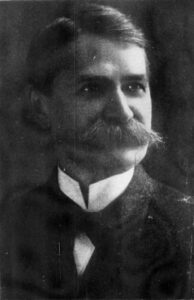
Sixty-three years after The Rise of the West‘s publication, it’s easy to take William McNeill for granted. You see, for many years, scholars widely accepted the worldview, one remarkably myopic in hindsight, that civilizations were not influenced by other civilizations. Perhaps this casual and subconscious strain of passive xenophobia was all the rage among upper-crust academics because, for several decades, these historians had walked the earth wearing too much tweed.
I don’t think we discuss just how dangerous tweed is in our culture. Oh sure, it’s a rough-and-tumble wool that is often handwoven into highly appealing earth tones. But it does turn colorful personalities with the memorably destructive charm of a Molotov cocktail into bores with an inexorably reactionary view of the universe.

In the course of my five decades on this planet, I have witnessed dependable punks — surly o.g. types who once donned studded leather jackets, safety pins, mohawks, a dependably formidable sneer ratio on their faces, and ripped up T-shirts with the most obscure bands on the more recherché side of The Licks and The Angry Samoans — transform into the blandest and most intransigent and most insufferable home-owning, macchiato-sipping academics imaginable. Many of them are named Mark, Leon, Jonathan, Dwight, or Chuck. You may not know this, but those who wear tweed are now required to register with the Online Tweed Registry, lest the remaining hordes of innocent anti-authoritarian readers in America be subsumed by the baleful fabric that, much like golf, was one of the few inventions from Scotland in which the full implications on everyday life had not been seriously considered.

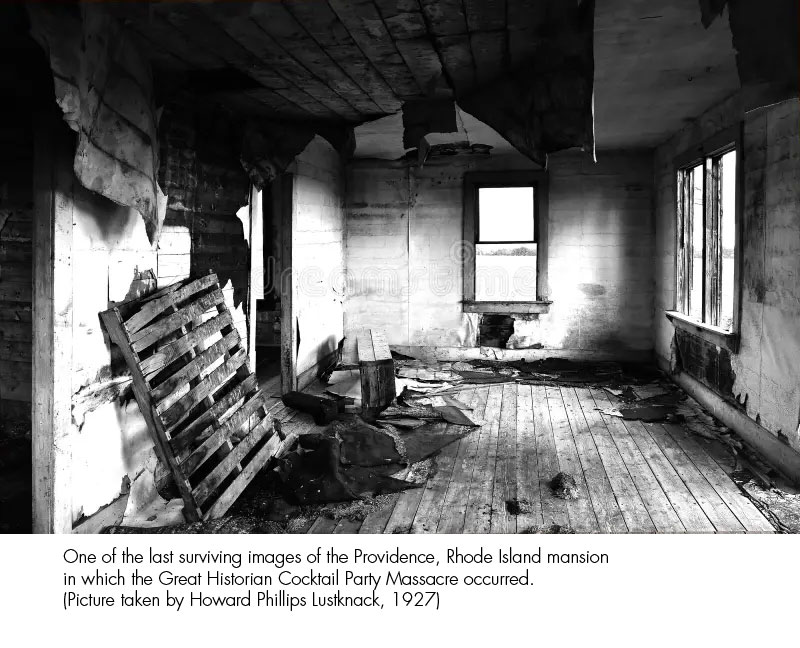
While those who have been enveloped — nay, terrorized — by tweed and converted into dull and invidious downers (they can now be found hawking timeshares to the few remaining affluent Americans with expendable income) are a tad more conversational than the pod people profiled by the great documentary filmmakers Don Siegel and Philip Kaufman, if you wear too much tweed, you tend to become a socially clueless introvert, which affects your ability to invite the right people to your weekend barbeque. I need not trot out the Great Historian Cocktail Party Massacre of 1867, in which many obnoxious academics fond of sucking the life out of the room — all naturally wearing tweed, of course — were momentarily congregated in a vestibule of a fancypants spread owned by a septuagenarian millionaire fond of kidnapping starving grad students — Edinburgh Medical School style (Scotland again!) — and withdrawing their blood in a desperate attempt to live throughout the duration of the 20th century.

The collective social energy within this sprawling manse located in Providence, Rhode Island (razed to the ground sometime in the 1920s by a group led by Howard Phillips Lustknack to deter any additional academic homicides) was so draining that letter openers became improvised daggers. Soft hands that had once been solely committed to flipping the pages of obscure tomes became feverishly devoted to strangling the most annoying guests. While there was an undeniably effective social Darwinist remedy to this horrible tragedy, it took many years before historians could wear tweed again without transmuting into killers with blandly vampiric energy.

For the next two decades, historians stopped being social, fearing that vital scholarship would be curtailed by sudden violence until they were able to isolate tweed as the common factor. But time passed and the historians learned how to be gregarious while showing greater caution in the amount of tweed they wore on any given week. Thus, the troubling backwards thesis in which historians — egged on by Toynbee — believed that civilizations did not communicate and exchange ideas when caravans passed each other on a trade route remained.

Until William McNeill came along, believed by many to mostly eschew tweed, putting together a thick and formidable volume with more annotations than David Foster Wallace and a bag of chips.

Yes, I realize I’ve bullshitted about tweed in an attempt to divagate from writing an essay about a thoughtful book about the interconnected nature of disparate cultures that is incredibly depressing to read as we presently contend with a highly dangerous madman who has threatened the Iranian people with nuclear annihilation and shows no immediate sign of dropping dead. (Grim Reaper, you had one job!) What can I say? I have procrastinated for two years on this essay because, while McNeill served up a commendable arsenal of information, he did write this book in a far more intellectual time that the one we presently live in: an epoch that was fueled in part by less judgment, more curiosity, and a take-it-or-leave-it form of American exceptionalism that seems healthier than the present efforts by a fascist government to erase our greatest mistakes from the museums.

And while I do not feel especially proud of our ugly and cruel nation right now, I am at least able to summon some enthusiasm for a sunny and idealistic book that has valiantly covered thousands of years of human history, reminding me that even America, particularly in its present iteration, will eventually cease to exist. Perhaps sooner than we know.

Africa, McNeill rightly informs us, was the cradle of human civilization. This is likely extremely difficult for certain red state CHUDs of the hayseed Klansman pedigree to understand (not that I expect them to be reading my essay), but it’s true. Africa became the premiere continent for hunting, art, human inventiveness, agriculture (which has been reinvented throughout human history more times than David Bowie’s career), and pastoral culture. I mention pastoral culture because these were not idyllic and rustic shepherds living in harmony — a myth promulgated most notably by Hesiod, who needed his fantasies as much as anyone. No, these were rugged individualists who discovered rather swiftly that the easiest path to acquiring wealth was to steal other people’s crops and animals, particularly during droughts. These early human tyrants often did so with heightened aggression and were far from polite about it. Chivalry and codes of honor were some centuries away, although it is believed that at least one cutthroat cabal did mutter the equivalent of “pretty please with sugar on top” shortly after smiting down some poor bastard and his family with their scimitars.

Obviously something had to change. Despite the troubling tendency of ape-descended life forms to pass the time by engaging in selfishness and cruelty, Neolithic barbarism, much like capitalism today, wasn’t exactly a winning formula for endurance, given that there were countless victims and many deaths from the “plutocrats” (early adopters?) back then who insisted on hoarding all of the resources.

And while many of our ancestors became depressed and developed deadly new wrist slicing techniques over this state of affairs, McNeill notes that, even in the years before Christ, various civilizations began to realize that there were better forms of social camaraderie than brute force upon your neighboring farmers and foragers! Seasonal labor led to the early rise of culture. Mesopotamia worked out the canal system. And agricultural developments led to a grain surplus, which resulted in a managerial class. (Thankfully none of the managers were named Karen.)

The early cities came from the Sumerians, which resulted in water engineering maintenance. And by 2500 B.C., the first ziggurats during the Third Dynasty of Ur. (And who doesn’t like ziggurats?) Priests often served as actuaries and, when crops were tabulated, humans started to understand that they could feed and take care of other people! (Religious practitioners quickly started to understand that if you kept tabs on the population, you could track who was religious and who tithed. It was not unlike the Hollerith punch card machines given to the Nazis by IBM to track the Jews in the extermination camps.)

But it was Mesopotamia that outdid the Sumerians, devising the following elements that later civilizations would roll with:

1. The development of an imperial political theory
2. The development of bureaucracy (i.e., the aforementioned managerial class)
3. The improvement of administrative technique (it remains unknown if the Mesopotamians had anything similar to free parking validation and casual Friday)
4. The growth of trade and a merchant class

It is with the fourth element that William McNeill’s thesis starts to congeal. Trade wasn’t just a way for you to offload your ingots to another civilization. Journeys in those ancient times often took months and years. So it made sense for you to rest for a few days and, oh say, chat with the Assyrians about iron metallurgy or engage in a discussion of Vedic literature with the Brahmans. These cultural clashes were not always conciliatory. But if they were angry about any intersectional setbacks, they were, much like today’s keyboard warriors on social media, quite vociferous in memorializing their umbrage, which resulted in accidental innovation. As McNeill notes, “Had writing remained the monopoly of a privileged clique, the angry words of prophets who so freely attacked established practices would never have been written down. Hence the democratization of learning implicit in simplified scripts must be counted as one of the major turning points in the history of civilization.”

William McNeill had a remarkable talent for exhuming the vital trade-happy virtues of any civilization. Of the Mycenaeans, he notes that, even though they were very fond of war and armor, the elaborate fleets that they constructed to dominate the waters ushered in a fresh wave of trade and piracy. But it’s also important to note that McNeill’s emphasis is quite different from modern-day neoliberalism in which free-market Keynsian capitalism, often deregulated, is seen as the dubious Curad doled out to remedy most problems. For McNeill, trade is the delivery system for cultural and intellectual developments, not the ideological blunt blow that keeps impoverished nations in manumission to the wealthier ones. Additionally, despite the title, McNeill was an inclusive enough historian (perhaps too inclusive) to account for more “Eastern” civilizations. He took great care to include the Ecumene steppe warriors who turned to Islam between the fifteenth and the seventeenth centuries, noting that Muslim expansion did not curtail even as the Europeans colonized Africa. Trevor Getz of the OER Project has rightly observed that one of the reasons why The Rise of the West became such a big hit in the early 1960s was because it was believed at the time that was then no limit to what Western style capitalist economies could do. Of course, we know now that corporate greed, income inequality, and the egregious reduction of taxes against corporations and the wealthy have ushered in a new frightening age of mass layoffs from corporations during highly profitable quarters, job interviews conducted by AI, and ever-increasing assaults on affordability and the cost of living by avaricious plutocrats. Nobody in 1963 could see the great hellscape of the 2020s. And when McNeill revisited his magnum opus twenty-five years later, he was very careful to point out that China, Japan, and Eastern nations were as important as Europe and America in shaping the course of human history.

I don’t believe that William McNeill should be condemned for his 1960s optimism. He was hardly a grifter in the manner of Francis Fukuyama, who has been roundly ridiculed in the years since The End of History was published for his risibly Panglossian faith in Western neoliberalism. It’s clear from reading The Rise of the West that he was both a realist about the evil that humans do while also pinpointing the virtues of any civilization he studied. It may be a tough ask right now to commit to a massive 800 page book (one mercifully outside the sinister influence of tweed) that dares to suggest hope instead of bloodshed when civilizations meet up at an unexpected interbordered clambake. But in an age of vapid demagogues propped up by both political parties in America, you can do far worse than believing, if only for a minute, that history might be restored to helping each other instead of mindless destruction. Maybe in such an age, an eccentric oddball like me would be more concerned with devising progressive policies that help everyone on this planet rather than cloaking his considerable fears and anxieties about the future of the human race in long and ridiculous passages about tweed. But we do what we can to keep our souls surviving.

(Next Up! C. Vann Woodward’s The Strange Career of Jim Crow!)

Zuleika Dobson (Modern Library #59)

(This is the forty-second entry in The Modern Library Reading Challenge, an ambitious project to read the entire Modern Library from #100 to #1. Previous entry: The Moviegoer.)

Max Beerbohm’s Zuleika Dobson — a wildly enjoyable and erudite sendup of romantic obsession that is astonishingly peerless and more than a little punk rock in its originality — was included on the Modern Library list, but this Beerbohm stumping was not without modest controversy. Judge William Styron — fulminating in the August 17, 1998 issue of The New Yorker — dismissed Zuleika (as well as The Magnificent Ambersons) as a “toothless pretender.” A novel in which nearly all of the characters commit mass suicide at the end is “toothless”? It does have me wondering if Styron ever dismissed Evelyn Waugh’s Black Mischief, Philip Roth’s Sabbath’s Theatre, and Martin Amis’s Money or what he would have made of Edward St. Aubyn’s Patrick Melrose novels or Alissa Nutting, Angela Carter, Anne Enright, or Mary Gaitskill at their fiercest. Styron was certainly right about Tarkington, who stands now with the sturdiness of a tray of blueberry muffins baked during the Obama Administration, left for decades on a kitchen island to attract generations of flies and rot into dowdy dust. Of Beerbohm, however, one can only conclude by this ridiculous and unwarranted dismissal that Styron was having a drunken or depressive episode.

As Beerbohm biographer N. John Hall has pointed out, this mustached satirist — who was friendly with Oscar Wilde, Henry James, and Edmund Gosse — was brilliant enough to attract the attention of William Empson in Seven Types of Ambiguity. Empson singled out this passage:

Zuleika was not strictly beautiful. Her eyes were a trifle large, and their lashes longer than they need have been. An anarchy of small curls was her chevelure, a dark upland of misrule, every hair asserting its rights over a not discreditable brow. For the rest, her features were not at all original. They seemed to have been derived rather from a gallimaufry of familiar models. From Madame la Marquise de Saint-Ouen came the shapely tilt of the nose. The mouth was a mere replica of Cupid’s bow, lacquered scarlet and strung with the littlest pearls. No apple-tree, no wall of peaches, had not been robbed, nor any Tyrian rose-garden, for the glory of Miss Dobson’s cheeks. Her neck was imitation-marble. Her hands and feet were of very mean proportions. She had no waist to speak of.

Of the “trifle,” Empson commended the ambiguity of not knowing whether to be charmed or appalled by the detail. Of the “No apple-tree” and “no wall of peaches” (and even, I append to Empson’s consideration, Beerbohm’s “not discreditable bow”), he praised Beerbohm’s negatives for casting doubt upon the lush imagery. Of “imitation-marble,” he rightfully asked whether Zuleika’s neck was imitating marble or imitating imitation marble. And he likewise called Zuleika’s professed beauty into question, pondering whether it was unique or conventional. Zuleika’s comely qualities are certainly impressionable enough to drive numerous Oxford students mad, leading many to commit suicide. Empson concludes his analysis by writing, “I hope I need not apologize, after this example, for including Mr. Beerbohm among the poets.”

Empson is recused. There are layers within layers here. And Zuleika Dobson is the rare satirical novel of this type that beckons you to read it again, if only to sort the real from the zany. Beeerbohm was a poet of the dandy comic strain — in addition to being a meticulously devilish satirist (“The Mote in the Middle Distance” is unsurpassed as the definitive sendup of Henry James’s hideously bloviated late career style), a formidable caricaturist, and an unexpected radio star in his later years. The language itself, with its recondite words (“chevelure” and “gallimufry”) and its potent phrases guaranteeing rich dopamine hits to anyone with true literary taste (“a dark upland of misrule,” “an anarchy of small curls”), surely reaches the heights of poetry. T.S. Eliot and W.H. Auden were just two prominent poets who sang bountiful praises to this “prince of minor writers.”

Even so, Max Beerbohm’s legacy in 2025 is quite possibly in shakier eminence than the underappreciated and veritable genius Henry Green. If Green was a “writer’s writer’s writer,” then surely Beerbohm is a “writer’s writer’s writer’s writer,” enjoyed only by those of us who still schlep dogeared paperbacks of John Barth and Robert Coover and who revere perverse and playful postmodernism even as we feel the hairs bristle on the backs of our necks as some doltish Goodreads sniper targets anyone with bold and subversive taste within their hopelessly unadventurous crosshairs. Even so, Beerbohm is still nestled enough in the canon to have inspired a high schooler to opine last month that she found the narration shift near the novel’s end to be “excitingly strange.” Let us not forget that great literature, even works published more than a century ago, can often be potent enough to stir vital and newfound passion within the young. And in our presently bleak epoch, we need all the good faith exuberance we can get.

That sudden transition to first-person after so many close third-person passages is indeed a thrill. I would likewise contend that the men who get so worked up over Zuleika — to the point of coveting a desire to unalive themselves over her — are still reflected today within the mythical “male loneliness epidemic” served up by wildly obnoxious MAGA incel types as the casus belli for their failure to find any woman who will endure their incessant mansplaining and their monstrous entitlement. Zuleika is rightfully bored by these hopped up doofuses and Beerbohm serves up some dependable zingers over how graphene-thin their souls are (intriguingly, the emphatic allcaps is in the original):

And oh, the tea with them! What have YOU been doing all the afternoon? Oh John, after THEM, I could almost love you again. Why can’t one fall in love with a man’s clothes? To think that all those splendid things you have on are going to be spoilt–all for me. Nominally for me, that is.

And unlike prolix and condescending nitwits like Arnold Bennett (his reputation rightfully destroyed by Virginia Woolf, with only imperious Tory scumbags like Philip Hensher eager to embrace this ancient sexist fiction better used for lining the bottoms of birdcages), Beerbohm is also surprisingly forward-thinking in 1911 when it comes to Zuleika seeing no difference between older men and youth who “fatuously prostrate to her,” inuring her of any deference she could possibly feel for them. At the end of the day, Zuleika, like so many of us, just wants someone to love. And when she does go gaga over the Duke, Beerbohm describes her soul “as a flower in its opetide.” Yet this is a “love” rooted on the Duke’s physical appearance. She is more transfixed by the “glint cast by the candles upon his shirt-front.” And Beerbohm doesn’t stop there. He compare the two pearl buttons on the Duke’s shirt to “two moons: cold, remote, radiant.”

It’s tempting to rope in Zuleika Dobson with Stefan Zweig’s Beware of Pity. While the two novels are entirely different in tone and sprang from the two writers observing wildly contrasting social milieus, they are both strangely mesmerizing about that one singular feeling that hasn’t yet been hammered out of the human race, even as our dating app age appears primed to reach a natural close: the mad claptrap rush of superficial attraction followed by an obligation to care for an increasingly wilting flower perceived to have lost its bloom. If anything, the 21st century has revealed that all of the social media layers intended for “connection” only buttress the primal superficiality that lurks beneath us all when it comes to matters of the heart and loins. It is the failure to consider some lover or this week’s main character as a palpable human being. True love — predicated on a physical, emotional, and intellectual connection of substance and depth — cannot hope to push past the solipsistic D.H. Lawrence nonsense that remains in place among many Feeld and Fetlife users today. Zuleika Dobson reminds us of the vital need for coruscating wordsmiths to send up this selfish stupidity from time to time, if only to preserve some hope for those who remain committed to the attenuating possibilities of real and enduring romance and the fulsome belonging that naturally emerges from it.

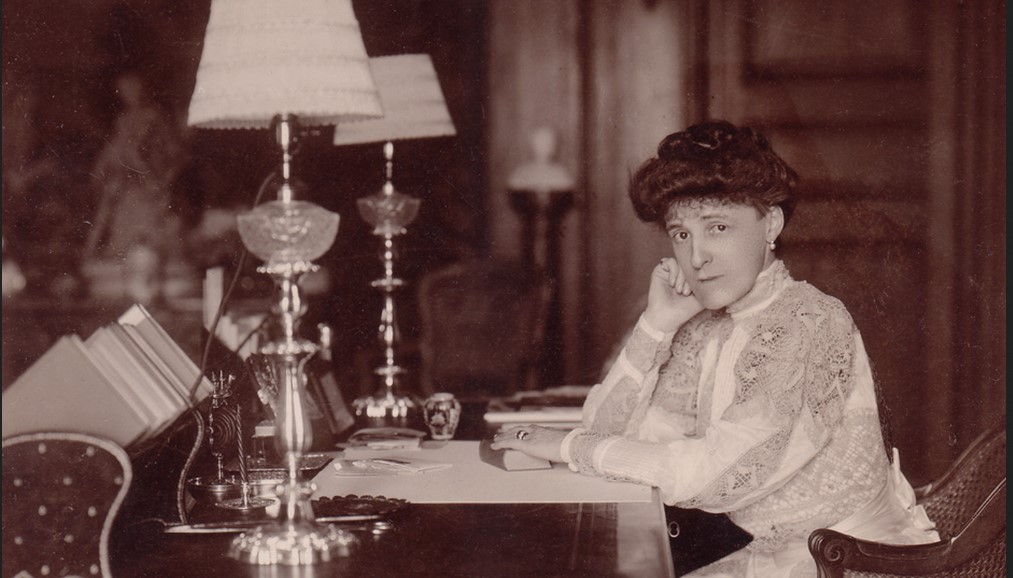
Next Up: Edith Wharton’s The Age of Innocence!

The Gnostic Gospels (Modern Library Nonfiction #72)

(This is the twenty-ninth entry in The Modern Library Nonfiction Challenge, an ambitious project to read and write about the Modern Library Nonfiction books from #100 to #1. There is also The Modern Library Reading Challenge, a fiction-based counterpart to this list. Previous entry: James Joyce.)

As I write these words — some eight months before a fateful presidential election threatens to steer my nation into a theocratic hellscape that will permanently erode many of the liberties and freedoms I have been humbled to partake in for cnearly fifty years — the tireless researchers at PRII inform me that Christian nationalism has substantive support in all fifty states (with the exception of California, New York, and Virginia — in which 75% remain skeptics or outright reject it), the Pew Research Center reports that 45% of Americans believe that our democratic republic should be “a Christian nation,” and 55% of Latino Protestants support Christian nationalism. Blind zealotry, even with white supremacy mixed into the sickening formula, comes in many colors.

Undoubtedly, many of these hayseed fanatics are easily manipulated and illiterate. They conveniently overlook the “love thy neighbor” ethos from Western civilization’s best known zombie in favor of a greater affinity for the limitless imbecility of zealous violence and tyranny, falsely believing themselves to be misunderstood rebels living in a new Roman Empire — this as the very institutional framework continues to uphold their right to yap and bellow in hateful and discriminatory terms as they line the pockets of wealthy telegenic carpetbaggers like Joel Osteen. They lead campaigns to ban books and to deracinate vital areas of knowledge from schools which offend their delicate and autocratically vanilla sensibilities. While the Book of Luke informs us that Christ asked us to “love and pray for our enemies,” you will find these unremarkable lemmings keeping their traps shut as trans kids commit suicide or another maniac massacres dozens in the week’s latest mass shooting. (Unable to summon true comity for anyone who deviates from their ugly and crudely formed politics, right-wing statesmen have substituted “love” for “thoughts,” presumably so they can show up to church on Sunday with a “clean” Christian conscience — even though they do nothing to curb this malignant cancer and care no more for these victims than any garden-variety sociopath.)

It has frequently been observed that atheists like myself know the Bible better than these monomoniacal morons. I have often been surprised by how easy it is to thoroughly rebut some born-again loser based on a singular reading of the King James more than twenty years ago and my apparent recall of specific passages that are well outside the soft and useless hippocampi of my hopelessly dim opponents. It never occurs to Christians to question their faith or even to comprehend (much less read) the very words they purport to uphold in their everyday living. And it certainly wouldn’t occur to them to consider that, much like any moment in history, the narrative and the very belief structure upholding this nonsense was written by the winners, by those who spent the majority of their lives silencing (and even murdering) anyone who offered perfectly reasonable questions about a man who rose from the dead.

Elaine Pagels’s excellent book, The Gnostic Gospels, is an equitable study of the many Gnostic sects that dared to question the Christian status quo. Indeed, had not the 52 treatises been discovered in Nag Hammadi in 1945, there is a good chance that many of us who tirelessly call out bullshit on all fronts would have lacked a far more seminal faith than one in Christ — namely, a boundless pride in our ancestors practicing the vital art of critical thinking.

The orthodox position of the Resurrection, as defined by Tertullian, is quite clear. Jesus Christ rose from the dead with full corporeal gusto. It was “this flesh, suffused with blood, built up with bones, interwoven with nerves, entwined with veins” (one might add “consummated with claptrap” and “molded with malarkey” to this laundry list). Tertullian further adds, “it must be believed, because it is absurd!” And, look, I’d like to believe in kaiju secretly emerging from the oceans to stomp on every megachurch from here to Alpharetta, Georgia, but I have confined my love for absurdity to my deviant imagination and my performative antics on TikTok.

What’s especially astonishing about Tertullian is how literal he is. The New Testament is ripe with stories in which Jesus’s disciples are invited to prod and touch the newly reanimated corpse. (There is curiously nothing in the Bible in which anyone asks Jesus about why he doesn’t carry the pungent smell of the dead or how the bearded wonder managed to rid himself of all the maggots gnawing at his decaying flesh.) And yet Pagels points out that not every story within the New Testament aligns with Tertullian’s “my way or the highway” interpretation of full-fledged concrete return. Acts 9:3-4 informs us that Christ’s Resurrection is merely “a light from heaven” with a voice. Acts 22:9 even points out that some observed the light, but ‘heard not the voice that spake to me.” And if that’s the case, would Tertullian have declared the Apostles heretics? In Acts, Christ’s “return” sounds very much like a low-rent Vegas act without a PA system.

And that’s just in the Bible, folks! I haven’t even snapped my fingers to summon the Gnostics on stage. Depending upon what part of the Bible you read, it is either Peter or Mary Magdalene who first sees Christ rise from the dead. Paul tells us that Christ said hello to five hundred people all at once. And if we take that literally, any of us could now do the same thing on social media. Pagels informs us that from the second century onward, “orthodox churches developed the view that only certain resurrection appearances actually conferred authority on those who received them.” And just like that, the manner in which you contend with Christ’s reappearance isn’t all that different from telling the right story to some bouncer on a Saturday night to slip past the velvet rope!

Believe in the power of this two-bit magician and the terms of the deal, as set up by Luke, are as follows: Christ returned from the dead, walked the earth for forty days, and then rose to the heavens in a bright coruscating light. This may not have the razzle-dazzle of Cirque du Soleil, but it is a belief that has nevertheless been swallowed whole and without question by generations of gullible rubes.

The Gnostics were the first to call this “the faith of fools.” In The Acts of John, one of the rare Gnostic texts that survived before Nag Hammadi in fragmented form, John offers the completely reasonable argument that, because Christ did not leave any footprints, he could not possibly be human, but spiritual. The Gnostics clearly had a more sophisticated interpretation of the Resurrection: it was not the literal observation of Christ’s Resurrection that counted, but the spiritual meaning behind it. But the underlying facts didn’t matter nearly as much as winning over the authorities who conferred you with a position of trust:

Consider the political implications of the Gospel of Mary: Peter and Andrew, here representing the leaders of the orthodox group, accuse Mary — the gnostic — of pretending to have seen the Lord in order to justify the strange ideas, fictions, and lies she invents and attributes to divine inspiration. Mary lacks the proper credentials for leadership, from the orthodox viewpoint: she is not one of the ‘twelve.’ But as Mary stands up to Peter, so the gnostics who take her as their prototype challenge the authority of those priests and bishops who claim to be Peter’s successors.

It thus became necessary for the Gnostics to expand authority to those who stood outside the Twelve. Some Gnostics were generous enough to ascribe VIP treatment to the Disciples, claiming that they had received the kind of custom vision that is a bit like the gift you receive nine months after you donate to a Kickstarter campaign. But as you can imagine, all this resulted in many elbowing their way into a vicious power grab over which interpretation of the Resurrection represented the “true” belief. And there was another important consideration. If Christ himself served as the truest source of spiritual authority, who then would be the authority in the years after his crucifixion and his “Hey there, baby!” sojurn from the great beyond?

The more bellicose strains of Christianity continue to endure in large part because a belief in Christ conveniently allows you to disguise your own sinister lunges for power. Enter Pope Clement I, who was arguably the first significantly ruthless monster who saw an opportunity. Clement insisted that, in the absence of his august presence, God delegates his authority to the “rulers and leaders on earth.” Naturally, these “rulers and leaders” were bishops, deacons, and priests. And if you didn’t bend at the knee to these sham practitioners, then Clement stated, with his great gift for speaking without nuance, that you would receive the death penalty.

Of course, this raises the question of whom you can trust within the church: an issue that has become evermore important given the decades of sexual abuse carried out by men of the cloth within the Catholic Church. A bloodthirsty fellow by the name of Irenaeus succeeded in widening the divide between orthodoxy and the Gnostics by suggesting that any interpretation existing outside Clement’s stern terms was not only heretical, but originated from Satan himself, thus paving the way for Christians to denounce any belief or behavior they disagreed with as “Satanic” over the next two thousand years. Over the years, they proceeded to execute innocent women in Salem and imagine Satanic messages in records.

These developments spelled trouble for the poor Gnostics. Within a few centuries, their texts were buried and destroyed. Their reasonable questions and liberal interpretations became casus belli to string them up. The Christians had the good sense to market themselves as victims persecuted by the Roman Empire and they began to realize sometime in the second century that pointing out how Christians suffered was a great draw for new acolytes. (Eighteen centuries later, Israel would employ the same tactic: use the suffering from the Holocaust to recruit Zionists, where they could then justify the seizure of Palestinian land and the mass-murdering of children on the Gaza Strip.) All this is a pity. Because the Gnostics were often far more interesting in their radicalism and their creative liturgical analysis than what we find in the so-called Holy Book. Consider The Gospel of Philip‘s inventive spin on the virgin birth. How can the Spirit be both Virgin and Mother? By a union between the Father of All and the Holy Spirit. And unlike the Christians, The Gospel of Peter ascribed a third quality to the Divine Mother (the first two being the Silence and the Holy Spirit): Wisdom, clearly delineated as a feminine power.

It is a testament to Christianity’s enduring evil that few people listen to the Gnostics in the twenty-first century. But if their reasonable transposition of literal interpretation to metaphor had become the more dominant text, it is quite possible that the millions of nonbelievers who died during the Crusades might have survived and that the present plague of Christian nationalism, which remains highly dangerous and ubiquitous in our dystopian epoch, might have nestled into the less injurious category of “optional only.”

{Next Up! William H. McNeill’s The Rise of the West!)

The Moviegoer (Modern Library #60)

(This is the forty-first entry in The Modern Library Reading Challenge, an ambitious project to read the entire Modern Library from #100 to #1. Previous entry: Death Comes for the Archbishop.)

There are many go-nowhere men like Walker Percy’s Jack “Binx” Bolling in American life: the type who creates nothing and who lives like some vaguely seedy salesman overly concerned with easy comities and sartorial aesthetics, the quasi-urbane man who, at his worst, is so terrified of even remotely staining his choppers that he slurps nothing but colorless sugar-free smoothies for breakfast, lunch, and dinner. I can’t say that I’ve wanted to spend a day (much less a life) like this. I am too much of a creative, feverishly curious, and pro-active man with a formidable work ethic and a great brio for life (and all of its attendant messes) to do so, but I do have my moments when I feel the draw to lie in bed for hours and listen to the beautiful rap of rain against my window pane, which is certainly a more human pastime than sucking on the cheap glass teats of television and being extremely online. Then I come to my senses and realize that I do need to make something that day, with the fulsome freedom of not needing approbation, so that I can sleep better at night and feel some self-respect — a drive for independence and authenticity that is decreasingly shared by my fellow Americans as the apocalyptic headlines lull many formidable workhorses into permanent or partial fatigue. I don’t blame anyone for slumming it. This is an exhausting asceticism for anyone to practice and the prolificity that results from my febrile commitment is probably one reason why some people fear me.

But poor Binx Bolling has nothing like that, which is why I find him so interesting and why I find Walker Percy’s The Moviegoer to be more weirdly meaningful with each fresh reeread. Absent of any real purpose, Bolling spends much of this plotless novel trying to shoehorn his rudderless life into something, particularly a “search,” which is not really a search for anything. He seems unwilling to ride or die with unconscious instinct, with the sheer enjoyment of being alive. (Typical of Bolling, he has no allegiance. At one point, he even declares himself “Jewish by instinct.”) He recognizes that instinct is something that people possess, but that doesn’t seem enough for him:

At the great moments of life — success, failure, marriage, death— our kind of folks have always possessed a native instinct for behavior, a natural piety or grace, I don’t mind calling it. Whatever else we did or failed to do, we always had that. I’ll make you a little confession. I am not ashamed to use the word class. I will also plead guilty to another charge. The charge is that people belonging to my class think they’re better than other people. You’re damn right we’re better. We’re better because we do not shirk our obligations either to ourselves or to others. We do not whine. We do not organize a minority group and blackmail the government. We do not prize mediocrity for mediocrity’s sake…Our civilization has achieved a distinction of sorts. It will be remembered not for its technology nor even its wars but for its novel ethos. Ours is the only civilization in history which has enshrined mediocrity as its national ideal.

But is this really so “better”? This is fairly similar to Holden Caulfield’s insufferable kvetching, except that it is far more fascinating because Bolling, unlike Caulfield, is more actively self-aware and constantly observant of others. He chooses to think and feel this way. It is what I call the “fuck my life” look that you see on people’s faces after they have given up on any dreams after the age of forty.

While the Binx Bollings of our world are capable of a few spontaneous decisions and may possess some cultural tastes and perhaps a soupçon of passion, they differ from the “slacker” types that Richard Linklater rightfully celebrated in his wonderful 1991 film in that exuberance is often absent and there isn’t an unusual nobility or even an ethos to their indolence. (And I would contend that Bollling’s “novel ethos” is a false one. For he says this when he has nothing in particular he is striving for. And those who strive for something rarely have a mediocre ideal in mind.)

The Binx Bollings simply live and that’s about it. They are, in short, working stiffs and the burden of surviving is often too much to do much more than that. You’ll find them represented in varying shades within Richard Yates’s Revolutionary Road, Richard Ford’s Frank Bascombe books, John Kennedy Toole’s A Confederacy of Dunces, Frederick Exley’s A Fan’s Notes, John P. Marquand’s The Late George Apley, Sam Lipsyte’s Homeland, Richard Russo’s Nobody’s Fool, Stewart O’Nan’s Last Night at the Lobster, and John Williams’s Stoner. And while I have no desire to leave out women in my literary consideration, yes, the fear of becoming “mediocre” or “detached” like this — the natural “evolution” of Dostoevsky’s “Underground Man” or what Colin Wilson unpacked in The Outsider — does seem to be an overwhelmingly male concern. Contemporary novelists as brilliant as Adelle Waldman, Kate Christensen, and Lauren Groff (you should very much read their work too) have also tackled this to great effect, although they are usually more interested in effect rather than cause or state and the vicarious first-person experience is of less importance. Think of the way that the characters in Edith Wharton, Muriel Spark, and Iris Murdoch (all literary queens who I will enthuse about to my dying day!) are so much more alive than the Binx Bolling type. I also can’t help but think of the way Ross McElwee (also a man of the South) brilliantly and vulnerably put himself front and center in such a way with his fascinating series of personal documentaries. Updike, in particular, was one of the foremost literary Johns drawn to these men and he nimbly spoke to American readers who recognized the telltale cadences of Durkheimian anomie.

Which is not to negate the quotidian struggles of the Binx Bollings. The miracle of Percy’s novel is that we’re still with him on his journey despite all this. Still, it often never occurs to these types to pay attention to the “beloved father” or “husband of X” found so ubiquitously on tombstones, which matters so much more than the roll of a Taylorist scroll memorializing an endless concatenation of checked off tasks. The worst of these aimless men possess no sense of humor and somehow transform into a homely insectoid creature worse than anything that ever bolted upward from Kafka’s imagination, a listless monstrosity commonly referred to as a “critic.” The critic, who is often a cretin, is a pitiful and unsmiling quadraped incapable of expressing joy, much less stridulating his legs together to make a pleasant sound in springtime.

And while we’re on the subject of bugs, as it so happens, there is a cameo appearance from a coterie of creepy-crawlies in Walker Percy’s The Moviegoer that saunter right past our malaise-fueled man Binx: “They dive and utter their thrumming skonk-skonk and go sculling up into the bright upper air.” Percy’s emphasis on sounds and gerunds here really says it all. That same whirlydirsh language is often beyond poor Binx.

* * *

The source for Boiling — as well as Williston Barrett, a Percy protagonist who would be explored in two stages of life (youthful folly and middle age) in, respectively, The Last Gentleman and The Second Coming) — was Percy’s essay “The Man on the Train” (collected in The Message in the Bottle) — in which Percy firmly established the type of protagonist he was interested in writing about:

There is no such thing, strictly speaking, as a literature of alienation. In the re-presenting of alienation the category is reserved and becomes something entirely different. There is a great deal of difference between an alienated commuter riding a train and this same commuter reading a book about an alienated commuter riding a train….The nonreading commuter exists in true alienation, which is unspeakable; the reading commuter rejoices in the speakability of his alienation and in the new triple alliance of himself, the alienated character, and the author. His mood is affirmatory and glad: Yes! that is how it is! — which is an aesthetic reversal of alienation.

In other words, Percy could not bring himself to write about a character in unbearable despair (it is not an artistic focus for the faint of heart) — largely because his natural writing voice is driven by a fine comedic impetus, with the Catholic novelist’s concern for philosophy planting one foot in the wings and the other on stage. (Look no further than Antonia White, Gene Wolfe, and Graham Greene for similarly intriguing juxtapositions.) Much like Richard Linklater’s “slacker” archetype, Percy seeks to pursue the bare minimum of alienation, although, as can be seen with Dr. Thomas More in Love in the Ruins, Percy’s characters are more eggs-in-one-basket types (in More’s case, the Ontological Lapsometer that he sees as a decaying society’s cure-all) and less committed to the free-floating spontaneity of hitching a ride with strangers, taking the entire day to assemble an elaborate rock structure to represent femininity, or being interviewed for a film student’s documentary.

At this point, the gusto-driven reader may rightfully ask, “So why read about this?” For the same reason that we read about any “unlikable” character. This is a form of living, albeit while clutching the bottom of one’s hemp, that is part of the human experience. The eccentric film journalist Jeffrey Wells has recently suggested that the criteria of art (specifically movies) involves being put into “a kind of alternate-reality mescaline dream state.” And while escapism is certainly a dopamine-fueled pastime practiced by a population increasingly hostile to pleasurable cerebration, requiring little of the mind but an uncritical blank slate and a sybarite’s zeal for incessant orgasm, what of the wisdom picked up from raw human experience? Art gives us the advantage of having access to the interior thoughts and feelings of those we may be disinclined to meet in the here and now. Wells’s limited definition therefore nullifies Jonathan Glazer’s excellent film adaptation of Martin Amis’s novel, The Zone of Interest, which is nothing less than a vital and deeply horrifying atmospheric experience warning us of the shockingly pedestrian character of fascism, which is dangerously close to permanently destroying the very fabric of this bountiful nation should the Orange Menace emerge victorious in November.

Likewise, Walker Percy’s masterpiece is a similar (if less baleful) cautionary tale of what it means to coast and how commitment to something (or, in Bolling’s case, someone) represents the inevitable reckoning that anyone is fated to face at one point or another. It is a sneaky warning to anyone with true fuck-it-all drive that even the dreamer faces the risk of slipping into adamantine complacency and is ill-equipped to gently pluck a rose from the carefully maintained bush planted atop a Sisyphean alp.

The New Yorker‘s Paul Elie has smartly observed that The Moviegoer is curiously ahistorical: less taken with unpacking the neverending residue of the Civil War, racial tension, or other hallmarks found prodigiously within typical Southern fiction. The novel is also, by its own prefatory admission, an inexact version of New Orleans: far from meticulously recreated like Joyce’s Dublin, though not entirely fabulist.

But I do think Elie is a tad too dismissive of Southern inventiveness to suggest that Percy mined exclusively from the European existentialists to summon his vision of the unlived and shakily examined life — even though the debt to Kierkegaard is obvious in The Moviegoer (and in “The Man on the Train”), not just because of the opening epigraph:

As for my search, I have not the inclination to say much on the subject. For one thing, I have not the authority, as the great Danish philosopher declared, to speak of such matters in any way other than the edifying. For another thing, it is not open to me even to be edifying, since the time is later than his, much too late to edify or do much of anything except plant a foot in the right place as opportunity presents itself – if indeed asskicking is properly distinguished from edification.

But what is this search? I strongly recommend Rose Engler’s smart unpacking, which eloquently outlines the religious component that was dear to Percy, but there is something intriguingly postmodern about it. One of Percy’s early reviewers — Edwin Kennebeck in Commonweal — believed that The Moviegoer entailed a search not merely for meaning, but for something beyond despair. And there is something to this, given how Bolling categorizes the search early on as “what anyone would undertake if he were not sunk in the everydayness of his own life.” The movies that Bolling regularly watches do not present a true search. And, for Bolling, it can be argued that his search involves doing everything possible to avoid that search, even though he knows inherently that he must search. Denied definitive time and space by Percy, Bolling splits up his search into horizontal and vertical ones, framed without any proper construct from Eddington’s The Expanding Universe. He complains of his family not understanding his search. He searches for a starting point by scribbling in a notebook and, after all this “effort,” tells us, “The search has spoiled the pleasure of my tidy and ingenious life in Gentilly.”

Kenneback pinpointed, quite rightly, that Bolling’s decision to marry Kate represented “a search ended and an ordeal begun.” Belonging then, which most of us crave for and which Bolling is not especially good at, represents the cruel gauntlet thrown down by the universe. Bolling tells us, “Show me a nice Jose cheering up an old lady and I’ll show you two people existing in despair.” He believes that Kate sustains a look of being serious, “which is not seriousness at all but despair masquerading as seriousness.”

Perhaps we’re all pretending in one way or another as we saunter about this mortal coil. But the tragedy of Binx Bolling is that, even with his apparent religious conversion, he cannot seem to accept life at face value. But he is not the only one suffering. Kate has this to say:

“Have you ever noticed that only in time of illness or disaster or death are people real? I remember at the time of the wreck — people were so kind and helpful and solid. Everyone pretended that our lives until that moment had been every bit as real as the moment itself and that the future must be real too, when the truth was that our reality had been purchased only by Lyell’s death. In another hour or so we had all faded out again and gone our dim ways.”

If our presence here is indeed ephemeral, should this not provide greater motive to connect and to find joy? The Catholic mind, and thus the Catholic novel, is not without its involutions and contradictions.

Next Up: Max Beerbohm’s Zuleika Dobson!

Death Comes for the Archbishop (Modern Library #61)

(This is the fortieth entry in The Modern Library Reading Challenge, an ambitious project to read the entire Modern Library from #100 to #1. Previous entry: From Here to Eternity.)

Most of the largely sexist pigs who came up with the Modern Library canon were ancient men more fond of oinking and logrolling rather than upholding literary standards. (There was only one woman among these judges: to evoke a recent Marc Maron bit, “It was a different time”).

Most of these judges are now dead. Just as the regressive viewpoints they tapped within their 20th century hearts are now mostly pushing up the daisies. (Thank you, #metoo movement!) Oddball Christopher Cerf is the only judge still alive and I invite him to verbal pistols at dawn (or perhaps, more accurately, a feisty reckoning over a cup of morning tea) if he wants to respond to the list’s hideous gender imbalance. The remaining judiciary corpses include Gore Vidal (dead, past his prime in ’98), Daniel J. Boorstin (dead, past his prime in ’98), Shelby Foote (dead, covert Confederacy apologist, we’ll be getting to him in a few years, past his prime in ’98), Vartan Gregorian (dead, but, from all reports, a decent dude), A.S. Byatt (GOAT, literally just died in November, should have pushed back harder against these testosterone-charged fossils, being a Willa Cather fan seems to be her only fault), Edmund Morris (dead, past his prime in ’98 and about to destroy his career with Dutch), John Richardson (dead, past his prime in ’98), Arthur M. Schlesinger Jr. (dead, past his prime in ’98), and William Styron (dead, perilously close to being done in ’98, but dammit he at least gave us Darkness Visible, which was rightly included on the Modern Library nonfiction list).

Anyway, it says a great deal about the casual misogyny of these then doddering judges that a hopeless and unremarkable square like Willa Cather (the kind of teeming bore that other teeming bores genuflect to) somehow secured a much higher slot than such indisputable virtuosos as Iris Murdoch, Jean Rhys, and Muriel Spark. It says a great deal that Willa “Cream Corn” Cather — a plodding rustic rube without a soupçon of edge who wrote sentences so loathsome that, only ten minutes after reading an especially awful exemplar, I sprout wings from my back, descend with my fangs upon innocents in Manhattan, and destroy random chevron-studded façades and angelic statuary mounted on art deco skyscrapers hundreds of feet above the streets (if you Google around, you’ll find TikToks out there depicting my frightening transmutation; it is a display that is not for the faint of heart) — is apparently more worthy of commendation than Toni Morrison, Margaret Atwood, Flannery O’Connor, Octavia Butler, Angela Carter, Zora Neale Hurston, Jane Bowles, Ursula K. Le Guin, or Harper Lee, who were all denied a single spot on the list.

In 1998, did the Modern Library Judges fear what was then called an “outspoken” woman? Did they wish to consign “innovation” solely to men? Were they unsettled by the many waves of feminism? Did they try to argue that an insufferable reactionary goody little two-shoes like Cather was a feminist because she exposed spousal discontent through only the barest minimum amount of effort (see Alexandra in My Ántonia; if you think that’s a “radical” depiction of what women had to go through, I’ve got a bridge I can sell you here in Brooklyn) and because she was a closeted lesbian (even as she was tearing down other women of letters privately and publicly)?

At this point, we’ll probably never know. The likeliest scenario is that Cerf will stay mum and take the problematic history of these internal discussions to the grave. And let’s face the facts: the dude wouldn’t meet me for tea even if I whipped up a fun electro cover of one of his two hundred plus compositions for Sesame Street. (Yo, Chris, I’ve got terabytes of samples on my desktop! If a goofy emo punk version of “Monster in the Mirror” whipped up on my synth over the weekend will get you to cough up about this regrettable state of affairs, then I’ll do it! Seriously, that “wubba wubba wubba wubba woo woo woo” just begs to be rasped out in the manner similar to the late Can singer Damo Suzuki.)

The wondrous Dame Hermione Lee, who remains one of our greatest living literary scholars, has written a solid and truly admirable bio advocating for Cather. And while I appreciated Lee’s volume in much the same way that I will always stump for Carl Wilson’s Let’s Talk About Love, which reckons with the question on why so many people love Celine Dion, make no mistake: I consider anyone willing to go to the mat for Willa Cather to be some terminally unhip rooster without a shred of literary taste, the kind of unadventurous sod who would invite suicidal thoughts if you got cornered by him at a cocktail party. Lee gets special dispensation from me because she’s awesome — in large part because she wrote an invaluable Edith Wharton book (and I am, of course, crazy about Wharton). In fact, in quoting a passage from One of Ours that described junk, Lee identified a possible class-based literary divide between people like me who detest Cather and certain frou-frou bourgie types who think that she’s the cat’s pajamas (Christian Lander, you were so asleep at the wheel on the Cather front when you ran your excellent satirical blog!):

There is a hint that junk, once it starts ageing into antiques, might be seductive (an American writer with more entropic tendencies, like Nathanael West or Thomas Pynchon, would have loved that cellar) but, more often, junk is just pitiful, like the debris of Claude’s marital house: ‘How inherently mournful and ugly such objects were, when the feeling that had made them precious no longer existed!’ [OOO, p. 223] When Claude comes to the ‘dump-heap’ of the French battlefields, he has already been living in a civilization (Cather suggests) which has not needed a war to turn itself into rubbish.

You have to love that “Cather suggests” parenthetical that Lee drops into this cogent analysis. (Don’t worry, Hermione! We cool! I have Quincy Jones’s wonderful Sanford and Son theme playing in the back as I write this paragraph!) I guess you could say that I’m one of those readers who is more drawn to authors with “entropic tendencies.” I believe you can find beauty in damned near anything. Including junk. But Cather, despite stumping for the heartland, is more of a rebuking prude who never earned the right to be a snob. She’d rather throw out the junk and align herself with the sanitarium/cornflakes crowd: you know, the alternative medicine quacks sent up decades later in T.C. Boyle’s The Road to Wellville. I know you whipper-snappers are keeping up with me in our age of conspiracy theories, rampant cognitive decline, and unfounded character assassination on social media. Or at least I hope you are!

There’s also the question of whether Cather’s “literary sensibilities” can be entirely trusted. Of The Awakening, Cather had the audacity to write, “I shall not attempt to say why Miss Chopin has devoted so exquisite and sensitive, well-governed a style to so trite and sordid a theme.” One might say the same of a hopeless stiff like Cather herself, though she does not possess anything especially exquisite in her early works beyond country bumpkin exclamation marks. She condemned Mark Twain — arguably the greatest wit that American letters has ever produced — as a man of “limited mentality” and “neither a scholar, a reader or a man of letters and very little of a gentleman.”

Yes, I realize that all this was written in the nineteenth century and it is incredibly absurd to pick a fight with somebody who has been dead for nearly eight decades. But I’m telling you. After reading far more Cather than I needed to for this essay, I had actual nightmares about Cather strangling me while laughing in a menacing high-pitched titter. These dreams were so terrifying that I would not even wish them on my worst enemy. And if I have to write about this mediocre and humorless nitwit from Nebraska because she’s on this goddamned Modern Library list, well, in the immortal words of Bugs Bunny, them’s fighting words.

Let’s take a look at some of the trite and treacly bullshit that Cather was banging out when she rolled out the howitzers against these legends.

From “Paul’s Case”:

The young man was relating how his chief, now cruising in the Mediterranean, kept in touch with all the details of the business, arranging his office hours on his yacht just as though he were home, and “knocking off work enough to keep two stenographers busy.”

Note the redundancies here (“cruising in the Mediterranean” and “arranging his office hours on his yacht”). Even an oft prolix mofo like me recognizes this sentence as interminably long, presumably extended to cash in on the word rate.

Or how about this overwritten nonsense from “The Sculptor’s Funeral”?

The grating sound made by the casket, as it was drawn from the hearse, was answered by a scream from the house; the front door was wrenched open, and a tall, corpulent woman rushed out bareheaded into the snow and flung herself upon the coffin, shrieking: “My boy, my boy! And this is how you’ve come home to me!”

I’m very forgiving of melodrama in fiction, but this is unpardonable corn pudding with an objectively disagreeable sweetness that would be rightly laughed out of any MFA workshop today. The sequence of events here is all wrong. “Drawn from the hearse”? Well, where else would the casket come from? Some giant descending from the heavens? The attempt here to create poignant emotion falls flat with this overwrought dialogue. “My boy” was enough. But we get two in a row, followed by the kind of awful expository dialogue I go out of my way to avoid as a radio dramatist.

And then I read the soul-destroying novels. O Pioneers! was a vicious slog. The Song of the Lark — with its hideous reactionary parochialism and its incessant reliance upon gossip — will have you howling at the ceiling over how stiff and superficial it is. And My Ántonia? You’d honestly be better off spending your time listening to The Knack’s “My Sharona” on repeat for six hours.

Which finally brings us to Death Come for the Archbishop after a lot of throat-clearing. (Look, I’m trying to have fun here. My Cather deep dive was a deeply unpleasant reading experience!)

The common narrative propped up by Cather’s fusty and foolish boosters is that, much like Robert Johnson meeting the Devil, Cather went down to the Southwest (particularly Santa Fe) in the summer of 1925 and came back “reborn” with a renewed “sensitivity” for other cultures. But this, of course, is a lie. And it certainly doesn’t explain why Cather, much like a hopped up Zionist airhead denying Israel’s genocidal complicity, didn’t glom onto the indigenous people who lived in the region, but chose to fixate on the Christian authorities who longed to convert them.

I can see the Cather acolytes arriving at this point in my essay, suggesting that I have deliberately misread Death, which is oh so “sympathetic” to the indigenous people of New Mexico. But at what cost? Depicting Mexicans as noble savages? Emily of It Was Evening All Afternoon arrived at a similar conclusion in 2009. So did Kali Fajardo-Anstine over at LitHub. But why not just go straight to the text to see how docile and obliging the locals are?

When this strange yellow boy played it, there was softness and languor in the wire strings—but there was also a kind of madness; the recklessness, the call of wild countries which all these men had felt and followed in one way or another. Through clouds of cigar smoke, the scout and the soldiers, the Mexican rancheros and the priests, sat silently watching the bent head and crouching shoulders of the banjo player, and his seesawing yellow hand, which sometimes lost all form and became a mere whirl of matter in motion, like a patch of sand-storm.

A strong argument can be made that Cather was a white supremacist, particularly given her treatment of non-white characters in her odious final novel, Sapphira and the Slave Girl, which features hideous Black caricatures in the form of Bluebell and Lizzie. In an October 14, 1940 letter to Dorothy Canfield Fisher available at the online Willa Cather Archive (I am greatly indebted to Hermione Lee for her endnote), Cather wrote:

I loved especially playing with the darkey speech, which was deep down in my mind exactly like phonograph records. I could remember exactly what they said and the quality of the voice. Just wait till our wise young reviewers, such as Clifton and Louis, sadly call attention to the inconsistency in Till’s and Nancy’s speech,- never knowing that all well trained house servants spoke two languages: one with white people and one with their fellow negroes.

I hope this blatant racism and this boorish boasting helps you to understand why I have felt morally obliged to ratchet up the rage.

When Cather was at work on Death, a Cleveland Press reporter asked her what it was about. She replied, “America works on my mind like light on a photographic plate.” Jesus Christ, could you be any more pretentious? (Hermione Lee informs us that Cather, when making a trip to a writer’s colony as Death squeaked out of her precious mind, was “not remembered for her conviviality.” Which is a gentle way of telling us that Cather was completely fucking insufferable.)

To give Willa the Imperialist Prig some credit, I will say that Death Comes for the Archbishop is slightly better than the early turgid works, although that’s a bit like saying that the Limburger with the least amount of mold that you pick up from the charcuterie plate — you know, that stinky piece you nibble at out of politeness at a party simply because the poor host is blind and she had no idea that she was paring pieces from ancient heads that had been sitting in the fridge since the Clinton Administration — is the bomb.

Death opens with three cardinals and a bishop “talking business” about establishing a new vicarite in New Mexico, which Cather with full colonialist glee tells us is “a part of America recently annexed to the United States.” Bishop Ferrand, the missionary who headed out to the Old West, is ancient and weather-beaten and describes the desolate and fissure-ridden landscape for which these vaguely sinister religious mobsters hope to open up a franchise.

Jean Marie Latour, a thirty-five-year-old naif from Lake Ontario, is enlisted to be the point man converting all the Mexcians and the indigenous people who live in the region. And after these men of the cloth scoff over Latour’s intelligence (or lack thereof), Cather cuts to 1851, where Latour is on his way to Santa Fe. Cather does a decent job describing the limitless “uniform red hills” that Latour takes in on his journey. And there is a modicum of grit in this early chapter that, while a far cry from the satisfying description of Cormac McCarthy at his best, I largely enjoyed.

Unfortunately, after this promising start, my interest waned significantly when Latour began whining about not packing enough water for his journey and losing all of his possessions other than his books. It’s safe that Latour is a far cry from Chaucer’s many priests, G.K. Chesterton’s Father Brown, or even Father John from M*A*S*H. He reveals himself quite rapidly to be an insufferable little shit and I started feeling sorry for Father Joseph Vaillant, Latour’s boyhood friend who accompanies him on the journey to Santa Fe. On the other hand, if you’re friends with a pompous windbag like Latour, then you probably deserve your shared misfortune.

As Father Latour is taken in by some locals, he finds a strange peace in the “bareness and simplicity” of the settlement. He quickly occupies space in a quietly domineering way and listens to the “simple” life stories of these people. I couldn’t help but wonder why a religious man like Latour was so ungrateful, but then I remembered how Cather herself hadn’t exactly been gracious to the many writers who tried to help her. Maybe the fact that Death can be read as a critique of religious imperialism is largely an accident.

Latour starts bragging about how great Americans are. You know, those white people who swooped in and destroyed the Mexican churches and stripped these good people of their religion? Those colonial assholes? They’re great, aren’t they? And, of course, Cather, by way of close narration through Latour, cannot feel any empathy for such debasement.

At this point, I began to loathe Latour with all my heart because of his cluelessness and his insensitivity. And I very much hoped that Cather would deliver on the promise of her title well before I was halfway through the book. Latour is very particular about a meal, telling some indigent to serve him a portion without chili because, as a Frenchman, he does “not like high seasoning.”

Not long after this, Latour is setting up his vicarite. And, of course, it’s Vaillant who is assigned to do all the cooking so that Latour can write endless letters in French. The bishop then takes the opportunity to bitch about the soup. Some friend this motherfucker is.

And even though condemning white privilege with this setup is easier than shooting monkeys in a barrel, I’ll give Cather some points for acknowledging hardscrabble reality:

The wiry little priest whose life was to be a succession of mountain ranges, pathless deserts, yawning canyons and swollen rivers, who was to carry the Cross into territories yet unknown and unnamed, who would wear down mules and horses and scouts and stage-drivers, tonight looked apprehensively at his superior and repeated, “No more , Jean. That is far enough.”

I suppose that Cather defenders will defend her belittling of Mexicans by pointing out how Vaillant is described as ugly. Maybe they’ll point to the way that Vaillant and Latour save an old Mexican slave named Sada. But their “help” involves this woman “obeying” the Padre and being ordered to go to church and pray. Sada really doesn’t have any agency other than wanting to return to her religion. And this, quite frankly, is nothing less than an insulting scene of religious tyranny and white privilege. As for the sinister murderer Buck Scales, it says quite a bit about Cather’s dormant xenophobia that his evil is defined equally in terms of interracial marriage: “All white men knew him for a dog and a degenerate—but to Mexican girls, marriage with an American meant coming up in the world. She had married him six years ago, and had been living with him ever since in that wretched house on the Mora trail.”

If you thought Jeanine Cummins was bad, try taking Willa Cather out for a spin. There’s no way I can defend Willa Cather and her repugnant insouciance in 2024. Her prose simply isn’t good enough for me to align myself with Hermione Lee. And I am pleased as punch that I will never have to read this mean and hideous writer ever again.

Next Up: Walker Percy’s The Moviegoer!