Javier Calvo and Mara Faye Lethem both appeared on The Bat Segundo Show #289.
Javier Calvo is the author of Wonderful World. Mara Faye Lethem is the translator.
Condition of Mr. Segundo: Considering the unseen cantaloupe.
Guests: Javier Calvo and Mara Faye Lethem
Subjects Discussed: TK
EXCERPT FROM SHOW:
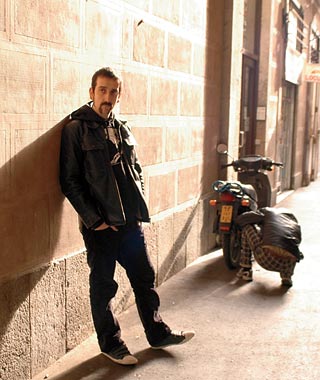 Correspondent: I must ask then, Mara Faye, if you had read any other books to get the idiom right in English for this. Because both your translation of this book [Wonderful World] and your translation of Pandora in the Congo strike me as far more specific. It’s almost as if the translation itself can be placed within a neat, genre-specific feel in the prose. And I’m curious if you do it more intuitively or if you actually do, in fact, try and read books surrounding a particular genre or a particular place it might end up. So that it might be more palatable to the English ear.
Lethem: No, I don’t do that. I don’t think that that would be fair to the author. I work with the text. And much more so than the author. Even if he’s in the room next door. Because there are two very separate things. The voice I try to pull from the text itself, not from any other text. Obviously, if the author is working with references — as in Pandora in the Congo, with adventure stories and things like that — it should come through in the original. And so I really try to be as faithful to that as I can. I think a mistake in translation can involve feeling that you know more than the author. It’s like a trap. You think, “Oh, I know what he’s trying to say here.” But you sometimes have to be able to say, “Okay, I can make this choice for him.” Because there’s choices to be made. Definitely. Sometimes, there’s the perfect word. And sometimes there isn’t. You know, there’s no one word that means that in English. But I try to avoid anticipating the author.
Correspondent: But in this case, what did you do to insulate yourself? Because the author here is in the next room. Did you essentially communicate as minimally or as little as possible with Javier? Or what happened here?
Lethem: Oh well, we communicate a lot.
(A noisy siren momentarily interrupts the conversation.)
Lethem: Often about what we’re going to have for lunch. Or who’s going to pick up our daughter from school.
Calvo: I think that the situation where your wife is your translator and you’re living under the same roof — or your husband is the author you’re translating — is a potential nightmare. So it was good that she didn’t really come to me that much or I wasn’t bothering her. And we had some space between us. It’s very easy too to create a professional distance in a question like that. But yeah, it was very good that we didn’t try and work together. And she only came to me when she had an important question or something like that. Because imagine. I think translating your husband’s work might be a pretty good cause for divorce. Potentially.
BSS #289: Javier Calvo and Mara Faye Lethem (Download MP3)
Listen: Play in new window | Download
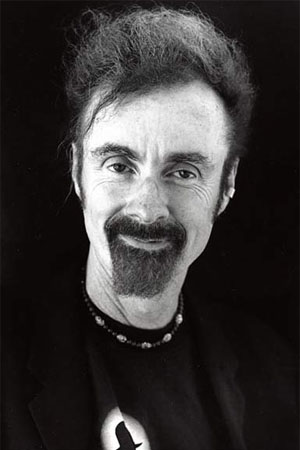 Boyle: I try to get it both ways. I try to involve you in something in a satiric way. And yet it should also move you. And of course, in this book, I had to do that because of the tragedy of Mamah, which will conclude the book. So you have to set the reader up for that throughout. And I think there is tragedy throughout the book. Tadashi’s life is incredibly tragic in many, many regards. So again, I’m playing one element against the other throughout. And there is commentary upon commentary upon commentary. And, for me, it opened up the structure and it made it fun. It made it invigorating. A lot of the footnotes exist to give you information that I would like you to know about Frank Lloyd Wright and his buildings and where he was at any given time. But a lot of them also, I just express surprise on the part of Tadashi. And I find the hilarious.
 Correspondent: How are you wrestling with Whitman exactly?
 Correspondent: I wanted to ask you about the tale of the prodigal son, which of course comes from Luke 15:11. The onus of guilt in that parable, however, falls largely on the son. Specifically, the quote is “Father I have sinned against heaven, and before thee / And am no more worthy to be called they son; make me as one of thy hired servants.” But Jack, he calls his father “Sir.” Not “Dad.” Although there’s a slight discrepancy near the end. He works on the DeSoto of his own accord. He’s often summoned to play on the piano and the like, and also work in the garden. But he’s sometimes an unapologetic sinner. And other times, he drowns his sorrows in alcohol. So the interesting question here about the prodigal son is: The framework of the Scriptures is clearly there in this book, but I’m curious as to when you decided to launch away from that. Likewise, was this actually a starting point? Or was it an intuitive process of trying to obvert what we know about that particular story from Luke?