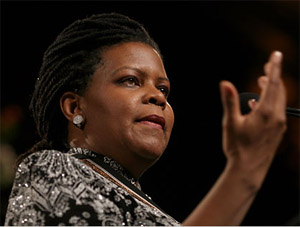
Marilynne Robinson appeared on The Bat Segundo Show #240. Ms. Robinson is most recently the author of Home.
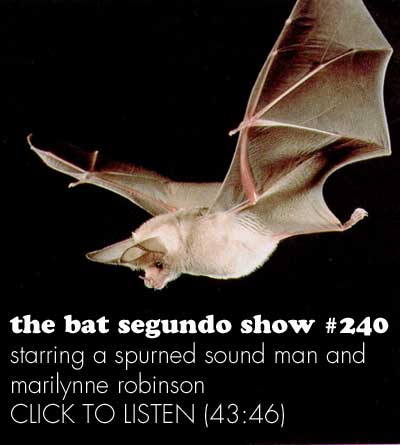
Condition of Mr. Segundo: Avoiding the relationship potential of malfunctioning XLR cables.
Author: Marilynne Robinson
Subjects Discussed: Revisiting the Gilead universe, Lawrence Durrell, Robinson’s aversion to sequels, the parable of the prodigal son, the role of letters and text within Gilead and Home, text as a lively and disturbing realm, affirming identity by chronicling detail, seizing the day, Bob Marley, the depiction of the home in Housekeeping in relation to the vertical landscape, “home” as a value-charged word, listening to vernacular hymns, characters who listen to the radio, music as the great common ground, music and memory, banishing certain words, whacking sentences down, characters and educational background, the advantages of not speaking, circular food in the Boughton household, the virtues of toast, family meals and communion, the frequency of dialogue in Robinson’s novels, the predestination colloquy in Gilead and Home, James Wood’s review, the advantage and limitations of third-person perspective, interpretation vs. living the events, the shifting definition of sin during the 20th century, Iowa and anti-miscegenation laws, the Chrysler DeSoto vs. Hernando De Soto, the Kennedys, secular figures within novels, Jonathan Edwards, hypocrisy and religion, the origins of character names, the role of judgment within family, Das Kapital and Jack’s Marxism, the history of The Nation, the writer-reader relationship, using a BlackBerry, and parody and the contemporary novel.
EXCERPT FROM SHOW:
 Correspondent: I wanted to ask you about the tale of the prodigal son, which of course comes from Luke 15:11. The onus of guilt in that parable, however, falls largely on the son. Specifically, the quote is “Father I have sinned against heaven, and before thee / And am no more worthy to be called they son; make me as one of thy hired servants.” But Jack, he calls his father “Sir.” Not “Dad.” Although there’s a slight discrepancy near the end. He works on the DeSoto of his own accord. He’s often summoned to play on the piano and the like, and also work in the garden. But he’s sometimes an unapologetic sinner. And other times, he drowns his sorrows in alcohol. So the interesting question here about the prodigal son is: The framework of the Scriptures is clearly there in this book, but I’m curious as to when you decided to launch away from that. Likewise, was this actually a starting point? Or was it an intuitive process of trying to obvert what we know about that particular story from Luke?
Robinson: Well, I have a slightly different interpretation of that story than the one that’s generally circulated.
Correspondent: I think so. (laughs)
Robinson: You notice that the prodigal son says, “I am no longer worthy to be called thy son.” But from the father’s point of view, this is never an issue. He doesn’t ask for the son to satisfy any standards of his. He doesn’t ask for confession. He doesn’t ask for some plea for forgiveness. He sees his son coming from a distance and wants to meet him before he knows anything about him, except that he’s his son coming home. And I think that the point of the parable really is grace rather than forgiveness. The fact that the father is always the father. Despite and without conditions. And this is true in Boughton’s case. As far as he concerned, Jack is his son. And that’s the beginning and the end of it. Jack is not able to accept his father’s embrace.
Correspondent: It’s basically approaching a parable or a well-known story from a kind of cockeyed manner. Really, it comes down to this notion of the text as Scripture. I think certainly in Gilead, that was the case. And in this case, you have them throwing away letters. You have, of course, the love letters that are thrown down the drain. The letters that Jack sends out, which come back RETURN TO SENDER. And of course, they’re schlepping off a number of magazines to Ames, who lives down the block. So this is very interesting to me. Whereas the first book dealt explicitly with this idea of text as this panacea for loneliness, this book deals with disseminating the text out to other people, or getting rid of text. Which is why I ask the question as to how this relates to Scripture. Is text really something for us to cling onto in this? Whether it be a book or whether it be the Bible? Whether it be religious or literary or what not, there are matters of interpretation in life that go well beyond text and well beyond the idea of fulfilling this need to cure loneliness.
Robinson: Well, I think of text — by the analogy to Scripture that you’re making — I think of it is as something that is lively and disturbing. Disruptive. I mean, for example, say that Ames’s best hopes are met and his son receives the voice of his father when his son is an adult, that would completely jar the sense of memory, the sense of proximity to another human person, and all kinds of things that we think we understand. The letters that come to Jack and the letters that don’t come to him — they’re central. They’re alive, even though they are profoundly problematic. And I think of, in a way, text and Scripture as active in that way. As a sort of eccentric presence in human experience.
BSS #240: Marilynne Robinson (Download MP3)
This text will be replaced
Listen: Play in new window | Download

 Correspondent: How are you wrestling with Whitman exactly?