(This is the forty-third entry in The Modern Library Reading Challenge, an ambitious project to read the entire Modern Library from #100 to #1. Previous entry: Zuleika Dobson.)
Newland Archer — the “hero” of Edith Wharton’s most celebrated novel (and the first book written by a woman to win the Pulitzer Prize) — is the 1870s answer to some privileged techbro half-heartedly trading crypto out of some Sand Hill Road office rental split with an AI slop merchant, leaving the finer details of regular cash flow to a hungrier underling living paycheck to paycheck. Yes, he’s a lawyer, although we never see him drafting a brief or appearing in court. (He does review “unwelcome documents,” the Mingotts ask him to persuade Ellen Olenska to talk her out of a divorce, and there is an off-stage lawsuit mentioned near the end of the book, but that’s about it.)
He has everything and more. If you ran into him today, he’d probably be bragging about his kitchen renovation or his Duolingo streak. Fortunately, he is confined to the atmospheric pages of Wharton’s novel, where we witness Newland attending friendly parties at Highbank and living in that dreaded conformist manner that even Emerson associated with the living dead in “Self-Reliance.” He has boxes containing the newest books. Yet all this privilege is just not enough for this foppish and artless staple slacking in nigh high society just before Gotham became the center of the universe. Oh sure, he’s got a fetching fiancée named May Welland who is nearly as vapid as he is (until she comes touchingly alive with an act of genuinely moving generosity during one particularly poignant moment halfway through the book, which naturally made me abhor Newland more). May has a cousin named Countess Ellen Olenska, a hot piece of ass who stirs Newland’s languorous Johnson into an upward bolt by way of her putative cosmopolitan experience. Thus, in The Age of Innocence, it’s hello Ellen, goodbye May, without the decency of Roger Hodgson’s high tenor singing “Will we ever meet again?” over cheerful keyboards in A♭ Major.
You may be thinking that I hated the book. But that’s not true. Wharton’s prose and storytelling craft in Age is as delicately crafted as any of the other high watermarks of her awe-inspiring career, frequently saddled with that understated sardonic quality of hers that I love so much. She notes that a woman’s hair “had tried to turn white and only succeeded in fading.” Her description of Ned Winsett also crackles when she notes how he “moved his arms with large pawing gestures, as though he were distributing lay blessings to a kneeling multitude.” And even though Wharton notes, during a hubba hubba moment, how Newland and Ellen’s “vain terrors [shriveled] up like ghosts at sunrise,” a brilliantly evocative image conjuring those last chance pangs that feel more immediate with oxytocin hits, I don’t buy for a second that Newland truly loves or cares about anyone.
In case I haven’t been subtle enough, it’s Newland Archer I hate. It’s a hell of a thing to hang a subtle evisceration of hoary societal virtues on such a cipher. I’m fine with reading books about unlikable characters, but it’s another thing when they are uninteresting. Sure, Wharton walks the walk in executing a narrative momentum despite such an unremarkable upper-crust zero at the cynosure. But I’m not going to lie. Newland Archer such a subtly obnoxious prick on the page that I would happily orchestrate one of the bloodiest ass-beatings known to humankind if I had the power to enter classic works of literature like the characters in Jasper Fforde’s Thursday Next series. Newland is, essentially, the mediocre man of his time and his infuriating entitlement is captured agonizingly well by Wharton:
…there were always two or three young men, fairly well-off, and without professional ambition, who, for a certain number of hours of each day, sat at their desks accomplishing trivial tasks, or simply reading the newspapers. Though it was supposed to be proper for them to have an occupation, the crude fact of money-making was still regarded as derogatory, and the law, being a profession, was accounted a more gentlemanly pursuit than business.
Marriage, for Newland, is little more than a medium with which to pass a substantial chunk of years. Early on in the novel, when Countess Olenska responds to one of his messages, he is smitten by the first three words “I ran away.” Like most young men who refuse to understand that moving to a new city or taking up a new job aren’t going to rid you of your preexisting problems, Newland is intoxicated by amorphous flight. And instead of asking Olenska what in the sam hill she means by “running away,” he instead imagines “some dark menace from abroad.” Newland’s limited imagination seems to be the very impetus that kickstarts his patriarchal desire to dominate her.
Newland’s indolence and his First World problems are probably the primary reason why I’m not as hot on this Wharton volume as I’d like to be. At least with “New Year’s Day” (contained in Old New York), Wharton demonstrated great craft on the affair between Henry Prest and Mrs. Lizzie Hazeldean, revealing how society’s understanding of this ostensible series of horizontal hookups did not quite live up to the reality. But there is no such disparity with Newland Archer. Newland is exactly who he appears to be: a chin-scratching slab of meat with an ADHD approach to women and a lack of curiosity matching some lonely mansplainer complaining about the mythical “male loneliness epidemic” when the truth of the matter is that he doesn’t know how to shut up and listen to women. All that spare time and no ambition to guide it. Excuse me while I bust out the world’s smallest violin.
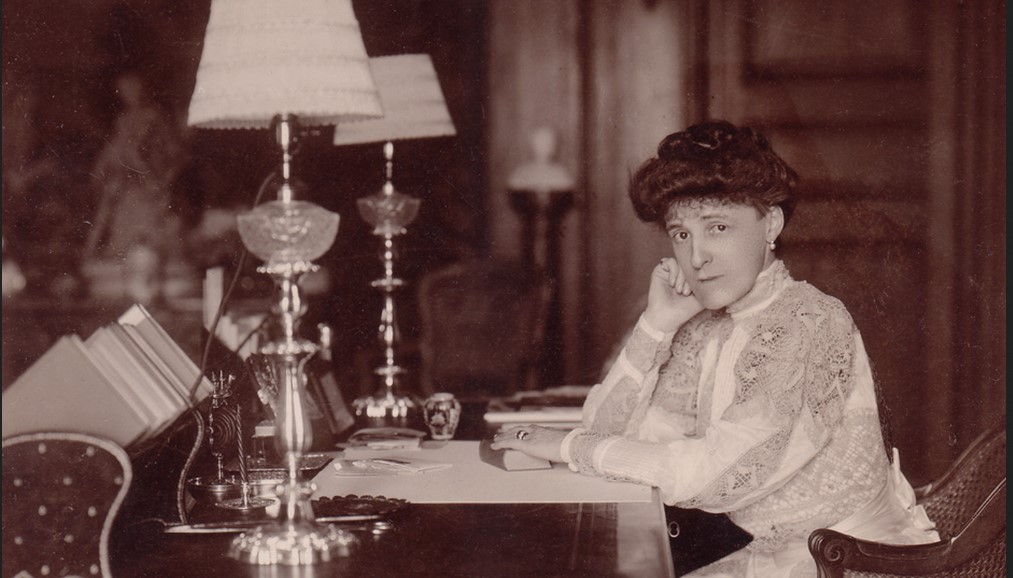
Wharton’s best biographer, Hermione Lee, has astutely observed that The Age of Innocence, of all of Wharton’s books, represented the widest gap between the time Wharton was writing (a remarkably swift six months ending in March 1920) and the time she was writing about (1871-1873), although I don’t fully buy her thesis that Innocence represented an autobiography. For one thing, Innocence is far more muted and guarded (but also more exquisitely understated) than The House of Mirth, which takes place a good two decades later. (With greater permissiveness allowed by later folkways, the characters will obviously dance to a slightly more liberated groove.)
At times, this remote detachment makes Innocence feel more like a work of history than fiction — even more so than Wharton’s Old New York novellas, which all contain far more zest than they get credit for. Age has a more subdued approach than the exuberance on display in Mirth. Lee rightly notes that Wharton had this tendency to leap away every time the characters revealed anything intimate, which suggests that the unpredictable vagaries of human agency are at odds with the fixed nature of history. So it should probably come as no surprise that a blunt and irreverent type like me was more passionate about Mirth than Age and that Wharton’s detached legerdemain proved a little too similar to the mannered logorrhea of her good friend Henry James — a writer whom I largely despise and whose novels I am sadly fated to write about. (Join the fun of watching a bald man lose his mind when we get to ML32, ML27, and ML26!) Still, I cannot gainsay Wharton’s great achievement here.
This is the New York of the 1870s: the onset of the Gilded Age and the tail end of Tweed. It is a little over two decades before the five boroughs consolidated, marching with mad passionate unity to forge a motile metropolis in which iron stalagmites sprouted into the sky with feverish chaotic glee. It is three decades before the sleek beatific curves of City Hall Station inaugurated a new subterranean mode of travel and Wharton’s great heroine Lily Bart lost it all. We are reminded all throughout Age that New York, despite its impressive development, is still something a runt on the world stage. But it is a metropolis blissfully unaware (truly innocent?) of the corruption and grift that will eventually define it. As Wharton writes with muted irony, “New York was inexorable in its condemnation of business irregularities. So far there had been no exception to its tacit rule that those who broke the law of probity must pay.”
Yet even at this premodern nascent point, Gotham’s class aspirations feel preordained. Newland remarks that The Shaughraun, a wildly popular melodramatic play of that pre-Broadway epoch, is as good as anything in Paris or London. Much later in the book, when Newland does find himself in London on his honeymoon, he cluelessly asks, “But don’t Englishwomen dress like everybody else in the evening?” Wharton also reminds us near the end of the novel that this is also the New York before the North River Tunnels carried trains to Penn Station (and one vital takeaway is that Newland doesn’t want these tunnels to be built):
there were people who thought there would one day be a tunnel under the Hudson through which the trains of the Pennsylvania railway would run straight into New York. They were of the brotherhood of visionaries who likewise predicted the building of ships that would cross the Atlantic in five days, the invention of a flying machine, lighting by electricity, telephonic communication without wires, and other Arabian Night marvels.
When Newland considers one of Madame Olenska, he observes that “the things she took for granted gave the measure of those she had rebelled against.” Could this not likewise be the beginning of the New York temperament?
Of course, you can’t gainsay The Age of Innocence‘s prose style. Some of the snarky imagery in the juicier Wharton novels does bubble up in Age from time to time, such as May Welland’s face wearing “the vacant serenity of a young marble athlete.” And Wharton’s glorious eclat for punchy noun-modifier rhythm is admirably fierce when she describes May “looking her loveliest under a wide-brimmed hat that cast a shadow of mystery over her too-clear eyes.”
It’s a pity then that Newland Archer is far flatter than the women, especially since Newland is the dude we have to spend time with while reading this. I get what Wharton was trying to do in sending up society with a doe-eyed meatbag of no great distinction as the protagonist. Stanley Kubrick’s best film, Barry Lyndon, succeeds in part because of the juxtaposition of Michael Hordern’s wry narration against the bland opportunism of Ryan O’Neal playing the titular character. (I suspect that Martin Scorsese’s film adaptation of Age was trying to recapture Kubrick’s stylistic approach to period-piece social critique with Joanne Woodward’s narration.) But after a certain point, shouldn’t exhuming the past like this offer a corresponding set of virtues? A nimble evisceration of the upper crust needs to have a few characters who remind us why life is worth living. And Age, despite numerous mesmerizing passages, will never hit me in the way that The House of Mirth and The Custom of the Country do. Even Pride and Prejudice, for all of its brilliant lunges at snobbery and reputation, still reminds us that marriage, if one is to do it, should be taken seriously and be predicated upon mutual respect rather than whether or not you meet the right people who can get you courtside seats for a Knicks game. And I feel that this is Age‘s fatal flaw. The emotional distance that Wharton demands of us deadens the journey.
On the other hand, the manner in which Newland and Madame Olenska gradually transform into “exhibits” of their time as the book leisurely moves to its end is legitimately brilliant. At one point, the adulterous couple visits the Wolfe collection at the Met and Newland remarks, “Some day, I suppose, it will be a great Museum.” Shortly after that, May remarks on exhibits that don’t matter being put under a label reading “Use unknown.” Newland’s confidence in the future becomes sad and absurd and his fate is sealed in the novel’s haunting final moments:
It was little enough to look back on; but when he remembered to what the young men of his generation and his set had looked forward—the narrow groove of money-making, sport and society to which their vision had been limited—even his small contribution to the new state of things seemed to count, as each brick counts in a well-built wall
It is a stern warning about the dangers of neutering your existence while conforming to patrician dipsticks. Sometimes being true to yourself, rather than avoiding “anything melodramatic and conspicuous” to fit in, is the very life choice you must make to ensure that history doesn’t repeat itself.
Next Up: Ford Madox Ford’s Parade’s End!
 Our universe has become more hopelessly transactional. Vile narcissists with limitless greed and an absence of smarts and empathy have taken over the landscape with their blunt bullhorns. At every socioeconomic level, you will find a plurality of mercenaries who will push any bright and promising head beneath the waterline with ruthless cruelty. Perhaps I’m finally understanding, at an embarrassingly late age, just how commonplace such self-serving treachery is in our world. But what’s the alternative? Cynicism? At times, I have a sense of humor that is darker than the nightscape above the Roque de los Muchachos Observatory, but no thanks. I’ve always been a cautious optimist with a healthy handle on reality, but I still detest this state of affairs. I will still speak out vociferously against it and fight the business-as-usual cowards who uphold this great sham known as the status quo at any personal cost. I stump for the outliers and the misfits. The people who have authentic and vital voices. I don’t care who they are or where they come from. I will stick up for the gas station attendants and the baristas. I will listen to their full stories rather than judge them from a fleeting glance or a superficial and supercilious position. I despise bullies and opportunists. I believe in affording everyone basic dignity. I believe that everyone has it within them to grow and to learn and that inquisitive efforts should never be mocked, especially when genuine curiosity is now in such short supply. Reprobates who use their positions of power to denigrate the marginalized and the underprivileged are scumbags who need to be fought and, if necessary, destroyed.