
Before Jonathan Demme became a world-renowned filmmaker, he was a film critic working for a small newspaper. The glorious schlock producer Roger Corman was shrewd enough to give the likes of Francis Ford Coppola, the late and profoundly misunderstood Paul Bartel, Martin Scorsese, the woefully underrated Joe Dante, James Cameron, and John Sayles their early starts. And Corman saw something in Demme while Demme was working for him as a unit publicist. Demme got his first directing assignment from Corman in 1974: a not-bad women-in-prison flick called Caged Heat that features catfights, gratuitous nudity, and a score from Velvet Underground founder John Cale. Demme followed this up with two more films for Corman before being snatched up by Paramount to direct Handle with Care. The rest, as they say, is history. I’ve long had a theory that the unfettered freedom that Corman gave to guys like Demme was invaluable. They became serious filmmakers a few decades later. And when we consider that some of the top-grossing Hollywood entertainments of the past decade (The Lord of the Rings, the Spider-Man trilogy) came from, respectively, Peter Jackson and Sam Raimi — two filmmakers who, only two decades ago, could not be possibly be identified as having mass commercial prospects, the theory that exploitation fare serves as an essential training ground becomes more plausible.
Like Demme, Rod Lurie was also a critic before he was a filmmaker. Regrettably, he did not have a Corman-like figure who encouraged him to go completely wild. And this apparent restraint, whether self-imposed or dictated by studio forces, has prevented Lurie from being anything more than a by-the-numbers filmmaker. One watches Lurie’s films wondering if the id will ever burst completely to the surface. Here is a man who put “win” in the names of two soldiers in The Last Castle, and was silly enough to have a scene in which a 64-year-old shirtless Robert Redford moves rocks without rest across a prison yard. There is clearly great exploitation potential here. But Lurie seems convinced that he is making a deeply intelligent film with each offering. He’s infinitely more interesting when he relies on these goofy what-the-hell moments, such as the audacious casting of Jeff “The Dude” Bridges as the President of the United States in The Contender. Not only does Jeff Bridges play, well, Jeff Bridges, but Lurie also includes a silly scene in which this President offers a ridiculously oversized sandwich in an effort to “break bread” and is taken aback when his political associate does not accept the offer.
This struggle between wanting to pound moral issues into his audience’s skulls with all the grace and subtlety of a limbless deli worker trying to use the meat cutting machine to make a hero and embracing film as something that is often fun and inexplicable is what makes Lurie’s most recent film, Nothing But the Truth, perhaps his most interesting. While my moviegoing companion dismissed Nothing But the Truth as “a steaming pile of dung,” I felt compelled to defend the movie’s odder moments, even as I simultaneously recognized it as a deeply flawed political drama.
Beneath Nothing But the Truth‘s implausible and pleasantly preposterous politics beats the half-hidden heart of a perfectly respectable exploitation film. There are girl-on-girl jail fights and a conjugal visit in which a woman screams, “Thanks for the fuck! It really hit the spot!” These are not the scenes that one expects from an austere political drama, and the film held my interest during these moments because I wanted to see just how far Lurie would go. Personally, I do not believe that Lurie went nearly far enough. And I felt sad. Because American cinema needs more people who take chances. I concluded that the only way that Lurie could get attuned to his innate craziness would involve remaking the wonderfully terrible movie, Ilsa: She Wolf of the SS, a script incapable of being directed with total sincerity. An Ilsa remake would put Lurie’s naivete to an end and would finally release him from the needless task of making “important” films. Failing that, perhaps Abel Ferrara could be employed to hold Lurie hostage for a month and Lurie could emerge from the smoky anarchy with a newfound determination to make batshit crazy films.
 Let us first ponder why a reprogramming along these lines is necessary. The film opens with a presidential assassination attempt with an unbelievable paucity of Secret Service agents. Later, there’s a stern judge who announces “Anyone want some tea? It’s from Greece” in his chambers at a wildly inappropriate moment. The newsroom of the fictive Capitol Sun-Times, more All the President’s Men than All the Present Realities, is utterly implausible with newspaper cuts and the Tribune Company’s bankruptcy in recent headlines. Everyone seems to have plenty of time to bullshit around in an editorial meeting. The graceful Angela Bassett almost sells her silly role as a top editor, until she urges Our Intrepid Reporter Based Heavily on Judith Miller (played by Kate Beckinsale) to get some rest, a wildly improbable request when today’s newspapers demand immediate copy to fuel sales. Our Intrepid Reporter lives in a very spacious house with another writer, who has written only one novel. (It’s safe to say that Lurie isn’t familiar with the financial ups and downs that would preclude such an affluent lifestyle.)
Lurie has this funny habit of getting one fact right, only to be completely wrong about another one. At one point, a CIA agent submits to a polygraph test. As anyone who had read Ken Alder’s interesting book, The Lie Detectors, knows, a polygraph is inadmissible in court, an unreliable measure, and entirely unscientific. (For more on polygraphs, you can listen to my podcast interview last year with Alder.) But Lurie doesn’t seem to know this, or at least never mentions it. Lurie does know that CIA agents are trained to beat a polygraph test (and this is mentioned). But if the CIA agent can beat the test, why would the investigation bother to carry it out? These numbskull decisions are at odds with the movie’s (perhaps unintentional) quirky charms.
Most egregiously, Matt Dillon has been cast in the role of the prosecutor who goes after Our Intrepid Reporter.
A few words about Matt Dillon: If you need someone to play a dick or a former high-school jock who is past his prime, Dillon’s your man. If, however, you need an actor to offer convincing authority, Dillon simply cannot be taken seriously. The director John McNaughton — a man, unlike Lurie, who knows how to have great fun with sleaze — understood the Dillon dilemma when he cast him in Wild Things and played this up. And one suspects from Dillon’s memorable appearance on Fishing with John that Dillon exhibits these qualities quite naturally.
Dillon is one of those guys who could easily be beaten up by out-of-shape thugs at a suburban bar. Sure, the bluehairs accepted his unintentionally hilarious performance in Crash and nominated him for an Academy Award. But the rest of us know that his attempts to take charge of a scene and exhibit masculinity are as dopey and diaphanous as a used car salesman trying to convince that he’s a friend. Had Nothing But the Truth possessed the courage to embrace its exploitation potential, Dillon’s casting would have proven to be a stroke of genius. But Lurie wants us to accept Dillon as a threat, because he believes too much in his premise, and has Dillon spout such silly lines as, “You know, vilify me all you want, but I had a job to do.” (To get a sense of how ridiculous this line is, imagine it spoken in Dillon’s voice, with that regrettable Dillon pause at the commas.)
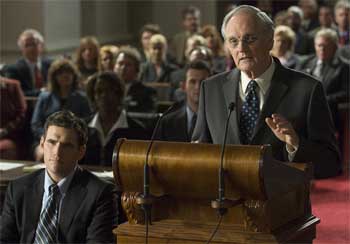 Alan Alda, on the other hand, is very good as the attorney who defends Our Intrepid Journalist, even when he’s given a preposterous scenario in which he essentially whines to a judge, “Oh, come on!” That Alda can work these scenarios without diminishing his authority is a credit to his great powers as an actor. Lurie was lucky to get him on board.
Beckinsale is okay. David Schwimmer is ridiculous. Vera Farmiga has been better elsewhere. But I liked Floyd Abrams as the Judge. (This may be because he’s a well-known lawyer. Perhaps he gave Alda some helpful tips.)
Even Alik Sakharov’s camerawork here is befitting of a quickly made film produced by Corman: lots of long lenses with soft and blurry backgrounds, too many closeups, muddled editing. This appears to be an effort to create claustrophobia. But it only serves to reinforce the rhetorical Don Edmonds question raised above. What would Lurie do with Ilsa?
I am not quite sure if I’ve written a bad review. But I have spent far more words than I expected to on Lurie’s latest opus. And there are pages of notes I haven’t even touched on. I know that Rod Lurie is a bit obsessive about leaving comments at nearly every website that reviews his films. Perhaps he cares very deeply what some of us think. So, Rod, if you are looking for advice, do yourself and the film world a favor. Remake Ilsa. Stop injecting your screenplays with silly moral predicaments. Be honest for once and realize that there’s a great big cornball exploitation filmmaker inside you. If you’re true to that voice, then maybe you could be a Demme decades down the line.

 Vigalondo: When you’re writing a script, sometimes the script is put into a nightmare. Sometimes, it’s giving you some gift. And in this case, when I was writing Timecrimes, I found a monster inside the story. But the story itself gave me the monster. I needed someone with a hidden face, with a scissors on the hand. So I found out that the story was building a monster. A monster that had these classical resonances, as you are telling. So I feel so fortunate. Because when you have a monster in your movie, the movie gets better most of the time. Every movie with a monster is better than the same story without the monster. You can apply this to all the other — to every example. I don’t know. If Million Dollar Baby had a monster, it would be a better film.
 Plummer: There is an Everyman in Hamlet. And every member of the audience must, whether they like it or not, try to identify with him in this sense. And there is the chance in that extraordinary role of them being able to do that. Then there’s the remoter side of Hamlet, which is the urbane and the wit and the wisdom in one so young. And the style that perhaps takes him away from being identified, but particularly with modern audiences, who probably don’t know what style is. So it is such a melange of extraordinary qualities, Hamlet, that it makes the greatest role ever written. There is no doubt of that. And he must have also the great temper. He must possess the great temper in order to frighten the audience. He must have all sorts of qualities all in one. Because it’s written that way. It’s written as a great symphony of a part. And unless you obey the codas, the climaxes, and the stresses, musically, you’re not anywhere near finished playing Hamlet.

 Correspondent: You have this train running behind the Sasaki home. And this suggested to me, along with the fact that you cut this film frequently crossing the axis in the editing — crossing the 180 line — it almost suggests an Ozu parody. Or the kind of movie that Ozu would have made if he were to live in our particular times. And I wanted to ask you how this visual style originated, as well as the subway line.