Of Human Bondage (Modern Library #66)

(This is the thirty-fifth entry in the The Modern Library Reading Challenge, an ambitious project to read the entire Modern Library from #100 to #1. Previous entry: Heart of Darkness.)

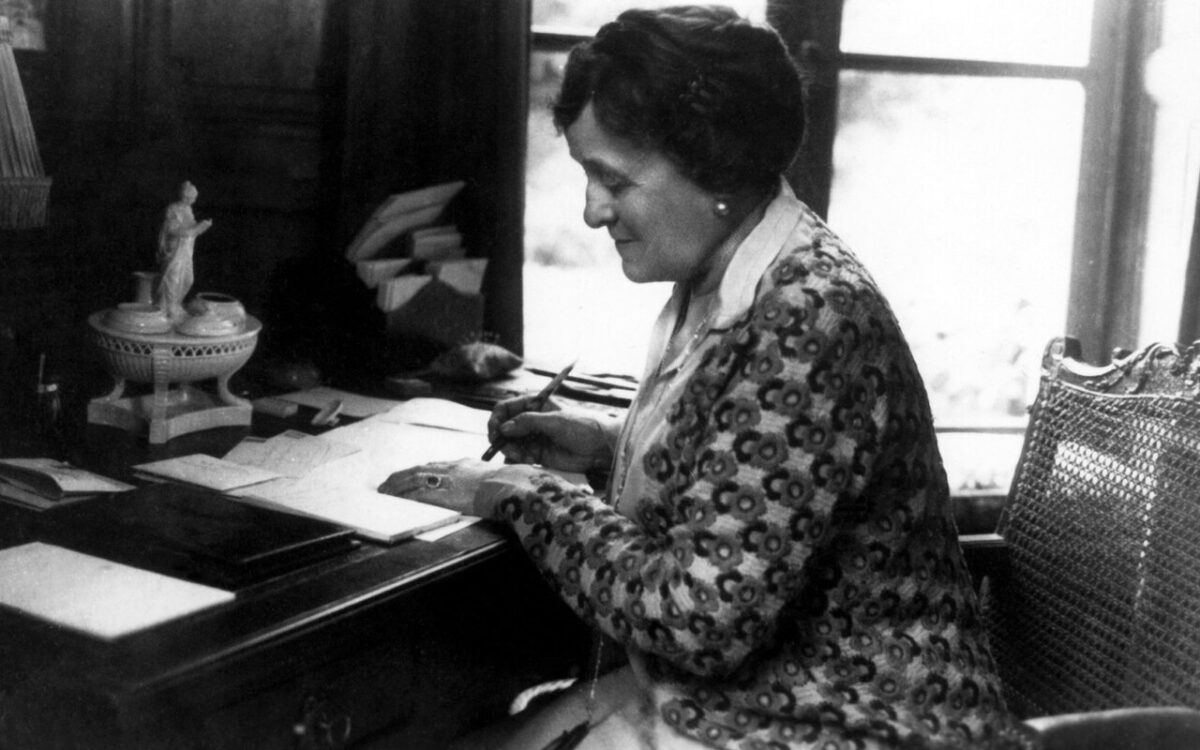
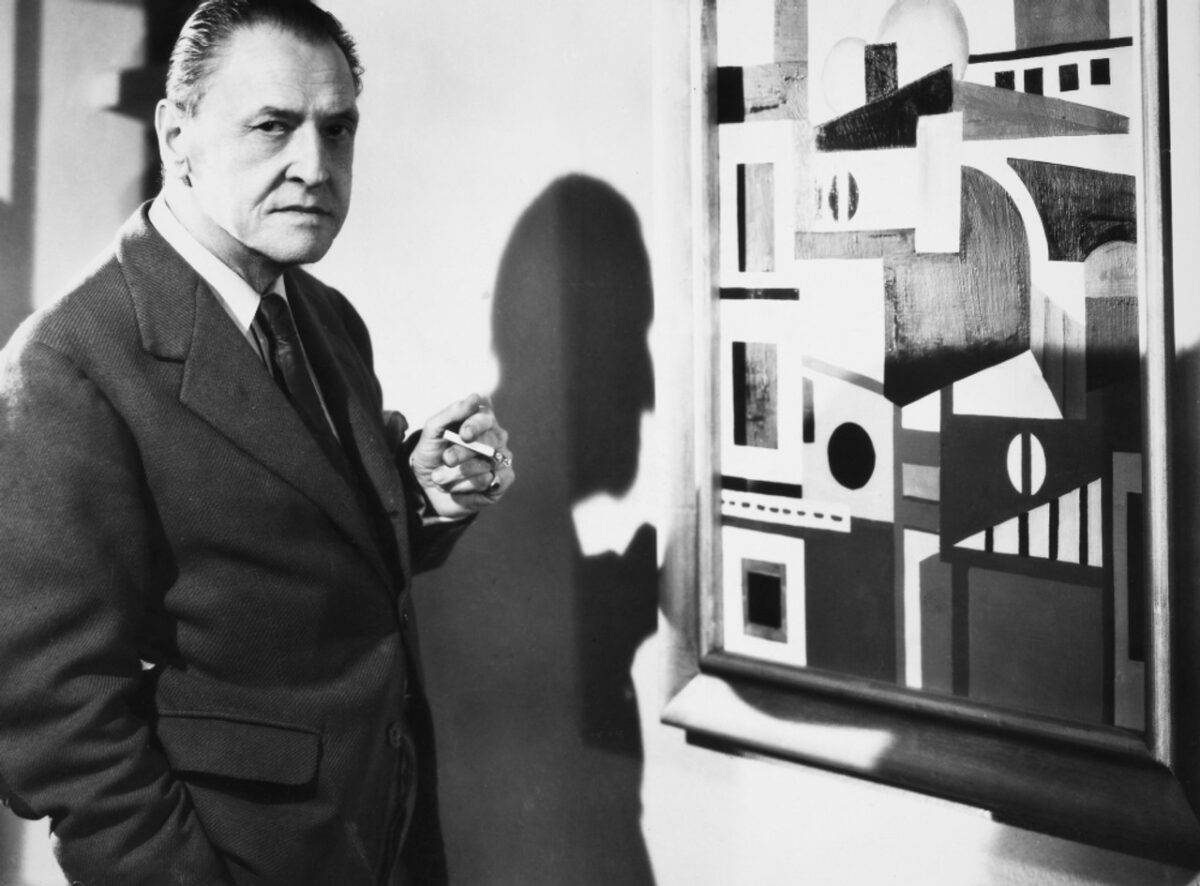
William Somerset Maugham was a largely gloomy man who just wanted to be loved. And because Maugaham was constitutionally incapable of behaving in the manner of Sally Field accepting her Oscar (and was frequently self-deprecatory), he often wasn’t. It certainly did not help that he was closeted, emo as fuck, fiercely protective of his private life, tight-lipped about his inexorable agony, and reported by many of his acquaintances and admirers as emotionally detached (although he did commit many quiet acts of generosity, including building up a library at The King’s School in Canterbury, where the ashes of Ashenden’s creator were eventually scattered). He frequently quipped that he stood in the first row of second-rate writers, almost to steel himself against the effusive and well-deserved reception he received for his considerable literary accomplishments. The Moon and Sixpence, Cakes and Ale, and The Painted Veil remain remarkably vivacious and salacious for their time and are still eminently readable today.

Maugham’s ardent commitment to the “fuck my life” bit, which one often sees today with glum cube slaves over forty, is best evinced by how difficult it is to find a photograph of Maugham smiling. This man hated himself so much that it’s safe to say that he probably would not have been the right man to ask for a selfie. Maugham’s knack for misery is seen in the themes and the grim humor that often punctuate his lurid fiction: the fixation on death and depression, the sense that all love affairs are fated to suffer an abominable heartbreaking end (often with a protagonist too steeped in butterfingers myopia to recognize what’s right in front of him), and a heartless world that is permanently at odds with the joys of human existence. I don’t think it’s an accident that Bill Murray decided on Maugham as his source material when he attempted to turn to dramatic acting in the mid-1980s. Numerous biographers have made noble attempts to ascertain why Maugham was so hopelessly dolorous, but even with “newly discovered papers,” Maugham’s pitch-black penumbra has stubbornly summoned more enigmatic angles. Despite his affluence, he lived quite modestly and, perhaps due to the publicity of his theatrical work, he perfected the art of suffering in plain sight. Given that he made it all the way to the age of 91, one wonders just what it was that kept this tortured depressive living. His storytelling is often so spellbinding that you just want to give the poor man a hug.

But Maugham was also one of the most successful writers of the early twentieth century. With fame came the relentless hail of stonecold critics who refused to budge from their gilded dogpens and throw Willie a bone. Despite his position on the Modern Library list, Maugham has been unfairly neglected in the 21st century. He is not taught, not stocked in most bookstores, and certainly not mentioned by the bratty hordes who are too busy dropping their knickers over such blinking babies as Colleen Hoover and R.F. Kuang. In 1908, Maugham had four wildly successful plays running simultaneously in London. And by the middle of the 20th century, Maugham was so wealthy, such a seemingly permanent mainstream pasha, that even the iconoclastic Simon Raven singled him out as a member of the protected class to be caviled with. And there was Edmund Wilson’s notorious drive-by on Maugham in the New Yorker (contained in Classics and Commercials): “He is for our day, I suppose, what Bulwer-Lytton was for Dickens’s: a half-trashy novelist, who writes badly, but is patronized by half-serious readers, who do not care much about writing.”

Well, I care very much about writing. And while I will concede that Maugham sometimes resorted to pat imagery, melodrama, and telltale tropes (“If only you knew how heartily I despise myself for loving you!” is one cringey line from Of Human Bondage), he could summon striking imagery when he wanted to. In Of Human Bondage, Maugahm beautifully evokes the hope limning the world’s roughness: “The delicate iridescence of the London air gave the softness of a pastel to the gray stone of the buildings; and in the wharfs and storehouses there was the severity of grace of a Japanese print.” Maugham compares a bottle of Chianti with “a slim fair Circassian guarded by four corpulent eunuchs.” And while such imagery probably did not occur frequently enough for a stodgy stooge like Wilson, Maugham’s fixation on surfaces is also vital to what Of Human Bondage is about: namely, the power of imagination and perception to alter one’s life for the better and to make something of one’s existence even when the chips are down.

In condemning Maugham, Wilson had only read two of Maugham’s novels: Then and Now, a truly mediocre historical novel which even we Maugham stans have to discount, and East is West, which even Wilson had to confess was “quite entertaining.” So why the adamantine hate? Why didn’t Wilson bother to tackle Of Human Bondage, which confidently debunks many of Wilson’s beefs with a writer who generations of readers have rightly loved?) I suspect that Wilson’s reckless irresponsibility here as a critic had more to do with the fact that he was an alcoholic who burned through four wives and who made it his lifelong mission to asphyxiate joy whenever he saw it. (And it’s worth pointing out that Wilson is much uglier and somehow more tormented than Maugham is in photographs, resembling nothing less than the living answer to Harold Skimpole: a rage-filled parasite with a permanent scowl.) Moreover, Wilson’s casus belli seems more motivated by Maugham’s dodgy stances on three of Wilson’s literary heroes: Henry James (whom I also despise), James Joyce (whom I am a perfervid acolyte of), and Yeats (yeah, okay, but I prefer Blake and Berryman). Which essentially makes Edmund Wilson’s position no different from those Comic-Con dweebs duking it out on Twitter (sorry, but I can’t will myself to call it X). Wilson engaged with the man and his views, not the work. His criticism is thus nullified.

Even so, I feel an aching need to defend Of Human Bondage against the likes of Wilson and his hamfisted acolytes — that is, if any of them are even still alive. This brilliant novel is far more than a picaresque Bildungsroman, although Dickens is mentioned multiple times and there are many colorful characters that are clearly inspired by Henri Murger’s Scenes of Bohemian Life, which is also name-checked by Maugham. It is, in short, a novel that adeptly portrays the behavioral patterns established in early life and reckoned with in the next two decades. (To cite one of many repetitive phrases throughout Of Human Bondage, the words “I don’t mind” factor in heavily among Philip’s romances.) Yes, Maugham’s grasp of working-class vernacular is not the greatest, confined largely to elided aitches in the manner of Shaw. But who cares? None of Maugham’s modest failings detract from the feel of the novel or the book’s quirky philosophical asides, which include the claim that suicide is better framed through the loss of money rather than the loss of love. Of Human Bondage is a book for the people. That it still remains remarkably absorbing more than a century after its publication and that its subtle lessons about life are still applicable in the 21st century should count for something.

It’s also a mistake to read this massive novel as transposable autobiography, which Wilson was content to do with Dickens in The Wound and the Bow: “If one approaches his first novel, Pickwick Papers, with these facts of Dickens’ biography in mind, one is struck by certain features of the book which one may not have noticed before.” Of Human Bondage‘s hero, Philip Carey, who we follow from the age of eight (after his parents die and he is adopted by his penurious and religious uncle) to early middle age, has a club foot. Maugham had a lifelong stutter. But the panoramic canvases that Maugham paints of London, Paris, and Heidelberg (to say nothing of Philip’s oppressive early life under his vicar uncle’s thumb, the art world, the medical world, and even the down-and-out Athelnys who show up near the book’s end) clearly tells us that there is something larger and more worldly at stake here.

And while Ruth Franklin suggested thirteen years ago that the doomed affair between Philip and Mildred is what makes this novel “original,” I think Mildred — as enthrallingly malicious as she is — is one of the least interesting aspects of this book, particularly when you consider Maugham’s vast scope. All of us meet a Mildred along the way. All of us make the mistake of rejecting people who are good for us — as Philip does with Norah Nesbitt, a woman estranged from her husband and saddled with a kid who is impressively writing penny dreadfuls to support her family and who, even when listening to Philip, is seen knitting so as not to waste a precious moment. All of us, like Philip, meet certain types over the course of our amorous journey. While my 21st century progressive spirit quibbles with Maugham’s portraits of accomplished women as spinsters, Maugham is nevertheless accurate when it comes to Miss Wilkinson (his first love, ten years older than Philip and treated abominably by the tormented young man) and Norah fill in the hole of his absent mother. (Over the course of the novel, Philip sadly loses the photographs and trinkets that are left of his mother, thus having little more than faint memories mimicked by the women he gets involved with in adulthood.) What counts is how we react to all this and how we become nimbler in this tricky business called living.

Of Human Bondage takes its title from the third section of Spinoza’s Ethics. And for the Wilson-friendly snobs who would decry Maugham’s lifting, claiming this to be as graceless as the way old Star Trek episodes were named after Shakespeare lines, this is hardly a casual reference. Rather interestingly, Philip comes to resent and reject religion over the course of the book. And anyone familiar with Spinoza knows that the famous philosopher was careful to establish the existence of God in the first part of Ethics. (Which causes, uh, issues for a staunch atheist and Spinoza fan like yours truly. But I’ve always found ways to look for spiritual sublimity outside of fictitious deities.) So the rejection of religion is, in some sense, a rejection of life. And one of the great thrills of reading Of Human Bondage is watching Philip gradually come to terms with negotiating existence. There is also a concern for Goethe’s notion of living resolutely in “the whole, the good, and the beautiful” — as mentioned by Hayward, the young man who Philip meets in Germany and who proceeds to make cameo appearances throughout the novel. But Maugham is equally suspect of philosophy when he has Cronshaw, a friend of Philip’s, who has this to say about life’s mysteries:

Have you ever been to the Cluny, the museum? There you will see Persian carpets of the most exquisite hue and of a pattern the beautiful intricacy of which delights and amazes the eye. In them you will see the mystery and the sensual beauty of the East, the roses of Hafiz and the wine-cup of Omar; but presently you will see more. You were asking just now what was the meaning of life. Go and look at those Persian carpets, and one of these days the answer will come to you.

Philip does indeed get his hands on a Persian carpet and hopes that, one day, the carpet will yield the mighty answer. But the carpet is destroyed during a particularly crushing moment. Much like Douglas Adams summoning the number 42 as the answer to life, the universe, and everything, so too is the carpet something of a Macguffin. At a certain point, one has to live instinctively rather than relentlessly ponder what life means. And when Philip loses the carpet (along with most of his fortune due to a foolish investment decision), it is only then when Philip begins to find true happiness, with Maugham telegraphing this hard by concluding Chapter CVI with the one sentence paragraph, “Philip was happy.”

And while Of Human Bondage‘s ending may feel a little too tidy, we do get a sense that Philip has thrown off the shackles that marred his efforts to grow as he bounced around many nations and all sorts of people. We have followed his adventures through the first half of his life. And in the end, he has conquered Spinoza’s “lack of power to moderate and restrain the affects” through the strange hope and humility that often comes with middle age. That Philip has done so after considerable misfortune is a testament to the happiness that poor Maugham himself tried so unsuccessfully to chase throughout his life. But then fiction is very often a prayer sent out into the universe, often entailing what the writer himself cannot possibly find in his life. At one point in the novel when Philip faces significant despair, the young man finds a sense of awe and within El Greco’s View of Toledo. El Greco’s raw colors are not easily found in the everyday, but the painting gives Philip the impetus he needs to find something close to heaven in humility. So too do we in revisiting this enormous and scrappy classic. Philip’s character transformation allows us to forgive him of his terrible treatment of the women who gently entered his life. And, in so doing, this novel allows us to forgive ourselves for our own inevitable transgressions.

Next Up: Anthony Burgess’s A Clockwork Orange!

Heart of Darkness (Modern Library #67)

(This is the thirty-fourth entry in the The Modern Library Reading Challenge, an ambitious project to read the entire Modern Library from #100 to #1. Previous entry: Main Street.)

Hello, Darkness, my old friend. I’ve come to talk with you again. Except that I don’t particularly want to. It’s not you, Joe. It’s me.

Don’t worry. We’ll still text each other. I’ll still speak fondly of you. We can still meet for Sunday brunch sometimes. I’m just in a different place these days. Namely the 21st century.

It can’t be an accident that the wildly underrated Julian MacLaren-Ross skewered the idea of reading Conrad as an upwardly mobile class aspiration in Of Love and Hunger. In Frog, Stephen Dixon took the piss out of Conrad along these lines as well. Indeed, slagging off Conrad seems to be a common trait among many of my literary Bohemian heroes. And I do need to heed them. I feel and trust their instincts. It’s almost as if we’re told that we should simply accept that Conrad is a great writer who changed the course of literature (and he did) even as we pretend that he isn’t ancient and hoary and horribly regressive. When I confessed my reluctance to reread Heart of Darkness to a few friends, they told me, “Well, it’s only a hundred pages.” Which suggested very strongly that nobody really wants to read Conrad anymore. He doesn’t pop out at you like Joyce or Faulkner or Nabokov or even Lawrence. And, to tell you the truth, I would much rather reread Finnegans Wake than anything from Conrad.
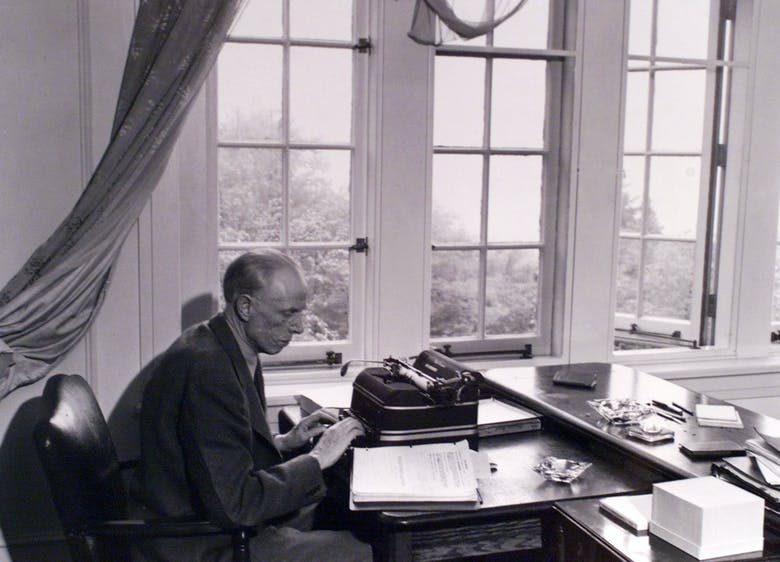
Yet I don’t detest Conrad. Certainly not with the full-bore commitment in which I direct my fierce energies loathing Henry James — a man who is represented on the Modern Library canon with three hideous doorstoppers and who I have tried to learn how to enjoy (even enlisting the tremendously gracious Dinitia Smith for assistance), but whose “charms” I have proven totally impervious to. And since I’m getting ever closer to fifty and there hasn’t been a break in the Henry James ice floe, I suspect that I’m fated to go to my grave hating him, possibly living a few extra months not only to spite my enemies, but to deliver a few final rounds of vitriol towards one of the most overrated and egotistical writers in the English language. I truly dread the James slog that’s in store for me about forty titles from now. The horror! The horror! Perhaps I shall be driven mad like Kurtz.

But not so with Conrad! There is much about Conrad to like: his intensity, his often beautiful imagery, and his insights into human atavism. Eleven years ago, Lord Jim did hold my attention — but I had to give Conrad everything that I had. Decades before I read Lord Jim, I was dazzled by Heart of Darkness in high school. I reread it twice in the last few months and, while the allure that once hypnotized me seems to be gone, I can’t gainsay that this is a masterpiece.

First off, I think we can all agree that Marlow is one of the most long-winded bastards in all of literature. “Mansplaining” doesn’t even begin to describe the dude’s incessant need to talk. Compared to your FOX News-watching uncle going on and on about Marxist conspiracies at the Thanksgiving table, Charlie Marlow is an outright conversational tyrant. All these poor sailors want to do is play dominoes, but the unnamed passenger listening to Marlow’s tale notes that only “the bond of the sea” keeps the sailors from bitching about this incessant rambler “so often unaware of what [his] audience would best like to hear.” (Incidentally, this two-layer approach to narrative is a shrewd move by Conrad to insulate himself from any charges of planting autobiography into his fiction. Conrad and Marlow share many similarities. Not only did Conrad go to the Congo to fulfill a boyhood dream, but he also, like Marlow, endured the stench of a fresh corpse while commanding a steamer. Small wonder that the Polish-Ukranian bard decided to devote all of his time and energies to a full-time writing career not long after this hideous tour of duty.)

Graying technophobes — the kind of unadventurous dullards best epitomized in today’s literary world by the likes of Jonathan Franzen and Sven Birkerts — often complain about the Internet’s impact on attention spans. But consider the alternative. Do you honestly want to live in a pre-radio world in which men explain things with indefatigable logorrhea? In this case, we have Marlow counterbalancing the “savage” world with the “civilized.” There were points in which I felt great sorrow for the poor sailors and imagined sending smartphones back in time so that these poor men could wile away their hours with Candy Crush and cat videos instead of listening to a reactionary seaman splaying out his white supremacy.

And about that white supremacy. Chinua Achebe has been perhaps the most vocal literary figure who has denounced Heart of Darkness, calling Conrad “a thoroughgoing racist,” rightly impugning Conrad’s belittling and dehumanization of Africa, and pointing out how Conrad’s “generosity” in having Black people show up for token cameos is anything but. Achebe scolds Conrad for avoiding the word “brother” in lieu of “kinship” in relation to Black people. (Indeed, the ocean itself, described as “a positive pleasure, like the speech of a brother,” gets more dignity than the dark-skinned “natives” of this tale.) What draws Marlow to Africa on a map is “a white patch for a boy to dream gloriously over.”

On the other hand, there is some modest pushback when the Company’s office is compared to a “whited sepulchre.” Smoke from gunpowder is described as “white,” thus suggesting some white complicity. Can we likewise interpret Marlow pointing to the Blacks being unable to distinguish between individual white men as “being so much alike at a distance” as an acknowledgment of Marlow’s tendency to do the same with Black people? And what are we to make of the white worsted tied around the neck of a dying Black man? Or the foreman whose beard is tied up in “a kind of white serviette he brought for the purpose”? Or a book “lovingly stitched afresh with white cotton thread”? Or the “cold and monumental whiteness” of a marble fireplace?

Humorless sods like Jonathan Jones have written masturbatory articles defending Conrad (and dissing Achebe) with all the clueless gusto of a Trump cultist declaring noted Hungarian tyrant Viktor Orban “a good guy.” But the truth of Conrad’s racism is somewhere in between. Conrad was racist. (The N-word appears ten times within Heart of Darkness‘s 38,000 pages. And the Black caricatures are frequently sickening.) Like all great writers, he executed his storytelling with instinctive ambiguity. And since many of the colonialists carry remnants of white, Conrad’s imagery — whether intentional or not — can also be read as condemnatory of imperialism and privilege.

And you cannot deny Conrad’s commitment to atmosphere! The old woman who greets Marlow with “flat cloth slippers…propped up on a foot warmer, and a cat reposed on a lap.” The Eldorado Exploring Expedition manager who resembles “a butcher in a poor neighbourhood.” The “torn curtain of red twill” hanging in the doorway of a hut that “flapped sadly in our faces.” A “long, decaying building on the summit…half buried in the high grass.” For all of Marlow’s garrulity, Conrad was a master of imagery, knowing the exact measure of words — never too many, never too few — to connote this tropical world.

Still, for all my complaints about Conrad’s racism, Kurtz is truly one of the all-time creepy fucks of literature. On one hand, we are told that “Mr. Kurtz lacked restraint in the gratification of his various lusts” and that he is possibly mad. But his seemingly calm rationalization about how he has manipulated the world around him is deeply unsettling. And while Conrad suggests that Kurtz has become this way because of uncharted and unfamiliar terrain (“The long shadows of the forests had slipped downhill as we talked”), it is quite likely that Kurtz was always unhinged. And if this is indeed the case, then Conrad is saying something very vital about the tyranny of white privilege, even if it comes saddled with tacit endorsement.

Next Up: W. Somerset Maugham’s Of Human Bondage!

Main Street (Modern Library #68)

(This is the thirty-third entry in the The Modern Library Reading Challenge, an ambitious project to read the entire Modern Library from #100 to #1. Previous entry: The House of Mirth.)

Evelyn Waugh, Erskine Caldwell, Iris Murdoch, Nathanael West, George Orwell, Joseph Heller, James Joyce, Rebecca West. They — and so many other writers — were far nimbler in their shellacking of institutional norms than Sinclair Lewis ever was. Yet it was Lewis who won the Nobel Prize. And they didn’t. Why? Likely because the Nobel Prize Committee had it in for Edith Wharton and the Norwegian cultural oligarchs may have secretly believed they were correcting a “wrong.” Just nine years before, Lewis quietly seethed after the Pulitzer Prize Board changed its mind and awarded the Fiction Prize to Edith Wharton for The Age of Innocence instead of Main Street. It was an appropriate correction. Not only is The Age of Innocence a far superior novel to Main Street, but this was also the first Pulitzer Prize for Fiction awarded to a woman. And Edith Wharton could write Sinclair Lewis’s wino ass under the table. (Meet me in a coffeehouse and I will argue this point for hours! I am Team Wharton all the way!) We also know from Hermione Lee’s biography that Wharton, who was tremendously gracious and got along with nearly everyone, became disappointed in Lewis after he revealed himself for the self-serving drunk he truly was. She wrote to Gaillard Lapseley that Lewis was “utterly unperceiving, & frankly interested only in the sale of Arrowsmith! What a queer product — for he really is an artist, though he is so unaware of it.”

Wharton was being kind. Sheldon N. Grebstein suggested that Lewis’s clear disinterest in style is one of the reasons why he is not more widely read today. And even Grebstein, who was in the tank for Lewis, pointed out that the Minnesota bard was not exactly your goto guy when it came to unpacking the complexities of human behavior. (Main Street, in particular, fails on this front. More anon.) But Grebstein also held up this absence of eclat as a virtue, for Lewis’s primordial approach liberated him to explore chance and contrivance. And when his id was hitting the right targets, he could be just as efficiently brutal as any twentieth century writer. (Lewis’s line in Elmer Gantry about the preacher flunking Greek, but winning a ten dollar prize for “Sixteen Ways of Paying a Church Debt” is a genuinely funny one.) Perhaps this is one big reason why Gore Vidal declared Lewis a romantic.

But ultimately Sinclair Lewis’s visceral qualities are often vitiated by his limited understanding of human behavior. Jealousy is one of the cornerstones to the Sinclair Lewis formula. Martin Arrowsmith hates the starry-eyed men who fawn over his wife, as well as the success of his associates. In his 1930 Nobel lecture, Lewis was to invoke jealousy as one salient reason for American literature being poorly regarded in Europe. In his biography Rebel from Main Street, Richard R. Lingeman makes a persuasive case that Lewis’s late-life romantic relationship with Marcella Powers was cemented in jealousy. It’s certainly true that jealousy can take you far in life. Sure, you may end up looking and behaving like Emperor Palpatine near the end of your days. And you probably won’t have a sense of humor. And countless people will secretly hate you even after you achieve a modicum of fame and renown. But, by Jove, you tripled down on your reach and you got somewhere! And in Lewis’s case, it landed him a Nobel and a slot on the Modern Library list.

Lewis’s canonical “importance” has been greatly inflated because Lewis cloaked his privilege in Midwestern roots. Even those who were enlisted to stump for Lewis in his prime did so with great reluctance. (In 1961, Mark Schorer wrote a Lewis biography for the money and dreaded every minute of it.)

To my mind, Lewis’s strongest novels are Babbit, Elmer Gantry, and the underrated It Can’t Happen Here. All three of these books document the peculiarly American dangers of obsession and conformity. Read this triptych today and you feel that Lewis was writing from a place of great urgency. Read his other work and you will find slipshod prose (Lewis was an alcoholic and it has been suggested by a few scholars that he wrote most of Arrowsmith completely blotto), rambling and often incoherent narratives (particularly in his later work), and wildly inconsistent quality. To write well, Lewis needed beastly instinct and emotional angst. And when he didn’t have that, he floundered along with bloat and bitterness.

Sadly, Main Street is the only Lewis volume represented on the Modern Library list. And the unfortunate truth is that this is a vastly overesteemed, doughty, and ponderous volume — not entirely without merit — that will surely fade from public memory by the middle of the 21st century. Its attempts at Minnesota vernacular feel belabored rather than felt. (“W a’n’t it in 1979?” “Why no ‘twa’n’t.” Yeah, whole pages like that.) Yes, Carol Kennincott does try to bring culture and progressive values to a town steeped in bland vanilla values. But her calls for revolution are unpersuasive:

We want our Utopia now — and we’re going to try our hands at it. All we want is — everything for all of us! For every housewife and every longshoreman and every Hindu nationalist and every teacher. We want everything. We sha’n’t get it. So we sh’n’t ever be content —

Frankly I’ve heard more convincing platitudes from some “mic check” kid at a protest

Granted, Lewis is very good at showing how the town of Gopher Prairie subsumes Carol’s identity and erodes her standards. These uneducated Caucasian hicks — the great grandparents to today’s right-wing morons who rapturously pay attention to Tucker Carlson and other hate merchants with a bafflingly big draw when not donning their red hats and fascist paraphernalia and claiming to be victimized by critical race theory even as they espouse racism — truly believe that they are remarkable (Mrs. Ole Jenson’s “thoughts” on Shakespeare are the apotheosis of incuriosity and are truly more pitiful than a poorly sourced Wikipedia entry) and that they are “just as good as anybody in Minneapolis.” Midway through the novel, Carol and her husband actually make a trip to Minneapolis (the only place to see happening new plays and buy fashionable new threads) and we see just how residing so long in a backwards town has altered her:

She felt rustic in this once familiar city, after a year an a half of Gopher Prairie. She was certain that Kennincott was taking the wrong trolley-car. By dusk, the liquor warehouses, Hebraic clothing-shops, and lodging-houses on lower Hennepin Avenue were smoky, hideous, ill-tempered. She was battered by the noise and shuttling of the rush-hour traffic. When a clerk in an overcoat too closely fitted at the waist stared at her, she moved nearer to Kennincott’s arm. The clerk was flippant and urban. He was a superior person, used to this tumult. Was he laughing at her?

As someone who spent half his life slowly migrating his way from the colorless doldrums of the California Central Valley to the thrilling possibilities of New York City, Carol’s uncertainty and anxieties truly resonated with me. When Lewis juxtaposes Carol against the relentless judgment of Gopher Prairie, Main Street is good. Carol can’t even have a quiet moment of joy to herself without inciting the judgmental scrutiny of being a doctor’s wife. She can’t be anonymous. Her every move is written up with illiterate relish in the local newspaper. (These days, the libeling and shaming and speculation can now be found on the great hellscape of social media, where your residency in a big city or a small town no longer matters to the twisted hateful losers who condemn you for living a fun and interesting life clearly beyond their talent and initiative.)

Yet despite Lewis’s attempts to show how Carol is victimized for being a woman, the sad irony is that Carol is less of a character and more of an object. We really don’t have a strong sense of what attracts Carol to her husband Will other than his neck. (Look, I’m not going to kink-shame. But seriously? One of the interesting eccentricities about Main Street is its relentless neck imagery, applied equally to humans and horses. When Lewis preposterously described how Carol is attracted to “the last light brought out the planes of his neck, his flat ruddied cheeks, the side of his nose, the depression of his temples,” I laughed so hard on the subway that two otherwise indifferent New Yorkers shot me disapproving glances. Even accounting for the unconsummated lust that Carol is acting out in this late section of the novel, it’s abundantly clear that Lewis didn’t really understand what women are attracted to.) We are told at the start of one chapter about how Carol suddenly loves her husband Will — this mediocre scumbag who won’t even give her enough money to buy groceries — but why? Then when Carol pops out a baby, we are told that “she loved him with all the devotion and instinct at which she had scoffed.” Sinclair, buddy, put the bottle down and give us more than these superficial details!

I didn’t outright hate Main Street, but I was greatly disappointed by it. After a hundred pages of this, all the potshots at Gopher Prairie locals feel like Lewis shooting monkeys in a barrel. Sinclair Lewis either lacked the desire or the talent to portray small town people as anything other than caricatures. But three years ago, the town of Sauk Centre erected a statue to the man. And in the immediate wake of the book’s publications, many rural Minnesotans proudly called themselves “Main Streeters.” Either they missed the point of the book or, more likely, they never bothered to read it.

Next Up: Joseph Conrad’s Heart of Darkness!

The House of Mirth (Modern Library #69)

(This is the thirty-second entry in the The Modern Library Reading Challenge, an ambitious project to read the entire Modern Library from #100 to #1. Previous entry: The Alexandria Quartet.)

“But brilliant young ladies, a little blinded by their own effulgence, are apt to forget that the modest satellite drowned in their light is still performing its own revolutions and generating heat at its own rate.” — The House of Mirth

Our universe has become more hopelessly transactional. Vile narcissists with limitless greed and an absence of smarts and empathy have taken over the landscape with their blunt bullhorns. At every socioeconomic level, you will find a plurality of mercenaries who will push any bright and promising head beneath the waterline with ruthless cruelty. Perhaps I’m finally understanding, at an embarrassingly late age, just how commonplace such self-serving treachery is in our world. But what’s the alternative? Cynicism? At times, I have a sense of humor that is darker than the nightscape above the Roque de los Muchachos Observatory, but no thanks. I’ve always been a cautious optimist with a healthy handle on reality, but I still detest this state of affairs. I will still speak out vociferously against it and fight the business-as-usual cowards who uphold this great sham known as the status quo at any personal cost. I stump for the outliers and the misfits. The people who have authentic and vital voices. I don’t care who they are or where they come from. I will stick up for the gas station attendants and the baristas. I will listen to their full stories rather than judge them from a fleeting glance or a superficial and supercilious position. I despise bullies and opportunists. I believe in affording everyone basic dignity. I believe that everyone has it within them to grow and to learn and that inquisitive efforts should never be mocked, especially when genuine curiosity is now in such short supply. Reprobates who use their positions of power to denigrate the marginalized and the underprivileged are scumbags who need to be fought and, if necessary, destroyed.
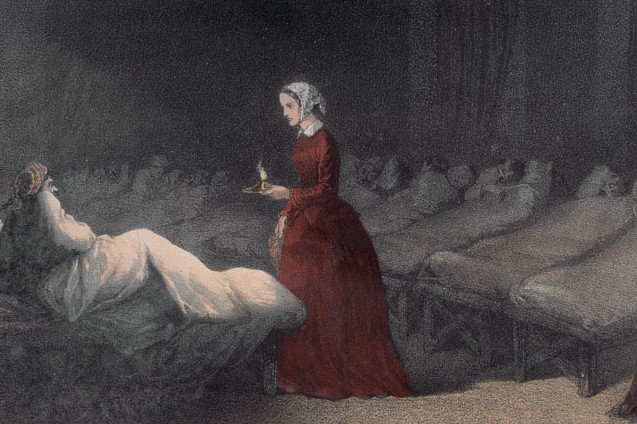

So you can probably imagine how much The House of Mirth means to me. It is one of the best books on the Modern Library list and it should have been ranked much higher. This is my favorite Edith Wharton novel, although The Custom of the Country is a close second. Just this year, I have purchased four copies of this book for friends, urging them to read it with every ounce of exuberance I can summon. And you need to read it too, if you haven’t already. This book is vivacious and brilliant and funny and utterly heartbreaking. I rooted for Lily Bart. I wept for her. Even when I knew her fate. She did not deserve her downfall. She is one of the great tragic heroines in all of literature, right up there with Emma Bovary, Dido, Anna Karenina, Ophelia, Bertha Mason, and Francesca da Rimini. Much like Muriel Spark’s masterpiece The Prime of Miss Jean Brodie, you can read this novel multiple times and always discover a new angle. That the rules of the game haven’t changed all that much in the one hundred and seventeen years since this classic was published is a great testament to Wharton’s sagacious and prescient genius. And if you finish this novel and you’re not in the “ride or die” wagon for Edith Wharton, then I’m sorry, but you simply have no literary taste.

Should Lily Bart be blamed for her fate? Conservatives (and privileged neoliberals) will likely condemn her for her apparent financial irresponsibility, but the peer pressure from her rich friends to gamble away vast sums she doesn’t have at bridge will be deeply felt by anyone who can recall the youthful horrors of trying to fit in. (In fact, I’d say the only contemporary writer today who could be an Edith Wharton in the making is the ferociously talented Adelle Waldman, whose excellent novel, The Love Affairs of Nathaniel P, mined similar territory. MacArthur people, are you listening? Award her a fellowship already! We really need to get her writing more books so we can find out!) And Wharton is exquisite in communicating to us precisely why Lily is so susceptible to social pressure from these higher-ups and hangers-on:

Her naturally good temper had been disciplined by years of enforced compliance, since she had almost always had to attain her ends by the circuitous path of other people’s; and, being naturally inclined to face unpleasant facts as soon as they presented themselves, she was not sorry to hear an impartial statement of what her folly was likely to cost, the more so as her own thoughts were still insisting on the other side of the case.

More than a century later, with the Dobbs Supreme Court decision and the Democrats’ failure to revive the Equal Rights Amendment serving as disheartening signs that a Handmaid’s Tale future could be in store for us, women are still pressured to be “good” and compliant. And while women have a lot more freedom today than they did in 1905, patriarchal conformity upheld through peer pressure has ensured that a lot of women silently endure such internal and external conflict.

Lily is lucky to have true friends like Carry Fisher (initially described as a “professional sponge” and “a mental habit corresponding to the physical titillations of the cigarette or the cock-tail,” but she turns out to be a hell of a lot more than this) and Gerty Farish (an indefatigable charity worker who doesn’t easily buy into any of the false charges eventually leveled towards Lily) when she eventually slips, but the affluent allure of the Trenors and their circle amaurotizes (and thus amortizes and possibly amouritizes?) her to the deadly puppetry of the Trenors and, most diabolically, the repellent and calculating bedhopper Bertha Dorset, whose doctors, we are informed, forbid “her from exposing herself to the crude air of the morning.” (Such a beautifully compact way of foreshadowing Bertha’s vampiric nature!)

Wharton was a master of gentle ambiguity nestling just beneath the surface of narrative clarity. The first time you read Mirth, you don’t buy Simon Rosedale’s mercy near the end. With his “small stock-taking eyes,” he’s little more than a bean-counting arriviste and his despicable tabulating also applies to people. (When Rosedale says, “I can’t help making love to you” to Lily near the end of the book, he’s basically every vulpine loser hitting a singles bar at 3 AM, scoping out the remaining women who haven’t gone home with anyone.) But the second time you read Mirth, you’re not so sure. Rosedale says, “The wonder to me is that you’ve waited so long to get square with that woman.” Can Rosedale be forgiven for simply being socially clueless? Is he a product of the system? And does his gesture actually mean anything? I’ll leave it to the capable writers of Jezebel and The Cut to argue the culpability of mediocre men.

Mirth‘s vast cast of characters tend to glom onto the split-second flourish of a socialite’s physical gesture to fuel gossip and umbrage. Consider the way that Mrs. Peniston is described as “the kind of woman who wore jet at breakfast.” But Wharton’s meticulous study of mercenary manipulators is far from vapid. She hoped to show that “a society of irresponsible pleasure-seekers…can acquire dramatic significance only through what its frivolity destroys.”

Perhaps one of the reasons why The House of Mirth is so authentically devastating is because Wharton was undergoing a great deal of stress as she wrote it. Her husband Teddy had just experienced a nervous breakdown and his erratic behavior was worse than ever. Her fiction was in demand and was being published everywhere, but her social calendar was spiraling out of control. Scribner’s editor Edward Burligname needed a serialized novel at the last minute after another writer had dropped out. And amazingly, Wharton produced this masterpiece in ten monthly installments, with Mirth appearing in publication before Wharton had even finished it (although the tale had gestated in her notebooks for at least five years under the working title “A Moment’s Ornament,” taken from a Wordsworth poem).

Scribner’s knew that it had a big hit on its hands and promptly placed sensationalist ads on the cover — packaging that Wharton objected to — when The House of Mirth hit bookstores in October 1905. The publicity forces also talked up Wharton’s social movements and, while Wharton was happy to have her novel read, she feared that her work would be seen as nothing more than a juicy gossipfest.

She need not have worried. The book was fiercely debated in various letters sections, with many wondering if Wharton was accurately portraying the leisure class or mercilessly skewering them for her own gain. And the robust discussion lent greater credibility to Mirth‘s considerable literary merits.

In her excellent Wharton biography, Hermione Lee has suggested that The House of Mirth can be defined by the presence of books within the book: largely decorative and untouched by few outside Lawrence Selden, the young lawyer who toys with Lily Bart’s need to land a husband. But Mirth can also be epitomized by the actors recruited to entertain the wealthy at Bellomont:

Indeed, so skillfully had the personality of the actors been subdued to the scenes they figured in that even the least imaginative of the audience must have felt a thrill of contrast when the curtain suddenly parted on a picture which was simply and undisguisedly the portrait of Miss Bart.

If all the world’s a stage, why then are we still susceptible to objectifying people? It’s actually quite astonishing how effortless it is to transpose the cruelty of class trappings to the casual character assassination that now passes for “truth” on social media. (As Wai-Chee Dimock has observed, Lily Bart spends most of the novel marketing herself, attempting to appeal to the highest bidder. This is not unlike the behavior of a comely Instagram influencer or, if we want to take Gus Trenor’s sinister insinuation on its face, an OnlyFans model willing to say or do almost anything to extract money.)

Many disgusting creatures in high places fancy themselves Lily Barts — even as they stab with the fierce sociopathic duplicity of Bertha Dorset. (On literary Twitter, there can be no better contemporary parallel to Bertha than the monstrous bully and largely mediocre writer Jennifer Weiner, whose relentless attacks on other writers are quietly circulated among those in the know and whose odious demands for “literary respect” were smartly captured by The New Yorker‘s Rebecca Mead in 2014.) They jockey for precarious perches to cleave to their careers while piling onto the week’s “main character” with gossip and lies. An otherwise innocent figure’s glaring mistake is used to perpetuate further prevarications and even those in the know, like Rosedale, will not lift a finger to salvage their own shaky ascent into a perceived predominance. Indeed, as someone who has been the target of multiple smear campaigns, I can report that a literary man of modest renown — a figure who once maintained a blog inspired by Wharton — treated me, when I was homeless, with the same false solicitude that Rosedale tenders to Lily Bart in the final crushing pages of The House of Mirth. He strung me along with phony plaudits about my writing talent and he offered me the sham promise of a prominent magazine gig that I would have killed to land at the time. He was not unlike Rosedale. Indeed, like all of Wharton’s socialites, he inevitably deemed me invisible — likely with a cognizant irony. It is doubtful that I will ever forgive this motherfucker for tinkering with my dignity and my then shaky self-respect to delude himself into thinking that he was a “kind and decent man.”

So Lily Bart’s awful and needless plunge into the abyss resonates deeply and painfully with me. Today I am tremendously grateful to be gainfully employed, doing what I love, tackling new creative mediums, and to be very much alive. That there are so many “influencers” who hold this book up without comprehending or practicing its emotionally instructive lessons about the need for empathy says everything about the vicious myopia of the contemporary literary world, which now thrives on stubbing out noisemakers and ruining outliers. They cancel anyone with an even remotely disagreeable opinion and they murder anyone who stands in their way of their self-serving and meretriciously earned “success.” Cutthroat capitalism and opprobrious opportunism at its finest! Edith Wharton had her finger on the pulse of 1905 life. And sadly 2022 life.

Next Up: Sinclair Lewis’s Main Street!

Florence Nightingale (Modern Library Nonfiction #74)

(This is the twenty-seventh entry in The Modern Library Nonfiction Challenge, an ambitious project to read and write about the Modern Library Nonfiction books from #100 to #1. There is also The Modern Library Reading Challenge, a fiction-based counterpart to this list. Previous entry: The Great War and Modern Memory.)

Of the four illustrious figures cannonaded in Eminent Victorians, Florence Nightingale somehow evaded the relentless reports of Lytton Strachey’s hard-hitting flintlocks. Strachey, of course, was constitutionally incapable of entirely refraining from his bloodthirsty barbs, yet even he could not find it within himself to stick his dirk into “the delicate maiden of high degree who threw aside the pleasures of a life of ease to succor the afflicted.” Despite this rare backpedaling from an acerbic male tyrant, Nightingale was belittled, demeaned, and vitiated for many decades by do-nothings who lacked her brash initiative and who were dispossessed of the ability to match her bold moves and her indefatigable logistical acumen, which were likely fueled by undiagnosed bipolar disorder.
As someone who has been diagnosed with bipolar, I am inclined to stick up for my fellow aggrieved weirdos. We bipolar types can be quite difficult, but you can’t gainsay our superpowers. A relentlessly productive drive, a magnetism and a magnanimity that bubbles up at our high points, an overwhelming need to help and empathize with others, and a crushing paralysis during depressive spells that often has us fighting the urge to stay in bed. And yet we get up every day anyway, evincing an energy and an eccentric worldview that others sometimes perceive as magical, but that our enemies cherrypick for lulz and fodder — the basis for unfounded character assassin campaigns, if not permanent exile. Hell hath no greater fury than that of aimless and inexplicably heralded mediocrities puffed up on their own prestige and press.

But regular people who aren’t driven by the resentful lilts of petty careerism do get us. And during her life, they got Florence Nightingale. She was flooded with marriage proposals, all of which she rebuffed and not always gently. She was celebrated with great reverence by otherwise foulmouthed soldiers. Yet she also suffered the slings and arrows of bitter schemers who resented her for doing what they could not: obtaining fresh shirts and socks and trays and tables and clocks and soap and any number of now vital items that one can find ubiquitously in any ward, but that were largely invisible in 19th century hospitals and medical military theatres. She had the foresight to study the statistics and the fortitude to work eighteen hour days practicing and demanding reform. And whatever one can say about Nightingale’s mental state, it is nigh impossible to strike at Florence Nightingale without coming across as some hot take vagabond cynically cleaving to some bloodless Weltanschauung that swiftly reveals the superficial mercenary mask of a boorish bargain hunter.

Florence Nightingale nobly and selflessly turned her back from the purse strings of privilege, hearing voices caracoling within her head that urged her to do more. While she was not the only nurse who believed in going to the front lines to improve conditions (the greatly overlooked Mary Seacole, recently portrayed by the wildly gifted and underrated Tina Fabrique in a play, also went to Crimea), it is now pretty much beyond question that she revolutionized nursing and military medicine through her uncommon will and a duty to others in which she sacrificed her own needs (and caused a few early suitors to suffer broken hearts). That she was able to do all this while battling her own demons is a testament to her redoubtable strength. That her allies returned to her, determined to see the best in her even after she was vituperative and difficult, is a tribute to one of humanity’s noblest qualities: putting your ego aside for the greater good.

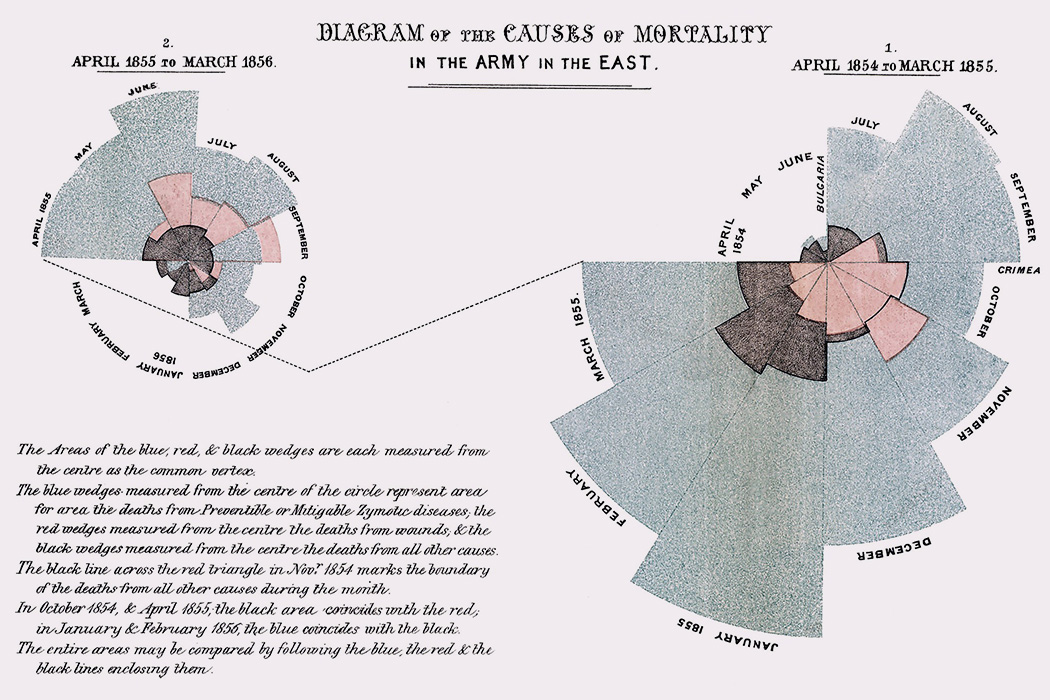
A century before PowerPoint turned 90% of all meetings into meaningless displays of vacuous egotism, Florence Nightingale was quite possibly the first person to use colorful graphical data at great financial expense (see above — it’s beautiful, ain’t it?) to persuade complacent men in power to care for overlooked underlings wounded in war and dying of septic complications in overcrowded and unhygienic hospitals. She was savvy and charismatic enough to win the advocacy of Lord Sidney Herbert, who, despite being a Conservative MP, had the generosity and the foresight to understand the urgent need for Nightingale’s call for revolution. Herbert secured funds. The two became close confidants. Yet poor Herbert suffered a significant erosion in his health and died at the age of fifty because he could not keep up with Nightingale’s demands.

I suspect that men in power resented such noble sacrifices, which could account for why Nightingale was often portrayed as a freak and a deranged outlier in the years immediately following her death. But biographer Cecil Woodham-Smith saw a different and far more complex woman than the haters. Her terrific and mesmerizing and well-researched 1950 biography on Nightingale greatly helped to turn the tide against one of the most astonishing and inspiring women that medicine has ever known. And Woodham-Smith did so not through preordained hagiography, but by taking the time to carefully and properly sift through her papers (and even a well-preserved lock of her bright chestnut hair, still as robust and as lambent as the lamp Nightingale carried in the dark more than a century later). There is a vital lesson here for today’s social media castigators, especially the testosterone-charged troglodytes who casually smear women, that they will likely ignore.

Next Up: Richard Ellmann’s James Joyce!