The Bat Segundo Show: Paul Murray, Part One

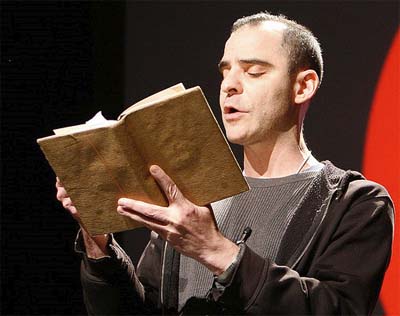
On December 5, 2010, the Irish novelist Paul Murray encountered one of Mr. Segundo’s many agents before a full audience at Word Brooklyn. The two gentlemen proceeded to talk, with smart audience interjection and Mr. Murray reading from the book, for a little under 90 minutes. Just as the tape ran out, the very patient Word Brooklyn staff wisely put an end to this gabfest. The two gentlemen had no idea they had rambled on for so long. From all reports, neither did the crowd.

The first part of this conversation is now available for your listening pleasure as The Bat Segundo Show #370 (also referred to as “Phyllis Presents,” for reasons known only to those possessing the appropriate handbook). It is about 41 minutes long and involves the initial Q&A between Mr. Murray and our most mysterious agent.

The second part of this conversation is now available for your listening pleasure as The Bat Segundo Show #371 (which does not possess any alternate name, we are sorry to report). It is about 38 minutes long and features Mr. Murray reading from his latest novel, Skippy Dies, along with further questions from our agent (and many from the crowd). If you listen carefully to this second part, you may be able to detect a broken haiku.

The producers wish to thank Brian Gittis, Stephanie Anderson, Jenn Northington, Sarah Weinman, and (of course) Paul Murray for their great assistance (much of it at the last minute) in making this special conversation happen. We hope to offer similar “live” conversations in the future.

Condition of Mr. Segundo: Recoiling from the pleasures of being applauded by a recorded audience.

Author: Paul Murray

Subjects Discussed: The influence of cinema, Gene Tierney, Glengarry Glenn Ross, the “Intelligent Eye” system, constructing a soundtrack for life, characters who flee reality, Anthony Lane and the Beijing Olympics, the camera increasingly pervading existence, Murray’s hero worship of David Lynch, balancing audience demand for traditional logic with shocking character revelation, Twin Peaks, not making sense as a bold aesthetic move, David Lipsky’s Although Of Course You End Up Becoming Yourself, Lynch vs. Pynchon, David Shields’s Reality Hunger, excavating the old in the quest for new fiction, Tristram Shandy, the importance of having a big nose, gutting from reality, Russell Hoban’s “feeling unreal is an essential part of reality,” mid-century Irish naturalistic writers, Irish fiction’s failure to interrogate modernity, video games as a teenage refuge, gamebooks of the 1980s, the Walkman as a shift in the way we perceive reality, The Legend of Zelda, Team Fortress 2, Shigeru Miyamoto, computer games and narcissism, Skippy Dies‘s slips into second person, the frustrations with maintaining a dimwit first-person perspective in An Evening of Long Goodbyes, the Celtic Tiger, writers and bank statements, the unexpected rise of phones in Ireland, lattes in Ireland, working in a cafe without comprehending focaccia, Dr. Seuss’s The Sneetches, ineffectual use of outdoor jacuzzis in Ireland, property fairs, Robert Graves and the Great War, Gallipoli, World War I Irish involvement erased from the history books, the Church and child abuse, Michael Durbin of The Irish Times, derivatives, and whether the novelist is guilty in ignoring certain narratives while coating reality within a fantasy.

EXCERPT FROM SHOW:

Murray: It needed to be structured in a way that wasn’t linear and that wasn’t naturalistic. Because I just don’t think like that. I wasn’t trying to be experimental. I just thought that, if you are a kid nowadays, your life is not very linear and it’s not very naturalistic. Because you’ll spend most of your time looking at your phone or looking at a screen. Or watching the TV. You’re very rarely actually where you are. Do you know what I mean? I guess maybe that’s part of the human condition. Never to be actually tuned into what’s around you. But it seems like the whole thrust of the 21st century is just to take us further and further and further away from where we are. And further away into strange digital fantasies.

Correspondent: And this probably explains why so much of Skippy is about this meshing between reality and fantasy. That, in your efforts possibly to examine life with these delimiting technological factors, you’re saying that it led inevitably to this blur between reality and fantasy?

Murray: Yeah, I think that’s what you do when you’re a kid. As I say, when I was a kid, there was no Internet. And computer games — I wasn’t quite Pong era.

Correspondent: Asteroids maybe.

Murray: Yeah. But I think the teenage — the way you kind of cope with the stresses of being a teenager is to take refuge in TV shows or films or computer games. Like I was really into those — well, I wasn’t into role playing. But there were these gamebook things.

Correspondent: Oh yeah.

Murray: Where you rolled the dice and fought orcs.

Correspondent: Yeah. Like the Lone Wolf books?

Murray: Yeah! Yeah! Totally!

Correspondent: I totally played those. They were great.

Murray: Don’t tell anyone.

Correspondent: It’s on tape, I’m afraid.

Murray: Ah! Again with the orcs! Oh no! When are the orcs going to get along?

Correspondent: I know.

Murray: That’s what you do. You’re constantly — like when I was growing up, the Walkman arrived, you know? And I’m going to argue that the Walkman is a major shift in the way we perceive reality. Because for the first time, you can carry music around you. And you start narrating your life. Like the self-narration just shifts gear. Shifts higher up. And that kind of process is — as I say, what technology gives us is more and more elaborate ways of doing that. So the kids in the book, because they’re young and they’re afraid and they’re lost, they take refuge. The big example is Skippy. Skippy’s this fourteen year old, quite reclusive boy who is addictively playing this computer game. Kind of a Legend of Zelda-like computer game. And have you ever played?

Correspondent: Zelda? Yeah, yeah. That thing sucked too many hours out of my life.

Murray: Yeah, it’s crazy.

Correspondent: Now it’s Team Fortress 2. If we’re going to be professional.

Murray: Yeah?

Correspondent: Oh yeah. Oh god.

Murray: Okay. We can talk about this later.

Correspondent: Yeah.

Murray: I mean, I’m not a huge computer games player. But my brother had a — whatever the machine was to play Zelda.

Correspondent: NES.

Murray: And it’s the same guy. The same game designer. The guy who invented Donkey Kong back in the ’70s has now done Legend of Zelda. And he creates these incredible worlds that are so powerful and are like art forms in some ways. In the richness of detail and in the beauty of them. But they’re not like art forms in the fact that they don’t challenge your perception. They don’t challenge you as a person at all. They make you like the master of this world that you find yourself in. Which is like a really narcissistic kind of fantasy. And the kids lose themselves in these fantasies of control and power. You know, like the same way if you walk down the street and you’re listening to Tupac, you kind of imagine that you’re Tupac. And even if you’re fourteen and very small, if motherfuckers come at you, look out. So that’s what you’re doing. I guess the really obvious conceit of the book is that that’s what everybody’s doing these days. That as an adult, being an adult or being mature is less and less part of the adult experience. Instead, being old and adult is someone with more spending power who can buy better enhancers or escapes from reality. Part of the reason the world is so — I’m trying to say fucked — is because we feel less and less responsibility for the world around us. Instead we’re just fleeing into whatever Apple has just produced and for a thousand dollars.

The Bat Segundo Show #370: Paul Murray, Part One (Download MP3)
This text will be replaced

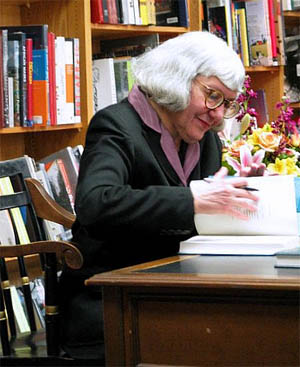
The Bat Segundo Show: Cynthia Ozick II

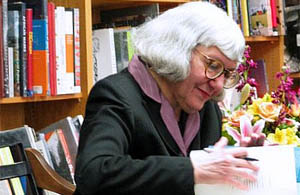
Cynthia Ozick recently appeared on The Bat Segundo Show #368. Ms. Ozick is most recently the author of Foreign Bodies. She previously appeared on The Bat Segundo Show #210.

Condition of Mr. Segundo: Wondering why Henry James forces him to have alarming dreams.

Author: Cynthia Ozick

Subjects Discussed: [List forthcoming]

EXCERPT FROM SHOW:

Ozick: The joy of dialogue. Oh, dialogue! It took me such a long time how to learn how to do dialogue. And I think I learned it from a single book. Which is Graham Greene’s The Heart of the Matter. Which I actually studied to see how he made it concise and dramatic. And I think once you know the character, you have the voice. I suppose you could say that once you have the voice, you have the character. But I don’t think it works like that for me. Once you know the character, you can hear the character speak. And of course, they all speak in their own voices. I don’t know if that’s really related to music. I think that’s more related to seeing. Because you see the character. And if you see visually the character, then if I am looking at you, the voice that comes out of you is naturally yours. Because I see you. Whereas music is this mystery of mathematics. Including Confucius, music and math go together. And that’s a wonder about E.M. Forster. He’s one of the few writers who was very musical. I mean, seriously musical. And that’s in his writing as well. But I think the link with writing is more painting. We see this. It’s so interesting. John Updike had the ability to draw and write. So did Thackeray. Kipling. There are others. I can’t think of them now, but they’re so many linkages in writing and art. In other words, the pen and the eye. Whereas music is abstract math. So that’s where the voices come from. From the eye, I think.

Correspondent: It’s interesting that you mention Greene. Because of course, we know him for the colon. And in terms of looking at your dialogue in this book, what is rather interesting is that sometimes you have almost a Marianne Wiggins-like dash. And sometimes you have the quotes. I’m curious to the methodology behind that. How that developed.

Ozick: Well, that was pretty simple. I needed to have a dialogue in the historic present, so to speak. And dialogue before then. So for the earlier dialogue, I used the dash to distinguish it from the dialogue that’s occurring in the now. Even though the now is in the past tense. Because I have to confess. I have a lot of trouble with our common currency of present tense. Despite those great books of Rabbit [Angstrom]. I was once standing in a group of writers and was so humiliated. Because I mentioned my prejudice against writing in the present tense. And Updike was standing at my right elbow and said, “Well, my Rabbit books are in the present tense.” That was not a good moment. (laughs)

Correspondent: Well, why the aversion specifically to present tense? It’s used a lot more, I think, now than it was thirty years ago.

Ozick: Absolutely. It’s ubiquitous. I don’t know. It just seems that it spoils storytelling. Because it escapes from the magical “Once upon a time.” This happened once. If it’s happening now, then there’s almost no history in it. It destroys the past. And, of course, you see that writers who write in the present tense have to go back and deal with the past. You see that they then have to revert to past tense anyway. And it has a kind of inconsistency. And it’s simply unpleasant to me.

Correspondent: You’re saying that a novel really should present itself almost as a sense of history.

Ozick: Exactly. It’s a story that happened. Not a story that’s happening. And I guess that really needs to be explored. Why should a story that happened be better than a story that’s happening? I don’t know. Help me. Why?

Correspondent: Well, I think when you have a situation like — there was a book by Elliot Perlman called Seven Types of Ambiguity. Named, of course, after the great text. I mean, I like the book. But it has this really absurd situation because it’s written in the present tense. And the narrator’s going, “He’s hitting me.”* When I read this, I thought, “This is just utterly preposterous.” It immediately takes you out of the story.

Ozick: (laughs) Right!

Correspondent: If he “hit” him, right. But “He’s hitting me.” It’s like — wait a minute.

Ozick: Then how can you be writing?

Correspondent: How can I be participating in this? But with the past tense, you can feel a greater sense of participation in the activity.

Ozick: You can believe in it!

Correspondent: Yes!

Ozick: You can believe in it. I mean, it really helps the suspension of disbelief if you present it as a history. And isn’t this the beginning of the modern novel? My Man Friday?

Correspondent: (laughs)

Ozick: We’re supposed to believe that.

Correspondent: Yeah.

Ozick: And we do. Because it’s written like a history. No, I think you hit it when you said it has to do with history. And maybe that is a problem — if there is a problem — with much of American writing today. That it is rather amnesiac.

* — In all fairness to Mr. Perlman, I feel compelled to issue a slight correction. I told Ms. Ozick that I remembered the phrase “He’s hitting me” from Elliot Perlman’s Seven Types of Ambiguity. It has been a good six years since I read Mr. Perlman’s book — sent to me with a handwritten note by Ami Greko, one of the few publicists back in the day to grasp the litblog medium that is now simultaneously ubiquitous and passe. But I can find no indication of the phrase “He’s hitting me” within Perlman’s book. Yet the specific passage I was trying to remember when Ms. Ozick put me on the spot, presented below and written in the present tense, does indeed reveal how the reader can be thrown off when violent gerunds are involved. It still reads as absurd and remains just as applicable to the conversation at hand. This funny little episode also reveals how a fatal expressive error can be misremembered years later, perhaps subject to the same “rather amnesiac” problem with American writing that Ms. Ozick mentions. Authors, take heed when using the present tense!

“I’m going to fucking kill you!” I scream at him. I am punching his face repeatedly, left then right again and again against the smooth stone paving and I am going to kill him. He is squeezing tighter. I am killing him. I am trying to kill him as Anna is pulling me off. She has her arms around my shoulders. She uses all her strength to drag me off him. (80, U.S. hardcover)

(Image: Zugoli Lany)

The Bat Segundo Show #368: Cynthia Ozick II (Download MP3)

This text will be replaced

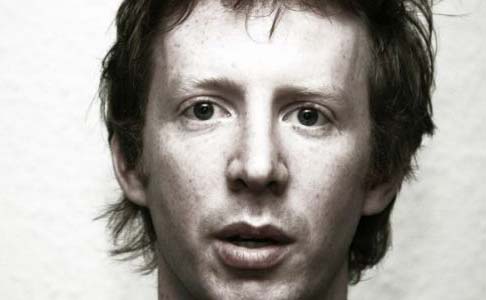
The Bat Segundo Show: David Rakoff II

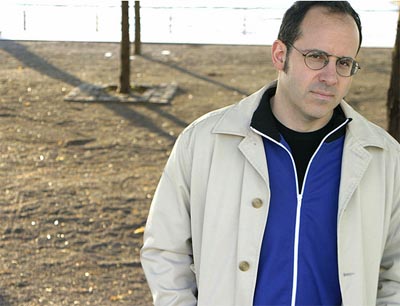
David Rakoff recently appeared on The Bat Segundo Show #362. Mr. Rakoff is most recently the author of Half-Empty. He previously appeared on The Bat Segundo Show #167 and The Bat Segundo Show #168.

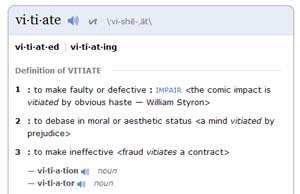
PROGRAM NOTE: This show contains many unusual moments: the unanswered phone calls ringing in Mr. Rakoff’s apartment, the race to the Internet to look up the word “vitiate,” the efforts by both gentlemen to assign various forms of depression and optimism to each other, the common counting mistakes (listen carefully to the intro), and Mr. Rakoff opening up a window. Since these flubs and quirks are presented here unadorned for the listener, we must offer at least one correction. Our Correspondent mangles a George Bernard Shaw late into the conversation. The correct quote is “The real moment of success is not the moment apparent to the crowd,” and comes from Caesar and Cleopatra.

Condition of Mr. Segundo: Confusing threes, fours, and fives.

Author: David Rakoff

Subjects Discussed: [List forthcoming]

EXCERPT FROM SHOW:

Correspondent: You just mentioned that you will not delve into certain aspects of your life in writing these essays.

Rakoff: For the most part.

Correspondent: For the most part. This leads me to wonder about “Shrimp.” The essay in which, as a child, you report that you have a desire to have a fast track to adulthood. This led me to wonder if you had even really attempted to view this from the reverse vantage point. Of you as an adult reporting back to David Rakoff the child, “Okay. Here’s what it’s all about. It’s perfectly okay.” You say you have a happy childhood. But you also have this longing to become an adult very, very rapidly.

Rakoff: Yes.

Correspondent: As a quick rung up the ladder. That’s just not the way life works. Why view it from this linear quality? This is interesting because you are often very digressive in your essays.

Rakoff: Yes.

Correspondent: Which is why I like them. But from this vantage point, from childhood to adulthood, you’re looking at only in one direction and not really the reverse. I’m curious why that was. Or if you have made attempts to look at it the other way. Or is that where the essay “Isn’t It Romantic?” comes into play? Is that you — okay, here’s the adult looking back to being a child.

Rakoff: Wow.

Correspondent: Just to throw some things at you.

Rakoff: Okay, let me see if I can parse this into something resembling an answer. Part of the reason that I don’t look back — or, you know, look in reverse — is twofold. I’m really not kidding when I said I didn’t enjoy being a child. So I don’t really adore remembering that. I’m not comfortable with who I was. I’m a little embarrassed with who I was. So I don’t spend a lot of time looking back. And also because I don’t generally try to mine my own life. It feels a little — I’m still not entirely comfortable with what seemed to be a certain sort of self-mythologizing aspects I’m not just comfortable using the details of my life. Although it’s a somewhat waffling response. Because this particular book is full of details about my life and things that are quite personal, I suppose.

Correspondent: And possibly the most personal of the three books.

Rakoff: Oh, undoubtedly the most personal of the three books. Yes, absolutely. But in terms of the forward-looking thing, there is that anxiety that marks whatever phase you’re at. And I think it’s an anxiety that marks life in general. Which is: Everything takes longer than you hope it’s going to. Everything. Everything has to gestate. Whether it’s work, whether it’s creativity, whether it’s just having people in the world knowing who you are and therefore throw work your way. It’s always, “Everything takes longer.” Certain recipes, where the congealing of albumen in an egg where you apply heat, you know, that takes the number of minutes that it takes. Everything takes longer than they say it’s going to take. It’s going to take years. To pay your dues. To get out of a job. Whatever. So it’s that source of tension. Which is that nobody wants to wait that long. Nobody wants to put in the time. And everybody hopes to be ushered past the velvet ropes or somehow upgraded on the great flight. To business class without having deserved it in any way. That’s a constant tension. Not just among me, but I think among every person alive. And every child wants to be suddenly older.

I suppose both essays are an attempt to both make sense of that and also to — if they are speaking to those younger people, to say, “It will be okay. This period shall pass.” And you will look back upon it not fondly. Because that would just be a little nostalgic and kind of unrealistic. But at least with some kind of peace. And I no longer quite begrudge myself those feelings, embarrassing though they may have been — you know.

Correspondent: But not wanting to look back. I’m wondering if this is one of the reasons why your sentences — and even more so with this book — are so ornate and modifier heavy and very phrase happy.

Rakoff: I am phrase happy. That’s a lovely expression! I’ve never heard of it.

Correspondent: Well, it’s one that just occurred to me.

Rakoff: It’s so good.

Correspondent: But if this almost serves as a kind of insulating mechanism, so that if you are going back to your self, you’re doing so in such an idiosyncratic way as to not direct kind of…

Rakoff: Oh, that’s interesting!

Correspondent: Putting your nib into your vein and letting the blood flood onto the page, which is what’s often said about writing.

Rakoff: Yes, it’s true. I guess though that being phrase happy is just inevitable. It’s the way that one moves through the world. You know, it’s the way that one looks at things. It’s the way that one speaks about things. Or rather the way I speak about things. You know, conversation and talking is my favorite thing. It’s my meat. So “phrase happy” is inevitable. It’s interesting to me that you would maybe see it as a kind of mediating or obfuscating screen. Because I see it as the opposite. As a way of actually getting at the exact nature of something. Because a reluctance to look back is not the same thing as not looking back. One cannot help but look back. But you know, it’s inevitable. And it’s not really in my control. So insomuch as I’ve chosen to in certain places, the best I can hope to do is to do so in an accurate and evocative manner. So that someone that I’ve taken along with me (i.e., the reader) will feel like, “Oh, I get what you mean.” That seems very vivid to me and I completely understand what kind of house this was, what kind of experience this was, or something. But, no, I don’t think of the barrage. You know, that huge wave of verbal diarrhea — which is the way I both speak and write –as being a mediating factor. I think of them as being closer to the nib in the vein.

Correspondent: Well, I think maybe it could be both. Words can both insulate and also be the telltale indicator to the reader, “Hey, if you want to go down my journey with me, you’re going to have to wend through my conscious patterns.” You know?

Rakoff: Sure.

Correspondent: And I don’t think that’s necessarily a bad thing. It’s just the way that you are introspective on the page perhaps.

Rakoff: Precisely. And in life. I’m not one of those minimal guy speakers or writers.

Correspondent: Yeah.

Rakoff: I like words. It’s just like having a lot of spices in my kitchen. It’s just that I like having access to all that stuff.

Correspondent: Well, this also leads me to wonder — because you did bring up words in “A Capacity for Wonder.” You report your concern for bad neologisms. Particularly those that are muffed on lexical blending. Words like “innovention.”

Rakoff: Oh yeah.

Correspondent: Or “snackitizer.”

Rakoff: (laughs)

Correspondent:Or “appeteaser.” In your words, “It makes one suspicious, wondering about the ways in which the object in question is found so wanting, so insufficiently innovative or lacking in invention to warrant this linguistic boost.” I’m wondering. Do you greet all words — all language — with some level of skepticism or suspicion? What does it take for you to trust a word?

Rakoff: Oh! What does it take for me to trust a word? First of all, I have to know what it means.

Correspondent: (laughs)

Rakoff: And there are a lot of words — that as often as I pack my ear with them and look them up all the time — I can’t get them. I’ve even said this in an interview. There was one word. “Vitiate.”

Correspondent: It was our interview! We talked about “vitiate” last time!

Rakoff: Yes! And then I even — I’ve still not gotten “vitiate” — and I’ve said it again in another interview with somebody else!

Correspondent: Yes!

Rakoff: Because I still can’t get it into my head.

Correspondent: To wither or to dry.

Rakoff: It means to either strengthen or weaken an argument. Which one does it mean?
Correspondent: No. I thought “vitiate” means to —

Rakoff: Strengthen?

Correspondent: To dry. Like…

Rakoff: No.

Correspondent: No, no, no! Because you’re vitiated! Your energy forces are…

Rakoff: No, it means to either strengthen an argument or weaken an argument. One vitiates one’s argument.

Correspondent: Oh, in rhetoric, that is.

Rakoff: I don’t know. In the dictionary. Should I look it up?

Correspondent: We may as well. Because….

Rakoff: All my stuff is in storage.

Correspondent: Wait, I could do it.

Rakoff: (moves off microphone to computer) Wait, I can do it right here. On the Internet.

Correspondent: I was going to suggest. I’ve got a netbook on me too.

Rakoff: Generally, I use a — is this picking up on the tape, you think?

Correspondent: We could — yeah, I think it’s going to pick up. I can boost it or something like this. We’ll get this moment or I’ll — I thought it was “to wither.”

Rakoff: (still faint, on computer) No, I don’t think so. Vitiate.

(Phone rings.)

Correspondent: Yeah. To impair the quality. To make faulty. Spoil. To repair or weaken.

Rakoff: Revert.

Correspondent: Yeah, yeah, yeah!

Rakoff: Interesting.

Correspondent: Well, do you want to answer? (indicates phone) Because I can stop.

Rakoff: No, no, no. I’ll let the machine pick up.

(Rakoff returns to mike.)

Correspondent: Anyway, now that we have used the Internet to confirm what this word is.

Rakoff: Yeah.

Correspondent: Both of us are coming at it slightly wrong. I drew my attention to the weakening aspect of the word and you drew your attention to the rhetorical quality of the word.

Rakoff: Yeah. To ruin one’s argument.

Correspondent: Yes.

Rakoff: So it’s the same.

Correspondent: We had the same idea. We’re close. But both of us are imprecise. I don’t know what that says about us or the word.

Rakoff: I think we are close. I think we both get the word. But it’s funny that we — Jesus, even five years later.

(Image: Kris Krug)

The Bat Segundo Show #362: David Rakoff II (Download MP3)

This text will be replaced

The Bat Segundo Show: Andrew Ervin

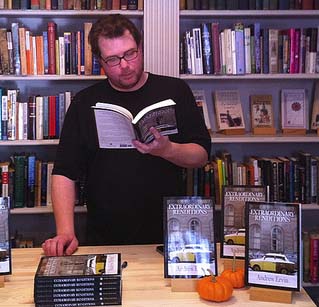
Andrew Ervin appeared on The Bat Segundo Show #361. He is most recently the author of Extraordinary Renditions.

Condition of Mr. Segundo: Contemplating alternative forms of freedom.

Author: Andrew Ervin

Subjects Discussed: [List forthcoming]

EXCERPT FROM SHOW:

Ervin: What else do we have but politics to write about? Ultimately. Whether it’s on a personal level or a cultural level or a national level, politics is going to play a part in every element of our lives, I would imagine. You were asking me about anger recently and I think that gets back to Brutus, who is a very angry character. And he’s the way that I found a voice from my intense anger about our political realm in America. I mean, what’s going on is disastrous to me. We’re still an incredibly racist nation. We’re still an incredibly sexist nation. And this character gave me an opportunity to voice that in some way. And it may be a bit over-the-top. It may push the radicalism a little too far in some regards. And perhaps I tried to mediate that with some of the other characters. But I’m not sure.

Correspondent: But with Brutus, you are very clear to point out that he has a good deal of materialistic hypocrisy.

Ervin: Absolutely.

Correspondent: Here’s a guy who goes ahead and he complains about blowing money. He complains about getting ripped off by the hotel and then he’s blowing money on fast food and Tom Clancy novels. And also that shopping trick he makes, where he’s totally fleeced. So for a guy who is in this really terrible and probably not very well-paying occupation of setting rat traps, and for a guy who is really anti-corporate and inflamed and into a possible post-Black Power situation, he is decidedly hypocritical. That his ultimate engagement with politics is actually a way of him getting lost further instead of finding that identity he wants.

Ervin: Is it still hypocritical if we’re aware that we’re participating? I mean, can we ever get completely outside of the system that we’re trying to critique. We can write the great environmentalist novel of our age, but it’s still going to be printed on bleached paper and packed into trucks and carried across the highway system. There’s always some participation in what we’re critiquing. No matter what. My hope is that I’m aware of the extent to which I’m working within a system to critique it to some extent. Not that I have a specific political agenda with this book. I don’t. I really don’t. Every critic that I speak to wants to ascribe one to it. And they tend to be different ones, depending upon whom I’m speaking to. Which is kind of nice. But there’s definitely an awareness both on my part and, I believe, on Brutus’s part — there’s no getting away from what we’re critiquing. We are also participating.

Correspondent: Yeah. So basically, the question I have now is why fiction is the best way to critique this problematic involvement with politics. Because…well, maybe I’m answering your question a bit. (laughs)

Ervin: (laughs) Yeah, would you please?

Correspondent: The thought I had here was maybe fiction serves as this container for you to examine our participation in the system we’re critiquing. Because it is, in itself, a container. And I did actually want to bring up some of the descriptive details about containment. You refer to “the ceiling of the sky.” There’s the Coca-Cola sign that is on the top of the apartment in the third novella. So this leads me to believe that this is indeed a preoccupation. But maybe we can tie in how you arrived at this walled in description with another query about whether fiction is the best way to create a dialogue about this issue. Do you think it is?

Ervin: I’m not sure that fiction is privileged in any way in speaking to those issues. If I could play piano, I would try that. If I could paint pictures, I would do that. I’d be willing to break out an interpretive dance for you.

Correspondent: Please do.

Ervin: If you think you can record that. I don’t know what fiction can do in relation to the other arts or any means of expression or nonfiction or poetry. They all play a part in whatever we’re trying to say. Fiction is just what works for me personally. And I don’t want to claim that it has some kind of privilege. It’s what I do.

Correspondent: Well, in terms of the description of characters walled in interiors, why do you think you’re so focused on this? I mean, you do use “the ceiling of the sky.” That is a very clear indicator that no matter where one goes, one is going to find one’s self in some kind of interior. Even walking outside.

Ervin: Are you telling me that you don’t feel that way?

Correspondent: Well, it depends.

Ervin: (laughs)

Correspondent: You’re asking me to confess perspective versus description perhaps. And maybe that’s the tension we’re describing here.

Ervin: I guess a large part of what this book is about are the restrictions that are placed on us by social organizations and political organizations. The barriers we put on ourselves. The limitations we’re wiling to put on our own imaginations very often without even knowing it. And this scares me. This frightens me a great deal. That we don’t know how free we are. And we participate in these polite little conversations in front of microphones. And we go out in public and follow the rules. And go where we’re supposed to go and buy what we’re supposed to buy. There’s some part of our humanity that we’ve lost touch with. We’ve lost something that is vitally important to who we are. We’re all so damn polite now.

Correspondent: Yes.

Ervin: And if my characters are constrained some way even by their natural environment, that may be the reason. Because I feel like we are constrained.

Correspondent: And yet you associate this freedom with violence. The end of the second novella has a very specific line about freedom. “This was something that he had not perceived for so long.” And to my mind, that is extremely interesting. Because on one level, what your freedom might be or what Brutus’s freedom might be — and then I think in my mind, Franzen’s idea of freedom, which from my standpoint is very much endorsing the exact system that you’re trying to critique. So since freedom is really a relative term, is it even a term to dwell on? Is it possibly too general a term? Does fiction, by way of ambiguity, allow one — either the author or the reader — to find not necessarily a solution, but at least an understanding of this dilemma that we’re describing?

Ervin: How are we going to know when we are free? I mean, that’s the question. Is it just opening up one more barrier and seeing a slightly bigger horizon? There’s no way for me to be able to answer that. The moment you’re talking about at the end of the second novella, with Brutus on the bridge over the Danube, I think references the [Frantz] Fanon book he’s reading. He’s carrying around The Wretched of the Earth. This great book in many ways about the curative power of violence. And to try and conflate my personal political agenda, if I have one, with that is a mistake, I think. That’s not me. That’s this one character who may have a more enlightened view of the world than I do or a more limited one in some way that I’m not sure. But freedom is not — I mean, what can you say? Who knows?

(Image: Dean Sabatino)

The Bat Segundo Show #361: Andrew Ervin (Download MP3)

This text will be replaced

The Bat Segundo Show: Matthew Sharpe II

Matthew Sharpe appeared on The Bat Segundo Show #358. He is most recently the author of You Were Wrong. He previously appeared on The Bat Segundo Show #132.

Condition of Mr. Segundo: Abandoning the animal experiment.

Author: Matthew Sharpe

Subjects Discussed: [The truth of the matter is that there doesn’t appear to be enough time in the day for me to summarize subjects anymore . Again, I am sorry and can only offer the lame “forthcoming” answer. Please beat me with a pool cue should we next meet, if this proves unsatisfactory for your capsule needs.]

EXCERPT FROM SHOW:

Correspondent: Does this improvisational nature explain in part why the book is so violent? I mean, it has the rather extremely creative usage of a pool cue against a gentleman’s head. Which I thought was a very idiosyncratic form of violence. I’m curious why the book was so violent, number one. Number two, how you settled on the pool cue to the head?

Sharpe: Um…

Correspondent: That’s not an easy thing to do, you know. The head is going to move around.

Sharpe: It’s not an easy thing to…

Correspondent: To hit the head, yes.

Sharpe: To brain someone with a pool cue?

Correspondent: Yeah, I know.

Sharpe: Well, if it’s an old guy and he’s not expecting it. (laughs) Let’s see, why was it so violent? That’s a really hard question to answer. I really — it’s not a part of my temperament as a social being or even as a private individual in this house. For whatever reason, when I write fiction, I guess I’m on the lookout for conflicts. And in some way, pain and impediments — as my friend the writer Lynne says, the body is the first and last metaphor. And if you want to show someone in difficulties, show somebody whose body is being impinged upon.

Correspondent: But you also are playing a bit of a marionette with these characters — the characters serve as marionettes. Because you often have Sylvia, for example, you are extremely specific about the way she sits on the bed, about her posture. And speaking of the body, there’s also much imagery with the face. Particularly with relation to Karl and how he views people. In fact, one of the curious things about this book that I have to ask you about is that Karl perceives Sylvia only in terms of the color and the generic item of clothing. Like “a blue shirt” and “an indigo bra” or what not. And that goes on throughout the entire book. There’s probably about seven or eight of them. So how did you arrive at that generic syntax? That shorthand for Karl perceiving Sylvia? And what of this idea of these characters placed in very specific forms of posture? I mean, to some degree, it’s very hyperspecific. To some degree, it’s almost mathlike in its generic description as well. From Karl’s perspective.

Sharpe: Yeah. Wow, you notice stuff that nobody else notices by the way. So I have to think about these answers. But I just actually want to circle back to a question I didn’t answer, which is the pool cue. You know, I really wanted to place the pool table and the piano next to each other. Because I wanted this very much to be a novel about a bourgeois home. Of the kind that I grew up in. Though luckily I didn’t grow up with the kind of family that Karl had.

Correspondent: (laughs) I would hope not!

Sharpe: But I was thinking at that moment of the beating on the head of John Millington Synge’s Playboy of the Western World. Which I’m sort of deciding whether to give away a major plot surprise. I think I probably won’t give it away. But that’s a play in which a guy walks into a bar in a strange town at the beginning, having just beaten his father with some kind of implement. I can’t remember what kind. But he beats him in the head. And so I was thinking, okay, how do I transpose Synge’s rural Irish play to Long Island at the beginning of the 21st century? And I thought, okay, I actually can’t remember right now what he beats him with. Maybe a farming implement? So I’m thinking, okay, what would be handy in a house like this? So that’s the answer to that question.

About the careful description of the people’s bodies and their posture, I think I just became fascinated through Karl’s eyes with the body of his beloved. Which he is very, very attuned to. Because he really, really digs it. And he’s constantly looking at it. He just is fascinated by her body. And Karl knowing in a sense that maybe he has something like what we could call Asperger’s. Or some kind of weird disorder where he’s not very good at reading faces. He’s always trying super hard to read faces and he really thinks, “If I can only learn the vocabulary of facial expressions, I will finally be able to decipher what the hell people are ever intending toward me.”

(Image: Felicia C. Sullivan)

The Bat Segundo Show #358: Matthew Sharpe II (Download MP3)

This text will be replaced