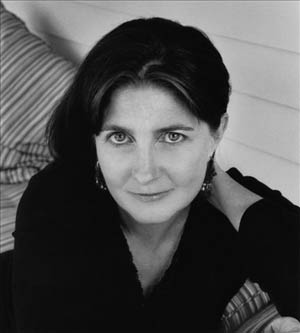
The Bat Segundo Show: Robin Black

Robin Black appeared on The Bat Segundo Show #333. Ms. Black is most recently the author of If I Loved You, I Would Tell You This.

Condition of Mr. Segundo: If he could tell you, he’d have to love you.

Author: Robin Black

Subjects Discussed: Writing ten stories over eight years, rumination time and writing, Black discarding 75% of what she writes, the importance of being surprised while writing, writing while doing the dishes, avoiding explicit metaphor, the scarf in “Tableau Vivant,” how a real-life neighbor’s fence became a fictional neighbor’s fence, feeling exposed through stories vs. the control of memoir, Veterans Day transformed into Resolution Day, perceived strangeness in reality, negotiating the gray area between two extremes, the tension between how people perceive their lives are vs. what their lives really are, the clinical approach to birth and death, being careful about deploying sentiment, observing limitless forms of human behavior and trying to corral it into the neatness of narrative, seeing more gestures and facts about people being more relevant, a character’s relationship with another person’s face, early problems with human gesture, being conscious of the symbolic scheme within a story, sex that isn’t explicitly stated within the stories, the words “sexual encounter,” cybersex, carnal reticence, the defamiliarization of the familiar, a disproportionate focus on the physical act, car crashes and accidents used to galvanize the characters, stories anchored by older women, older women as an increasingly invisible presence in society, the fictional potential in leading an undercover life, explicit communicative disconnect in “Immortalizing John Parker,” characters who resist what the author is trying to get them to do, crutch words from characters, the phrase “So what,” revealing the surname of a character slightly later than expected after the initial introduction, learning from Virginia Woolf’s Mrs. Dalloway, first person vs. third person, twos and threes within the stories, avoiding the usual lists of threes, and playing with fairy tale images.

EXCERPT FROM SHOW:

Black: I also wrote a lot of bad stories. I went into writing ten that I thought were decent enough.

Correspondent: How many bad stories?

Black: I think that if you count just the ones I completed, there are probably twenty-five others. And if you count the others that I started, and got anywhere from two to twenty pages into, there are probably another two dozen of those. So a lot. I produce a lot of pages. I like a very low percentage of them.

Correspondent: This is interesting that you do all of your thinking at the keyboard. Because the character relationships in many of these stories are quite intricate and quite connected. Do you figure out these relationships over the course of writing? How does this work exactly? Expand upon the rumination.

Black: Where does it all come from? None of it’s autobiographical. I always have to start there. So I’m not one of these people who thinks, “Wow! This thing that just happened to me would make a great story.” And to the extent that I ever think that, I put that into memoir. So if I write about myself, then I’m really writing about myself. These things are all made up. I said that a lot of it happens at the keyboard. But I should more accurately say that I also do a lot of my writing while I’m doing the dishes. Though my husband may laugh at the idea that I ever do the dishes. While I’m walking. I’m not somebody who thinks that everyone needs a regiment of sitting down and writing. A certain amount of time. Because a lot of my writing happens away. I’ll just be thinking about the people in the stories. Really as though they were friends of mine, and I was trying to figure out just what the heck they would do with their lives. And so it’s a lot of just thinking through human psychology that goes into it.

Correspondent: You mention not wanting to lift from reality. And this is interesting to me. Because I noted that in these stories, you really go out of your way to avoid extremely explicit metaphors, save in two stories. In “Tableau Vivant,” you of course have the scarf. And “If I Loved You” has the fence. I’m wondering if the scarf and the fence came about as a way of knowing the characters. Or a way of moving the characters on the chessboard while you were doing the dishes. What happened here?

Black: The scarf in “Tableau Vivant” is complete invention. The fence is not. We actually have a neighbor who built a fence in our driveway. And in pondering how to write about it — because it was one of those events that struck me as so peculiar. That somebody would just move into a neighborhood and start tromping on their neighbors. It seemed like such an odd character defect, I guess, in a human being. I thought, “Well, I’ll write an essay about it.” What’s it like to have a horrible human being move in next to you. And then I thought, “Well, I don’t really want to write an essay about it. I’ll write a story about it.” But, again, I don’t write about myself. So the only thing in there that’s true is that there was a fence. And the other piece of truth was my impulse in the story to say to this man, “How can you just be this mean to people when you have no idea what the meaning of this is to them?” And there’s actually a funny story about that. When that story was published in the Southern Review — and in the story, the woman whose fence it is, is dying a very sad, terrible death; and when Bret Lott, who was then editing the Review called me up to say they had taken it — I was all excited. And I said — the first words out of my mouth were “Oh, I can’t wait to throw a copy of it over that damn fence.” And there was this terrible pause. And I realized that he was trying to figure out how much of it was true. And I said, “Oh! I’m not dying. There just is a fence.” So often my stories will have tiny real elements among them, and I’ll kind of build a universe around that.

The Bat Segundo Show #333: Robin Black (Download MP3)

This text will be replaced

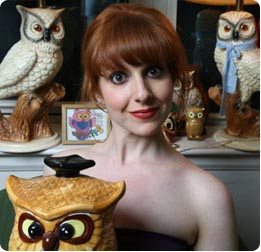
The Bat Segundo Show: Julie Klausner

Julie Klausner most recently appeared on The Bat Segundo Show #330. Ms. Klausner is most recently the author of I Don’t Care About Your Band

Condition of Mr. Segundo: Dodging dubious-minded vegans.

Author: Julie Klausner

Subjects Discussed: [List forthcoming]

EXCERPT FROM SHOW:

Correspondent: I actually wanted to ask you of your keen interest in the Muppets.
Klausner: Yes.

Correspondent: You know, I was very interested in this. You have a great affinity for Miss Piggy.

Klausner: Yes.

Correspondent: But you have a problem with the Miss Piggy-Kermit wedding — particularly the line, “What better way could anything end. Hand in hand with a friend.” You insist that this represents Kermit’s preference for guys, or going out with the guys, instead of having a commitment.

Klausner: Sort of. Or that he, in other words, how he feels about her deep in his heart is almost like how he feels about Fozzy.

Correspondent: Yeah, but…

Klausner: That she’s a friend of his more than anything else. And that she’s not special, I guess.

Correspondent: But you’ve developed an entire theory about your life based off of this. And this caused me some confusion.

Klausner: It’s normal, right?

Correspondent: Well, well, I mean, I want to just poke holes in this.

Klausner: Sure. Poke away.

Correspondent: First of all, you have Miss Piggy voiced in a high-pitched tenor by Frank Oz.

Klausner: Frank Oz. The great, the great Frank Oz.

Correspondent: Yes. And Kermit the Frog by Jim Henson.

Klausner: M’hmm. Rest in peace.

Correspondent: Depending upon how obsessive a Muppets fan you talk to, it’s kind of a bromance thing more than a romance thing.

Klausner: Interesting. Interesting.

Correspondent: So therefore your whole childhood theory may very well be….

Klausner: About a man in drag.

Correspondent: …despoiled by what was going on underneath the Muppets.

Klausner: That’s interesting. So let me ask you this. Do you think of Miss Piggy as a man in drag? Or do you think of her as a lady?

Correspondent: I think of her as a wonderfully poly-gender, polysexual queen.

Klausner: That’s a beautiful answer!

Correspondent: But I’m just wondering if this had occurred to you. Because you’ve seen The Muppet Movie so many times.

Klausner: Oh my god. I love the Muppets. And I’m a huge fan of the Muppets. And my interpretation of the relationship between Kermit and Miss Piggy is — I mean, it’s obviously cheeky. I’m not going to go around and be like, “Children shouldn’t watch this filth! It’s going to give them bad ideas!” But I remember identifying with their relationship as being very — it resembled a lot of the dating experiences that I had. Which is that I was always chasing this sort of skinny guy that was more interested in his friends and his projects and his band or his show than me. And it’s interesting this way to think of Miss Piggy as a drag queen. As Frank Oz. Because drag queens are sort of hyperfeminine in that glamorous jewelry and perfume. And fabulous performers. And all of it.

Correspondent: I’ve seen that karate chop deployed in the Castro.

Klausner: I’m sure you have. And you know what? I don’t even know where the target was. But it was probably well deserved.

The Bat Segundo Show #330: Julie Klausner (Download MP3)

This text will be replaced

The Bat Segundo Show: Nell Irvin Painter

Nell Irvin Painter appeared on The Bat Segundo Show #329. Painter is most recently the author of The History of White People.

Condition of Mr. Segundo: Drowning in David Coverdale’s noxious imperialism.

Author: Nell Irvin Painter

Subjects Discussed: [List forthcoming]

Correspondent: You are careful to write, “Harvard’s importance in eugenics does not imply some nefarious scheme or even a mean-spirited ambiance. Rather, Harvard’s import in this story attests to the scholarly respectability of eugenic ideas at the time.”

Painter: And that could be said about Princeton or Yale or any of the other lofty institutions.

Correspondent: But it is curious to me. I mean, if we recognize today [Robert] Yerkes and [William] Ripley’s stuff as “junk science” essentially, why at the time were these ideas so respected? Why did some of these people get tenured at Harvard?

Painter: Indeed.

Correspondent: I mean, it couldn’t have just been Harvard’s prestige. It had to be something else, I suppose.

Painter: Well, we’re talking about what was considered good science at the time. That was the knowledge that our culture needed at the time. And, after all, Ripley consulted all sorts of authorities. European authorities, American authorities, and so forth. So he had a really big bibliography and he followed the rules.

Correspondent: If someone attempted something along those lines today, I guess the Internet would kill it, I suppose.

Painter: Not necessarily. If it were something that we all agreed upon. Like, for instance, we’re seeing in the medical field right now. Recently, I read a report in the New York Times by a doctor saying there’s just too many prostrate cancer screenings. But a year or so ago, that was considered good science to have everybody screened. So things change.

Correspondent: I wanted to talk about Emerson, who you really take to task in this book. You devote a whole chapter to English Traits.

Painter: Yes. There are three Emerson chapters.

Correspondent: Yes. There are three Emerson chapters. But English Traits seems to be the one key text with which the…

Painter: It is the key text for this reason.

Correspondent: Yeah. But I just wanted to ask you about this. You note later in the book that Henry Ford was an admirer of English Traits.

Painter: Yes.

Correspondent: But in the book that you cited from — because I was really curious about this – Neil Baldwin’s Henry Ford and the Jews. Baldwin notes that it was Emerson’s essay, “Compensation,” that Ford favored above all else. And he even handed that out as as gifts. And that essay doesn’t contain any reference to race. You also state that Theodore Roosevelt echoes the phrase “hideous brutality” in English Traits. But in English Traits, Emerson uses the word “hideous” only once, in reference to the injustice of pauperism. And granted, there are issues with pauperism related to the Saxon seed, which we had mentioned earlier. But I just want to ask. Because I don’t disagree with you that Emerson’s views on the Irish, his drawing upon Robert Knox — these are problematic.

Painter: Yeah. I’m not saying that Emerson is a bad man. But I’m saying that Emerson, because of his importance in American culture, by focusing on these themes and presenting them, orchestrating them in his impeccable prose, made it acceptable. So it’s not that I’m castigating Emerson. I’m trying to place him in an intellectual theme.

Correspondent: But in the case of Henry Ford drawing more upon “Compensation,” say, than English Traits, that’s where I was — my question mark went up.

Painter: But we’re doing Henry Ford — what? Sixty, seventy years after Emerson.

Correspondent: Yeah. Well, the other thing too is picking and choosing one’s values from Emerson. Like Ralph Ellison, for example. He was named after Ralph Waldo Emerson.

Painter: Right.

Correspondent: And actually took a lot from the transcendentalists.

Painter: Oh, there’s a lot of Emerson. Emerson’s an extraordinary figure. And one who his contemporaries said embodies the whole of American learning. And to a certain extent, he did.

Correspondent: But going back to the question or relativism. Can he be let off the hook somewhat simply because he was, in part, an abolitionist? Maybe he didn’t go all the way, but…

Painter: No. We’re talking about different things.

Correspondent: Hmmm.

Painter: We’re talking about different things. Because he had one set of views, this doesn’t change what we think about another set of views. You can still respect Emerson for his central role in the American Renaissance and still know about his Saxonism.

The Bat Segundo Show #329: Nell Irvin Painter (Download MP3)

This text will be replaced

The Bat Segundo Show: Marisa Meltzer

Marisa Meltzer appeared on The Bat Segundo Show #328. Ms. Meltzer is most recently the author of Girl Power.

Condition of Mr. Segundo: Wondering why Liz Phair is running away.

Author: Marisa Meltzer

Subjects Discussed: [List forthcoming]

EXCERPT FROM SHOW:

Correspondent: You quote Susan Douglas’s Where the Girls Are, in which Douglas notes that the women performing in the 1960s gave voice to all these inner warring selves. But she also notes later in her book — not quoted by you — that this period of music also captured the way that young women were caught between this entrapment and this freedom. Now some of the examples you use in the book, such as Phair, Bikini Kill, riot grrl culture in general, they tend to suggest more of the latter than the former. What do you think is the ultimate distinction between, say, the music of the last twenty years versus almost this second wave reaction to the 1960s?

Meltzer: That’s a hard question. You know, I’m reading her new book right now. And it’s all about the ’90’s and the past few decades. So I’ve been thinking about her a lot, but not so much the ’60’s. I think the distinction is that there’s so much more feminist rhetoric in culture now that, after the ’70’s, you had this postfeminist era — which is not a word that I’m a fan of. But in everything from advertising to music to television, there’s all this lip service and references to feminism and empowerment. But I don’t know how many actual empowerment there is. To me, that’s the difference. I think it’s really easy to think that we’ve come a long way musically or politically because there’s so much feminism around us. But I don’t know if it’s so substantive.

Correspondent: On the other hand, empowerment has been rather easily co-opted by marketing forces.

Meltzer: Yeah.

Correspondent: And so the question of what empowerment actually provides within this music, I suppose, is subject to the fluctuating market forces that may actually abscond with the inherent self-righteous truth of this message.

Meltzer: Yeah. I mean, the word “empower” is also just one of those words that, at this point, I don’t even know if it has much meaning. I feel like it’s been drained away by marketers. So it’s something that I have a lot of suspicion towards.

Correspondent: Yeah. Well, it begs the question of whether a phrase or a word — whether it be “riot grrl,” “girl power,” “lady” as you point out later in the book — if the terms are constantly shifting, then are the terms essentially meaningless? Or must one gravitate towards whatever terms are presently fashionable among young girls, or among culture at large, and just attempt to play this game of leapfrog?

Meltzer: Yeah. I do think that there is a certain amount of leapfrog. I think that there is a lot of fashion. I think of my mother’s generation — the baby boomers. And none of them describe themselves as girls. Whereas all of my friends — many of them in our thirties or even in our forties now — constantly use the word “girl” to describe ourselves, to describe other people, to describe people who are older than us, younger than us. And you see some real generational divides. And then you also see in divisions in terms of culture, where there was “grrl” and “girl power,” and suddenly that was taken over, and you had to start calling everyone “lady.” I hope that those terms don’t seem compulsory. But I do think that there can be a certain amount of feeling — it’s kind of like a password or a code. I think that — especially the term “lady” for the past few years — it was “Oh, you’re going to love this great lady.” Or “Have you seen this lady that’s making cupcakes at the flea market or the pop-up shop?” Or whatever. I think there’s a certain shorthand to it. But is it necessary? No. But I think that if it makes you feel good, if it makes you feel as if you’re in on something.

(Image: Shayla Hason)

The Bat Segundo Show #328: Marisa Meltzer (Download MP3)

This text will be replaced

The Bat Segundo Show: David Shields

David Shields recently appeared on The Bat Segundo Show #326. Mr. Shields is most recently the author of Reality Hunger.

Condition of Mr. Segundo: Settling for a quesadilla or some reality for lunch.

Author: David Shields

Subjects Discussed: The origins of the novel and the pretense of actuality, Shields’s dismissal of Myla Goldberg’s forthcoming novel based solely on a catalog description, the creative possibilities that emerge from mishearing, Sherman’s March, the mutability of text, Bloom’s The Anxiety of Influence, whether a truer creative impulse comes from misappropriation, common reality and the individual reception of a novel, Spenser’s “Mutability Cantos,” espousing work that is true to human consciousness, Shields’s view as the lyrical essay as the best opportunity for investigation, dreamworlds, Shields’s hatred of the exit door within the novel, Shields’s dismissal of Lolita as a “masturbatory book” that is “smug, so sure of itself,” laden with “purple prose” and “full of condescension,” Shields’s boredom with the “monuments,” Shields’s opinion on “formulaic” plot, the Ca’pn Crunch moment in Neal Stephenson’s Cryptonomicon, the Huey Lewis and Genesis chapters in American Psycho, Saul Bellow’s Herzog, Shields’s view of novel reading as a “childish” and “frivolous” activity, Vollmann’s The Royal Family, challenging Shields on the “fun” of reading, Sarah Waters, David Markson, Shields’s boredom with The Great Gatsby, a lengthy attempt to find a Lou Reed-related quote in the book, the value of the “hyperfake,” the Gormenghast books, China Mieville’s City and the City, Shields’s failure to maintain a “story gene,” Wittgenstein’s Mistress, Sebald, Rothko, quibbling with Shields’s definition of “a great artist,” David Foster Wallace and Tom Clancy, the meshing of high and low culture, Shields’s distaste for DFW’s fiction, Ulysses, “in no way is Infinite Jest a great novel,” Laura Miller’s review, the contradiction of Shields dissing a book without finishing it, and Shields liking Franzen’s The Corrections when sick and then getting over the flu and retrieving his brain to loathe it.

EXCERPT FROM SHOW:

Correspondent: Let’s start with the beginning of the novel. I think that’s pretty appropriate. You write, “The origin point of the novel lies in its pretense of actuality.” You point to Defoe and Fielding’s efforts to suggest “real” accounts. But I’m wondering if any effort to offer a pretense of actuality in our present age, whether it’s through a remix or a collage, really represents an inevitable return to this antediluvian form. This pretense of actuality.

Shields: Exactly. I’m going to see if I can find this wonderful quote by Adam Gopnik in the book. And maybe you can help me find it. But he basically says that the only kind of — I’ve been trying to find it of late. Let me see if I can find it.

Correspondent: You didn’t memorize all 600? (laughs)

Shields: I’ve memorized most if them. But see if you can find the Gopnik. But anyway, there’s this incredible passage by Gopnik, who says that the only kind of work that can move us is work that is full of a kind of gallows humor and, above all, has an authentic disorder.* I think he’s talking about Francis Bacon. I’m not sure what. But I don’t know. Perhaps later, we’ll find it. But I think that’s right. That in a way, you’ve cut to the core of it. And Gopnik has. And I hope I have. Which is: any such gesture like, for instance, I must admit I was looking at the Knopf catalog. You know, I visited the Knopf office and they send you home with a catalog. That’s their big gift to you. And I’m looking at some of the books described. Various mainstream novels. And I’m just thinking, “You cannot be serious.” That in 2010, you’re publishing this book by this person. It seemed like such an unbelievably antebellum thing. I mean, it’s like, what does this possibly have to do with life lived at the ground right now? It just seemed absolutely preposterous. I just started bursting out in laughter.

Correspondent: Such as what exactly?

Shields: Well, the book that was being described — and no offense to her; I haven’t read her work — but it was a book by somebody named Myla Goldberg. Do I have her name right?

Correspondent: Yeah.

Shields: And, my god, talk about a formulaic text with these little plot points. (to waiter) Thanks a lot.

Waiter: You’re welcome.

Shields: You know, with these little plot points everywhere. (to waiter) Some more water when you have a moment?

Waiter: Sure, I’ll be back.

Shields: And it was just like, I don’t know what. You know, probably an intelligent, well-meaning, well-read writer. It’s like, “Wow!” This is so — you may as well be writing the most formulaic sitcom. And she’s a respected — and I think somewhat respected, somewhat commercially successful writer.

Correspondent: But you’re also…

Shields: And I was like — anyway, this is a longwinded answer of saying.

Correspondent: Yeah.

Shields: You’ve cut to it. Any such gesture now strikes me as antediluvian indeed. Absolutely.

Correspondent: But you’re also judging this not on the book, but on the description of the book. So therefore, we get into meta territory. So how can you make a judgment based off of a catalog description. If I did that, then I would probably avoid most books.

Shields: True.

Correspondent: Because they’re often written in this corporate copy.

Shields: Of course. But I’ve read enough of her other book. I’ve flipped pages to realize that catalog copy was all too relevant to the book. And also I love the line of Borges in the book, where he says something like, “Why write the book? Let’s just write the commentary of the book. The book can be summarized in ten sentences. Let’s write the meta commentary and cut to the point.” So the meta commentary interests me at least as much as the text itself. So in this case, it did not seem to be doing a disservice to the book.

Correspondent: Even though you haven’t actually flipped through the book.

Shields: Well, I’ve read her earlier — I’ve read in and around her earlier books. And it seemed the way — frankly, the way in which the book can be entirely summarized as a narrative machine — seemed to me a very, that very fact meant it was, by definition, for me, a dead text. I mean, there wasn’t a single thing discussed, but “this happened” and “that happened” and “this happened” and “that happened.” I mean, you might as well have had — it was just really embarrassing. It was embarrassing to read.

Correspondent: Embarrassing? You felt embarrassed?

Shields: I felt embarrassed that I was part — I mean, I think it was a Doubleday book. I was embarrassed that I was a publisher that had a relationship to that. I was like, “What does this have to do with the advancement of culture?” You know, nothing.

* — The specific passage Shields is trying to locate can be found in Paragraph 365, and reads: “It may be that nowadays in order to move us, abstract pictures need, if not humor, then at least some admission of their own absurdity — expressed in general awkwardness, or in an authentic disorder.” It’s taken from Gopnik’s “What Comes Naturally,” The New Yorker, July 20, 1992, pp. 66-69.

The Bat Segundo Show #326: David Shields (Download MP3)

This text will be replaced