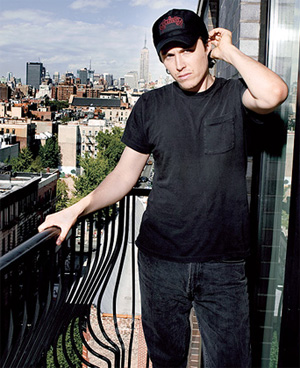
The Bat Segundo Show: Ursula Meier

Ursula Meier appeared on The Bat Segundo Show #277. This particular discussion was conducted in French and English. Many thanks to Aurélie Godet, who kindly assisted us in our conversation.

Ursula Meier is most recently the director of Home. The film is presently playing at the New Directors/New Films series, which is running between March 25 and April 5 at MOMA and the Film Society of Lincoln Center.

segundo277

Condition of Mr. Segundo: Searching for a new home in Bulgaria.

Guest: Ursula Meier

Subjects Discussed: [List forthcoming]

"HOME"

EXCERPT FROM SHOW:

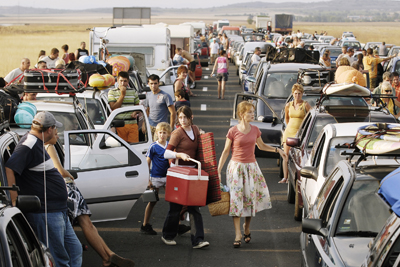
Correspondent: I must ask how you found this particular house and whether you had to consult some French transportation authority to get this particular freeway. What did you do for location scouting for something that was so essential to the movie? And I’m just curious if you had to broker any particular arrangements with any particular governmental agencies to get the cars. Maybe you could describe this.

Meier: (through translator) It was actually a lot of research. It was complicated to find that road. More than the house, it was the road that gave us a lot of work. We needed a large road. Like an abandoned highway. And it’s very difficult to find. Because if we approached highways that were under construction, they would quickly go into being bumped into the traffic. So it did not work. And then we looked around Europe. Firstly, the co-producing countries, France, Switzerland, and Belgium. And then other European countries. We went as far as Quebec. And it still didn’t work. Actually, if you had constructions on the road anyway, you had construction trucks going by all the time. So eventually, we tried another option, which was airport tracks. Landing tracks. And the problem there was that the landscapes around them were absolutely ugly and uninteresting. I was looking for something that would look well and, at the same time, have this abstract but real-looking quality to it. Also, we needed a road that would be long enough. You know, we couldn’t have anything that was short. Which was the case most of the time for airport tracks. Because we had all these cars. Approximately 300. With extras in them, driving them to create the traffic. And you needed them to drive fast enough. Like 90 miles per hour. So you needed a road that was long enough, far ahead so that they could break, and then re-stop.

BSS #277: Ursula Meier (Download MP3)

This text will be replaced

The Bat Segundo Show: Tatia Rosenthal

Tatia Rosenthal appeared on The Bat Segundo Show #275.

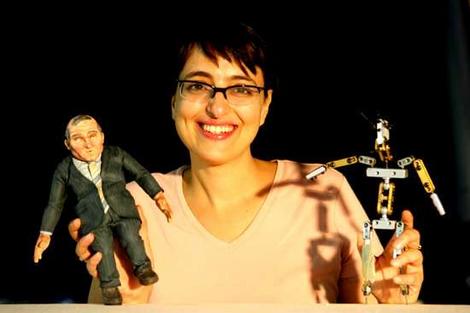
Tatia Rosenthal is is most recently the director of $9.99. The film is presently playing at the New Directors/New Films series, which is running between March 25 and April 5 at MOMA and the Film Society of Lincoln Center. It is also scheduled for limited release on June 17, 2009.

segundo275

Condition of Mr. Segundo: Ushering in an economic revolution.

Guest: Tatia Rosenthal

Subjects Discussed: Unintentionally defying the “good things come in threes” maxim, animating at two frames per movement, Bill Plympton, the aesthetic advantages of budget limitations, character proportions in relation to the sets, camera placement, a shared affinity for short lenses, immersing puppets in shadow, dealing with sweat in animation, animating natural elements, “A Buck’s Worth” as template for $9.99 (YouTube link), compositing vs. in-camera stop-motion animation, shrinking the Lilliputian puppets down in post, sticking to scale parameters, the look of the piggy bank, human mouths and animating Os, the problems of animating dialogue, whether animation must have fantastical elements to be “animation,” magical realism, animating eyes and blinking, breaking away from stereotypical body movement and defying cliches in animation, animating multiple characters in the Show and Tell scene, Anthony Elworthy, ambition, tracking shots, color coordination, self-help books, and graphical elements.

trosenthal

EXCERPT FROM SHOW:

Correspondent: The other thing I wanted to note is sweat in this film, and bodily fluids in general. Now we see sweat in a love scene late in the film and also in the elevator. However, going back to this question of lighting, I should point out that you lit this in such a way so it appears that the texture is sweating, even though it isn’t. So I’m wondering about how you dealt with this idea of actually having to put some sort of moisture on the puppets in order to get that sense of seat. And not only that. You also have to animate that as well. So I’m curious how this came about.

Rosenthal: I think you’re going to be surprised by the answer. Did you like it?

Correspondent: Yeah, I did.

Rosenthal: Interesting. Because it was an accident. And we were doing our best to conceal the sweaty look. Because the silicone actually appears shiny and looks like sweat. The material that we used. And we were doing our damnedest to erase it with powders and stuff like that. And then some of it would get revealed. Because the animators were touching the puppets. And they looked like they gradually were sweating. And then when we got to post, what we did, when it was really distracting, we deleted it frame-by-frame.

Correspondent: Really?

Rosenthal: Painstakingly. And the places where it stayed were the places where it felt appropriate to the scene. Like you’re remarking. So it was really sweating in reverse.

Correspondent: Oh, but I like sweat! Characters should sweat. Puppets should sweat.

Rosenthal: I like it now.

(Photo: Quentin Jones)

BSS #275: Tatia Rosenthal (Download MP3)

This text will be replaced

New Directors/New Films: Barking Water (2009)

[This is the first in a series of dispatches relating to the New Directors/New Films series, running between March 25 and April 5 at MOMA and the Film Society of Lincoln Center.]

barkingwater

Oklahoma, a state unfairly associated with Rodgers and Hammerstein, is a vast prairie with a pan-shaped territory suggesting a definitive cooking surface for the great American melting pot. It has been dismissed by East Coast elitists as a hotbed of virulent Christianity and backwater intellect. But as Will Rogers famously quipped to the state’s detractors, “When the Oakies left Oklahoma and moved to California, it raised the IQ of both states.”

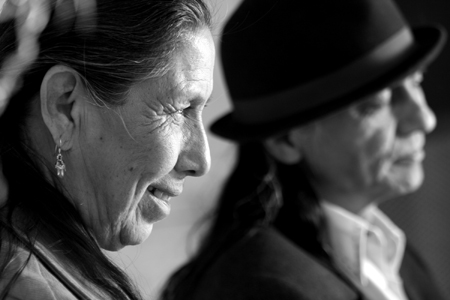
It’s something of a relief to know that filmmaker Sterlin Harjo has dedicated himself to not only raising the stereotypical plateau with which his homestate is viewed and understood, but by documenting the state’s Native American population over the course of three films. It should be noted that Oklahoma has 25 Native languages, which is more than any other state. The lingua franca is so fascinatingly variegated that the Oklahoma Legislature passed a bill in 1990 that permitted a Native language to serve as the state-mandated high school language requirement.

Language of an altogether different sort is what makes Harjo’s third film somewhat interesting. Here is a young filmmaker struggling to collect the quiet experiences that older people often keep to themselves. At one point, our two heroes — Frankie, a man dying of cancer and hoping to clear up a few fractured relationships before passing on, and Irene, his ostensible soulmate — thumb a ride from a young couple from Tulsa. The young woman, Wendy, remarks to her husband about how adorable they are and how they might be able to forward to a future where they can be just as comfortable with each other. Her husband looks upon this lifelong commitment with a quiet horror. And when Irene brazenly announces that the two are not together, the young couple’s illusion is shattered. But a mix tape serves as a cross-generational point of reconciliation. One particular song proves so intoxicating to Frank that we see him torturing Irene later, playing the tune over and over again in a car. Since the man is dying, he’s excused for this apparent rudeness. But is it really rudeness? Or is this Frank’s way of expanding Irene’s rigidly parochial perspective? Is the lie that Irene committed years ago — a prevarication that Frank himself has quietly braced and has never attempted to clear up with anyone — worse than Frank’s auditory sleight?

That such character questions are buried inside this film is a testament to Harjo’s talent. Perhaps it’s the landscape itself that’s cloaking these concerns. Harjo frequently cuts away to shots of rusted stop signs and the flat terrain, as if to suggest that the patient and restricted Oklahoma culture may be responsible for some of these communicative failings.

There is one unexpectedly flamboyant scene at a diner that suggests an alternative Oklahoma. Irene, who only has a ten dollar bill for their journey, is in the habit of calling friends and relatives to get people to buy the two meals. She calls on a nephew that neither Frank nor Irene are particularly crazy about. The nephew and his friend are delightfully boorish. (The pal insists on ordering nothing but “a whole mess of bacon.”) And Harjo films this scene using wild and often low diagonals, even capturing the large deer’s head at the top of the wall. The glum waitress taking the order insists that every breakfast platter requires toast. And one gets a sense of the need to resist such rigid folkways by the bacon enthusiast’s baseball cap reading RESIST.

“That’s what I miss most about being young. Magic,” says one character at one key point in the film. And this sentiment reveals the film’s major flaw. Harjo doesn’t quite have the chops to present us with the magic dazzling at the other end of life: that jam-packed existential epoch just after sixty troublesomely incompatible with Hollywood’s commercial emphasis on the young and unshaped. Frank and Irene keep a very interesting enigma to themselves. But instead of permitting these characters to communicate the edges of this mystery with a telling look or a curious conversational fragment, Harjo spoils it all with that most amateurish of film narrative devices: the flashback. And once this mystery is revealed, Frank and Irene become thinner in character dimension than they have every right to be.

Here is an ambitious film that knows its underserved state very well, but it doesn’t quite know people as well as it should. But I harbor a faith that Harjo’s subsequent films will become more expansive as this young filmmaker matures with time. Let us hope that some benefactor permits him to make more films and hone his craft. His voice, as unformed as it is, is needed.

The Bat Segundo Show: Andrea Peyser

Andrea Peyser appeared on The Bat Segundo Show #272.

Andrea Peyser is most recently the author of Celebutards.
segundo272

[PROGRAM NOTE: At the 22 minute mark, while the conversation concerned itself with the dangers of generalization, a woman, who was sitting at a table located a good seventy-five feet away from them, gave Ms. Peyser and Our Young, Roving Correspondent a note. The note read: CAN YOU PLEASE TALK QUIETER? Now it should be observed that, while the conversation was animated, the two talkers did keep their volume level to a reasonable decibel level. Indeed, many folks sitting adjacently to these two appeared to be interested in the conversation. (This has been known to happen from time to time, since these conversations are recorded in public places. Indeed, there are a few amicable people working at one Midtown cafe who have urged Our Correspondent to come back because these conversations are apparently quite odd and intriguing to them. It also helps that we tip well.) It should also be noted that the woman with the note had congregated with a group of peers for a discussion that deployed such strange terms as “synergy,” “collaboration,” and “market forces,” and that this group talked at a level far exceeded all other conversations occurring in the cafe. We note all this for several reasons: (a) to explain to the listener yet another odd and unusual moment in the history of this program, (b) to point to the problematic lack of distinction between workplace and social gathering point in our present epoch, and (c) to demonstrate that strange forms of passive-aggressive behavior remain troublesomely alive and well.]

Condition of Mr. Segundo: Pursuing the unexpected qualities.

Author: Andrea Peyser

Subjects Discussed: Why celebrities cannot be ignored, “anti-American” sentiment, Sean Penn’s trips to other countries, whether or not Alec Baldwin is entitled to privacy, photographers and paparazzi, the limits of the media, whether hypocrisy is a valid description of celebrity, First Amendment rights, Martin Sheen’s 9/11 remarks, being invited to be honorary mayor, rudimentary viewpoints and free thinking, Nancy Pelosi’s importance, whether it’s possible for Peyser to agree with Al Sharpton, Munich and Black September, the problems of holding an artist’s statement on the same level as the art, Steven Spielberg’s remarks about Israel, the problems with generalizing about Mumia Abu-Jamal’s followers, being friends with Rosie O’Donnell and O’Donnell’s betrayal, on not taking the high road, celebrities of virtue, Bruce Springsteen, old Hollywood vs. the present publicity machine, on being vituperative in the New York Post column, quibbling with the infamous Heath Ledger column, “knowing” the celebrity from a snippet view, whether or not Peyser is happy, giving into the readership, and a few positive things that Peyser can say about the entertainment industry.

EXCERPT FROM SHOW:

peyserCorrespondent: You deem Alec Baldwin a celebutard partly because of the infamous voicemail to his daughter. But I’m wondering if it really is fair, given what you’ve just discussed in relation with Sean Penn and his political sentiments, to take something that was never intended for the public and put it up there with something that is actually in the public record. I mean, is it really fair to deem someone a celebutard for their private actions like this?

Peyser: Well, private actions. He left a voicemail. Any idiot knows that anything you say on a cell phone, anything you email and voicemail, it’s out there. He was in the middle of a custody battle. He was threatening his daughter. To come over to California and straighten you out. It got into the public eye and he got furious because of that too. He blamed others for his own actions. That’s also a common thread in celebutardism. When Barbra Streisand, for example, is caught being really, really stupid, she blames other people for her own stupidity. So in the case of Alec Baldwin, he did something really stupid — actually dangerous — and he blamed someone else.

Correspondent: But if it were not Alec Baldwin, someone could leave that voicemail and it may not have been disseminated out into the media like this. Just as, for example, you mention George Clooney and his anger and fury towards a photographer shooting a picture of him above the men’s stall. You’re saying to me that if a photographer came up to you while you were doing your business that you wouldn’t have any particular problem with that?

Peyser: No.

Correspondent: It’s out there to be disseminated?

Peyser: I wish George Clooney would make up his mind. One day, he’s fighting against the stalerkazzi, as he’s called them. As other celebrities have called them. People who stalked Princess Diana. Of course, the courts found that she was killed not because of the paparazzi, but because of her drunk driver. But anyway, he made a very big deal about that. People could be seeing it as censorship. Whatever. But then he turned around and he decided that I am going to back off. And that is censorship. And it’s okay. Say whatever you want about me. So I wish he’d make up his mind really.

Correspondent: Well, he is expressing understandable anger at a photographer shooting a picture of him above the stall. If someone did that to me, I would probably also be quite upset. I’m sure you would too.

Peyser: Yeah.

Correspondent: I’m wondering if it’s fair to hold him accountable for that particular understandable reaction and use this in the broader painting of who he is in relation to all of his other actions.

Peyser: Well, that was in Australia, first of all. He’s giving a picture of the media. The media. I love that word. I’m not shooting George Clooney naked. I really don’t care. But that was in Australia. He got the thing suppressed. He threatened a lawsuit. And I wish he’d now be quiet. And now he’s decided that the media has to be left alone. Which one is it? Are they killing Princess Diana? Or are they okay? Which one is it?

Correspondent: But do you believe that a celebrity is entitled to some level of privacy? Is it really fair to constantly — I mean, you’re living a life as a celebrity. You’re having all these photographers, reporters, paparazzi, you name it, invade your particular personal space. So understandably, your particular lines in interviews and the like are going to be subject to more scrutiny. And so this makes me wonder whether it’s actually fair to attack them.

Peyser: What I really love is how somebody — like, take Madonna, for example. Way back when, she was creating things that would attract media attention. She was desperate for media attention. And now that she’s a huge star, she’s the most controlling person who exists as far as interviews go. So why can they run to me and say, “Please, pay attention. Pay attention.” They do everything including taking their clothes off in public to get us to write about them. To take their pictures. And then when they reach a point of fame and fortune, it no longer exists. I don’t know. Actually, I would say that the media is dreadfully controlled by celebrities. I don’t think it’s as much of a free-for-all as you’re suggesting. I think there are armies of publicists out there who really control the image.

Correspondent: I certainly agree with you about that. You make many interesting points about Tom Cruise and Michael Moore certainly.

Peyser: Yes, that’s very…

Correspondent: I would never interview them because of these particular controls. But nonetheless, look at what happened with the Christian Bale outburst. This was remixed in a very fun way on YouTube. And suddenly things did get out. But the question is whether it’s entirely fair. I mean, I understand what you’re saying. Which is that the media — one needs it to advance in one’s career. But simultaneously, is there a particular point when the media should back off? Should they be probing and taking pictures of children and the like? And that sort of thing?

Peyser: Well, you know, personally, I have never done that. I don’t go after somebody’s children. Not without permission. But you know, I don’t know. Michael Jackson goes out in public with his children in veils. I would say that he’s attracting more attention to them then if he had just gone out in public with children with their faces showing. But I don’t personally condone using children. But I think that a lot of celebrities put them out there. Put them out there to attract attention.

Correspondent: Even if they’re doing their shopping, for example. And the children happen to be along. And then the paparazzi come. I mean, see, this is where we get into — I’m trying to just clarify where you’re coming from here.

Peyser: See, once again, this is a very small thing. I make the point. And I do this in the cases where the celebrity is obnoxious in the control. Of pointing out that at one point in their career, when they were very young, they would do anything for attention. Now I have never stalked anyone. Everything I get is from above-board sources. So I’m not speaking for myself. I’m talking about the hypocrites. The celebrities who use the media and then have no use for it once they’re famous and rich.

BSS #272: Andrea Peyser (Download MP3)

This text will be replaced

The Bat Segundo Show: Tony Stone

Tony Stone appeared on The Bat Segundo Show #271.

Tony Stone is the director, writer, producer, editor, and actor of Severed Ways, a film about Vikings that opens in limited release on March 13, 2009.

segundo271

Condition of Mr. Segundo: Unsure of whether he wants to be a Viking or not.

Guest: Tony Stone

Subjects Discussed: The many crew positions that Tony Stone worked, music clearance people who keep weapons under their beds, making a film with seven chapters, how a two week shoot went on for three years, not getting the visuals right the first time, motivations for handheld camera work, accepting art as it is, “Greedo shoots first,” contemporary slang transposed into Viking talk, A Knight’s Tale, how far filmmakers can go in “modernizing” historical settings, the ethics of killing chickens on screen, Ingmar Bergman’s Shame, helpful ways of agitating both vegetarians and meat eaters through cinema, filming a defecation scene, the appropriate constituency of shit for a beautiful shot, Charles Leland’s Algonquin Legends, abstaining from profiling the Abenaki religion, paganism, anarchy, and secular humanism.

EXCERPT FROM SHOW:

tstoneCorrespondent: “This fish is pretty killer.” Well, “killer,” as I understand it, is a recent modifier in the English language.

Stone: Yes, it is.

Correspondent: And I don’t think necessarily that the Vikings were using this or that the Nordic tongue had any answer to “killer.” So why the modernization of etymology here? Is this an inroad point along the lines of the Viking headbanger who likewise appears in this?

Stone: Yeah. It’s that. But it’s also that a lot of the times, you’d watch any period piece or historical film, whether it’s Romans or barbarians or whatever else, they’re speaking in semi-Shakespearean accents in their Old British. It doesn’t really make any sense. And everything’s very formal. There’s no reason why, a thousand years ago, they weren’t just as casual as us and they had their own vernacular. So this is using a piece of dialogue — like “This fish is killer” — is basically more of an accurate translation in my mind. Because you’re taking whatever their vernacular was and putting it into our vernacular. So you understand the tone and the vibe of what they’re actually saying. So I actually find there’s more accuracy in it. And we’ve just been so beaten down by the traditional Hollywood stupidity of how I’m dealing with history in films. So that sort of explains why I wanted it there. And of course, the film is trying to bridge the past and the present. And so it’s maing these characters have mannerisms that maybe the dude walking down the street has. Or whatever else. It’s trying to just not have it be this distant, far off, separate thing. It’s trying to make it more current and now. And it is with us.

Correspondent: But on the flip side, there is a certain point where it becomes ridiculous; i.e., A Knight’s Tale, for example. In which you have the Nike swoosh in the Middle Ages. Do you remember this film?

Stone: Yeah, I do. I do.

Correspondent: I mean, it was totally ridiculous. It was fun. But at the same time, one does not look to this for verisimilitude.

Stone: “The Boys Are Back In Town.” Yeah.

Correspondent: So the question is: how far can you go with this?

Stone: Yeah, that’s interesting. A Knight’s Tale. I forgot about that. It’s been a while. But yeah. They use modern music.

Correspondent: “We Will Rock You.” Yeah.

Stone: Then there’s that amazing part where they’re going back to London. And the Thin Lizzy song comes in. “The Boys Are Back In Town.” (laughs) It’s very incredible.

Correspondent: I mean, if we’re talking about Hollywood stupidity, I’m wondering how…

Stone: Yeah. Obviously, there is a level of absurdness to it. I’m not going to deny it. But I think the film is sort of rebellious in a way. It’s trying to set up a dialogue. I don’t know. But in a way, like I’m saying, it’s sort of modernizing the Viking. Making him a current character. Making him more similar to somebody maybe you know is the idea. I’m just getting away from that wall that’s usually put up in terms of dealing with historical material.

BSS #271: Tony Stone (Download MP3)

This text will be replaced