NYFF: Waltz with Bashir (2008)

[This is the thirteenth part in an open series of reports from the New York Film Festival.]

About a week ago, fearing that all of the films were turning my mass into flabby mush, I walked two brisk miles in twenty minutes to take in Ari Folman’s Waltz with Bashir, my fourth film of the day. The movie had been described to me by one critic, who purportedly writes for a newspaper, as “a little fiesta” — a qualification that I certainly quibbled with at the time. I’m not sure that a movie depicting the trauma of war and memory can be accurately identified as a “little fiesta.” Certainly, the real-life figures drawn from the Israeli Army do interpret a break between battles as a “little fiesta,” even if they do not precisely use these two specific words. It is true that these soldiers toil in homemade banana leaf huts on the beach and frolic about just before their comrades get shot in their head. But to suggest that these activities represent a “little fiesta” is, I suspect, missing the point just a mite. I’d like to think that the critic in question was having me on, but when I questioned him about specific points in Israel’s history, he had no knowledge of events that went down in 1967.

A professional animator informed me that he had disliked the film because of its gimmick and what he characterized as “amateurish” animation, but this same gentleman had gone bananas over Shuga, a film that I did not care for very much. But it should be observed that the device of a journalist-like protagonist (here, Folman) who questions various people about the meaning of some hazy memory has its roots in Citizen Kane and numerous personal documentaries. I don’t think that Waltz with Bashir is a documentary exactly. It’s more of a recreated narrative with the appearance of an objective pursuit. Something akin to a memoir played out for the camera. Certainly the animation technique, of which more anon, lives up to this notion of reconstruction. If it is not technically successful, then it is certainly viscerally successful.

But I was determined to make up my own mind. My initial reaction after the screening was somewhat ecstatic. But now that it has been a week since I’ve seen Waltz with Bashir, I see the film with slightly different eyes. This is a film that stacks its deck just a bit too heavily. War is bad, and it doesn’t matter what side you’re on. But this predictable rush to condemn war leaves little for the audience to make up their own minds. Paths of Glory is one of the best antiwar films in cinema, but it was Kubrick’s visual genius and his insistence on wiggle room for the audience that made the film work. Waltz with Bashir offers no comparative anthill. It offers more of a sideways glance for a topic that requires thinking in twenty dimensions and more time than you have for rumination. (As Tom Bissell noted in his underrated memoir, The Father of All Things, Vietnam is a subject that one can easily devote a lifetime to.) Waltz is, however, very good about clarifying something just as troubling: more than two decades later, it cannot be stated with any certainty that war memories match up to the reality. (Come to think of it, this is likewise a subject broached by Bissell, and Waltz with Bashir and The Father of All Things might make an intriguing book/movie double bill, or perhaps “two little fiestas” for critics who cloak their ignorance in uninformed mirth.)

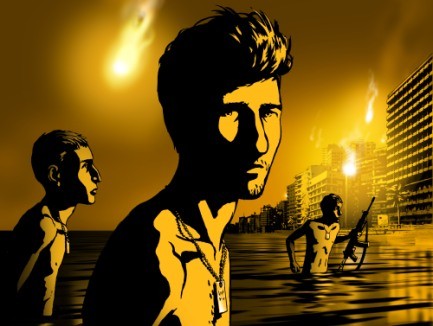
The reality itself is the 1982 Lebanon War, and Folman was directly involved. He fought in the Isreali Army and, now in middle age, he retains a memory of naked young men emerging out of the water before a ruined city. Some key friends figure into this fugue: the long-haired Carmi Cna’an, the teenager who everybody figured would succeed in any science, now living in Amsterdam and fiercely protective of his privacy; Shmuel Frenkel, who has taken up vigorous physical exercise and maintains a bald pate; and Israeli war correspondent Ron Ben-Yeshai, who telephoned then-Minister of Defense Ariel Sharon about the massacres at Sabra and Shatila and was given a peremptory answer to back off.

What is quite interesting about Waltz with Bashir is its production method. Folman tracked down the people who haunted his memories, interviewed them, and then styled an animated narrative around these efforts. He even managed to persuade these people to reproduce their voices for the film. (Only a handful of Folman’s subjects declined.)

Each figure appears flat, representing a clear demarcation along a particular focal point. At times, it’s akin to watching a Flash animation or something involving cardboard cutouts from a pre-digital time. Folman’s team has added layers of smoke and reflections atop this basic approach.

Folman also has respect for his subjects’ wishes. When Carmi Cna’an declares that Folman can draw him as he is talking about war, he requests that Folman not include his son. Sure enough, the camera drifts away from the house as Carmi Cna’an engages in this paternal pastime.

But while the testimony that Folman unravels from his subjects certainly inhabits a feel of a bygone time — an atmosphere enhanced by a decent soundtrack and dutiful pop cultural juxtaposition — Folman fumbles a bit on memory’s false starts. Folman’s best friend and shrink, Ori Sivan, brings up a psychological experiment. When subjects were given photographs containing one false element, they believed that the false element was part of the memory. While Folman has exonerated himself somewhat by presenting this caveat to those seeking truth, he nevertheless remains very determined to align his memories to the film’s final moment: a live-action video clip depicting Sabra and Shatila’s aftermath. And while this footage is heartbreaking, with injustices that made me quite angry, I’m not sure if it is entirely fair to corral the film’s theme of ever-shifting memory to this harder reality. If anything, this piecemeal clip presents additional questions about the relationship between documentation and memory that were better pursued in Standard Operating Procedure. This conclusive curveball not only undermines Folman’s thesis and stubs out the strengths of his early emphases, but I suspect that this eleventh-hour departure was why the critic offered me a diabolical conclusion about war being “a little fiesta.”
The Bat Segundo Show: Jerzy Skolimowski

Jerzy Skolimowski appeared on The Bat Segundo Show #239. Skolimowski is a filmmaker, and is most recently the director of Four Nights with Anna, which is currently playing at the New York Film Festival.

Condition of Mr. Segundo: Waiting for the fifth night.

Guest: Jerzy Skolimowski

Subjects Discussed: Moonlighting (1982), starting from a home to get the lay of the land, the importance of place, how location dictates character motivations, Bruce Hodsdon’s observations about Skolimowski’s objective-subjective dialectic, the importance of story, Leon’s movement in Four Nights with Anna, using sparse dialogue, sticking with the script vs. accidental improvisation, how one of Anna’s reactions originated from an unexpected problem with noisy boots, inserting moments of sympathy for Leon and cleaning Leon’s image, the film’s flashbacks/flash forwards, dead cows floating in the river, decorating Anna’s room, artificial waterfalls, explaining the seventeen-year gap between Ferdyduke and Four Nights with Anna, Skolimowski’s problems with Ferdyduke, the pursuit for artistic satisfaction, Skolimowski’s career as a painter, acting as “easy money,” observing KGB agents and White Nights, collaborating with Polanski on the Knife in the Water script, Skolimowski’s early efforts at poetry, dialogue getting in the way of the visuals, the relationship between political tension in Poland and Skolimowski’s art, and the problems of thinking about money when pursuing art.

EXCERPT FROM SHOW:

Skolimowski: For me, the most important thing is the story. I’m telling the story. And I’m not speculating on what it means more than it is. It’s a story. And of course, one can always find some additional interpretation and some theoretical sightseeing into it.
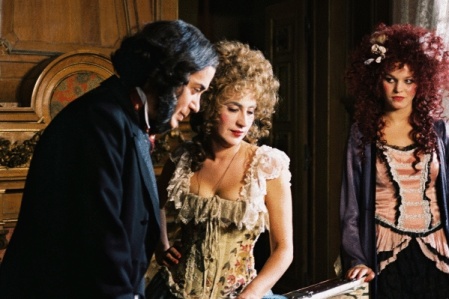
Correspondent: But I’m wondering if you’re perhaps being a little disingenuous here with your answer. After all, there is this chronicle with the ring. Which, of course, made me think logically of the old Jewish tale of putting the ring on the corpse and the like. And here you have it in reverse. And here Leon actually uses this as a kind of code with which to act and use his severance pay on purchasing a new particular ring. And so I’m wondering, when you think about a situation involving a ring, I mean, clearly that is a symbol. So it’s not entirely just basic storytelling, I would think.

Skolimowski: But to me, it is a basic story. And I don’t treat it as a symbol at all. Because logically this ring belongs into the story. He buys this ring for a specific purpose. He executes that purpose. And again, if that means something more, fine. It’s the benefit of it.

Correspondent: This is where audiences come in. You essentially exculpate yourself from responsibility for symbolism and critical analysis and things like this.

Skolimowski: I rather do. Because I think, once again, I have to say the story is the most important. Everything else is just, you know, how would I describe it? It’s….

Correspondent: The additional icing on the cake, I suppose.

Skolimowski: Exactly! Those are the words.

Correspondent: Okay. Fair enough. Well, let’s talk about Leon’s movement. I was really fascinated by it. Because he constantly circles around people. He’s clumsy. He slips in the mud. And again, I was rather taken with a larger allegorical meaning of what this particular movement might mean. Because it’s definitely misfit-like movement from him. And I’m wondering how this came about and how this emerged.

Skolimowski: When I was writing this story, I thought that the character should have a specific complex. That he should be extremely withdrawn and shy. And to manifest it, the best way — as you probably noticed, there’s very little dialogue in the movie. So he is practically not saying anything. He’s got maybe three dozen words through the whole film. But physically, he has to present that character which I wanted to create. So I thought that his walk should be kind of specific. And therefore when I choose the actor, I put some heavy stuff into his boots. I put some lead so each of his boots were like five kilograms heavy. Therefore, he had to walk like this natural.

Correspondent: That explains it. Did he slip because of this? Or was that planned? I’m sure.

Skolimowski: No, the slips were done for purpose. Because I need some light moments. You know, it’s a very gloomy story, and I didn’t want to have the audience be sad all the time. So I purposely planted those moments where one can laugh or at least smile, and have a little bit of relaxation from that tragedy. Because this is a tragic story. Tragic love.

(For related information about the film, here’s our review of Four Nights with Anna.)

BSS #239: Jerzy Skolimowski (Download MP3)

This text will be replaced

NYFF: The Northern Land (2008)

[This is the tenth part in an open series of reports from the New York Film Festival.]

In considering The Northern Land (aka A Corte do Norte), adapted from a Agustina Bessa-Luís novel by director João Botelho and José Álvaro Morais (mysteriously listed in the IMDB as dead, which suggests an intriguing collaboration if you believe in the afterlife), I am compelled to present the following positive facts about Portugal:

  • Portugal has a high Human Development Index and is among the world’s 20 highest countries rated in terms of quality of life.
  • Portugal is ranked as the 8th freest press in the world. (This beats out the United States, quite a bit, in case you were wondering.
  • Portugal has its own form of martial arts called jogo du pau, in which fighters kick the asses of other fighters using staffs.
  • As we all know, Portugal’s capital is Lisbon. And as names for capital cities go, this is quite pleasant to say. Because it sounds much colder than it really is. And then after you’ve said “Lisbon” for the seventy-seventh time, you realize that this is a city name with some character.
  • According to the CIA World Factbook’s page on Portugal, “Azores and Madeira Islands occupy strategic locations along western sea approaches to Strait of Gibraltar.” I do not know the degree to which the Portuguese population itself is aware of these places of beauty as “strategic locations,” but given that The Northern Land is set in this area, I suspect that, on this level, filmmaker Botelho knew what he was doing.
  • You can expect to live about 74.78 years if you are a Portuguese man and 81.53 years if you are a Portuguese woman.
  • Portugal’s literacy rate? 93.3%!

And this is only scratching the surface. There are many good things that one can say about Portugal. I am trying to stay positive. This film’s muddled digital look did not help matters. (And should one call this a film if it does not look like a film?)

However, I am struggling to find something cheery to say about this film. (Let us be fair and aesthetically progressive here.) On a rather base T&A level, Botelho is to be commended for including one interesting costume featuring a single boob sticking out. No doubt the intention here was to bring a peculiar sartorial quality to the proceedings. But this is essentially a Merchant-Ivory-style film that will put any sensible person to sleep. I should note that I checked my cell phone five times during the course of this film to determine the time, and I am a very patient person. I should also note that this film attempts to express sympathy for a family that is squandering its considerable affluence over the course of a century. In light of the current economic disaster and the egregious bailout bill (a zombie in Congress?) that is currently scaring the hell out of anyone with money, this was not exactly a theme that floated my own particular dinghy.

Botelho also has a rather intrusive narrator describing the action for us. The narrator was so lifeless that I longed for a bon mot from Guy Debord. But here’s the thing. Botelho resists dramatizing this action. And what’s more, he has the characters on the screen frozen in their actions while the narrator continues her plodding narration. And the actors deliver their most impassioned performances while they are frozen. When they are released by the narrator, they became less interesting to me. And I was so disinterested in their lives that I longed for them to kill themselves. Fortunately, Botelho does kill a few of them off. But it’s simply not enough.

This, I would contend, is a bad cinematic strategy. When the most compelling visual that a filmmaker presents is a smug and affluent man sitting naked in a large bathing dish, waiting for servants to douse him with water, I likewise must suggest that the filmmaker has failed in some sense. Let me put it this way. I longed to revisit Bullet in the Head and Serbis.

But that’s just me. This is, after all, the New York Film Festival. And that cultural imprimatur will persuade enough misguided cineastes that The Northern Land is a beautiful film. And it certainly is beautiful in the same way that a particularly striking postcard purchased at Duane Reade is beautiful. The people who inhabit this film are not beautiful. Nor are they particularly interesting.

“This island is killing me,” says one member of the spoiled Barros family. And I suppose that this individual had a point. When your biggest worry in life is a bunch of people laughing at you, and when you declare such a common snafu to be an unmitigated “disaster,” and when the insult itself involves being called a “smelly Boal” (about as tepid an insult in any epoch), chances are that just about anything is going to kill your oversensitive soul. Such is the Barros family.

But if you’re the kind of person who genuinely believes that “I have never looked upon my father as a rich man” is the worst insult known to humankind, I suspect you’ll have a better time at this film than I did.

The Bat Segundo Show: Mike Leigh

Mike Leigh is the filmmaker behind Naked, Life is Sweet, Vera Drake, and, most recently, Happy-Go-Lucky, which is currently playing the New York Film Festival (among many others) and opens in the United States on October 10.

Condition of Mr. Segundo: Too unhappy and too unlucky.

Guest: Mike Leigh

Subjects Discussed: Vocational symmetries within Leigh’s films, Oscar Wilde, looking at a community, bad teachers, Leigh’s considerable frustrations about Poppy being “too happy,” the difficulties of filming Poppy’s jewelry, audience members misperceiving details, the confusion over Scott being a taxi driver, Bechdel’s Rule, depicting women who aren’t in relationships, the duty to portray life, Leigh’s problems with semiotics, collaborating with cinematographer Dick Pope, feeling the buzz of a visual instinct, devising Naked‘s opening shot, getting an Ozu fix, pursuing the issue of technology, flamenco dancing, MySpace, drawings and investigating domestic violence, “En-ra-ha,” Aleister Crowley, gloomy bookstore employees and literary references, shooting in High Definition, and film financing.

EXCERPT FROM SHOW:

Leigh: But as to the jewelry as a symbol of cyclical anything, I don’t know whether I’d go along with that one.
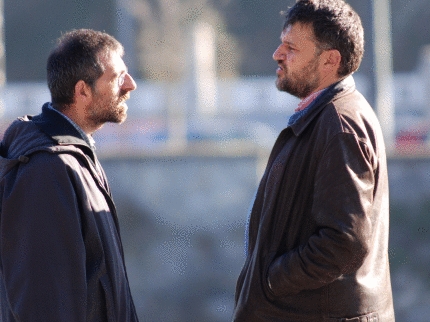
Correspondent: Okay. Well, fair enough.

Leigh: (laughs) Nice try.

Correspondent: Well, let’s talk about another possible symbol. The back pain that she experiences. This to me suggests that here we have Poppy moving forward as her specific identity — “happy-go-lucky” — and yet there is this pain in the back. And, of course, she laughs it off while she’s at the chiropractor’s office. But the thing that’s fascinating about this to me is that, well, this is behind her. So it’s almost as if she has her blinders on. She’s so focused in on moving forward that she doesn’t notice what she’s feeling in the back. And I’m wondering again how much one should read symbols into these particular choices.

Leigh: I think as we progress into this conversation — I think you are plainly a fundamental, unreconstituted, top-rate intellectual. Which I’m not. I think it’s fascinating, your analysis. But I think it’s a load of old rope. Basically. And I can’t go along with it at all. I mean, the fact is, she gets a bend in the back because she pulls her back when she’s trampolining. And it happens to be her back because that’s what she pulls. The back muscle. I think what’s more interesting about that unfortunate thing that happens to her, which gets fixed by an osteopath, not a chiropractor…

Correspondent: My apologies.

Leigh: No, no, you couldn’t, you know. But I think what is interesting, I’ve found, is that, you know, a lot of people — this has nothing to do with your question, but it’s talking about the same part of the film.

Correspondent: Sure.

Leigh: The same aspect of what happens to Poppy. You know, people are conditioned — mainly, courtesy of Hollywood — into the inevitability that something terrible is going to happen. And a number of people have thought, “Oh! She’s got cancer of the kidneys! That’s what this film is about!” Partly because the last film I made was about an abortionist. The fact is that it’s not about that. People say, “Well, couldn’t something terrible happen to her in the film?” And then you think of that. And you say, “No. Because that’s not what it’s about.” Of course, this could become a film about a woman who dies of cancer of the kidneys. But so what? That’s not what it’s about. It’s about somebody who giggles at stuff and is positive.

Correspondent: You also quibbled in another interview over people identifying Scott as a taxi driver instead of a driving instructor.

Leigh: Yeah, people say “that scene with the taxi driver.” I mean, it’s amazing. The number of people everywhere — here, in Paris, in London, in Berlin, and we’re talking about international fests — who call him a taxi driver. And it’s very curious. It’s as though this is a film about an airline pilot and people are calling him a doctor. It’s very strange.

Correspondent: I mean, I’m wondering. Could it be the way that you actually shot him? Because I know that you and Mr. Pope actually used lipstick cams to get…

Leigh: No, no. Come on. You cannot construct any correlation between how the film was shot and the fact that, for some reason, people call a driving instructor a taxi driver. You really can’t do that.

Correspondent: So it’s the audience’s problem. Not yours.

Leigh: No, no. It’s just a weird thing. I mean, I don’t think it’s even a problem. It’s just a strange quirk. But I don’t think anything should be made of it really.

BSS #238: Mike Leigh (Download MP3)

This text will be replaced

NYFF: Bullet in the Head (2008)

[This is the ninth part in an open series of reports from the New York Film Festival.]

Your intrepid reporter has lined up several interviews with filmmakers and has even braved a press conference. (I try to be spontaneous whenever I attend mammoth expositions of this sort, but I wasn’t entirely aware that there was a press conference component to some of the screenings. A good reporter, however, always comes prepared. Just don’t ask what essential items I have in my backpack. I’m sure that my arsenal is somewhat unorthodox. But among the ordnance was some equipment to perform a little experiment.) The press conference did not quite work out to my satisfaction, but I now have a plan in place that should work well for next week.

I saw two films today: one very, very good, the other very, very bad. And there’s still have another film (good) from yesterday that I need to cover. So let’s get the bad apple out of the way first, shall we?

Jaime Rosales’s Bullet in the Head, which by no means should be confused with John Woo’s entertaining 1990 action flick of the same name, is a sleep-inducing mess that should be avoided at all costs. If you’ve been reading the nearly 10,000 words (!) I’ve generated here, you may recall that I expressed certain reservations with Serbis. I was fairly certain that I wouldn’t see a film that could be worse. Much to my regret, I was proved wrong this afternoon. (It’s a strange coincidence that probably means nothing, but I must point it out. Both films feature a sound mix loaded with intrusive street traffic.)

Despite copious quantities of coffee that were ingested very carefully in the morning, your intrepid reporter was forced to slap his cheeks in order to stay awake. Not just once. Four times. Unfortunately, I was not armed with a large trout that could probably wake me up in one slap. So I had to settle for palms that needed to do it in four. I caught a glimpse of my mug in the mirror about an hour ago and espied a slightly pinkish mark from these pelts. Let it not be said that your intrepid reporter nodded off on the job. I cannot say the same for some of my colleagues.

Let us be clear. Within Rosales’s film lies a perfectly interesting concept for a good 15 minute short. This is a film determined to tell its story without a line of dialogue. And with the exception of a character yelling “Fucking cops!” twice, it clings quite devoutly to this credo. I presume that this “artistic” choice was made so that the film would stand a better chance of being accepted into film festivals around the world. Or maybe the idea here was to cut down on the subtitling bill. Whatever the motivations, Rosales’s approach shares much in common with the flawed but interesting 1952 film, The Thief, which starred Ray Milland as a physicist and did not feature a single line of dialogue. But The Thief, for all of its problems, at least gave us an FBI agent pursuing Milland and featured the Empire State Building. Rosales’s film, by contrast, features not a single distinguishing landmark. Nor is there an FBI agent.

I would have liked an FBI agent.

There are, however, two cops. But they don’t really look like cops and they don’t really offer what one might identify as cop-like behavior. Instead of the character shouting “Fucking cops!,” he might have yelled “Fucking nondescript guys around thirty!” I contend that this would have been a slightly subversive and more entertaining line of dialogue for Rosales to deploy. And if Rosales had inserted this line into the movie, I would have been the first to declare Rosales a genius. But “Fucking cops!” is what we have to work with here. So “Fucking cops!” it shall be.

Bullet in the Head, for its first hour, doesn’t clue us into the possibility that there might actually be a bullet fired into someone’s head. The film saves this violent moment for later. So if you’re looking for a bullet in the head, you’ll get one. Just don’t expect anything spectacular. And I may have spoiled the film a bit by pointing out the cops. But maybe I’m not really giving anything away because the movie is, after all, called Bullet in the Head. So there’s a certain promise here in the title that the film has to live up to.

We see characters talking behind windows, across the street, at the other end of a restaurant, and at pay phones. Strangely enough, nobody in this movie seems to own a set of blinds or drapes. Which strikes me as damn curious and damn convenient, especially since we see the stoic Ion (played by a burly guy named Ion Arretxe, which suggests that Rosales is quite lazy in naming his characters) getting it on with his girlfriend/wife. Rosales, to his credit, does occlude our view of the events quite frequently, having people pass while the camera pans, thus deliberately mangling the camera move. He does sometimes choose interesting and incongruous audio to play over the visuals, such as a basketball court in the film’s establishing shot of Ion’s apartment. The actors don’t overexpress with their hands too much. And there is one amusing moment at a restaurant in which three people try to look over at another table without suspicion, and their body language indicates how obvious their efforts to be sneaky are.

But this film isn’t called Views Through a Window. It’s called Bullet in the Head! And your intrepid reporter, being a patient man, eagerly awaited a payoff. But there was none. There was indeed no compelling narrative to speak of. No particular detail within the apartment decor that might have said something about the characters. But I can assure you based on the number of eating shots that Ion is a character who likes to eat.

I suppose I would have enjoyed this film if I could (a) read lips and (b) read lips that spoke Spanish. But I am only slightly competent in (a) and utterly incompetent at (b). And if Rosales really wanted us to know what the characters were saying, he would have provided us with audio and/or subtitles.

So what we have here is a pretty disappointing film — indeed, one so disappointing that there was an audible hiss from the critics when the credits rolled. And while I’m not a guy who likes to fall into critical consensus, I will admit that the hissers had a good point. I certainly hope that Rosales’s misfire doesn’t hinder other filmmakers from making films without dialogue. There is much within our body language and our actions that is interesting without silly lines getting in the way. But these future filmmakers may want to consider including an FBI agent.