The Bat Segundo Show: Robert A. Caro

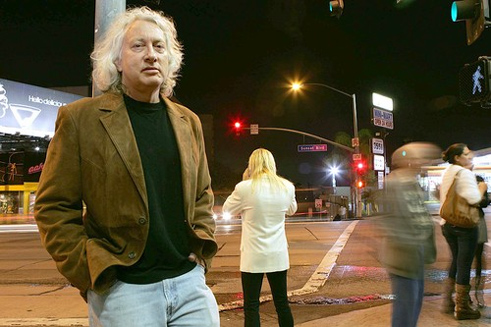
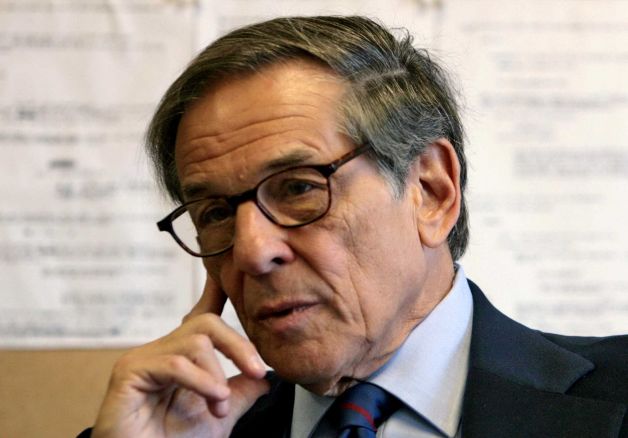
Robert A. Caro appeared on The Bat Segundo Show #455. He is most recently the author of The Passage of Power.

Condition of Mr. Segundo: Expressing his determination to keep the forward thrust of America began with notable historians.

Author: Robert A. Caro

Subjects Discussed: Lyndon B. Johnson as a great reader of men, Horace Busby, Johnson talking with people until he got what he wanted, Johnson’s misread of John F. Kennedy, the 1960 Presidential Election and Johnson’s self-sabotage streak in seeking the nomination, Emmett Till and Autherine Lucy, passing the 1957 Civil Rights Act, Jack Kennedy’s use of television, Johnson having his staff calculate the odds of a U.S. President dying in office, “power is where power goes,” Sam Rayburn, Johnson’s mode of desperation vs. Steve Jobs’s “reality distortion field,” Southerners as Presidents, Johnson’s decisiveness in the Senate, John Connally, Johnson’s fear of failure, Sam Houston, Johnson not wanting to be like his father, Johnson’s inability to stare physical reality in the face, smoking and fluctuating weight, challenging Arthur Schlesinger, Johnson being shut out from many of the key Kennedy meetings as Vice President, Johnson’s humiliations, LBJ being reduced to a “salesman for the administration,” the spiteful rivalry between Robert Kennedy and LBJ, character being a defining quality of politics, the importance of vote counting in Washington, Johnson as Senate Majority Leader, Johnson’s preying upon the loneliness of old men, Richard Russell, the Armed Service Committee, Johnson’s manipulation of Russell on civil rights and the Warren Commission, how Southern Senators were duped into believing that Johnson was against civil rights, the phone call in which Johnson forced Russell into the Warren Commission, how Johnson preyed on older men to get what he wanted, Kennedy’s tax bill, how Johnson worked on Harry Byrd, how Johnson dealt with human beings, the impact of personality on policy, Johnson’s terrible treatment of Pierre Salinger, Johnson bullying his subordinates, what Caro found the hardest to write about, triumphs of willpower, Johnson’s involvement with Bobby Baker, the Bobby Baker scandal, the surprising sensitivity with which the media handled Johnson’s corruption after the Kennedy assassination, the Life investigative team on Johnson (as well as Senate investigation), the lowering of the Presidency because of Johnson, some hints about Volume V, and Johnson’s legacy.

EXCERPT FROM SHOW:

Correspondent: You challenge in this book Arthur Schlesigner’s long-standing notion about the relation between Kennedy and Johnson. Now Johnson is in the vice presidential seat. Schelsinger’s idea was that, well, Kennedy was absolutely fond, genial, and generous. The vice president was included in most of the major meetings. And then, of course, we read this chapter “Genuine Warmth” and we find out, well, wait a minute! That’s not always the case. According to Ted Sorenson, Johnson was shut out from a pivotal ExCom decision, a decision meeting relating to the Cuban Missile Crisis. And that also is in large part because Johnson is a bit hawkish to say the least. So my question is: why has the lens of history been so keen to favor the Schlesigner viewpoint? And what was the first key fact that you uncovered that made you say to yourself, “Well, this isn’t exactly true”? What caused you to start prying further and further? That caused you to think, well, things are not all wine and roses.

Caro: Well, you know, part of it was that as soon as you start to look at Johnson and the Kennedys, you hear about the nickname that the Kennedy people called him. “Rufus Cornpone.”

Correspondent: That’s right.

Caro: “Uncle Cornpone.” “Uncle Rufus.” You know, they coined phrases for Lyndon Johnson and Lady Bird. They used to call them “Uncle Cornpone and His Little Pork Chop.” Then you ask someone like Ted Sorensen, who helped me immensely. He was the person probably closest to Kennedy in the administration.

Correspondent: You spent a lot of time with him.

Caro: I spent a lot of time with Ted. And he said, yes, as has previously been said, Johnson was included in all the big meetings, the Cabinet meetings, the National Security meetings. But in the Kennedy government, those weren’t the meetings that mattered. The meetings that mattered were the small little groups that Kennedy would convene. And Johnson wasn’t invited to those. You know, when the 1963 Civil Rights Act is introduced by the Kennedys and Johnson has to say to Ted Sorensen — we happen to have a recording — “You know, I don’t know what’s in this act. I have to read about it in The New York Times.” The greatest legislator possibly of the century, the greatest legislator of the 20th century is not consulted on Kennedy’s legislation.

Correspondent: Why then has the Schlesinger lens been allowed to proliferate for so long? That’s the real question.

Caro: Well, I don’t know that it’s just the Schlesinger lens.

Correspondent: Or this idea.

Caro: I really can’t answer that question. But when you talk to the surviving Kennedy people — like Sorensen — when you read their oral histories, you see it’s simply not true. I mean, Horace Busby talks basically about going to see Sorensen one day and asking, “Well, what role do you want Lyndon Johnson to play in this administration?” And Sorensen says, “Salesman for the administration.” I mean, this is Lyndon Johnson, who is to be the salesman for the administration. Johnson says to an aide, Harry McPherson — you know, they’ve turned the legislative duties over to Larry O’Brien. Johnson says, “You know, O’Brien hasn’t been to see me to ask advice once in two years.” So it’s undeniable that Johnson was shut out from Kennedy’s legislative processes and from the Cuban Missile Crisis — the key meeting of the Cuban Missile Crisis. He’s not invited to it.

Correspondent: I know. It’s really amazing. One of the other great showdowns in this book — the great clash is between Bobby Kennedy and Johnson. I mean, you want to talk about cats and dogs, these two guys were it. You have their first meeting in the Senate cafeteria in 1953 where Kennedy was glowering at Johnson and forced to shake his hand. Then years later, Johnson is Vice President. And he’s largely powerless as we’ve been establishing here. He serves on the Committee on Equal Employment Opportunity. And Bobby Kennedy shows up late, humiliates him over two meetings.

Caro: Yeah.

Correspondent: And then on the Saturday after the Kennedy assassination, there’s this misunderstanding over how the West Wing is going to be cleared out and ready for Johnson. There’s this very tense meeting not long after. But Johnson is in this interesting predicament of having to maintain the Kennedy faction all through Election Day in 1964. Yet he also tests the waters a bit with the Thomas Mann nomination. So my question is: was there any hope of Bobby Kennedy and Johnson putting aside their differences? What factors do you think caused Bobby to acquiesce to Johnson for the good of the nation while Johnson was President?

Caro: Well, he doesn’t always acquiesce.

Correspondent: Sure.

Caro: We see him breaking with him strongly over Vietnam in 1967 and 1968 and running for the nomination. I mean, when Bobby Kennedy enters the race, Lyndon Johnson bows out basically. You know, people don’t understand, in my opinion, enough. And I try to explain in my books how personality, how character, has so much to do with politics and government. And with Robert Kennedy and Lyndon Johnson, whatever the reasons are, at bottom you have this personal hostility. You talked about the first meeting. You know, this first meeting is when Lyndon Johnson is the Leader. He is the mighty Leader. Bobby Kennedy — I think he’s 27. And he’s just gone to work for Senator Joe McCarthy as a staffer. So Joe McCarthy — the Senate cafeteria is on the second floor of the Senate Office Building. And every morning, Johnson goes in there to have breakfast with his aides. And Joe McCarthy is sitting every morning at this big round table near the cashier with four or five or six of his aides, you know. And every time Johnson comes in, McCarthy jumps up as everyone does to Johnson and says, “Hello, Mister Leader. Can I have a few moments of your time, Mr. Leader? Good work yesterday, Mr. Leader.” One morning, there’s a new staffer there. It’s Robert Kennedy. Johnson walked over. Senator McCarthy jumps up. And so, as always, do all his staffers. Except one. Robert Kennedy, his 27-year-old staffer, sits there glaring at Johnson. Johnson knows how to handle situations like this. He holds out his hand to everybody sort of halfway out and forces Bobby Kennedy to stand up and take his hand. And George Reedy said to me — I said, “What was behind that?” George Reedy said, “You know, you ever see two dogs come into a room that never met each other and the hair rises on the back of their neck immediately and there’s a low growl?” That was the relationship between Bobby Kennedy and Lyndon Johnson. Of course, there were other reasons. Robert Kennedy was very attached and devoted to his father, Joseph Kennedy.

Correspondent: Sure.

Caro: And Johnson, who was close to Roosevelt, was always repeating these stories about Roosevelt firing Joe Kennedy, tricking him into coming back to Washington from England, and then firing him. Making him look bad. So I think that Robert Kennedy hated him for that. But it’s not too strong a word to use hatred for what was going on between Bobby Kennedy and Lyndon Johnson. And, you know, at the convention, one of Johnson’s assistants, Bobby Baker, he thinks everything’s just politics. So he’s having breakfast in a coffee shop in Los Angeles at the convention. He sees Bobby Kennedy come in and says, “How about sitting down?” He’s Bobby Baker, sitting with his wife, having breakfast. Bobby Kennedy sits down. But within two minutes, he’s up. And he throws money on the table. And he says to Baker, “Don’t worry. You’ll get yours when the time comes.” Well, the time came. Johnson was Jack Kennedy’s Vice President. Bobby Kennedy has, in effect, power over him. And he makes life miserable for Lyndon Johnson.

Correspondent: What you said at the beginning of this, about character being a defining quality of politics. I mean, Johnson, as you establish in this book and in Master of the Senate, is a master vote counter. He has his tally sheets when he’s in the Senate. He’s going ahead and making sure he knows exactly how things line up. In this book, you point out during the wheat bill that not only does he want enough votes to make the wheat bill [an amendment from Sen. Karl Mundt banning sale of surplus wheat from Russia] die. He wants it murdered, as he says. So the question I have. He may have been a master vote counter. But how much character did he need to go along with that? Was vote counting enough for him? Was that relentless drive just as much of a quality as the sheer statistician approach that he had?

Caro: It was never a sheer statistician, of course.

Correspondent: Of course.

Caro: He was a great legislator. Listen. A key thing in politics is the ability to count. And Johnson was the great counter. He’d send aides to find out how senators were going to vote. So sometimes someone would come back. Usually they didn’t do this more. They said, “I think Senator X is going to vote this way.” Johnson would say, “What good is thinking to me? I need to know.” He never wanted to lose a vote. So vote counting. He was the great vote counter. He’s a young Congressman. He comes to Washington. He’s 29 years old. He falls in with this group of New Dealers, who later become famous. Abe Fortas. Jim Rowe. “Tommy the Cork” Corcoran. These are guys who live and breathe politics. And do you know what they do when they have a dinner party on Saturday night? They get together for dinner. They count votes. They say, “How is Roosevelt’s bill on this going to be?” And Johnson, they said, was always right. We might think this Senator was going to vote this way. Johnson always knew. He was the greatest vote counter. And when he was in the Senate, he was the greatest vote counter of them all. But that’s not all of why Johnson was great. Johnson was this master on the Senate floor. He got through amendments. And there’s the base. And there’s shouting back and forth. He can seize the moment. He sees the moment where he can win. And he acts decisively. He says, “Call the vote.” And he’s Majority Leader. And he would stand there at the Majority Leader’s desk. So he’s towering over everybody else’s front row center desk. He’s got this big arm in the air. And if he’s got the votes, he wants the vote fast before anyone can change. Or maybe some other people on the other side are absent and not there. He makes little circles on his hands, like someone revving up an airplane, to get the clerk to call the rolls faster. And if one of his votes wasn’t there, and he was being rushed from somewhere in a car across Washington, he would make a stretching motion with his hands. He ran this. There were a lot of things that went into Johnson’s dominance of the Senate.

The Bat Segundo Show #455: Robert A. Caro (Download MP3)
This text will be replaced

The Bat Segundo Show: Stewart O’Nan II

Stewart O’Nan appeared on The Bat Segundo Show #454. He is most recently the author of The Odds. He previously appeared on The Bat Segundo Show #161. You can also read our lengthy conversation by email in 2011. This 2012 talk was recorded before a live audience at McNally Jackson. My gratitude to Michele Filgate, Langan Kingsley, Holly Watson, and, of course, Stewart O’Nan for their help in putting this event together.

Condition of Mr. Segundo: Inexplicably hungering for Wendy’s hamburgers.

Author: Stewart O’Nan

Subjects Discussed: [forthcoming later this afternoon]

EXCERPT FROM SHOW:

Correspondent: Niagara Falls. Here is a location that’s loaded with all sorts of associations. Joyce Carol Oates wrote a book there.

O’Nan: The Falls.

Correspondent: Yes, exactly.

O’Nan: Yes, I was introduced the other night as “the author of The Falls.”

Correspondent: (laughs)

O’Nan: And I was like, “Not that prolific.” Not nearly.

Correspondent: (laughs) Well, you are churning them out one a year.

O’Nan: Oh thank you. Churning them out. You said cranking before.

Correspondent: Crafting! Cranking, churning. All right. But they’re short! They’re short.

O’Nan: They’re tiny.

Correspondent: There’s craftsmanship in there. Don’t worry.

O’Nan: I understand.

Correspondent: But I’m wondering. You’re taking a location that’s loaded with all sorts of cultural baggage. There’s that Marilyn Monroe/Joseph Cotten film.

O’Nan: Gotta love it.

Correspondent: But I’m wondering. Here you are taking two characters and putting them in a touristy location. I’m wondering if you did that to work up against limitations and see what kind of behavior you could mine based off of that. I’m wondering why you chose this. What was the process of selecting the Ice Bridge or the details of the customs location? What went into nailing Niagara?

O’Nan: Well, it’s a ready made stage. Usually when I take on an area or a setting, it’s virgin territory in a way. Conneaut, Ohio. Kingsville in Songs for the Missing. No one’s ever written about that in any kind of novel. Western Pennsylvania. Butler, PA in 1974. So I always say I’ve written the best Butler, Pennsylvania novel ever written.

Correspondent: (laughs)

O’Nan: Or Avon, Connecticut. Usually these are overlooked places. Like New Britain, Connecticut, that Last Night at the Lobster takes place in. I write in that interzone, that nowhere America of strip malls. It has been kicked around forever. But in the new book, I thought, let’s focus solely on the characters and put them on a stage that everybody knows. So I don’t have to do that disorienting, here is the place that you don’t know and now I’m going to tell you about it. So I had a little less responsibility to the setting and I could spend a little bit more time on the characters.

Correspondent: I have to ask you about the odds as chapter headers for all of these. Some are, in fact, true. “Odds of a black number coming up in roulette: 1 in 2.06.” I Wikipediaed that. Some are unscientifically true. “Odds of a marriage proposal being accepted: 1 in 1.001.” So I’m wondering. How many odds did you collect? I mean, I’m wondering if you were sitting on a bunch of odds sets.

O’Nan: Yes. Yes.

Correspondent: You were?

O’Nan: Yes, I was. And I was trying to figure out: How do I weave these into the book and what effect are they going to have when I get them in there? And they seemed to me to work. When I thought of using them rather than chapter headings, in the way I did with, say, Emily or in Songs of the Missing, I saw them as how the chapter headings are in something like Blood Meridian or in, say, 19th century fiction work, which is “In this chapter I am eaten by sharks.” And before you even get into the chapter, you’re like, “Oh sharks! This could be cool!” So it kind of brings the reader and it gives them an expectation of what may happen in this chapter. Not necessarily has to happen. But it may happen. The odds of dying in a bus crash. Whoa! There might be a bus crash. I’ll stick around and find out.

Correspondent: It’s interesting. Because here you are in one sense messing with the reader for the first ten pages, repelling them, and then on this, you’re subverting their expectations. It’s actually, “Ooh! I want to continue to read this chapter.”

O’Nan: Well, you hope.

Correspondent: What of this bipolar approach to fiction writing?

O’Nan: Flannery O’Cononr. Flannery O’Connor said, “Distract them and hit them over the head.” Absolutely right. Absolutely right. Give them a reason to come into the place. A Prayer for the Dying. The opening sections are very — it’s a terrible thing to say, very beautifully written. I use the language. I make the beauty of the language a key thing to hang into. And so the reader gets rewarded somehow. And by the time they have to go through the book, they’re kind of stuck. They’re like, “Well, I don’t really want to hang around and watch this guy go crazy while I’m inside of his mind.” Well, it’s too late. So like Poe, say, in “The Black Cat.” Once you get them in the door, then after a certain point, they’re kind of yours. They have to follow along. Or you hope so. You always hope so.

Correspondent: I’m curious if the odds sets actually were methods for you to riff off of Art and Marion. If you were stuck at a certain place. Is this a point? I mean, you’re a former engineer. I presume that this was either heavily designed. Or were there false starts? And did the odds help you in anything?

O’Nan: No. There weren’t a whole lot of false starts. I knew the characters very well before I opened up. It’s also a small novel. It’s very much sort of a drawing room novel in a way. It’s the one weekend. You’ve got the unity of place. The unity of time. You’ve got a lot of pressure on them from the memories. This is their second honeymoon. They’re in Niagara Falls. And you have the time pressure of, well, at some point, they’re going to have to put their money down on the wheel. And they’re always kind of at odds with one another. They’re always picking at one another. So I had a lot to work with. The plates were already spinning when I started getting into it.

Correspondent: I wanted to also ask you. One interesting thing that you also do with Marion is body image. She doesn’t like Art to see her undress. And in one of the passages you’re going to read tonight, the only thing you mention is her stomach. We actually don’t really know what she looks like physically. So I’m wondering if this is a method for you to not reveal certain details to the reader or this reflects your relationship to the reader. Is this your way to protect your own characters? To not divulge all? Or is this your way to encourage judgment? Perception on the reader’s behalf?

O’Nan: This is more to encourage the reader to join in the process of creating the work. And I don’t say what the character looks like unless it’s really necessary to the arc of the story there. So what the characters look like is completely up to the reader there. And I leave judgment to the reader. I don’t try to steer the reader too much in terms of who’s good, who’s bad, who’s right, who’s wrong. And it’s always sort of that inkblot that shows how generous the reader can be or how, on the flip side, how stingy they can be. “I hate Marion. I hate her so much.” It’s like, “Easy there, lady. Easy there.”

Correspondent: Have you had this happen before?

O’Nan: Oh yeah.

Correspondent: Wow. Really?

O’Nan: In Wichita of all places.

Correspondent: Wichita!

O’Nan: “I didn’t like her.” Well, that’s good. That’s your prerogative. That’s fine. That’s you.

Correspondent: You know, one of the interesting things — I’ve read a number of reviews of this book. And they actually don’t mention, for example, Karen or these two characters who are having affairs with the couple. And I’m curious about this. Maybe this relates to this issue of giving the reader something. Maybe they don’t want to talk about this aspect of Art and Marion. What do you think of this?

O’Nan: Yeah. I think they want to key more on Art and Marion and just say, “Look, there are problems in the marriage.” And this is how they work them out over this weekend. Or don’t work them out.

Correspondent: Inevitably, because you do deal with Heart, I have to bring up celebrity gossip.

O’Nan: Heart.

Correspondent: So in late 2010, Nancy Wilson and Cameron Crowe initiated divorce proceedings. It was a great shocker to certain waves.

O’Nan: So sad. They had everything going for them, didn’t they? They did.

Correspondent: Yeah. I’m wondering if you including the Heart concert before or after you heard this news. Or if you possibly predicted this dissolution in anyway. I mean, what of this?

O’Nan: I don’t know.

Correspondent: Some sort of angle here.

O’Nan: No. I don’t know. It’s accidental subtext, I guess. I guess it happens from time to time.

Correspondent: Another silly question. Wendy is a character. And I have to ask you, and I know this is really pedantic, but I have noticed in all of your books — nearly all of your books — there’s a moment where someone eats Wendy’s. A Wendy’s hamburger.

O’Nan: Really?

Correspondent: But not, not in The Odds. The last time I saw this was Last Night at the Lobster. There was a Wendy’s moment. It was the Stewart O’Nan Wendy’s moment!

O’Nan: He doesn’t go to Wendy’s.

Correspondent: Oh, he doesn’t go to Wendy’s?

O’Nan: He decides not to go to Wendy’s.

Correspondent: But he does actually consider it!

O’Nan: This is a climax. This is a climax in an actual work of fiction. “Want to go to Wendy’s? Nah.”

Correspondent: Do you eat at Wendy’s quite a bit?

O’Nan: No. Maybe that’s it. Maybe I want to eat at Wendy’s more. I can see my biographer doing a lot on Wendy’s now. A map of all the Wendy’s around my house.

(Photo credit: Here)

The Bat Segundo Show: Steve Erickson II

Steve Erickson appeared on The Bat Segundo Show #447. He is most recently the author of These Dreams of You. He previously appeared on The Bat Segundo Show #180.

Condition of Mr. Segundo: Contriving plans to join a community of one half.

Author: Steve Erickson)

Subjects Discussed: Writing a novel around short bursts, plagiarizing the future, The Sea Came In at Midnight, the novel as kaleidoscope, rationale that emerges midway through writing a novel, losing 50 pages in These Dreams of You, not writing from notes, Zan’s tendency to hear profane words from telephone conversations, the considerable downside and formality of being dunned, fake politeness and underlying tones of contempt, not naming Obama, Kennedy, or David Bowie, Molly Bloom in Ulysses and Molly in These Dreams of You, Erickson’s commitment to the ineffable, letting a reader find her own meaning, defining a character in terms of story instead of public and historical terms, listening to David Bowie to get a sense of Berlin, Erickson’s cherrypicked version of Bowie’s Berlin Trilogy, not capitalizing American and European throughout Dreams, using autobiographical details for fiction, Jeanette Winterson’s Why Be Happy When You Could Be Normal?, “part fact part fiction is what life is,” dating a Stalinist, why fiction is more informed by real life, how invented details encourage a conspiracy, the dissipating honor of being true to what is true, the last refuge of a bad writer, what a four-year-old can and cannot say, bending the truth when it sounds too fictional, Kony and Mike Daisey, combating the needs for believability and readers who feel defrauded, authenticity within lies, kids and photos who disappear in Dreams, striking a balance between the believable and the phantasmagorical, fiction which confounds public marketeers from the outset, postmodernism’s shift to something not cool, limitations and literary possibilities, the burdens of taxonomy, living in a culture that wishes to pigeonhole, why Zeroville and These Dreams of You gravitate more toward traditional narrative, reviewers who are hostile to anything remotely unconventional, writing a novel from the collective national moment, the relationship between history and fiction, being a man “out of time,” thoughts on how a private and antisocial reading culture is increasingly socialized, having an antisocial temperament, writers who cannot remember the passages that they write, the pros and cons of book conventions, and being “a community of one.”

EXCERPT FROM SHOW:

Erickson: We do live in a culture that wants to pigeonhole things. I don’t know whether that’s a function of late 20th century/early 21st century culture or is a function of American culture, or some combination of the two. In Japan, for instance, they don’t seem to worry about that when it comes to my novels.

Correspondent: But with Zeroville and with Dreams, we have moved a little bit more toward traditional narrative. I mean, maybe the impulse was always there. But do you think this has just been symptomatic of what you’ve been more occupied with of late? Fusing that traditional narrative with, say, some of these additional ideas of disappearance, of inserting words into sentences, and so forth?

Erickson: Right. Well, it’s hard for me to know. There are still a lot of people out there who would read this novel, These Dreams of You, and think it’s a pretty damn unconventional novel. They may not have read Our Ecstatic Days and thereby see this novel as whatever you want to call it: more accessible. But I can tell from the reviews I’ve gotten on this novel, which have largely been somewhere between good and better than good, nonetheless there are reviewers out there who really don’t quite know what to make of even this particular novel, which I think you’ve rightly said steers a little bit toward the conventional than earlier novels. And in the case of Zeroville, again, I had a strategy from the beginning, having thought about this novel for a while. I had started the novel at one point and I was writing it differently. And I was writing it — I don’t mean differently in terms of my earlier books. It was written more like my earlier books. And I stopped. I threw it out. Because I felt that this novel is about loving the movies, being obsessed with movies. It should have some of the energy of a movie. It should follow some of the narrative laws of a movie. So you had a lot of dialogue and a lot of the story being told in external terms. Being told in dialogue. Being told in action. Not a lot of motivational stuff. The main character in that novel, we never quite know where he’s coming from. We never know if he’s some kind of savant, or socially and mentally challenged. We never know.

In the case of this novel, I was aware at some point that, first of all, I was writing a story about a family, which I had never done. And, secondly, I was writing a story that it became clear to me, really from the first scene, that addressed the national moment and a moment that any reader could recognize in a way that none of my other novels quite had. Los Angeles was not submerged in a lake or covered by a sandstorm. It was out of that opening scene of the novel, which was the real-life scene that led to writing the novel. I merged a story that I thought would be recognizable to most readers. And I didn’t want to completely lose that. There are a lot of times in the novel that I think that is challenged. That recognizability. Or that recognition rather of the contemporary moment. Halfway through the book, the story suddenly changes track. But even as I was taking the reader, even as three quarters of the way through the book I knew the reader was going to be saying “Where is this thing going?” I didn’t want to lose that connection between the book and a moment of national history. It’s a history that’s still going on. It’s not a history of the past, but of the present. I didn’t want to lose that connection.

Correspondent: But why did you feel at this point, with this novel, that you needed to respond to the national moment? I mean, history is something, especially as it is unfolding, that one doesn’t necessarily feel obliged to respond to. So now you’re getting into questions of, well, is it possible that you are giving into the reader somewhat? In light of the conditions that we were describing earlier. Where did this need to respond to the 2008 climate come from?

Erickson: Well, I think it was completely personal. I was sitting on the sofa watching the election in November 2008 — Election Night — with my black daughter. And I knew this was a singular moment for me. And I knew this was a singular moment for her. And it was a singular moment for the country. And it was one of those cases where the story made itself manifest to the point of screaming at me. Here’s a story that not many other people are in a position to tell, given the circumstances of their lives as those circumstances were coinciding with the circumstances of the country.

Correspondent: Sure. I wanted to actually go back into the intertextuality within the novel. You have this character — J. Willkie Brown, the Brit who invites Zan over to give the lecture on “The Novel as a Literary Form Facing Obsolescence in the Twenty-First Century, Or the Evolution of Pure History to Fiction.” Now if we call journalism the first draft of history, it’s interesting that you also describe that “Zan’s single triumph over Brown is that, in time-honored journalistic tradition, the world-famous journalist always longed to write a novel.” It’s also interesting that Zan must return to his American roots: the original British origin point, right? To collect his thoughts on how he has dealt with words. And I’m wondering how much this relationship between history and pure fiction is predicated on Anglo-American relations. Can any novel or any life entirely deflect “the crusade against gray” that you mention?

Erickson: The crusade against what?

Correspondent: The crusade against gray. It’s when you’re describing Ronnie Jack Flowers and the specific content of his views. I wanted to talk about him, if it’s possible too.

Erickson: Yeah. That’s a big question. Early on, Zan wonders — or actually an omniscient narrator wonders by way of Zan — if this is the sort of history that puts novelists out of business. And I’m not sure I’ve got a sweeping cultural answer for all this. At some point early on in my life, well before the 21st century, I knew that I was a man out of time. I knew that the great art form of the 20th century was film. And I still believe that. And at the same time, popular music was rendering other media obsolete or, in terms of relevance, was usurping all of these other forms. But my talent and my temperament is to write novels. You know, and I should probably have been born fifty years earlier. And so as much as I would love to convince myself that I am operating in the central cultural arena of the time, I know I’m not. I know that fiction becomes not a fringe form, because too many people still read. And not even a secondary form. But a form that becomes more private. That is not shared with the culture at large. I mean, people read novels in private. Whereas they still tend to watch movies in public. Even as we watch more and more movies by ourselves at home. Even as they tend to respond still to music in public, whether they’re in the car with their sound system. So it’s just…it’s what I do. And it’s what I’m stuck doing. And the relevance or significance of fiction in relationship to history or journalism is almost beside the point for someone like me.

Correspondent: So working in a cultural medium that is below the mass culture omnipresence is the best way for you to negotiate these issues of history and fact?

Erickson: Well, I think…

Correspondent: A more dignified way?

Erickson: No, I think, Ed, it’s the only way I know. That’s all. I don’t know that it’s the best way or the more dignified way. I mean, I can’t rationalize it in those terms. In a way, I would like to be able to. You know, at some point early on, I thought a lot about filmmaking. When I was in college, I was actually a film student.

Correspondent: Yes.

Erickson: But I recognized at some point that, for better or worse, whatever talent I had — I felt I had some talent writing fiction. I had no idea whether I’d have any talent making movies. But perhaps even more importantly, temperamentally fiction is the province of a loner. Fiction is about locking yourself up in a room and having as little social interaction with other people as possible, and living in this world that you’ve created. There is nothing collaborative about it in the way that film is, or even making music is. So the answer to your question is entirely personal. It’s entirely personal. It’s what I was just meant to do.

Correspondent: You just have an anti-collaborative temperament.

Erickson: Absolutely I do. I mean, it’s more than that. I have an antisocial temperament. I teach in a writing program back in California and I have a lot of problems, actually, with writing programs and writing workshops. And I tell my students this. I say, the thing is, the paradox is that a writing program socializes what is really an antisocial endeavor. There’s something very strange about shutting yourself off from the rest of society to create this world or reality that’s completely yours and that you don’t share with anybody until it’s done, and even then you share it on a very private basis. If someone’s sitting across the room, and they’re reading one of my novels, I’m going to leave. You know, I don’t want to be there. Because even though I know that the public has complete access, what I did still remains so private to me, I don’t want to be around when somebody’s reading my work. Except for cases like this, I don’t especially want to have casual conversations about it. Perhaps strangest of all, and I’ve heard a number of other writers say this — I heard Jonathan Lethem say it a few weeks ago — people will come up to me, for instance, and ask me about a section of a book and I have no recollection of what they’re talking about. I have no recollection of writing it. I have no recollection of what I was thinking when I wrote it. I often have to ask them to show me what it is. Because I was utterly immersed in that, and then it’s done, and I need to leave it behind.

Correspondent: Running away from people who are reading your books. I mean, does this create any problems for you to go about your life? If you’re interested in the types of things that Steve Erickson readers are likely to be interested in, this could create some intriguing social problems.

Erickson: Well, as uncomfortable as it may make me to be in the same room, I would love to tell you that my life is littered with scenes of people reading my books everywhere I go. But that’s not the case. So it doesn’t happen that often. But I don’t have a lot of conversations with people who are casual friends about my work. And I don’t want to. So in that sense, the antisociability — is that the right word for it? The antisociability of the writing and the work, it does go on. It bleeds outside the lines of the life of that work, and it bleeds into areas of my other life, where I don’t, even though I’m always a writer, I don’t want to be interacting with people as a writer.

Correspondent: So is there any place for community? An increasing term used, I find, in writing. We have a “literary community” and so forth. Is this a logical extension of what some people find in, say, AWP or MFA workshops? Is there any possible place for community for you? Or that you find of value?

Erickson: For me, not especially. For other writers, perhaps. And I’ve been to AWP. And I’ve been to book conventions. The LA Times Festival of Books. And I can even drive a certain amount of pleasure for 24 hours to meet other writers. But the only community that gets any writing done is a community of one. And at the point that it becomes too much a salon, then I check out of it.

Correspondent: So for you, being antisocial is the truest temperament for an artistic writer.

Erickson: Well, I don’t know how you can be anything else. Certainly at the moment that when you’re doing the work. For me, that’s true, yeah. I can’t speak for other writers.

(Photo: Stefano Paltera)

The Bat Segundo Show #447: Steve Erickson (Download MP3)

This text will be replaced

The Bat Segundo Show: Adam Wilson

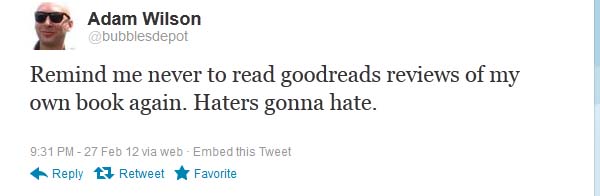
Adam Wilson appeared on The Bat Segundo Show #439. He is most recently the author of Flatscreen.

Condition of Mr. Segundo: Seeking his remote control and his dignity within an armed blanket.

Author: Adam Wilson

Subjects Discussed: Wilson’s dislike of flying, Will Self’s rules for writers, Flatscreen‘s televisual influence, working at Flavorpill, innovating literature through the Slanket, attempts to win television watchers to literature, the couch potato as Renaissance man, using bulleted lists and possible endings as alternative chapters, Frederick Exley’s A Fan’s Notes, awkward uses of Viagra, the davenport vs. the Slanket, Saul Bellow’s The Adventures of Augie March, Johnson going to Columbia because he was a Sam Lipsyte fan, Portnoy and Playboy Go to Summer Camp,” reading Portnoy’s Complaint at the age of 13, satisfying queasiness and Jewish identity, brutal workshop smackdowns, finding a new take to send up middle-class suburbia, 21st century Borscht Belt schtick, the difficulties of writing about synagogues, spiritual vacancy, troubled and handicapped mentors, Augie March character inspiration for Flatscreen, The Modern Library Reading Challenge, creating a fictitious Boston suburb, Matt Corley’s obsessively hyperlinked interview with Wilson, Newton, Massachusetts, finding creative freedom drifting away from the realities of location, the frequency of Boston residents who live and spend time and do bad things in basements, unappealing young men with profligate sex lives, pathetic people who hook up, ensuring one sexual climax every 100 pages, throwing humiliation at a protagonist, needlessly beautiful people in contemporary fiction, the cruel fates that Martin Amis hands his characters, Money‘s John Self, Dead Babies, Success, Lord of the Flies, going through a rough period while writing Flatscreen, Kurt Vonnegut’s idea (“In America, high school never ends”), adults who live with their parents, Lipsyte’s Venus Drive, Eli being a good cook and eating good meals alone, men who build arsenals of kitchen utensils rather than making weekend trips to Home Depot, gender roles in urban environments, cooking shows and masculinity, finding an agent, writing Flatscreen over five years, resistance to unlikable characters in contemporary fiction, hostility from Goodreads, Cynthia Ozick, Amazon reviewers, Fitzgerald as a commercial failure during his lifetime, The Great Gatsby, Wilson’s father beaten down by Amazon reviews, being a victim of impressions made by blurbs, working as a bookseller at Bookcourt, false romance attached to literary people, trying to get a mass audience excited about books attached to smaller audience, Ben Lerner’s Leaving the Atocha Station, slipping secret books to students and customers, competing literary canons vs. secret books, creative writing programs as your buying audience, Richard Nash, the literary inefficiencies of the American education system, teachers and enthusiasm, George Saunders, Donald Barthelme, how literature can encourage young people to rebel, Gary Lutz’s “The Sentence is a Lonely Place,” fusing different sentences together, Wilson’s answer to “portable solitude,” ideal sentences, and the inner life vs. dramatic narrative.

EXCERPT FROM SHOW:

Correspondent: I’m glad I could get in touch with you before you were actually getting on a plane.

Wilson: Yeah. No, it’s good. I hate flying.

Correspondent: Oh, you do? Well, what’s wrong with flying?

Wilson: Um…

Correspondent: Aside from the security theater and all that?

Wilson: No, it’s…

Correspondent: Aside from the defenseless position you’re put in?

Wilson: Yeah. That’s a big part of it.

Correspondent: Aside from the lame snacks that you get? Sorry. I don’t want to be negative here.

Wilson: Yeah. You sort of hit the nail on the head.

Correspondent: Yeah.

Wilson: Although I do love Ativan. So it’s sort of a…

Correspondent: (laughs) Let’s get into the book. I actually wanted to broach the TV question from a weird angle. One of the items contained within Will Self’s half-serious, not really serious rules for writing. He has this on his list: “Remember how much time people spend watching TV. If you’re writing a novel with a contemporary setting there need to be long passages where nothing happens save for TV watching.” Now I know that you once worked as a TV blogger for Flavorwire.

Wilson: That’s true.

Correspondent: There is a notable televisual influence down to the technical details in Flatscreen that is often so striking that one, in fact, even encounters Eli’s mom sleeping on a sofa in a Slanket. So I’m wondering. Do you have any pragmatic ideas…

Wilson: The Slanket was actually a period detail.

Correspondent: Ah, yes! Okay.

Wilson: Not to go off topic too much.

Correspondent: I’m sorry to be so out of touch. (laughs)

Wilson: But I will say the Slanket was the one thing that I guess I had to change in the book. Because I originally had it as a Snuggie. The book’s set in 2006. And the Snuggie was not yet on the market.

Correspondent: Oh, that’s right. Yeah.

Wilson: But the Slanket was.

Correspondent: Yes.

Wilson: It was sort of the precursor. But the Snuggie has since taken a monopoly on the armed blanket.

Correspondent: The armed blanket thing.

Wilson: Yes.

Correspondent: No, Slankets do seem very endurable — the Slanket, I have to say. So maybe they just seem to last like plastic that’s not going to biodegrade or something.

Wilson: Oh yeah. Anyway…

Correspondent: No, no, no! Thank you for the clarification. It’s very important to get the Slanket detail right.

Wilson: It might be that I think I learned about both items in infomercials. (laughs)

Correspondent: Well, I mean, the question I have is how novelists can win over readers from television. And do they need to follow this advice that Will Self offers. Writing long scenes describing watching television? To what degree was the process of writing Flatscreen your way of contending with your own television feelings? Clearly, we touched a nerve here on the Slanket thing.

Wilson: Yeah. (laughs)

Correspondent: Let’s just get the ball rolling here. Do you need to specialize also in short alternating chapters? That’s a lot to throw. So go for it.

Wilson: No. I don’t think necessarily. I don’t know. It does seem like a ridiculous rule. Will Self’s rule seemed almost the opposite of what you’re probably told in most writing programs. Which is: set up conflict so that your characters can move around rooms and pick up objects. And stuff like that. I don’t know. I think more so, I was just interested in a character whose worldview has been so shaped by television. Perhaps in the way that mine has, or that people of my generation or even your generation, a slightly younger, probably a slightly older generation too have. I like the idea of having this guy whose kind of poorly educated and didn’t pay attention in school. Didn’t go to college. But at the same time, he actually has quite a lot of information available to him. Based on the fact that he’s watched an incredible amount of television. And I like this idea that if you actually spend days just watching The Discovery Channel and The History Channel and The Nature Channel, but also the news and CNN and old movies on AMC, that you could sort of become this Renaissance man of knowledge, in that you know about all sorts of different things without having any kind of deeper understanding of any of them.

Correspondent: So the couch potato is a superficial Renaissance man?

Wilson: Yeah.

Correspondent: That’s all America has to offer these days? (laughs)

Wilson: (laughs) Well, I don’t know.

Correspondent: Come on! We’re trying to win these people so that they dive into libraries! I was hoping that you, the guy who managed to synthesize TV in novel form, might have a few ideas here.

Wilson: Um, no. I have almost no ideas on that front. I think we’re losing the battle.

Correspondent: We are losing the battle. But at least it’s marvelous nonetheless to watch this cultural phenomenon mushroom as it is.

Wilson: Sure. Then again, I have received — I sort of did have this idea that, oh, you know, maybe people can relate to this. Because we all spend our time on the Internet and watch a lot of movies on TV and stuff. But then I’ve gotten all sorts of criticisms on Goodreads and from bloggers complaining about how this guy just sits around and watches TV and doesn’t do anything. So maybe these people, who are complaining about the book, are like living these rich lives that the rest of us aren’t experiencing. And they’re sick of reading about characters. I don’t know. They probably wouldn’t like Will Self’s books either.

Correspondent: Yes, that’s true. Well, I’ll get into the Goodreads review thing. Because I actually checked them out too. But I wanted to get into your book before we actually did that.

Wilson: Sure.

Correspondent: I mean, you have this strategy of alternating chapters throughout the book. It kind of relates to what we’re talking about here. Where you’ll have something short, followed by another Eli episode. The first two parts of the novel have these bulleted lists. You have things such as “Facts About My Mom.” “Ways In Which I am Like a Rapper.”

Wilson: That’s one of my favorites.

Correspondent: Good! I caught the right one. And then the third part shifts to all these possible endings. And then Eli starts to reference these narrative terms near the end. Sitcom C-plot. Things like that. So I’m wondering to what extent these alternative chapters were almost a series of bona-fide notes to help you better know your character in your book. How did this tension between the self-reflective and almost the self-aware narrative occur during the course of writing this book? I’m curious.

Wilson: I think it happened in a few different stages. Originally, the book was quite a bit longer. And I felt it was bogged down. I felt it was a bit slow and that there were two things slowing it down. One is that there was a lot of time spent relating backstory. Things about this character’s childhood memories. And all this type of stuff that I felt was really slowing down the pace of the book. Because I knew I wanted to have this really quick pace. And maybe part of that is trying to appeal to readers who have low attention spans.

Correspondent: Well, this leads me to wonder. Did the bulleted lists come from the larger draft? Where one would normally expect that type of thing to come from a notebook, the awkward details you plucked from…

Wilson: Exactly. Exactly.

Correspondent: Wow.

Wilson: So I wanted to figure out a way to speed it up without losing a lot of this information. And so I thought of these kinds of lists. And I ended up cutting about 100 pages from the book and replacing it with all of these interesting little chapters that I hoped were doing some of the work in a kind of fun and more entertaining and quicker way, and that felt right for the character who is reading blogs. And it felt like it worked. So that was one thing. And then as for the other endings, I think those in part came out of — one thing I think the character Eli is struggling in the book is this idea that everything, all his points of reference, comes from television and movies. And he has this idea that he wants to be in the classic coming-of-age movie. He wants to grow and become a real person maybe. Whatever that means. And live some kind of grown-up life. But his imagination, I think, has been compromised in some way. Because I think everything he can imagine is something he’s seen in a movie or on TV. And he has bad points of reference in terms of his family. He can’t look at his father and say, “I want to be like that.” So he looks at movies and he says, “Well, I could be like that. But is that realistic? Or is that even a possibility?” Or has it gotten to the point where American life is really just a kind of imitation of these tropes and this received culture or narratives? And I think Eli’s struggle with that reflected my own struggle as a writer to try and imitate and write a book in a genre that’s been done a million times and come up with a kind of narrative that is, at the same time, aware of all that’s come before it and doesn’t cop out and have and ending where someone drives off into a sunset with a perfect song playing. And so the way I battled that was to have Eli himself imagine all these endings that he’s seen before. But then they don’t all come at the end. They come over the last 100 pages. So I think that each time one is presented, my hope is that, with the book continuing along, that ending is passed over. And that it’s pointed out as being ridiculous or unrealistic or cliche or impossible or all of those things. And then life continues to go on in the book.

Correspondent: But it’s also trying to find an ending while all these other things are happening.

Wilson: Sure.

Correspondent: Which also made me — I had a total wonkish question for you. But the whole incident on the football field with the Viagra.

Wilson: That’s not really happened to me. (laughs)

Correspondent: (i>laughs) Well, I was going to ask first and foremost, what is your Viagra experience? And second, I mean, that almost seemed to remind me, almost, of Frederick Exley’s A Fan’s Notes. I’m wondering if that might have been a possible nod.

Wilson: A Fan’s Notes is one of the books I’ve read more times than any other book.

Correspondent: And, of course, Exley talks about reading other books multiple times.

Wilson: Yeah.

Correspondent: Was that a touchstone for you? In terms of reading?

Wilson: In my life. It’s funny. I didn’t think of it that much. In terms of when I was working on the book. But it’s a book that’s been really important to me in my life. And interestingly, I think, in that book, one of his touchstones is Saul Bellow’s The Adventures of Augie March.

Correspondent: Which I also know is a big influence on you.

Wilson: Which was in some ways a big influence on this book too. So maybe it all kind of comes together. But A Fan’s Notes is great. I just did a piece for Flavorwire on my ten favorite slacker novels,

Correspondent: Oh yeah?

Wilson: I think my favorite thing about that book is that it introduces a great piece of slacker furniture I’d never known about. Which is the davenport.

Correspondent: Yes. (laughs) So there are all these little clues for furniture that almost doesn’t exist anymore in there.

Wilson: Yeah. It’s the perfect slacker item, I think. (laughs)

Correspondent: Well, it makes me wonder if Flatscreen is, in some sense — I mean, we were talking about it being set in 2006 — whether it’s more of a historical novel as well. Maybe your davenport is the Slanket. (laughs)

Wilson: Yeah. I think so. I’d like to think that. If I leave one thing in the world, it’s to put the Slanket into the history of American literature.

Correspondent: (laughs) We need more writers to do that.

The Bat Segundo Show #439: Adam Wilson (Download MP3)

This text will be replaced

The Bat Segundo Show: Stephen Fry

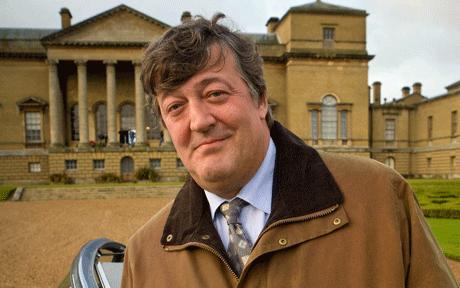
Stephen Fry appeared on The Bat Segundo Show #432. He is most recently the author of The Fry Chronicles.

Condition of Mr. Segundo: Basking in a pleasant tsunami of erudition.

Author: Stephen Fry

Subjects Discussed: Journalists who attack morally and spiritually, capitulating an iPhone, the number of gadgets that Fry carries on him, physical books vs. ebooks, high school physics lessons and vacillating ideas about the atom, books and mass, Anthony Powell’s Books Do Furnish a Room, technological developments and misunderstanding about replacement, ways in which technologies complement each other, the plight of newspapers, Page One, whether The New York Times is a trusted platform, accepting the fact that Gaddafi is dead, embedded journalists, Kickstarter campaigns and journalism, working for free in the post-Internet age, Fry’s presence on Twitter, Twitter vs. newspapers, not giving print interviews, the achievements of journalists, terrorists who rely on newspapers, the difficulties of not reporting serious changes to the Manhattan skyline, “cheating” on essays in school by writing them in advance, Fry’s ability to recall books by line number and specific edition, Shakespeare, hypothetical exam answers to Macbeth, the Wooly Willy, the pointlessness of exams, Fry’s love for technology, what education can learn from the ancient Greeks, the numerous intellectual trajectories which spring from coffee, Diderot, Secessionist Viennese coffeeshops, Gustav Klimt, the value of giving someone a single word to jump off from, Oscar Wilde’s “De Profundis,” Lord Alfred Douglas, the Oxford manner, education as “the ability to play gracefully with ideas,” intelligence rooted around connection, the No Child Left Behind Act, Diane Ravitch’s The Death and Life of the Great American School System, the etymology of “draconian,” vocational training, fruit trees, people who believe the Alps to be dull, those who blame teachers, having a busy schedule, Fry’s schedule vs. a politician’s schedule, not knowing things and greed, Fry’s shaky terpsichorean skills, humans and language, Steven Pinker, Guy Deutscher, how tenses imply futurity, animals and sex, the Phoenicians and writing, cuneiform and the alphabet, hip-hop, Fry’s rapping talent, forgetting to delight in the beauty of language, Wodehousian language rhythms and music, connections between Wodehouse, Cicero, and W.S. Gilbert, film adaptations of The Importance of Being Earnest, Jewish and gay identity, the linguistic roots of Shoah, 19th century anti-Semitism, meeting Anita Lasker-Wallfisch, playing Schumann’s Träumerei on the cello for Josef Mengele, when human beings are treated like machines, Hannah Arendt, Ring Lardner’s golden rule for screenwriting, political correctness, restrictions on the depictions of smoking in BBC documentaries and drama, Spooks, bizarre moral standards on British television, being exploited by Stephen Sondheim for a scavenger hunt, having a fax machine in the early days, Fry’s efforts to read Atlas Shrugged, the 1949 film adaptation of The Fountainhead, writing the book for Me and My Girl, the fine aural distinctions between a fax machine and a 56k modem, the 21st century audience for Ayn Rand, maniacal ideologies that don’t include joy or hope, the RAND Corporation, the Tea Party, reasonable addictions vs. extreme addictions, empathy, false categories when contemplating what it is to be human, Artistole’s “man is a political animal,” Kant’s symbolic logic, the behavioral thrust of David Hume, the readability of philosophers, TE Hulme’s influence on Pound and the modernists, moralists, Hulme’s “concrete flux of interpenetrating intensities,” humans being verbs rather than nouns, doctors and diagnosis-based language, referring to people by their condition, kindness and cheerfulness as essential virtues, eudaimonism, Mad cartoons, the “pay it forward” principle, Fry’s aborted career as a book reviewer, whether criticism is necessary, thick skins vs. thin skins, not wanting to hurt people’s feelings, Alec Guinness’s rude remarks to other actors, Paul Eddington, The Browning Version, Fry’s desire to play Crocker-Harris, pathetic efforts to be polite, Fry’s futile efforts to hawk his own book, teaching Aeschylus to inspire, cruelty, “Never presume to understand another man’s marriage,” ethics and absolute evil, Schindler’s Ark, the French Resistance bombing restaurants, Fry’s Apple zeal in relation to Foxconn abuses, suicides at Foxconn, Steve Jobs vs. Henry Ford, Brave New World, Godwin’s law, Apple’s business in China, overseas industrialization, Alms for Oblivion, and why Fry believes Simon Raven is better than Anthony Powell.

EXCERPT FROM SHOW:

Correspondent: Tying these multifarious observations with what is in your book, I actually wanted to ask you about this intriguing period when you were at Cambridge. You describe how you were “cheating” on essays because you wrote all of the essays in advance in your head — to the point where you were able to cite chapter and verse.

Fry: Yes.

Correspondent: Specific lines down to the line number of Shakespeare. Specific critical reference works down to the publisher, the edition.

Fry: The review course.

Correspondent: Whether it was in trade or whether it was in hardcover. Rather extraordinary. And that you would actually tilt these essays in relation to the question that was asked of you.

Fry: That’s the point. Exactly. The point is: if you have an essay on Othello, if you have an essay on Anthony and Cleopatra — we’ll stick with Shakespeare just for the sake of a closed canon, so we can think about it — if you have an essay on Macbeth, you have a point of view. I know I can deliver 3,000 words very quickly on Macbeth if I know I can.

Correspondent: You have 45 minutes right now, man!

Fry: And the question is “The essence of Macbeth is the difference between the microcosm of Macbeth’s mind and the macrocosm of the real world,” say. Now that may not suit my thesis at all for Macbeth, which is actually to do with the way the poetry disintegrates as the play progresses. But I can make it exactly answer that question. You just have to polarize. You know, it’s like getting a magnet. Did you ever have it in — you probably were American. So I don’t know why I’m asking if you had them. Those little bald men with iron filings and a magnet and you used to make beards out of them.

Correspondent: That was, I think, before my time.

Fry: It probably was before your time. But that’s what you’re doing. You’re taking a magnet and you’re polarizing what you know. Now it’s kind of cheating. It’s not cheating really. Because I am passionate about Shakespeare. I love Shakespeare. But I’m very, very lazy when it comes to exams. And I also am aware that an examination is nothing other than the ability to pass an exam. And what use is that? You might as well say, “In order to qualify from Harvard University, you have to win a squash match. Or you have to do the best Lady Bracknell of your year. Then you’ll get your top degree.” But why is the ability to reproduce prepared pappy ideas about intellectual concepts on paper — why is that a good reason to give someone a job in a law firm, in Wall Street, or in a publishing company for that matter? And part of my love of technology, personally what I would love is, of course, to go all the way back to the days of ancient Greece where you had Aristotle and you had Plato and you had the Lyceum and you had the Academy. So you would actually have a master. And to me, this is how an ideal examination would go. It doesn’t matter what subject the person is reading, as we say in England, or studying, as you would say here. You would just say, “Coffee.” Now someone who’s reading history might just instantly start talking about the coffee shops and how they were banned by Charles II, how they then came back again under Queen Anne, and how they caused a movement with the coffee shops in Paris with Diderot and the Republic of Letters and Voltaire and the Enlightenment. Or they could talk about the Secessionist Viennese coffee shops of Mahler and Klimt and so on. And Stefan Zweig and the whole generation of intellectuals. Rilke and Kraus and so on. Or you could talk about coffee as: Is it an emulsion? Is it a solution? How is coffee grown? What is it as a cash crop? What is is politically? Ethically? That there are some countries who are not allowed to grow food that they can eat. They can only grow food that they can sell. Currency rates. It’s a geopolitical issue. You can talk about the history — here we are in a publisher’s office — about the coffee table book. You could talk about it as a medical student. You could talk about it as a stimulant. You could talk about caffeine.

Correspondent: Worker exploitation. Fair trade.

Fry: Yeah. Basically, what you want, if you’re examining someone, is just to give them a single word and watch them run with it. One of my absolutely favorite quotations — and I’ll try and get it right — is from “De Profundis,” the letter that Oscar Wilde wrote in prison to his lover, Lord Alfred Douglas. Bosie, as he nicknamed him. The man who basically destroyed his life. The boy who destroyed his life. And at one point, he’s talking about Oxford, and he’s saying, “The fact that you didn’t get a first-class degree is a disgrace. Many first-class minds never achieve first-class degrees. The fact that you didn’t get any degree at all is no disgrace. Many first-class minds never finish their course and get their degrees. But what to me, Bosie, is unforgivable is that you never achieved what I believe used to be called” — he put in inverted commas — “the Oxford manner.” And he then says, “Which I take to mean the ability to play gracefully with ideas.” Isn’t that the most beautiful definition of education you’ve ever heard? The ability to play gracefully with ideas! So whether the idea be coffee, whether it be paper, whether it be homosexuality, whether it be floorboards, it doesn’t matter. Because intelligence is about connection.

Correspondent: Yes!

Fry: So an exam question that just says, “Discuss Shakespeare’s use of imagery in Measure for Measure.” Well, gah! Come on.

Correspondent: But it’s actually much worse here in America. I’m sure you’re familiar with the No Child Left Behind Act, which is imposing these draconian standards and is absolutely convinced that all schools can offer 100% competence adhering to these standards. As a result — and there’s a great book by Diane Ravitch called The Death and Life of the Great American School System.

Fry: Oh yes. I’ve heard about it.

Correspondent: Which outlines exactly what’s been going on. Which means that if the school doesn’t meet these draconian standards, it gets sanctioned. It can fire teachers and administrators who are considered to be failures.

Fry: The pedant in me would say that Draco was a leader of the Greek Republic at a time when every single crime was punishable by death. Which is what “draconian” really means. And I’m sure it isn’t draconian in that sense. (laughs)

Correspondent: But when the Oxford manner is in opposition like this…

Fry: I know what you mean.

Correspondent: …it’s difficult.

Fry: And even more in opposition to that is the other group of people, which tend to be the right-wing industrial nexus. Whatever you might call them. Those who have influence over politics who say that education actually is irrelevant. What matters is vocational training. And so they want people with MBAs. They want people with apprenticeships. They want people who don’t have a wide, broad education and the ability to play with ideas, but who can do very specific things. Like training. It’s training. and think of that in terms of a tree. You know how you used to train a fruit tree against a wall. You straightened out its branches. [begins spreading arms] You stapled them to the wall. And that’s it. And it bears fruit very efficiently. Now we’re human beings. We’re not fruit trees. And we’re certainly not there to have ourselves straightened out to produce fruit for the state. We’re here to question, to wonder, to oppose.

Correspondent: But you are extending your arms very impressively, resembling a branch.

Fry: Thank you very much.

Correspondent: So I think that if you wanted to be a fruit tree, you could. You have a good line in that.

Fry: (laughs) I’ve certainly been a good fruit. Whether or not I’m a tree — well, of course, by their fruits, shall ye know them.

Correspondent: (laughs)

Fry: But the education point is a really interesting one. And I don’t know what the answer to it is. I think, oddly enough, if I am educated, if I have an education, it’s obviously one I’ve given myself. Because that’s what, by definition, what all educations are. You’re drawn out. Nothing’s put in. You’re not a bucket that is filled by a good teacher. And one of the saddest things is when people say, “Ah, well, Shakespeare was ruined for me at school. Because I had a terrible Shakespeare teacher.” I would say back to them, “Yeah. It’s the Alps for me. I had this awful geography teacher. I just find the Alps so dull. Because I had this awful geography teacher.” I mean, it’s ridiculous. I think it’s either beautiful or it isn’t. You can’t blame a teacher for not being able to communicate its beauty. I can look at the Alps and see that they’re beautiful. And if you can’t look at Shakespeare and see that it’s beautiful, don’t blame a teacher. Blame yourself for not looking hard enough. And I know people don’t want to hear that. But that’s the answer.

Correspondent: And you get into that in the book. And I actually wanted to discuss this further. I mean, I’m in agreement that, okay, we are in a world of riches. We have more information available to us than at any point in human history. But at the same time, learning about apple trees, Shakespeare, or what not, this requires time. And if you are someone who is working two jobs, who is raising a kid, how do you factor that into your dismissal of…

Fry: I like that. Because I’m a gay actor who doesn’t do much…

Correspondent: (laughs) No, no, no. It’s not that at all.

Fry: No. I know you weren’t. But it is funny. I have to say — and I don’t mean this in a boastful way, but I have yet to share diaries with someone who is busier than I am. Including politicians. I’ve had meetings recently. I’m trying to get…

Correspondent: (laughs) Including politicians? Like who?

Fry: Well, they always say that every single hour of every day is taken up by…

Correspondent: Even the bathroom breaks and all that.

Fry: Yeah. Etcetera. And, of course, they are to some extent. But they’re not busier than me. Because that’s actually all stuff that’s done. And then when it’s done, it’s done. If you’re a writer and you have other things, it’s never finished. And I am a very, very busy person. But you may notice I’m quite tubby. It’s because I’m greedy. And if people say they don’t know anything, it’s only because they’re not greedy. They’re not greedy for knowledge. Sometimes an image I give is — imagine that the Mayor of Washington was told when he was a child, “Go to London. Because the streets are paved with gold.” If he knew that in every city, the sidewalks, as you call them here — the pavements were piled high with gold coins and it made a noise. It made a kind of clashing noise as you shuffled your way through it. And it was terrible. And you bumped into a beggar standing with his hat out, saying, “Please. Please. Give me some money. I’m poor. I can’t eat.” You’d look at him and go, “What? Look around you! Just bend down and pick it up!” And that’s what I feel when people say, “Oh, it’s all right for you. You went to Cambridge and were taught things. Oh, why can’t I? I don’t know about this stuff.” I just want to say, “Bend down and pick it up.” It’s never been more available. All it takes is greed. Curiosity.

Correspondent: You are in a country where most Americans don’t have a passport. You are in a country where they actually don’t know these options. I’ll give you a perfect existential example of my own. So the New York Public Library — if you go in that marvelous reading room, it’s capacious. Tables. Everything. It’s like, “Of course! I’m going to study. Because this is an environment totally made to not slack off in any way.” Right? But if you try to find a seat at a coffeehouse now, every single table is completely filled up with people with their laptops. And there’s often people who sit down and they have this board meeting vernacular. And you can’t get anything done. I mean, it’s to the point where it’s almost a Trail of Tears-like situation for me and my friends.

Fry: (laughs)

Correspondent: We have to go to the next coffeehouse before they discover it! But you can pretty much almost always get a seat at the New York Public Library. And the question is: What do we do to restore the balance? To get people understanding that, yes, the streets are paved with informational gold if you go and reach down and pick it up. What do you think?

Fry: To me, this is simply prejudice. It’s prejudice that comes from the gifts that nature never gave me. And they were coordination and music. Although I love music and I’m passionate about music and I listen to music every day and I collect music. I have musical heroes that are distinct and different. You may know that I made a film about Richard Wagner, which is very important to me. Partly because as a Jewish person, Wagner is always going to be traumatic if you love him. Because he was such a bestial anti-Semite. Of course, that was not his fault. Because he died fifty years before — literally fifty years before Hitler became Vice-Chancellor of Germany, who of course adored Wagner too. So I do love music. But I can’t do it. I can’t perform it. I can’t sing. I can play the odd note on the piano.

Correspondent: But can you dance?

Fry: Absolutely cannot dance! I can’t even begin to put myself in a position.

Correspondent: Have you tried to take ballroom dance lessons?

Fry: I would hate it! I would loathe it!

Correspondent: Come on, Stephen! Pick it up! The dance is right there! (laughs)

Fry: If you read my book, you would know my physical self-consciousness is extreme.

Correspondent: Yeah.

Fry: But bad as this sounds, and this is no complaint, the fact that I was so incompetent, so uncoordinated physically, so ungifted musically, meant that all I had to give myself any pride was language. It’s all I had. And the odd thing is that’s all any of us have. It is the miracle of the human species.

The Bat Segundo Show #432: Stephen Fry (Download MP3)

This text will be replaced