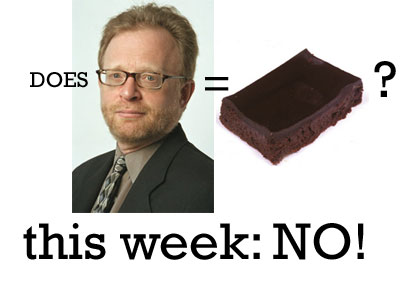
WEEKLY QUESTION: Will this week’s NYTBR reflect today’s literary and publishing climate? Or will editor Sam Tanenhaus demonstrate yet again that the NYTBR is irrelevant to today’s needs? If the former, a tasty brownie will be sent to Mr. Tanenhaus’ office. If the latter, the brownie will be denied.
I didn’t receive so much as a thank you from Mr. Tanenhaus for the Fat Witch shipment I sent him last week. That’s okay. I’m sure he’s a busy guy.
Even so, if this week’s NYTBR is any indication of things to come, it’s unlikely that Tanenhaus will be getting brownies again anytime soon. This week, it’s business as usual. Tanenhaus has perhaps outdone himself in the irrelevancy department by including this unpardonable two-page review of the Jane Fonda memoir. Whatever your thoughts on Jane Fonda, it’s safe to say that she’s no Vanessa Redgrave or Peter Ustinov. Nor does she need any further press from the considerable largesse eked out by Random House. Why the NYTBR would see fit to depart from the momentum it built up with last week’s brownie victory is a mystery.
I think I’ve been a little too easy on Sam. To rectify any miscalculations, in addition to the three trusty tests, I’ve introduced the BROWNIE BITCHSLAP FACTOR. From now on, should Tanenhaus include content that doesn’t befit the Sunday books section of a major newspaper, he will have additional points deducted against him.
So without further ado, the gloves come off:
BROWNIE BITCHSLAP FACTOR: Jane Fonda? Wasting Maureen Dowd’s time? What were you thinking, Sam? SLAP! (Minus .6 points.)
BROWNIE BITCHSLAP FACTOR: What the hell do Sex in the City-style self-help books have to do with literature? SLAP! (Minus .8 points. Introduction of David Orr column = +.8 bitchslap handicap. End result: 0)
Onto the tests:
THE COLUMN-INCH TEST:
Fiction Reviews: 1 2-page comics overview (half comics, half nonfiction, 1 page calculated), 1 page “On Poetry,” 1 1-1/2 page review, 1 half-page Crime roundup, 1 one-page Fiction Chronicle. (Total books: 11. Total pages: 5.)
Non-Fiction Reviews: 1 2-page review, 1 2-page comics overview (half comics, half nonfiction, 1 page calculated), 1 page and a half review, 3 one-page reviews, 4 half-page reviews. (Total books: 11. Total pages. 9.5.)
Out of this week’s 13.5 pages of review coverage, a mere 37% has been devoted to fiction. While the introdution of David Orr’s poetry column (set to appear “every four to six weeks”) represents a long-term commitment that is better than nothing, and while some graphic novel coverage is better than nothing (of which more anon), “better than nothing” is hardly satisfactory. These are throwaway gestures which demonstrate Tanenhaus’s almost total disinterest in current literature.
That a Jane Fonda memoir would get six times the column inches of a new Donald E. Westlake novel illustrates that either Tanenhaus hasn’t learned that Barbarella is a crapppy movie that most people outgrow before 25 or that, popular writers such as Alexander McCall Smith aside, genre ghettoization is all part of the program.
In fact, if you haven’t been keeping score, it looks like Tanenhaus will never pass the column-inch test (which requires a 48% minimum to fiction and poetry). The last six weeks show that, far from featuring “all the news that’s fit to print,” Sam has shown again and again that even compressed fiction reviews get fewer column inches than the latest political snoozefest:
March 20, 2005: 44%
March 27, 2005: 41%
April 3, 2005: 32%
April 10, 2005: 34.7%
April 17, 2005: 44.4%
April 24, 2005: 37%
So the question now is whether the reader lowers the bar or that the reader demands greater accountability. From where I’m sitting, the choice is obvious.
Brownie Point: DENIED!
THE HARD-ON TEST:
This test concerns the ratio of male to female writers writing for the NYTBR.
Two women review fiction. And, in fact, the longest review goes to Janet Malcolm, who reviews Alexander McCall Smith’s latest from a gender and biblical perspective. But Malcolm’s comparison to Twain based off of five formally placed words is dubious at best and she never quite follows through on her thesis. I’ve encountered the sentence “I do not think so” used in a humorous literary context 300 times in the past two years — perhaps fifty times alone in Susanna Clarke’s overrated book Jonathan Strange & Mrs. Norrell. But Twain’s irony involved something craftier than a tonal rejoinder (think Huckleberry Finn deciding to save Jim).
As any liberal arts major knows, irony itself involves the disparity between what is said and what is meant. And the excerpt Malcolm quotes two people who are clueless about Freud. But that’s not necessarily ironic. It’s endearing and colloquial, and it offers a particular perspective to the reader. But methinks Malcolm’s overstating the case here. Besides, as any good patriot knows, irony died sometime after September 11.
And was it really necessary to announce not one, but two articles that confirmed Smith’s subtext of AIDs in Botswana? Article clippings might get you a gold star from a junior high school history teacher (perhaps even a hug and a “way to go” in the remarks section of a report card). But in the journalism world, there’s a little thing called an established fact (i.e., something that anyone can find out in thirty seconds) that allows an editor to cut down a rambling review for more pressing matters – like, say, more fiction coverage.
Beyond this and Marilyn Stasio’s mystery column, there’s the aforementioned Jane Fonda review by Maureen Dowd and three other women covering nonfiction coverage (among eleven reviews). Women get disregarded once again. Not a surprise.
Brownie Point: DENIED!
THE QUIRKY PAIR-UP TEST:
Eugenia Zukerman’s take on a Stradivari memoir is the kind of unexpected arts book coverage that’s rare these days in the NYTBR Beyond this, most of the coverage has been delegated to Gray Lady staffers.
Wake me up when the revolution starts.
Brownie Point: DENIED!
CONTENT CONCERNS:
Hey, John Hodgman, get a clue about comics. For the record:
- There’s a whole litany of independent comics out there that don’t involve superheroes. Get schooled.
- Not a single person I know of has ever been fearful of a Chris Ware panel. Ware is a fantastic artist, but his work is hardly that “of a strange alien visitor to our world.” It’s sui generis. Perhaps it might seem alien to someone unfamiliar with comics.
- If Peter Bagge is “new” to you, then I’m almost positive you’ve never set foot in a comics store.
- What kind of comics columnist confesses that he’s completely ignorant about the medium he’s writing about? (See mention of Michael Allred’s The Golden Plates for specific sentence.)
If Tanenhaus is smart, he will sack John Hodgman on the spot. If it can be believed, Hodgman comes across more ignorant than Chip McGrath did last year. If Tanenhaus is going to offer comics coverage, then he needs someone actually acquainted on the subject. At least Chip McGrath was smart enough to hire Nick Hornby.
Yes, kids, you too can become a successful self-publisher. All you have to do is shoot your lover’s wife, get national press for your story, and then you’ll stand a remote chance of yokels looking for some titilation who might just remember your name buying your memoir! Since when did the NYTBR become an overflow depository for silly Writer’s Digest articles that encourage amateurs to waste their precious savings on delusions?
This week’s Times staffer golden watch review? James Atlas.
CONCLUSIONS:
This is a first. Tanenhaus earned a negative score this week. Presumably, this means that he’ll return some of the brownies back to us. But we’d prefer if he actually clued in and amped up the coverage.
Brownie Points Denied: 3
Brownie Points Earned: 0
Brownie Bitchslap Factor: -.6 points
TOTAL BROWNIE POINTS REQUIRED FOR BROWNIE DELIVERY: 2
TOTAL BROWNIE POINTS EARNED: -.6 points